Slides
Lesson plan
Spot Them, Write Them, Use Them: Squares and Cubes
Pupils learn what square numbers and cube numbers mean and how ² and ³ work. They match notation to multiplications in a paper domino chain.
Objectives
- Students will recognise square numbers to 10² and write them using ².
- Students will recognise cube numbers to 5³ and write them using ³.
- Students will match ² and ³ notation to multiplications and explain answers.
Success criteria
- I can write square facts like 7² = 49 correctly.
- I can write cube facts like 3³ = 27 correctly.
- I can explain why 5² is 25 and not 10.
Key words
| Word | Meaning |
|---|---|
| squared | little 2 that tells you to multiply a value by itself |
| cubed | little 3 that tells you to multiply a value by itself and then again |
| square number | result when a whole value is multiplied by itself |
| cube number | result when a whole value is multiplied by itself twice |
| product | answer you get when you multiply two or more values together |
Timed plan (60 minutes)
| Time | Stage | What happens |
|---|---|---|
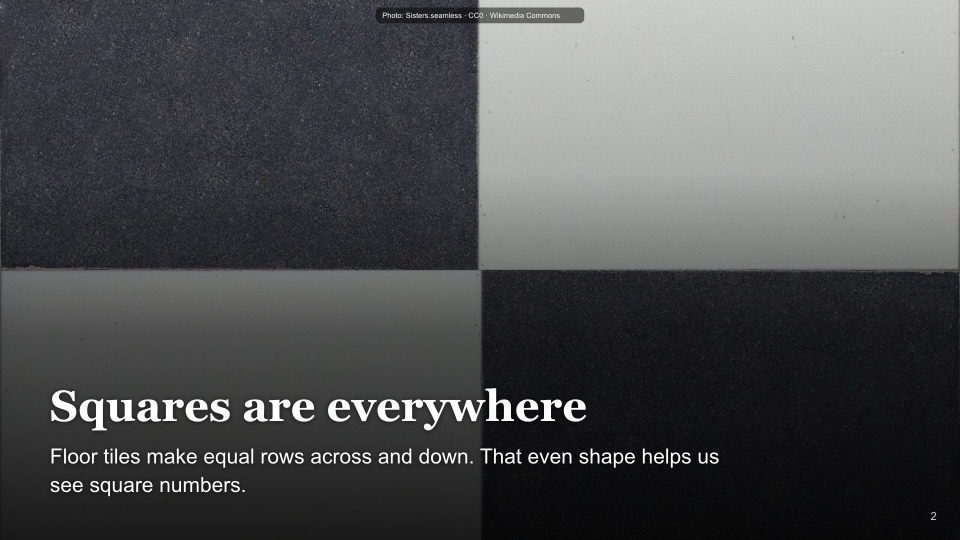
| 8 min | Starter | To recall times-table facts and hook pupils into seeing even arrays as squares. Show Slide 1: Square and Cube Numbers [title]: Spot them, write them and use them and read the title together. Show Slide 2 photo and point out: Floor tiles make equal rows across and down. That even shape helps us see square numbers. Do a fast times-table recall: 3 x 3, 4 x 4, 5 x 5, then ask what 7 counters would look like in equal rows. Introduce the main challenge for later in the lesson. |
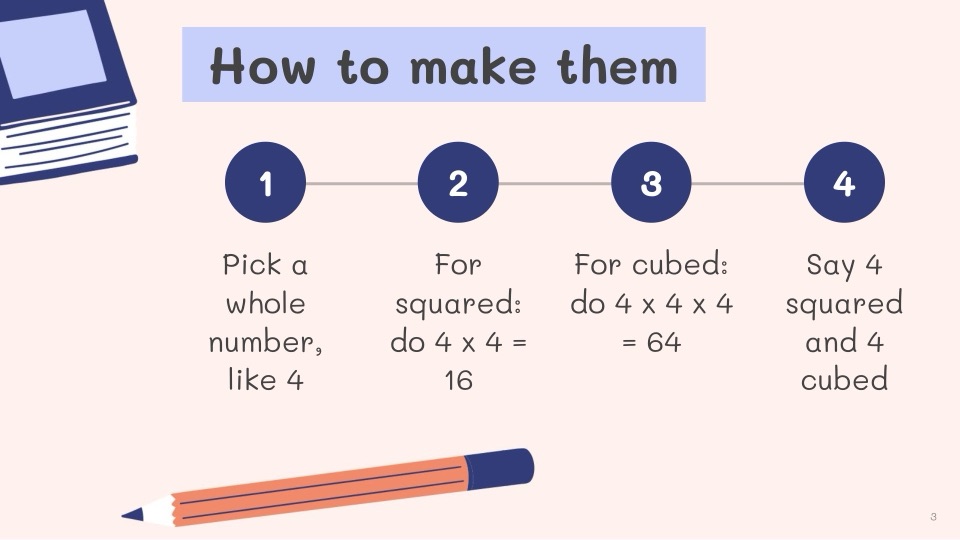
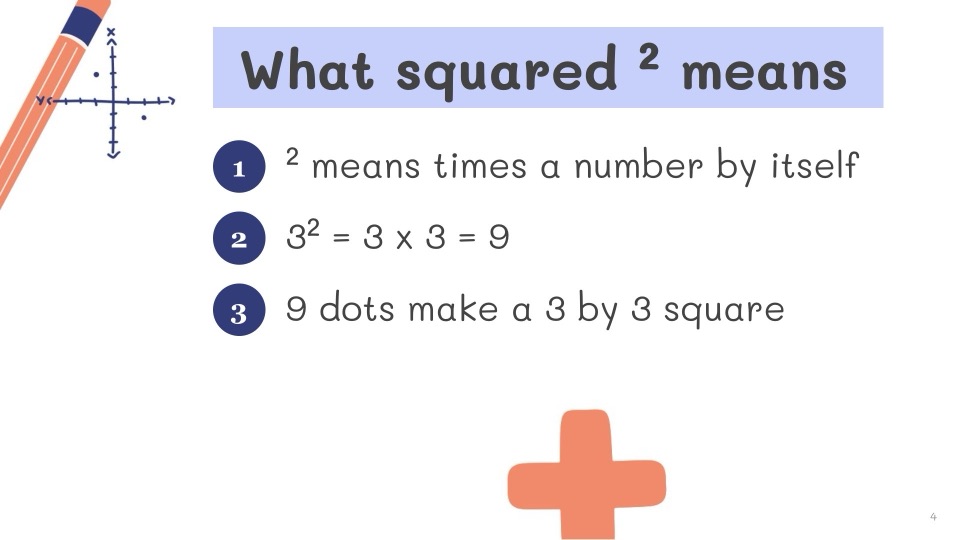
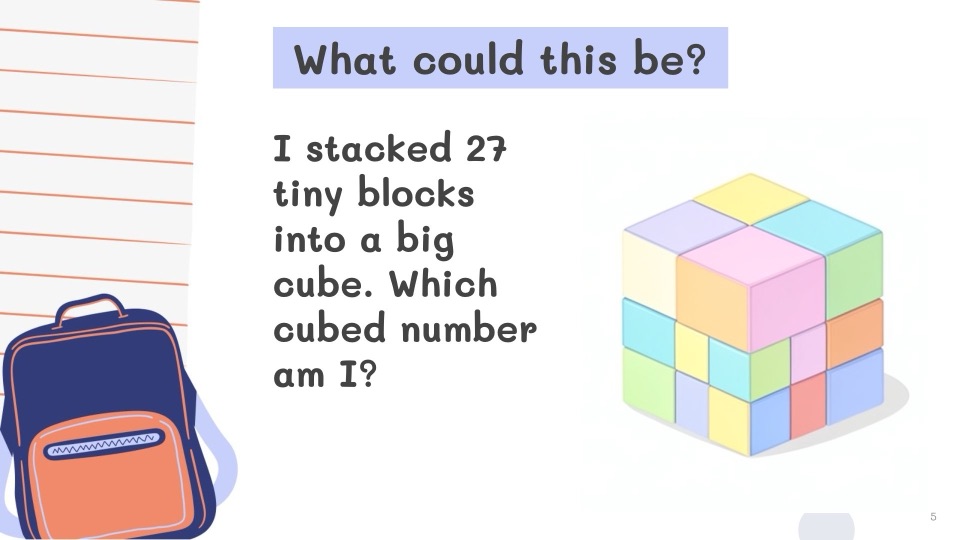
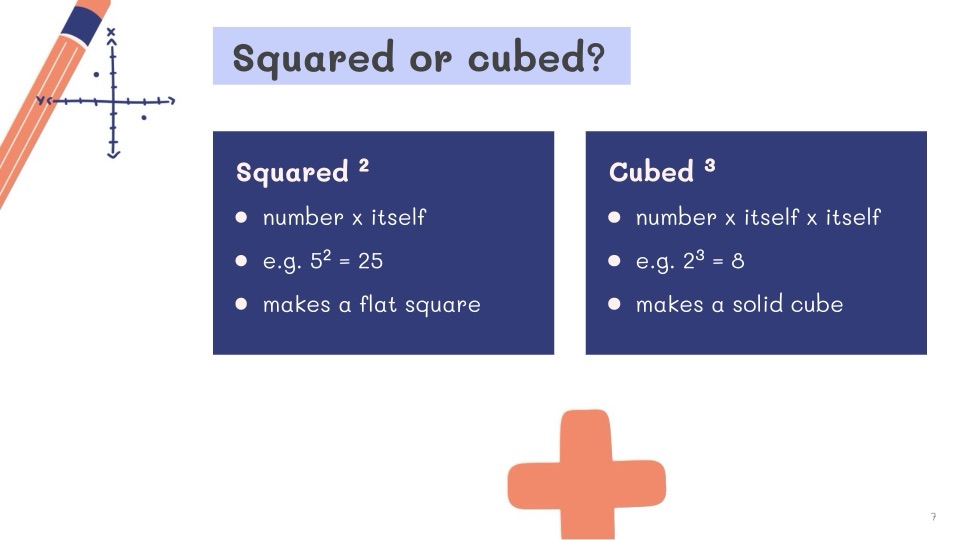
| 15 min | Teaching | To explain what ² and ³ tell us to do and model square and cube calculations. Show Slide 3 steps and model: Pick a whole number, like 4 · For squared: do 4 x 4 = 16 · For cubed: do 4 x 4 x 4 = 64 · Say 4 squared and 4 cubed. Show Slide 4 and stress: ² means times a number by itself. Model that 3² = 3 x 3 = 9 and that 9 dots make a 3 by 3 square. Show Slide 5 mystery: I stacked 27 tiny blocks into a big cube. Which cubed number am I? Agree that 27 is 3 cubed: 3³ = 3 x 3 x 3. Explain that a cube number is a number multiplied by itself twice and the symbol for cubed is ³. Show Slide 7 to compare: Squared ² · number x itself · e.g. 5² = 25 · makes a flat square · Cubed ³ · number x itself x itself · e.g. 2³ = 8 · makes a solid cube. |
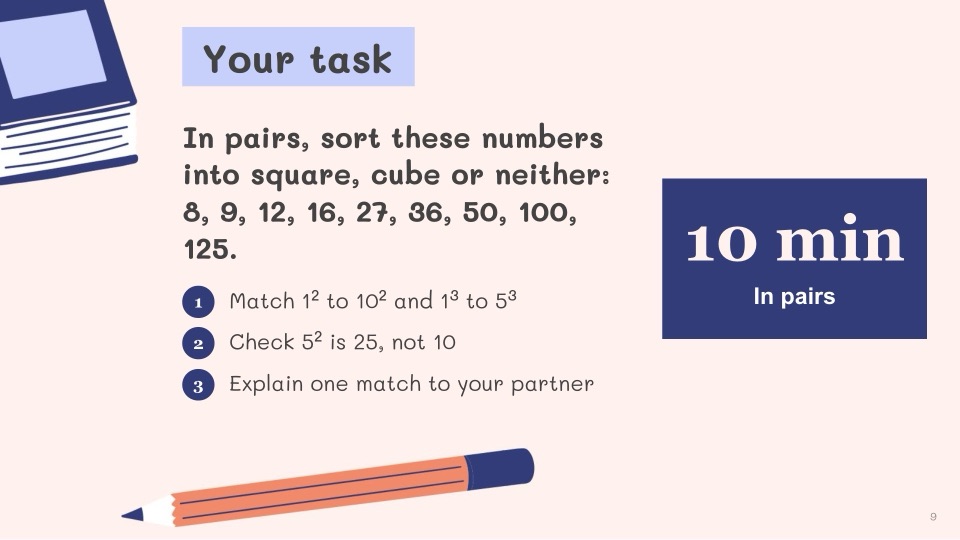
| 20 min | Main activity | To match ² and ³ notation to multiplications and answers in a domino loop. Show Slide 9 instruction: Match 1² to 10² and 1³ to 5³ · Check 5² is 25, not 10 · Explain one match to your partner. Hand out domino sets and model one join: 3² joins to 3 x 3 joins to 9, and 4³ joins to 4 x 4 x 4 joins to 64. Stress that this matches the Year 5 expectation to recognise and use square numbers and cube numbers, and the notation for squared (²) and cubed (³). Let pairs lay the full loop using the cube order 1, 8, 27, 64, 125 alongside squares to 100. Stop the class twice to hear pairs read back two matches correctly, e.g. explaining that 8² is the same as 8 x 8 and makes 64. |
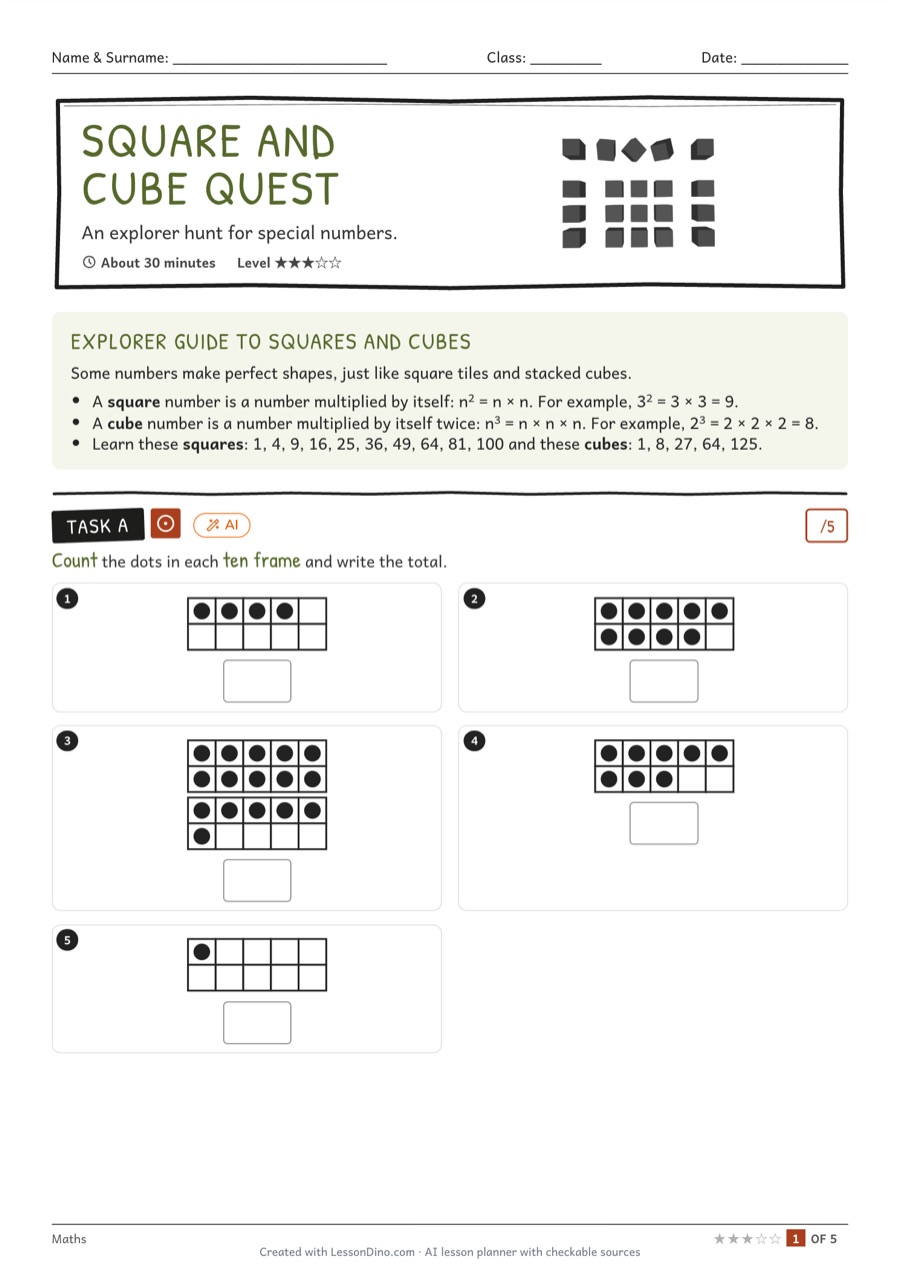
| 7 min | Consolidation | To practise working out square and cube values on their own. Hand out Worksheet Task B and read the instruction together. Ask pupils to work silently for 5 minutes on the first set of squares and cubes. Remind them to write both the multiplication and the ² or ³ form. Collect in to spot errors for the plenary. |
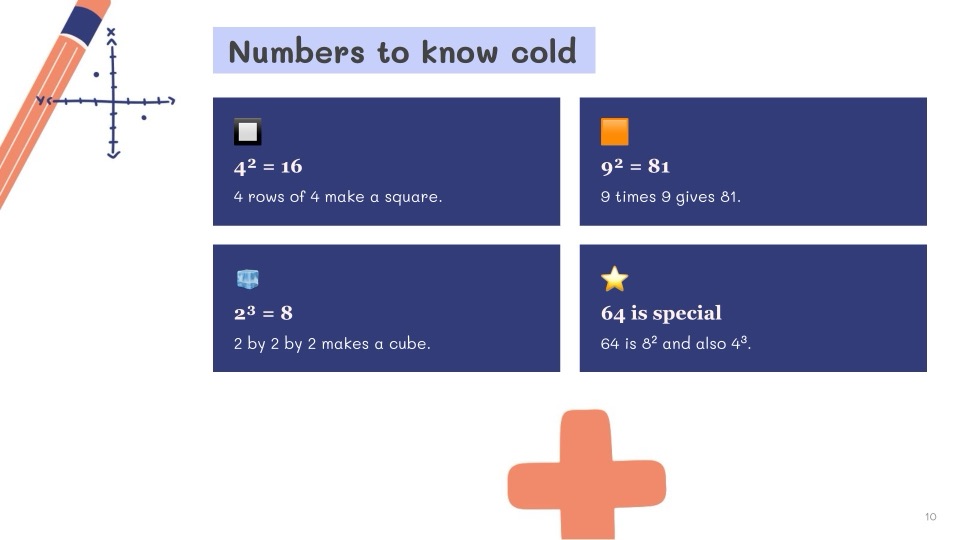
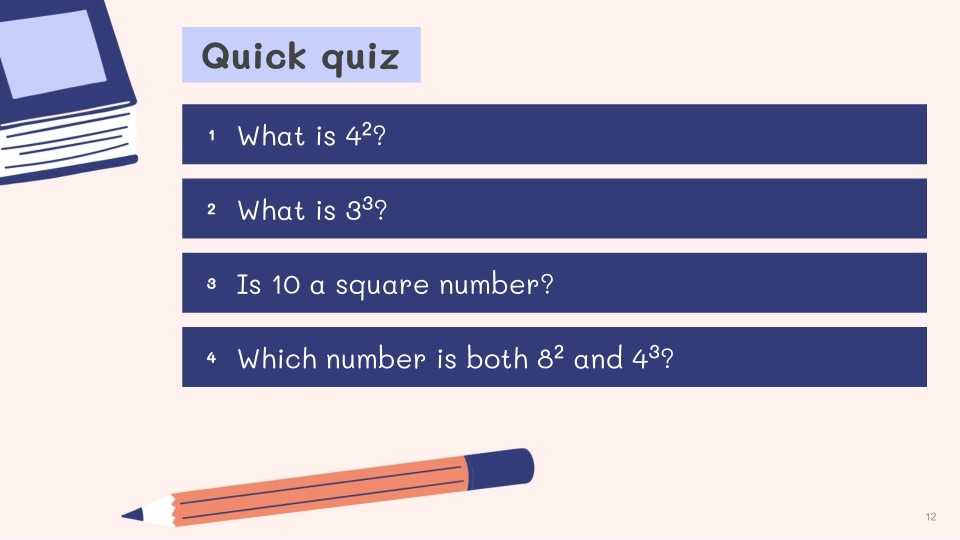
| 10 min | Plenary | To check recall of key squares and cubes and fix the doubling mix-up. Show Slide 10 cards and chant: 4² = 16 · 4 rows of 4 make a square. Then 9² = 81 · 9 times 9 gives 81. Then 2³ = 8 · 2 by 2 by 2 makes a cube. Then 64 is special · 64 is 8² and also 4³. Run Slide 12 quiz: What is 4²? Agree 16, because 4 x 4 = 16. What is 3³? Agree 27, because 3 x 3 x 3 = 27. Ask: Is 10 a square number? Agree No. 3² = 9 and 4² = 16, so 10 is missed. Return to success criteria and ask pupils to show fingers for each I can. |
Common mistakes
- Thinking squaring means doubling, e.g. 5² = 10
How to spot it: Pupil writes 5² = 10 or 4² = 8
Rebuild with dots: 5 rows of 5 is 25, not 10. Stress that 5² = 25, not 10 and to calculate a square number, you times a number by itself. - Thinking cubing means adding or multiplying by 3, e.g. 2³ = 6
How to spot it: Pupil says three lots of 2 equals 6 for 2 x 2 x 2
Build with blocks and do steps: 2 multiplied by 2 is 4 and this multiplied by 2 is 8. Emphasise to calculate a cube number, you multiply a number by itself and then by itself again. - Mixing up ² and ³, e.g. 3³ = 9
How to spot it: Pupil gives square answer for a cube card in dominoes
Count the factors: square is the product of two repeated integers and cube is the product of three repeated integers. Check 3 x 3 = 9 but 3 x 3 x 3 = 27.
Support
- Give a starter domino chain already joined, including 5 x 5 (or 5²) = 25, then ask pupils to continue it
- Provide a multiplication grid and dot arrays for 1² to 5² and block layers for 1³ and 2³
- Use sentence frames: Squared means ___ and Cubed means ___
Stretch
- Pupils make three extra dominoes of their own for another pair to solve
- Challenge pupils to predict the next square without building it, then check
- Ask whether a number could ever be both a square and a cube and to give reasons
Check questions
- What is 7²?
Answer: 49, because 7 x 7 = 49 - What is 3³?
Answer: 27, because 3 x 3 x 3 = 27 - Is 10 a square number? Explain.
Answer: No, because 3² = 9 and 4² = 16 so 10 is missed
Curriculum
recognise and use square numbers and cube numbers, and the notation for squared (²) and cubed (³)
Video clips
Clips on YouTube, from the start and end times we chose. Check each one before you show it.
-
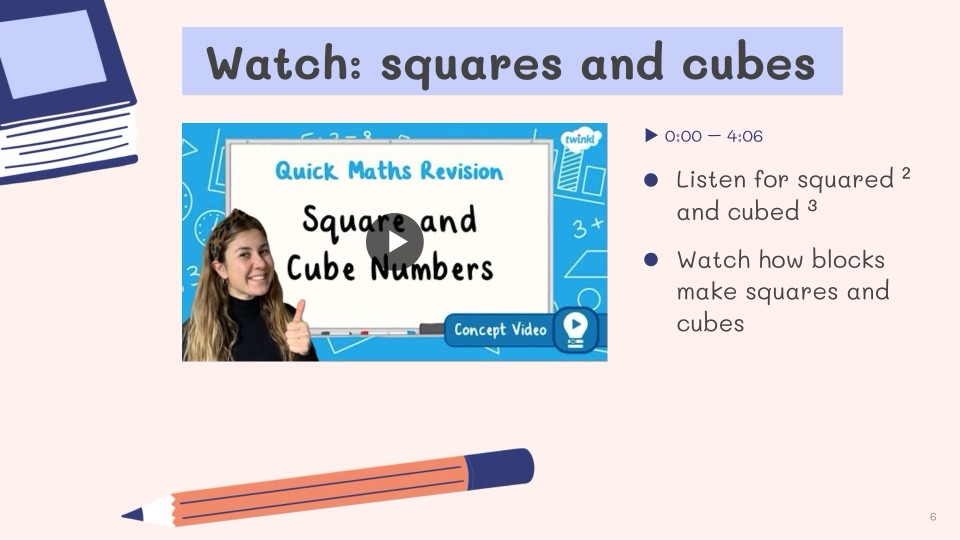
Square and cube numbers calculated from 0:00 to 4:06
Twinkl Educational Publishing: How Do I Calculate Square and Cube Numbers? | KS2 Maths Concept for Kids
Covers both square and cube numbers with 2 and 3 notation in clear KS2 language ideal for 9-10-year-olds.
-
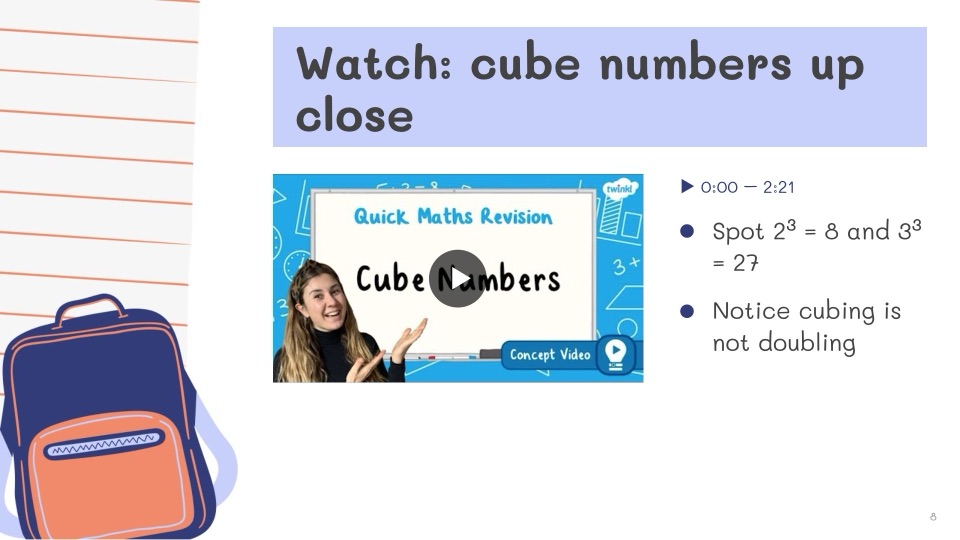
What are cube numbers? from 0:00 to 2:21
Twinkl Educational Publishing: What Are Cube Numbers? | KS2 Maths Concept for Kids
Short KS2 explainer with clear visuals and language that suits 9-10-year-olds learning cubes.
Worksheet
Sources
- National curriculum in England: mathematics programmes of ... gov.uk
- Year 5 Maths Curriculum map 2023-2024 westend.lancs.sch.uk
- Square and cube numbers - BBC Bitesize bbc.co.uk
- What are square and cube numbers? (KS3 Maths - BBC bbc.co.uk
- Square Numbers and Cube Numbers – GCSE Maths Revision Guide gcsemathsai.co.uk
- Year 6 Square and Cube Numbers Varied Fluency ruytonschool.org.uk
- Square and Cube Numbers - Earth Site Education earth-site.co.uk
- Factors, Multiples, Primes, Square Numbers and Cube Numbers ... bam.files.bbci.co.uk
- Lesson: Square and cube numbers | Oak National Academy thenational.academy
- Square and Cube Numbers 1 to 20: Charts and Roots | Cliffpoint cliffpointabacus.com
- Kids Math: Square and Square Root - Ducksters ducksters.com
- Using and Recognising Square and Cube Numbers Worksheet - Twinkl twinkl.co.uk
- What is a Square and a Cube Number? PowerPoint - Twinkl twinkl.com.au
- Square Numbers and Cube Numbers – — GCSE Maths Formula Sheet ... gcsemathsai.co.uk
- Using and Recognising Square and Cube Numbers tilstockprimaryschool.co.uk
- Recognise and use square numbers and cube numbers, and the ... mathsframe.co.uk
Picture credits
Made with Lesson Dino's AI on 19 October 2026. AI can make mistakes, so check facts against the sources before you teach.