The worksheet
About this worksheet
Pupils learn prime, composite and prime factor words. They sort numbers and test for primes to 100. This Year 5 Maths worksheet gives students (ages 9–10) six pages of practice on prime numbers, part of the number: multiplication and division unit. It goes with our free Prime numbers lesson, which has the slides and a timed lesson plan.
What it covers
By the end, students should be able to:
- Students will use prime, composite and prime factor words correctly.
- Students will test numbers up to 100 and recall primes to 19.
- Students will break composites into a product of prime factors.
How to use it
- Practice (15 minutes): Hand out Worksheet Task D and ask pairs to sort primes and composites and find prime factors.
- Support: Give a factor list for each number so students can count the factors instead of working them out.
- Stretch: Add cards for 21, 27 and 49 and ask students to prove the placement with a factor pair.
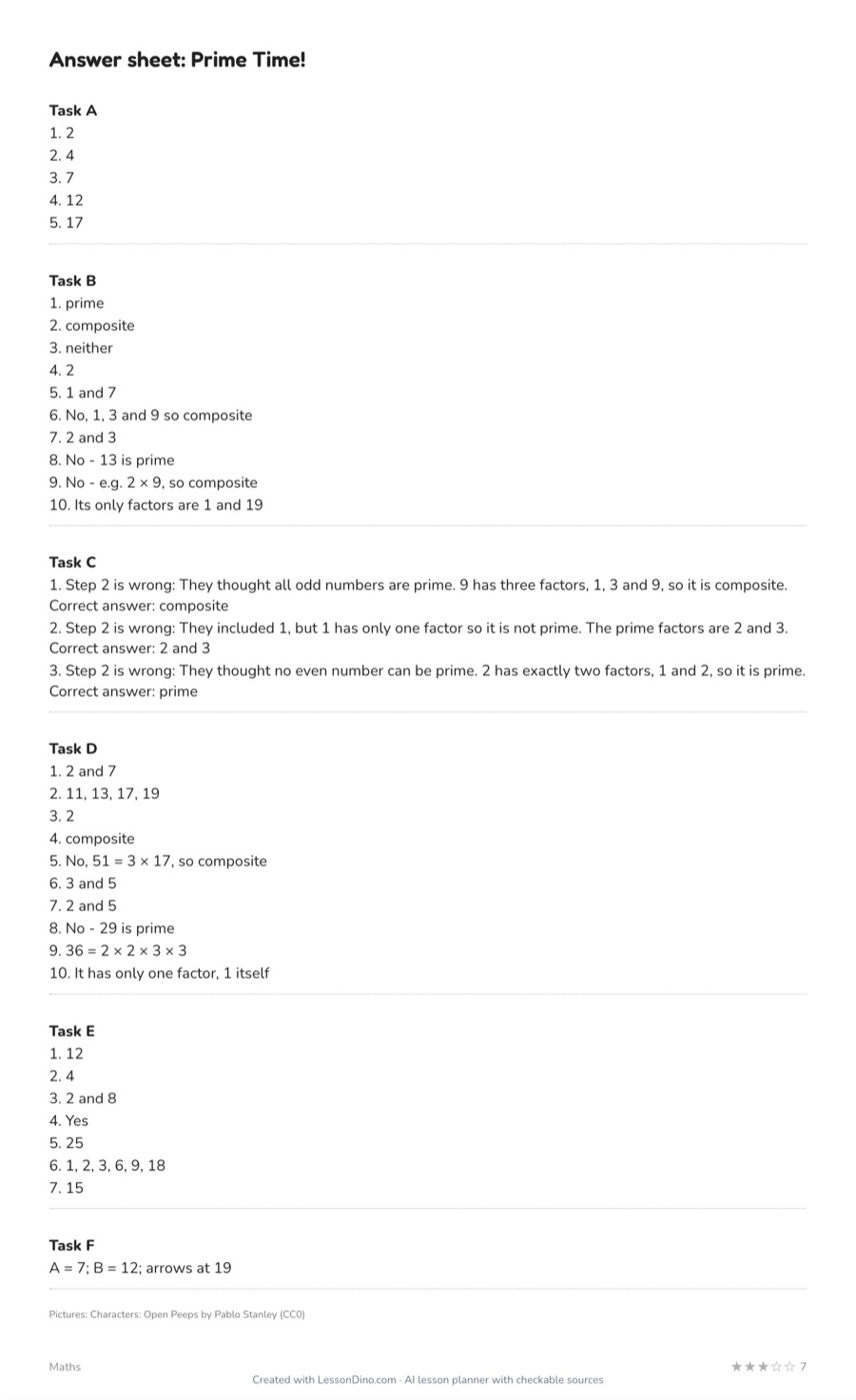
- The answer sheet is the last page, so you can print it on its own or let students check their own work.
Key vocabulary
- prime number: a counting number greater than 1 with exactly two divisors, 1 and itself
- composite number: a counting number greater than 1 with more than two divisors
- prime factor: a building-block number greater than 1 with only two divisors that multiplies to make another number
- factor: a whole number that goes into another number exactly with nothing left over
- multiple: the answer you get when you multiply a number by a counting number
Mistakes to watch for
- Thinking 1 is prime. Count its factors: 1 has one factor, a prime has exactly two, so 1 is neither prime nor composite.
- Thinking all odd numbers are prime. Show 9 = 3 x 3 and 15 = 3 x 5; they are odd but have extra factors so are composite. All primes except 2 are odd, but not all odds are prime.
- Thinking 2 is not prime because it is even. List factors of 2 as 1 and 2 only, so it is prime and the only even prime number.
What's on the worksheet
Prime Number Detectives
Learn what makes a number prime or composite.
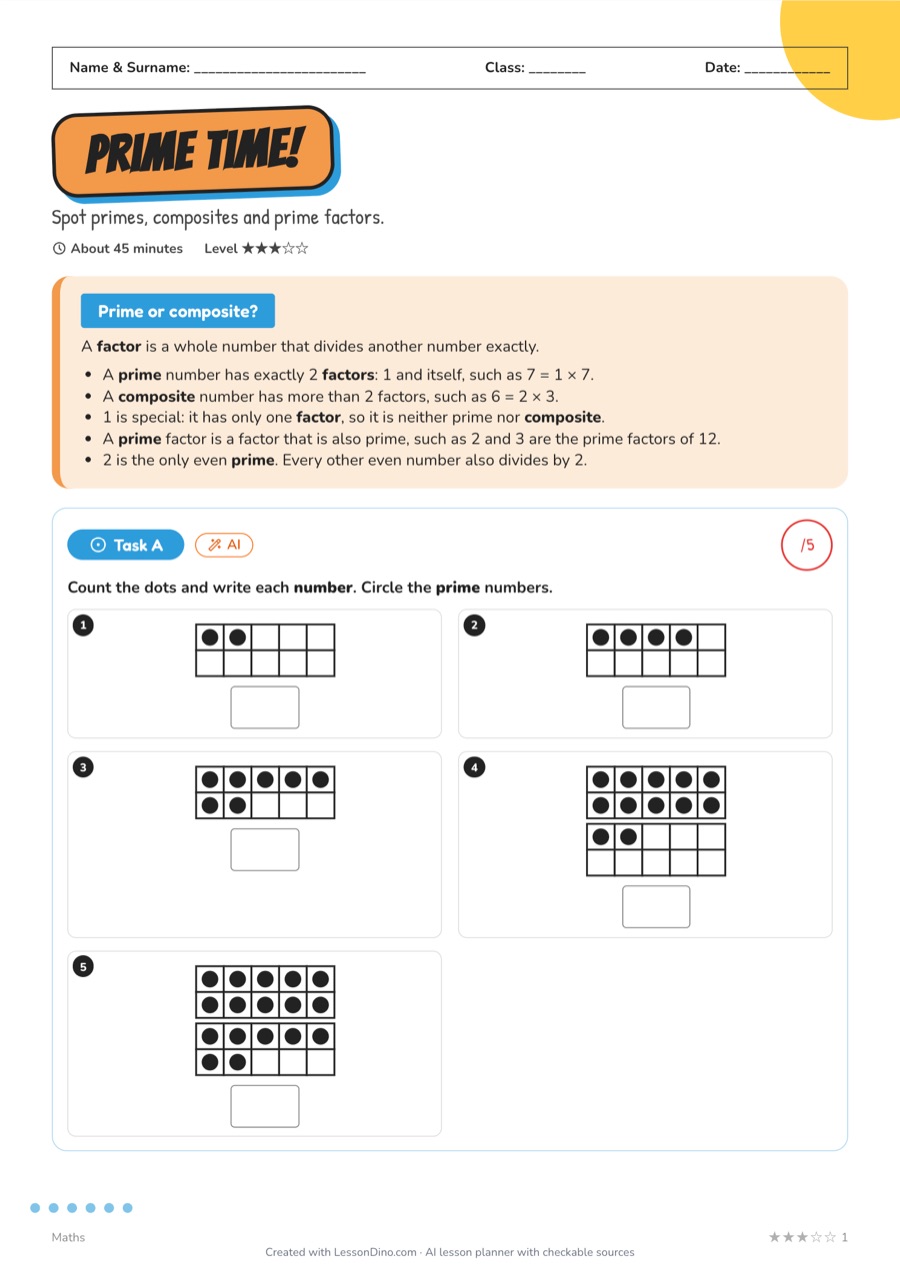
Prime or composite?
- A factor is a whole number that divides another number exactly.
- A prime number has exactly 2 factors: 1 and itself, such as 7 = 1 × 7.
- A composite number has more than 2 factors, such as 6 = 2 × 3.
- 1 is special: it has only one factor, so it is neither prime nor composite.
- A prime factor is a factor that is also prime, such as 2 and 3 are the prime factors of 12.
- 2 is the only even prime. Every other even number also divides by 2.
Count the dots and write each number. Circle the prime numbers.
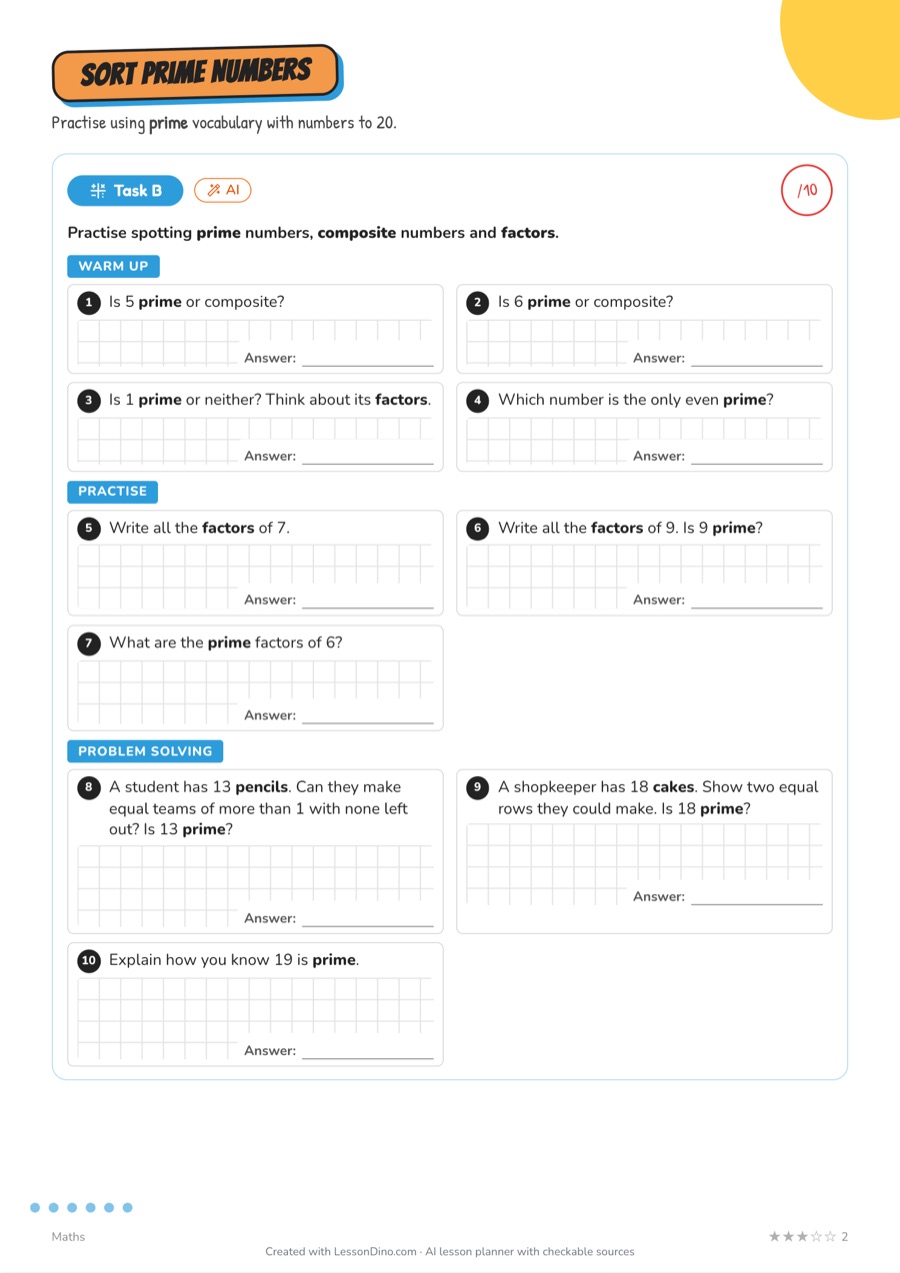
Sort Prime Numbers
Practise using prime vocabulary with numbers to 20.
Practise spotting prime numbers, composite numbers and factors.
Warm up
- Is 5 prime or composite?
- Is 6 prime or composite?
- Is 1 prime or neither? Think about its factors.
- Which number is the only even prime?
Practise
- Write all the factors of 7.
- Write all the factors of 9. Is 9 prime?
- What are the prime factors of 6?
Problem solving
- A student has 13 pencils. Can they make equal teams of more than 1 with none left out? Is 13 prime?
- A shopkeeper has 18 cakes. Show two equal rows they could make. Is 18 prime?
- Explain how you know 19 is prime.
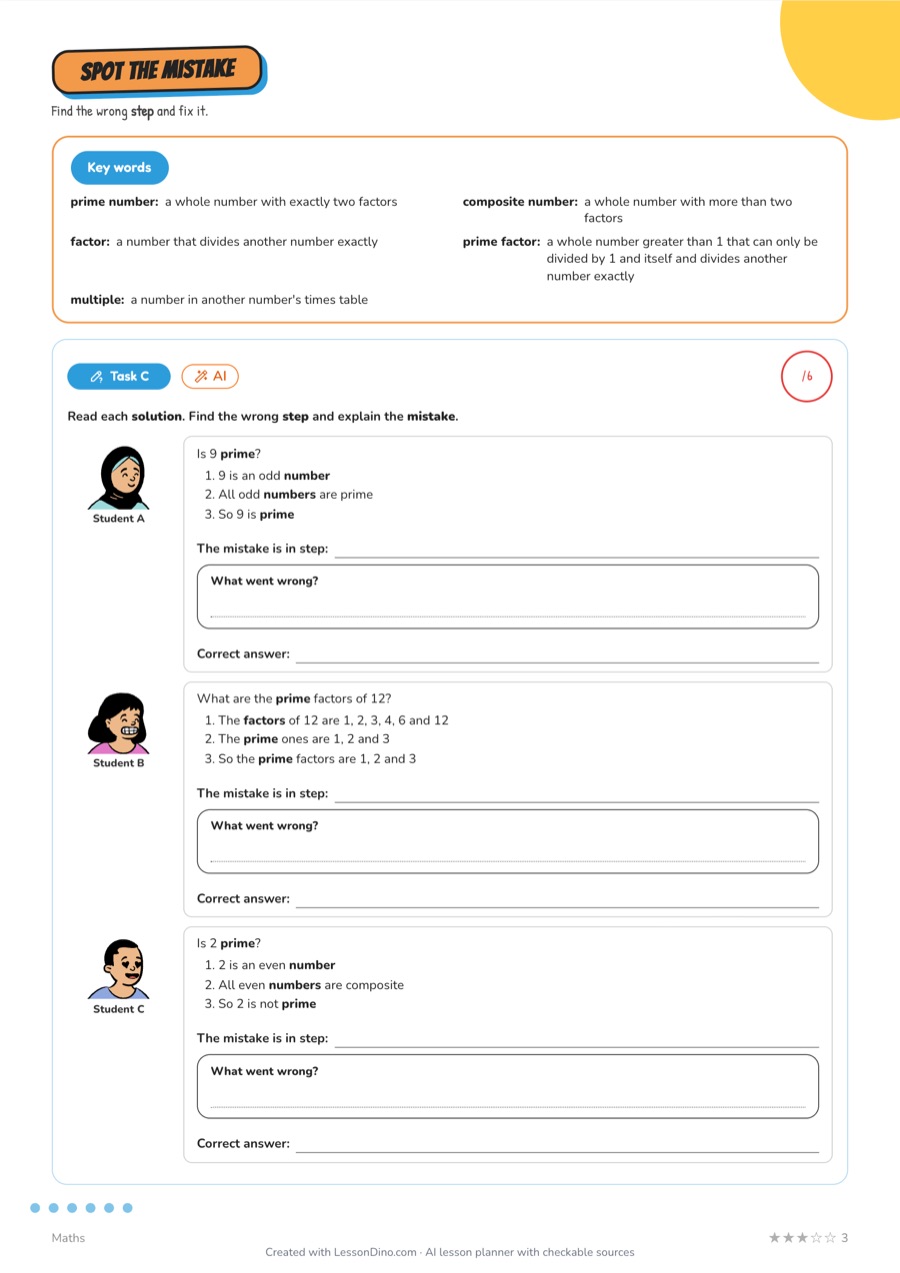
Spot the Mistake
Find the wrong step and fix it.
| Word | Meaning |
|---|---|
| prime number | a whole number with exactly two factors |
| composite number | a whole number with more than two factors |
| factor | a number that divides another number exactly |
| prime factor | a whole number greater than 1 that can only be divided by 1 and itself and divides another number exactly |
| multiple | a number in another number's times table |
Read each solution. Find the wrong step and explain the mistake.
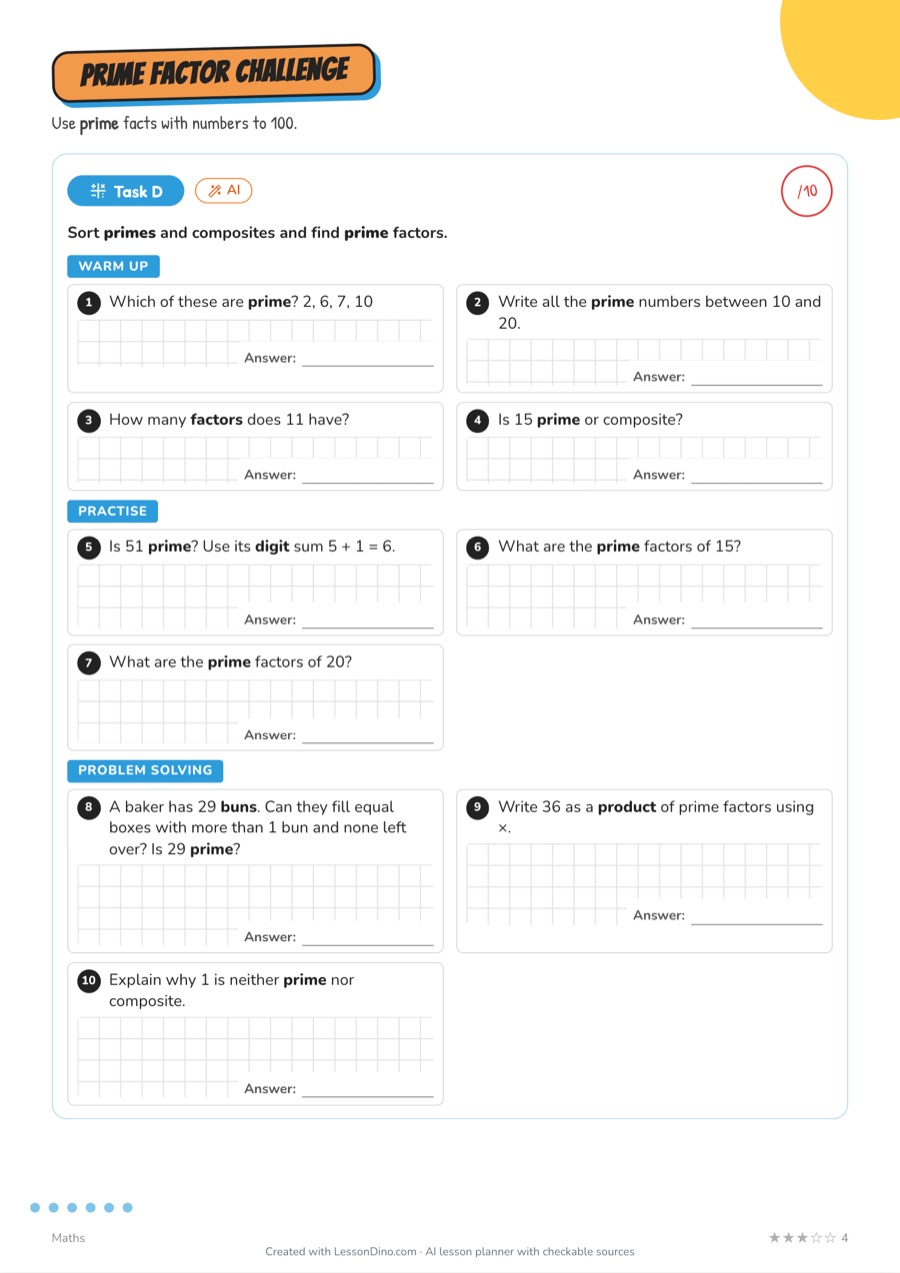
Prime Factor Challenge
Use prime facts with numbers to 100.
Sort primes and composites and find prime factors.
Warm up
- Which of these are prime? 2, 6, 7, 10
- Write all the prime numbers between 10 and 20.
- How many factors does 11 have?
- Is 15 prime or composite?
Practise
- Is 51 prime? Use its digit sum 5 + 1 = 6.
- What are the prime factors of 15?
- What are the prime factors of 20?
Problem solving
- A baker has 29 buns. Can they fill equal boxes with more than 1 bun and none left over? Is 29 prime?
- Write 36 as a product of prime factors using ×.
- Explain why 1 is neither prime nor composite.
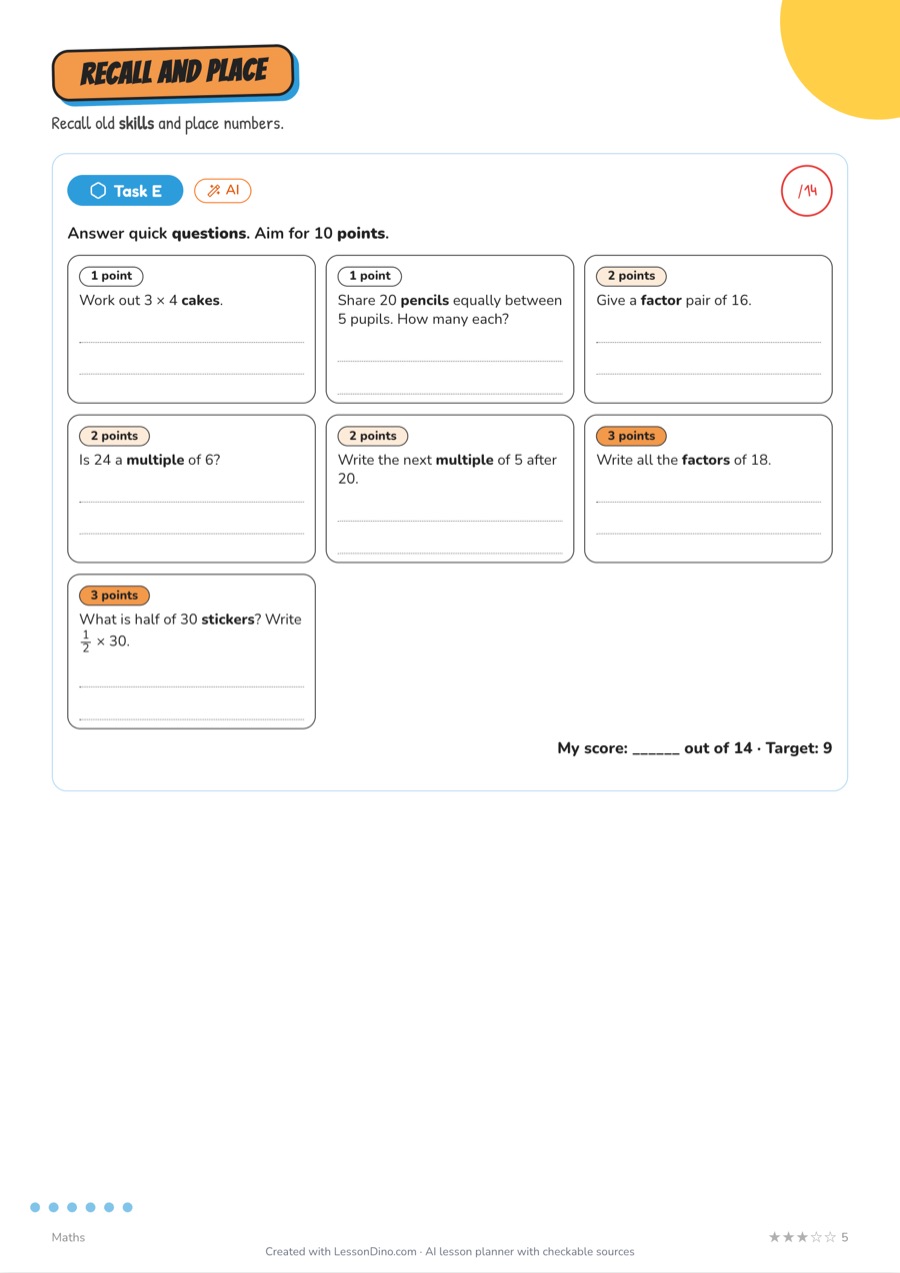
Recall and Place
Recall old skills and place numbers.
Answer quick questions. Aim for 10 points.
- Work out 3 × 4 cakes.
- Share 20 pencils equally between 5 pupils. How many each?
- Give a factor pair of 16.
- Is 24 a multiple of 6?
- Write the next multiple of 5 after 20.
- Write all the factors of 18.
- What is half of 30 stickers? Write 1/2 × 30.
Page 6
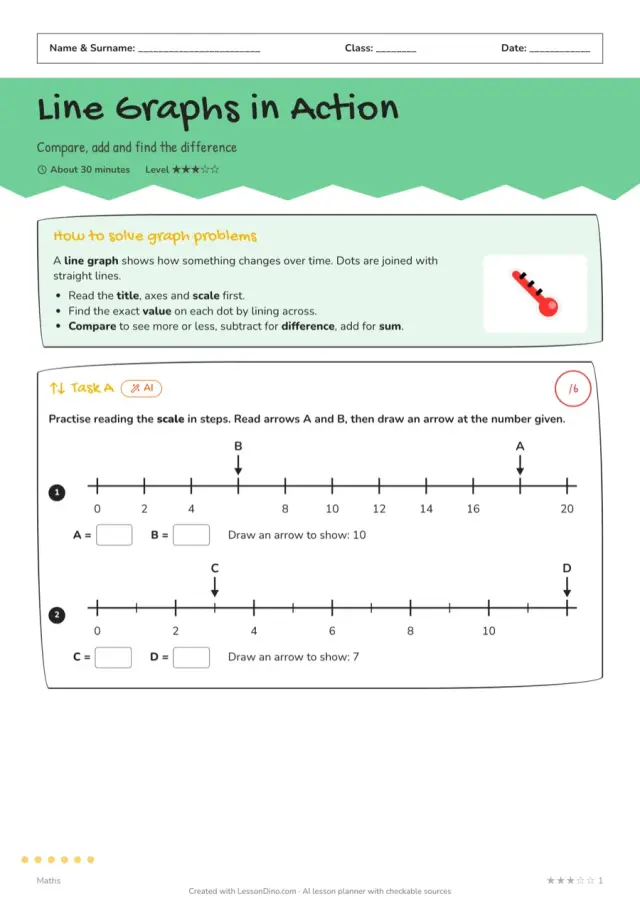
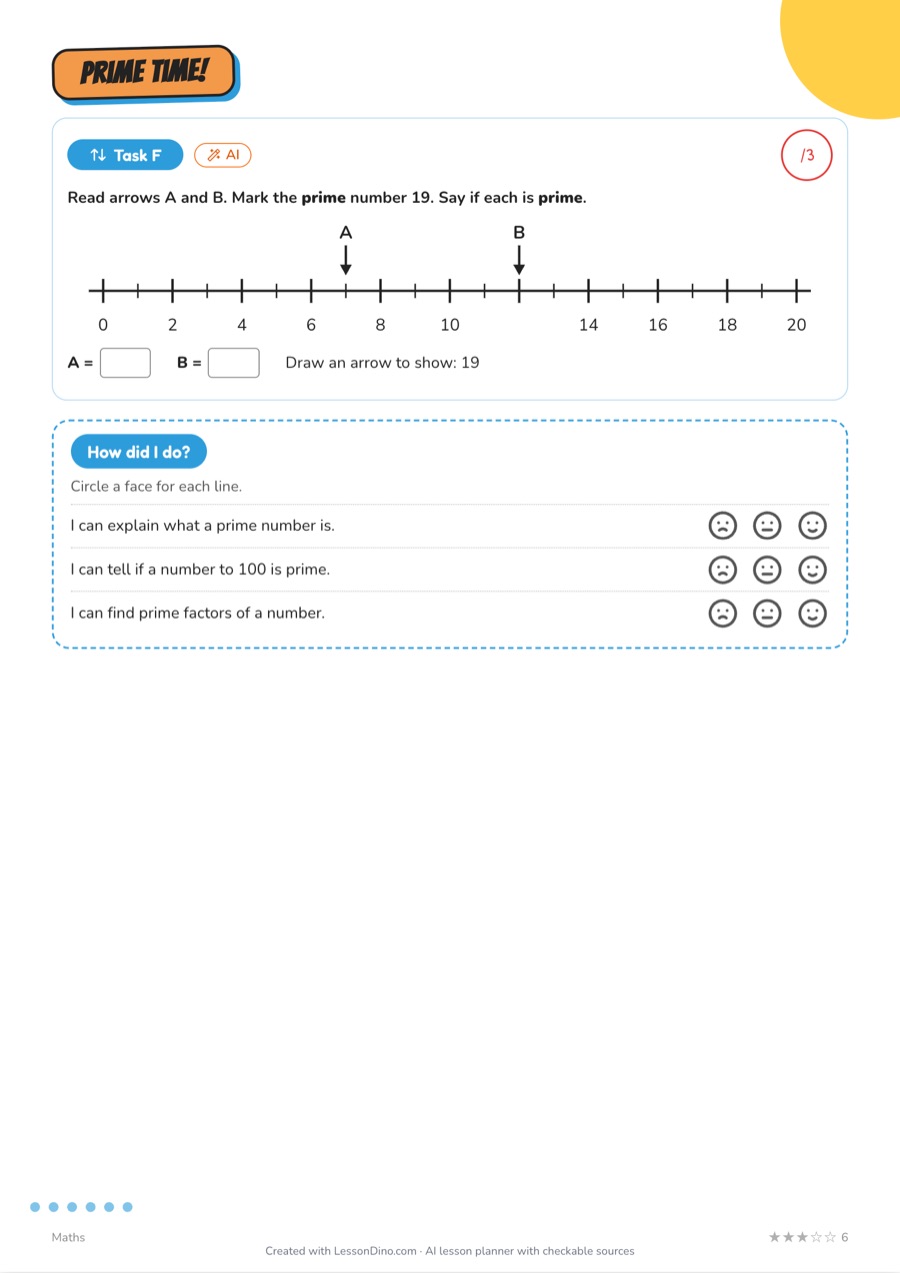
Read arrows A and B. Mark the prime number 19. Say if each is prime.
Answers
Show the answers
- Is 5 prime or composite? prime
- Is 6 prime or composite? composite
- Is 1 prime or neither? Think about its factors. neither
- Which number is the only even prime? 2
- Write all the factors of 7. 1 and 7
- Write all the factors of 9. Is 9 prime? No, 1, 3 and 9 so composite
- What are the prime factors of 6? 2 and 3
- A student has 13 pencils. Can they make equal teams of more than 1 with none left out? Is 13 prime? No - 13 is prime
- A shopkeeper has 18 cakes. Show two equal rows they could make. Is 18 prime? No - e.g. 2 × 9, so composite
- Explain how you know 19 is prime. Its only factors are 1 and 19
- Which of these are prime? 2, 6, 7, 10 2 and 7
- Write all the prime numbers between 10 and 20. 11, 13, 17, 19
- How many factors does 11 have? 2
- Is 15 prime or composite? composite
- Is 51 prime? Use its digit sum 5 + 1 = 6. No, 51 = 3 × 17, so composite
- What are the prime factors of 15? 3 and 5
- What are the prime factors of 20? 2 and 5
- A baker has 29 buns. Can they fill equal boxes with more than 1 bun and none left over? Is 29 prime? No - 29 is prime
- Write 36 as a product of prime factors using ×. 36 = 2 × 2 × 3 × 3
- Explain why 1 is neither prime nor composite. It has only one factor, 1 itself
- Work out 3 × 4 cakes. 12
- Share 20 pencils equally between 5 pupils. How many each? 4
- Give a factor pair of 16. 2 and 8
- Is 24 a multiple of 6? Yes
- Write the next multiple of 5 after 20. 25
- Write all the factors of 18. 1, 2, 3, 6, 9, 18
- What is half of 30 stickers? Write 1/2 × 30. 15
The answer sheet is the last picture above.
Curriculum
know and use the vocabulary of prime numbers, prime factors and composite (non-prime) numbers
Made with Lesson Dino's AI on 17 October 2026. AI can make mistakes, so check the answers and facts against the sources before you teach.