Slides
Lesson plan
Prime Detectives to 100
Pupils learn prime, composite and prime factor words. They sort numbers and test for primes to 100.
Objectives
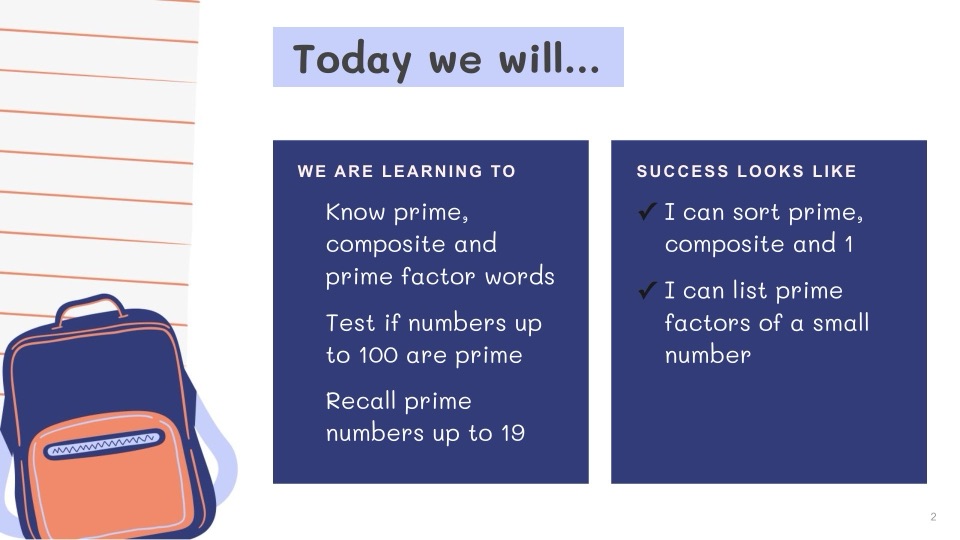
- Students will use prime, composite and prime factor words correctly.
- Students will test numbers up to 100 and recall primes to 19.
- Students will break composites into a product of prime factors.
Success criteria
- I can sort numbers into prime, composite and neither.
- I can recall the prime numbers up to 19.
- I can write a composite as a product of prime factors.
Key words
| Word | Meaning |
|---|---|
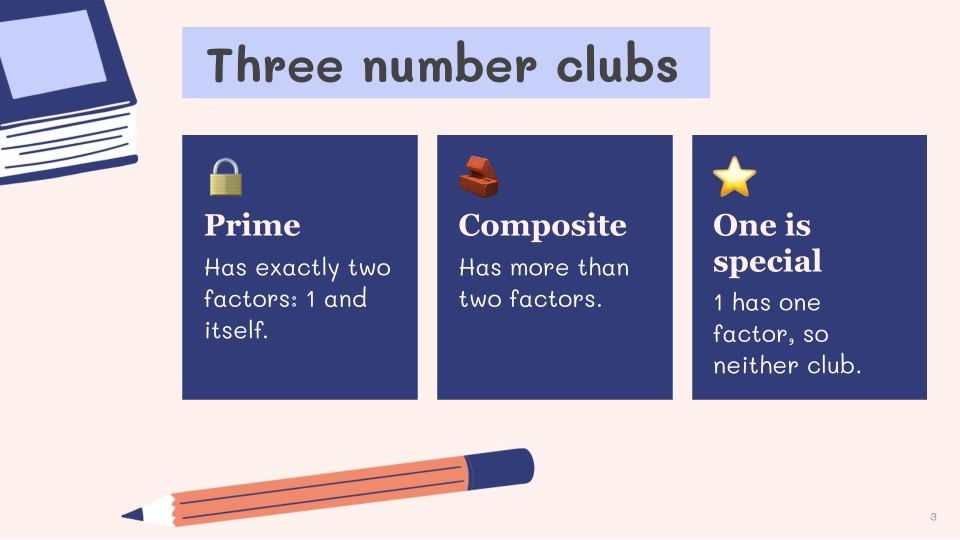
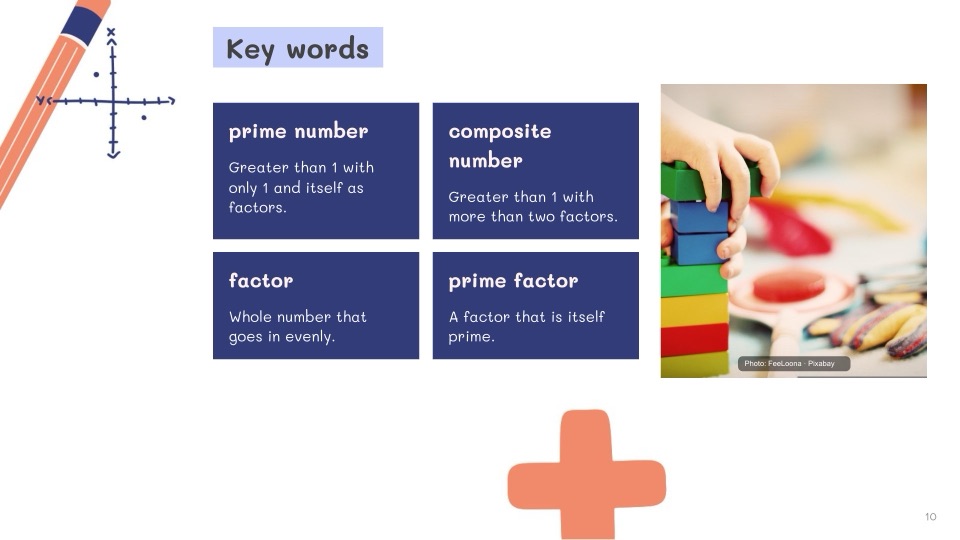
| prime number | a counting number greater than 1 with exactly two divisors, 1 and itself |
| composite number | a counting number greater than 1 with more than two divisors |
| prime factor | a building-block number greater than 1 with only two divisors that multiplies to make another number |
| factor | a whole number that goes into another number exactly with nothing left over |
| multiple | the answer you get when you multiply a number by a counting number |
Timed plan (60 minutes)
| Time | Stage | What happens |
|---|---|---|
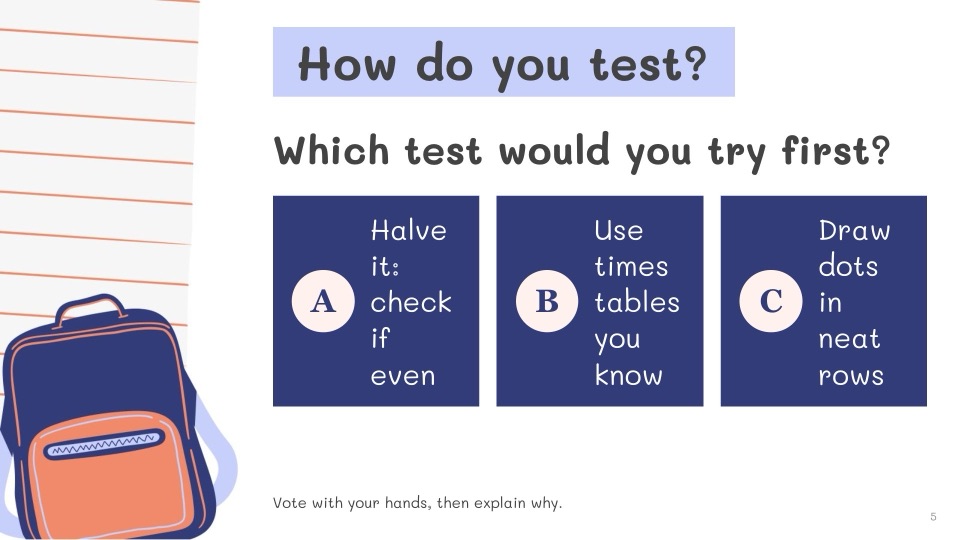
| 5 min | Starter | Recall factor pairs and spark debate about where 1 belongs. Show Slides 1–2 and share that today we are Prime Detectives learning prime, composite and prime factor words. Ask pupils to write factors of 6 on mini whiteboards to recall that a factor divides exactly. Show Slide 5 vote and ask which test they would try first for a mystery number. Pose the hook for partner talk: where does 1 belong. |
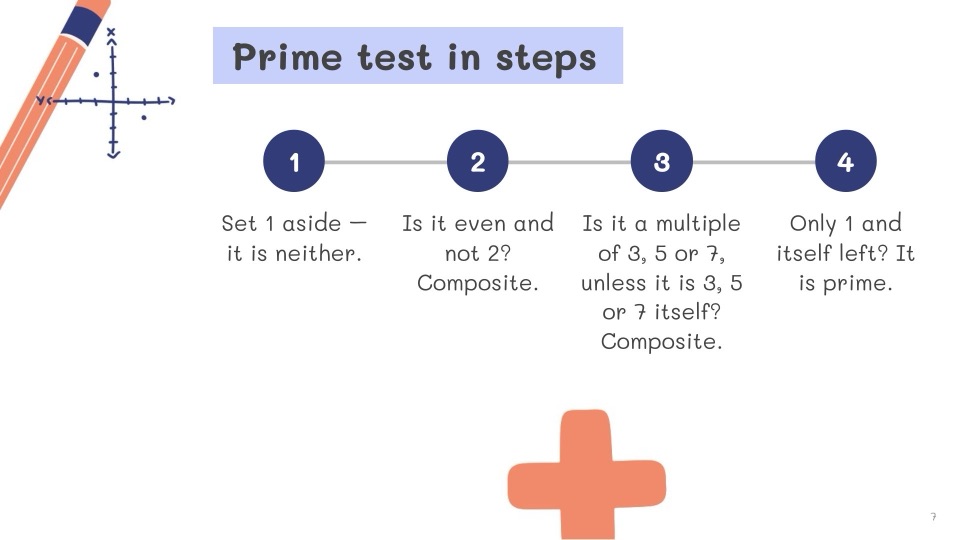
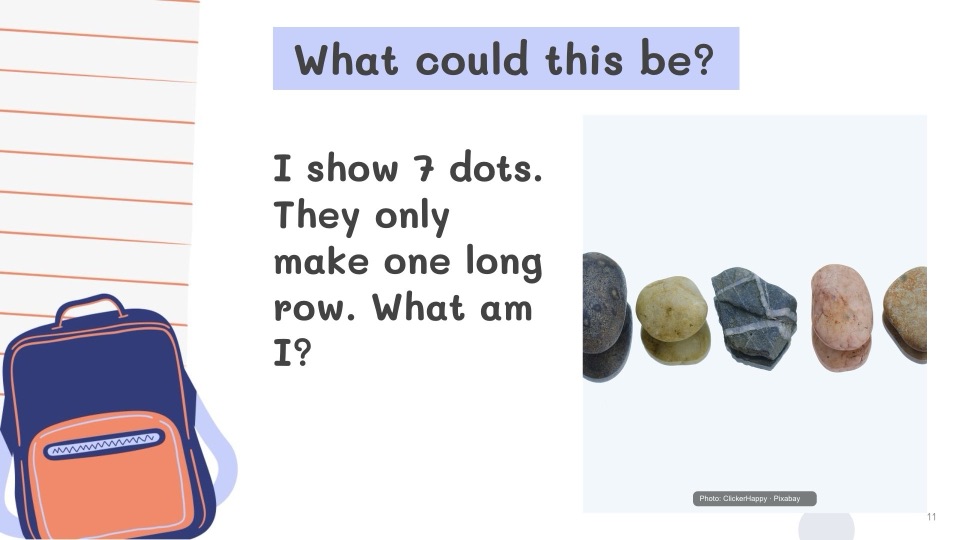
| 10 min | Teaching | Explain prime, composite and neither and model testing with factors. Show Slide 3 clubs and explain in own words that prime has exactly two factors, composite has more than two. Show Slide 11 with 7 dots and model that 7 only makes 1 x 7, so it is prime. Model 9 as 1 x 9 and 3 x 3, so it has three factors and is composite. Model Slide 7 steps: set 1 aside, check even, then multiples of 3, 5 and 7. |
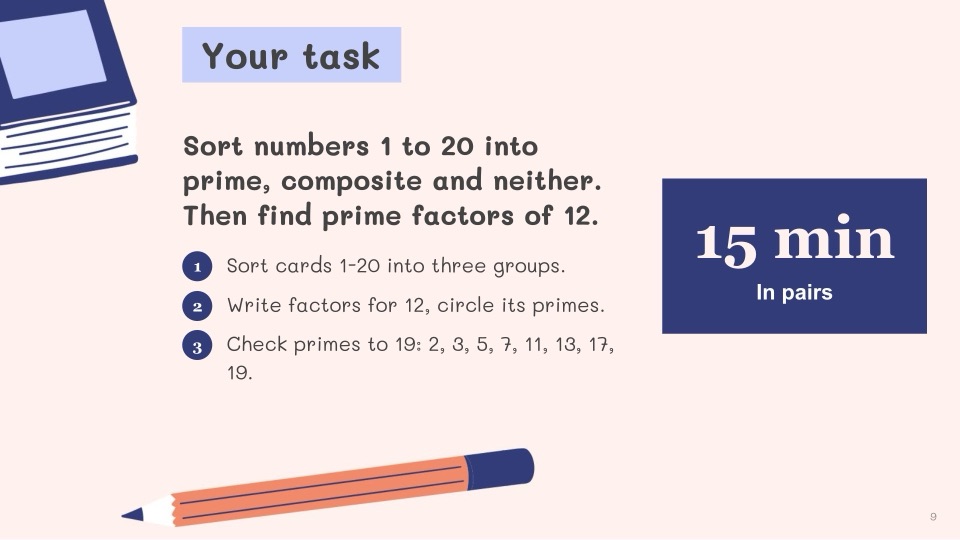
| 20 min | Main activity | Sort numbers 1–20 into prime, composite and neither using correct vocabulary. Give each group number cards 1–20 and three hoops or trays for prime, composite and neither. Show Slide 9 task and model sorting 13 and 15 with the stem It is ___ because its factors are ___. Ask groups to write factors for 12, circle its primes, and check primes to 19: 2, 3, 5, 7, 11, 13, 17, 19. Circulate, ask for factor-pair proof and correct 1 into neither. |
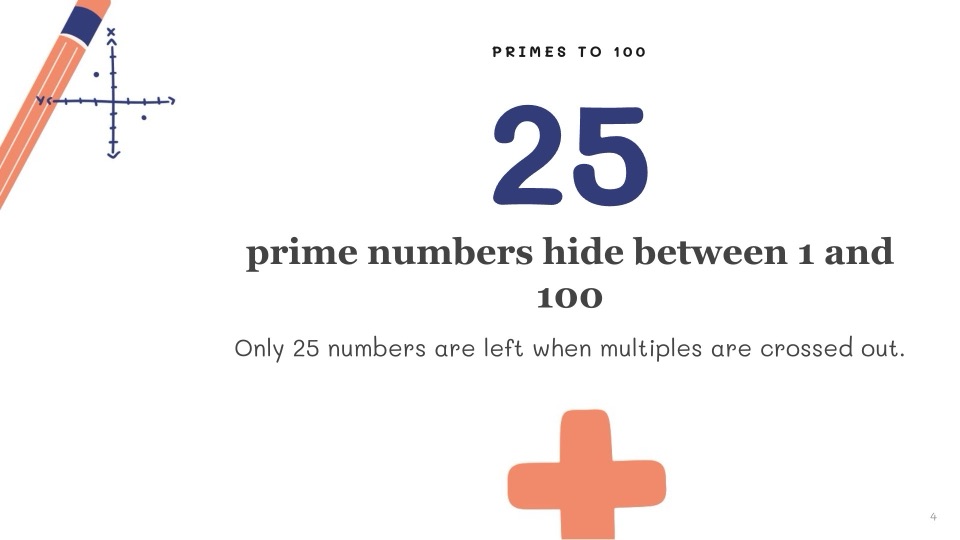
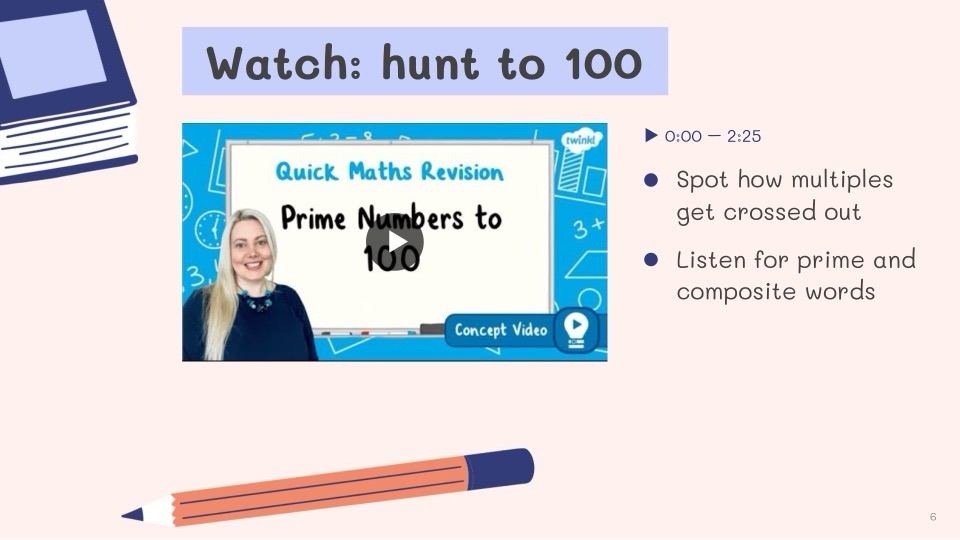
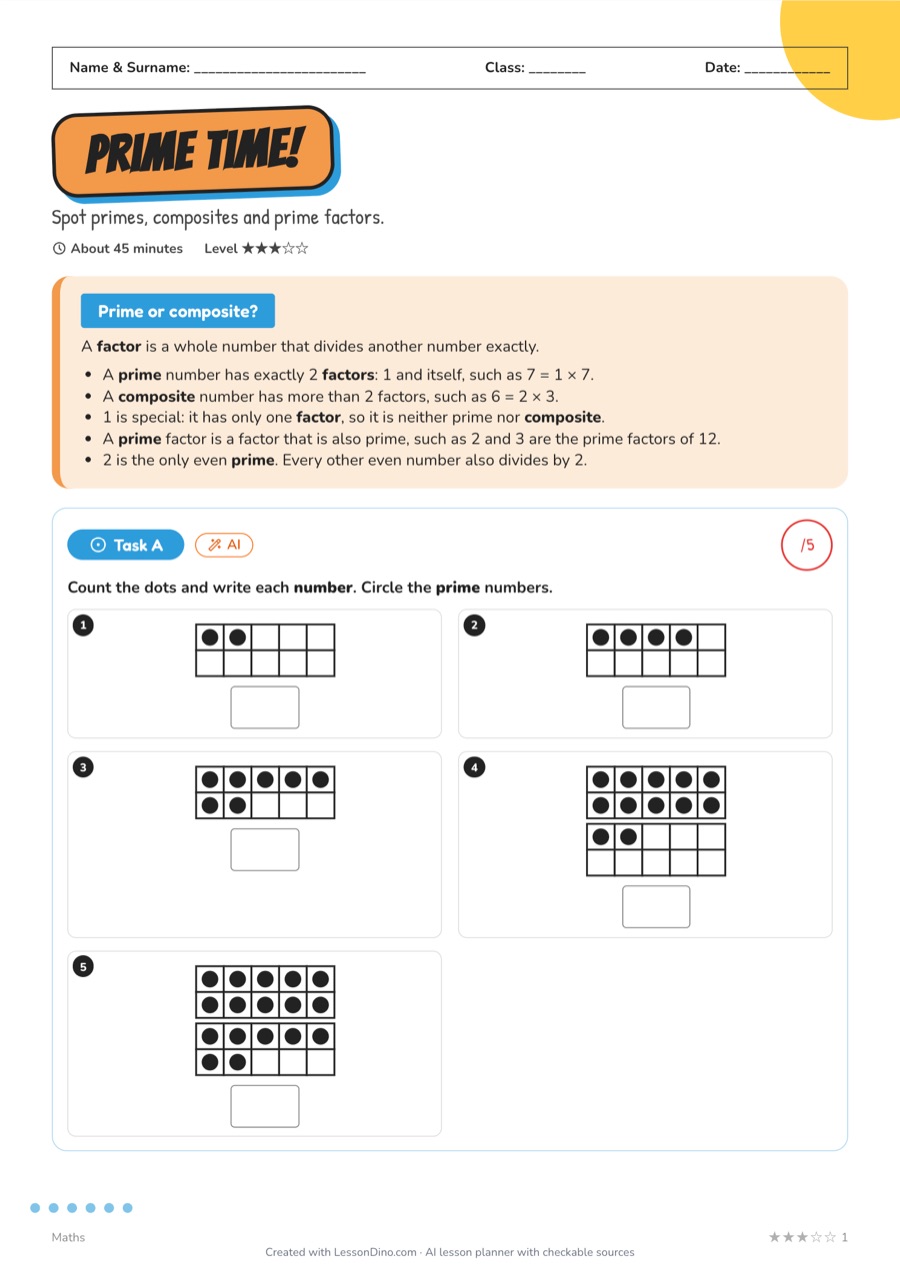
| 15 min | Practice | Use times tables to trap primes to 100 and practise prime factors. Show Slide 4 and explain only 25 numbers remain between 1 and 100 when multiples are crossed out. Play Video clip 1 on Slide 6 and pause to spot crossing multiples of 2, 3, 5 and 7 using times tables. Model on a 1–100 grid: circle 2 and cross its multiples, then circle 3 and cross its multiples. Hand out Worksheet Task D and ask pairs to sort primes and composites and find prime factors. |
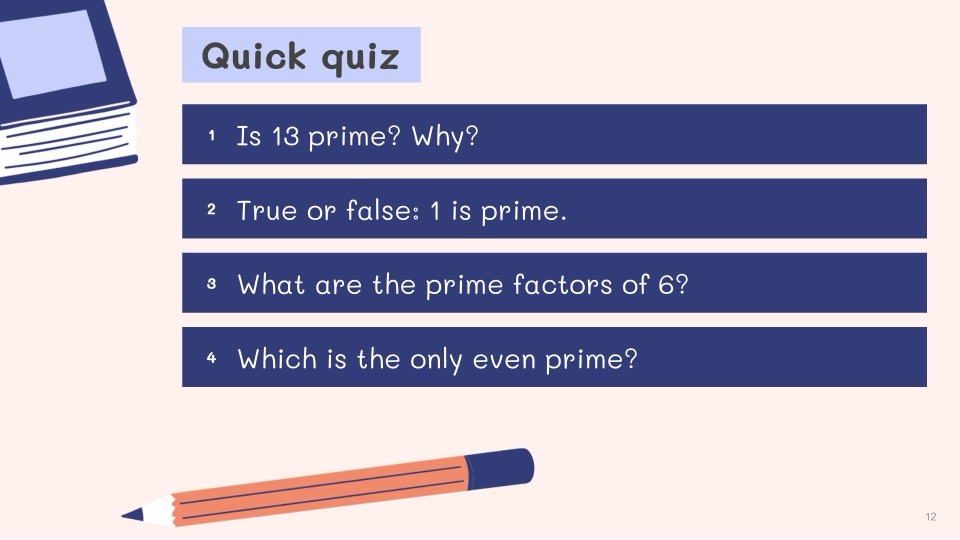
| 10 min | Plenary | Revisit key words and check recall of primes to 19. Show Slide 10 and ask pupils to say each word and meaning without reading: factor, prime, composite. Show Slide 12 quiz and cold-call: Is 13 prime, is 1 prime, what are prime factors of 6. Ask pupils to write primes to 19 from memory on whiteboards: 2, 3, 5, 7, 11, 13, 17, 19. Collect exit answers and restate 1 is neither and 2 is the only even prime. |
Common mistakes
- Thinking 1 is prime
How to spot it: Puts 1 in the prime hoop or ticks it on the 100 grid
Count its factors: 1 has one factor, a prime has exactly two, so 1 is neither prime nor composite. - Thinking all odd numbers are prime
How to spot it: Labels 9, 15, 21 or 25 as prime
Show 9 = 3 x 3 and 15 = 3 x 5; they are odd but have extra factors so are composite. All primes except 2 are odd, but not all odds are prime. - Thinking 2 is not prime because it is even
How to spot it: Sorts 2 as composite
List factors of 2 as 1 and 2 only, so it is prime and the only even prime number.
Support
- Give a factor list for each number so students can count the factors instead of working them out
- Keep a 10 x 10 multiplication grid and times-table prompts on desks to test for extra factors
Stretch
- Add cards for 21, 27 and 49 and ask students to prove the placement with a factor pair
- Test tricky numbers like 49, 51 and 91 and write which prime divides them
Check questions
- Is 19 prime? Why?
Answer: Yes, its only factors are 1 and 19. - Sort 1, 7 and 9 into prime, composite or neither.
Answer: 7 prime, 9 composite, 1 neither. - What are the prime factors of 10?
Answer: 2 and 5, because 10 = 2 x 5.
Curriculum
know and use the vocabulary of prime numbers, prime factors and composite (non-prime) numbers
Video clips
Clips on YouTube, from the start and end times we chose. Check each one before you show it.
-
primes to 100 for KS2 from 0:00 to 2:25
Twinkl Educational Publishing: What Are the Prime Numbers up to 100 | KS2 Maths Concept for Kids
Made for KS2 pupils aged 9-10 and directly teaches prime vocabulary to 100 for Year 5.
-
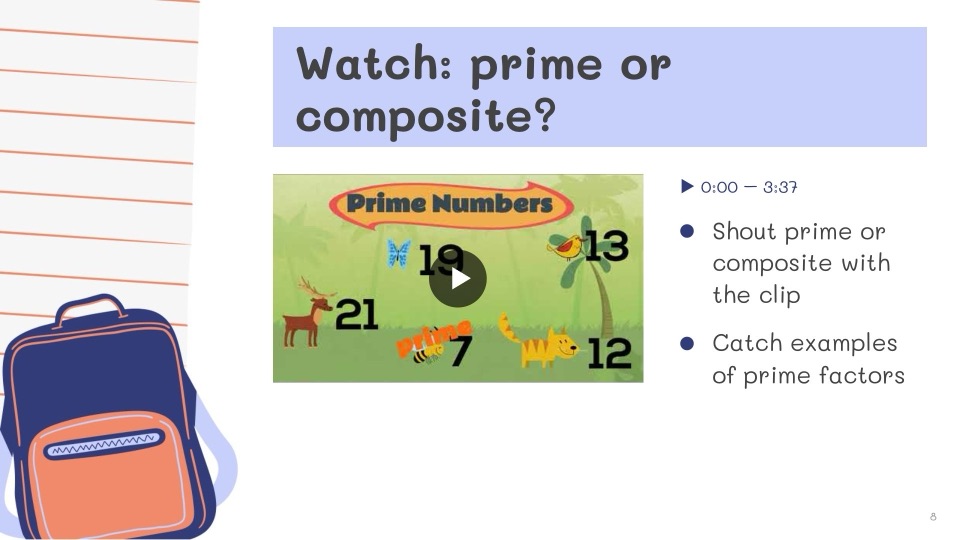
prime and composite explained from 0:00 to 3:37
EasyTeaching: Prime and Composite Numbers | Maths | EasyTeaching
Clear primary maths explanation of prime and composite that suits age 9-10 pace and vocabulary.
Worksheet
Sources
- National curriculum in England: mathematics programmes of study gov.uk
- Year 5 Maths Curriculum map 2023-2024 westend.lancs.sch.uk
- prime numbers: FAQ and resources - University of Exeter empslocal.ex.ac.uk
- Prime numbers - MacTutor History of Mathematics mathshistory.st-andrews.ac.uk
- Prime numbers from 1 - 100 - Prime numbers - 3rd level Maths ... bbc.co.uk
- Prime numbers - KS2 Maths resources for Year 6 - BBC Bitesize bbc.co.uk
- Prime Numbers | Free GCSE Maths Worksheet (PDF) | Virtus Academy virtusacademy.co.uk
- Prime Numbers - Primary Resources primaryresources.co.uk
- What are prime numbers? - BBC Bitesize bbc.co.uk
- Kids Math: Prime Numbers - Ducksters ducksters.com
- Prime number Facts for Kids kids.kiddle.co
- Explain how to identify a prime number or a composite number thenational.academy
- Prime numbers (video) | Khan Academy khanacademy.org
- prime numbers and composite numbers - Kids - Britannica Kids kids.britannica.com
- What is a prime? - BBC Bitesize bbc.co.uk
- PRIME AND COMPOSITE NUMBERS for Kids What are Prime Numbers? MATH ... kidvideo.org
- Prime Numbers with Python (Example) coderwall.com
- What Are Prime Numbers? – Explained for Kids | SmartOnlineGames smartonlinegames.com
- Prime Numbers Explained for Kids - Prongo.com prongo.com
- Prime Numbers - Properties, Examples and Chart - FirstCry.com firstcry.com
- Prime Numbers, LCM, and Factors Made Easy For Kids meredithplays.com
- What are Prime Numbers 1 to 100? Definition, Chart, Examples splashlearn.com
- Prime Numbers in Maths - GeeksforGeeks geeksforgeeks.org
- Prime Numbers - Prime Numbers 1 to 100, Examples | Prime ... - Cuemath cuemath.com
- Prime Numbers Explained For Kids With Easy Examples And Mini Quiz math-exercises-for-kids.com
Picture credits
Made with Lesson Dino's AI on 17 October 2026. AI can make mistakes, so check facts against the sources before you teach.