The worksheet
About this worksheet
Pupils learn to name cubes, spheres, cylinders and cones. They handle shapes and count faces, edges and vertices. This Year 2 Maths worksheet gives students (ages 6–7) five pages of practice on properties of 3D shapes, part of the geometry: properties of shapes unit. It goes with our free Properties of 3D shapes lesson, which has the slides and a timed lesson plan.
What it covers
By the end, students should be able to:
- Students will name cube, sphere, cylinder and cone by handling shapes.
- Students will count and describe faces, edges and vertices on shapes.
How to use it
- Use it for practice after the teaching part of the lesson, once students have seen the worked examples on the slides.
- Support: Keep real shapes in sight and put a sticker dot on each face counted.
- Stretch: Describe a square-based pyramid with five faces, eight edges and five vertices.
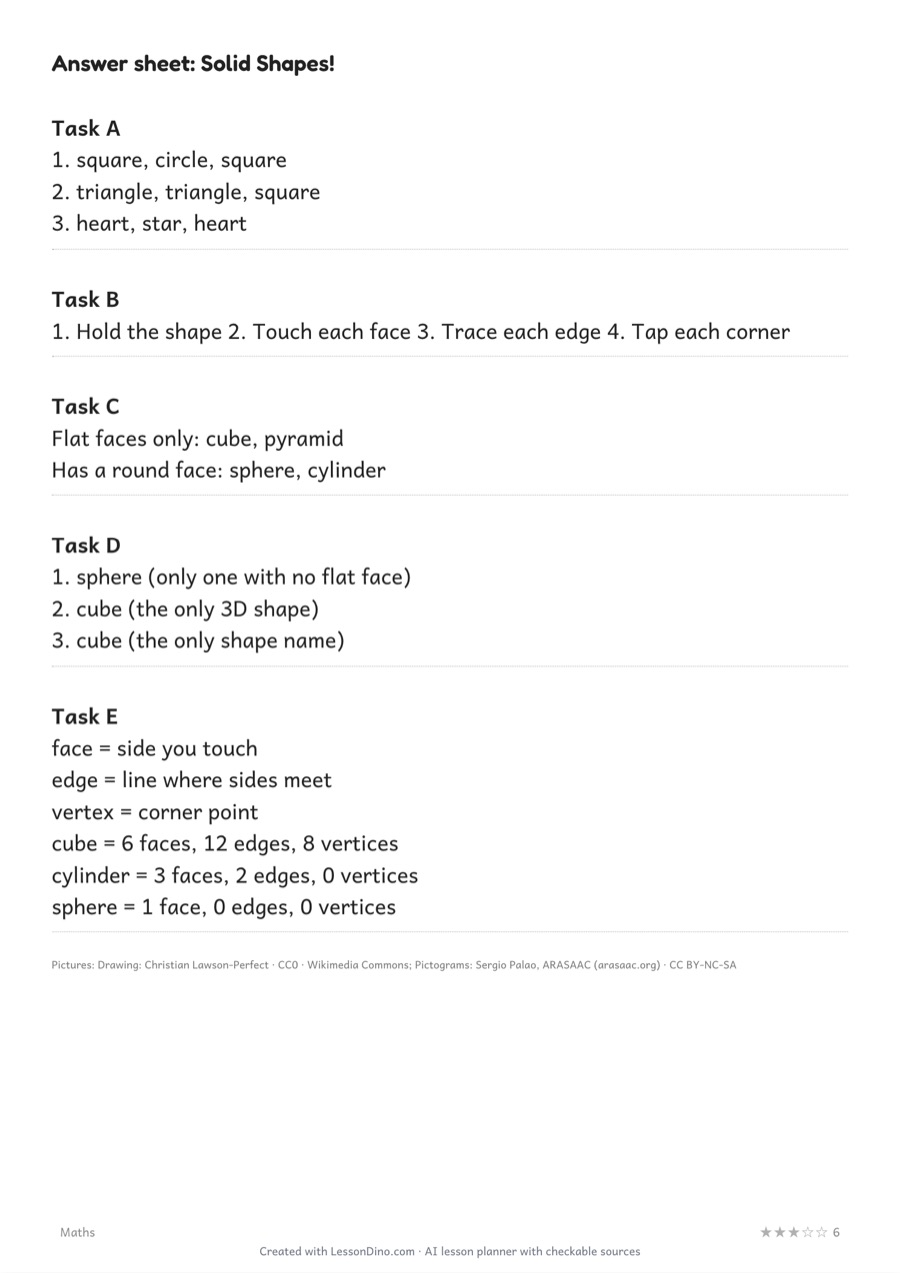
- The answer sheet is the last page, so you can print it on its own or let students check their own work.
Key vocabulary
- face: a flat or curved surface you can touch
- edge: a line where two surfaces meet
- vertex: a corner point where lines meet
- cube: a solid box with six square faces
- cylinder: a solid like a tin with three surfaces
Mistakes to watch for
- Saying a sphere has faces like a cube or has corners. Hold and turn the ball. Show it has just one face, zero edges and no vertices.
- Mixing up edge and face. Remind: a face is a flat or curved surface, an edge is where two faces meet. Trace the line, not the side.
- Missing faces or counting one twice on cube or tin. Mark each face with a sticker dot as you touch it. A cube has six square faces, a cylinder has three faces.
What's on the worksheet
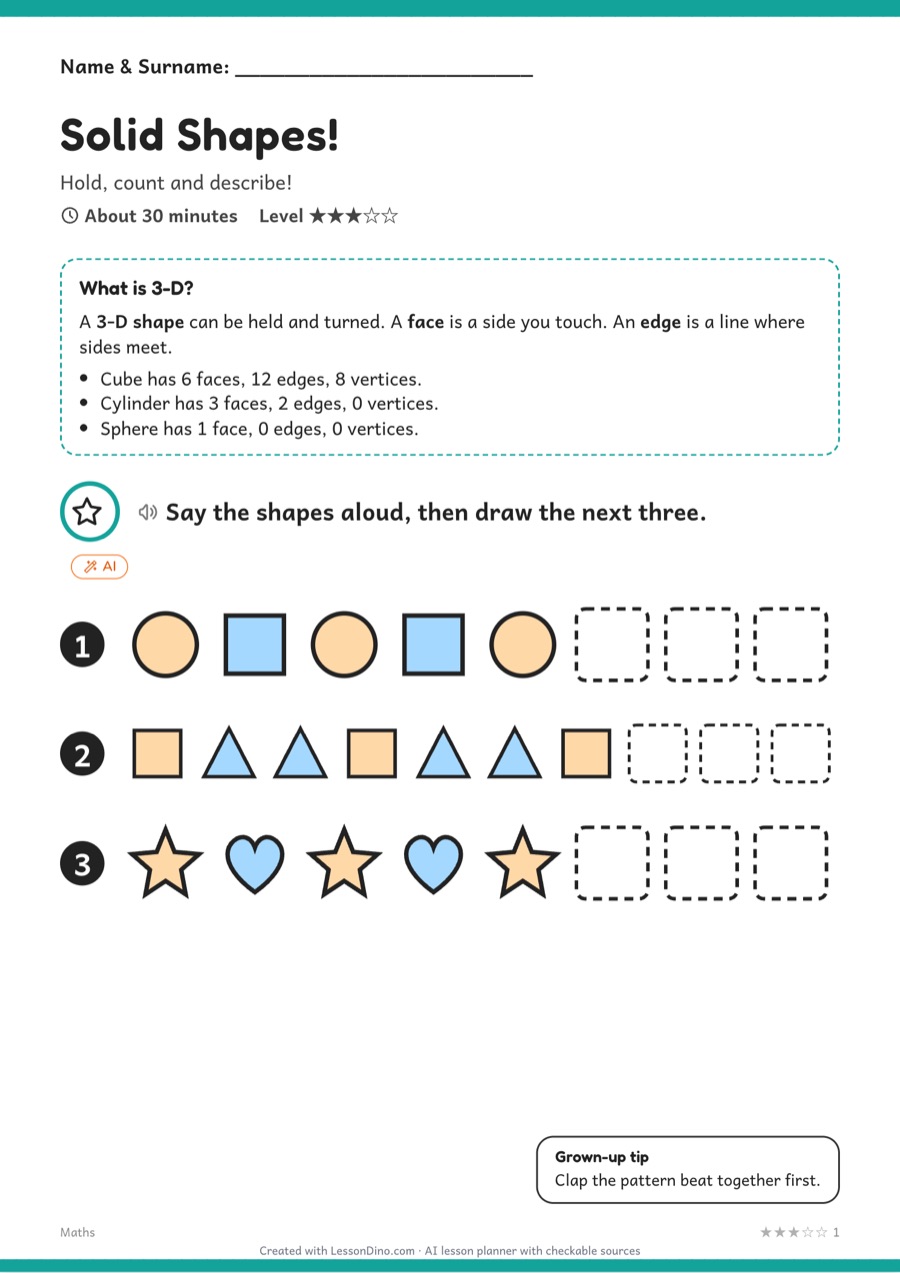
Finish the Pattern!
What is 3-D?
- A 3-D shape can be held and turned. A face is a side you touch. An edge is a line where sides meet.
- Cube has 6 faces, 12 edges, 8 vertices.
- Cylinder has 3 faces, 2 edges, 0 vertices.
- Sphere has 1 face, 0 edges, 0 vertices.
Say the shapes aloud, then draw the next three.
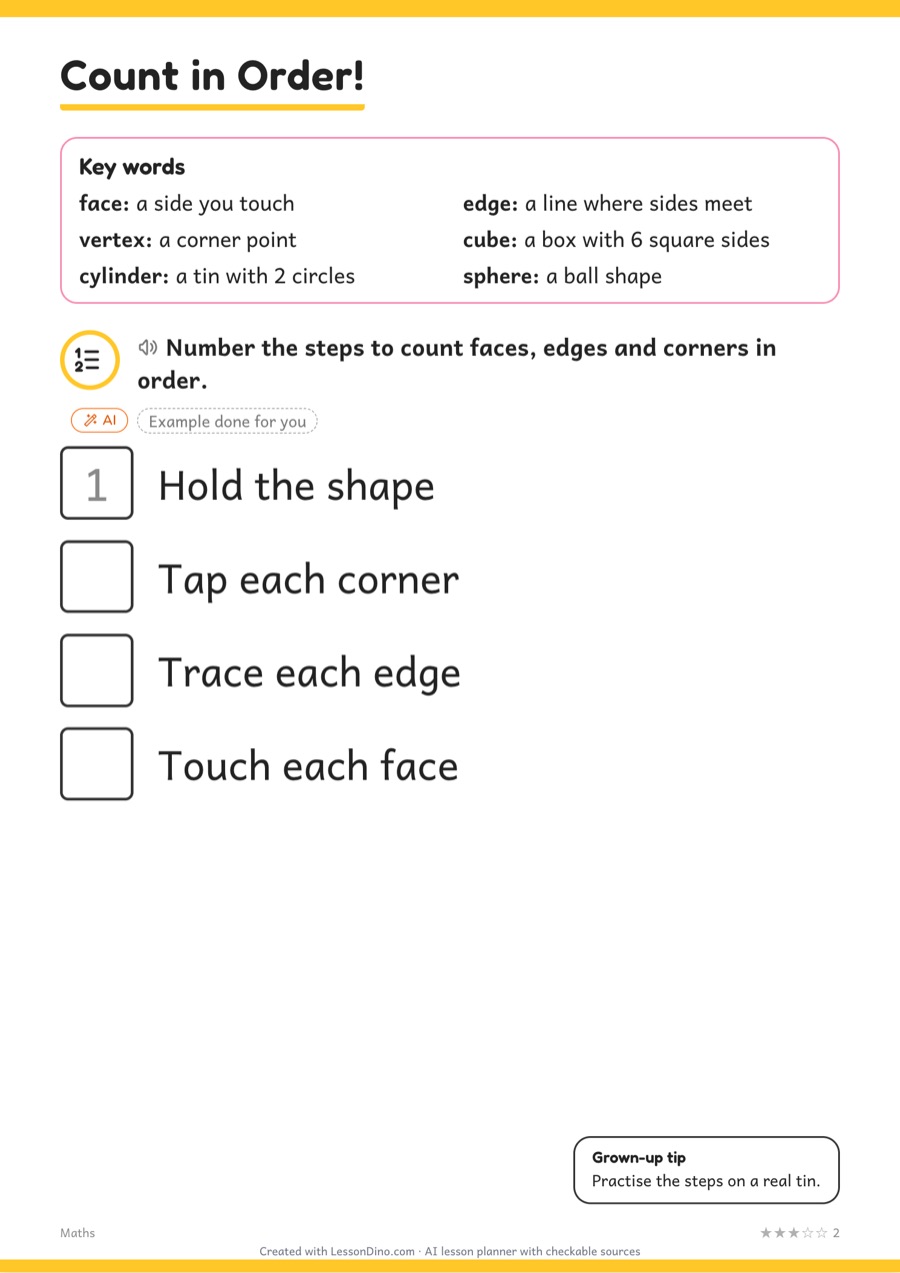
Count in Order!
| Word | Meaning |
|---|---|
| face | a side you touch |
| edge | a line where sides meet |
| vertex | a corner point |
| cube | a box with 6 square sides |
| cylinder | a tin with 2 circles |
| sphere | a ball shape |
Number the steps to count faces, edges and corners in order.
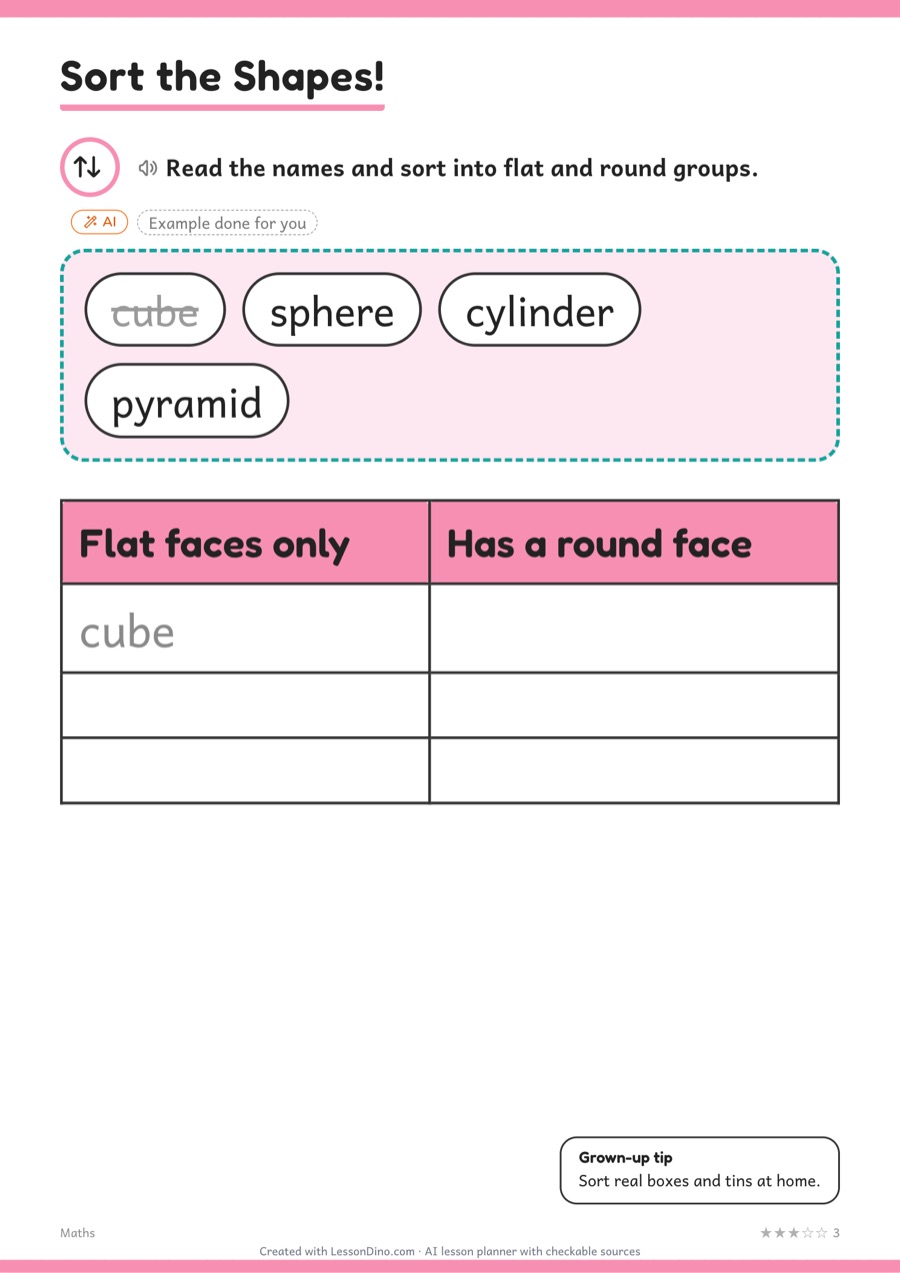
Sort the Shapes!
Read the names and sort into flat and round groups.
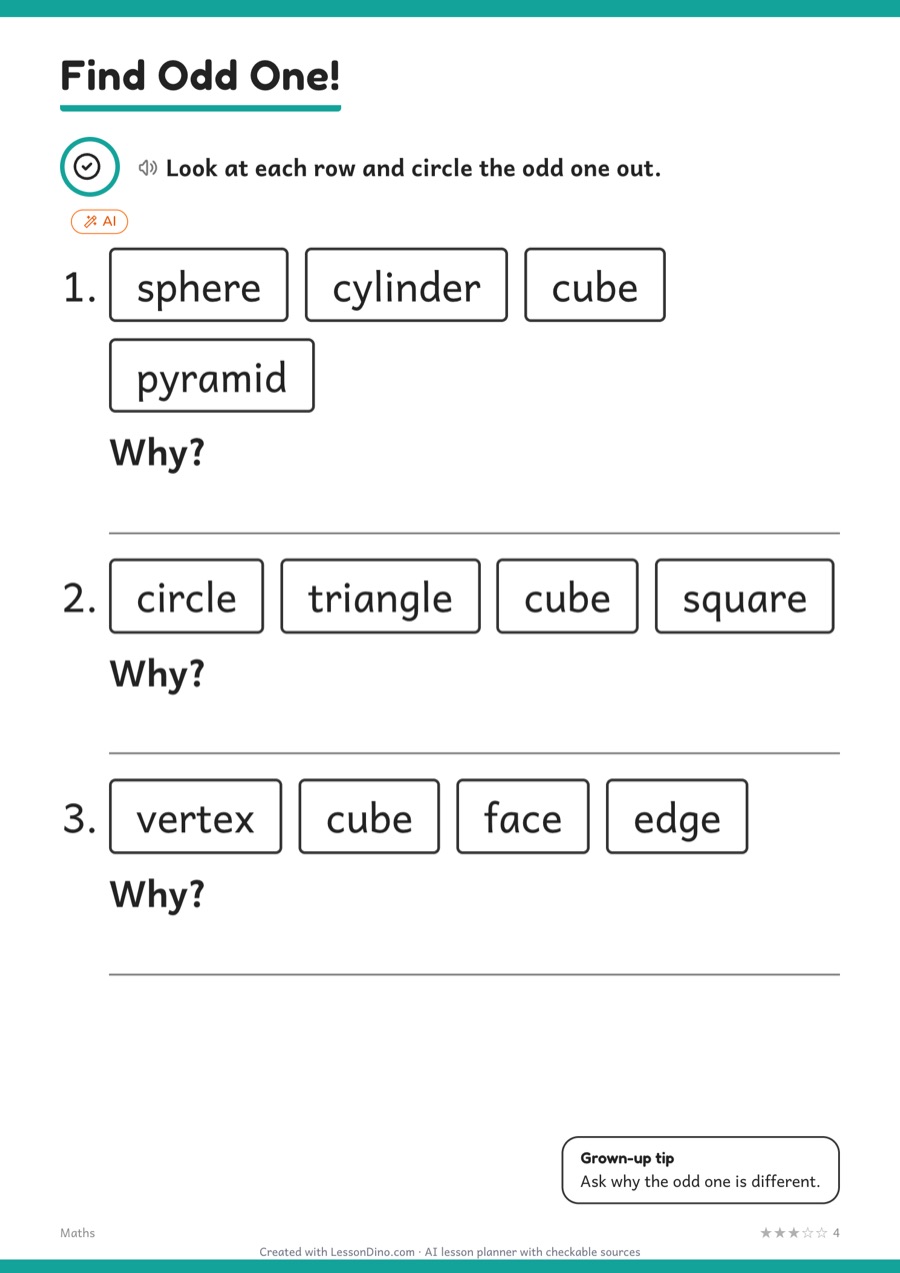
Find Odd One!
Look at each row and circle the odd one out.
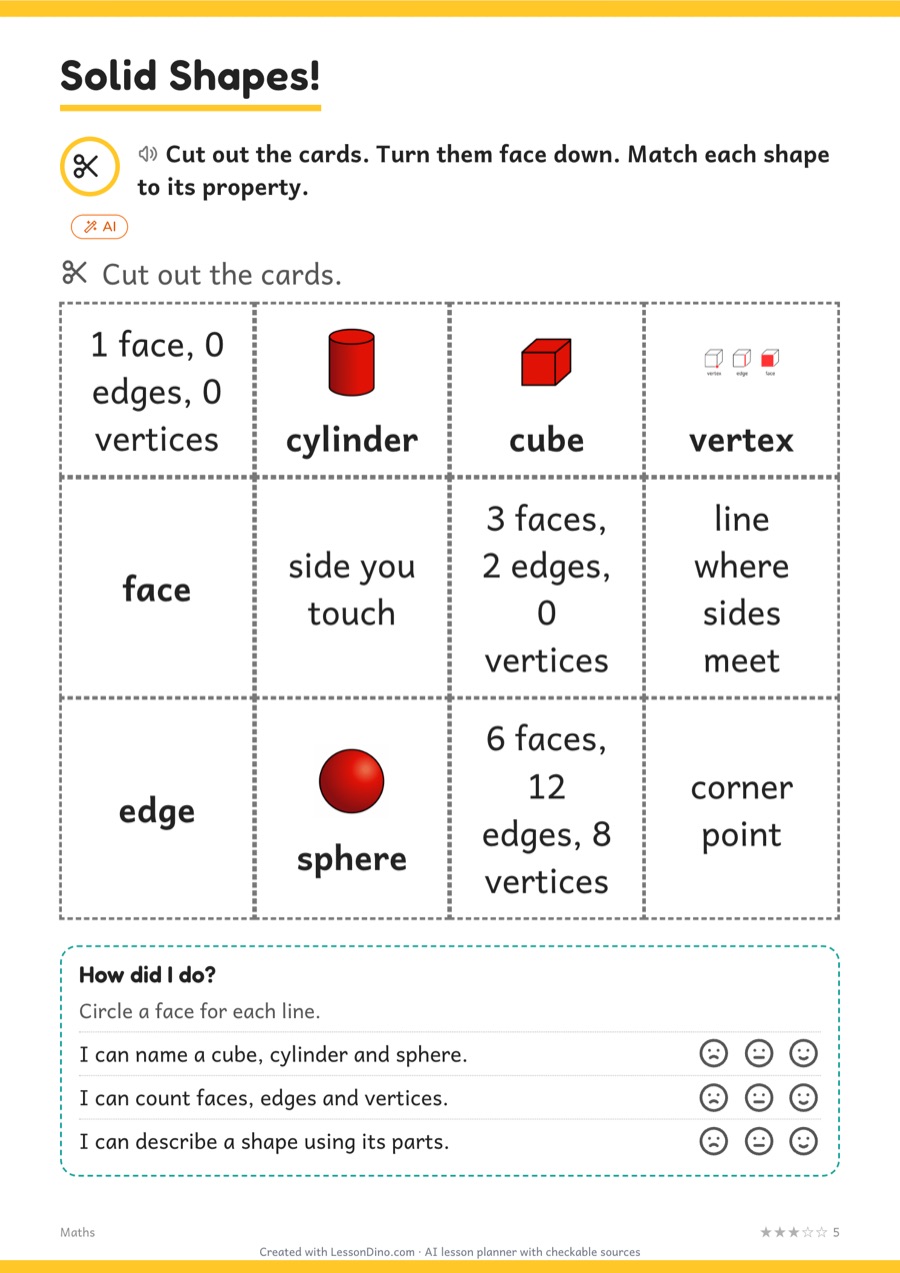
Page 5
Cut out the cards. Turn them face down. Match each shape to its property.
Answers
Show the answers
The answers are on the answer sheet, the last picture above.
Curriculum
identify and describe the properties of 3-D shapes, including the number of edges, vertices and faces
Made with Lesson Dino's AI on 19 October 2026. AI can make mistakes, so check the answers and facts against the sources before you teach.