Slides
Lesson plan
Hold, Count, Describe Solid Shapes
Pupils learn to name cubes, spheres, cylinders and cones. They handle shapes and count faces, edges and vertices.
Objectives
- Students will name cube, sphere, cylinder and cone by handling shapes.
- Students will count and describe faces, edges and vertices on shapes.
Success criteria
- I can name a cube, sphere, cylinder and cone.
- I can count faces, edges and vertices on a shape.
Key words
| Word | Meaning |
|---|---|
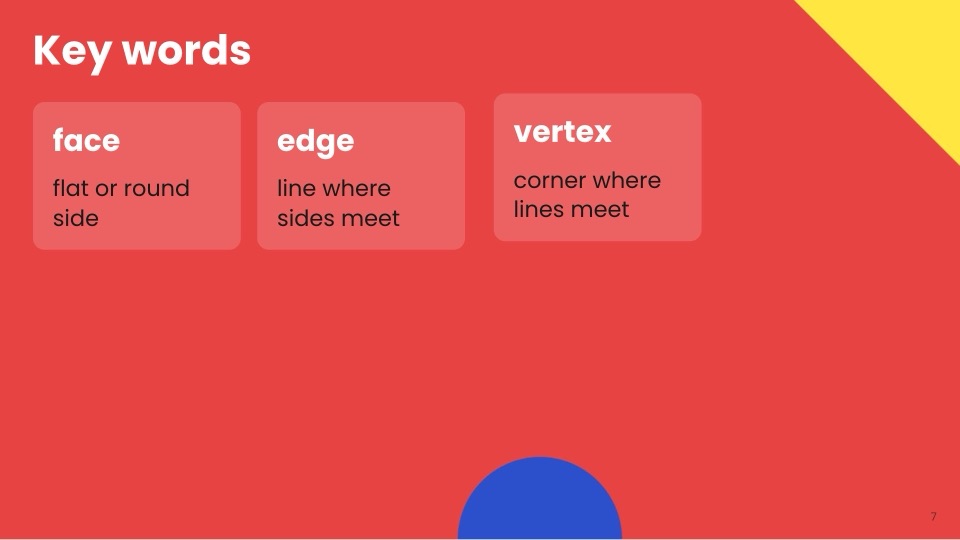
| face | a flat or curved surface you can touch |
| edge | a line where two surfaces meet |
| vertex | a corner point where lines meet |
| cube | a solid box with six square faces |
| cylinder | a solid like a tin with three surfaces |
Timed plan (60 minutes)
| Time | Stage | What happens |
|---|---|---|
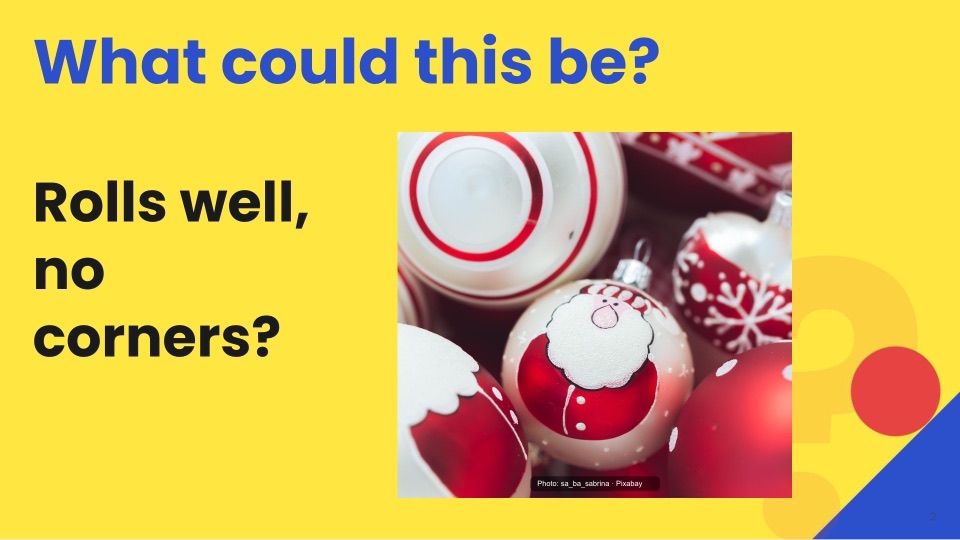
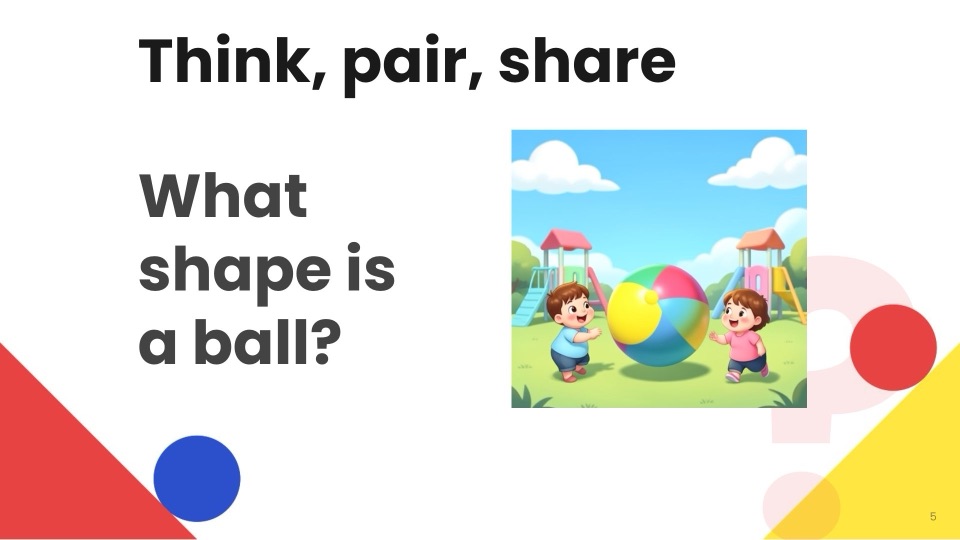
| 10 min | Starter | To hook pupils and recall 3-D shape names through feeling and guessing. Show Slide 1 and explain we will hold, count and describe solid shapes. Say the hook: I have a sneaky shape hiding in this bag. Can your hands guess what it is without your eyes? Invite a student to feel the ball in the bag without looking, then reveal it to the class. Show Slide 2 and link the ball to sphere, rolls well and has no corners. |
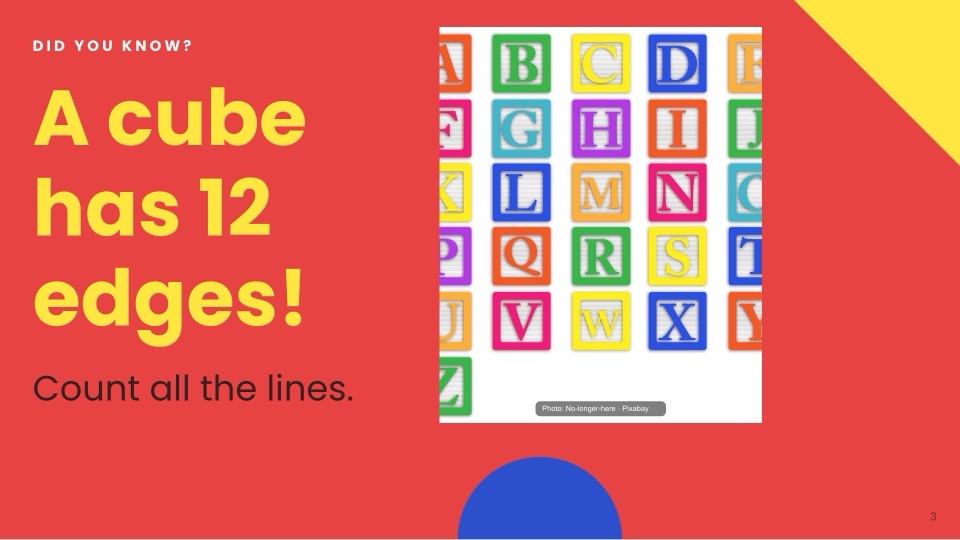
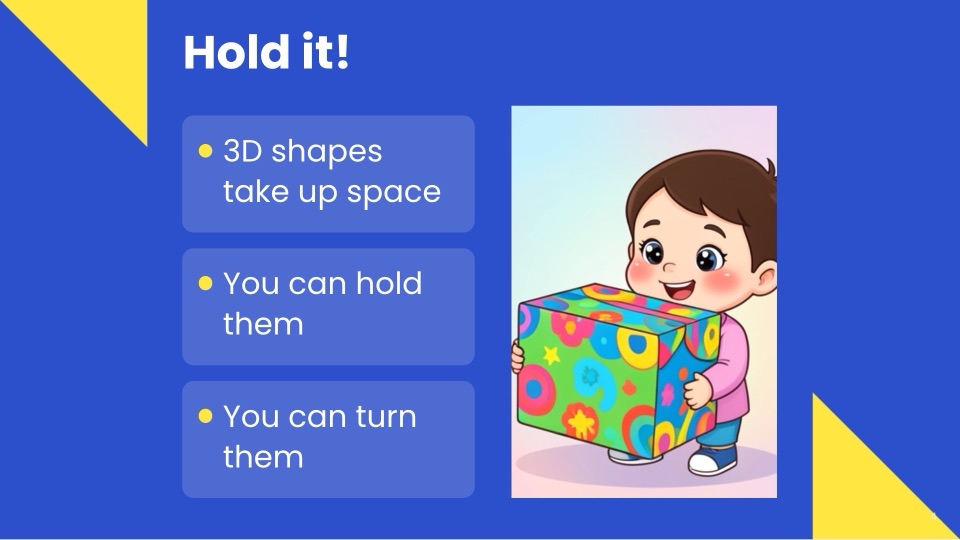
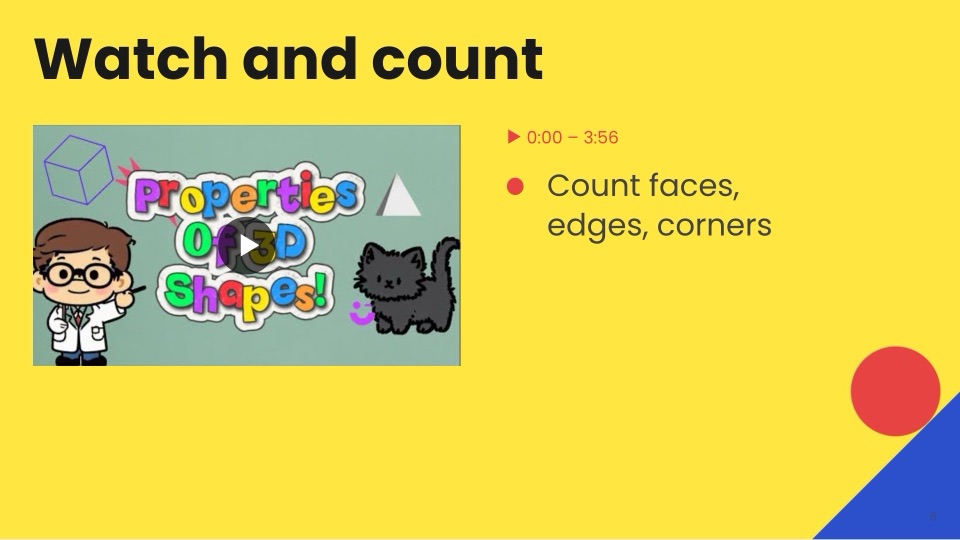
| 12 min | Teaching | To teach face, edge and vertex and model counting them on a cube. Show Slide 7 and teach the words with actions: pat for face, trace arm for edge, tap head for vertex. Show Slide 3 and read: A cube has 12 edges! Count all the lines. Play Video clip 1 on Slide 6 and pause to count together. Model with a cube block: touch each face, trace each edge, tap each corner and say numbers. |
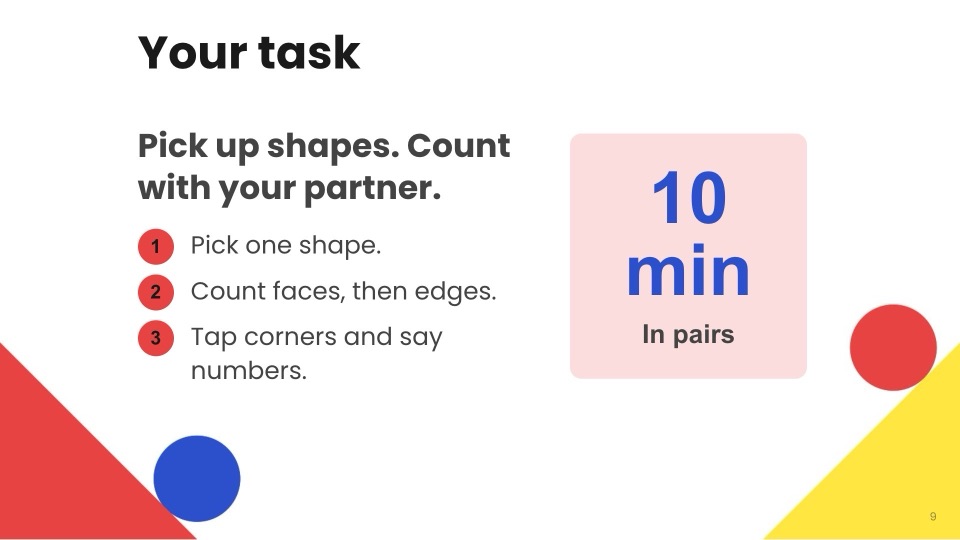
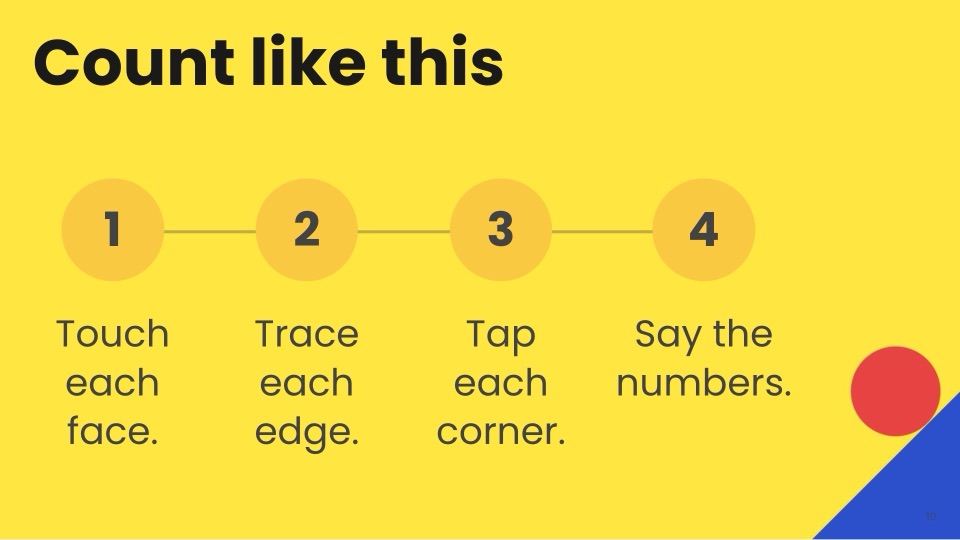
| 23 min | Main activity | To handle shapes in pairs and describe them by faces, edges and vertices. Show Slide 10 and model: Touch each face. Trace each edge. Tap each corner. Say the numbers. Show Slide 9 and explain: Pick one shape. Count faces, then edges. Tap corners and say numbers. Feel one shape in the cloth bag with the class, reveal the cube block, ball or empty tin, then count together by touching. Send pairs to pick a shape, count, and hold up fingers to show faces then say the shape name. |
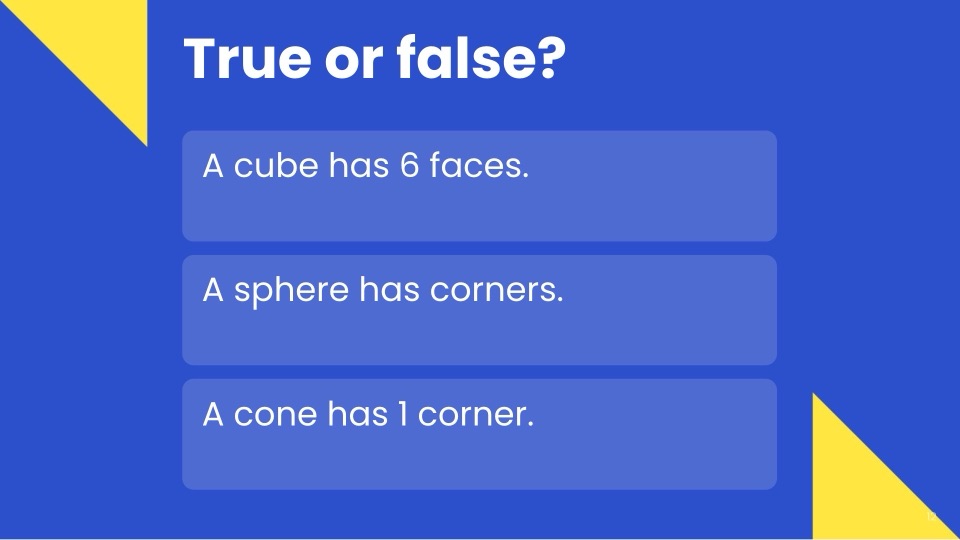
| 15 min | Plenary | To check naming and counts and fix mix-ups about round shapes. Bring class back with cube, ball, tin and cone on the table. Show Slide 12 and read each line: A cube has 6 faces. A sphere has corners. A cone has 1 corner. Ask true or false with thumbs up or down, then touch the real shape to prove it. Return to success lines and agree what we can do now. |
Common mistakes
- Saying a sphere has faces like a cube or has corners
How to spot it: Pupil counts flat sides on the ball or points to nowhere as a corner
Hold and turn the ball. Show it has just one face, zero edges and no vertices. - Mixing up edge and face
How to spot it: Pupil traces a flat side when asked for an edge
Remind: a face is a flat or curved surface, an edge is where two faces meet. Trace the line, not the side. - Missing faces or counting one twice on cube or tin
How to spot it: Counts to 5 or 7 for a cube, or 2 for a cylinder
Mark each face with a sticker dot as you touch it. A cube has six square faces, a cylinder has three faces.
Support
- Keep real shapes in sight and put a sticker dot on each face counted
- Use pat, trace, tap actions and sentence frame: This is a ___ because it has ___
Stretch
- Describe a square-based pyramid with five faces, eight edges and five vertices
- Predict the 2-D print, a circle on a cylinder and a triangle on a pyramid, before checking
Check questions
- A cube has how many faces, edges and vertices?
Answer: 6 faces, 12 edges, 8 vertices - A sphere has how many faces, edges and vertices?
Answer: 1 face, 0 edges, no vertices - A cone has how many vertices?
Answer: 1 vertex
Curriculum
identify and describe the properties of 3-D shapes, including the number of edges, vertices and faces
Video clips
Clips on YouTube, from the start and end times we chose. Check each one before you show it.
-
Faces, edges and vertices from 0:00 to 3:56
Teacher Trey: Learn About Properties of 3D Shapes! Faces! Edges! Vertices!
Teaches faces, edges and vertices for common 3D shapes with clear language and pace ideal for 6-7-year-olds.
-
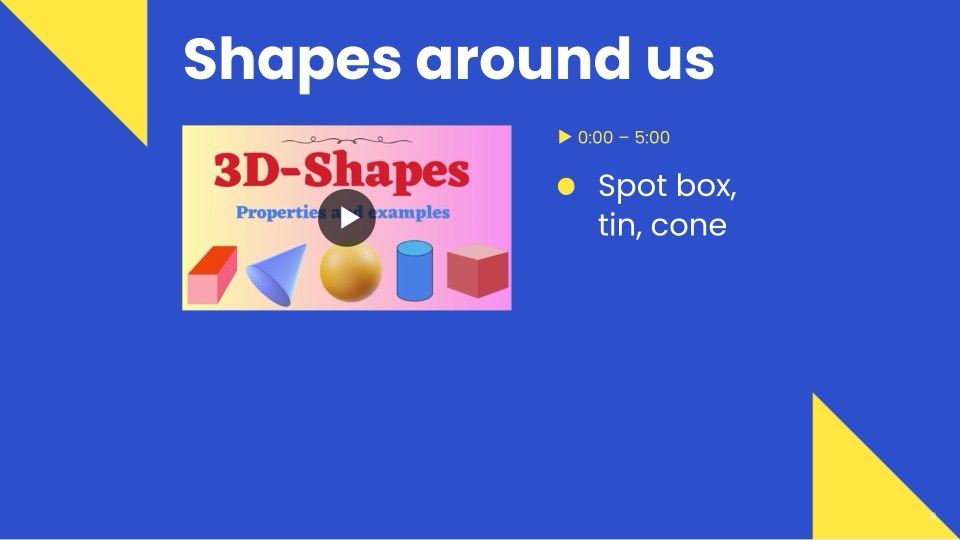
3D shapes with examples from 0:00 to 5:00
Superkids Gurukul: Basic understanding of 3D shapes- its properties with examples
Uses colourful visuals and real-life examples to show properties of cube, cuboid, sphere, cylinder and cone at a pace ideal for 6-7-year-olds.
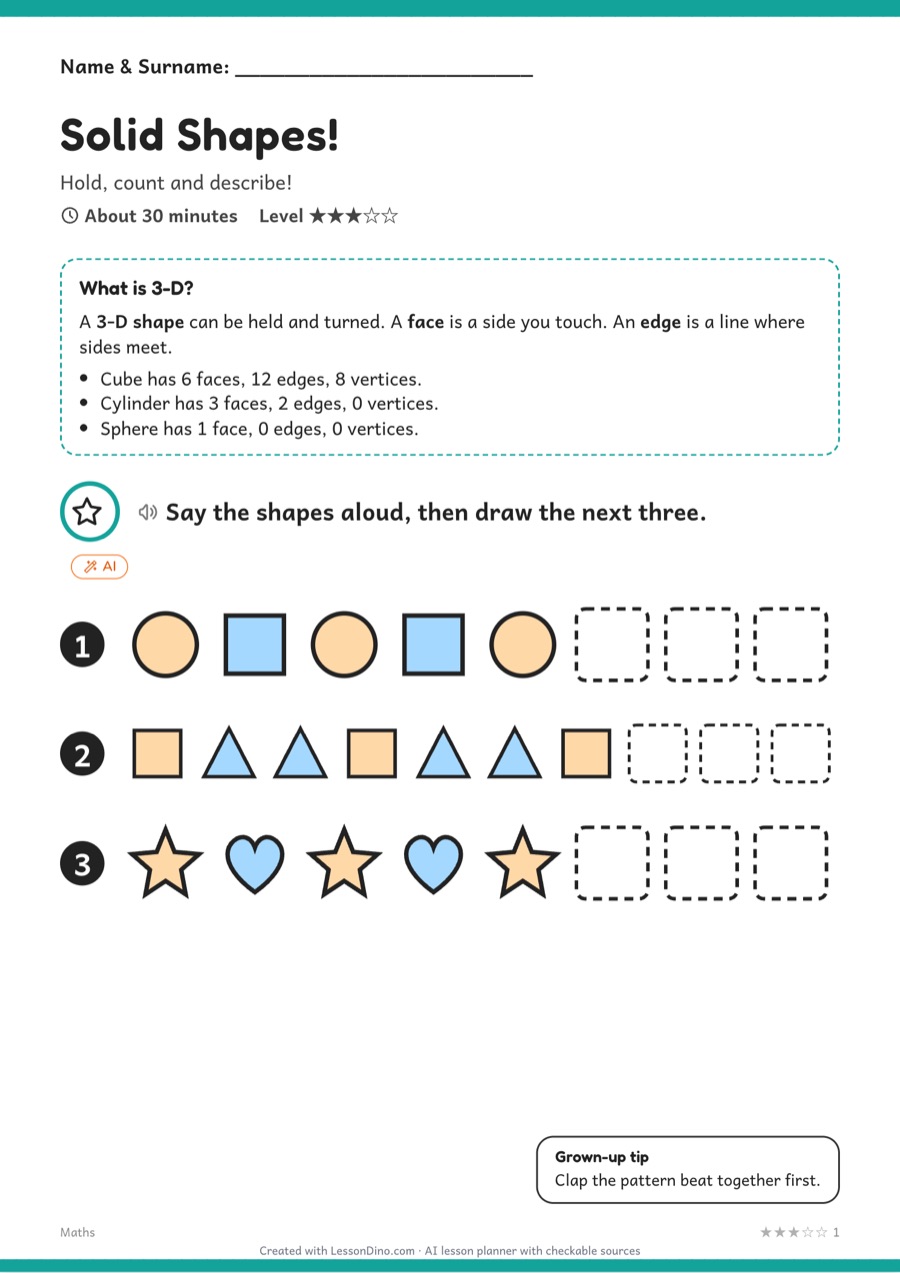
Worksheet
Sources
- National curriculum in England: mathematics programmes of study assets.publishing.service.gov.uk
- National curriculum in England: mathematics programmes of ... gov.uk
- What are the properties of 3D shapes? - BBC Bitesize bbc.co.uk
- Properties of 3D Shapes - KS3 Maths - BBC Bitesize bbc.co.uk
- Faces, edges and vertices of 3D shapes | Academy11+ academy11.co.uk
- Learn about the properties of 3D shapes - BBC Bitesize bbc.co.uk
- Recognise and describe 3D shapes - Maths - Learning ... - BBC bbc.co.uk
- What Children Know and Need to Learn about Shape and Space prek-math-te.stanford.edu
- What are 3D shapes? Names & properties - Doodle Learning doodlelearning.com
- Properties of 3D shapes – HeLovesMath helovesmath.com
- 3D Geometry Shapes - Definition, Properties, Types, Formulas cuemath.com
- properties of 3d shapes primarysite-prod-sorted.s3.amazonaws.com
- 3D Shapes for Kids: Names, Properties, and Real-World Examples boddlelearning.com
- The Importance of Shape and Space in the Early Years - NRICH Maths nrich.maths.org
Picture credits
- Photo: geralt · Pixabay
- Photo: sa_ba_sabrina · Pixabay
- Photo: No-longer-here · Pixabay
- AI illustration · Cloudflare
- Diagram: Garfungled · CC0 · Wikimedia Commons
- Drawing: Christian Lawson-Perfect · CC0 · Wikimedia Commons
- Pictograms: Sergio Palao, ARASAAC (arasaac.org) · CC BY-NC-SA
Made with Lesson Dino's AI on 19 October 2026. AI can make mistakes, so check facts against the sources before you teach.