The worksheet
About this worksheet
Students learn how water changes individual growth and population size. They measure seedlings, graph data, and write claims with evidence. This Grade 7 Science worksheet gives students (ages 12–13) five pages of practice on resources and populations in ecosystems, part of the ecosystems: interactions, energy, and dynamics unit. It goes with our free Resources and populations in ecosystems lesson, which has the slides and a timed lesson plan.
What it covers
By the end, students should be able to:
- Students will analyze seedling data to show how water affects growth.
- Students will explain cause and effect for abundant and scarce resources.
- Students will use data points as evidence for population claims in ecosystems.
How to use it
- Use it for practice after the teaching part of the lesson, once students have seen the worked examples on the slides.
- Support: Pre-made table with columns for cup, water amount, and height plus sentence starters for the claim.
- Stretch: Predict what would happen to height if water was cut in half again and explain why.
- The answer sheet is the last page, so you can print it on its own or let students check their own work.
Key vocabulary
- resource: something an organism needs to live and grow, such as food, water, or shelter
- population: all members of one kind of living thing living in the same place
- limited resource: something needed for life that can run out
- competition: when organisms both try to get the same thing that is in short supply
- scarce: when there is very little of something to use
Mistakes to watch for
- Thinking scarce resources only make individuals smaller, not populations smaller. Point to Slide 7: scarce means Slower growth, fewer offspring and numbers fall, because growth and population increases are limited by access to resources.
- Thinking populations can grow forever if animals want to. Show locust data: as populations get bigger, limited resources can start to run out, and competition slows growth or causes declines.
- Confusing competition with fighting rather than needing the same resource. Restate that organisms with similar requirements may compete for limited food, water, or space, even plants competing for water and light.
What's on the worksheet
Resources Limit Growth
Learn why populations rise and fall with resources.
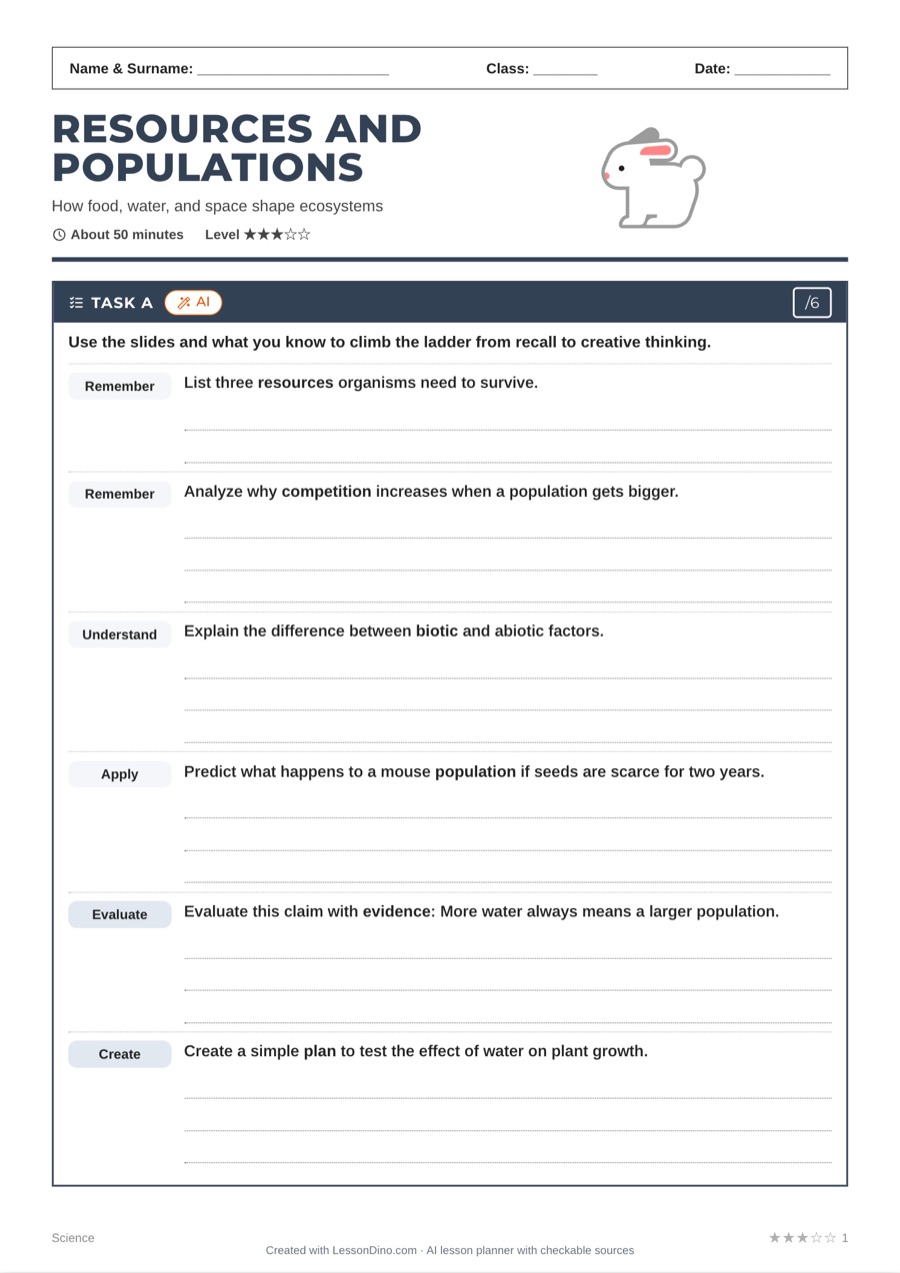
Use the slides and what you know to climb the ladder from recall to creative thinking.
- List three resources organisms need to survive.
- Analyze why competition increases when a population gets bigger.
- Explain the difference between biotic and abiotic factors.
- Predict what happens to a mouse population if seeds are scarce for two years.
- Evaluate this claim with evidence: More water always means a larger population.
- Create a simple plan to test the effect of water on plant growth.
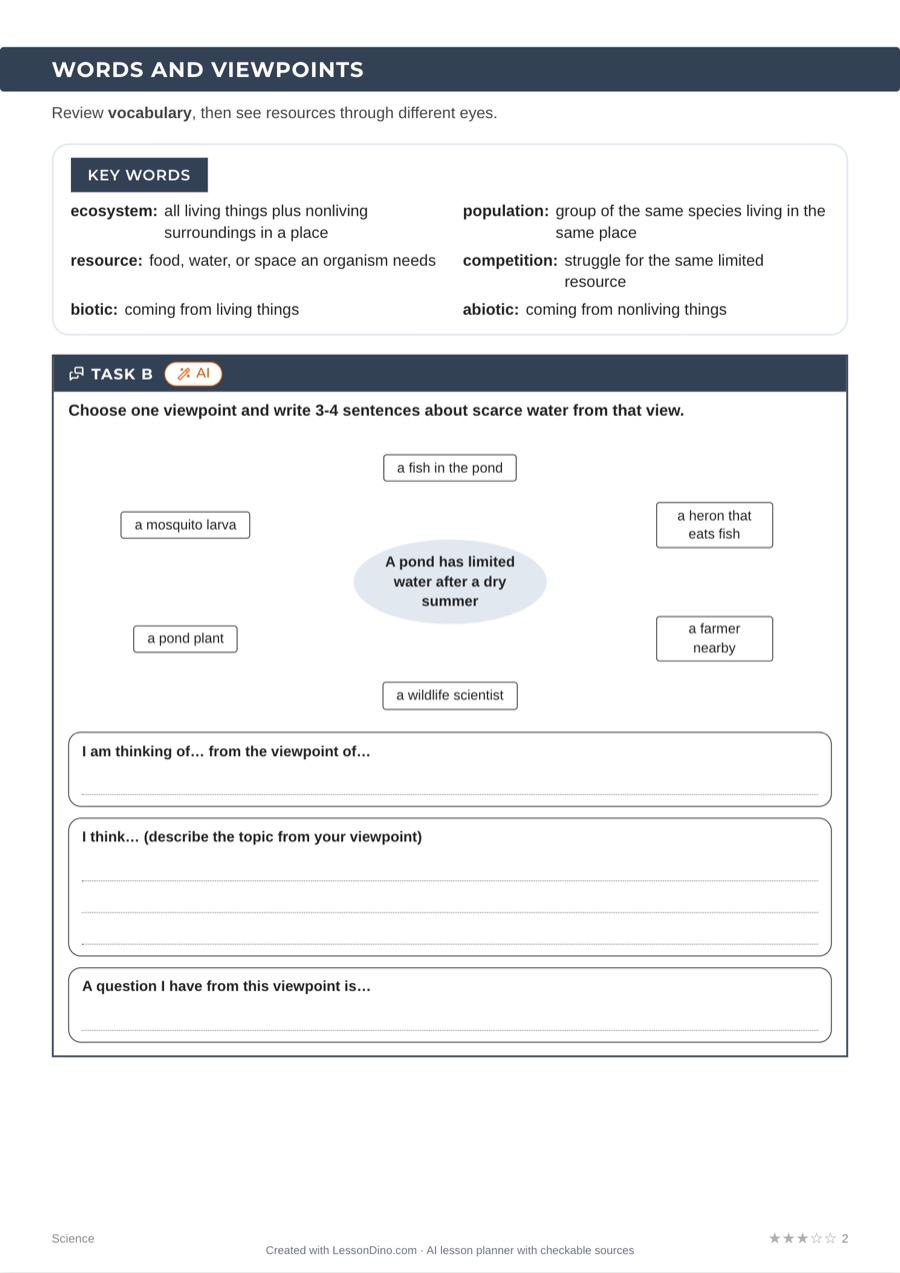
Words and Viewpoints
Review vocabulary, then see resources through different eyes.
| Word | Meaning |
|---|---|
| ecosystem | all living things plus nonliving surroundings in a place |
| population | group of the same species living in the same place |
| resource | food, water, or space an organism needs |
| competition | struggle for the same limited resource |
| biotic | coming from living things |
| abiotic | coming from nonliving things |
Choose one viewpoint and write 3-4 sentences about scarce water from that view.
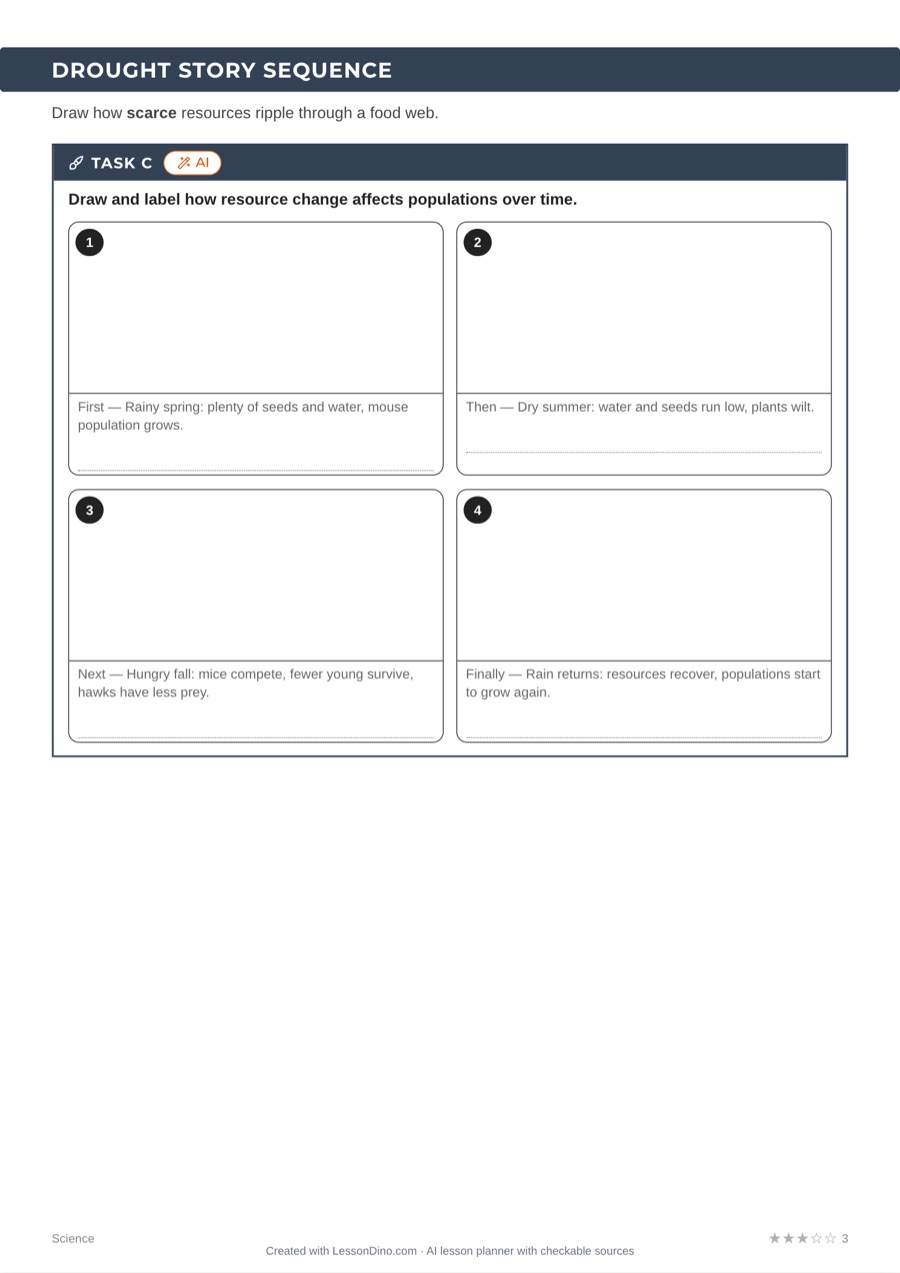
Drought Story Sequence
Draw how scarce resources ripple through a food web.
Draw and label how resource change affects populations over time.
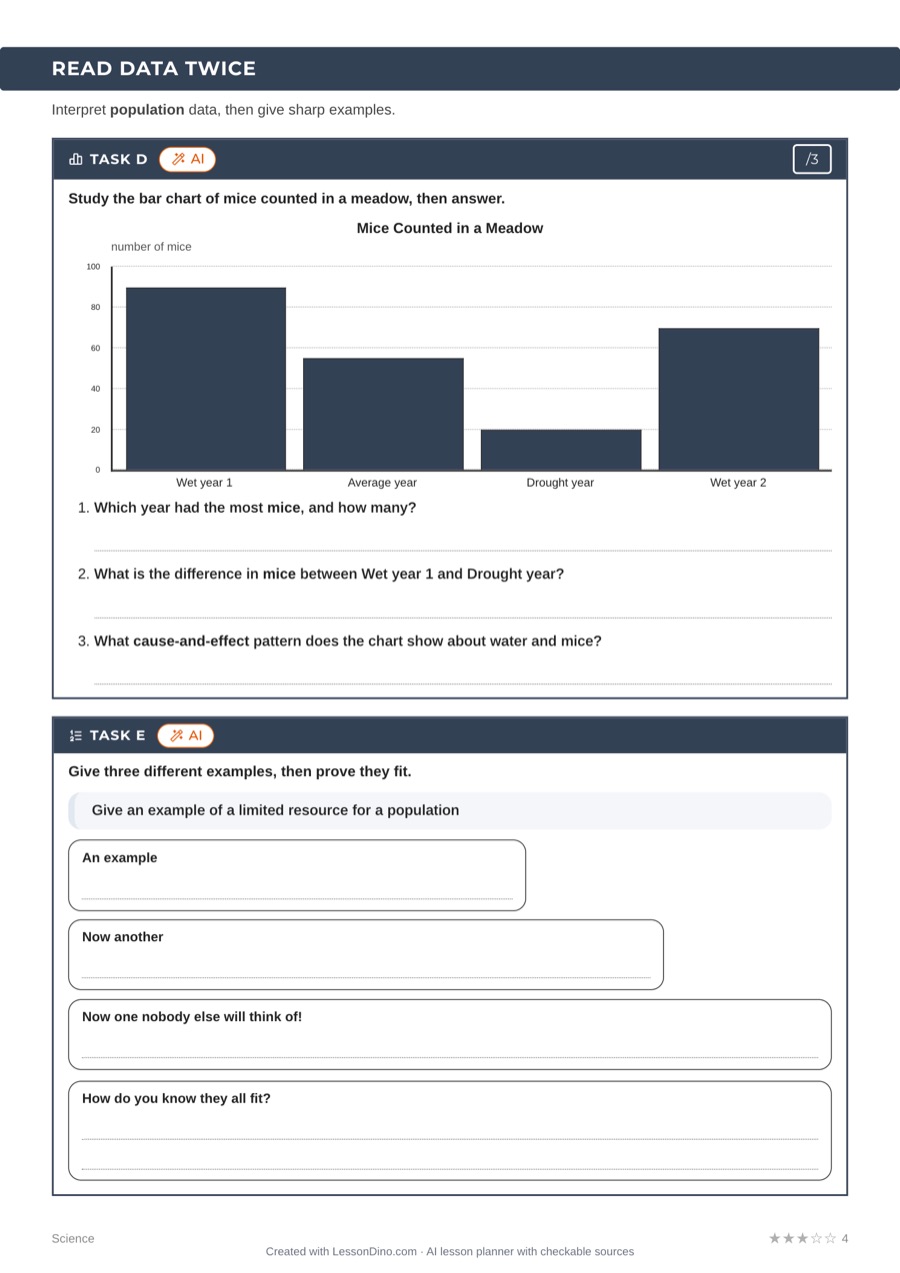
Read Data Twice
Interpret population data, then give sharp examples.
Study the bar chart of mice counted in a meadow, then answer.
- Which year had the most mice, and how many?
- What is the difference in mice between Wet year 1 and Drought year?
- What cause-and-effect pattern does the chart show about water and mice?
Give three different examples, then prove they fit.
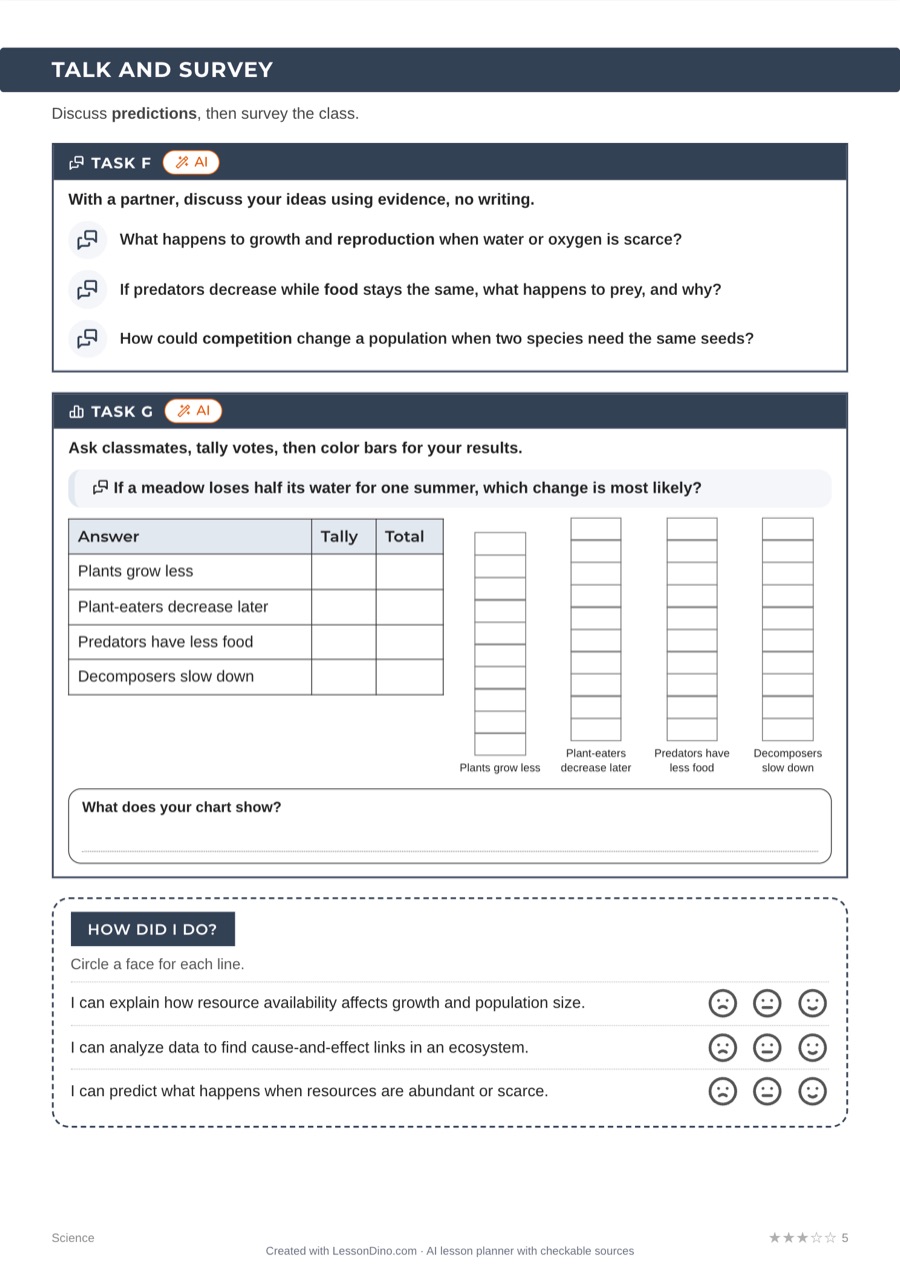
Talk and Survey
Discuss predictions, then survey the class.
With a partner, discuss your ideas using evidence, no writing.
- What happens to growth and reproduction when water or oxygen is scarce?
- If predators decrease while food stays the same, what happens to prey, and why?
- How could competition change a population when two species need the same seeds?
Ask classmates, tally votes, then color bars for your results.
Answers
Show the answers
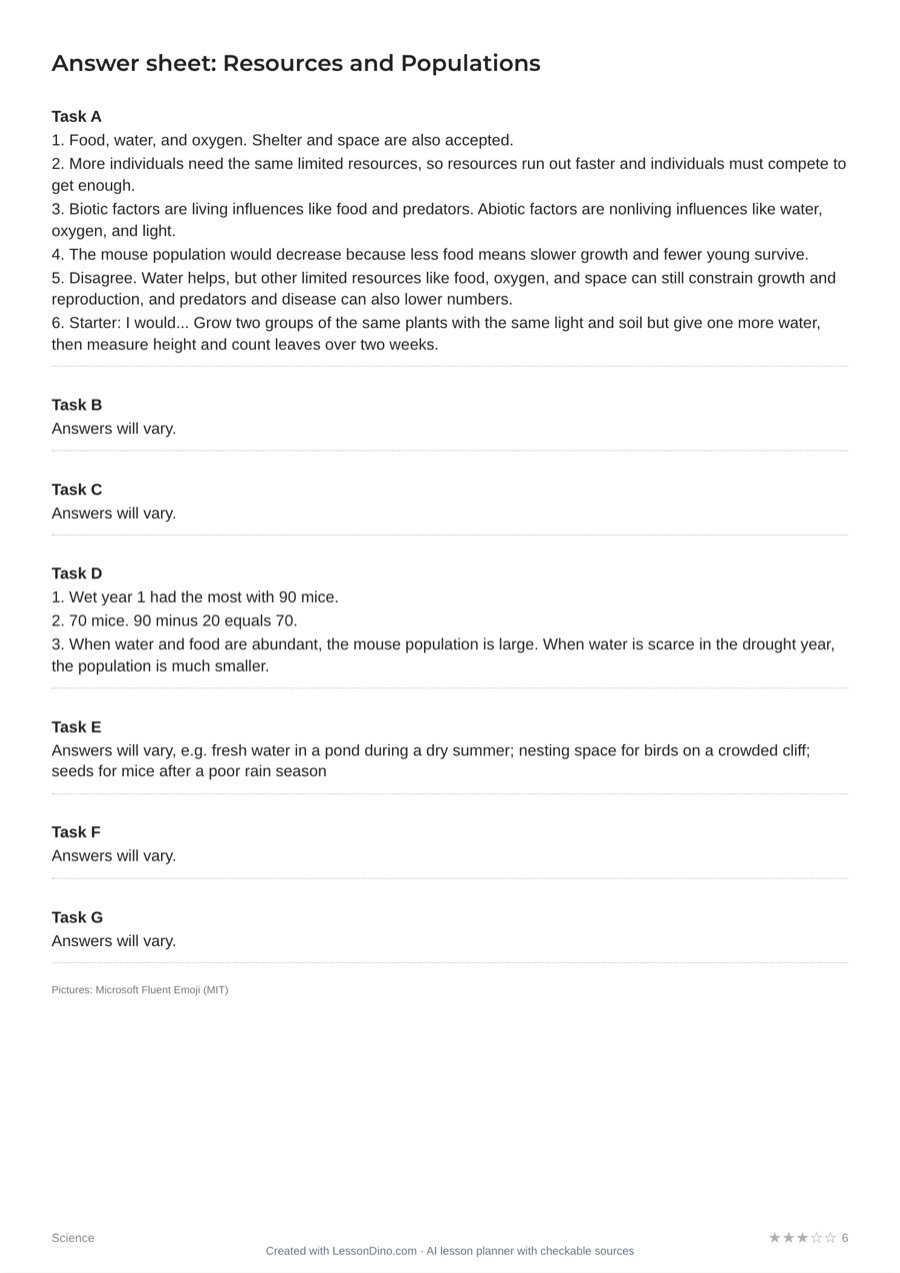
- List three resources organisms need to survive. Food, water, and oxygen. Shelter and space are also accepted.
- Analyze why competition increases when a population gets bigger. More individuals need the same limited resources, so resources run out faster and individuals must compete to get enough.
- Explain the difference between biotic and abiotic factors. Biotic factors are living influences like food and predators. Abiotic factors are nonliving influences like water, oxygen, and light.
- Predict what happens to a mouse population if seeds are scarce for two years. The mouse population would decrease because less food means slower growth and fewer young survive.
- Evaluate this claim with evidence: More water always means a larger population. Disagree. Water helps, but other limited resources like food, oxygen, and space can still constrain growth and reproduction, and predators and disease can also lower numbers.
- Create a simple plan to test the effect of water on plant growth. Starter: I would... Grow two groups of the same plants with the same light and soil but give one more water, then measure height and count leaves over two weeks.
- Which year had the most mice, and how many? Wet year 1 had the most with 90 mice.
- What is the difference in mice between Wet year 1 and Drought year? 70 mice. 90 minus 20 equals 70.
- What cause-and-effect pattern does the chart show about water and mice? When water and food are abundant, the mouse population is large. When water is scarce in the drought year, the population is much smaller.
The answer sheet is the last picture above.
Curriculum
Analyze and interpret data to provide evidence for the effects of resource availability on organisms and populations of organisms in an ecosystem.
Made with Lesson Dino's AI on 17 October 2026. AI can make mistakes, so check the answers and facts against the sources before you teach.