Slides
Lesson plan
Did It Really React?
Students compare properties before and after mixing. They decide with evidence if a new substance formed.
Objectives
- Students will compare color, state, bubbles and temperature in °F before and after mixing.
- Students will use property evidence to decide if a new substance formed.
Success criteria
- I can record before-and-after properties for each sample.
- I can claim reaction or not using two property changes.
Key words
| Word | Meaning |
|---|---|
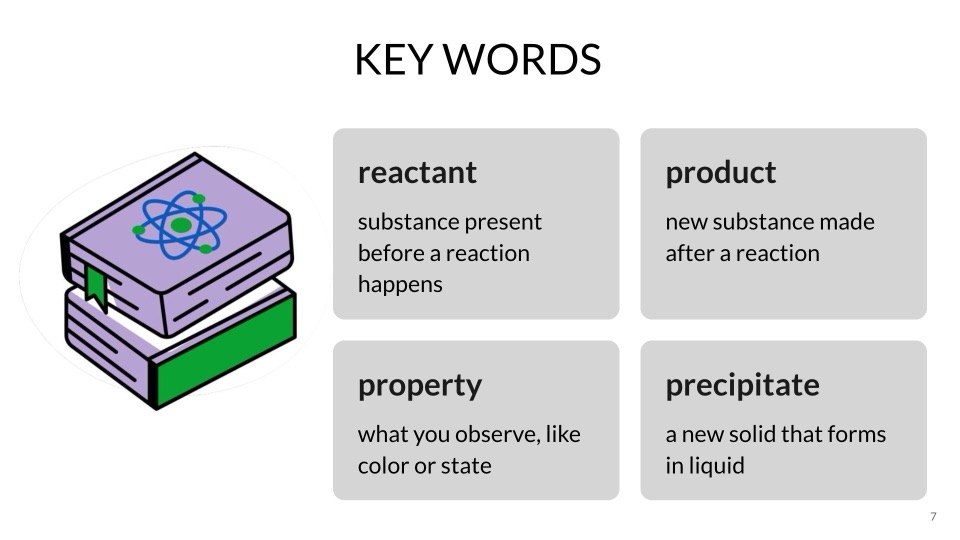
| reactant | a starting material present before a change happens |
| product | a new material made after a change happens |
| property | something you can observe about matter, like color, state, or temperature |
| precipitate | a solid that forms inside a liquid during a change |
| chemical reaction | starting materials changing into one or more different materials |
Timed plan (60 minutes)
| Time | Stage | What happens |
|---|---|---|
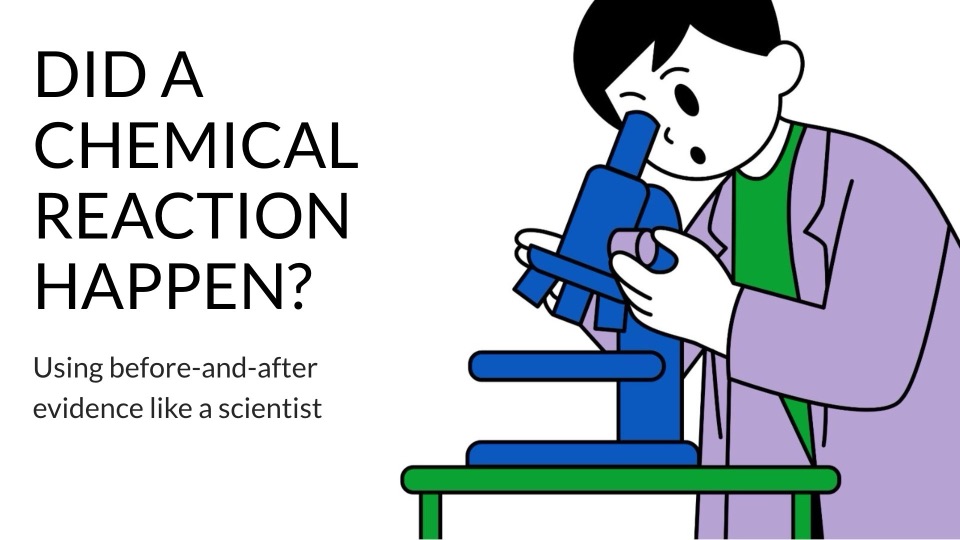
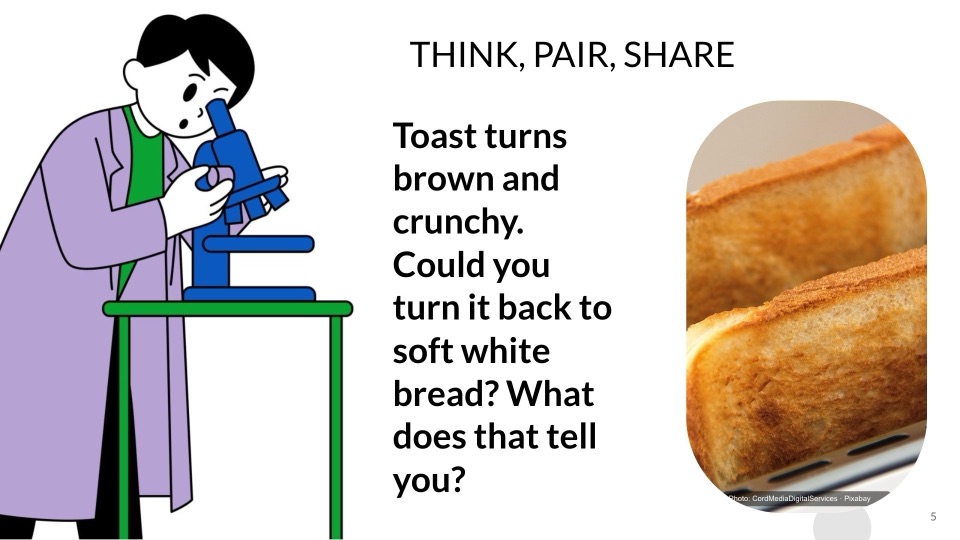
| 5 min | Starter | Hook students and recall that new substances mean something different formed. Show Slide 1: Did a Chemical Reaction Happen? Say the hook question and show Slide 2 photo of before-and-after comparison. Show Slide 5 question about toast turning brown and crunchy. Take 3 quick votes: could you turn toast back to soft white bread? |
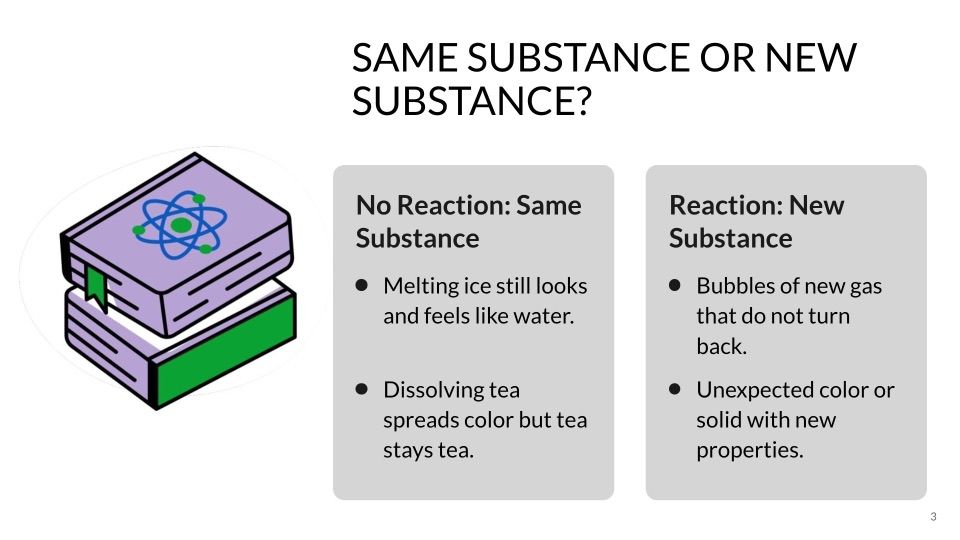
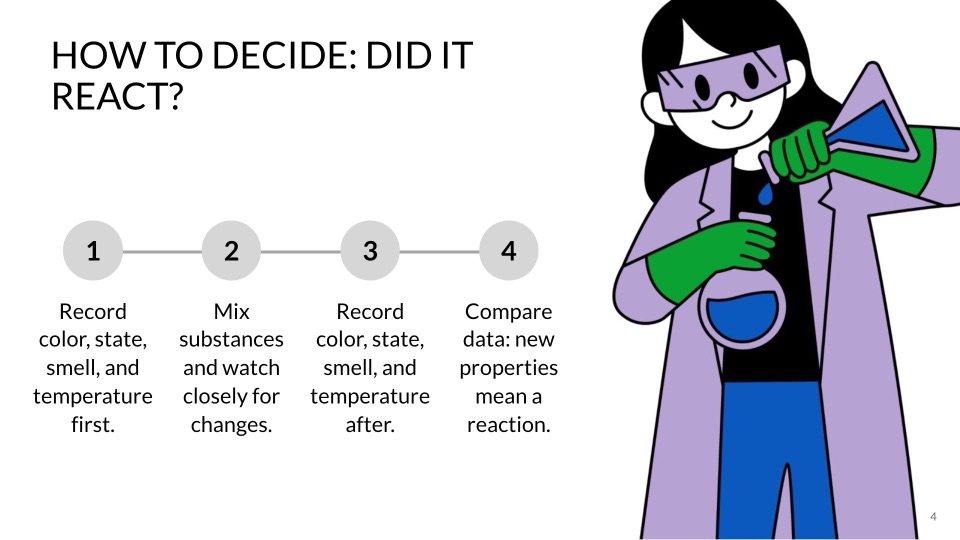
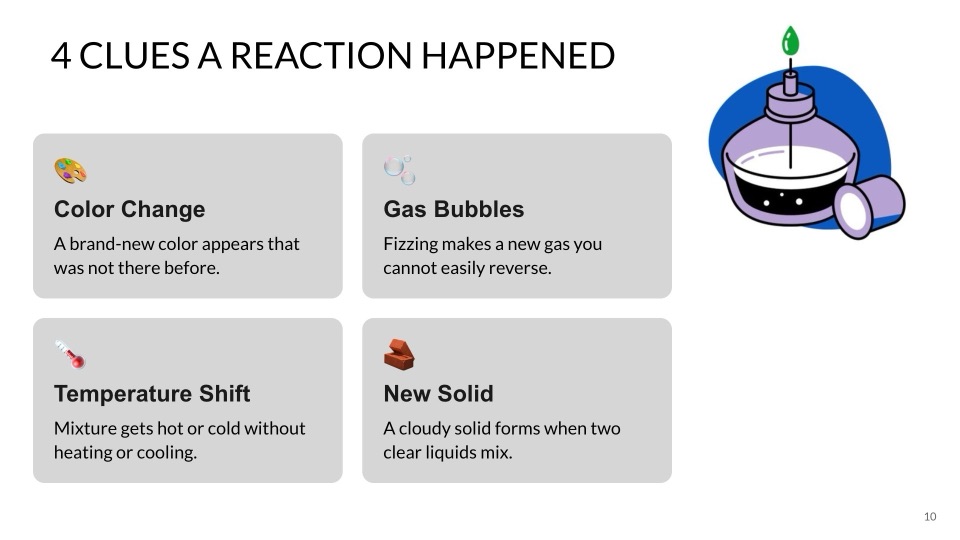
| 10 min | Teaching | Teach the 4 clues and how to record before-and-after evidence. Show Slide 3 compare: melting ice and dissolving tea stay same substance. Show Slide 4 steps: record color, state, smell, temperature first, mix, watch, record after. Teach Slide 7 words: reactant, product, property, precipitate and Slide 10 cards for color change, gas bubbles, temperature shift. Model one decision on the board with before-and-after boxes. |
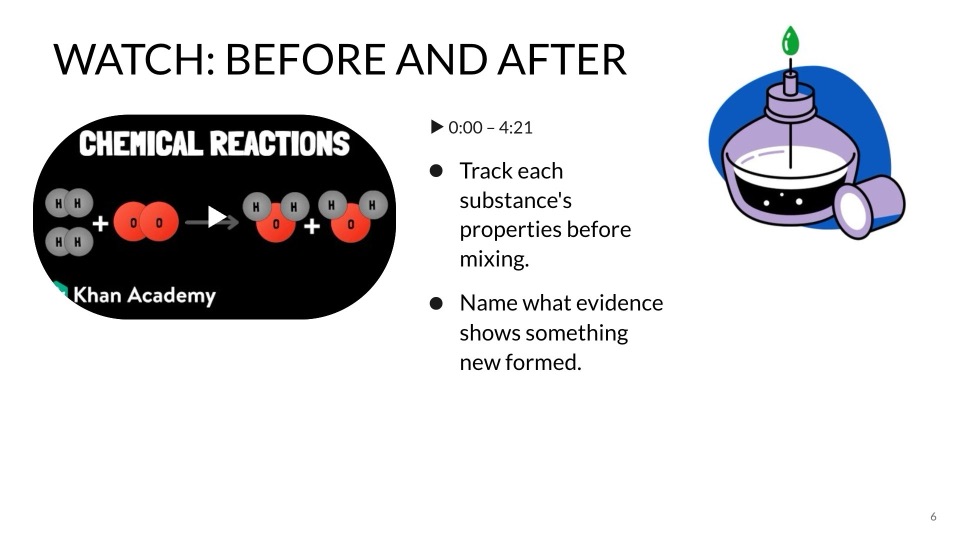
| 10 min | Guided video | See real before-and-after tracking and name the evidence. Show Slide 6: Watch: Before and After. Play Video clip 1 (0:00-4:21) and pause twice to name properties. Think aloud to fill before-and-after table for one demo. Link each clue to new substance or just mixed. |
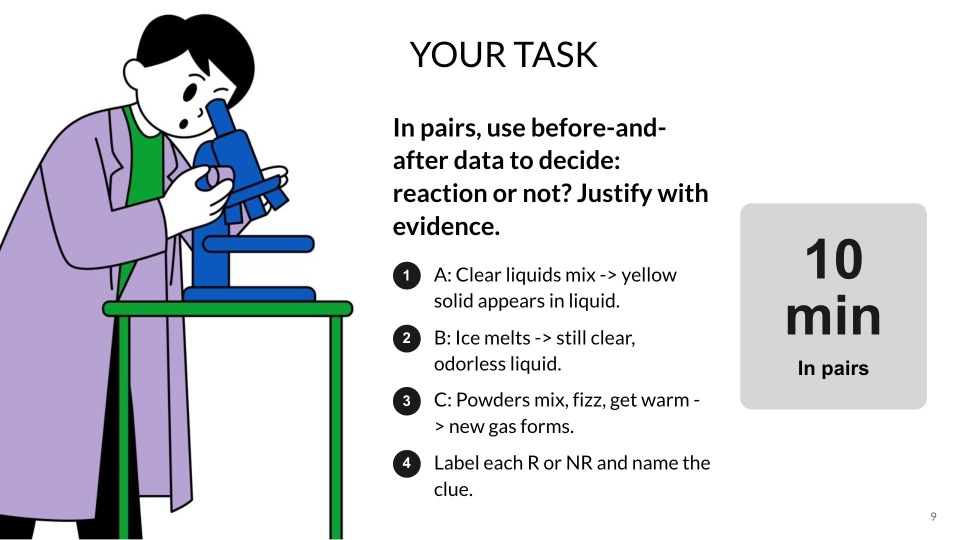
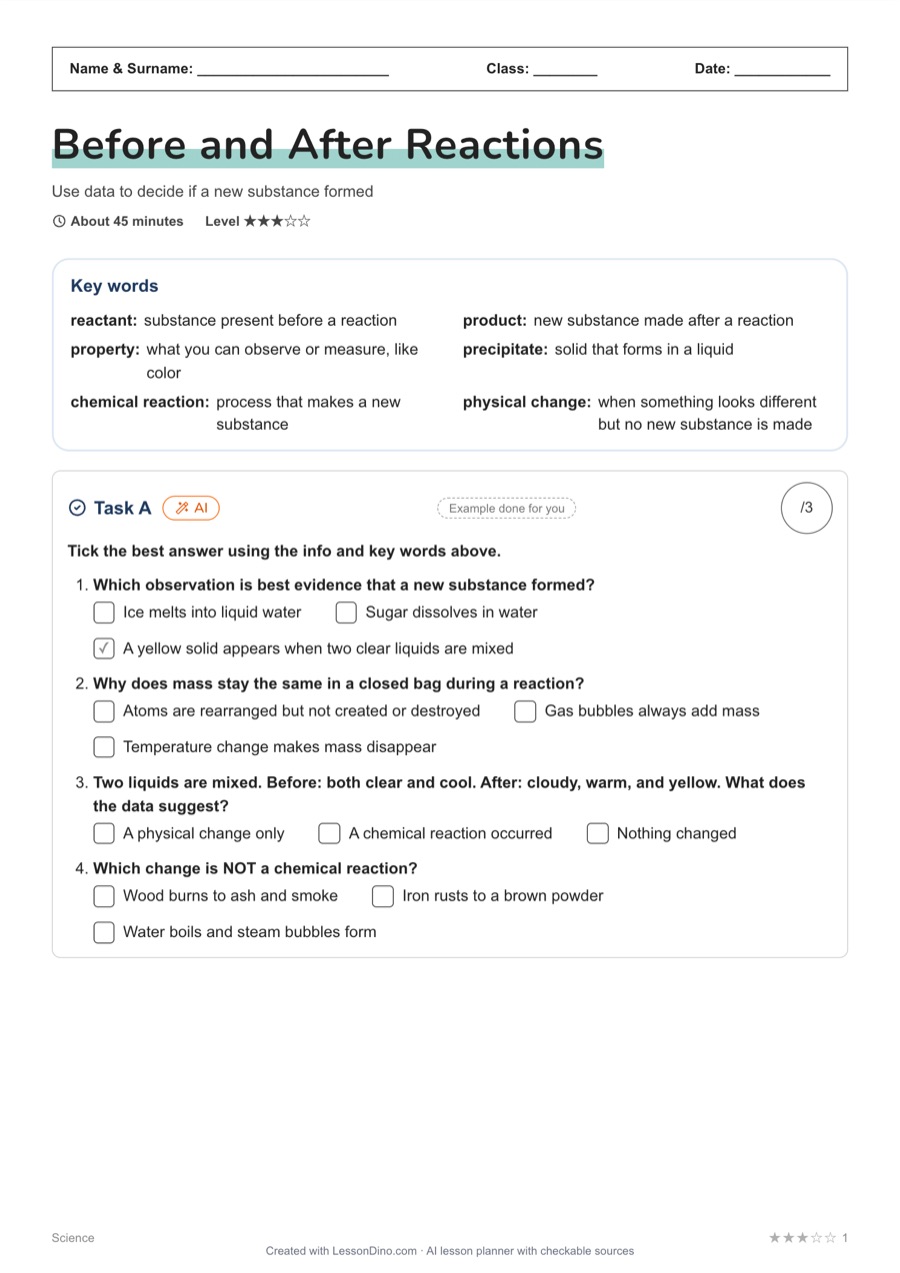
| 25 min | Main Activity | Test samples and write claims with before-and-after evidence. Show Slide 9 task: A yellow solid case, B ice melts case, C fizzing warm powders case. Hand out goggles, cups, baking soda, vinegar, ice cubes, thermometers in °F, observation sheet / Worksheet Task D. Direct groups: record before, mix small amounts, record after for 2 live tests, then use data photos for yellow solid case. Circulate, prompt claims with two property changes and reactant/product labels. |
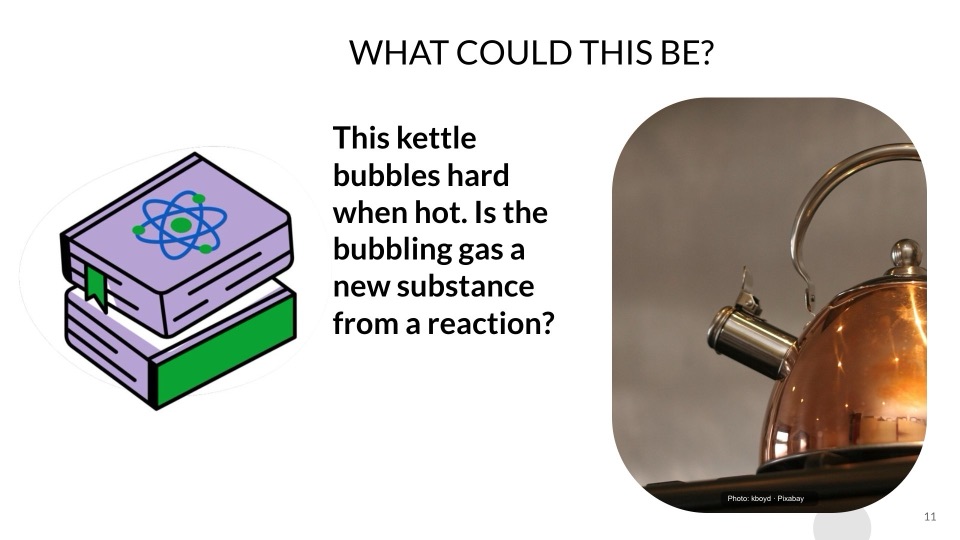
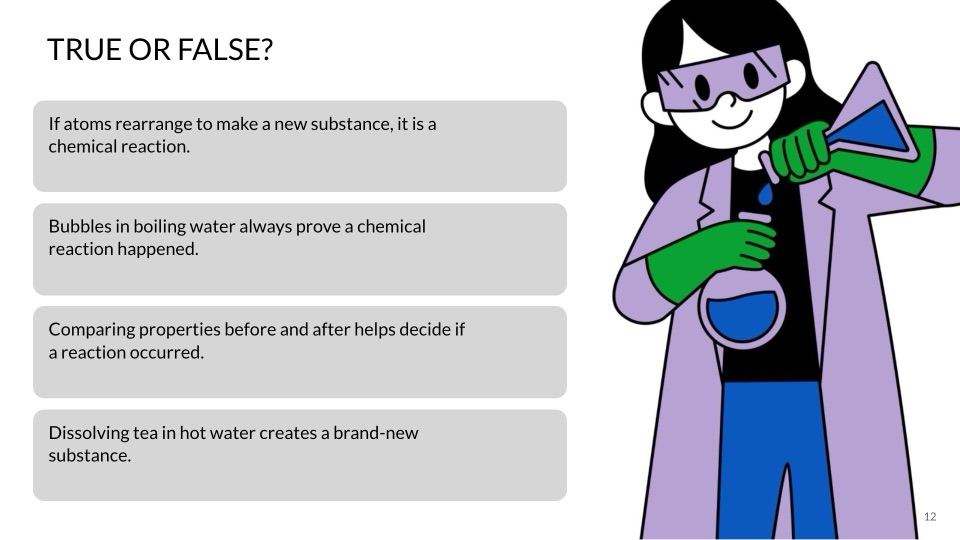
| 10 min | Plenary | Fix the boiling trick and agree on when bubbles count. Show Slide 11 mystery: kettle bubbles hard when hot. Contrast with fizzing mixture that leaves new material. Show Slide 12 true/false for rearrangement and bubbles in boiling water. Hand out Worksheet Task F for final two-sentence rule. |
Common mistakes
- Thinking all bubbles mean a chemical reaction.
How to spot it: Calls boiling kettle water a reaction.
Cool the steam: it condenses back to liquid water, so boiling is a physical change, not a chemical reaction. Ask for proof of a new gas. - Thinking color spreading by dissolving means new substance.
How to spot it: Calls tea in water a reaction because color changed.
Tea chemicals dissolving is a physical change. A new substance must be produced for a reaction. - Thinking atoms disappear or appear.
How to spot it: Counts show different totals before and after.
Recount together: atoms are rearranged but the number of atoms does not change.
Support
- Give sentence frame with word bank for color, gas, temperature in °F, and solid for all claims.
- Pre-fill before-properties so focus is on after-properties and evidence.
Stretch
- Have students predict what observations would look like if atoms rearranged but number did not change.
- Have teams add an everyday example card and defend with before-and-after properties.
Check questions
- Clear liquids mix and a bright yellow solid appears. Reaction? Give one evidence.
Answer: Yes. New solid product formed from clear liquids shows a precipitation reaction with solid products. - Ice melts to clear liquid and temperature stays cold. Reaction? Why?
Answer: No. Same substance, only state changed from solid to liquid. - Powder + liquid fizzes, makes new gas, and temperature drops. Reaction? Why?
Answer: Yes. Gas bubbles plus large energy change show new substances formed from reactants.
Curriculum
Analyze and interpret data on the properties of substances before and after the substances interact to determine if a chemical reaction has occurred.
From Next Generation Science Standards (middle school), MS-PS1-2.
Video clips
Clips on YouTube, from the start and end times we chose. Check each one before you show it.
-
Middle school chemical reactions from 0:00 to 4:21
Khan Academy: Chemical reactions | Middle school chemistry | Khan Academy
Explicitly made for middle school and ideal for 12-13 with clear before-and-after examples of a chemical reaction.
-
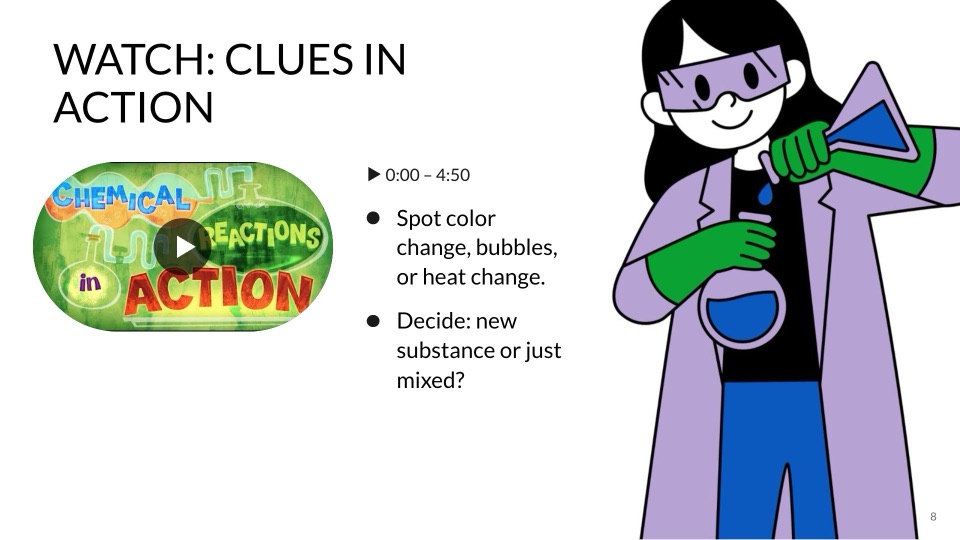
Chemical reactions in action from 0:00 to 4:50
Smithsonian Science Education Center (SSEC): Good Thinking! — Chemical Reactions in Action
From a trusted museum education channel with vocabulary and pace perfect for 12-13 and focused on evidence of reactions.
Worksheet
Sources
- 7th Grade Science Curriculum boepublic.parkhill.k12.mo.us
- Grade 7 Science Curriculum - Fairfax County Public Schools fcps.edu
- CH150: Chapter 5 – Chemical Reactions - Chemistry wou.edu
- Chemical Reactions | Harvard Natural Sciences Lecture Demonstrations sciencedemonstrations.fas.harvard.edu
- 8.3 Other Types of Chemical Reactions – Chemistry Fundamentals pressbooks.online.ucf.edu
- 8.1 Chemical Equations and Stochiometric Relationships - Chemistry ... pressbooks.online.ucf.edu
- Chemical Reactions chemed.chem.purdue.edu
- Classifying Chemical Reactions - Chemistry - UH Pressbooks pressbooks-dev.oer.hawaii.edu
- Chemical reactions - KS3 Chemistry - BBC Bitesize bbc.co.uk
- What is a chemical reaction? - BBC Bitesize bbc.co.uk
- Understanding chemical reactions KS3 | Y8 Science | Lesson Resources thenational.academy
- Characteristics of chemical reactions KS3 | Y8 Science | Lesson ... thenational.academy
- Chemical reaction | Definition, Equations, Examples, & Types | Britannica britannica.com
- chemical reaction - Students | Britannica Kids | Homework Help kids.britannica.com
- Chemical reaction - Energy, Reactants, Products | Britannica britannica.com
- Chemical reactions | High school chemistry | Science | Khan Academy khanacademy.org
- Learn: Types of chemical reactions - Khan Academy khanacademy.org
- Chemistry for Kids: Chemical Reactions - Ducksters ducksters.com
- Chemical Reaction - Definition, Equations, Types, Energy Changes and ... flexbooks.ck12.org
- Chemical Reactions - Page 3 | Live Science livescience.com
- Belousov–Zhabotinsky reaction en.wikipedia.org
- Biochemistry : the chemical reactions of living cells : Metzler,… archive.org
- [2204.04201v1] A Mini-Chemical Scheme with Net Reactions for 3D … arxiv.org
- chemical reactions | American Council on Science and Health acsh.org
- Chemical Reactions Overview - Chemistry LibreTexts chem.libretexts.org
Picture credits
Made with Lesson Dino's AI on 16 October 2026. AI can make mistakes, so check facts against the sources before you teach.