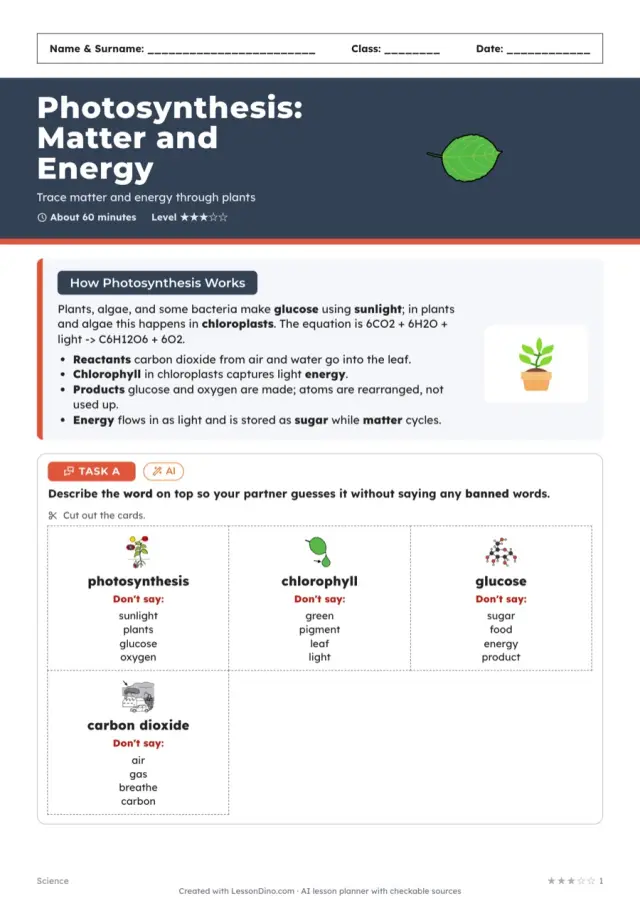
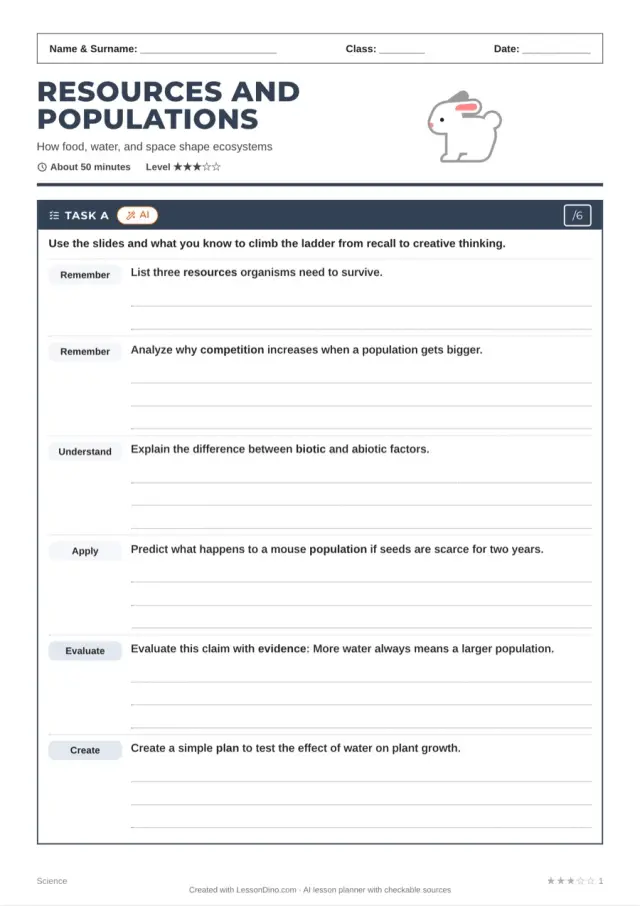
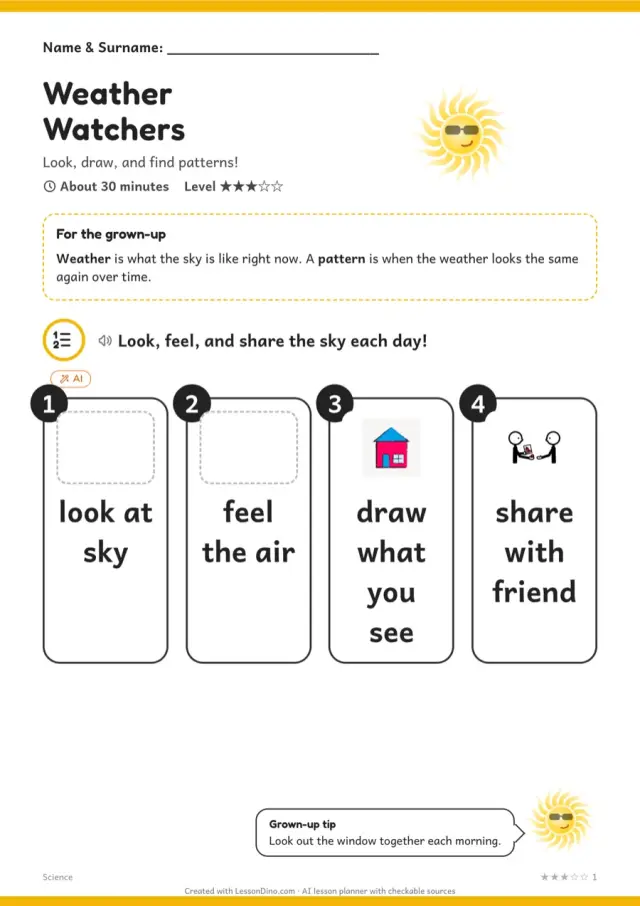
The worksheet
About this worksheet
Students compare properties before and after mixing. They decide with evidence if a new substance formed. This Grade 7 Science worksheet gives students (ages 12–13) five pages of practice on chemical reactions, part of the matter and its interactions unit. It goes with our free Chemical reactions lesson, which has the slides and a timed lesson plan.
What it covers
By the end, students should be able to:
- Students will compare color, state, bubbles and temperature in °F before and after mixing.
- Students will use property evidence to decide if a new substance formed.
How to use it
- Main Activity (25 minutes): Hand out goggles, cups, baking soda, vinegar, ice cubes, thermometers in °F, observation sheet / Worksheet Task D.
- Plenary (10 minutes): Hand out Worksheet Task F for final two-sentence rule.
- Support: Give sentence frame with word bank for color, gas, temperature in °F, and solid for all claims.
- Stretch: Have students predict what observations would look like if atoms rearranged but number did not change.
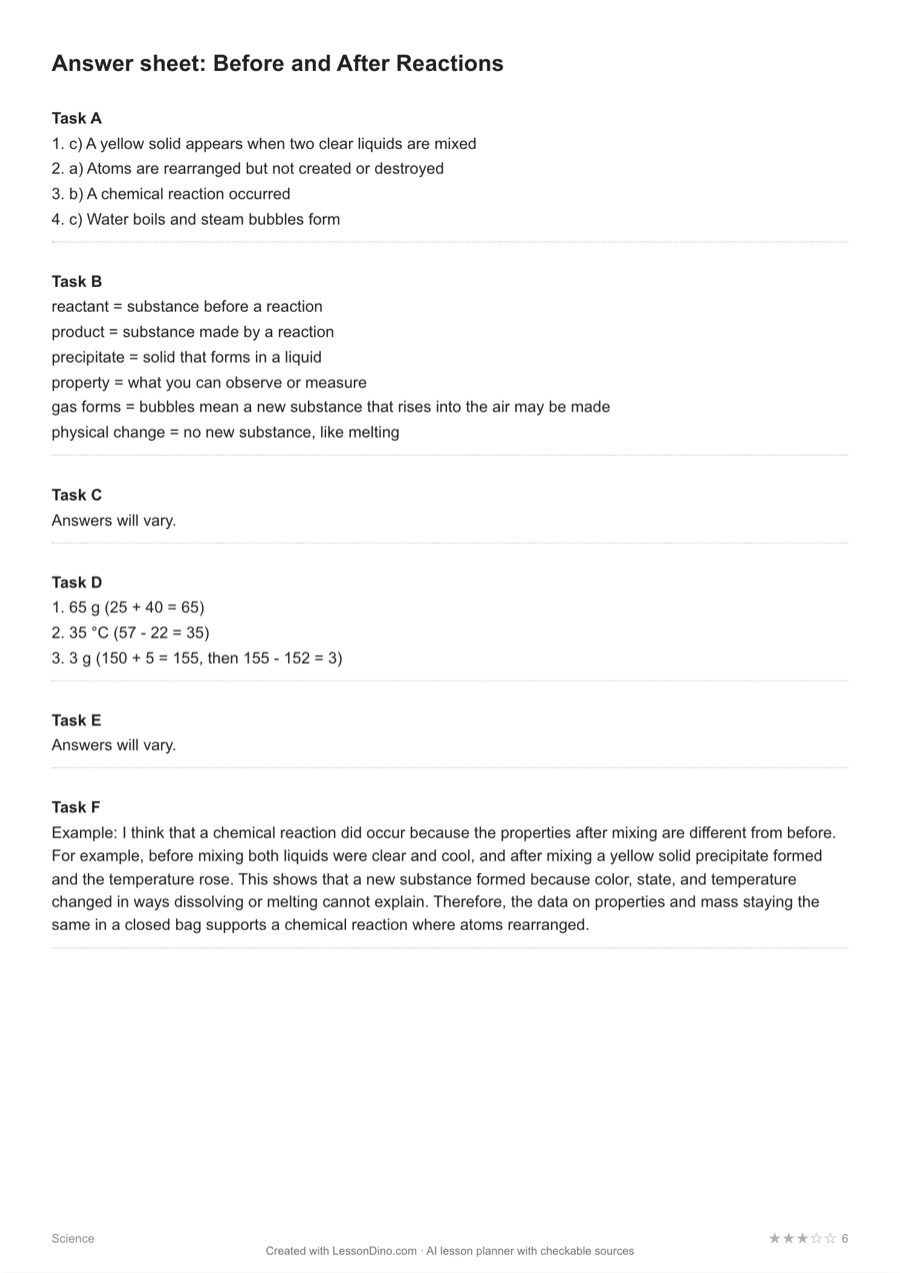
- The answer sheet is the last page, so you can print it on its own or let students check their own work.
Key vocabulary
- reactant: a starting material present before a change happens
- product: a new material made after a change happens
- property: something you can observe about matter, like color, state, or temperature
- precipitate: a solid that forms inside a liquid during a change
- chemical reaction: starting materials changing into one or more different materials
Mistakes to watch for
- Thinking all bubbles mean a chemical reaction. Cool the steam: it condenses back to liquid water, so boiling is a physical change, not a chemical reaction. Ask for proof of a new gas.
- Thinking color spreading by dissolving means new substance. Tea chemicals dissolving is a physical change. A new substance must be produced for a reaction.
- Thinking atoms disappear or appear. Recount together: atoms are rearranged but the number of atoms does not change.
What's on the worksheet
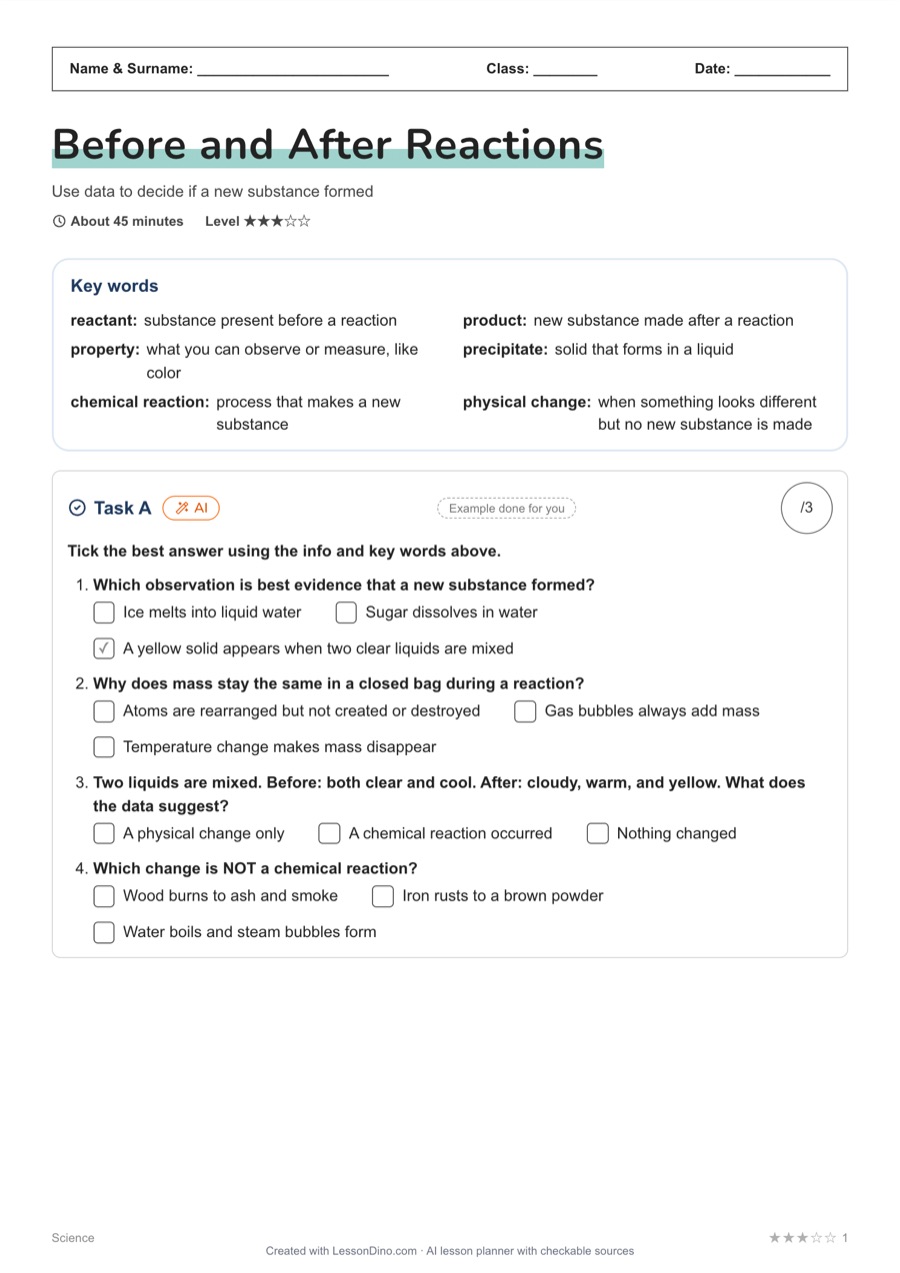
Signs of Change
Learn how to tell if a chemical reaction happened.
| Word | Meaning |
|---|---|
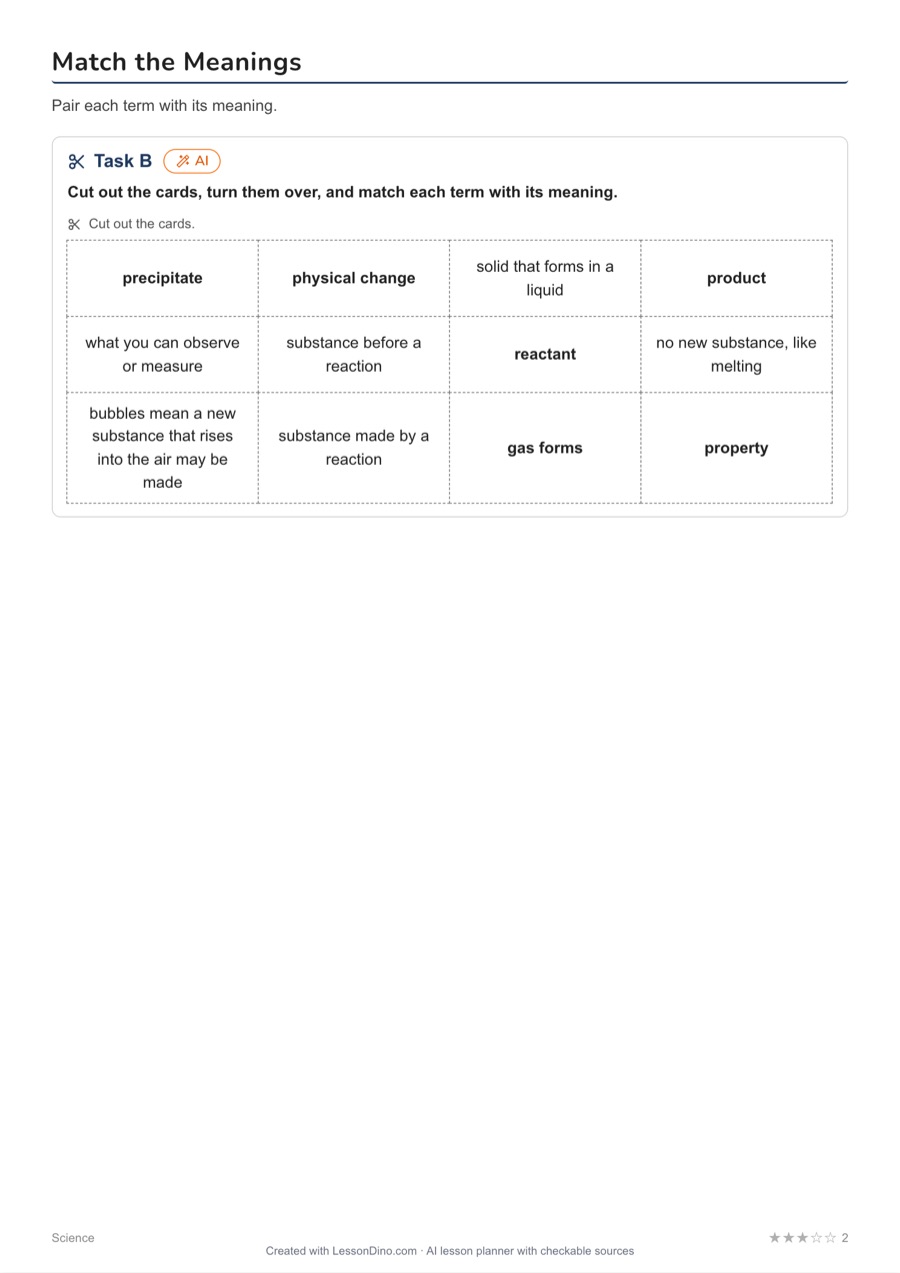
| reactant | substance present before a reaction |
| product | new substance made after a reaction |
| property | what you can observe or measure, like color |
| precipitate | solid that forms in a liquid |
| chemical reaction | process that makes a new substance |
| physical change | when something looks different but no new substance is made |
Tick the best answer using the info and key words above.
- Which observation is best evidence that a new substance formed?
- Why does mass stay the same in a closed bag during a reaction?
- Two liquids are mixed. Before: both clear and cool. After: cloudy, warm, and yellow. What does the data suggest?
- Which change is NOT a chemical reaction?
Match the Meanings
Pair each term with its meaning.
Cut out the cards, turn them over, and match each term with its meaning.
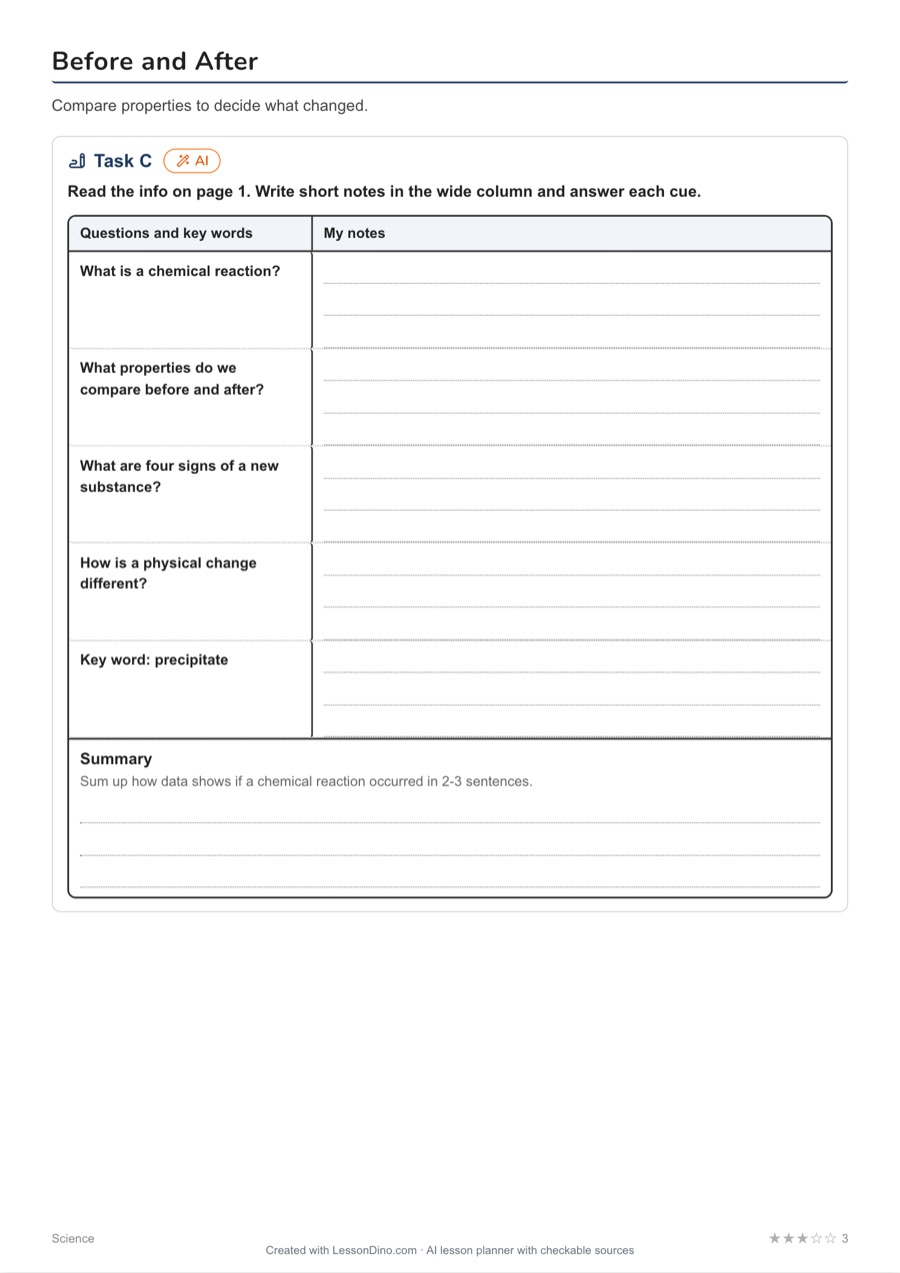
Before and After
Compare properties to decide what changed.
Read the info on page 1. Write short notes in the wide column and answer each cue.
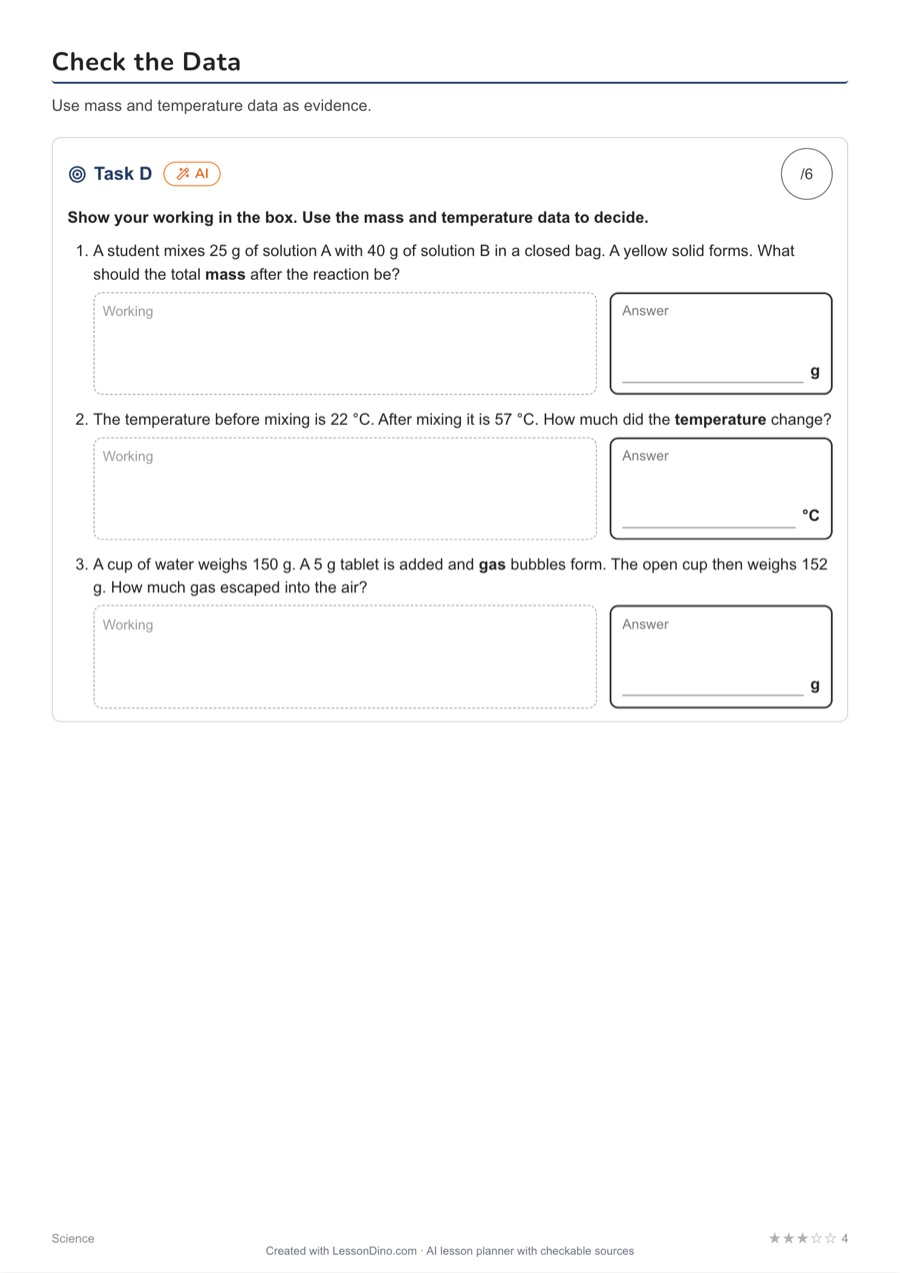
Check the Data
Use mass and temperature data as evidence.
Show your working in the box. Use the mass and temperature data to decide.
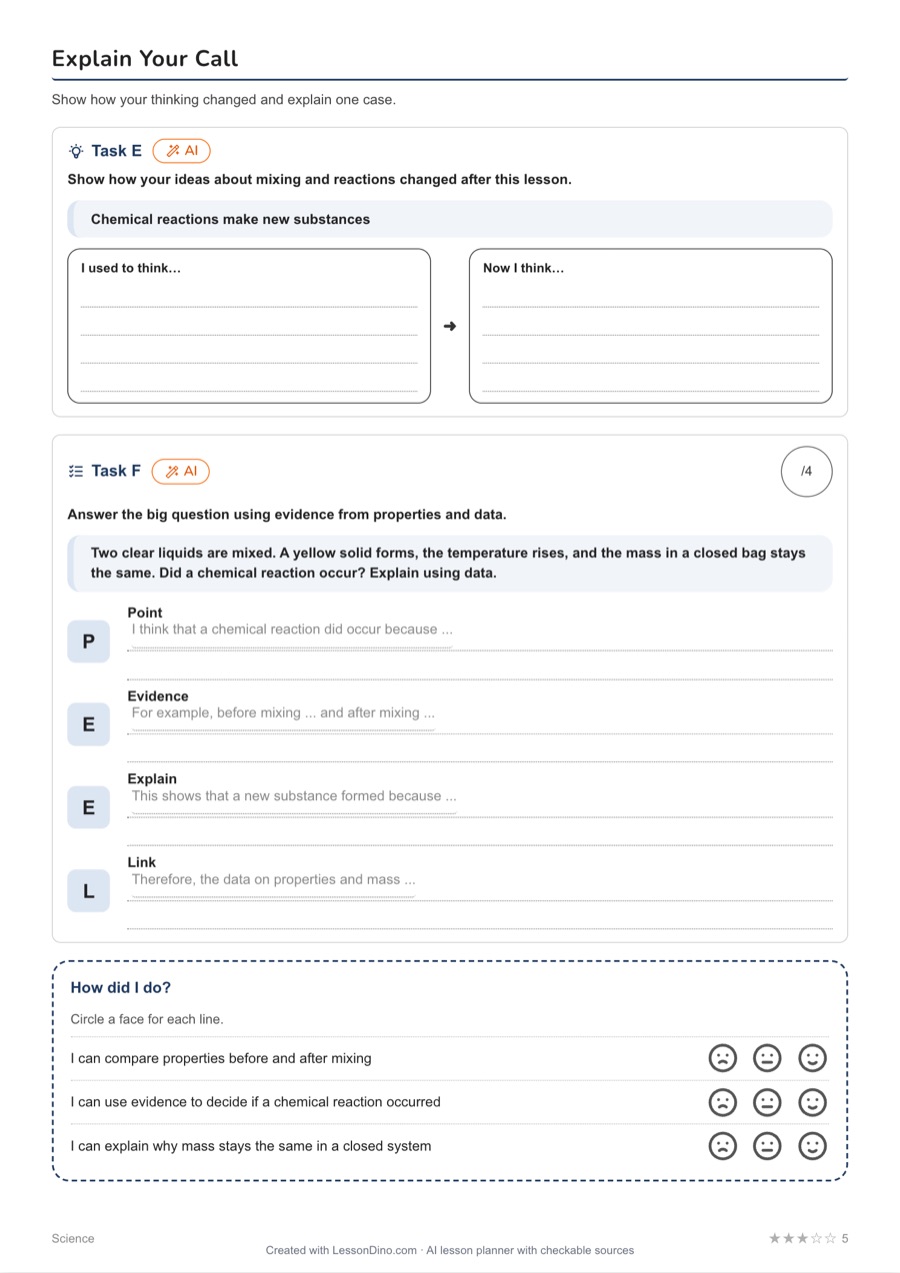
Explain Your Call
Show how your thinking changed and explain one case.
Show how your ideas about mixing and reactions changed after this lesson.
Answer the big question using evidence from properties and data.
Answers
Show the answers
- A student mixes 25 g of solution A with 40 g of solution B in a closed bag. A yellow solid forms. What should the total mass after the reaction be? 65 g
- The temperature before mixing is 22 °C. After mixing it is 57 °C. How much did the temperature change? 35 °C
- A cup of water weighs 150 g. A 5 g tablet is added and gas bubbles form. The open cup then weighs 152 g. How much gas escaped into the air? 3 g
The answer sheet is the last picture above.
Curriculum
Analyze and interpret data on the properties of substances before and after the substances interact to determine if a chemical reaction has occurred.
From Next Generation Science Standards (middle school), MS-PS1-2.
Made with Lesson Dino's AI on 16 October 2026. AI can make mistakes, so check the answers and facts against the sources before you teach.