Slides
Lesson plan
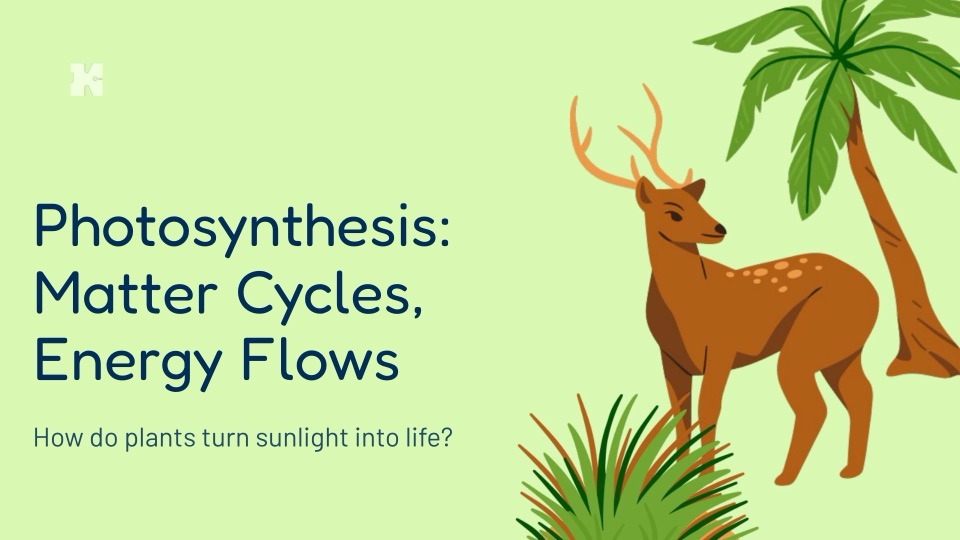
Photosynthesis: Matter Cycles, Energy Flows
Students learn how photosynthesis cycles matter and moves energy into life. They sort evidence and write a claim-evidence-reasoning explanation.
Objectives
- Students will identify inputs and outputs of photosynthesis using the equation.
- Students will trace how atoms cycle through photosynthesis into sugar and oxygen.
- Students will explain how light energy flows into chemical energy stored in sugar.
Success criteria
- I can write the photosynthesis equation and label reactants and products.
- I can trace carbon, hydrogen and oxygen atoms to sugar and oxygen.
- I can describe energy flow from sunlight to chemical energy in sugar.
Key words
| Word | Meaning |
|---|---|
| photosynthesis | the process where green living things make sugar from water and carbon dioxide using light |
| carbon dioxide | a gas in air that plants breathe in and use to build sugar |
| glucose | a kind of sugar that stores energy plants can use to grow |
| chlorophyll | green coloring inside leaves that catches blue and red light |
| chemical energy | energy held in sugar links that living things can later use |
Timed plan (60 minutes)
| Time | Stage | What happens |
|---|---|---|
| 8 min | Starter | Hook students and surface ideas about where plant mass comes from. Show Slide 1 and read the title question: How do plants turn sunlight into life? Use the hook: A student says plants eat soil to grow bigger. How would you prove them wrong with evidence? Poll the class: soil, water, or air for most new wood, then have neighbors give one reason in 1 minute. Show Slide 2 objectives and tell students they will prove the answer with evidence today. |
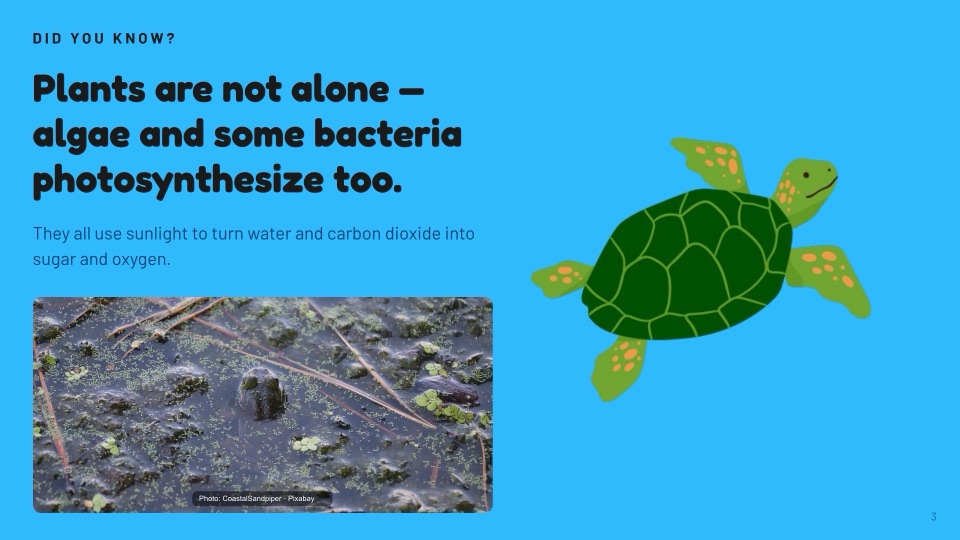
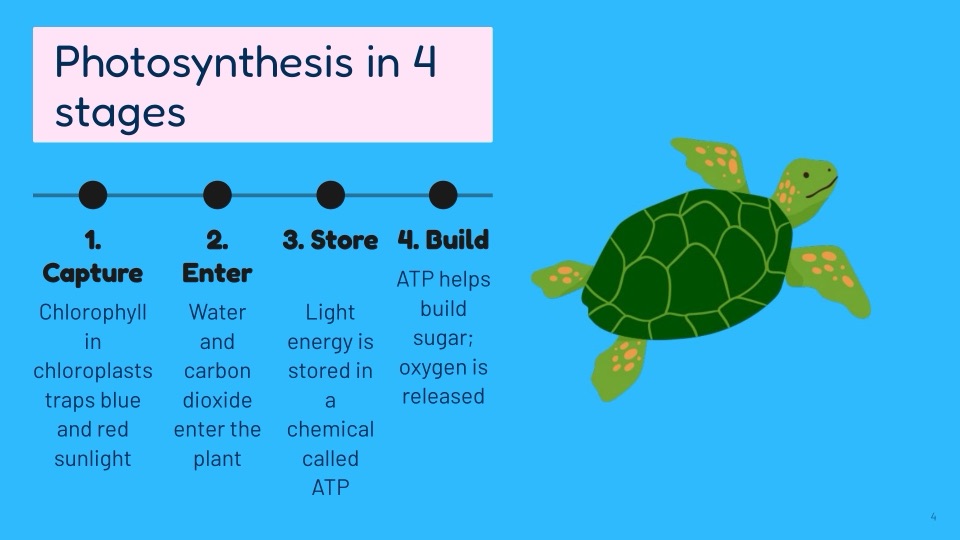
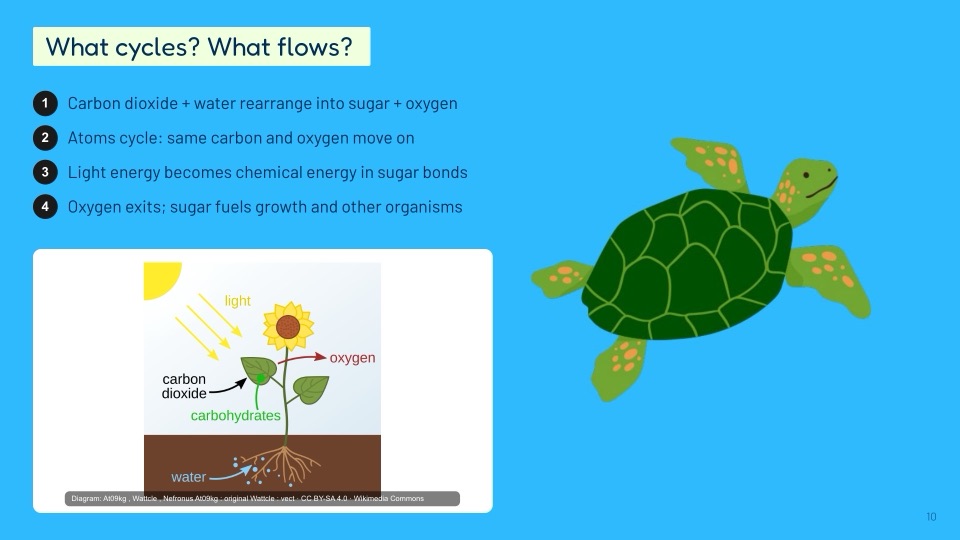
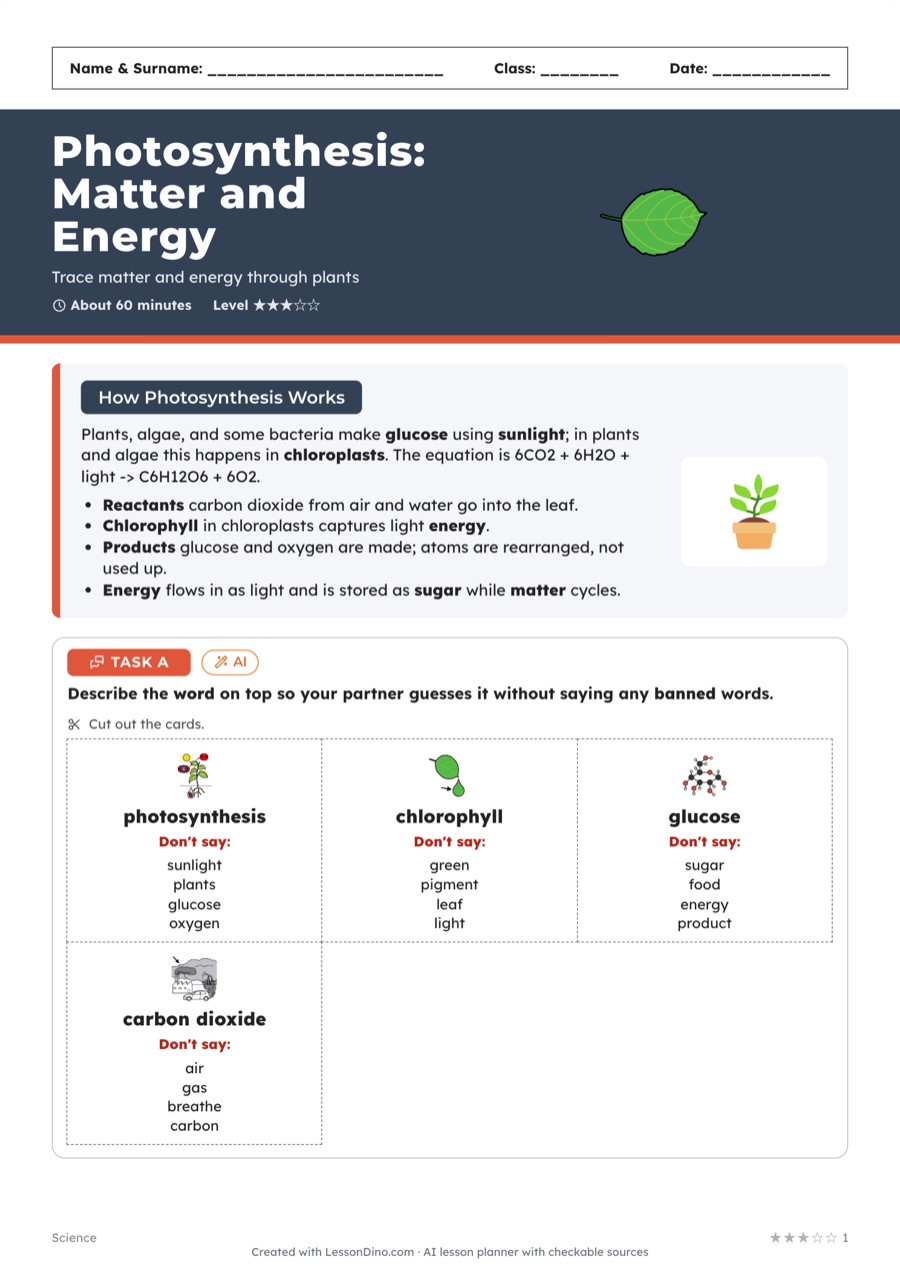
| 12 min | Teaching | Explain inputs, outputs, and energy change in photosynthesis. Show Slide 3 and explain plants are not alone — algae and some bacteria photosynthesize too, all using sunlight to turn water and carbon dioxide into sugar and oxygen. Show Slide 4 timeline and explain chlorophyll inside chloroplasts captures sunlight, with chlorophyll residing inside chloroplasts and reflecting green while absorbing blue and red light. Model the equation on the board: 6CO2 + 6H2O + light -> C6H12O6 + 6O2, labeling carbon dioxide and water as reactants and glucose sugar and oxygen as products. Think aloud that photosynthesis is a process used by plants, algae, and certain bacteria to harness energy from sunlight into chemical energy stored in sugar made from water and carbon dioxide. |
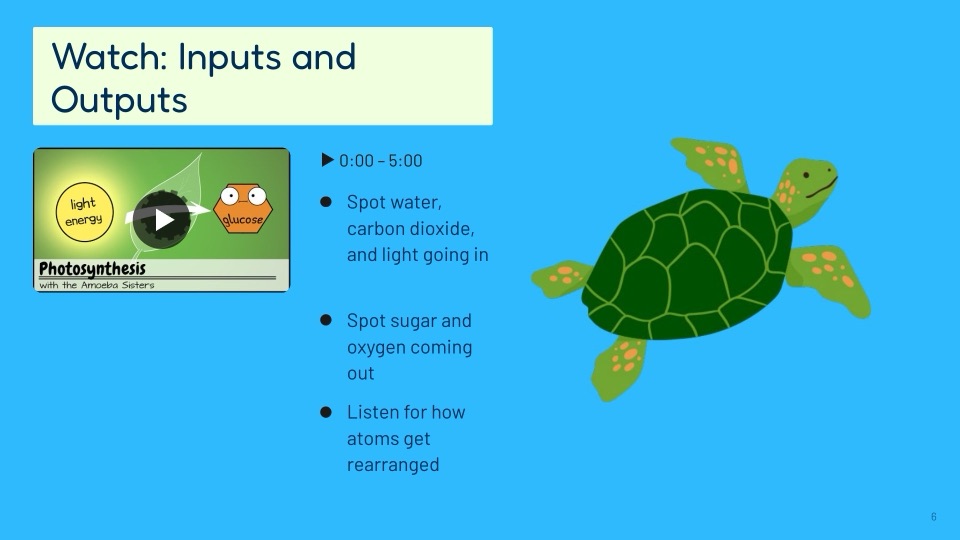
| 10 min | Video focus | Use video to see atoms rearrange while energy flows into sugar. Show Slide 6 and set task: Spot water, carbon dioxide, and light going in and sugar and oxygen coming out. Play Video clip 1 (0:00–5:00) without stopping. Replay one 30-second section if students missed atom rearrangement and pause to label inputs and outputs. Summarize: atoms cycle, energy flows from Sun to sugar. |
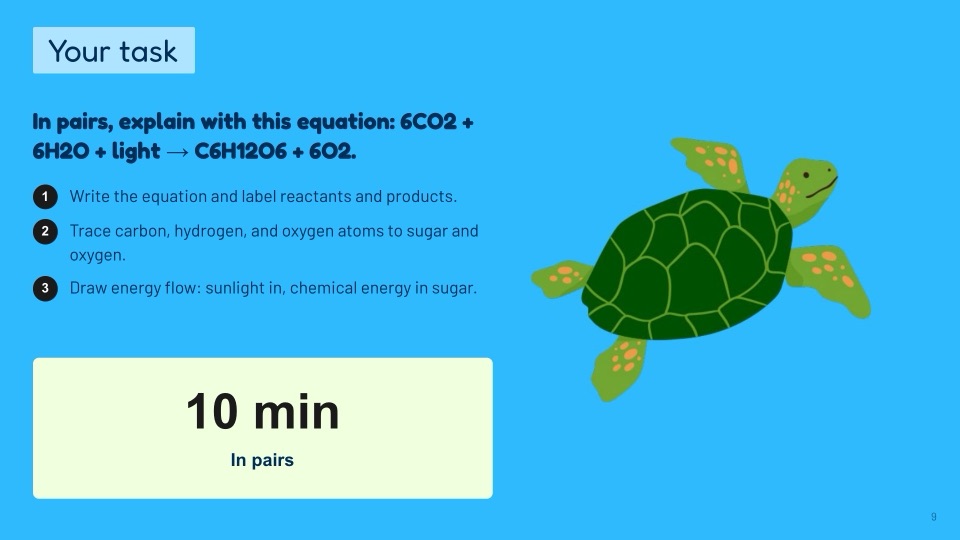
| 20 min | Main activity | Build a claim-evidence-reasoning explanation for photosynthesis. Show Slide 9 task and hand out printed evidence cards, large claim sheet, and markers. Model sorting one card: plants need water, sunlight, and carbon dioxide goes under matter in and energy in. Circulate while groups sort cards showing they harness sunlight into chemical energy stored in sugar made from water and carbon dioxide and release oxygen. Prompt groups to write a paragraph that constructs a scientific explanation based on evidence for how matter cycles and energy flows. |
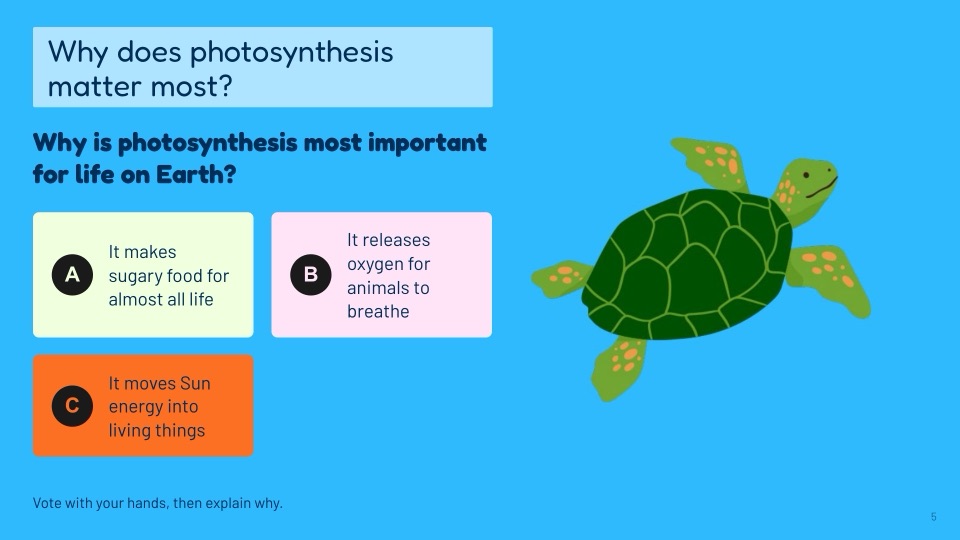
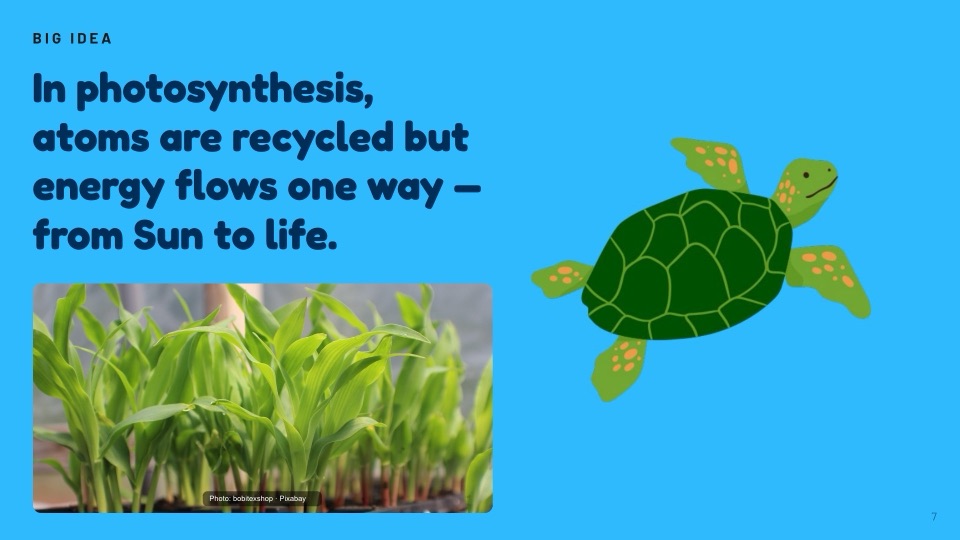
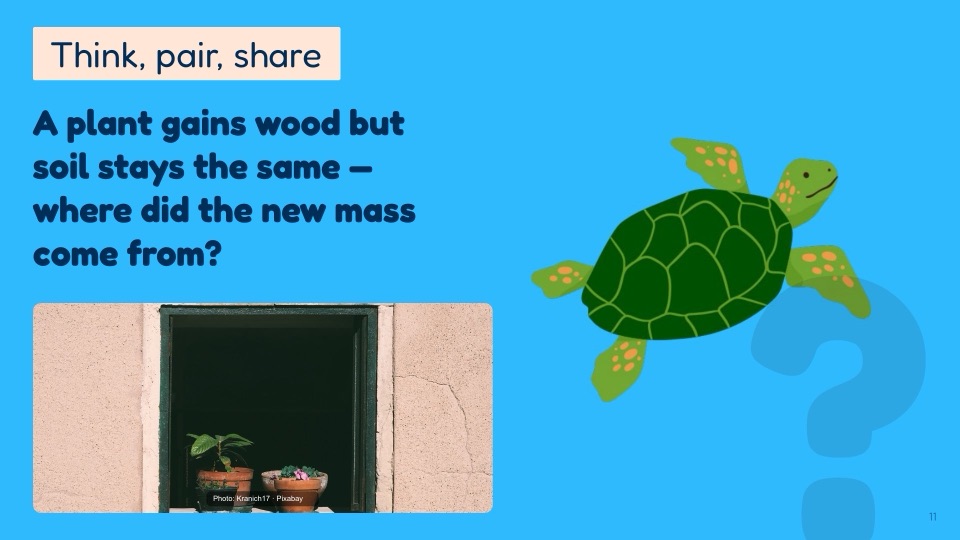
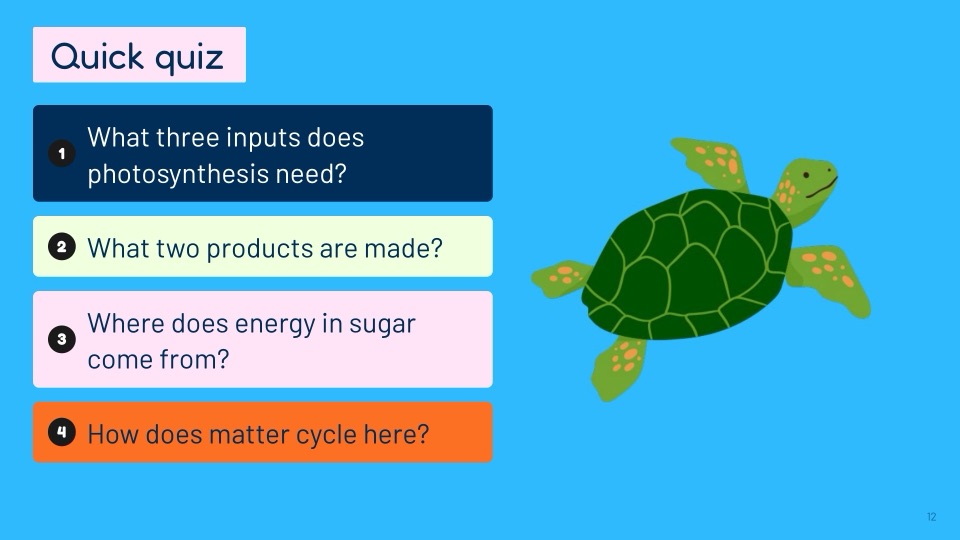
| 10 min | Plenary | Check understanding of matter cycling and energy flow. State big idea: In photosynthesis, atoms are recycled but energy flows one way — from Sun to life. Lead Slide 11 think, pair, share: A plant gains wood but soil stays the same — where did the new mass come from? Run Slide 12 quick quiz orally for inputs, products, and energy location. Collect exit answers on paper. |
Common mistakes
- Thinks plant mass comes from soil being eaten.
How to spot it: Explanation says roots eat soil and soil loss equals wood gain.
Weigh idea: soil stays nearly same while carbon dioxide plus water rearrange into sugar plus oxygen, so mass comes from air and water. - Thinks sunlight is food or becomes an atom in sugar.
How to spot it: Draws light as part of glucose molecule.
Show light is energy, not matter: plants harness sunlight into chemical energy stored in sugar made from water and carbon dioxide. - Thinks oxygen breathed out comes from nowhere or energy cycles like atoms.
How to spot it: Says energy cycles back to the Sun or oxygen appears without input.
Trace oxygen atoms from carbon dioxide and water to oxygen gas, and stress energy flows one way from Sun to sugar.
Support
- Pre-filled equation with word bank: carbon dioxide, water, light, glucose, oxygen.
- Talk frames for claim, evidence, and reasoning plus enlarged evidence cards.
Stretch
- Trace one carbon atom from air into leaf sugar, then into an animal that eats the plant.
- Design a soil-mass test to add as new evidence for the explanation.
Check questions
- What three inputs does photosynthesis need?
Answer: Carbon dioxide, water, and sunlight. - What two products are made and where is energy stored?
Answer: Glucose sugar and oxygen; energy stored as chemical energy in sugar. - A seedling in a pot gains 500 grams but soil loses 10 grams. Explain with evidence.
Answer: Extra mass came from carbon dioxide and water rearranged into sugar and wood, with light energy stored.
Curriculum
Construct a scientific explanation based on evidence for the role of photosynthesis in the cycling of matter and flow of energy into and out of organisms.
Video clips
Clips on YouTube, from the start and end times we chose. Check each one before you show it.
-
Amoeba Sisters photosynthesis overview from 0:00 to 5:00
Amoeba Sisters: Photosynthesis (UPDATED)
Fun clear US middle-school style is perfect for ages 12-13 and links inputs and outputs to cycling matter and energy flow.
-
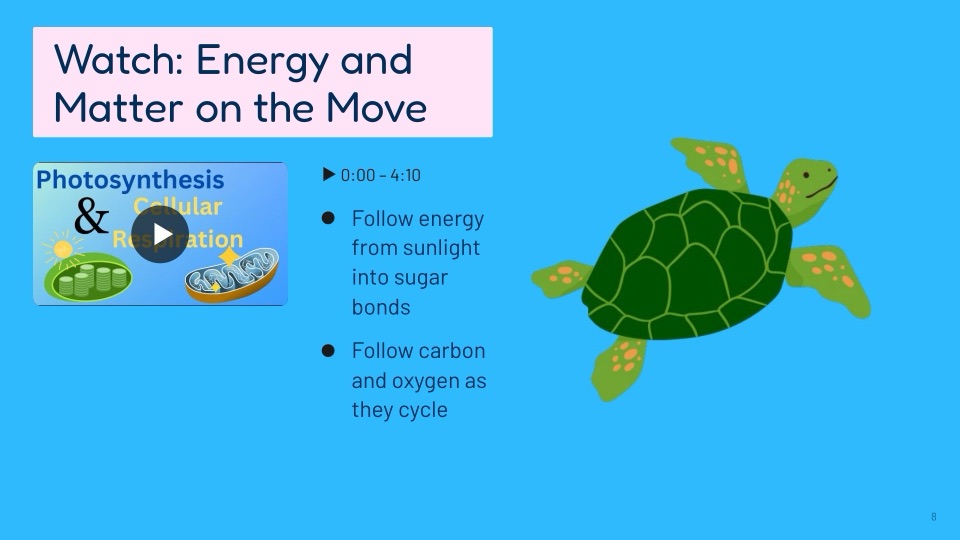
Energy cycle of life from 0:00 to 4:10
Point Source Science: Photosynthesis and Cellular Respiration - Energy Cycle of Life
Directly matches the lesson goal on cycling of matter and flow of energy and the pace and vocabulary suit ages 12-13.
Worksheet
Sources
- 7th Grade Science Curriculum boepublic.parkhill.k12.mo.us
- Grade 7 Science Curriculum - Fairfax County Public Schools fcps.edu
- Department of Energy Announces $100 Million for Artificial Photosynthesis Research | Department of Energy energy.gov
- Top seven photosynthesis researchers include three Plant Biology faculty members | School of Integrative Biology | Illinois sib.illinois.edu
- Define photosynthesis. - Definition | CK-12 Foundation ck12.org
- photosynthesis | PBS News pbs.org
- Photosynthesis istitutolipani.com
- photosynthesis.bg Website Traffic, Ranking, Analytics [September 2026] semrush.com
- United States (US) Artificial Photosynthesis Market (2025-2031) | Outlook Growth & Trends 6wresearch.com
- CyberScope Daily - United States Plant Photosynthesis Instrument Market Brands 2026: Size & Ap sites.google.com
Picture credits
- Photo: RuslanSikunov · Pixabay
- Photo: CoastalSandpiper · Pixabay
- Photo: bobitexshop · Pixabay
- Diagram: At09kg , Wattcle , Nefronus At09kg : original Wattcle : vect · CC BY-SA 4.0 · Wikimedia Commons
- Photo: Kranich17 · Pixabay
- Pictograms: Sergio Palao, ARASAAC (arasaac.org) · CC BY-NC-SA
- Microsoft Fluent Emoji (MIT)
- Drawing: Carlos Francisco Cruz Fierro · CC0 · Wikimedia Commons
Made with Lesson Dino's AI on 16 October 2026. AI can make mistakes, so check facts against the sources before you teach.