The worksheet
About this worksheet
Students learn to turn stories into px+q=r and p(x+q)=r with decimals and fractions. They create, swap, and solve their own story posters. This Grade 7 Math worksheet gives students (ages 12–13) seven pages of practice on word problems with equations, part of the expressions and equations unit. It goes with our free Word problems with equations lesson, which has the slides and a timed lesson plan.
What it covers
By the end, students should be able to:
- Students will translate word stories into px+q=r and p(x+q)=r using rational numbers.
- Students will solve two-step equations with inverse operations in correct order.
- Students will define the unknown with units and check answers in story words.
How to use it
- Guided practice (12 minutes): Hand out Worksheet Task B: Solve each equation and check with the story.
- Plenary (8 minutes): Preview homework from Worksheet Task C.
- Support: Word bank with total, each, per, plus, in all, combined for translation.
- Stretch: Solve with fractions like (3/4)(x+2)=9 and explain each bar step.
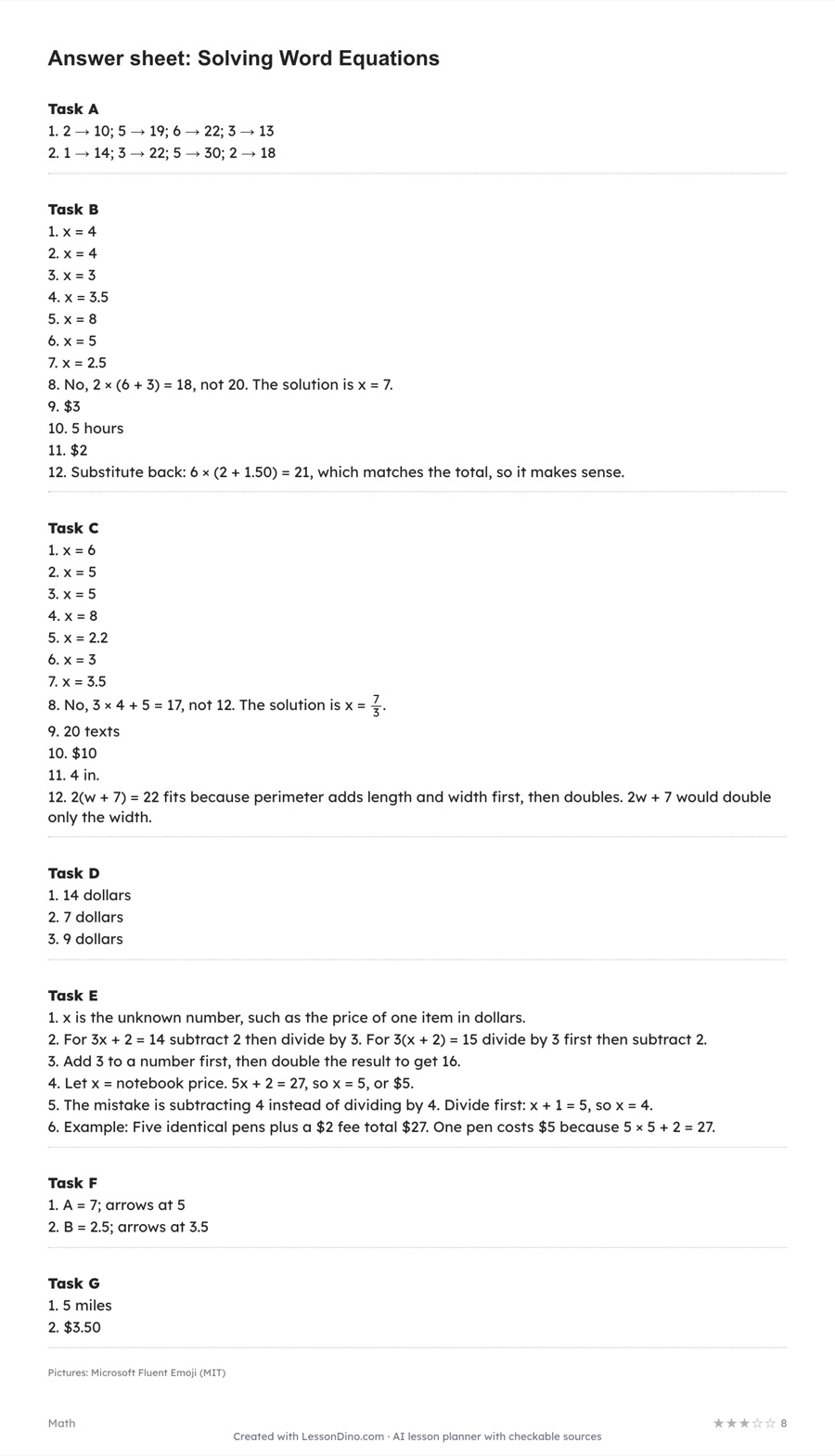
- The answer sheet is the last page, so you can print it on its own or let students check their own work.
Key vocabulary
- variable: a letter that stands for a number you have not found yet
- equation: a number sentence that shows two amounts are the same
- total: the whole amount after all parts are put together
- inverse operations: opposite steps that undo each other, like add then subtract
- parentheses: curved marks that show what to do first inside equal groups
Mistakes to watch for
- Writing 5 - x = 12 for 5 less than a number. Teach that less than reverses order to x - 5 = 12 and test with numbers like 10-8.
- Treating 2(x+3)=14 as 2x+3=14. Use bars of two equal (x+4) parts making 26 to show divide first, then subtract.
- Giving x without units or no story check. Require Let x with units and one sentence check back in story words and ask Does this make sense?.
What's on the worksheet
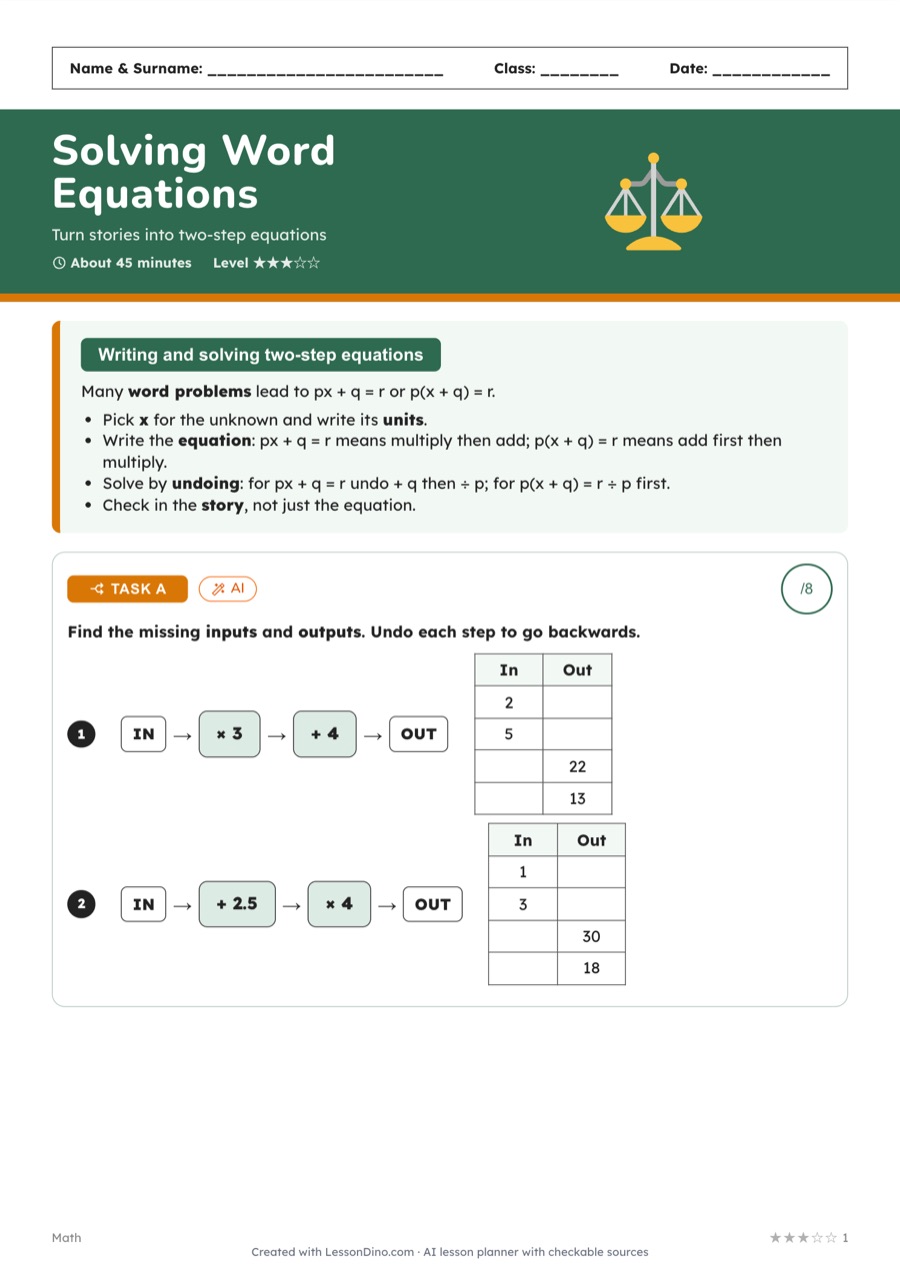
Words Into Equations
Turn word problems into two-step equations and solve them.
Writing and solving two-step equations
- Many word problems lead to px + q = r or p(x + q) = r.
- Pick x for the unknown and write its units.
- Write the equation: px + q = r means multiply then add; p(x + q) = r means add first then multiply.
- Solve by undoing: for px + q = r undo + q then ÷ p; for p(x + q) = r ÷ p first.
- Check in the story, not just the equation.
Find the missing inputs and outputs. Undo each step to go backwards.
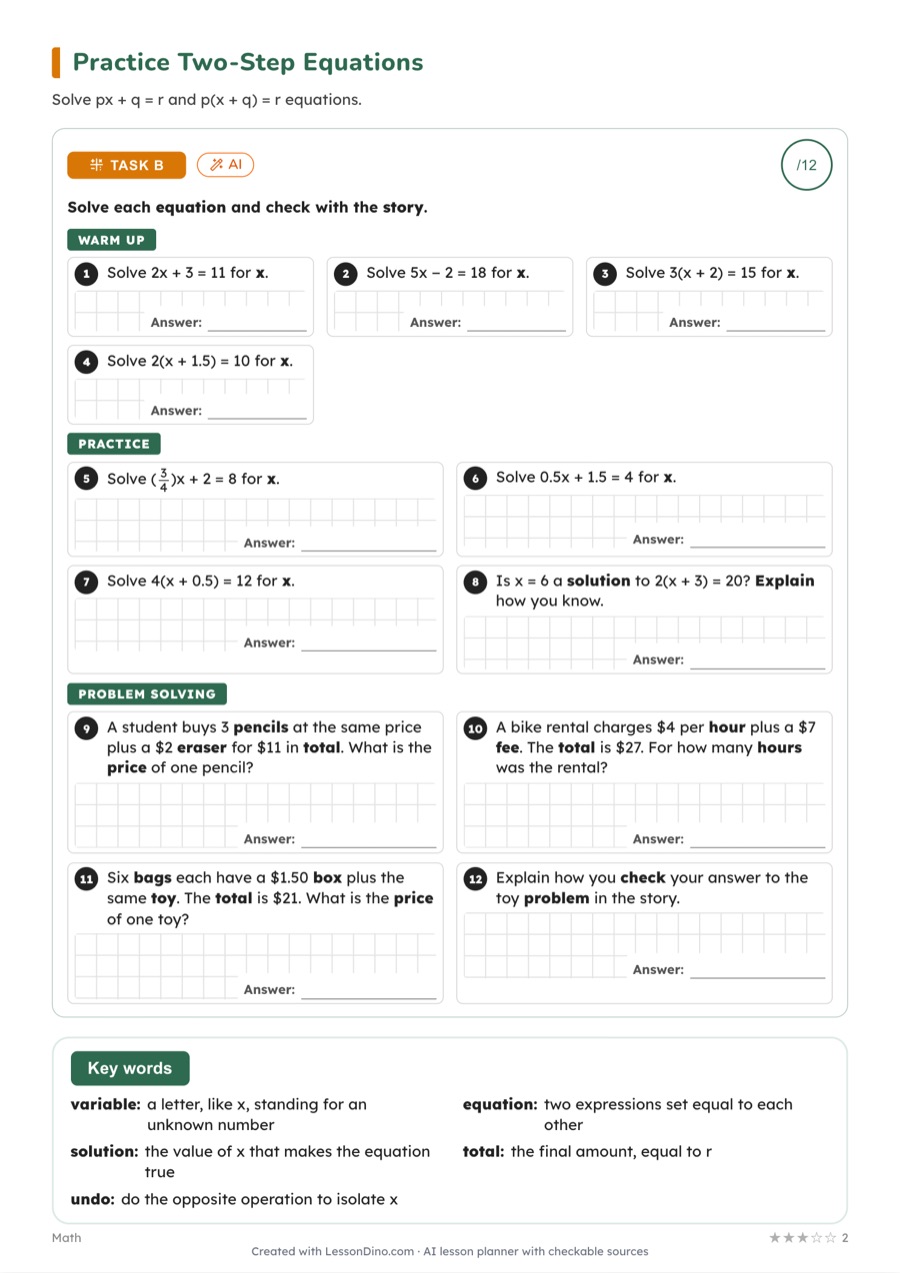
Practice Two-Step Equations
Solve px + q = r and p(x + q) = r equations.
Solve each equation and check with the story.
Warm up
- Solve 2x + 3 = 11 for x.
- Solve 5x − 2 = 18 for x.
- Solve 3(x + 2) = 15 for x.
- Solve 2(x + 1.5) = 10 for x.
Practice
- Solve (3/4)x + 2 = 8 for x.
- Solve 0.5x + 1.5 = 4 for x.
- Solve 4(x + 0.5) = 12 for x.
- Is x = 6 a solution to 2(x + 3) = 20? Explain how you know.
Problem solving
- A student buys 3 pencils at the same price plus a $2 eraser for $11 in total. What is the price of one pencil?
- A bike rental charges $4 per hour plus a $7 fee. The total is $27. For how many hours was the rental?
- Six bags each have a $1.50 box plus the same toy. The total is $21. What is the price of one toy?
- Explain how you check your answer to the toy problem in the story.
| Word | Meaning |
|---|---|
| variable | a letter, like x, standing for an unknown number |
| equation | two expressions set equal to each other |
| solution | the value of x that makes the equation true |
| total | the final amount, equal to r |
| undo | do the opposite operation to isolate x |
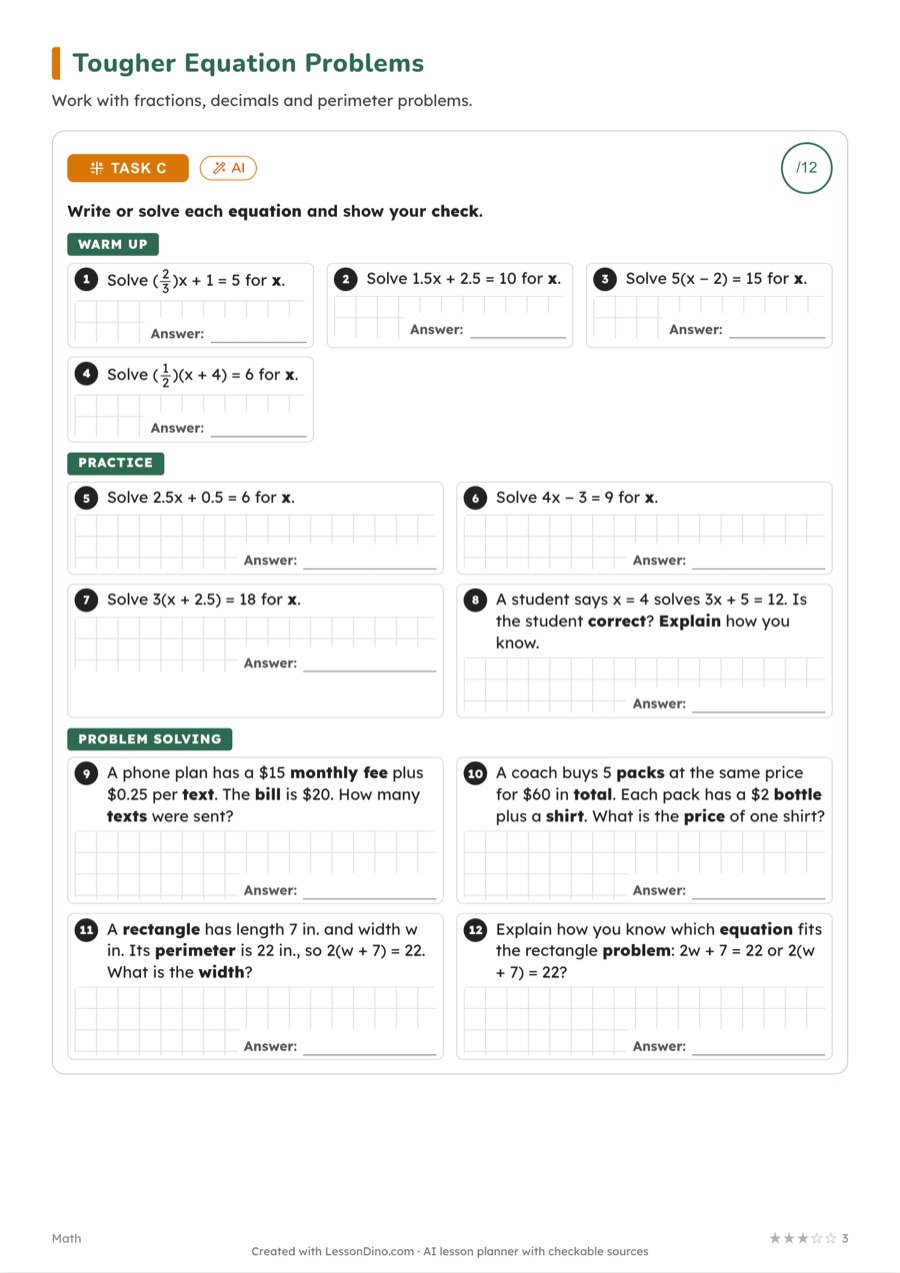
Tougher Equation Problems
Work with fractions, decimals and perimeter problems.
Write or solve each equation and show your check.
Warm up
- Solve (2/3)x + 1 = 5 for x.
- Solve 1.5x + 2.5 = 10 for x.
- Solve 5(x − 2) = 15 for x.
- Solve (1/2)(x + 4) = 6 for x.
Practice
- Solve 2.5x + 0.5 = 6 for x.
- Solve 4x − 3 = 9 for x.
- Solve 3(x + 2.5) = 18 for x.
- A student says x = 4 solves 3x + 5 = 12. Is the student correct? Explain how you know.
Problem solving
- A phone plan has a $15 monthly fee plus $0.25 per text. The bill is $20. How many texts were sent?
- A coach buys 5 packs at the same price for $60 in total. Each pack has a $2 bottle plus a shirt. What is the price of one shirt?
- A rectangle has length 7 in. and width w in. Its perimeter is 22 in., so 2(w + 7) = 22. What is the width?
- Explain how you know which equation fits the rectangle problem: 2w + 7 = 22 or 2(w + 7) = 22?
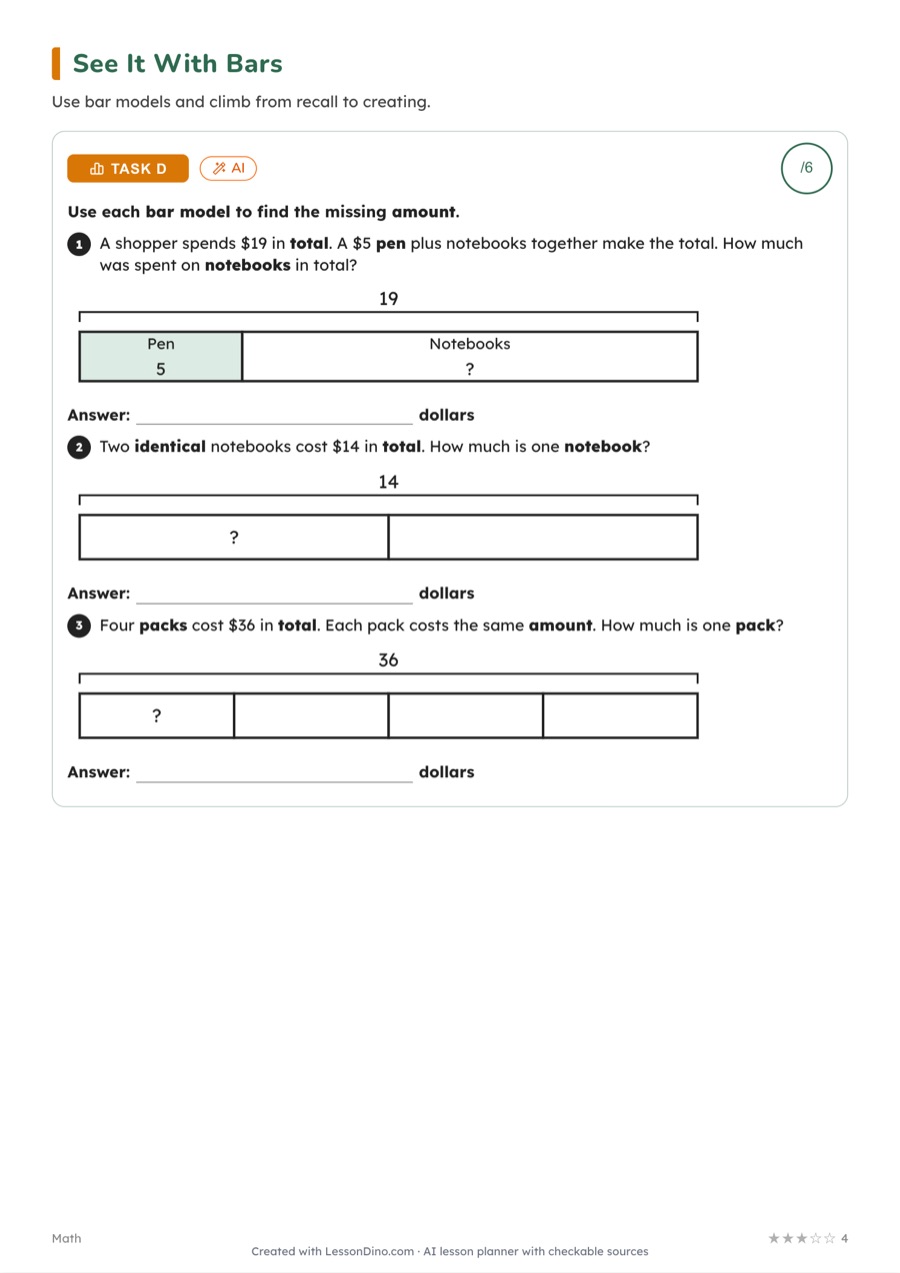
See It With Bars
Use bar models and climb from recall to creating.
Use each bar model to find the missing amount.
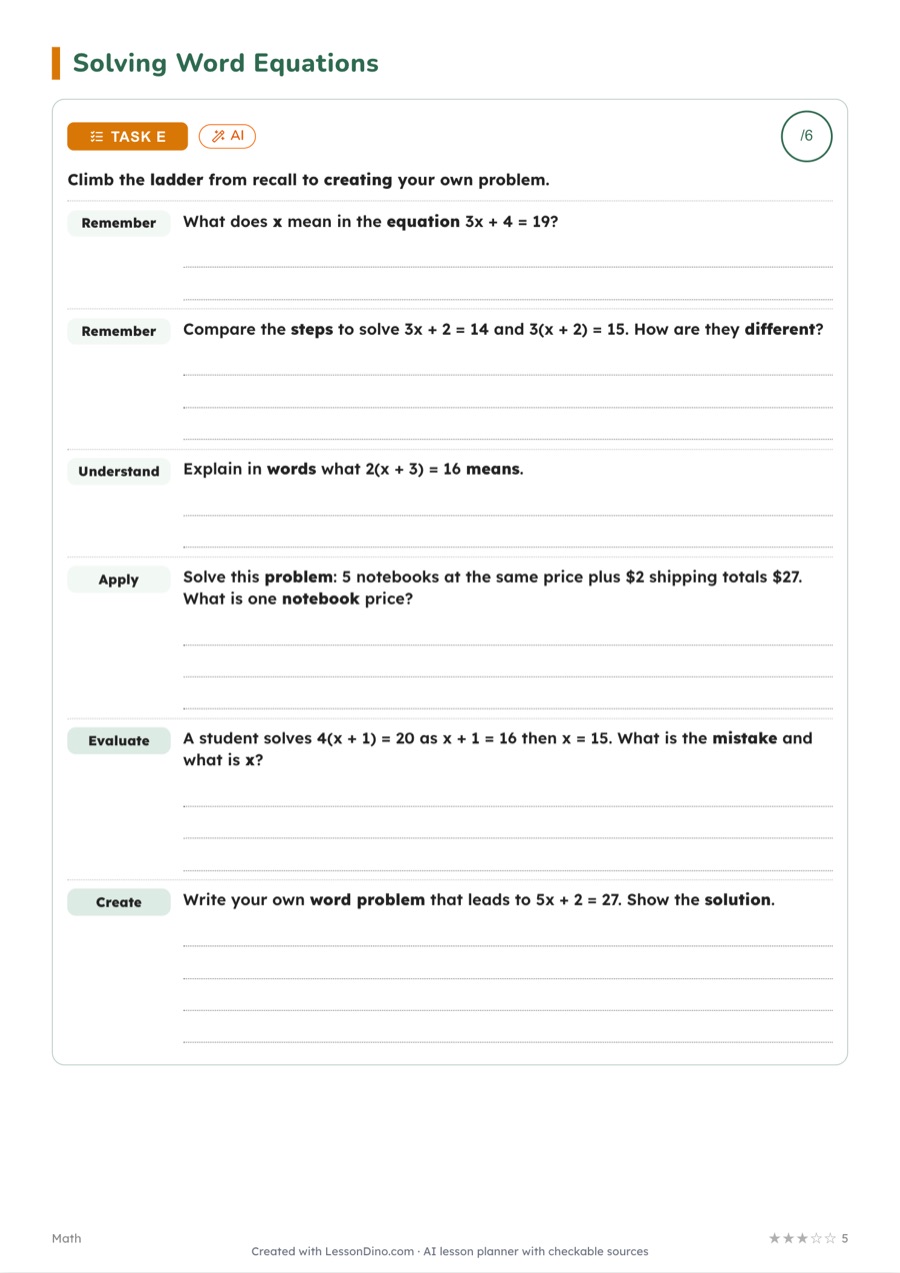
Page 5
Climb the ladder from recall to creating your own problem.
- What does x mean in the equation 3x + 4 = 19?
- Compare the steps to solve 3x + 2 = 14 and 3(x + 2) = 15. How are they different?
- Explain in words what 2(x + 3) = 16 means.
- Solve this problem: 5 notebooks at the same price plus $2 shipping totals $27. What is one notebook price?
- A student solves 4(x + 1) = 20 as x + 1 = 16 then x = 15. What is the mistake and what is x?
- Write your own word problem that leads to 5x + 2 = 27. Show the solution.
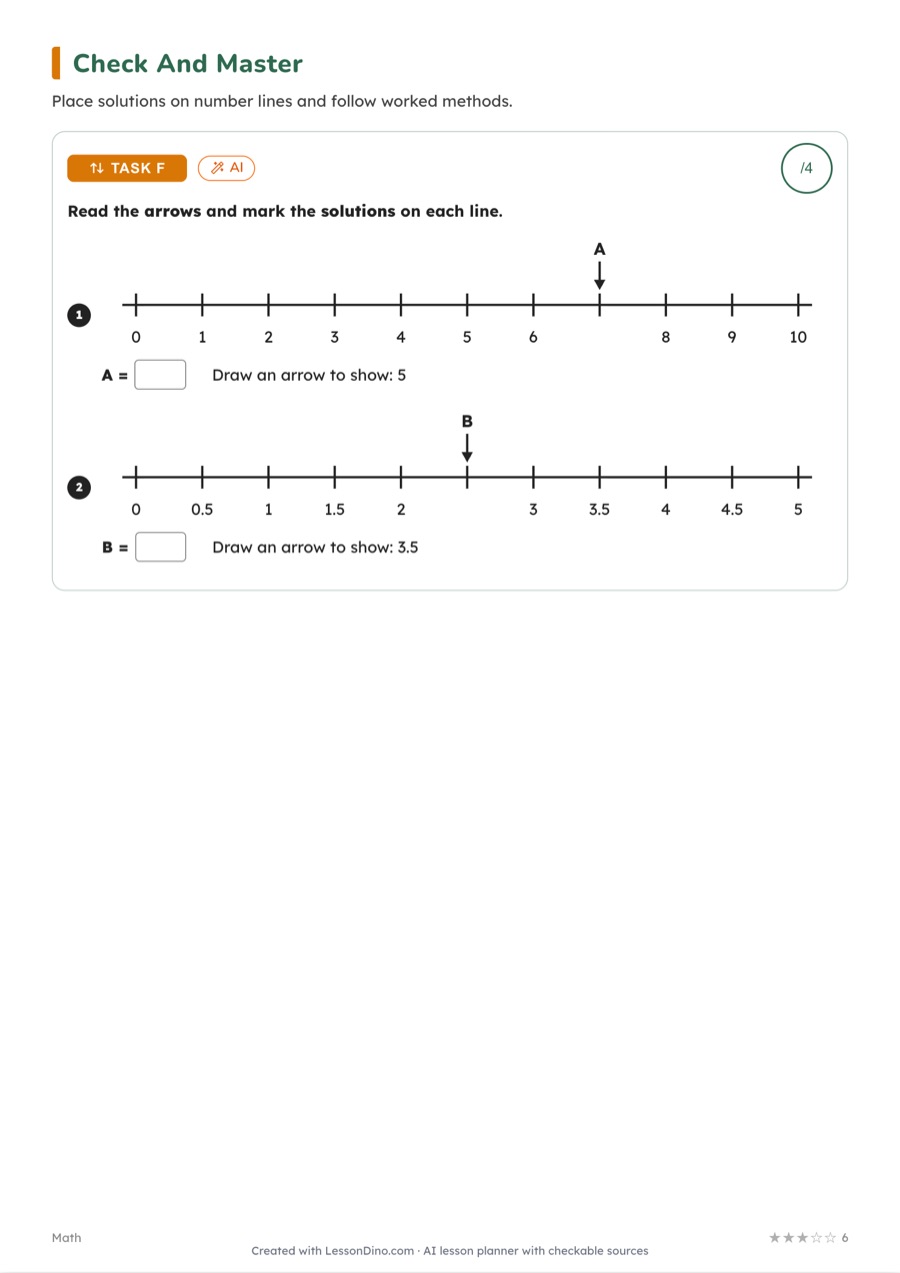
Check And Master
Place solutions on number lines and follow worked methods.
Read the arrows and mark the solutions on each line.
Page 7
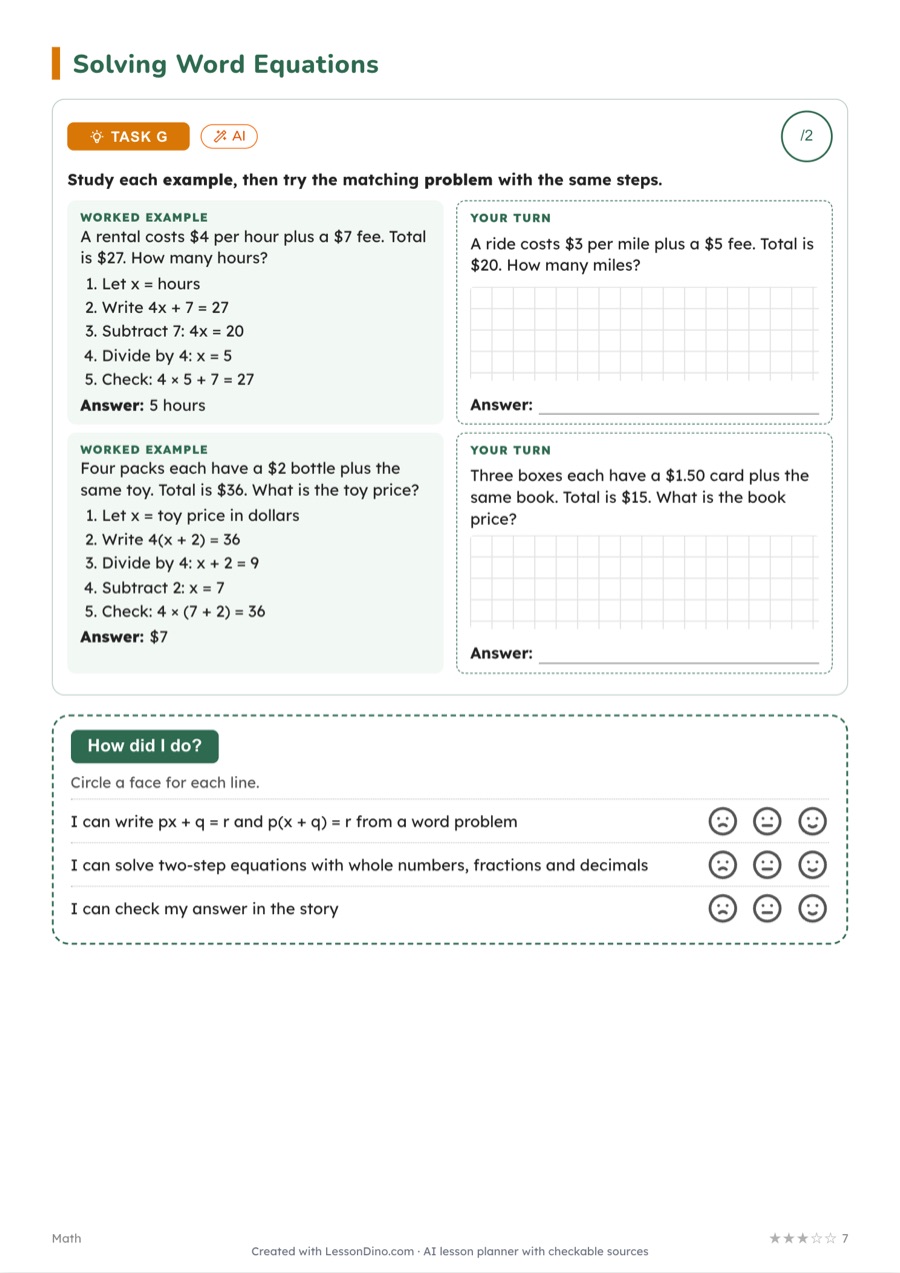
Study each example, then try the matching problem with the same steps.
Answers
Show the answers
- Solve 2x + 3 = 11 for x. x = 4
- Solve 5x − 2 = 18 for x. x = 4
- Solve 3(x + 2) = 15 for x. x = 3
- Solve 2(x + 1.5) = 10 for x. x = 3.5
- Solve (3/4)x + 2 = 8 for x. x = 8
- Solve 0.5x + 1.5 = 4 for x. x = 5
- Solve 4(x + 0.5) = 12 for x. x = 2.5
- Is x = 6 a solution to 2(x + 3) = 20? Explain how you know. No, 2 × (6 + 3) = 18, not 20. The solution is x = 7.
- A student buys 3 pencils at the same price plus a $2 eraser for $11 in total. What is the price of one pencil? $3
- A bike rental charges $4 per hour plus a $7 fee. The total is $27. For how many hours was the rental? 5 hours
- Six bags each have a $1.50 box plus the same toy. The total is $21. What is the price of one toy? $2
- Explain how you check your answer to the toy problem in the story. Substitute back: 6 × (2 + 1.50) = 21, which matches the total, so it makes sense.
- Solve (2/3)x + 1 = 5 for x. x = 6
- Solve 1.5x + 2.5 = 10 for x. x = 5
- Solve 5(x − 2) = 15 for x. x = 5
- Solve (1/2)(x + 4) = 6 for x. x = 8
- Solve 2.5x + 0.5 = 6 for x. x = 2.2
- Solve 4x − 3 = 9 for x. x = 3
- Solve 3(x + 2.5) = 18 for x. x = 3.5
- A student says x = 4 solves 3x + 5 = 12. Is the student correct? Explain how you know. No, 3 × 4 + 5 = 17, not 12. The solution is x = 7/3.
- A phone plan has a $15 monthly fee plus $0.25 per text. The bill is $20. How many texts were sent? 20 texts
- A coach buys 5 packs at the same price for $60 in total. Each pack has a $2 bottle plus a shirt. What is the price of one shirt? $10
- A rectangle has length 7 in. and width w in. Its perimeter is 22 in., so 2(w + 7) = 22. What is the width? 4 in.
- Explain how you know which equation fits the rectangle problem: 2w + 7 = 22 or 2(w + 7) = 22? 2(w + 7) = 22 fits because perimeter adds length and width first, then doubles. 2w + 7 would double only the width.
- What does x mean in the equation 3x + 4 = 19? x is the unknown number, such as the price of one item in dollars.
- Compare the steps to solve 3x + 2 = 14 and 3(x + 2) = 15. How are they different? For 3x + 2 = 14 subtract 2 then divide by 3. For 3(x + 2) = 15 divide by 3 first then subtract 2.
- Explain in words what 2(x + 3) = 16 means. Add 3 to a number first, then double the result to get 16.
- Solve this problem: 5 notebooks at the same price plus $2 shipping totals $27. What is one notebook price? Let x = notebook price. 5x + 2 = 27, so x = 5, or $5.
- A student solves 4(x + 1) = 20 as x + 1 = 16 then x = 15. What is the mistake and what is x? The mistake is subtracting 4 instead of dividing by 4. Divide first: x + 1 = 5, so x = 4.
- Write your own word problem that leads to 5x + 2 = 27. Show the solution. Example: Five identical pens plus a $2 fee total $27. One pen costs $5 because 5 × 5 + 2 = 27.
The answer sheet is the last picture above.
Curriculum
Solve word problems leading to equations of the form px + q = r and p(x + q) = r, where p, q, and r are specific rational numbers.
Made with Lesson Dino's AI on 17 October 2026. AI can make mistakes, so check the answers and facts against the sources before you teach.