The worksheet
About this worksheet
Students learn to cite exact words for explicit facts and inferences. They defend claims about a tower story in a court-style team trial. This Grade 6 ELA worksheet gives students (ages 11–12) three pages of practice on reading comprehension: citing evidence, part of the reading informational text unit. It goes with our free Reading comprehension: citing evidence lesson, which has the slides and a timed lesson plan.
What it covers
By the end, students should be able to:
- Students will cite exact words to prove explicit details in text.
- Students will cite text clues to support inferences from text.
- Students will explain how each quote supports a claim.
How to use it
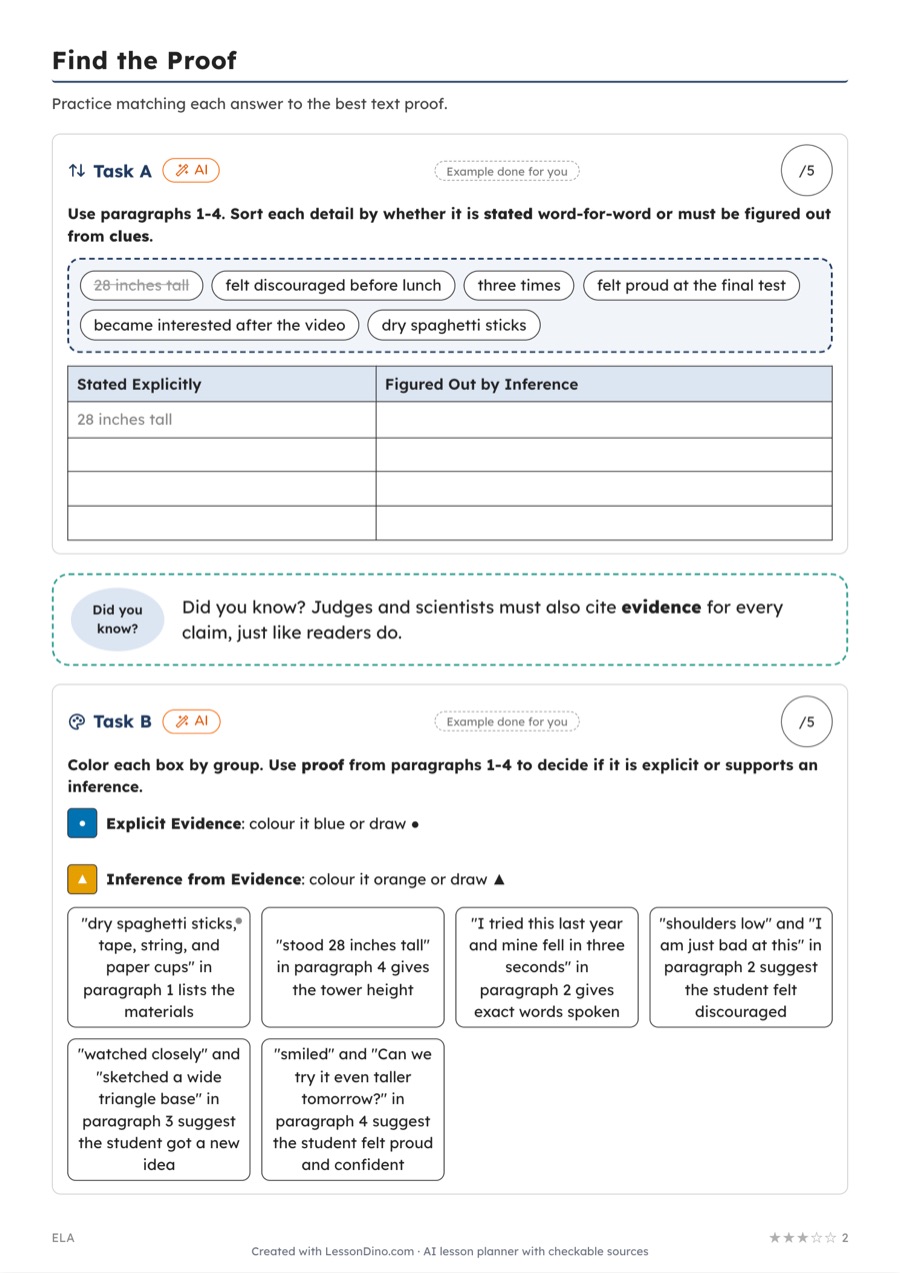
- Guided practice (12 minutes): Hand out passage and Worksheet Task A: Use paragraphs 1-4. Sort each detail by whether it is stated word-for-word or must be figured out from clues.
- Support: Give evidence cards with paragraph numbers marked so teams search a smaller section.
- Stretch: Require finding a counter-quote to challenge another team's inference.
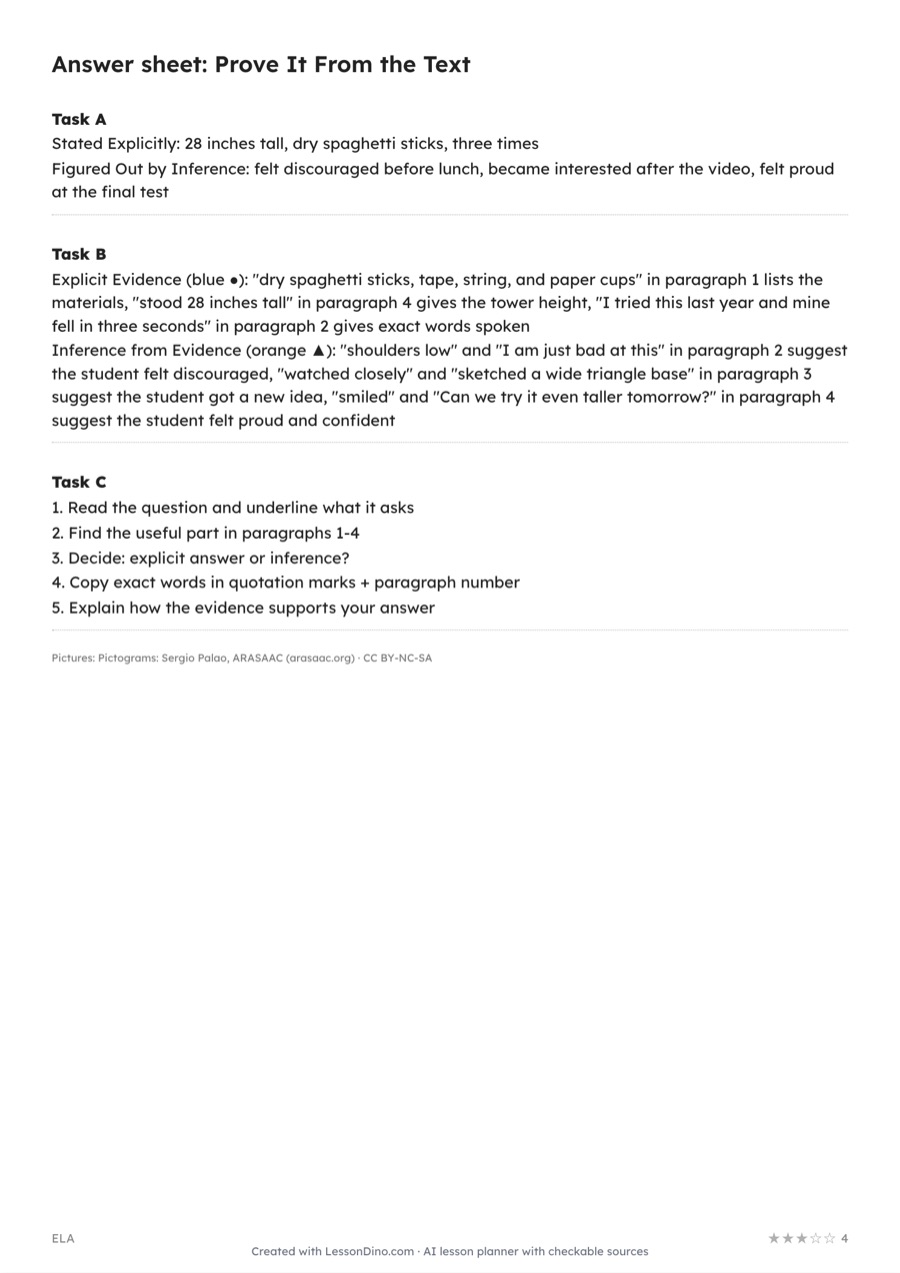
- The answer sheet is the last page, so you can print it on its own or let students check their own work.
Key vocabulary
- explicit: said straight out in the words on the page
- inference: a smart guess you make by putting clues together
- cite: to show the exact words where you found proof
- claim: an idea about the reading that needs proof
- quote: exact words copied word for word from the page
Mistakes to watch for
- Retelling in own words instead of citing exact words. Have students put finger on the sentence and copy 4-8 key words exactly with paragraph number.
- Mixing up explicit and inference. Ask: Does the page use that exact word? If not, it is an inference and needs clue words plus reasoning.
- Dropping a quote with no link to the claim. Add frame: This proves ___ because ___, using short, on-topic proof.
What's on the worksheet
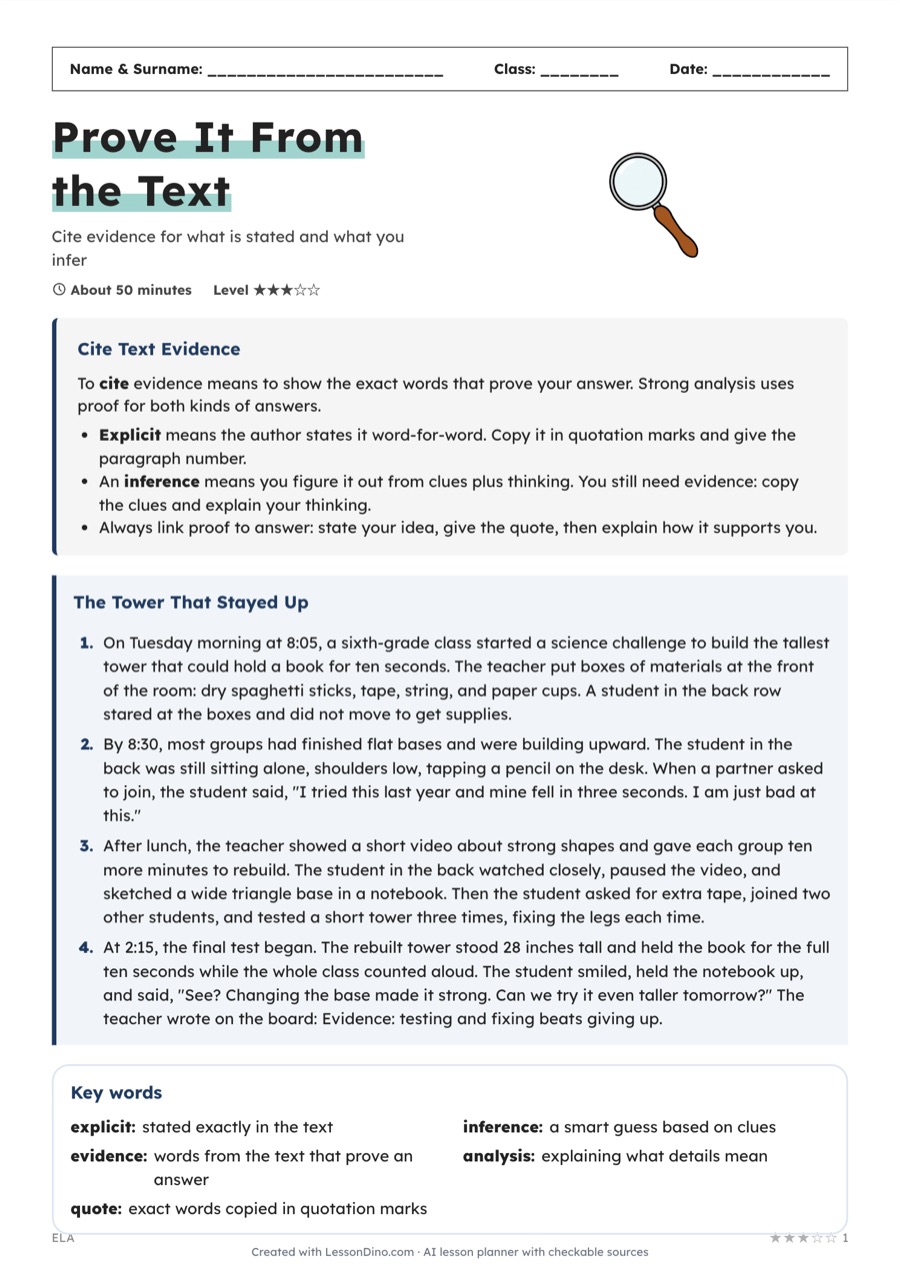
Prove It With Words
Learn the difference between explicit proof and inference clues.
Cite Text Evidence
- To cite evidence means to show the exact words that prove your answer. Strong analysis uses proof for both kinds of answers.
- Explicit means the author states it word-for-word. Copy it in quotation marks and give the paragraph number.
- An inference means you figure it out from clues plus thinking. You still need evidence: copy the clues and explain your thinking.
- Always link proof to answer: state your idea, give the quote, then explain how it supports you.
The Tower That Stayed Up
| Word | Meaning |
|---|---|
| explicit | stated exactly in the text |
| inference | a smart guess based on clues |
| evidence | words from the text that prove an answer |
| analysis | explaining what details mean |
| quote | exact words copied in quotation marks |
Find the Proof
Practice matching each answer to the best text proof.
Use paragraphs 1-4. Sort each detail by whether it is stated word-for-word or must be figured out from clues.
- Did you know? Judges and scientists must also cite evidence for every claim, just like readers do.
Color each box by group. Use proof from paragraphs 1-4 to decide if it is explicit or supports an inference.
Build Strong Answers
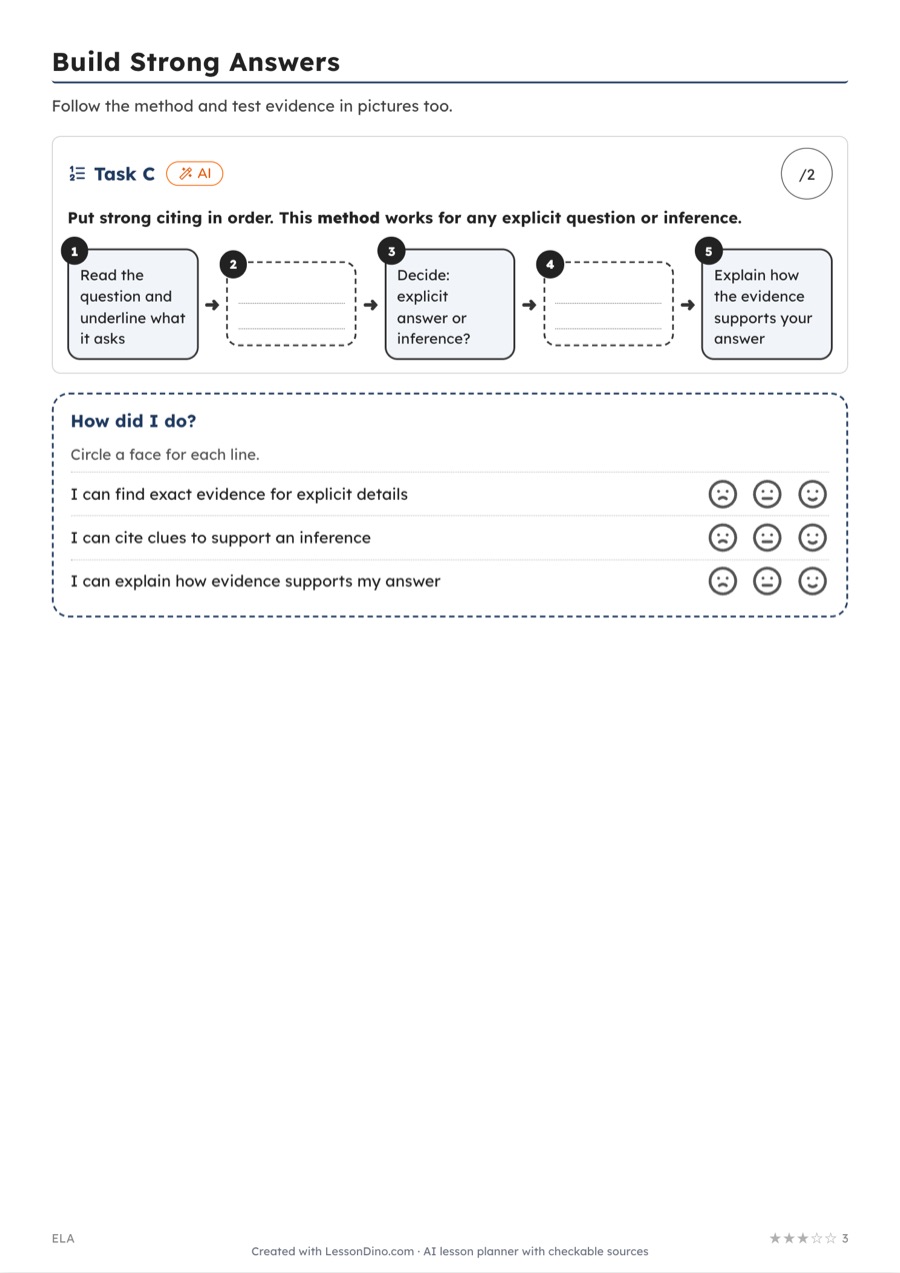
Follow the method and test evidence in pictures too.
Put strong citing in order. This method works for any explicit question or inference.
Answers
Show the answers
The answers are on the answer sheet, the last picture above.
Curriculum
Cite textual evidence to support analysis of what the text says explicitly as well as inferences drawn from the text.
Made with Lesson Dino's AI on 16 October 2026. AI can make mistakes, so check the answers and facts against the sources before you teach.