Slides
Lesson plan
Prove It With the Text
Students learn to cite exact words for explicit facts and inferences. They defend claims about a tower story in a court-style team trial.
Objectives
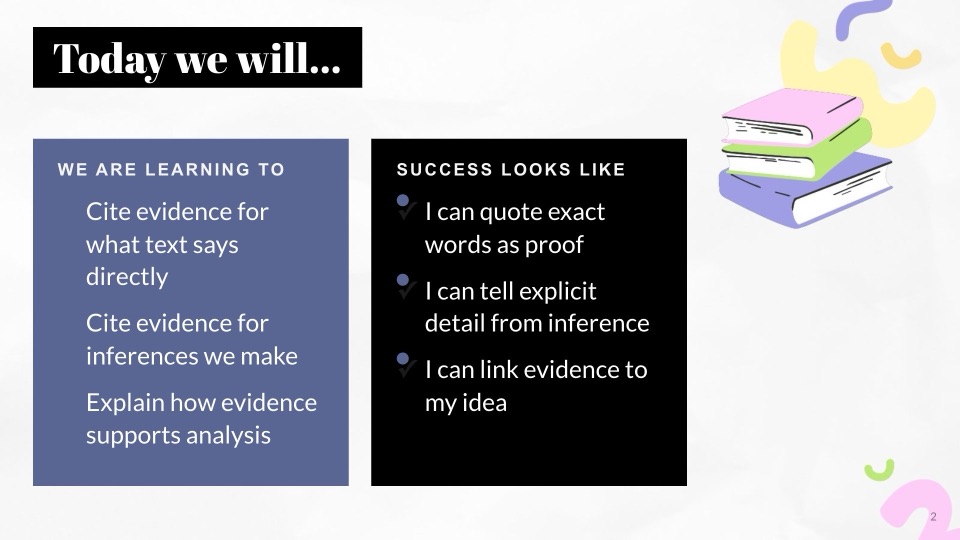
- Students will cite exact words to prove explicit details in text.
- Students will cite text clues to support inferences from text.
- Students will explain how each quote supports a claim.
Success criteria
- I can quote exact words to prove an explicit detail.
- I can quote clues to support an inference I make.
- I can explain how my quote proves my idea.
Key words
| Word | Meaning |
|---|---|
| explicit | said straight out in the words on the page |
| inference | a smart guess you make by putting clues together |
| cite | to show the exact words where you found proof |
| claim | an idea about the reading that needs proof |
| quote | exact words copied word for word from the page |
Timed plan (60 minutes)
| Time | Stage | What happens |
|---|---|---|
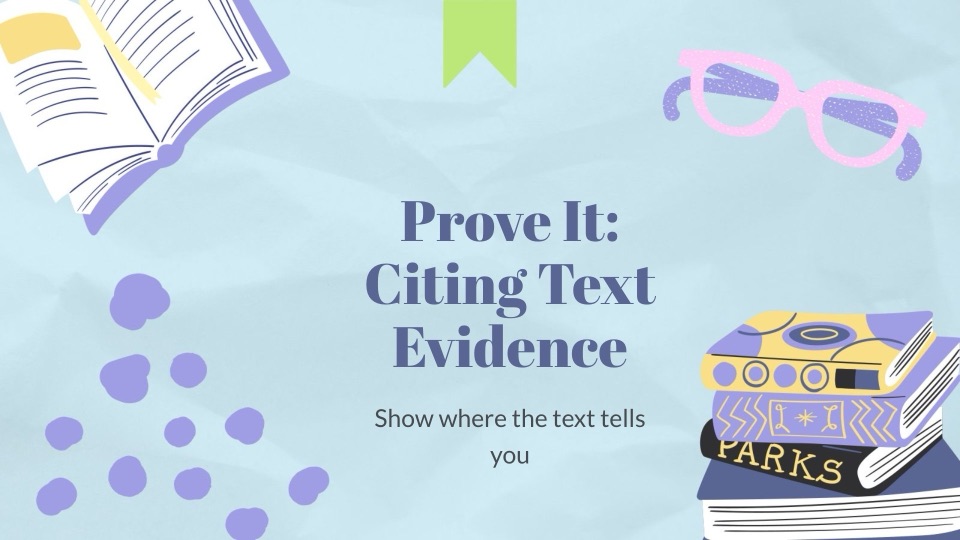
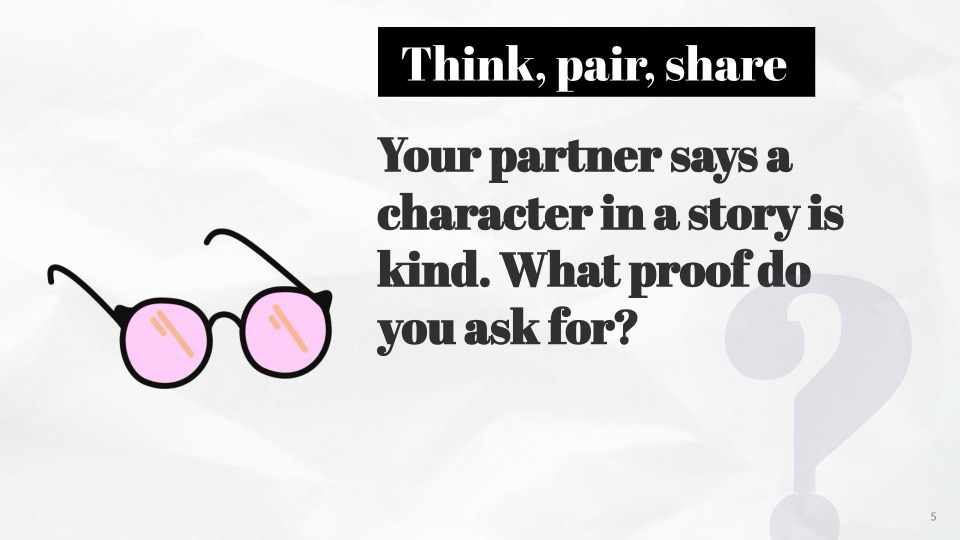
| 5 min | Starter | To hook interest in proving ideas and recall the need for proof. Show Slide 1 Prove It: Citing Text Evidence and read the title line Show where the text tells you. Say the hook: Court is in session and your only witness is the text itself. Show Slide 5 Think, pair, share question: Your partner says a character in a story is kind. What proof do you ask for? Take 3 quick answers and push for exact words, not just opinion. |
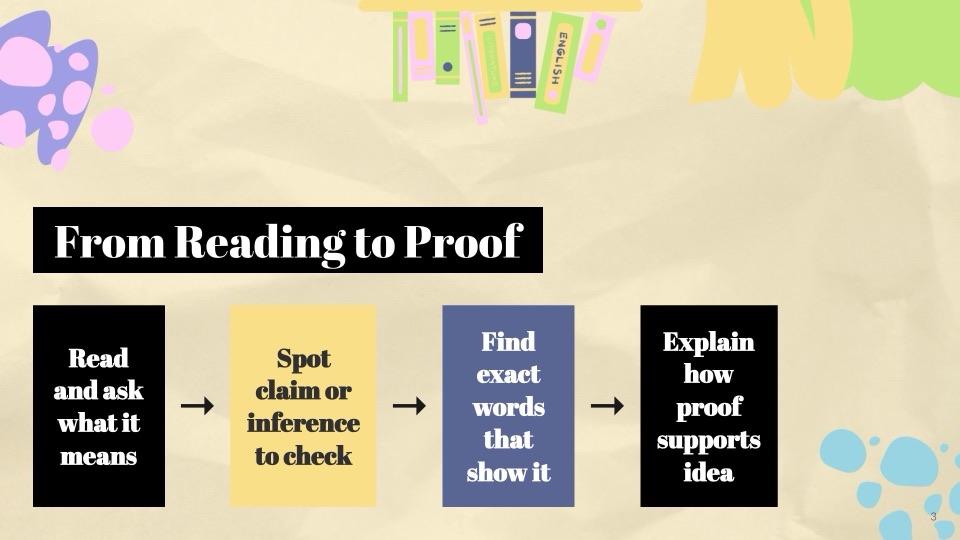
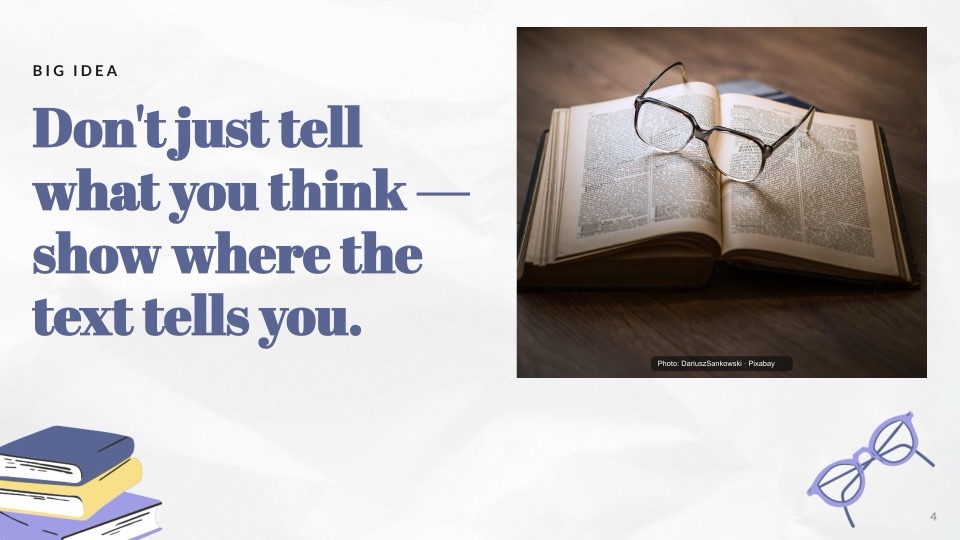
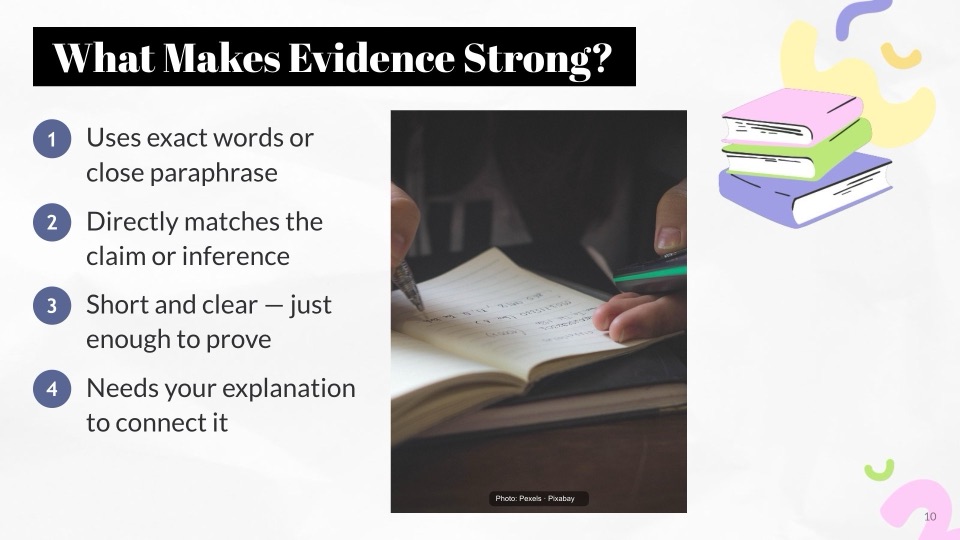
| 10 min | Teaching | To model how to cite explicit details and inference clues with explanation. Show Slide 2 objectives and Slide 3 chain: Read and ask what it means, spot claim, find exact words, explain link. Show Slide 4 statement: Don't just tell what you think — show where the text tells you. Model with paragraph 1 using close reading, which is careful, sustained interpretation of a brief passage that pays close attention to individual words and syntax. Show Slide 10 What Makes Evidence Strong and think aloud how the quote matches the idea. |
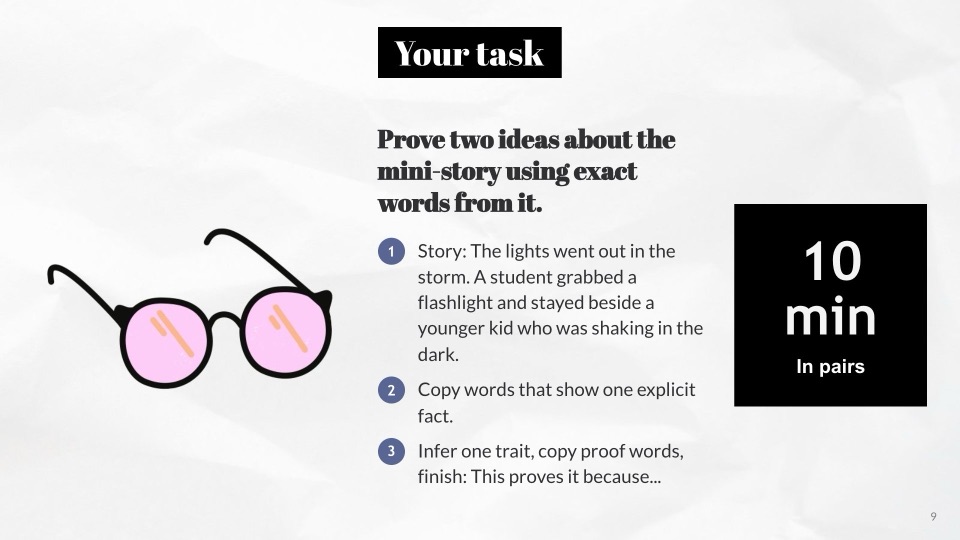
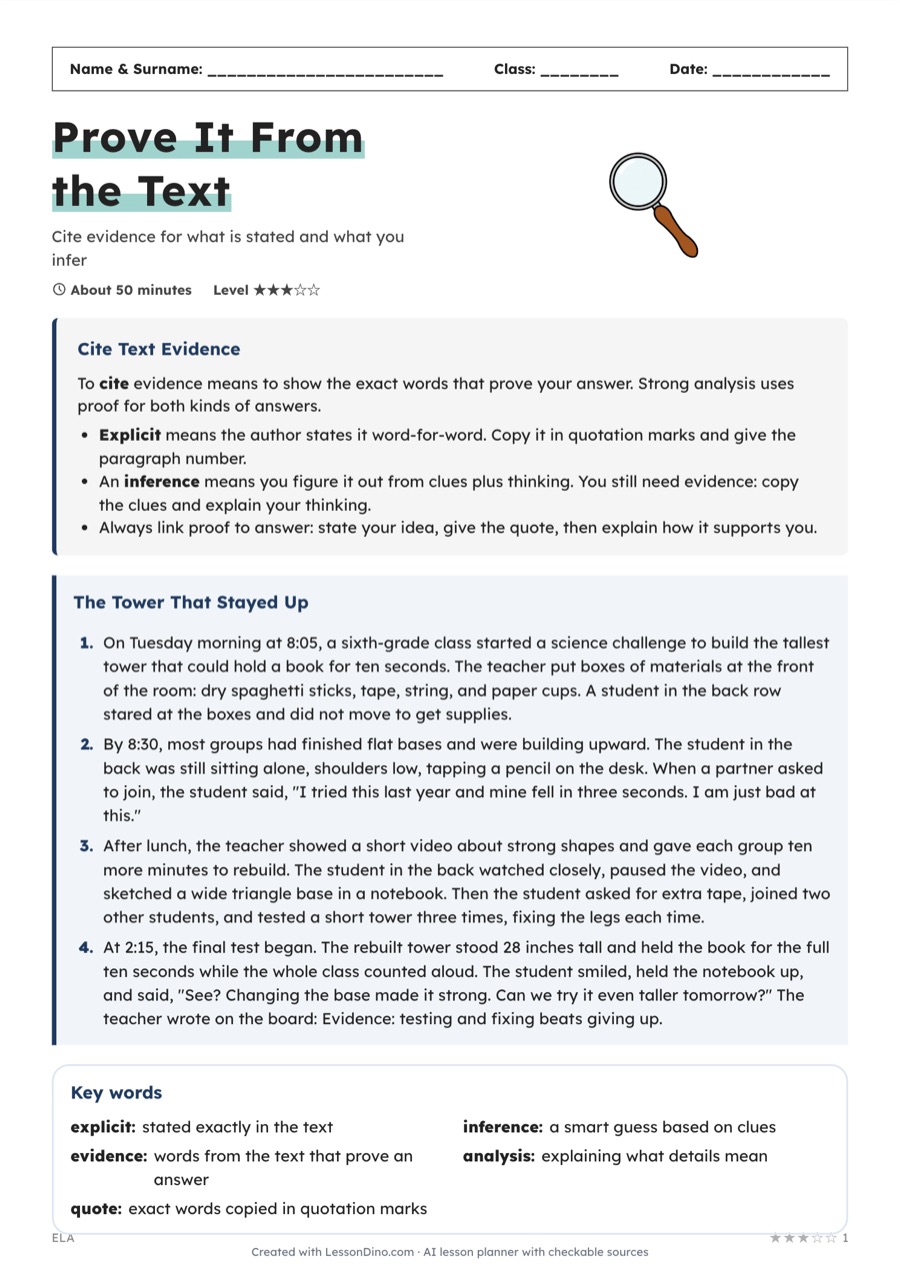
| 12 min | Guided practice | To practice sorting explicit facts from inference clues with citations. Hand out passage and Worksheet Task A: Use paragraphs 1-4. Sort each detail by whether it is stated word-for-word or must be figured out from clues. Read paragraph 2 aloud while pairs follow, stressing tapping a pencil and shoulders low. Circulate and prompt pairs to copy exact words plus paragraph number for each sort. Stop at 10 minutes and confirm two answers as a class. |
| 23 min | Main activity | To defend claims about the text with two cited quotes and reasoning. Post three claim cards on the whiteboard: 1. The student felt discouraged at the start. 2. The student learned a new strategy after lunch. 3. Testing and fixing made the tower succeed. Give each team one claim, the passage paragraphs 1-4, and a timer for 8 minutes to find two exact quotes with paragraph numbers and write one reasoning sentence per quote. Call teams to the front in trial order to present quote plus reasoning while the class considers a wider range of textual evidence to make fuller use of text. Lead the vote: strong proof or weak proof, and record winning quotes on the whiteboard. |
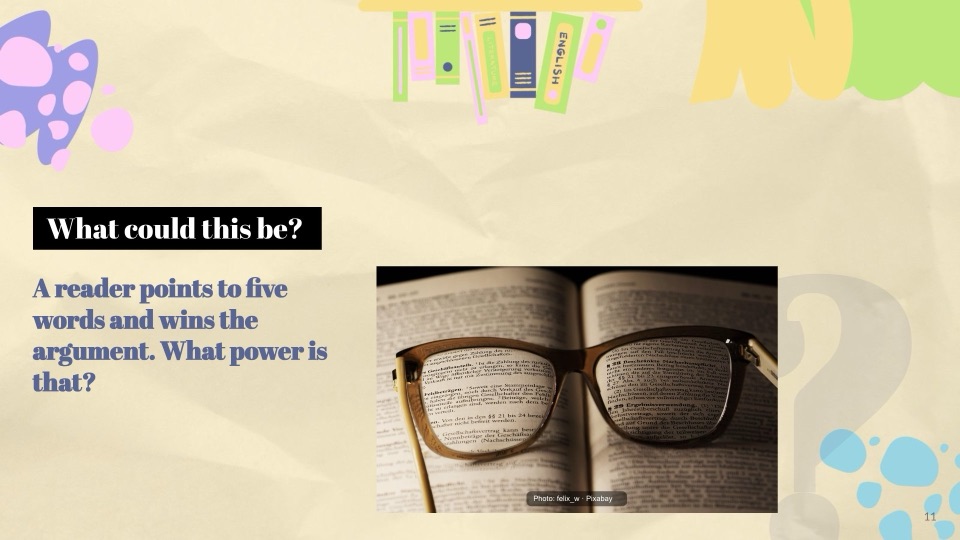
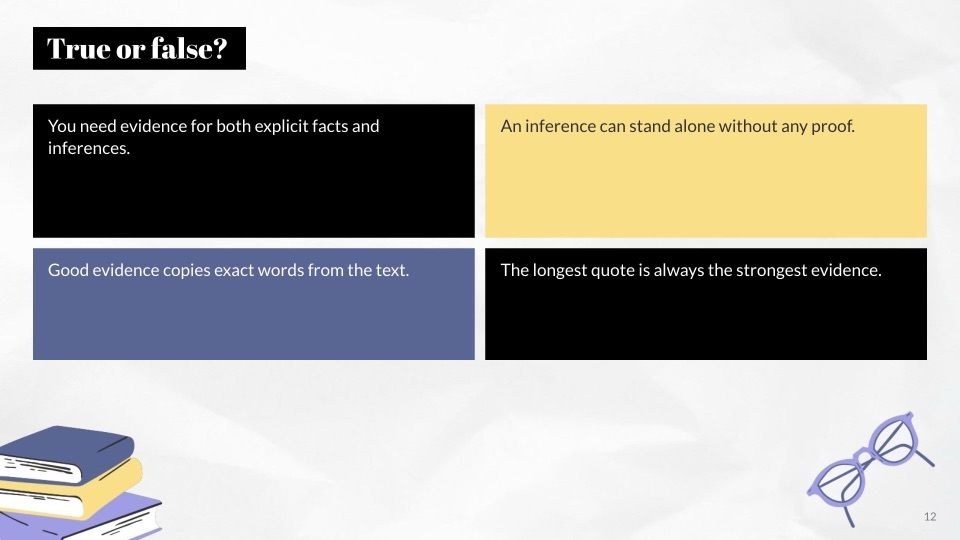
| 10 min | Plenary | To check that both explicit facts and inferences need cited proof. Show Slide 11 mystery: A reader points to five words and wins the argument. What power is that? Elicit citing exact text proof. Show Slide 12 true or false: You need evidence for both explicit facts and inferences. Inferences must be backed by text clues. Collect oral answers and restate the rule: exact, short, on topic, plus explanation. Give 3-question exit ticket on paper. |
Common mistakes
- Retelling in own words instead of citing exact words
How to spot it: Answer has no quotation marks or does not match the passage
Have students put finger on the sentence and copy 4-8 key words exactly with paragraph number. - Mixing up explicit and inference
How to spot it: Labels a figured-out feeling as word-for-word fact
Ask: Does the page use that exact word? If not, it is an inference and needs clue words plus reasoning. - Dropping a quote with no link to the claim
How to spot it: Quote is correct but no explanation of how it proves the idea
Add frame: This proves ___ because ___, using short, on-topic proof.
Support
- Give evidence cards with paragraph numbers marked so teams search a smaller section
- Provide sentence frames and pre-underlined key sentences for students who find it hard
- Pair readers so one finds the line and the partner copies the quote
Stretch
- Require finding a counter-quote to challenge another team's inference
- Ask for a second quote for the same inference and explain how clues connect
- Ask why one inference is stronger based on how direct the proof is
Check questions
- Is this explicit or inference: The tower held the book for ten seconds? Copy the proof.
Answer: Explicit. stood 28 inches tall and held the book for the full ten seconds, paragraph 4. - What clue proves the student felt discouraged at first? Is it explicit or inference?
Answer: Inference. shoulders low, tapping a pencil / I am just bad at this, paragraph 2. - Claim: The student kept trying. Give one quote and explain the link.
Answer: Tested a short tower three times, fixing the legs each time, paragraph 3; shows repeated fixing, so kept trying.
Curriculum
Cite textual evidence to support analysis of what the text says explicitly as well as inferences drawn from the text.
Video clips
Clips on YouTube, from the start and end times we chose. Check each one before you show it.
-
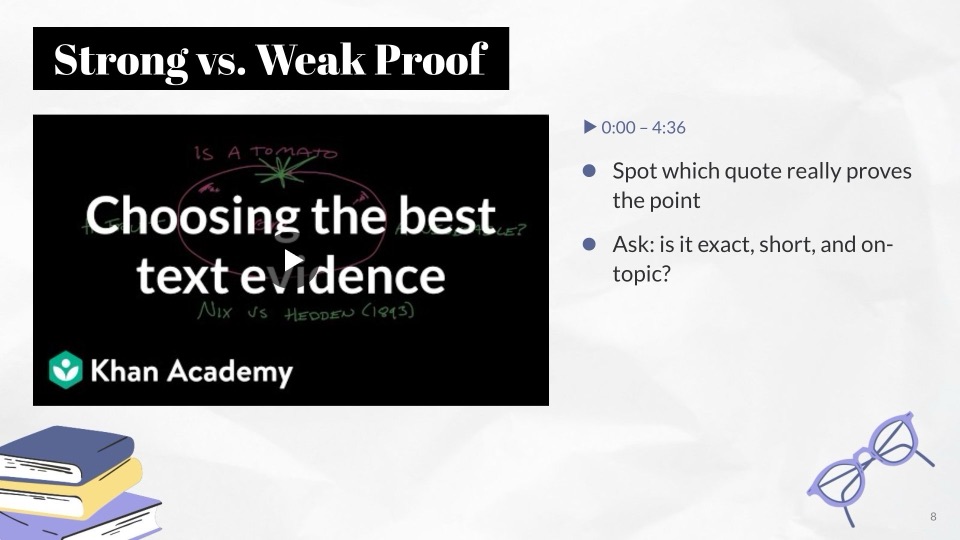
Choosing the best text evidence from 0:00 to 4:36
Khan Academy: Choosing the best text evidence | Reading | Khan Academy
Shows how to pick strong vs weak evidence, ideal for 11-12s learning to support analysis.
-
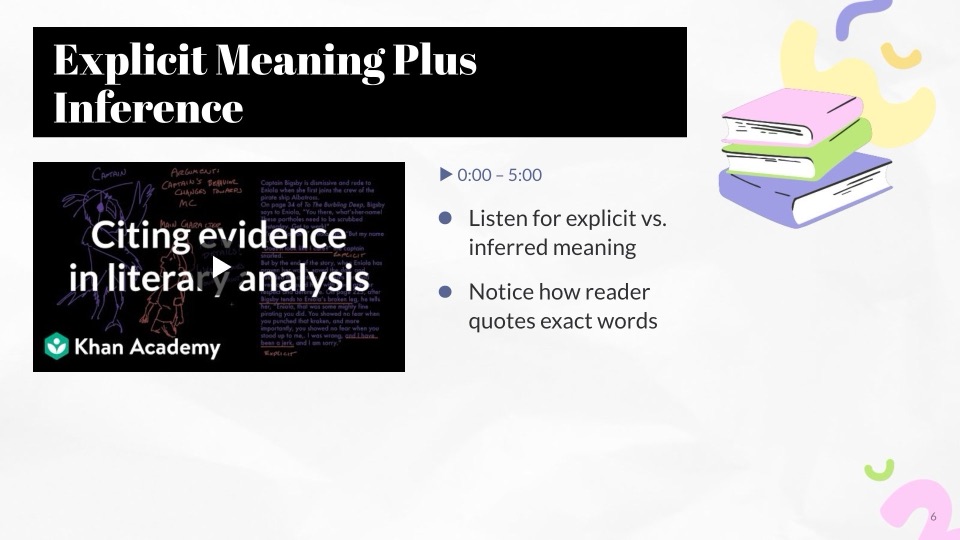
Citing evidence in literary analysis from 0:00 to 5:00
Khan Academy: Citing evidence in literary analysis | Reading | Khan Academy
Explains explicit meaning plus inference with evidence at just the right level for 11-12s.
Worksheet
Sources
- How to Read the Standards thecorestandards.org
- Reading - Wikipedia en.m.wikipedia.org
- Reading, Berkshire - Wikipedia en.m.wikipedia.org
- Download Citing Evidence From the Text Worksheets | Worksheetzone worksheetzone.org
- Science of reading Wikipedia
- Close reading Wikipedia
- Reading achievement Wikipedia
Picture credits
- Photo: sasint · Pixabay
- Photo: DariuszSankowski · Pixabay
- Photo: ChristopherPluta · Pixabay
- Photo: Pexels · Pixabay
- Photo: felix_w · Pixabay
- Pictograms: Sergio Palao, ARASAAC (arasaac.org) · CC BY-NC-SA
Made with Lesson Dino's AI on 16 October 2026. AI can make mistakes, so check facts against the sources before you teach.