The worksheet
About this worksheet
Students learn that volume is space inside solid figures. They pack boxes with unit cubes and compare volumes. This Grade 5 Math worksheet gives students (ages 10–11) six pages of practice on understanding volume, part of the measurement and data unit. It goes with our free Understanding volume lesson, which has the slides and a timed lesson plan.
What it covers
By the end, students should be able to:
- Students will recognize volume as space inside solid figures.
- Students will measure volume by counting unit cubes with no gaps.
- Students will compare two solids by volume in cubic units.
How to use it
- Main activity (25 minutes): Move groups that finish to Worksheet Task B counting practice.
- Plenary (15 minutes): Hand out Worksheet Task A true or false for independent check.
- Support: Pre-fill the bottom layer so the row and column structure is visible before counting up.
- Stretch: Predict a third box that would hold about twice as many cubes, then test by filling.
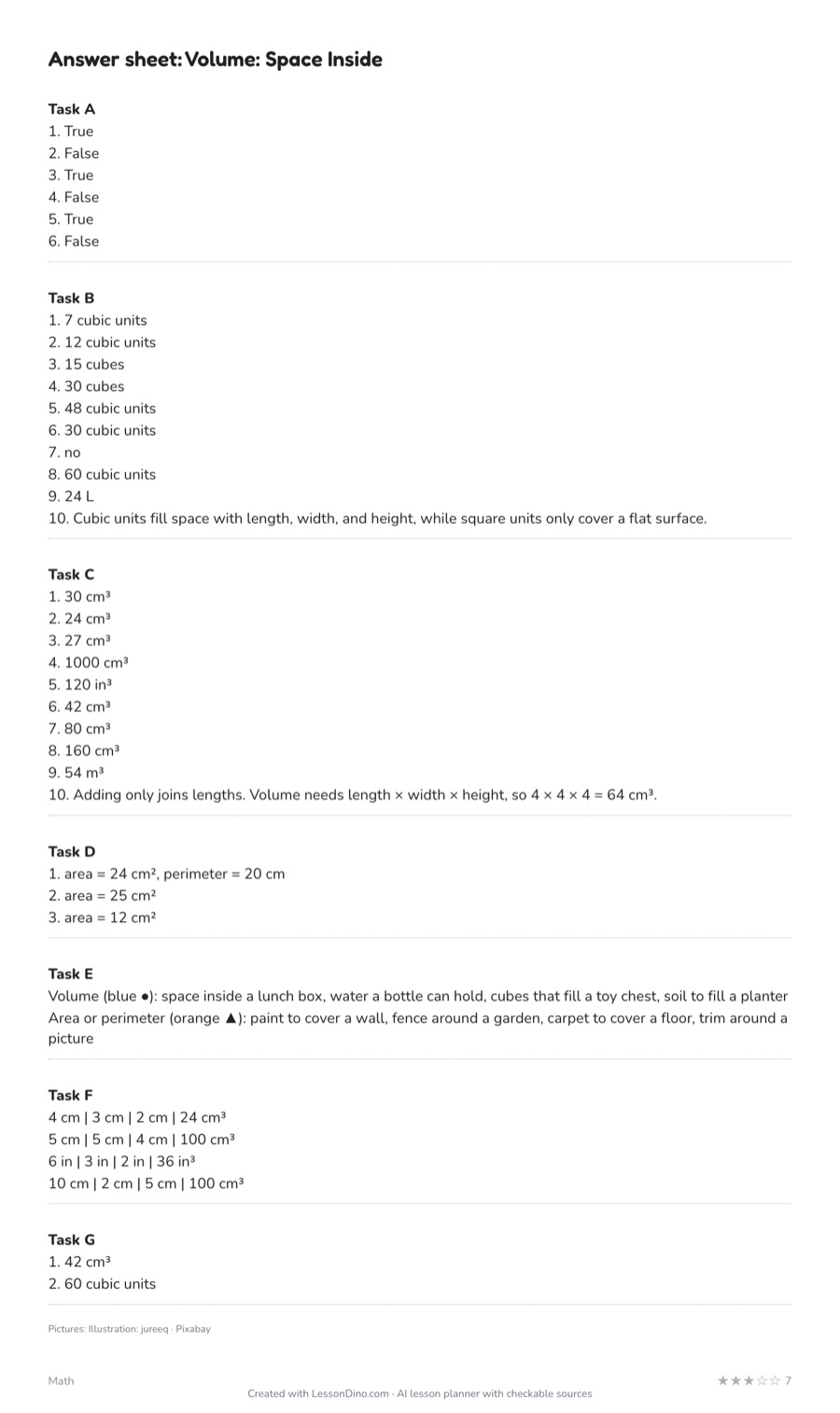
- The answer sheet is the last page, so you can print it on its own or let students check their own work.
Key vocabulary
- volume: how much space is taken up inside an object
- solid figure: an object that has length, width, and height
- unit cube: one tiny block used to measure space inside
- cubic centimeter: space inside a tiny block with 1-cm sides
Mistakes to watch for
- Finding surface area when asked for volume. Ask: Are we covering the outside or measuring space inside? Repack with cubes to show volume is inside.
- Leaving gaps or overlaps when packing and miscounting. Rebuild as rows, columns, and layers with no gaps or overlaps and count one layer at a time.
- Using cm instead of cubic units, or thinking flat shapes have volume. Hold up the 1-cm cube: a cube with 1-cm sides is 1 cm3; flat shapes cannot hold cubes so have no volume.
What's on the worksheet
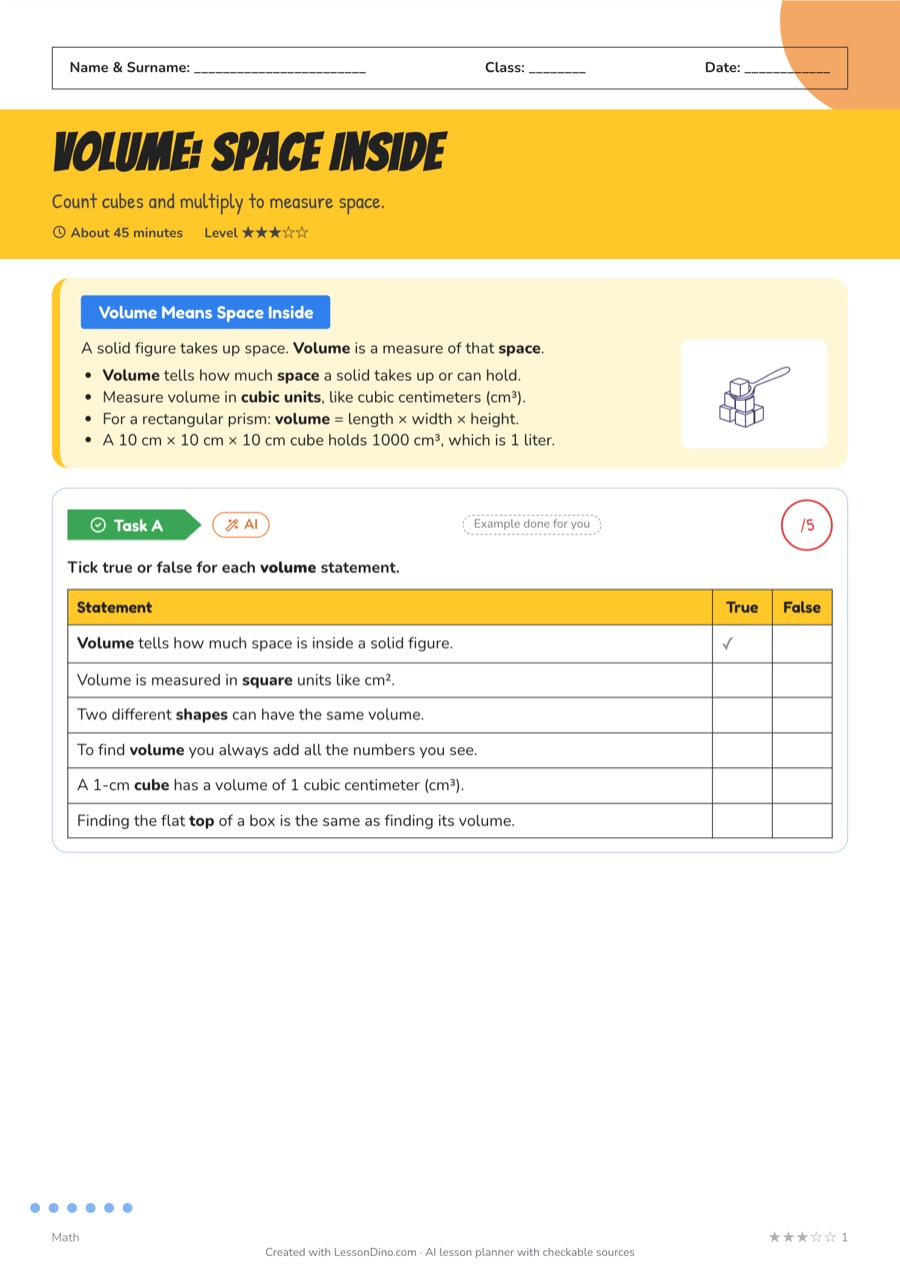
What Is Volume?
Learn what volume means and how we measure it.
Volume Means Space Inside
- A solid figure takes up space. Volume is a measure of that space.
- Volume tells how much space a solid takes up or can hold.
- Measure volume in cubic units, like cubic centimeters (cm³).
- For a rectangular prism: volume = length × width × height.
- A 10 cm × 10 cm × 10 cm cube holds 1000 cm³, which is 1 liter.
Tick true or false for each volume statement.
Count the Cubes
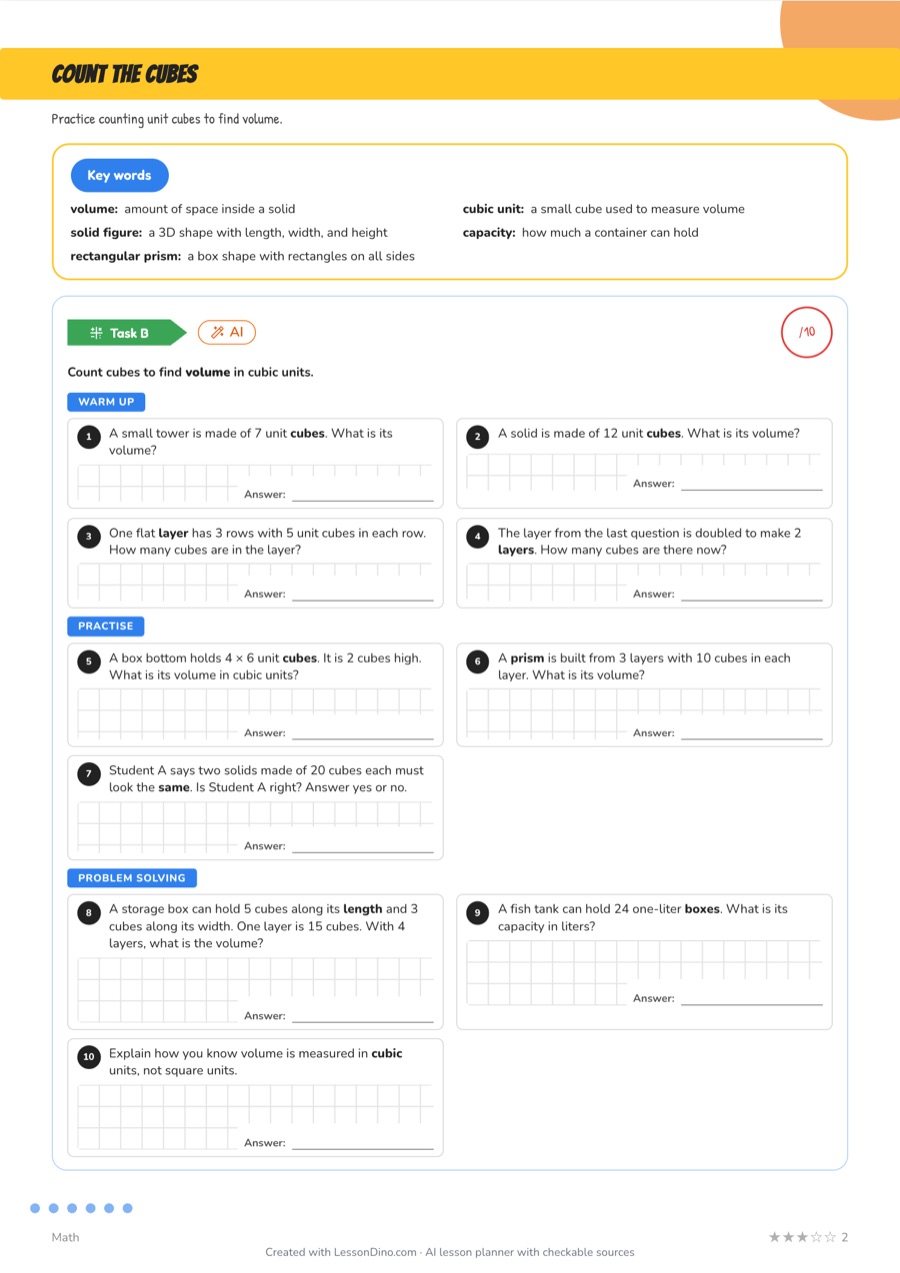
Practice counting unit cubes to find volume.
| Word | Meaning |
|---|---|
| volume | amount of space inside a solid |
| cubic unit | a small cube used to measure volume |
| solid figure | a 3D shape with length, width, and height |
| capacity | how much a container can hold |
| rectangular prism | a box shape with rectangles on all sides |
Count cubes to find volume in cubic units.
Warm up
- A small tower is made of 7 unit cubes. What is its volume?
- A solid is made of 12 unit cubes. What is its volume?
- One flat layer has 3 rows with 5 unit cubes in each row. How many cubes are in the layer?
- The layer from the last question is doubled to make 2 layers. How many cubes are there now?
Practise
- A box bottom holds 4 × 6 unit cubes. It is 2 cubes high. What is its volume in cubic units?
- A prism is built from 3 layers with 10 cubes in each layer. What is its volume?
- Student A says two solids made of 20 cubes each must look the same. Is Student A right? Answer yes or no.
Problem solving
- A storage box can hold 5 cubes along its length and 3 cubes along its width. One layer is 15 cubes. With 4 layers, what is the volume?
- A fish tank can hold 24 one-liter boxes. What is its capacity in liters?
- Explain how you know volume is measured in cubic units, not square units.
Use Length Times Width
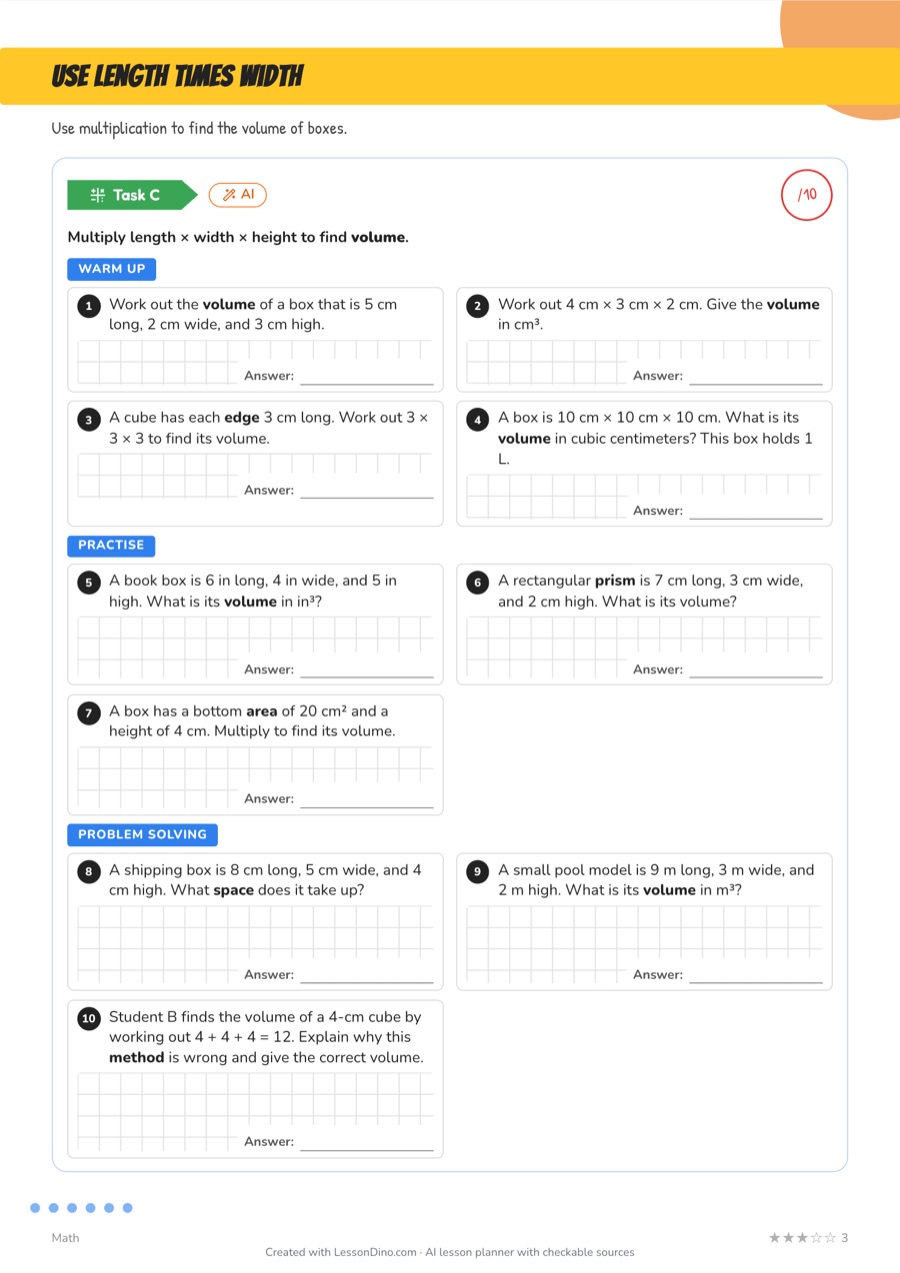
Use multiplication to find the volume of boxes.
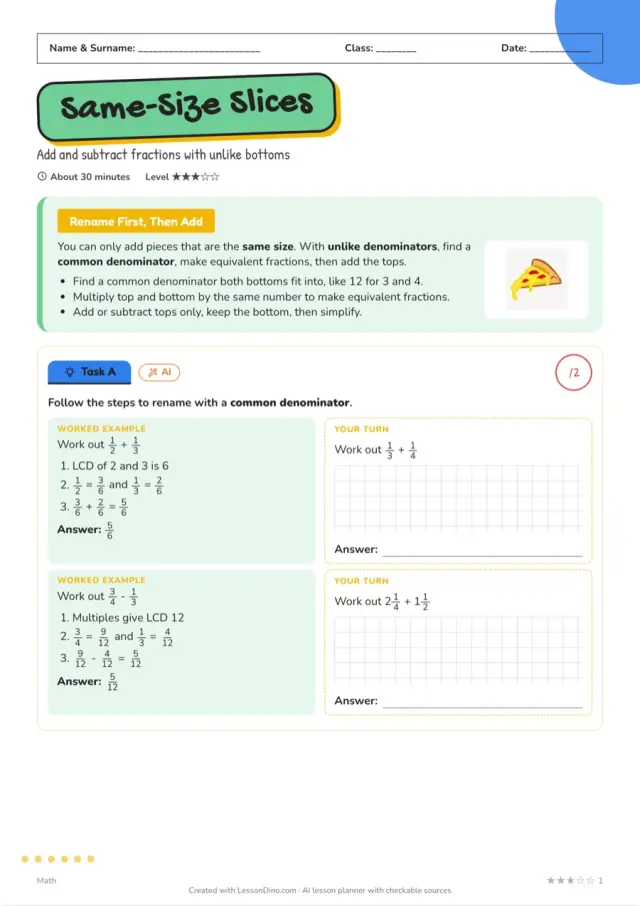
Multiply length × width × height to find volume.
Warm up
- Work out the volume of a box that is 5 cm long, 2 cm wide, and 3 cm high.
- Work out 4 cm × 3 cm × 2 cm. Give the volume in cm³.
- A cube has each edge 3 cm long. Work out 3 × 3 × 3 to find its volume.
- A box is 10 cm × 10 cm × 10 cm. What is its volume in cubic centimeters? This box holds 1 L.
Practise
- A book box is 6 in long, 4 in wide, and 5 in high. What is its volume in in³?
- A rectangular prism is 7 cm long, 3 cm wide, and 2 cm high. What is its volume?
- A box has a bottom area of 20 cm² and a height of 4 cm. Multiply to find its volume.
Problem solving
- A shipping box is 8 cm long, 5 cm wide, and 4 cm high. What space does it take up?
- A small pool model is 9 m long, 3 m wide, and 2 m high. What is its volume in m³?
- Student B finds the volume of a 4-cm cube by working out 4 + 4 + 4 = 12. Explain why this method is wrong and give the correct volume.
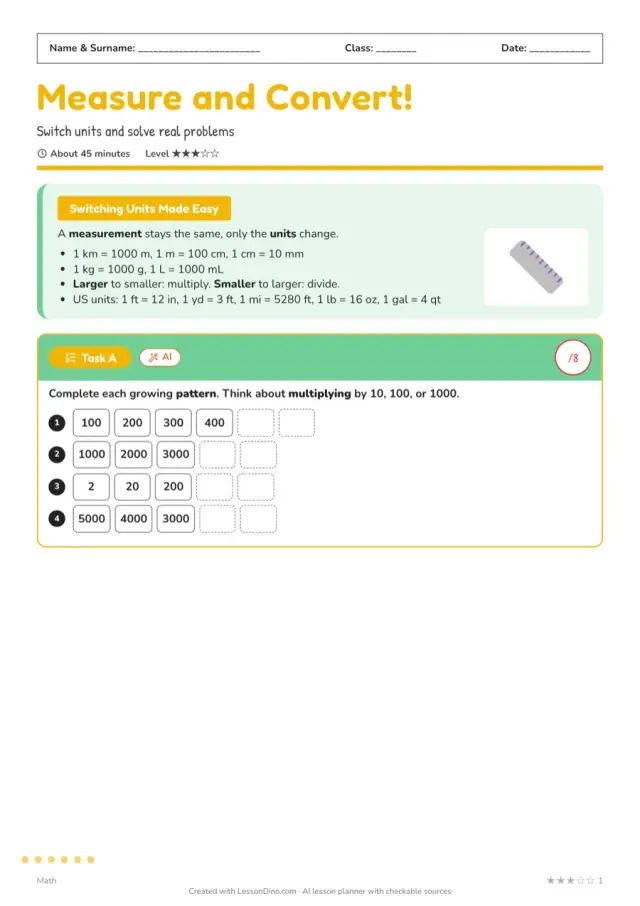
Area or Volume?
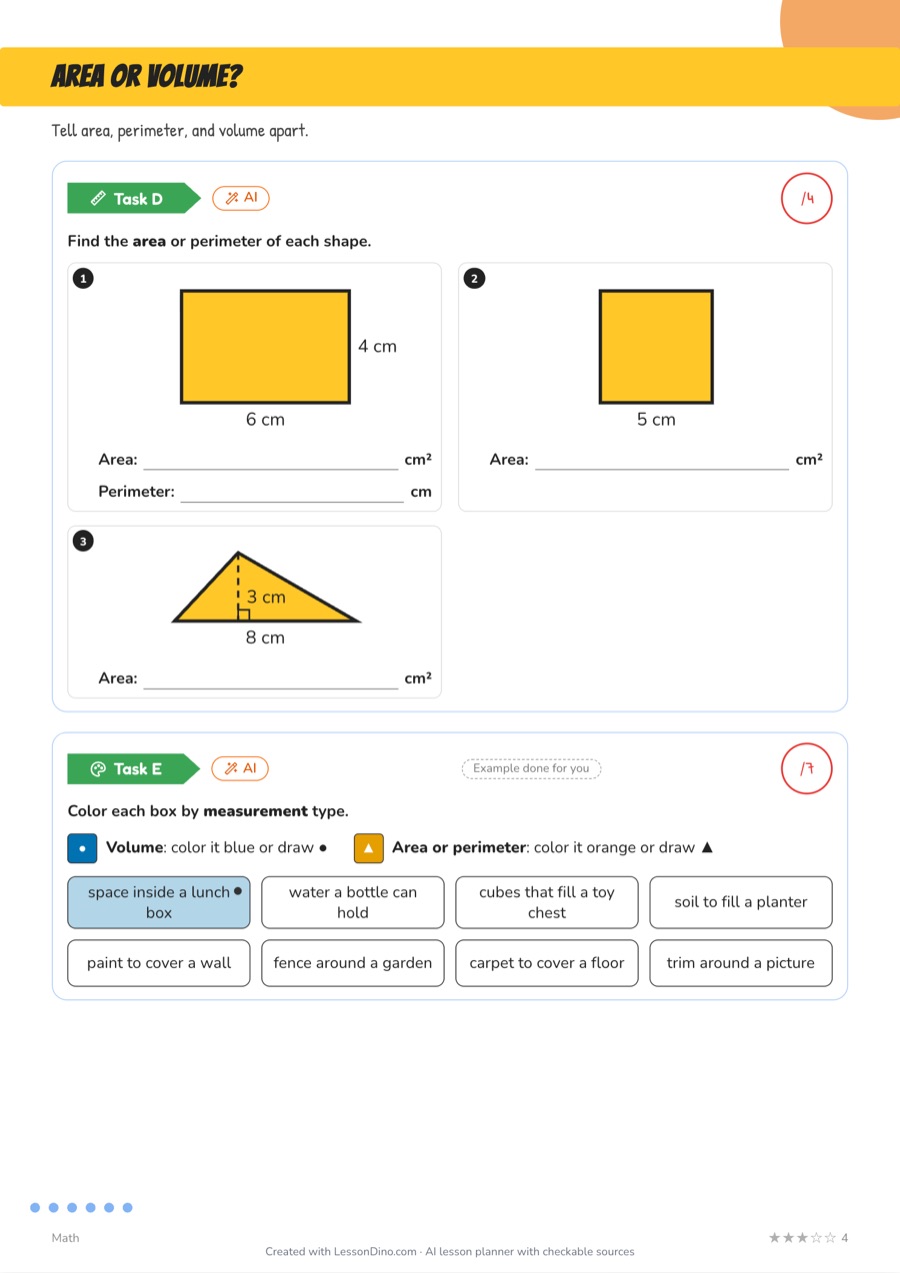
Tell area, perimeter, and volume apart.
Find the area or perimeter of each shape.
Color each box by measurement type.
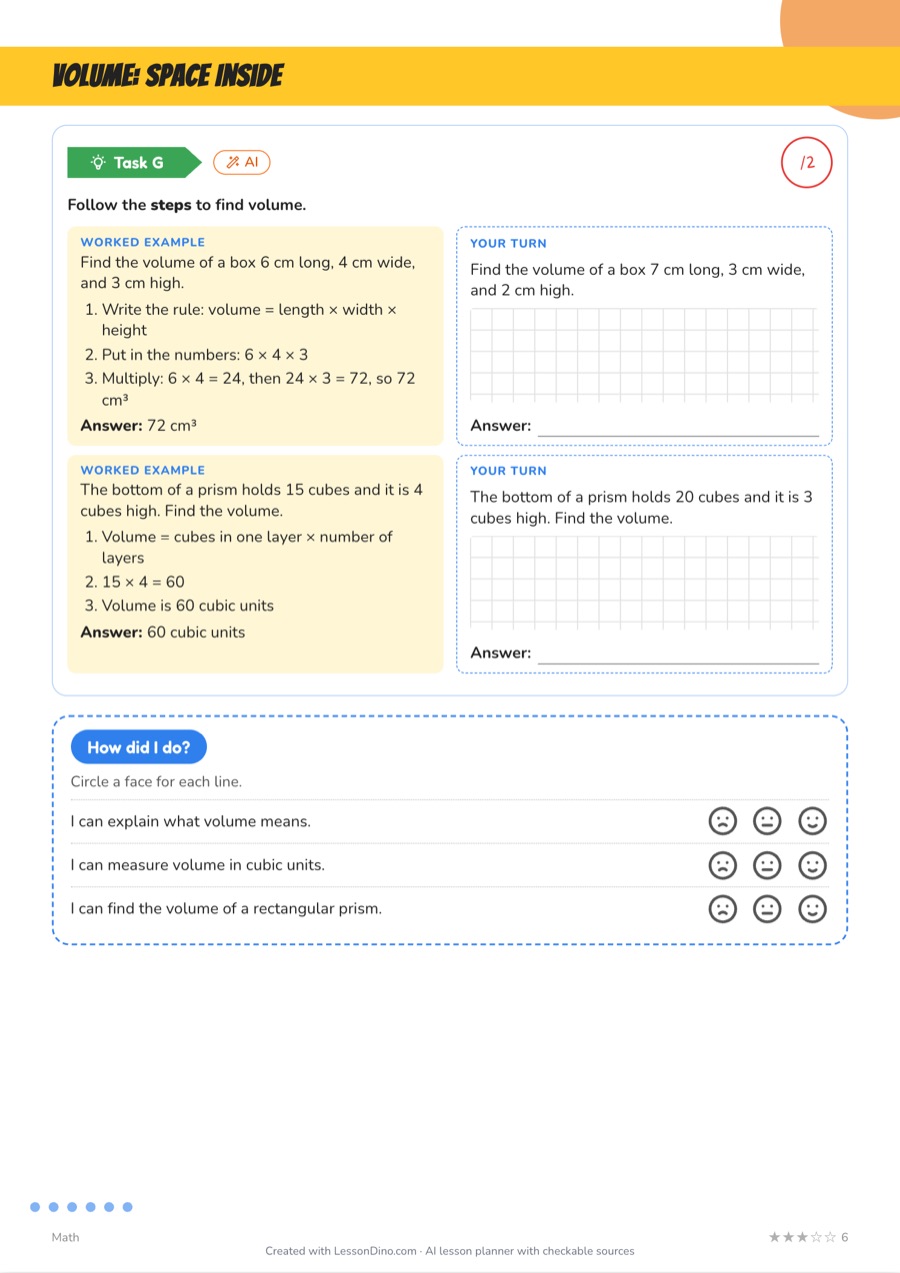
Tables and Examples
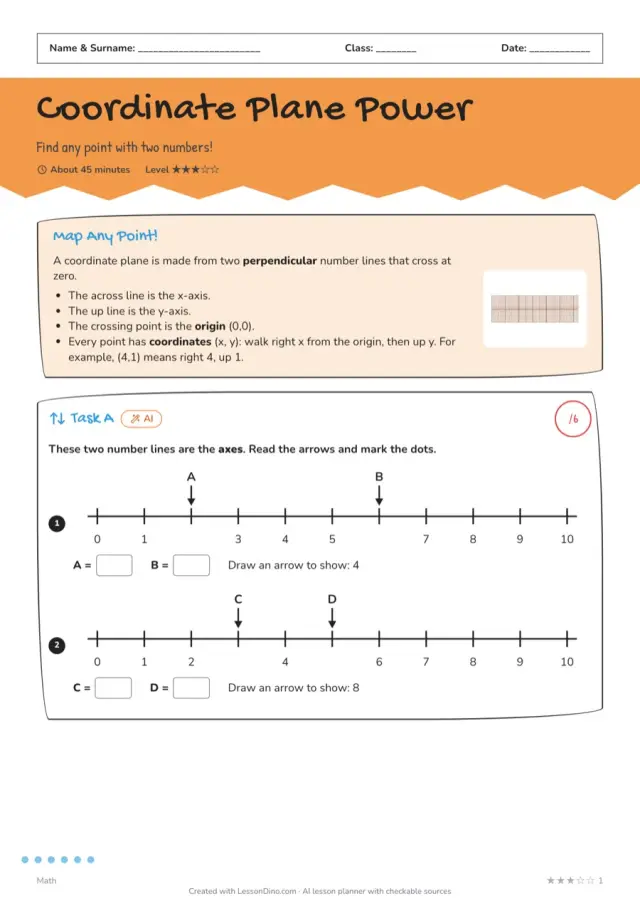
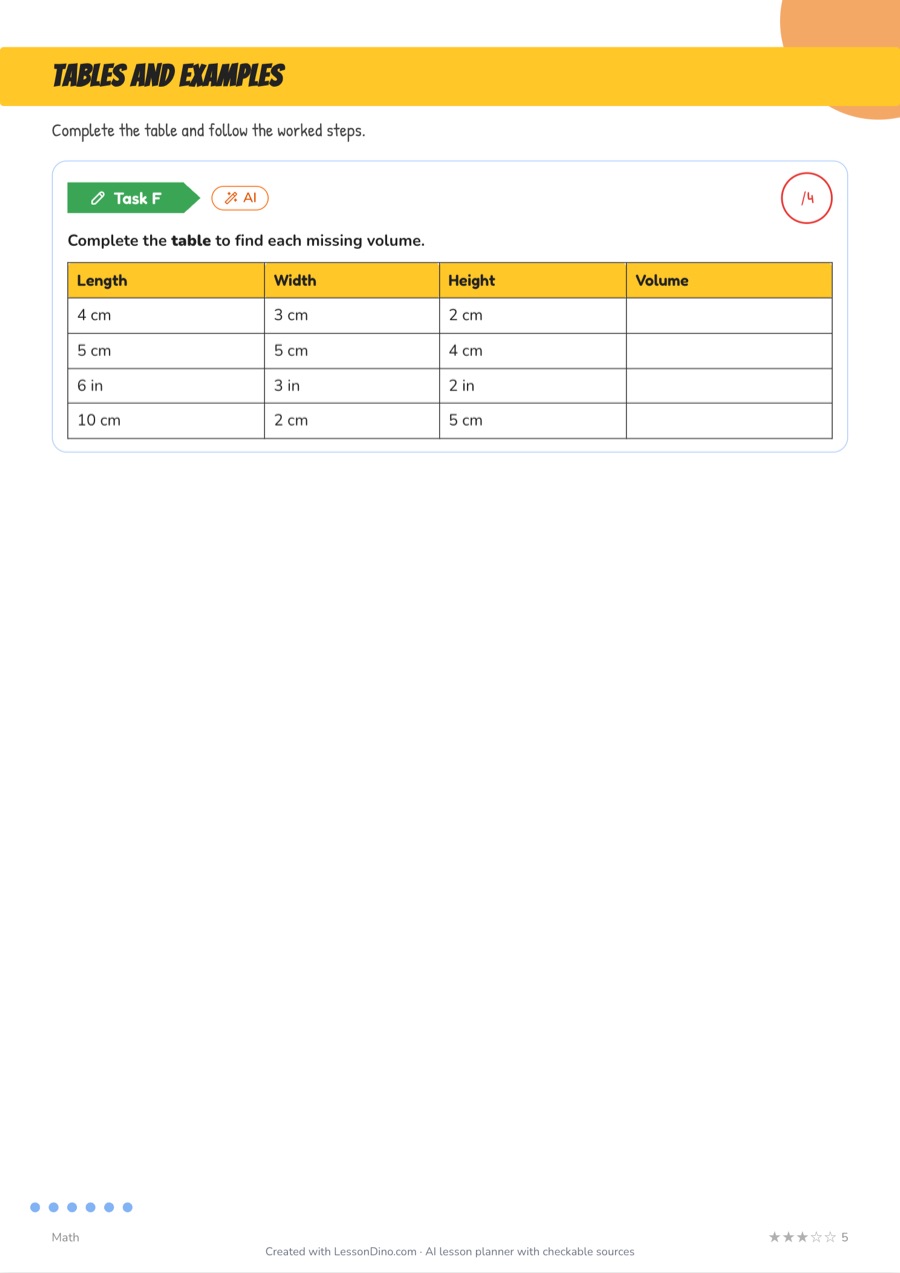
Complete the table and follow the worked steps.
Complete the table to find each missing volume.
Page 6
Follow the steps to find volume.
Answers
Show the answers
- A small tower is made of 7 unit cubes. What is its volume? 7 cubic units
- A solid is made of 12 unit cubes. What is its volume? 12 cubic units
- One flat layer has 3 rows with 5 unit cubes in each row. How many cubes are in the layer? 15 cubes
- The layer from the last question is doubled to make 2 layers. How many cubes are there now? 30 cubes
- A box bottom holds 4 × 6 unit cubes. It is 2 cubes high. What is its volume in cubic units? 48 cubic units
- A prism is built from 3 layers with 10 cubes in each layer. What is its volume? 30 cubic units
- Student A says two solids made of 20 cubes each must look the same. Is Student A right? Answer yes or no. no
- A storage box can hold 5 cubes along its length and 3 cubes along its width. One layer is 15 cubes. With 4 layers, what is the volume? 60 cubic units
- A fish tank can hold 24 one-liter boxes. What is its capacity in liters? 24 L
- Explain how you know volume is measured in cubic units, not square units. Cubic units fill space with length, width, and height, while square units only cover a flat surface.
- Work out the volume of a box that is 5 cm long, 2 cm wide, and 3 cm high. 30 cm³
- Work out 4 cm × 3 cm × 2 cm. Give the volume in cm³. 24 cm³
- A cube has each edge 3 cm long. Work out 3 × 3 × 3 to find its volume. 27 cm³
- A box is 10 cm × 10 cm × 10 cm. What is its volume in cubic centimeters? This box holds 1 L. 1000 cm³
- A book box is 6 in long, 4 in wide, and 5 in high. What is its volume in in³? 120 in³
- A rectangular prism is 7 cm long, 3 cm wide, and 2 cm high. What is its volume? 42 cm³
- A box has a bottom area of 20 cm² and a height of 4 cm. Multiply to find its volume. 80 cm³
- A shipping box is 8 cm long, 5 cm wide, and 4 cm high. What space does it take up? 160 cm³
- A small pool model is 9 m long, 3 m wide, and 2 m high. What is its volume in m³? 54 m³
- Student B finds the volume of a 4-cm cube by working out 4 + 4 + 4 = 12. Explain why this method is wrong and give the correct volume. Adding only joins lengths. Volume needs length × width × height, so 4 × 4 × 4 = 64 cm³.
The answer sheet is the last picture above.
Curriculum
Recognize volume as an attribute of solid figures and understand concepts of volume measurement.
Made with Lesson Dino's AI on 17 October 2026. AI can make mistakes, so check the answers and facts against the sources before you teach.