Slides
Lesson plan
Switch It! Two-Step Conversions
Students learn to convert units within one system. They use conversions to solve two-step real-world problems.
Objectives
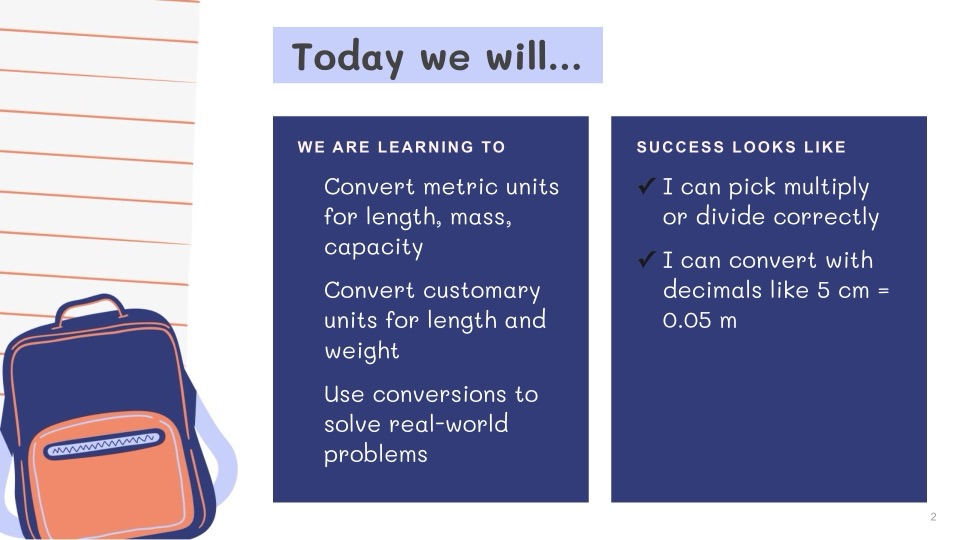
- Students will convert metric length, mass and capacity units within the system.
- Students will convert customary length and weight units within the system.
- Students will solve multi-step real-world problems that require converting units first.
Success criteria
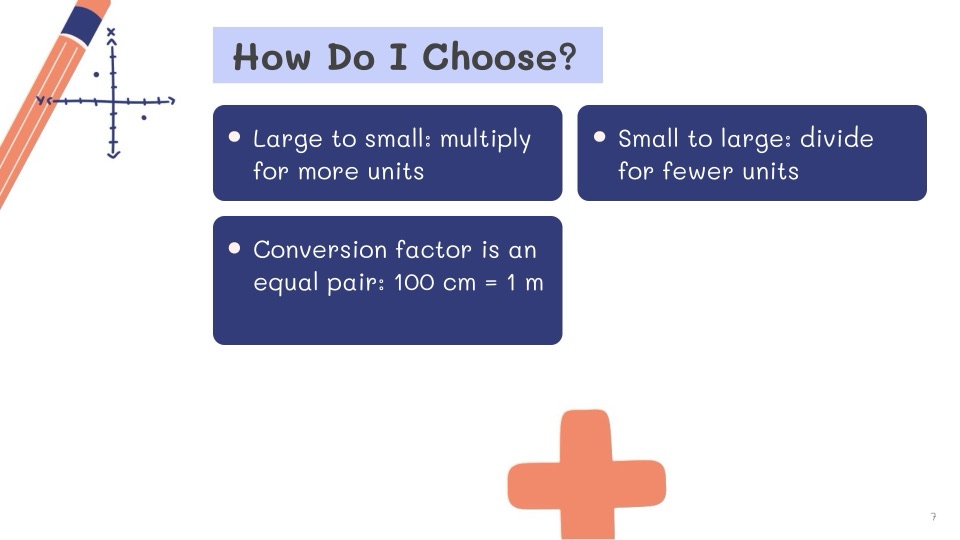
- I can switch metric units by multiplying or dividing by 10, 100, 1000.
- I can switch customary units using 12, 3, 1760 and 16.
- I can convert to one unit first, then solve two-step problems.
Key words
| Word | Meaning |
|---|---|
| convert | change an amount so it is shown in a different unit |
| conversion factor | an equal pair like 100 cm = 1 m that lets you switch |
| kilogram | a mass equal to 1,000 grams |
| inch | a small customary length; 12 make 1 foot |
| centimeter | a metric length; 100 make 1 meter |
Timed plan (60 minutes)
| Time | Stage | What happens |
|---|---|---|
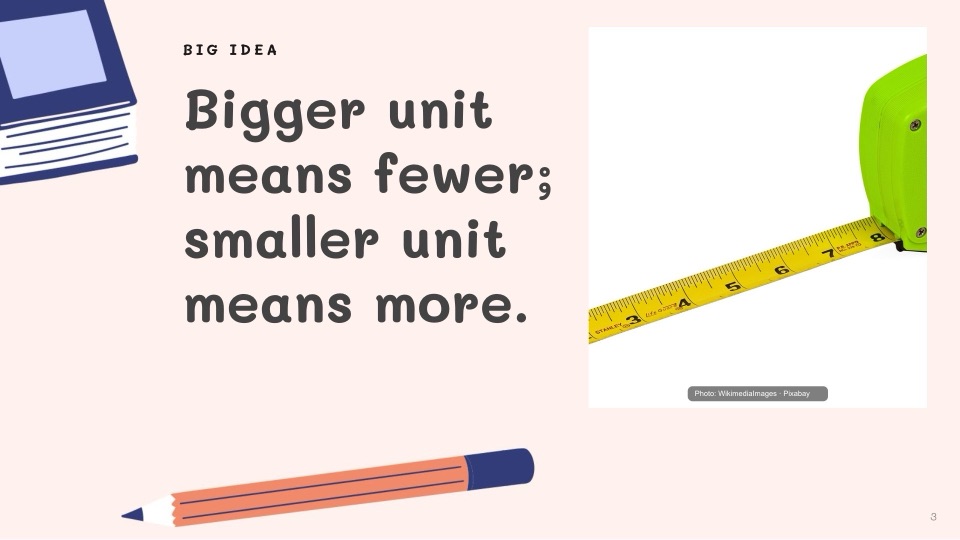
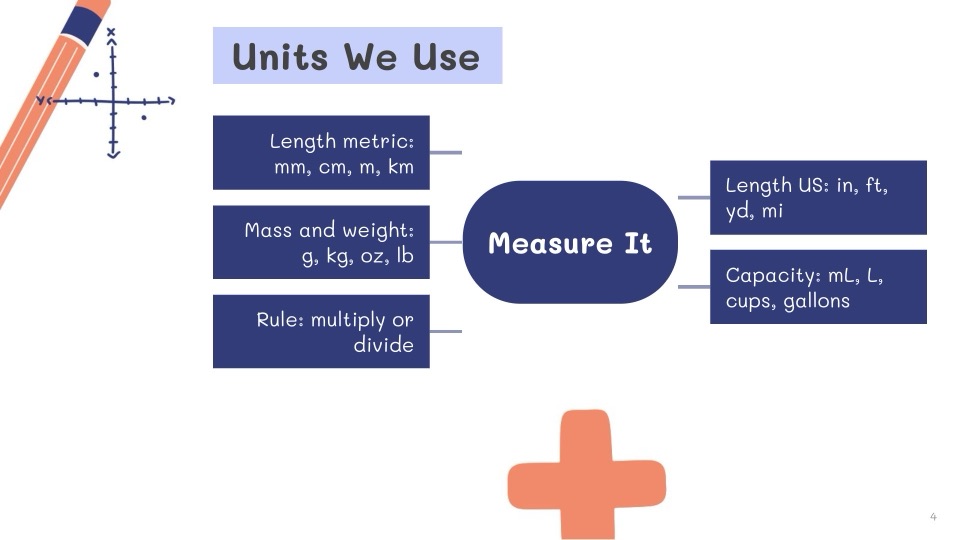
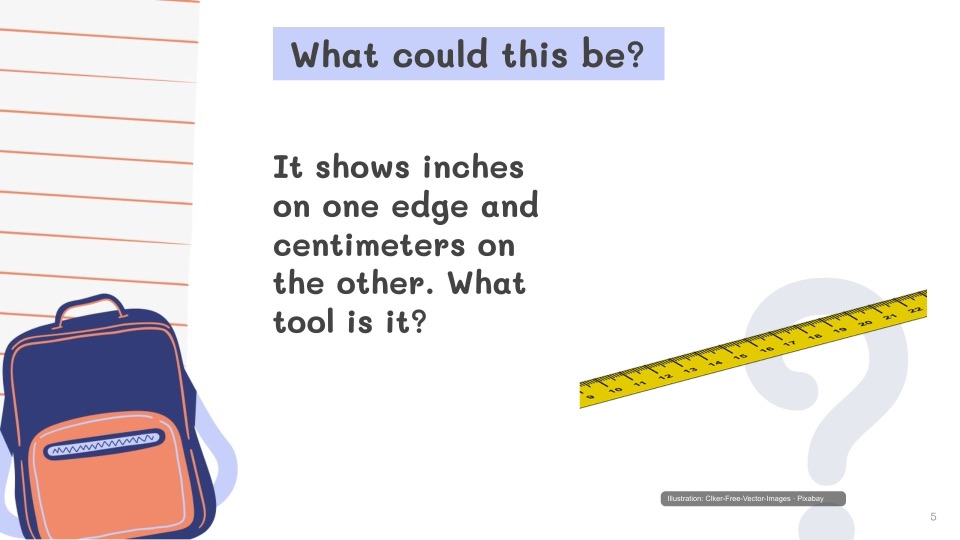
| 8 min | Starter | Activate prior unit knowledge and set up the need to convert before solving. Show Slide 1 and read the title, then give the hook: A builder has a plan in one unit but a ruler in another — what should they do? Show Slide 4 mindmap and ask pairs to name metric and US units they already know. Show Slide 3 and teach the rule: bigger unit means fewer; smaller unit means more. Show the ruler and tape measure that has inches on one edge and centimeters on the other. |
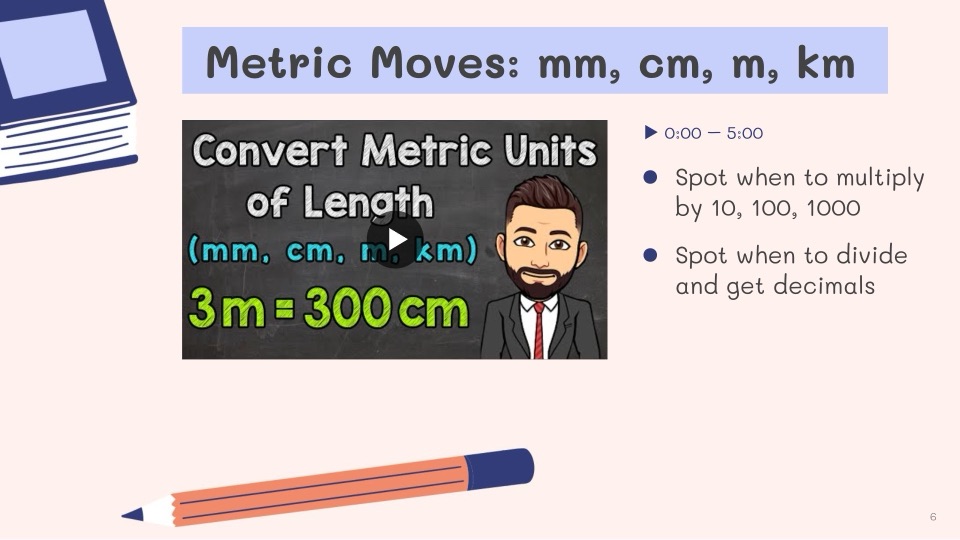
| 12 min | Teaching | Model how to convert metric units by multiplying or dividing by 10, 100 and 1000. Play Video clip 5 (0:00-5:00) on Slide 6 and tell students to spot when to multiply and when division gives decimals. Show Slide 7 and model large to small means multiply for more units and small to large means divide for fewer units. Model 2 m = 200 cm by multiplying by 100 because 100 cm = 1 m. Model converting kilograms to grams by multiplying by 1,000 because a kilogram is 1,000 grams. |
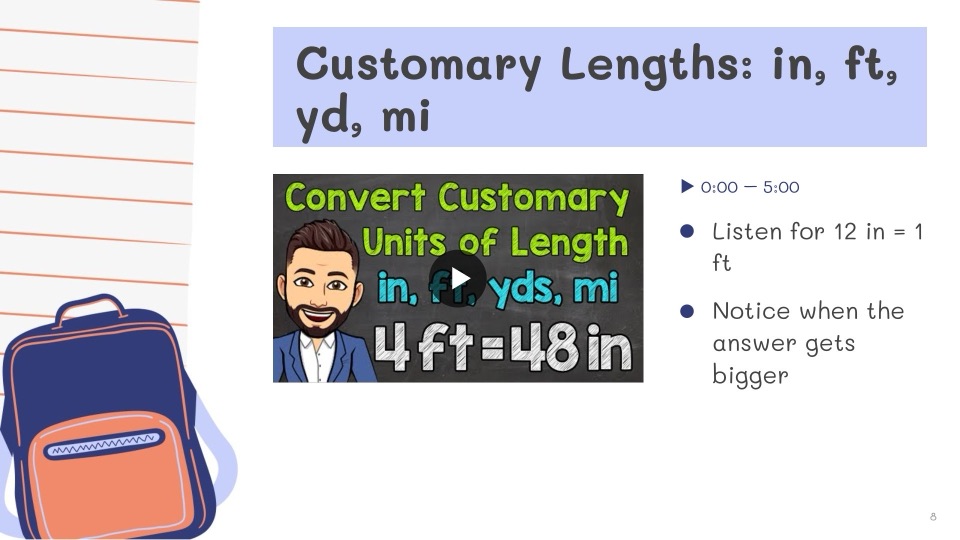
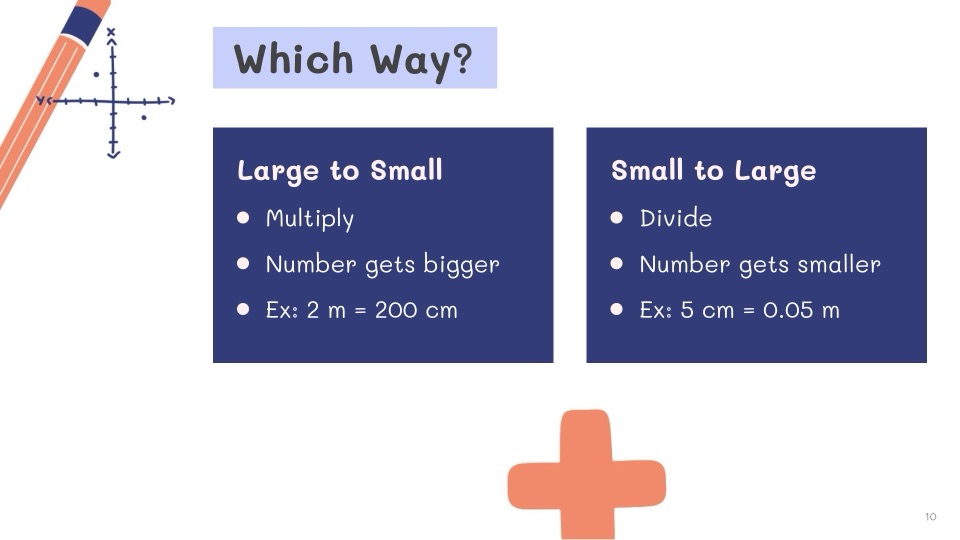
| 10 min | We do | Practice choosing multiply or divide for customary length and weight conversions. Show Slide 10 and remind pairs that large to small means multiply and the number gets bigger, like 2 m = 200 cm. Model 36 feet equals 12 yards by dividing 36 by 3 because 1 yd = 3 ft. Model converting 7 feet to inches by multiplying 7 by 12, giving 84 inches because 1 ft = 12 in. Have pairs solve 80 ounces to pounds on whiteboards. |
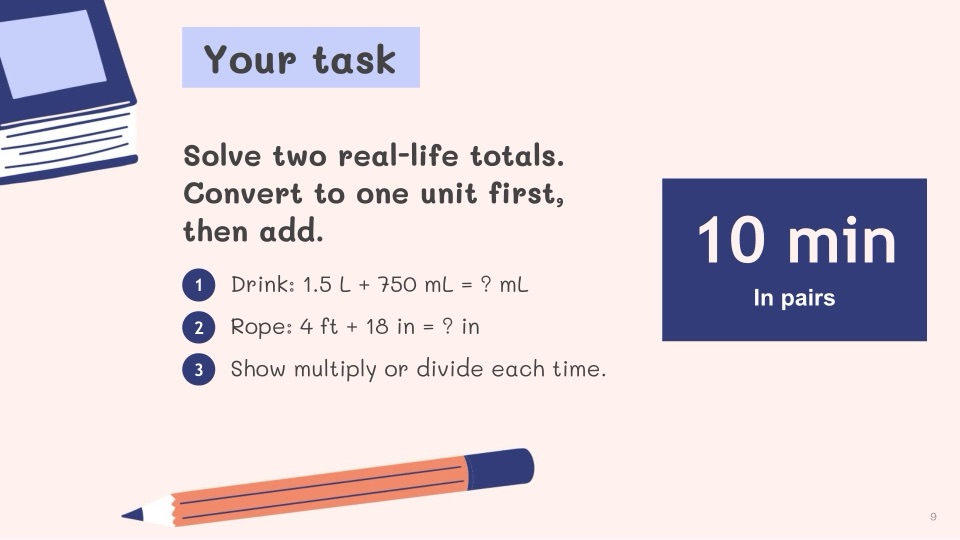
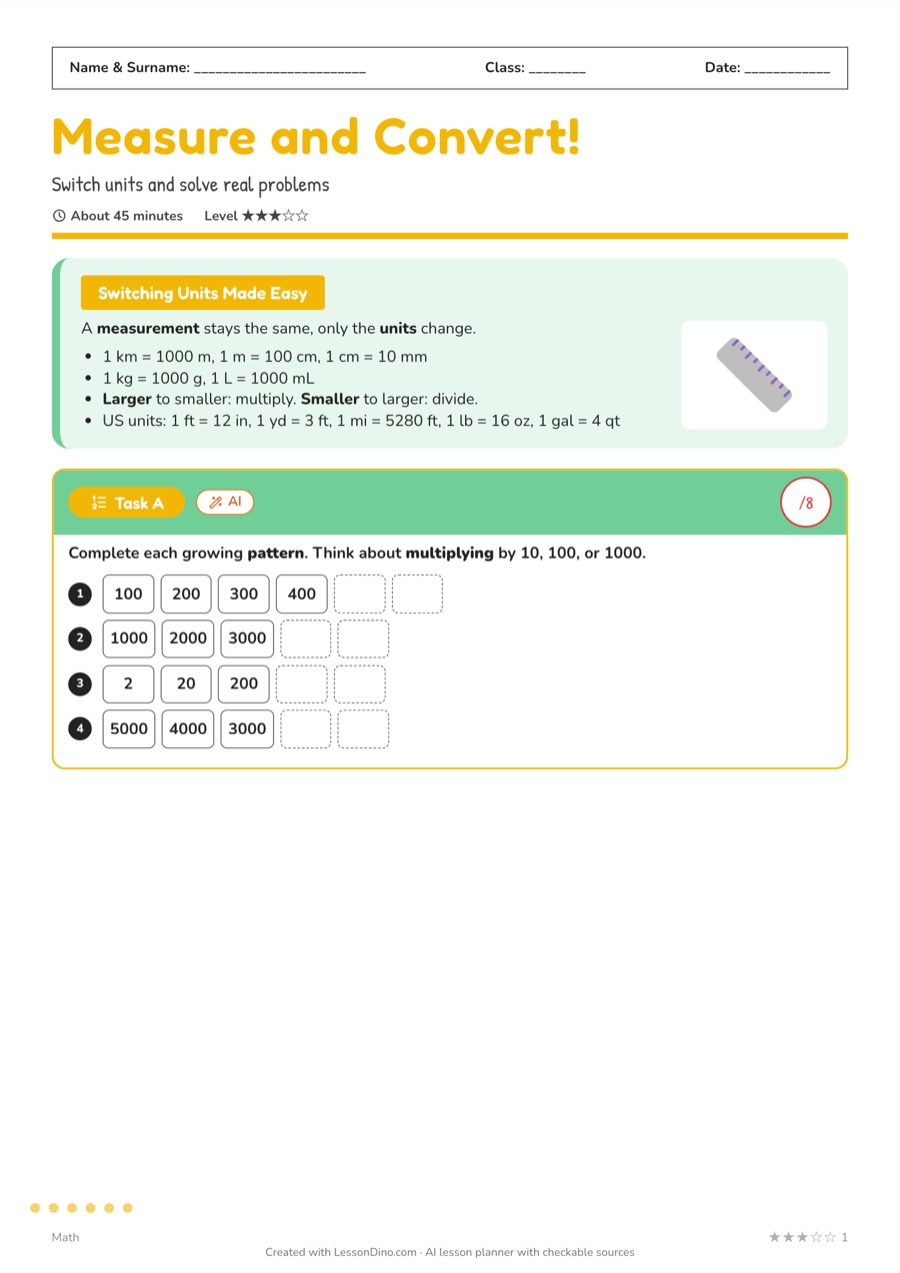
| 20 min | Main activity | Solve multi-step real-world problems by converting to one unit first, then adding. Hand out Worksheet Task B and show Slide 9 with the drink and rope totals. Model the rope without devices: 4 ft = 4 x 12 = 48 in, then 48 + 18 = 66 in, circling in. Set pairs to work: convert first, then add, showing multiply or divide each time. Remind students that 1.2 meters is 120 centimeters and operations with decimals to hundredths help write answers like 1.05 m. |
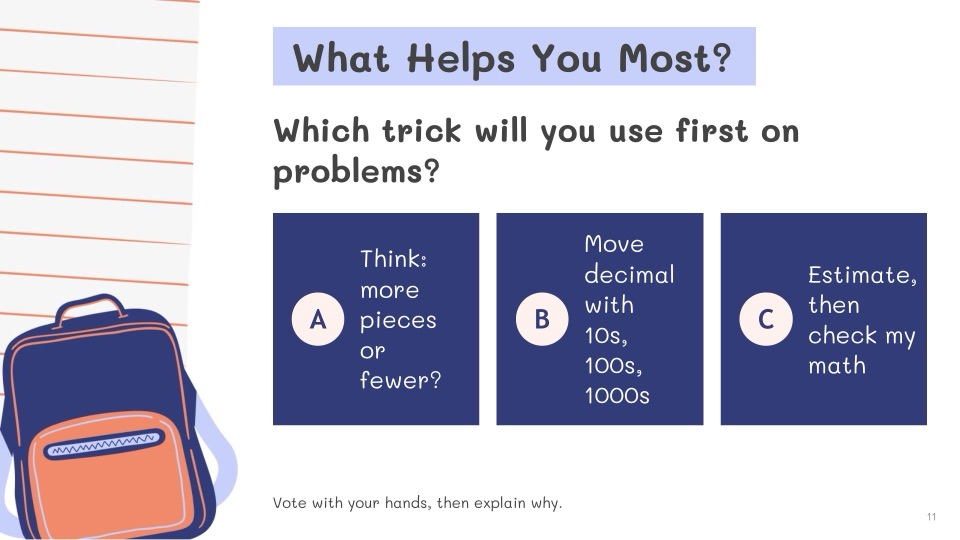
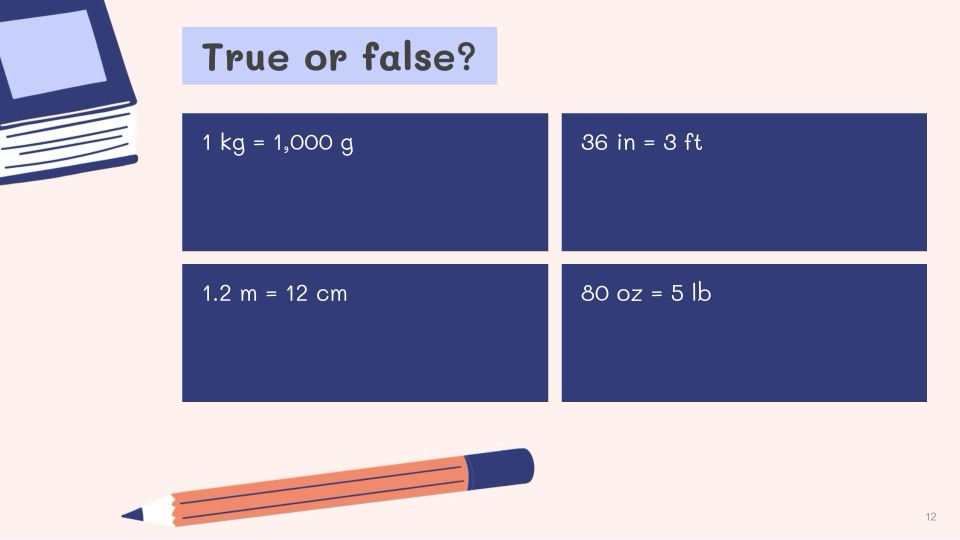
| 10 min | Plenary | Check accuracy of conversions and lock in when to multiply or divide. Show Slide 12 true-or-false cards and have teams vote true or false with paddles. Fix the trick: 1.2 m = 120 cm, not 12 cm, because 1.2 meters is 120 centimeters. Show Slide 11 and have each student pick the trick they will use first: more pieces or fewer, decimal move, or estimate then check. |
Common mistakes
- Multiplying when converting to a larger unit, getting a bigger number.
How to spot it: Answer has more units after switching to a larger unit, like 5 cm = 500 m.
Use bigger unit means fewer; small to large means divide for a smaller number. - Writing 1.2 m = 12 cm.
How to spot it: Student multiplies by 10 instead of 100.
Show 100 cm = 1 m, so 1.2 m is 120 centimeters. - Multiplying ounces to get pounds, like 80 oz = 1280 lb.
How to spot it: Number gets huge when it should shrink.
Recall 16 ounces in a pound, so divide 80 by 16 to get 5 lb.
Support
- Highlight the units in each problem and provide the fact that 1 kilometer = 1000 meters for reference
- Give a place-value chart and centimeters to millimeters table where 10 mm = 1 cm
- Let students line up centimeter strips to build 120 cm using 100 cm = 1 m
Stretch
- Have students create an extra step that asks for the difference between two converted amounts
- Have pairs find a third length between 120 cm and 121 cm and write it in both units
- Have students write two tricky false statements for another team to fix
Check questions
- Convert 5 cm to meters.
Answer: 0.05 m (divide by 100) - Is 36 in = 3 ft true? Show the math.
Answer: True, 36 divided by 12 = 3 because 12 in = 1 ft - Solve: 1.5 L + 750 mL = ? mL. Show both steps.
Answer: 1500 mL + 750 mL = 2250 mL
Curriculum
Convert among different-sized standard measurement units within a given measurement system (e.g., convert 5 cm to 0.05 m), and use these conversions in solving multi-step, real world problems.
Video clips
Clips on YouTube, from the start and end times we chose. Check each one before you show it.
-
Customary length conversions from 0:00 to 5:00
Math with Mr. J: Converting Customary Units of Length (Inches, Feet, Yards, and Miles)
Covers inches, feet, yards, and miles conversions needed in the US system with clear modeling for 10-11-year-olds.
-
Metric length mm cm m km from 0:00 to 5:00
Math with Mr. J: Metric Units of Length | Convert mm, cm, m and km
Perfect focus on converting mm, cm, m, and km with visuals and pace ideal for 10-11-year-olds.
Worksheet
Sources
- Grade 5 Math Curriculum - Fairfax County Public Schools fcps.edu
- Mathematics Grade 5 - Chicago Public Schools cps.edu
- Converting units KS2 | Y5 Maths | Lesson Resources thenational.academy
- Converting Units pontefractacademiestrust.org.uk
- Flexi answers - How to learn conversion of metric units? | CK-12 Foundation ck12.org
- Converting Units | Purplemath purplemath.com
- Z UNITS: A program for converting units hpmuseum.org
- Convert Units of Measurement Math Video for Kids - Grades 3-5 generationgenius.com
- Teaching Kids About Measurements | Unit Conversion Guide qonvert.org
- Conversion of Units of Measurement cs.utexas.edu
- Converting Units of Time Easy | Teaching Resources tes.com
- 6.4%3A+Unit+Conversion+ +American+System math.libretexts.org
Picture credits
- Illustration: TyliJura · Pixabay
- Photo: WikimediaImages · Pixabay
- Illustration: Clker-Free-Vector-Images · Pixabay
- Microsoft Fluent Emoji (MIT)
Made with Lesson Dino's AI on 17 October 2026. AI can make mistakes, so check facts against the sources before you teach.