The worksheet
About this worksheet
Students learn to read, write and compare decimals to thousandths. They judge close race times and order them fastest to slowest. This Grade 5 Math worksheet gives students (ages 10–11) five pages of practice on reading and comparing decimals, part of the number and operations in base ten unit. It goes with our free Reading and comparing decimals lesson, which has the slides and a timed lesson plan.
What it covers
By the end, students should be able to:
- Students will read and write decimals to thousandths in digits and words.
- Students will compare decimals to thousandths using place value and symbols.
- Students will order up to four decimals least to greatest and explain reasoning.
How to use it
- Teaching (12 minutes): Have students build and write two numbers on Worksheet Task E on whiteboards.
- Support: Give times with same ones and tenths, like 11.451 and 11.475, so they only compare hundredths and thousandths in a lined-up chart.
- Stretch: Add a fifth time that ties on thousandths and ask students to explain what tie means in thousandths.
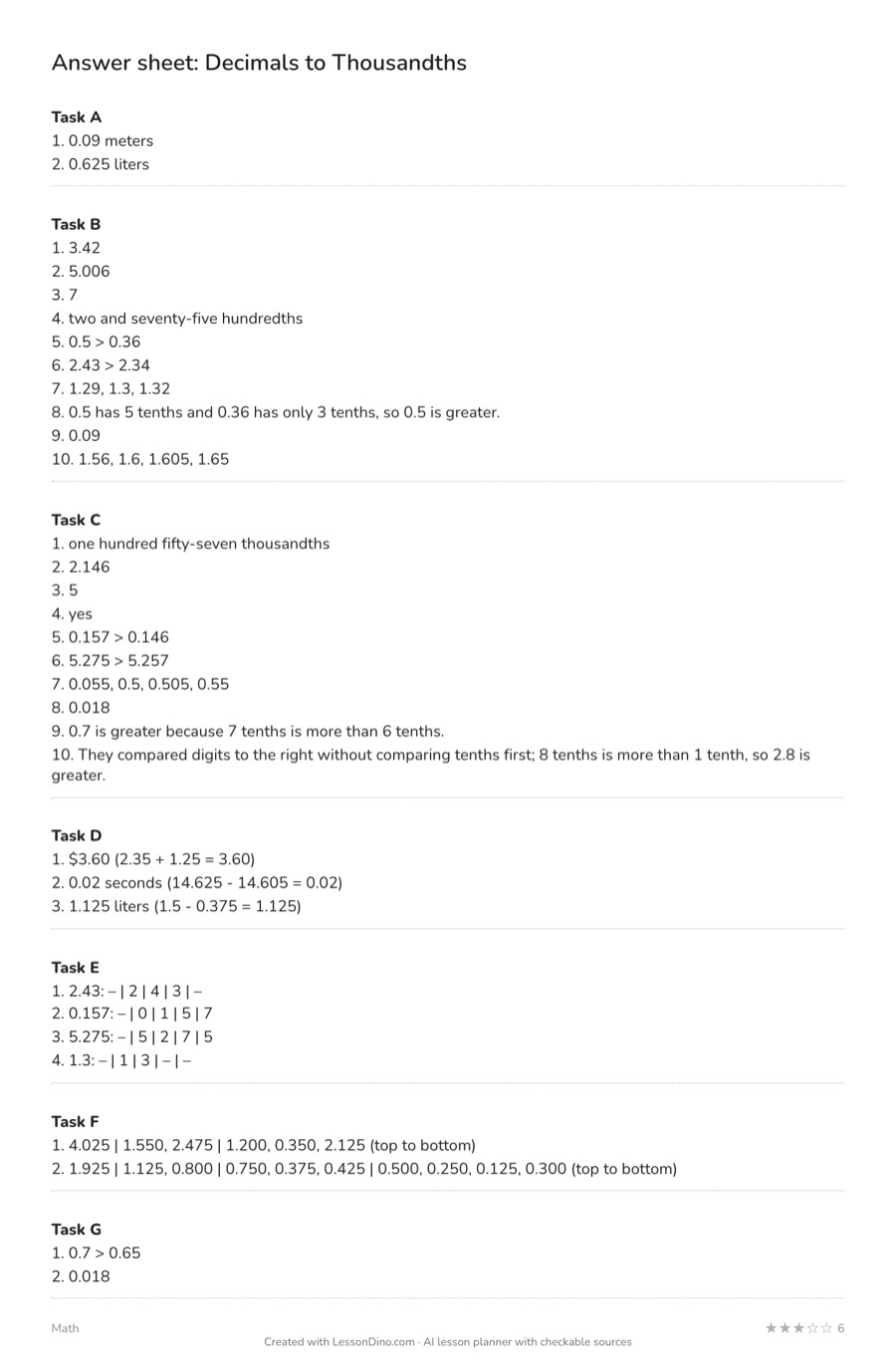
- The answer sheet is the last page, so you can print it on its own or let students check their own work.
Key vocabulary
- thousandth: one tiny piece when a whole is cut into 1,000 even pieces
- decimal point: little dot that keeps whole numbers apart from parts less than one
- place value: how much a digit counts for because of where it sits
- compare: tell which amount is bigger, smaller, or if both match
Mistakes to watch for
- Longer is larger: thinking 0.36 > 0.5 because 36 > 5. Line up as 0.50 vs 0.36 and model with tenth and hundredth grids to see sizes.
- Reading as point digits, like two point three four five for 2.345. Insist on place words: two and three hundred forty-five thousandths, since point talk leads to confusion about value.
- Lining up left edge instead of decimal points, so 2.34 looks bigger than 2.43. Rewrite in place-value table lining up decimal points and fill gaps with zero, then compare left to right.
What's on the worksheet
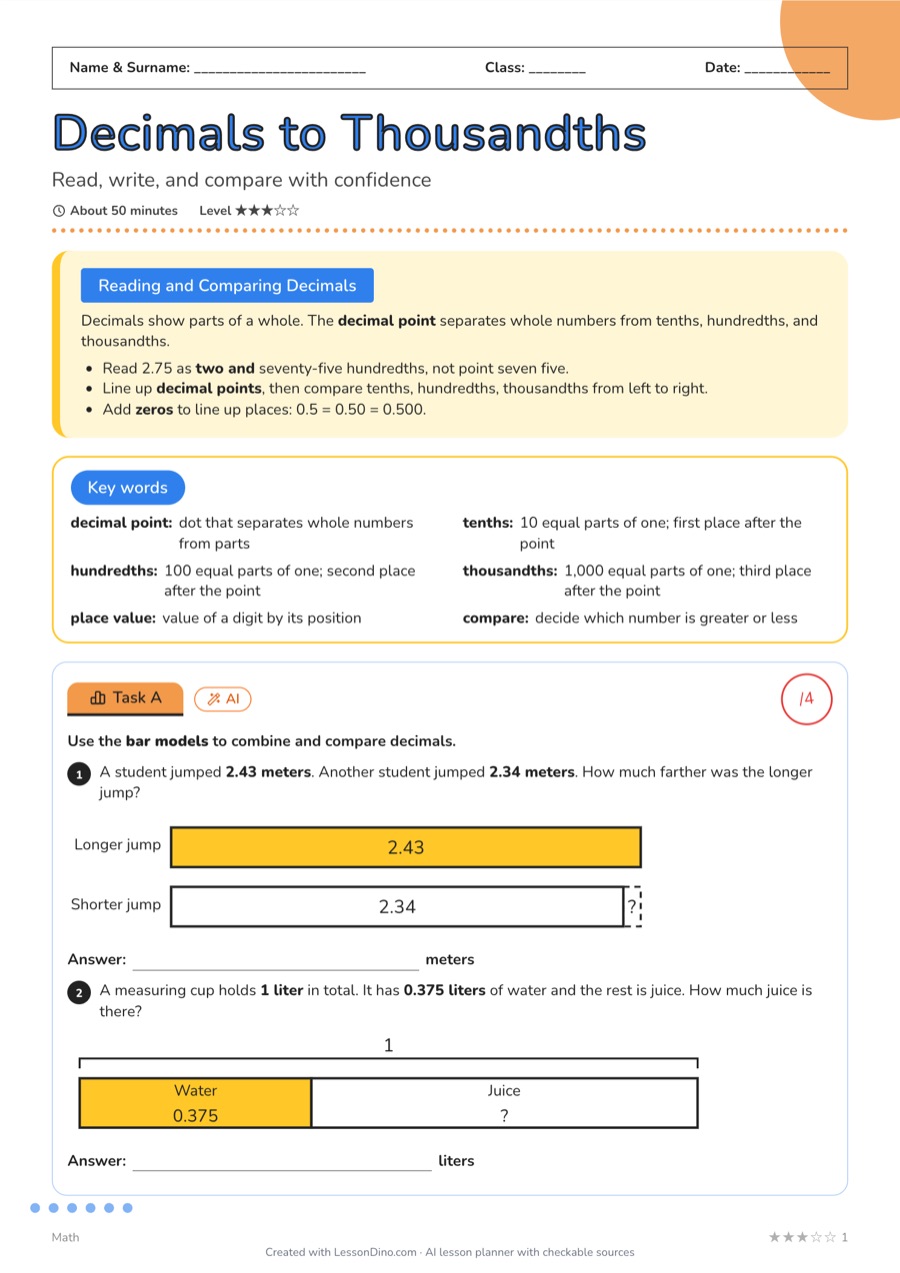
Decimals to Thousandths
Learn how place value helps you read and compare decimals.
Reading and Comparing Decimals
- Decimals show parts of a whole. The decimal point separates whole numbers from tenths, hundredths, and thousandths.
- Read 2.75 as two and seventy-five hundredths, not point seven five.
- Line up decimal points, then compare tenths, hundredths, thousandths from left to right.
- Add zeros to line up places: 0.5 = 0.50 = 0.500.
| Word | Meaning |
|---|---|
| decimal point | dot that separates whole numbers from parts |
| tenths | 10 equal parts of one; first place after the point |
| hundredths | 100 equal parts of one; second place after the point |
| thousandths | 1,000 equal parts of one; third place after the point |
| place value | value of a digit by its position |
| compare | decide which number is greater or less |
Use the bar models to combine and compare decimals.
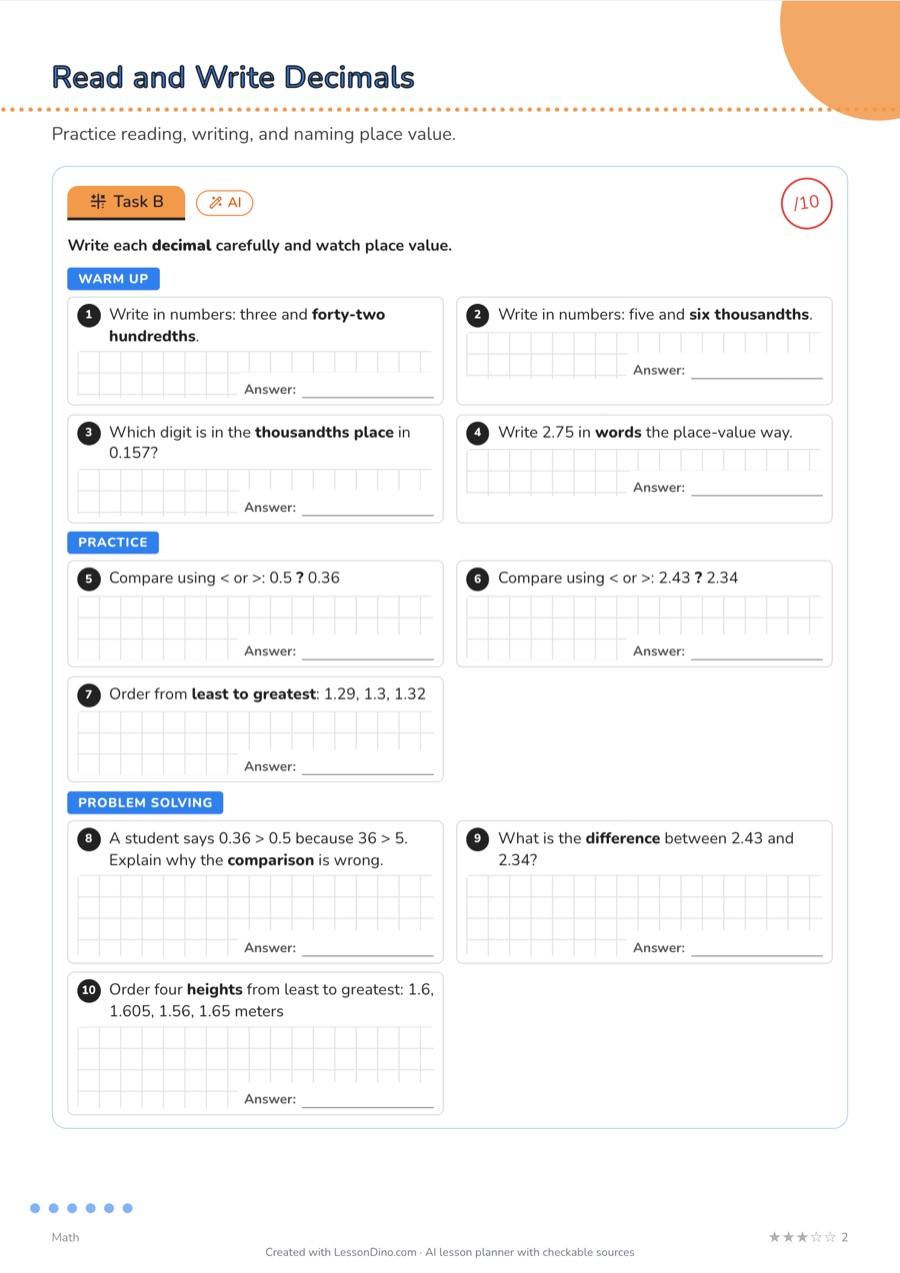
Read and Write Decimals
Practice reading, writing, and naming place value.
Write each decimal carefully and watch place value.
Warm up
- Write in numbers: three and forty-two hundredths.
- Write in numbers: five and six thousandths.
- Which digit is in the thousandths place in 0.157?
- Write 2.75 in words the place-value way.
Practice
- Compare using < or >: 0.5 ? 0.36
- Compare using < or >: 2.43 ? 2.34
- Order from least to greatest: 1.29, 1.3, 1.32
Problem solving
- A student says 0.36 > 0.5 because 36 > 5. Explain why the comparison is wrong.
- What is the difference between 2.43 and 2.34?
- Order four heights from least to greatest: 1.6, 1.605, 1.56, 1.65 meters
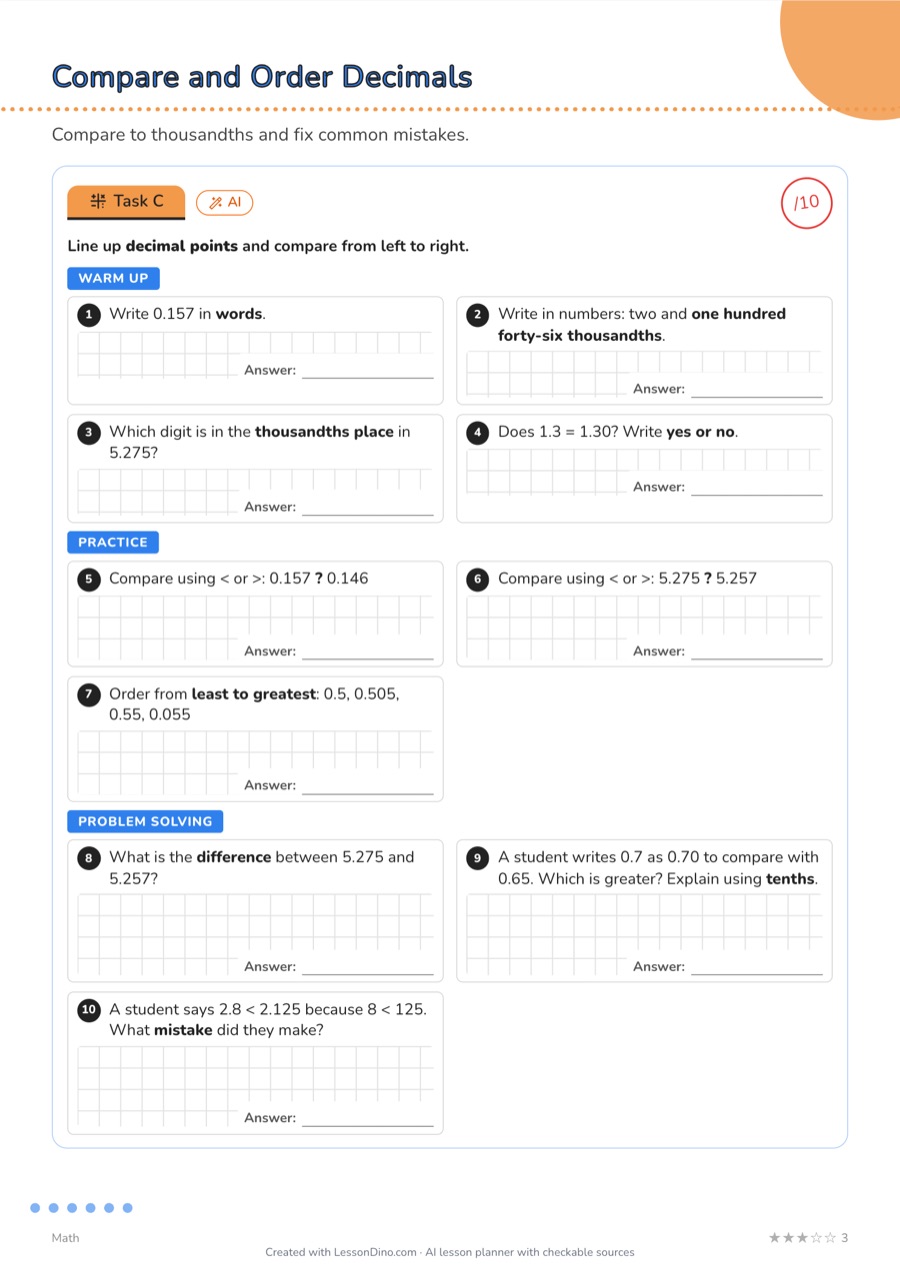
Compare and Order Decimals
Compare to thousandths and fix common mistakes.
Line up decimal points and compare from left to right.
Warm up
- Write 0.157 in words.
- Write in numbers: two and one hundred forty-six thousandths.
- Which digit is in the thousandths place in 5.275?
- Does 1.3 = 1.30? Write yes or no.
Practice
- Compare using < or >: 0.157 ? 0.146
- Compare using < or >: 5.275 ? 5.257
- Order from least to greatest: 0.5, 0.505, 0.55, 0.055
Problem solving
- What is the difference between 5.275 and 5.257?
- A student writes 0.7 as 0.70 to compare with 0.65. Which is greater? Explain using tenths.
- A student says 2.8 < 2.125 because 8 < 125. What mistake did they make?
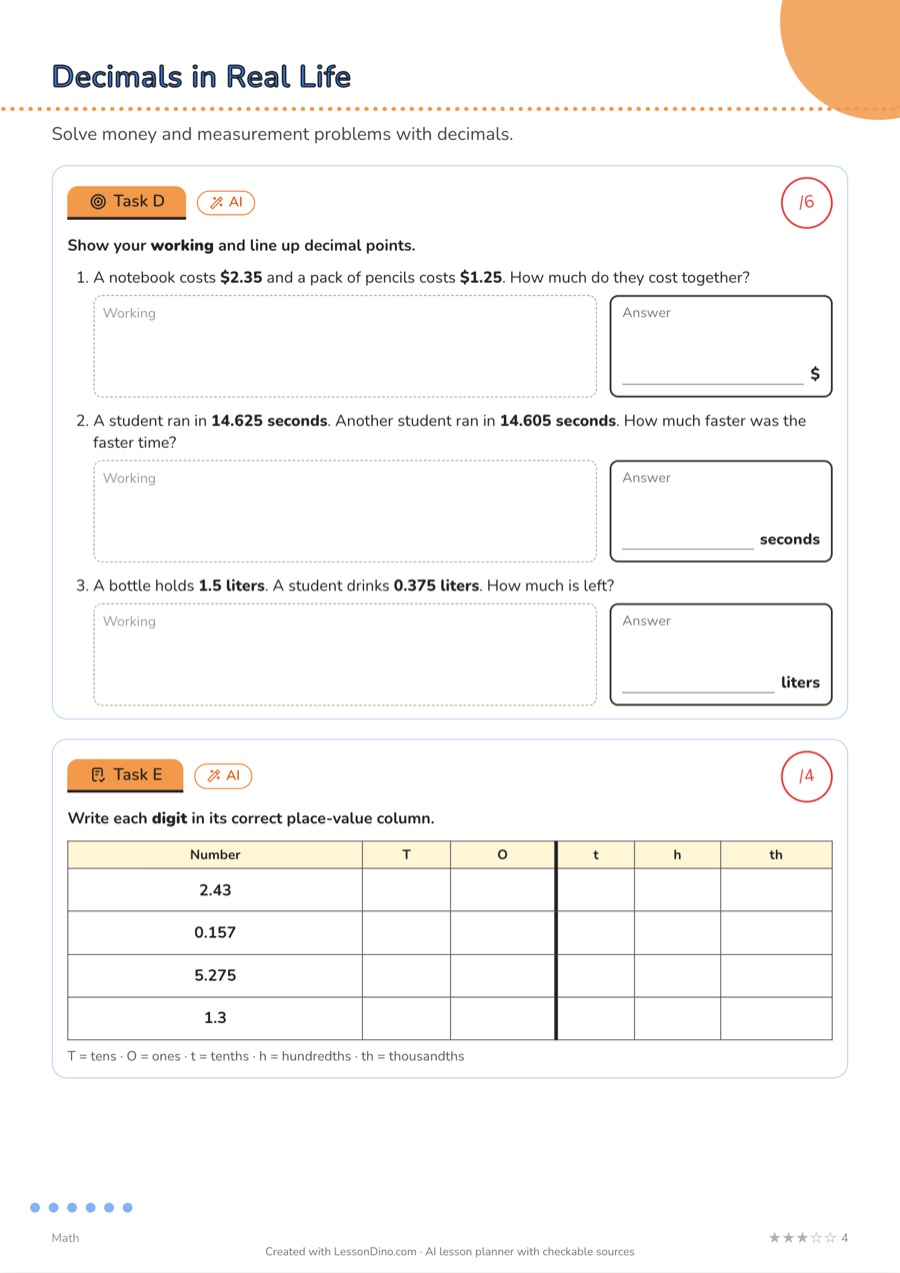
Decimals in Real Life
Solve money and measurement problems with decimals.
Show your working and line up decimal points.
Write each digit in its correct place-value column.
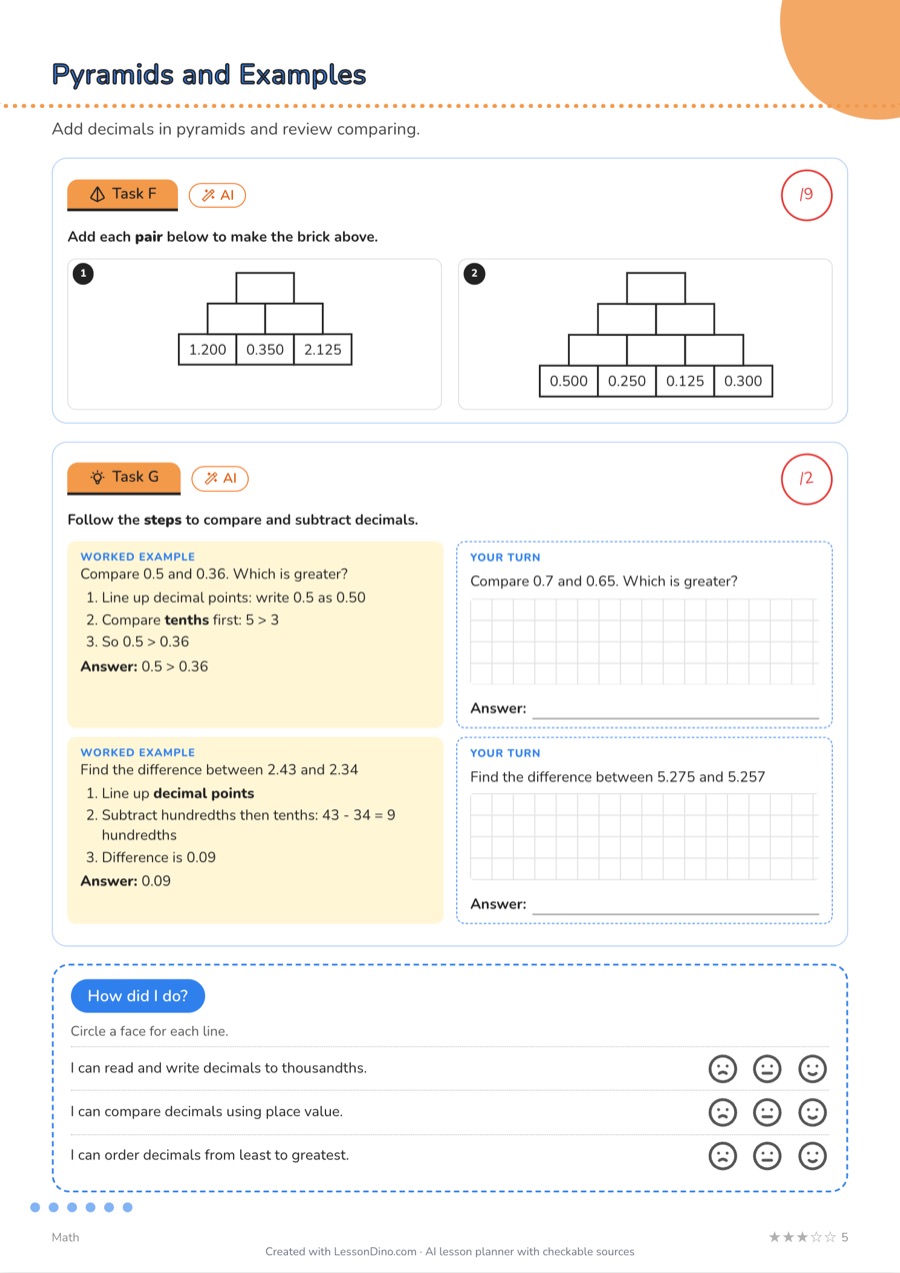
Pyramids and Examples
Add decimals in pyramids and review comparing.
Add each pair below to make the brick above.
Follow the steps to compare and subtract decimals.
Answers
Show the answers
- Write in numbers: three and forty-two hundredths. 3.42
- Write in numbers: five and six thousandths. 5.006
- Which digit is in the thousandths place in 0.157? 7
- Write 2.75 in words the place-value way. two and seventy-five hundredths
- Compare using < or >: 0.5 ? 0.36 0.5 > 0.36
- Compare using < or >: 2.43 ? 2.34 2.43 > 2.34
- Order from least to greatest: 1.29, 1.3, 1.32 1.29, 1.3, 1.32
- A student says 0.36 > 0.5 because 36 > 5. Explain why the comparison is wrong. 0.5 has 5 tenths and 0.36 has only 3 tenths, so 0.5 is greater.
- What is the difference between 2.43 and 2.34? 0.09
- Order four heights from least to greatest: 1.6, 1.605, 1.56, 1.65 meters 1.56, 1.6, 1.605, 1.65
- Write 0.157 in words. one hundred fifty-seven thousandths
- Write in numbers: two and one hundred forty-six thousandths. 2.146
- Which digit is in the thousandths place in 5.275? 5
- Does 1.3 = 1.30? Write yes or no. yes
- Compare using < or >: 0.157 ? 0.146 0.157 > 0.146
- Compare using < or >: 5.275 ? 5.257 5.275 > 5.257
- Order from least to greatest: 0.5, 0.505, 0.55, 0.055 0.055, 0.5, 0.505, 0.55
- What is the difference between 5.275 and 5.257? 0.018
- A student writes 0.7 as 0.70 to compare with 0.65. Which is greater? Explain using tenths. 0.7 is greater because 7 tenths is more than 6 tenths.
- A student says 2.8 < 2.125 because 8 < 125. What mistake did they make? They compared digits to the right without comparing tenths first; 8 tenths is more than 1 tenth, so 2.8 is greater.
- A notebook costs $2.35 and a pack of pencils costs $1.25. How much do they cost together? $3.60
- A student ran in 14.625 seconds. Another student ran in 14.605 seconds. How much faster was the faster time? 0.02 seconds
- A bottle holds 1.5 liters. A student drinks 0.375 liters. How much is left? 1.125 liters
The answer sheet is the last picture above.
Curriculum
Read, write, and compare decimals to thousandths.
Made with Lesson Dino's AI on 16 October 2026. AI can make mistakes, so check the answers and facts against the sources before you teach.