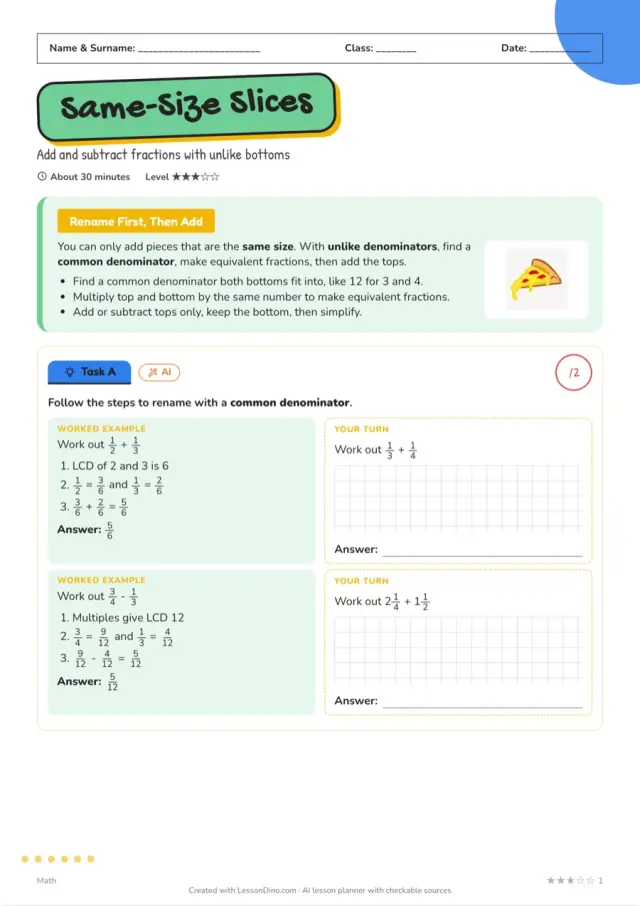
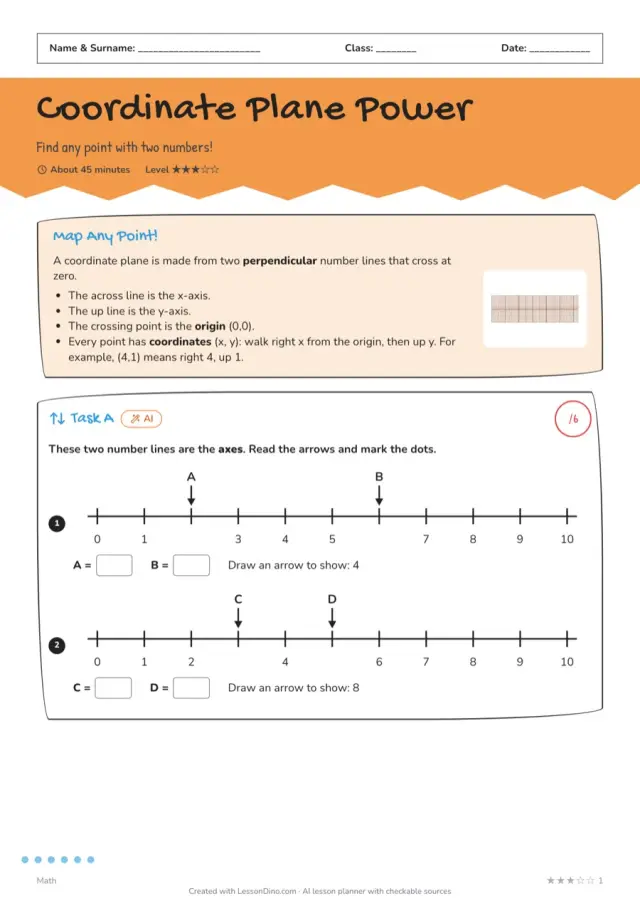
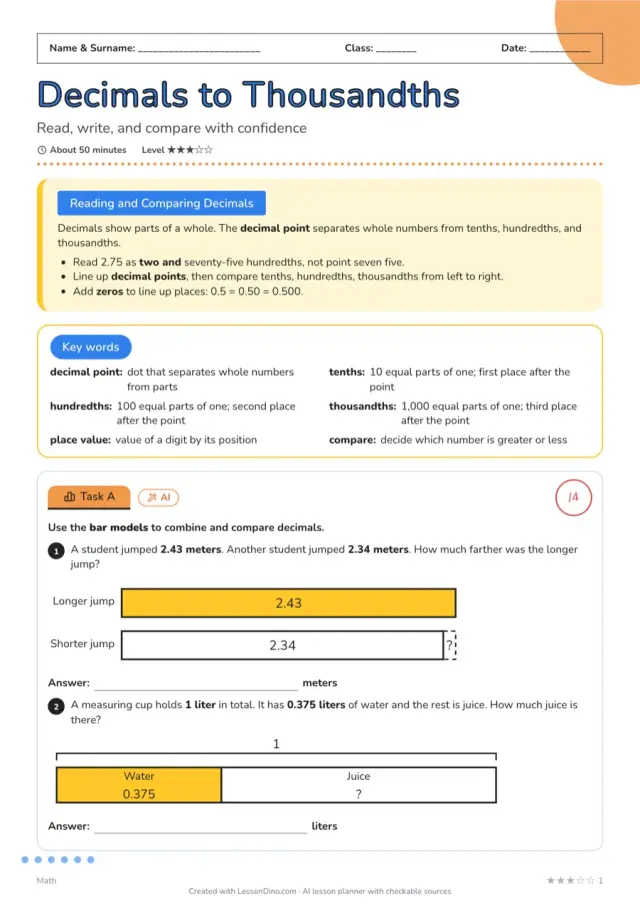
The worksheet
About this worksheet
Students learn to convert units within one system. They use conversions to solve two-step real-world problems. This Grade 5 Math worksheet gives students (ages 10–11) seven pages of practice on converting units, part of the measurement and data unit. It goes with our free Converting units lesson, which has the slides and a timed lesson plan.
What it covers
By the end, students should be able to:
- Students will convert metric length, mass and capacity units within the system.
- Students will convert customary length and weight units within the system.
- Students will solve multi-step real-world problems that require converting units first.
How to use it
- Main activity (20 minutes): Hand out Worksheet Task B and show Slide 9 with the drink and rope totals.
- Support: Highlight the units in each problem and provide the fact that 1 kilometer = 1000 meters for reference.
- Stretch: Have students create an extra step that asks for the difference between two converted amounts.
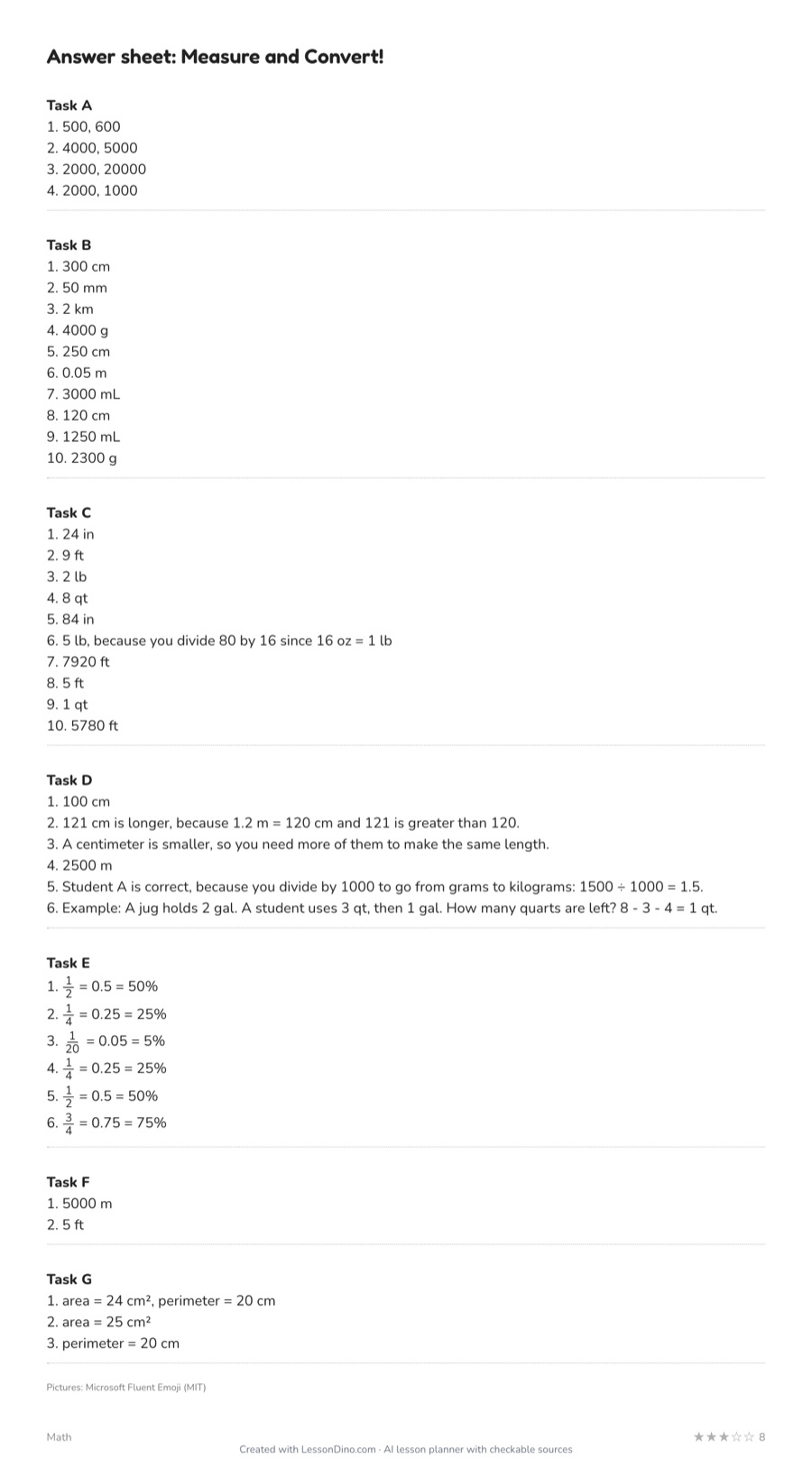
- The answer sheet is the last page, so you can print it on its own or let students check their own work.
Key vocabulary
- convert: change an amount so it is shown in a different unit
- conversion factor: an equal pair like 100 cm = 1 m that lets you switch
- kilogram: a mass equal to 1,000 grams
- inch: a small customary length; 12 make 1 foot
- centimeter: a metric length; 100 make 1 meter
Mistakes to watch for
- Multiplying when converting to a larger unit, getting a bigger number. Use bigger unit means fewer; small to large means divide for a smaller number.
- Writing 1.2 m = 12 cm. Show 100 cm = 1 m, so 1.2 m is 120 centimeters.
- Multiplying ounces to get pounds, like 80 oz = 1280 lb. Recall 16 ounces in a pound, so divide 80 by 16 to get 5 lb.
What's on the worksheet
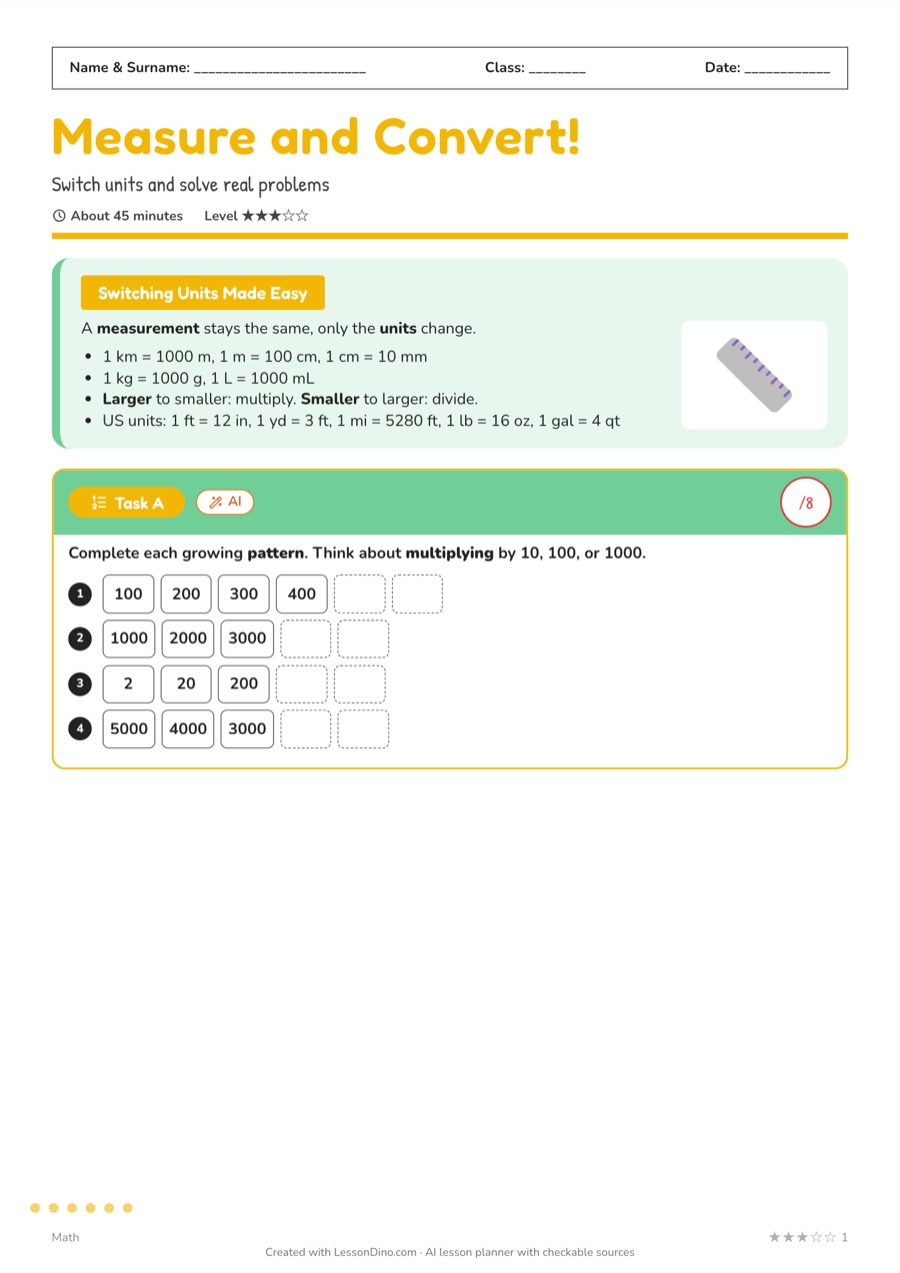
Convert Like a Pro
Learn the quick rules for switching units.
Switching Units Made Easy
- A measurement stays the same, only the units change.
- 1 km = 1000 m, 1 m = 100 cm, 1 cm = 10 mm
- 1 kg = 1000 g, 1 L = 1000 mL
- Larger to smaller: multiply. Smaller to larger: divide.
- US units: 1 ft = 12 in, 1 yd = 3 ft, 1 mi = 5280 ft, 1 lb = 16 oz, 1 gal = 4 qt
Complete each growing pattern. Think about multiplying by 10, 100, or 1000.
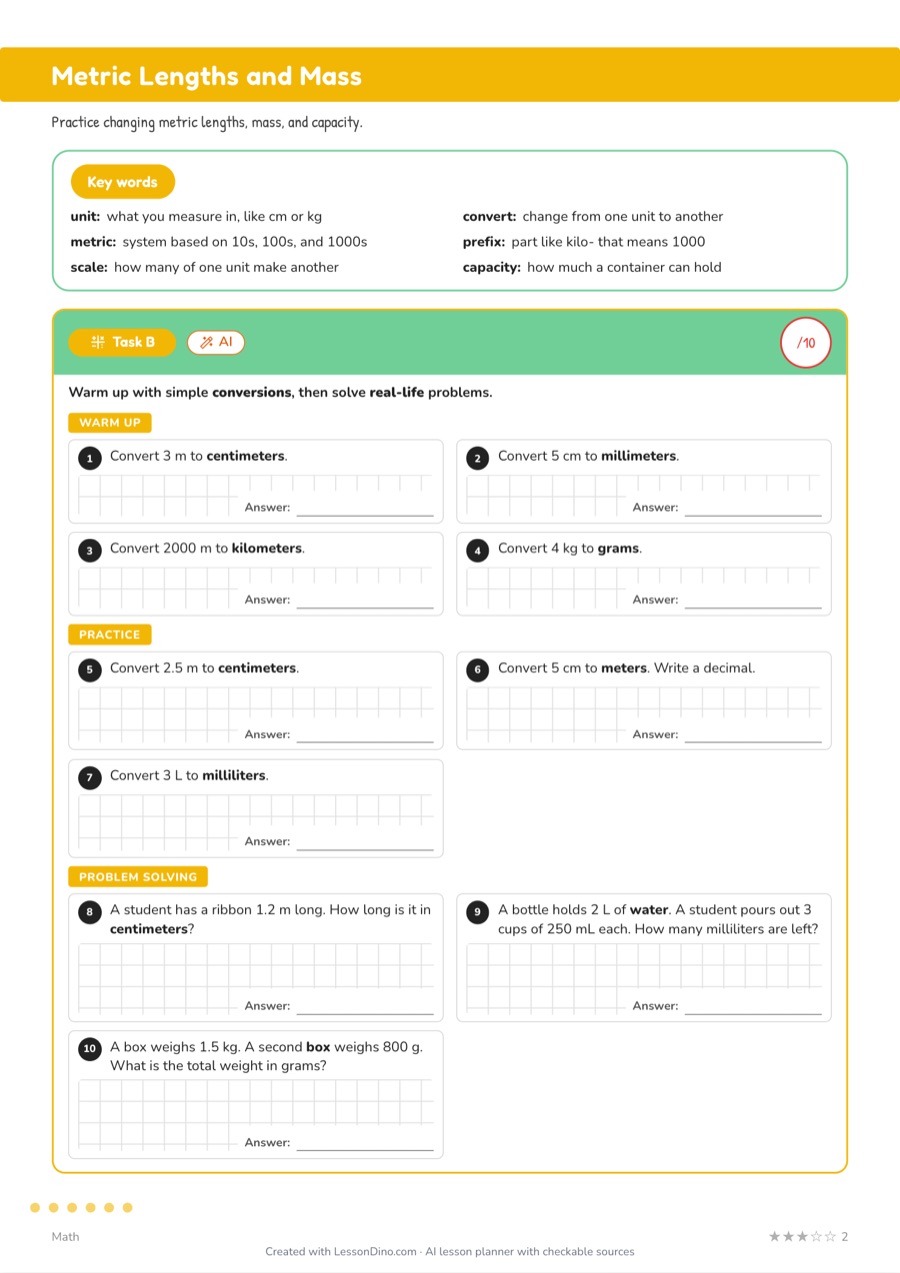
Metric Lengths and Mass
Practice changing metric lengths, mass, and capacity.
| Word | Meaning |
|---|---|
| unit | what you measure in, like cm or kg |
| convert | change from one unit to another |
| metric | system based on 10s, 100s, and 1000s |
| prefix | part like kilo- that means 1000 |
| scale | how many of one unit make another |
| capacity | how much a container can hold |
Warm up with simple conversions, then solve real-life problems.
Warm up
- Convert 3 m to centimeters.
- Convert 5 cm to millimeters.
- Convert 2000 m to kilometers.
- Convert 4 kg to grams.
Practice
- Convert 2.5 m to centimeters.
- Convert 5 cm to meters. Write a decimal.
- Convert 3 L to milliliters.
Problem solving
- A student has a ribbon 1.2 m long. How long is it in centimeters?
- A bottle holds 2 L of water. A student pours out 3 cups of 250 mL each. How many milliliters are left?
- A box weighs 1.5 kg. A second box weighs 800 g. What is the total weight in grams?
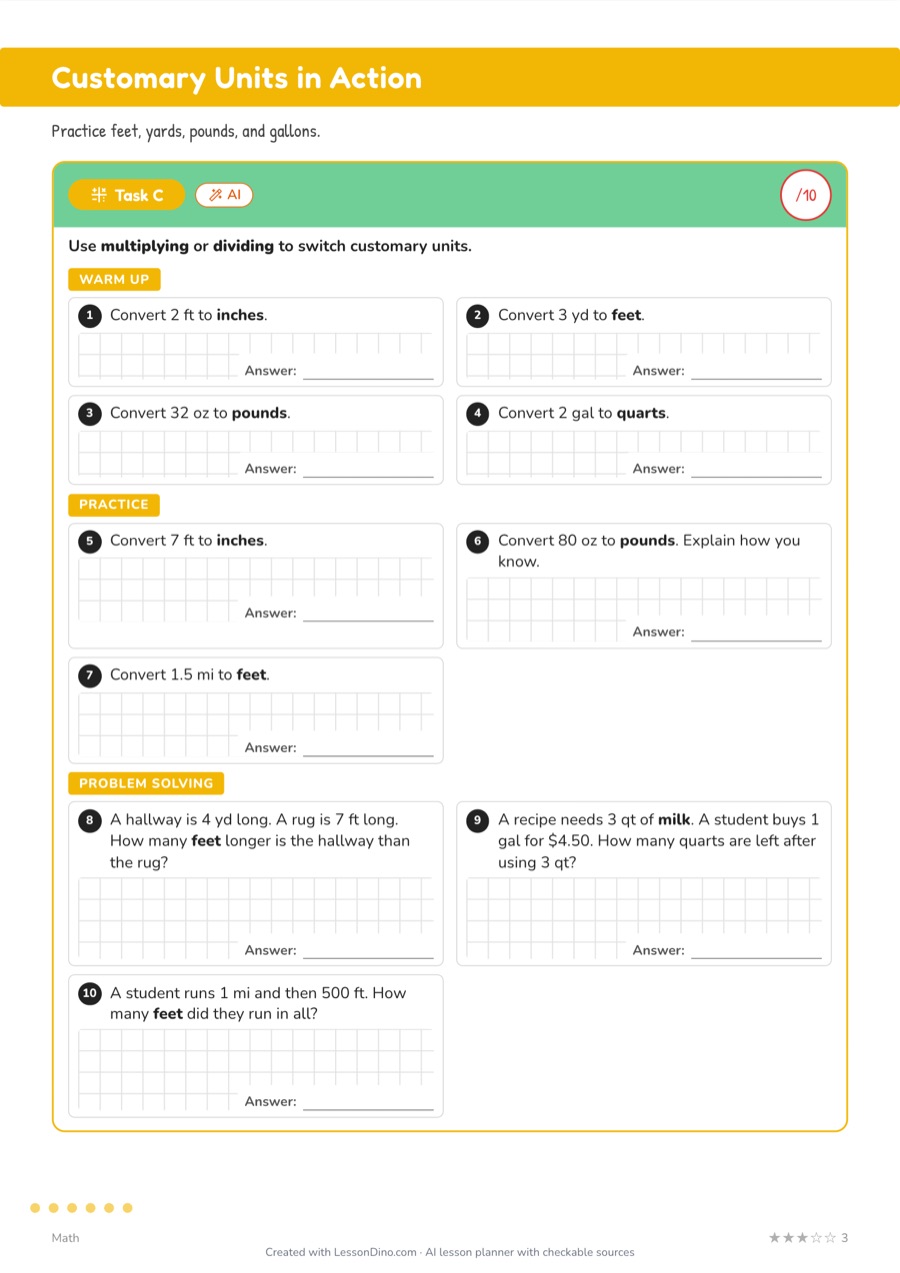
Customary Units in Action
Practice feet, yards, pounds, and gallons.
Use multiplying or dividing to switch customary units.
Warm up
- Convert 2 ft to inches.
- Convert 3 yd to feet.
- Convert 32 oz to pounds.
- Convert 2 gal to quarts.
Practice
- Convert 7 ft to inches.
- Convert 80 oz to pounds. Explain how you know.
- Convert 1.5 mi to feet.
Problem solving
- A hallway is 4 yd long. A rug is 7 ft long. How many feet longer is the hallway than the rug?
- A recipe needs 3 qt of milk. A student buys 1 gal for $4.50. How many quarts are left after using 3 qt?
- A student runs 1 mi and then 500 ft. How many feet did they run in all?
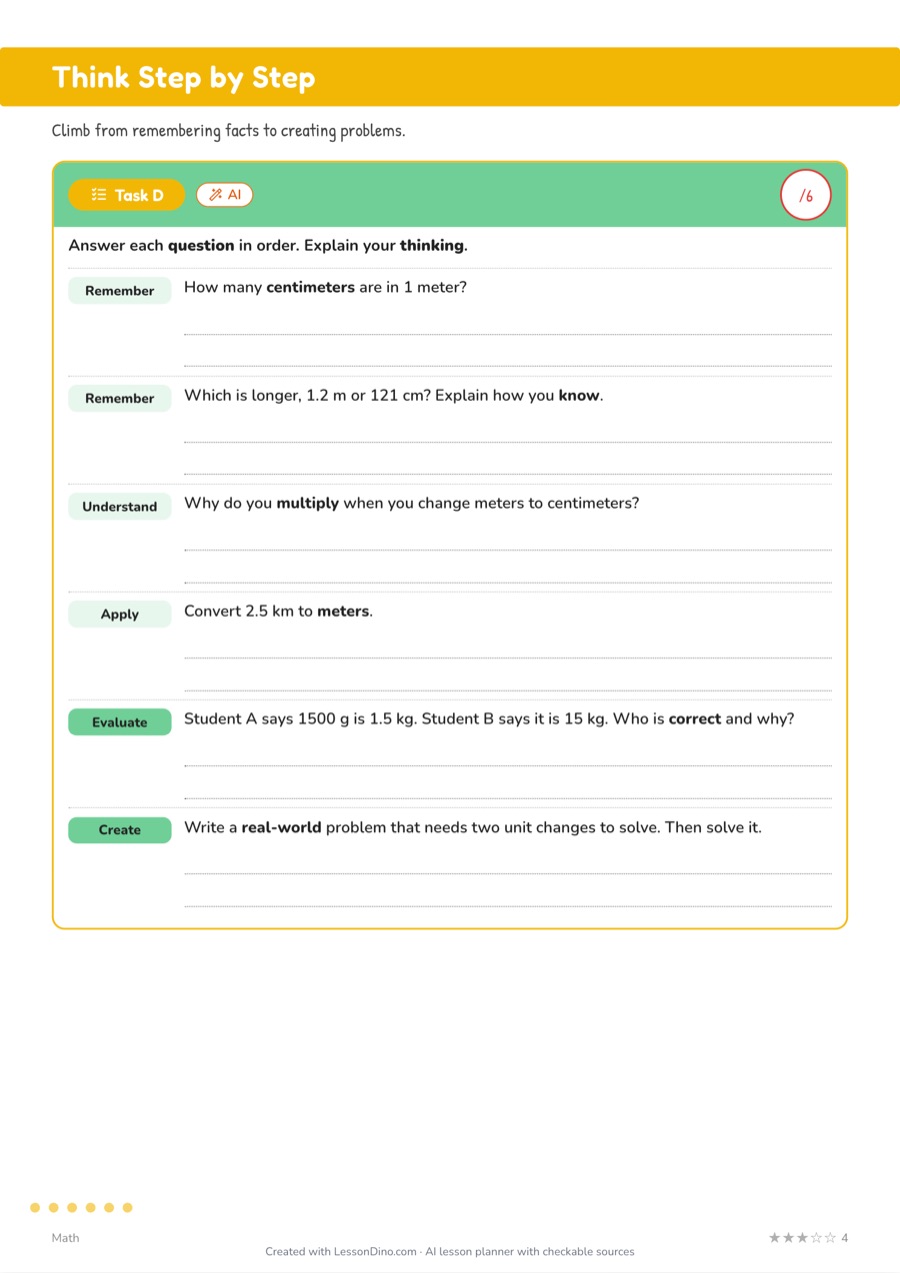
Think Step by Step
Climb from remembering facts to creating problems.
Answer each question in order. Explain your thinking.
- How many centimeters are in 1 meter?
- Which is longer, 1.2 m or 121 cm? Explain how you know.
- Why do you multiply when you change meters to centimeters?
- Convert 2.5 km to meters.
- Student A says 1500 g is 1.5 kg. Student B says it is 15 kg. Who is correct and why?
- Write a real-world problem that needs two unit changes to solve. Then solve it.
Page 5
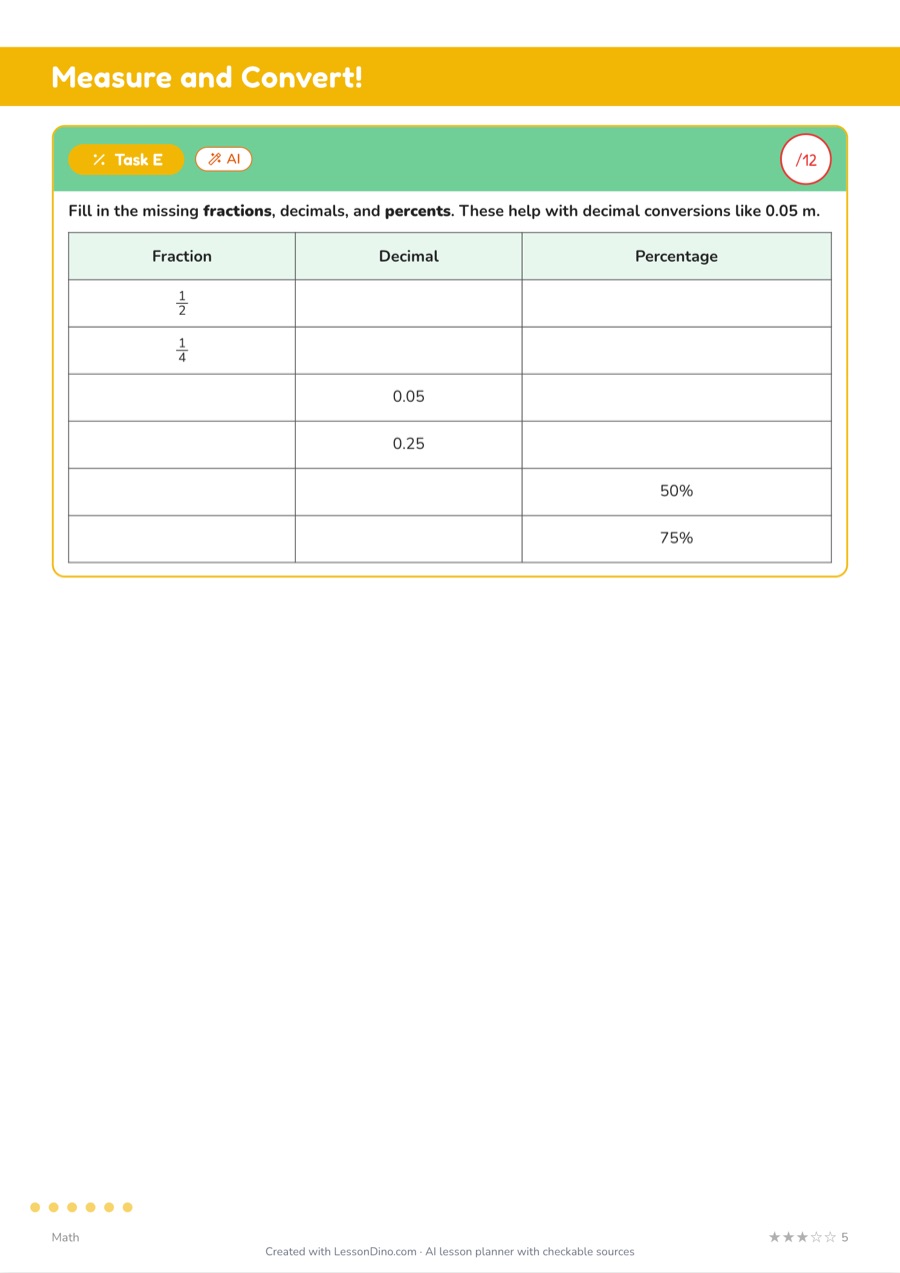
Fill in the missing fractions, decimals, and percents. These help with decimal conversions like 0.05 m.
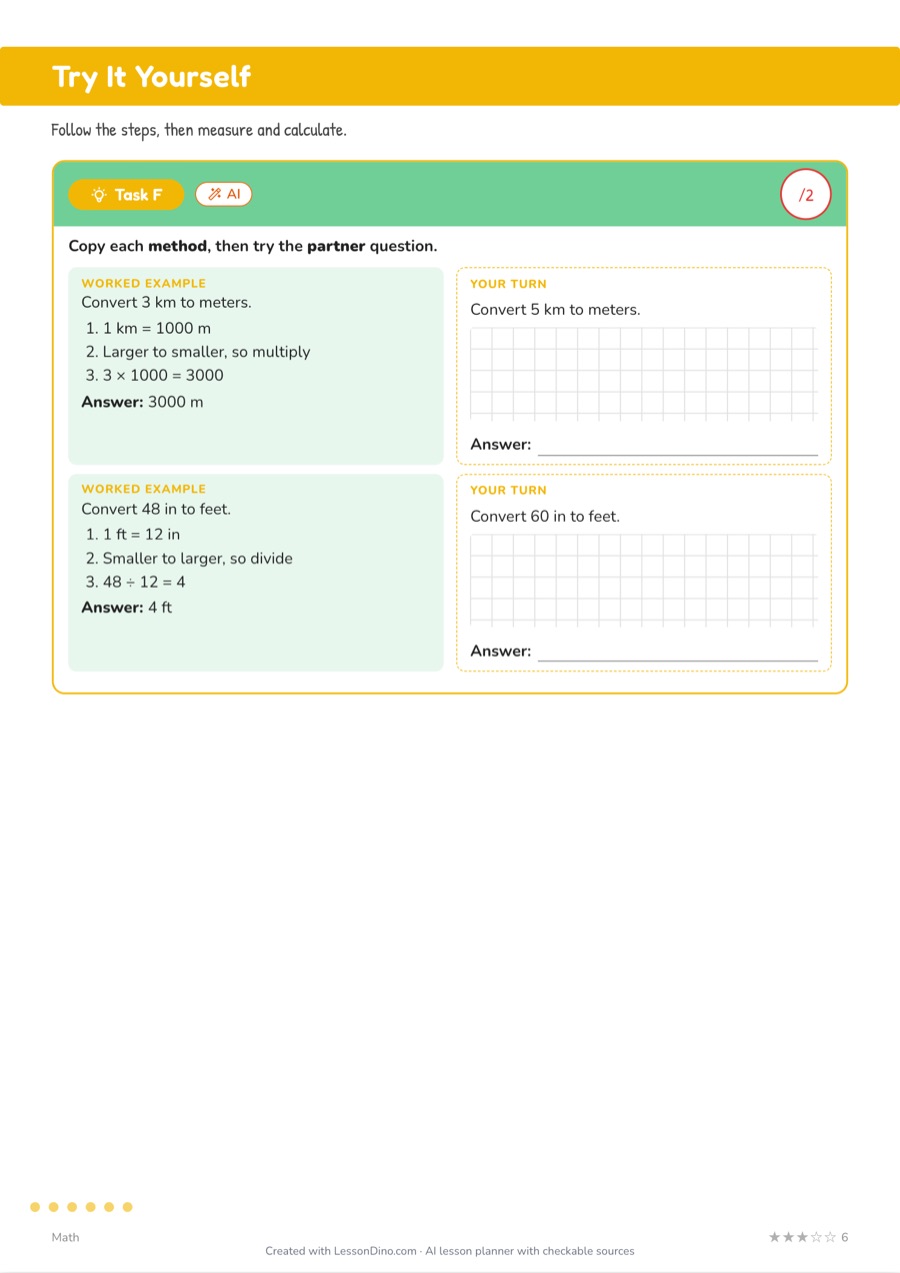
Try It Yourself
Follow the steps, then measure and calculate.
Copy each method, then try the partner question.
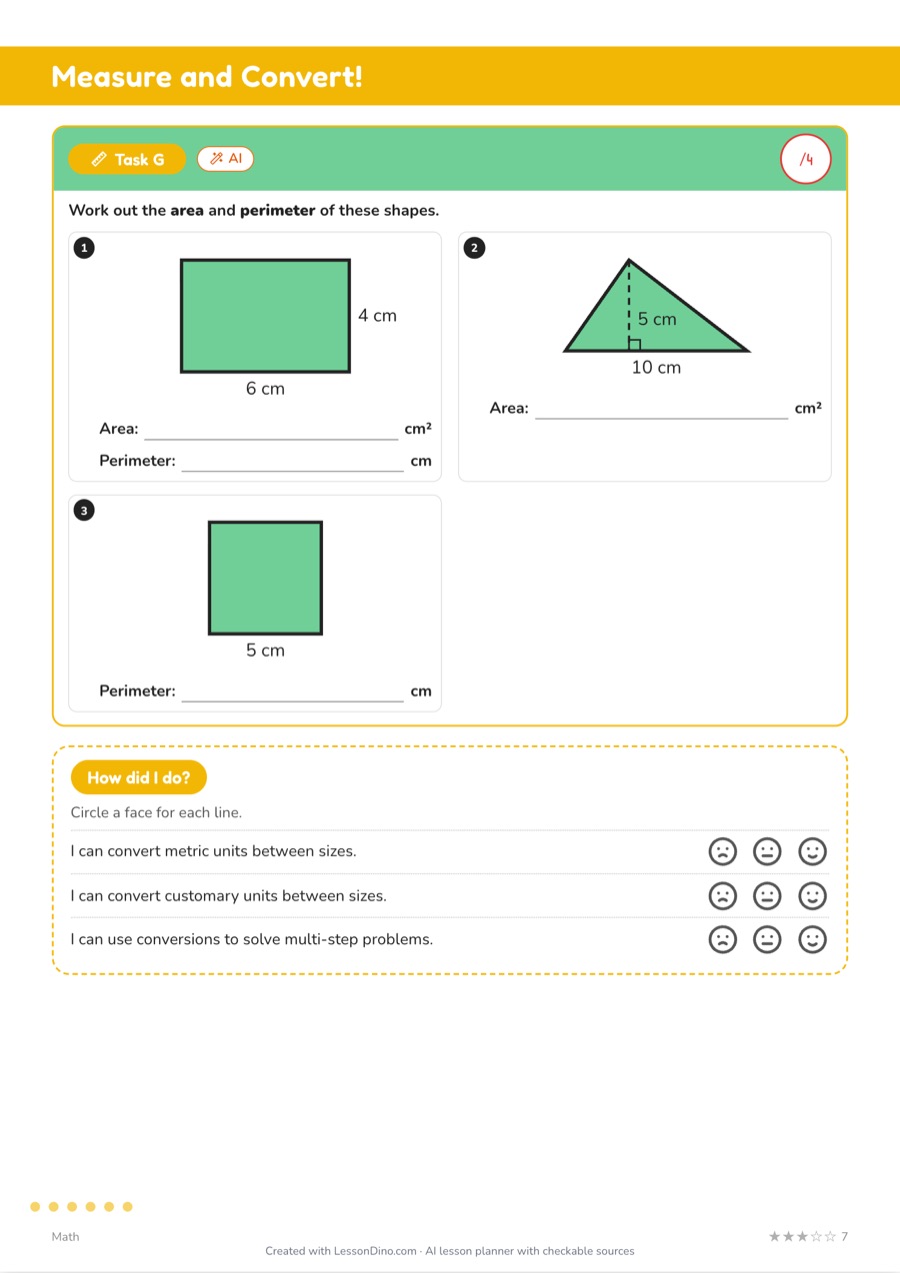
Page 7
Work out the area and perimeter of these shapes.
Answers
Show the answers
- Convert 3 m to centimeters. 300 cm
- Convert 5 cm to millimeters. 50 mm
- Convert 2000 m to kilometers. 2 km
- Convert 4 kg to grams. 4000 g
- Convert 2.5 m to centimeters. 250 cm
- Convert 5 cm to meters. Write a decimal. 0.05 m
- Convert 3 L to milliliters. 3000 mL
- A student has a ribbon 1.2 m long. How long is it in centimeters? 120 cm
- A bottle holds 2 L of water. A student pours out 3 cups of 250 mL each. How many milliliters are left? 1250 mL
- A box weighs 1.5 kg. A second box weighs 800 g. What is the total weight in grams? 2300 g
- Convert 2 ft to inches. 24 in
- Convert 3 yd to feet. 9 ft
- Convert 32 oz to pounds. 2 lb
- Convert 2 gal to quarts. 8 qt
- Convert 7 ft to inches. 84 in
- Convert 80 oz to pounds. Explain how you know. 5 lb, because you divide 80 by 16 since 16 oz = 1 lb
- Convert 1.5 mi to feet. 7920 ft
- A hallway is 4 yd long. A rug is 7 ft long. How many feet longer is the hallway than the rug? 5 ft
- A recipe needs 3 qt of milk. A student buys 1 gal for $4.50. How many quarts are left after using 3 qt? 1 qt
- A student runs 1 mi and then 500 ft. How many feet did they run in all? 5780 ft
- How many centimeters are in 1 meter? 100 cm
- Which is longer, 1.2 m or 121 cm? Explain how you know. 121 cm is longer, because 1.2 m = 120 cm and 121 is greater than 120.
- Why do you multiply when you change meters to centimeters? A centimeter is smaller, so you need more of them to make the same length.
- Convert 2.5 km to meters. 2500 m
- Student A says 1500 g is 1.5 kg. Student B says it is 15 kg. Who is correct and why? Student A is correct, because you divide by 1000 to go from grams to kilograms: 1500 ÷ 1000 = 1.5.
- Write a real-world problem that needs two unit changes to solve. Then solve it. Example: A jug holds 2 gal. A student uses 3 qt, then 1 gal. How many quarts are left? 8 - 3 - 4 = 1 qt.
The answer sheet is the last picture above.
Curriculum
Convert among different-sized standard measurement units within a given measurement system (e.g., convert 5 cm to 0.05 m), and use these conversions in solving multi-step, real world problems.
Made with Lesson Dino's AI on 17 October 2026. AI can make mistakes, so check the answers and facts against the sources before you teach.