The worksheet
About this worksheet
Students learn how axes, origin and ordered pairs locate points. They plot pairs in order to reveal a mystery shape. This Grade 5 Math worksheet gives students (ages 10–11) six pages of practice on coordinate plane, part of the geometry unit. It goes with our free Coordinate plane lesson, which has the slides and a timed lesson plan.
What it covers
By the end, students should be able to:
- Students will build a coordinate system with axes meeting at origin zero zero.
- Students will plot and read ordered pairs in the first quadrant correctly.
- Students will interpret coordinate values of points in simple everyday map situations.
How to use it
- Teaching (13 minutes): Do Worksheet Task A together, reading arrows on the axes and marking the dots.
- Guided Practice (10 minutes): Start Worksheet Task B and have partners use the sentence frame to describe each point.
- Support: Number the pairs in plotting order and give a grid with every line already numbered to reduce counting errors.
- Stretch: Have students add two more pairs of their own to add a door or chimney to the shape and list the new coordinates.
- The answer sheet is the last page, so you can print it on its own or let students check their own work.
Key vocabulary
- x-axis: flat number line going left to right
- y-axis: tall number line going bottom to top
- origin: start spot where both lines show zero
- ordered pair: two numbers in brackets showing across first, then up
- x-coordinate: first number telling how far to go across
- y-coordinate: second number telling how far to go up
Mistakes to watch for
- Swapping x and y, plotting (5,2) as (2,5). Rehearse across first then up, and check x-coordinate is horizontal position and y-coordinate is vertical.
- Starting count at 1 on the axis instead of at the origin (0,0). Always place finger on origin where lines cross at 0 then count moves, since intersection coincides with 0 on each line.
- Thinking order does not matter, so (3,5) and (5,3) are the same. Plot both from origin step by step to show different spots, since x is listed before y.
What's on the worksheet
Meet the Grid!
Learn what the axes, origin, and ordered pairs mean.
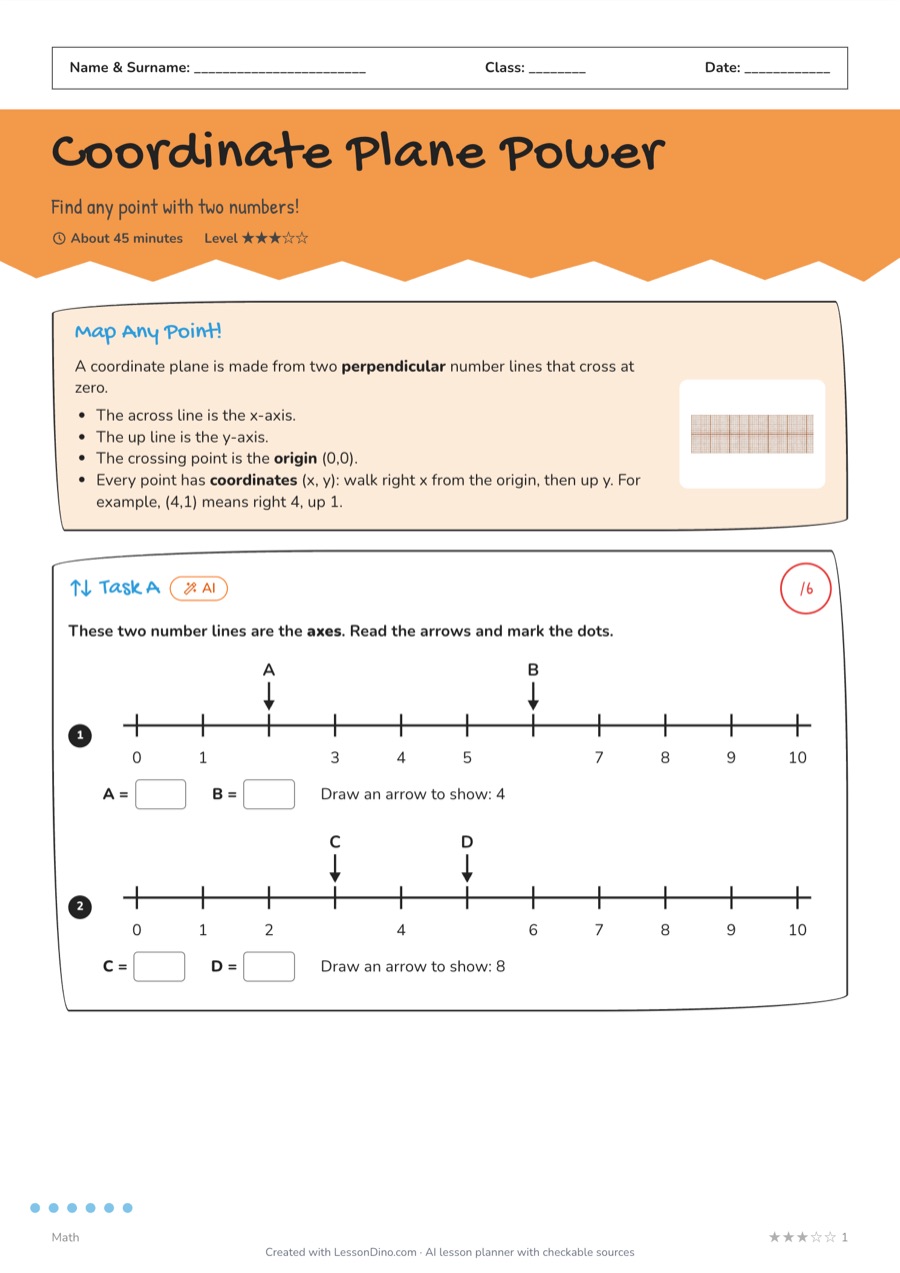
Map Any Point!
- A coordinate plane is made from two perpendicular number lines that cross at zero.
- The across line is the x-axis.
- The up line is the y-axis.
- The crossing point is the origin (0,0).
- Every point has coordinates (x, y): walk right x from the origin, then up y. For example, (4,1) means right 4, up 1.
These two number lines are the axes. Read the arrows and mark the dots.
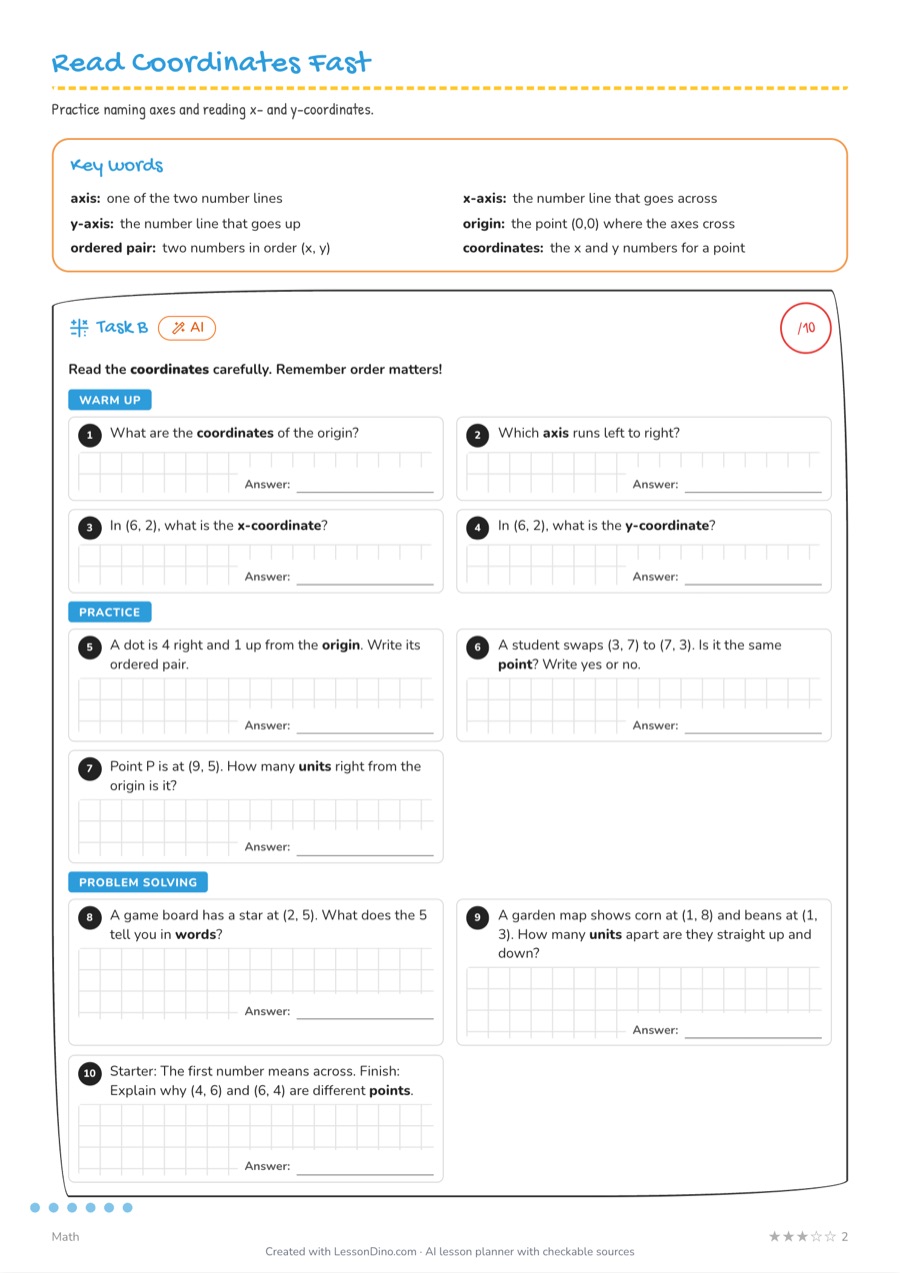
Read Coordinates Fast
Practice naming axes and reading x- and y-coordinates.
| Word | Meaning |
|---|---|
| axis | one of the two number lines |
| x-axis | the number line that goes across |
| y-axis | the number line that goes up |
| origin | the point (0,0) where the axes cross |
| ordered pair | two numbers in order (x, y) |
| coordinates | the x and y numbers for a point |
Read the coordinates carefully. Remember order matters!
Warm up
- What are the coordinates of the origin?
- Which axis runs left to right?
- In (6, 2), what is the x-coordinate?
- In (6, 2), what is the y-coordinate?
Practice
- A dot is 4 right and 1 up from the origin. Write its ordered pair.
- A student swaps (3, 7) to (7, 3). Is it the same point? Write yes or no.
- Point P is at (9, 5). How many units right from the origin is it?
Problem solving
- A game board has a star at (2, 5). What does the 5 tell you in words?
- A garden map shows corn at (1, 8) and beans at (1, 3). How many units apart are they straight up and down?
- Starter: The first number means across. Finish: Explain why (4, 6) and (6, 4) are different points.
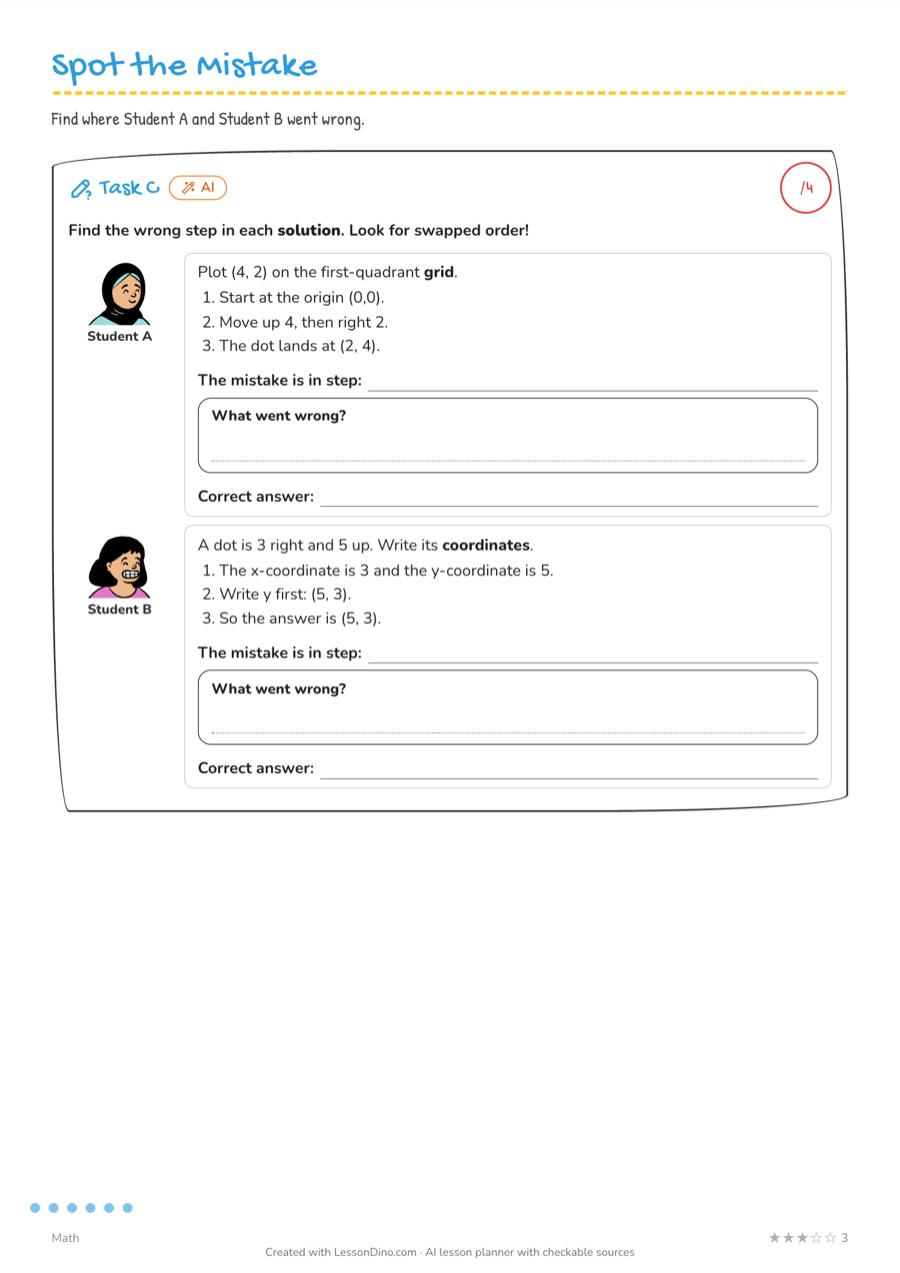
Spot the Mistake
Find where Student A and Student B went wrong.
Find the wrong step in each solution. Look for swapped order!
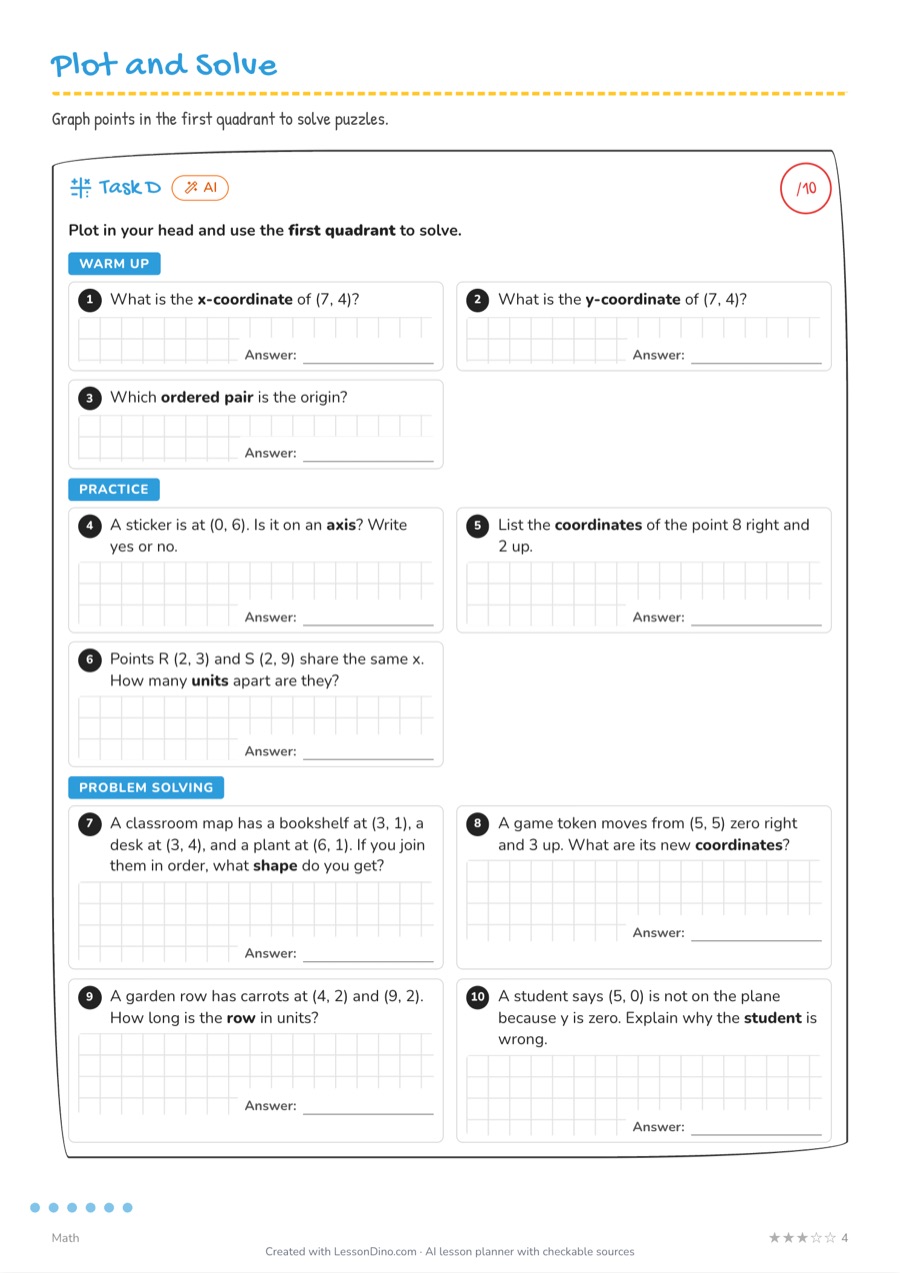
Plot and Solve
Graph points in the first quadrant to solve puzzles.
Plot in your head and use the first quadrant to solve.
Warm up
- What is the x-coordinate of (7, 4)?
- What is the y-coordinate of (7, 4)?
- Which ordered pair is the origin?
Practice
- A sticker is at (0, 6). Is it on an axis? Write yes or no.
- List the coordinates of the point 8 right and 2 up.
- Points R (2, 3) and S (2, 9) share the same x. How many units apart are they?
Problem solving
- A classroom map has a bookshelf at (3, 1), a desk at (3, 4), and a plant at (6, 1). If you join them in order, what shape do you get?
- A game token moves from (5, 5) zero right and 3 up. What are its new coordinates?
- A garden row has carrots at (4, 2) and (9, 2). How long is the row in units?
- A student says (5, 0) is not on the plane because y is zero. Explain why the student is wrong.
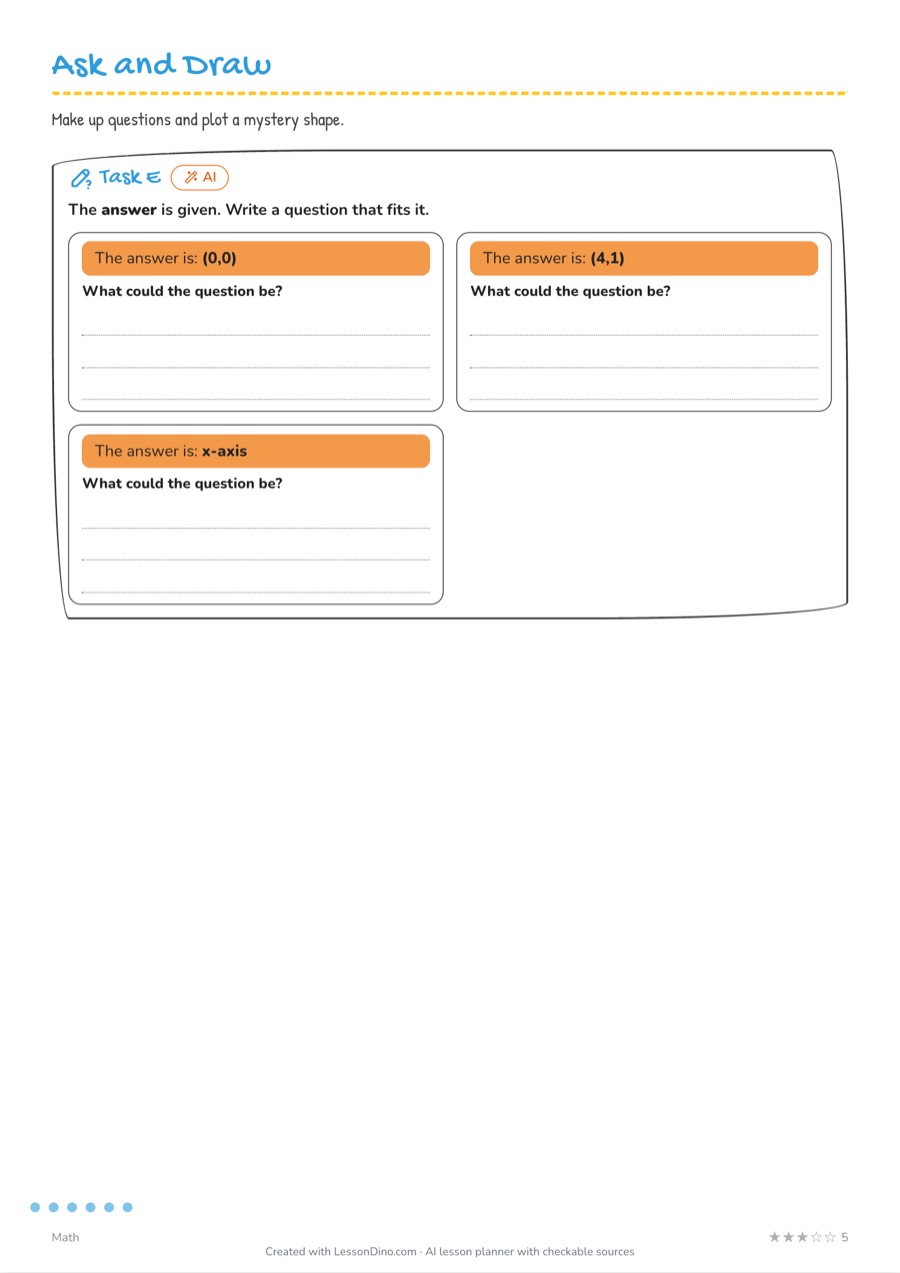
Ask and Draw
Make up questions and plot a mystery shape.
The answer is given. Write a question that fits it.
Page 6
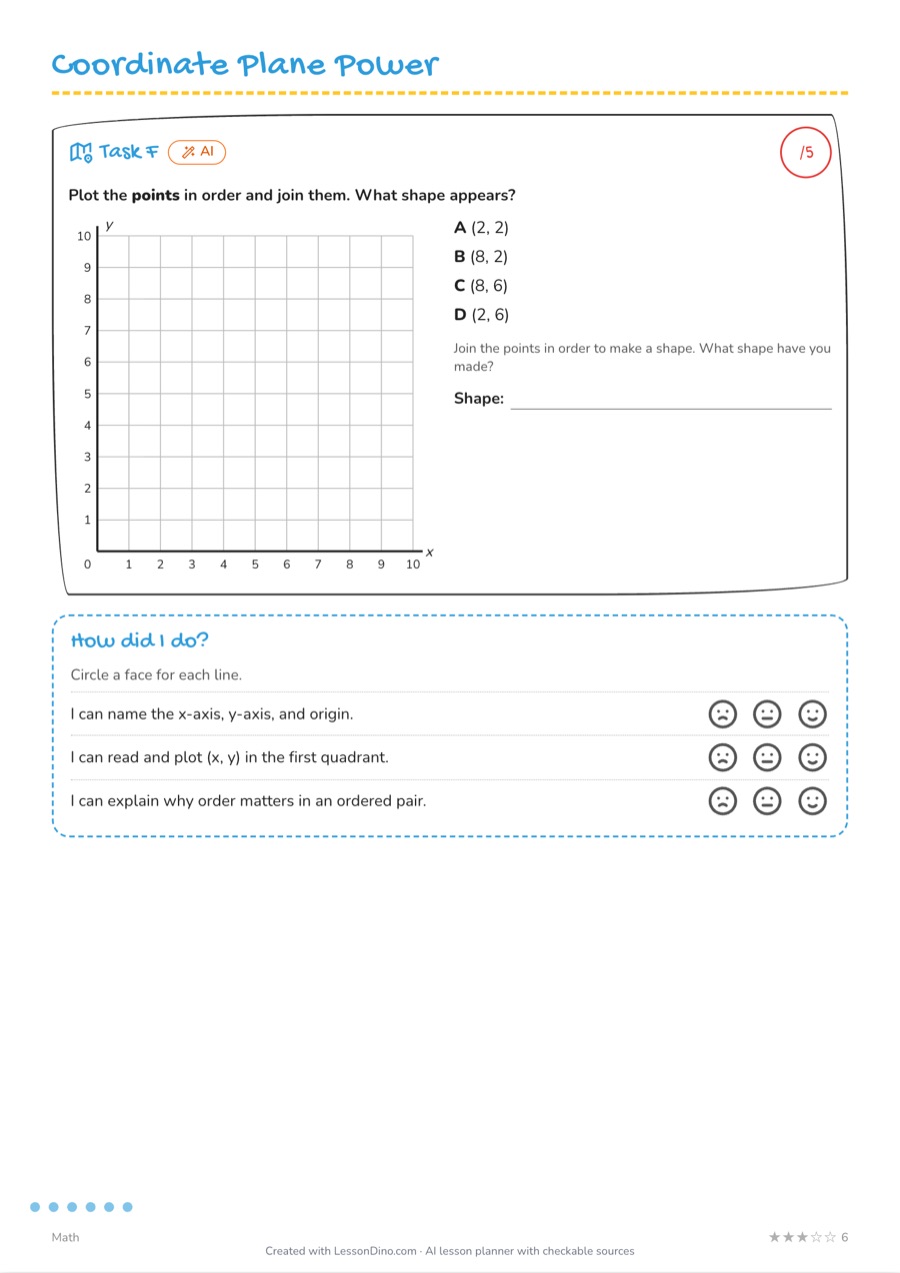
Plot the points in order and join them. What shape appears?
Answers
Show the answers
- What are the coordinates of the origin? (0,0)
- Which axis runs left to right? x-axis
- In (6, 2), what is the x-coordinate? 6
- In (6, 2), what is the y-coordinate? 2
- A dot is 4 right and 1 up from the origin. Write its ordered pair. (4,1)
- A student swaps (3, 7) to (7, 3). Is it the same point? Write yes or no. no
- Point P is at (9, 5). How many units right from the origin is it? 9
- A game board has a star at (2, 5). What does the 5 tell you in words? 5 units up
- A garden map shows corn at (1, 8) and beans at (1, 3). How many units apart are they straight up and down? 5
- Starter: The first number means across. Finish: Explain why (4, 6) and (6, 4) are different points. The first number is across and the second is up, so they land in different places.
- What is the x-coordinate of (7, 4)? 7
- What is the y-coordinate of (7, 4)? 4
- Which ordered pair is the origin? (0,0)
- A sticker is at (0, 6). Is it on an axis? Write yes or no. yes
- List the coordinates of the point 8 right and 2 up. (8,2)
- Points R (2, 3) and S (2, 9) share the same x. How many units apart are they? 6
- A classroom map has a bookshelf at (3, 1), a desk at (3, 4), and a plant at (6, 1). If you join them in order, what shape do you get? right-angled triangle
- A game token moves from (5, 5) zero right and 3 up. What are its new coordinates? (5,8)
- A garden row has carrots at (4, 2) and (9, 2). How long is the row in units? 5
- A student says (5, 0) is not on the plane because y is zero. Explain why the student is wrong. Points with zero are still on the plane on an axis. (5, 0) is 5 right on the x-axis.
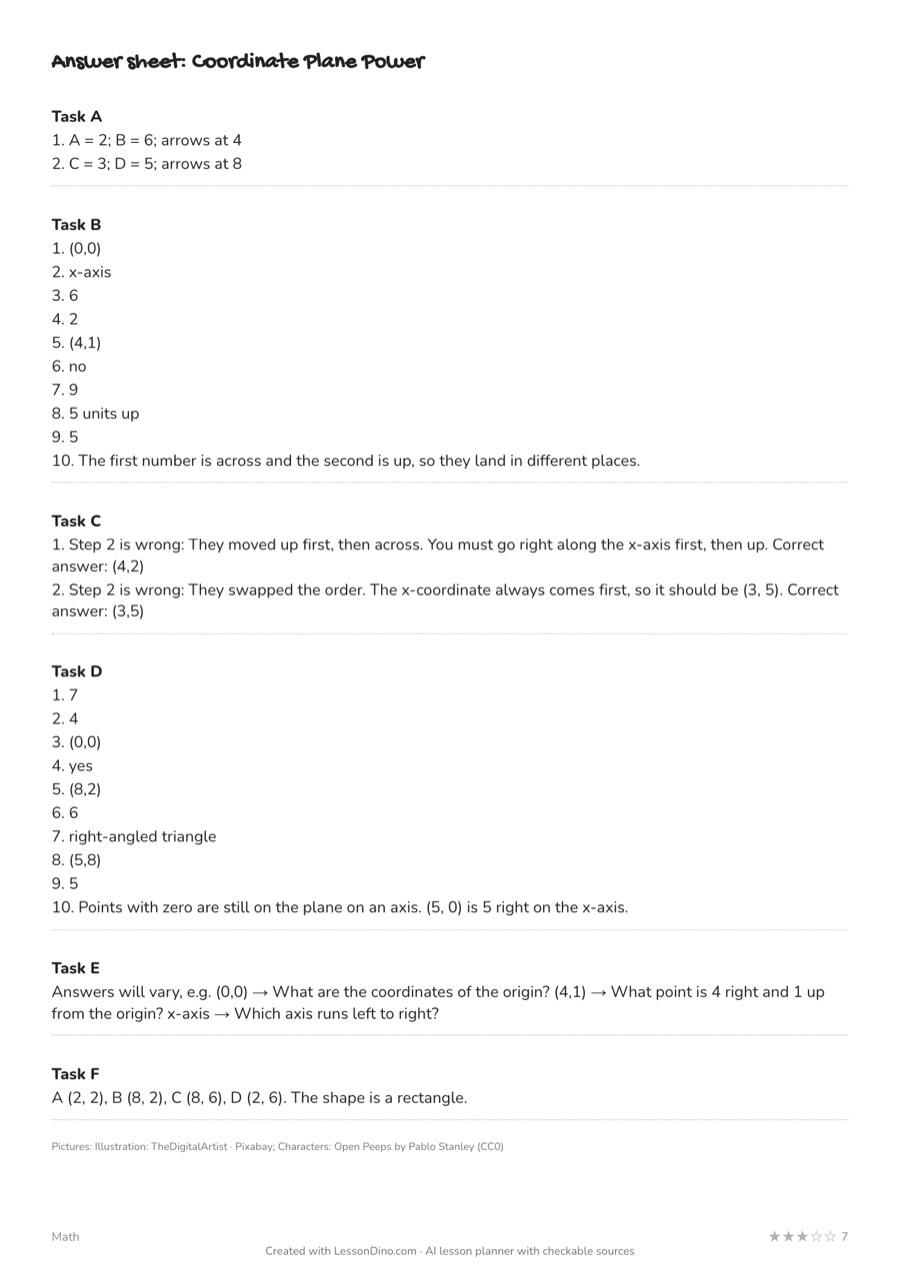
The answer sheet is the last picture above.
Curriculum
Use a pair of perpendicular number lines, called axes, to define a coordinate system, with the intersection of the lines (the origin) arranged to coincide with the 0 on each line and a given point in the plane located by using an ordered pair of numbers, called its coordinates.
Made with Lesson Dino's AI on 17 October 2026. AI can make mistakes, so check the answers and facts against the sources before you teach.