Slides
Lesson plan
Reading and Comparing Thousandths
Students learn to read, write and compare decimals to thousandths. They judge close race times and order them fastest to slowest.
Objectives
- Students will read and write decimals to thousandths in digits and words.
- Students will compare decimals to thousandths using place value and symbols.
- Students will order up to four decimals least to greatest and explain reasoning.
Success criteria
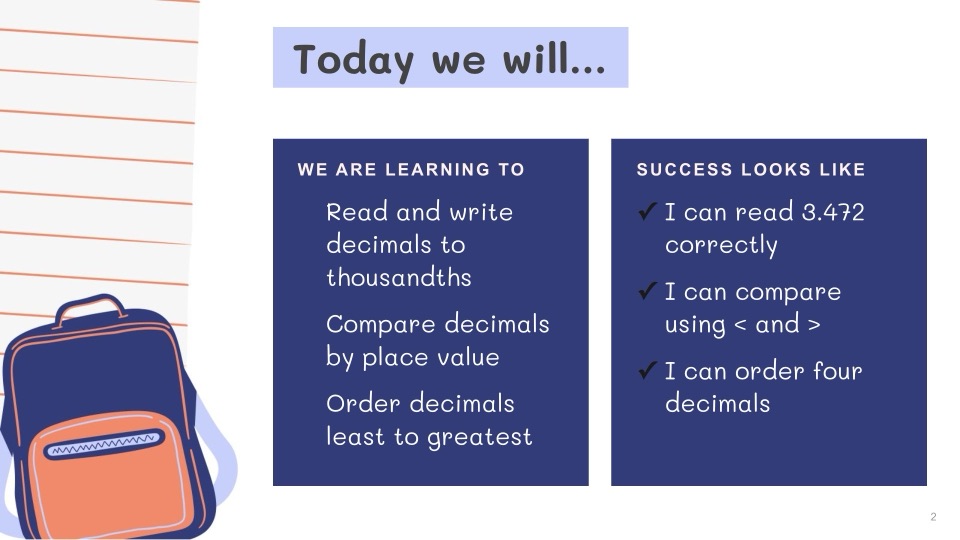
- I can read 3.472 correctly and write it in digits and words.
- I can compare two thousandths decimals using <, > or =.
- I can order four decimals least to greatest and explain why.
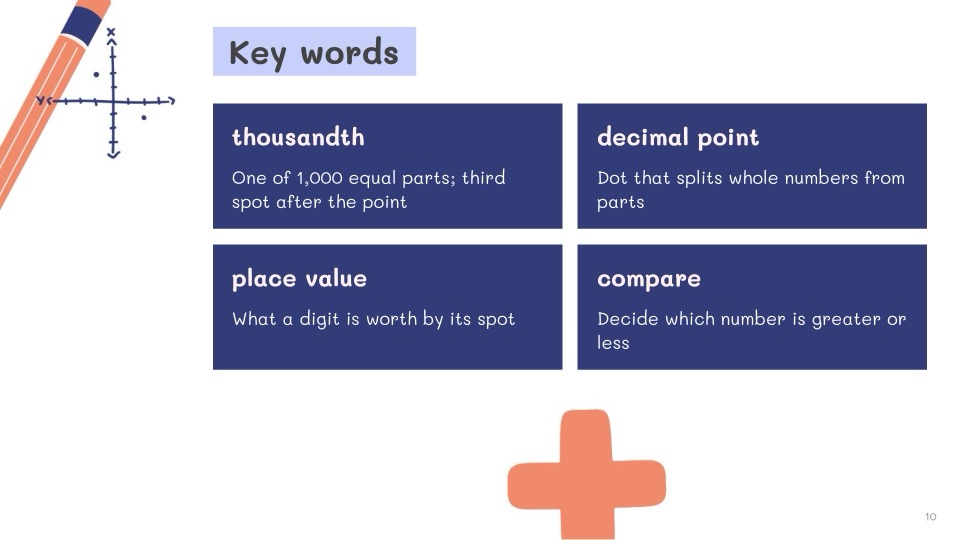
Key words
| Word | Meaning |
|---|---|
| thousandth | one tiny piece when a whole is cut into 1,000 even pieces |
| decimal point | little dot that keeps whole numbers apart from parts less than one |
| place value | how much a digit counts for because of where it sits |
| compare | tell which amount is bigger, smaller, or if both match |
Timed plan (60 minutes)
| Time | Stage | What happens |
|---|---|---|
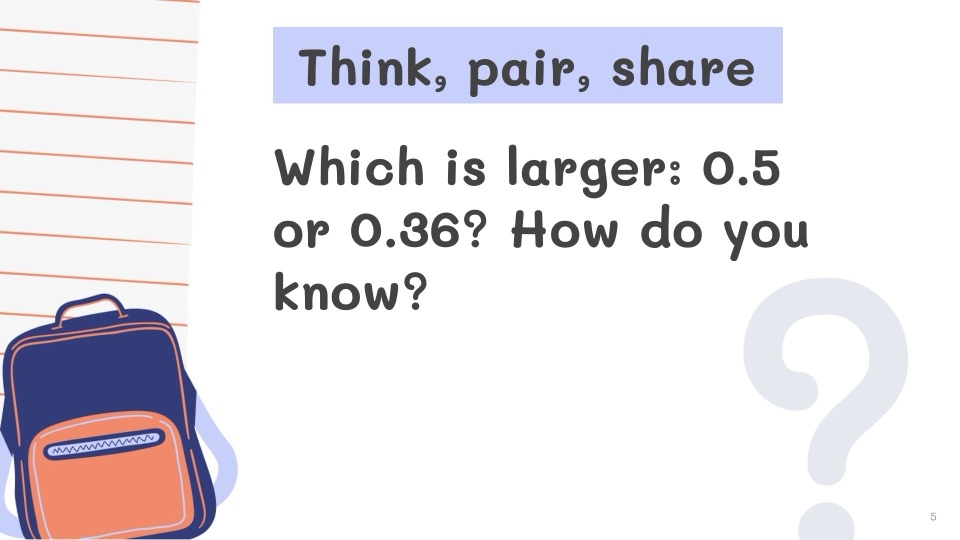
| 5 min | Starter | Hook students with a close finish and surface ideas about 0.5 and 0.36. Welcome class and show Slide 5 question: Which is larger: 0.5 or 0.36? How do you know? Say the hook: Two runners finished 0.009 seconds apart. Who won, and how do you know? Give 30 seconds think time, then 60 seconds pair talk. Take two quick answers without fixing them and say we will prove it today. |
| 12 min | Teaching | Teach reading and writing decimals to thousandths with place value. Show Slide 1 title and Slide 2 goals and point to success lines for reading 3.472. Model 2.375 on a place-value chart, naming the decimal point that separates the whole numbers from the parts of a number. Think aloud expanded form 2 + 0.3 + 0.07 + 0.005 and stress each place to the left is 10 times greater and each place to the right is 10 times smaller. Have students build and write two numbers on Worksheet Task E on whiteboards. |
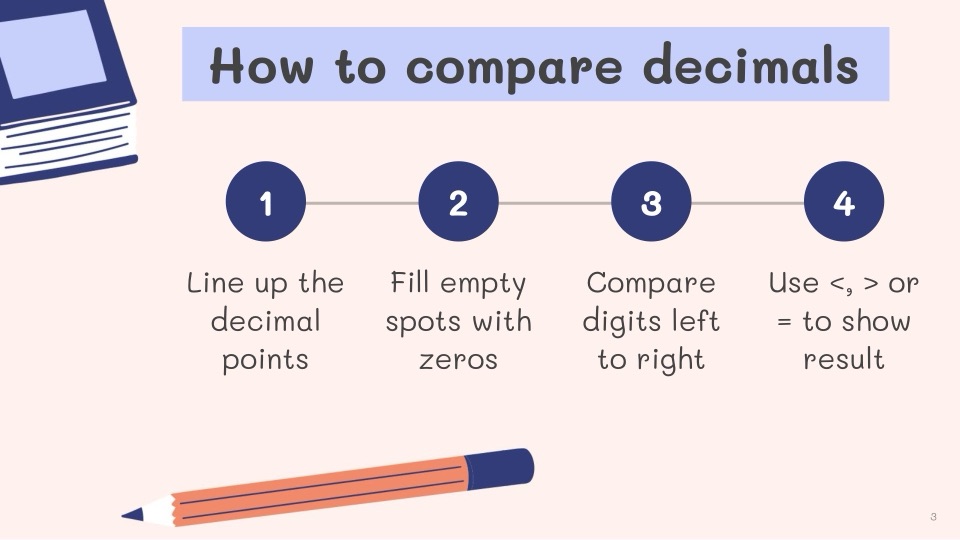
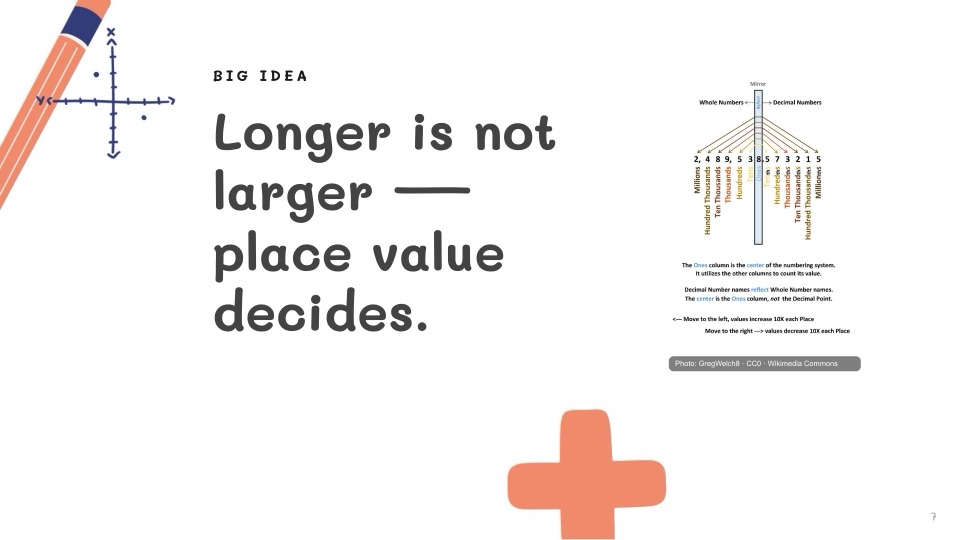
| 13 min | We do | Model lining up points and comparing left to right to thousandths. Show Slide 3 steps and play Video clip 6 (0:00-4:50) for lining up points and adding zeros. Model 0.157 vs 0.146 by looking at the digit with the greatest value first, then moving right when digits match. Model filling gaps with zero, so 0.5 becomes 0.500, then compare digits starting at the left with the greatest place value. Show Slide 7 big idea: Longer is not larger — place value decides. |
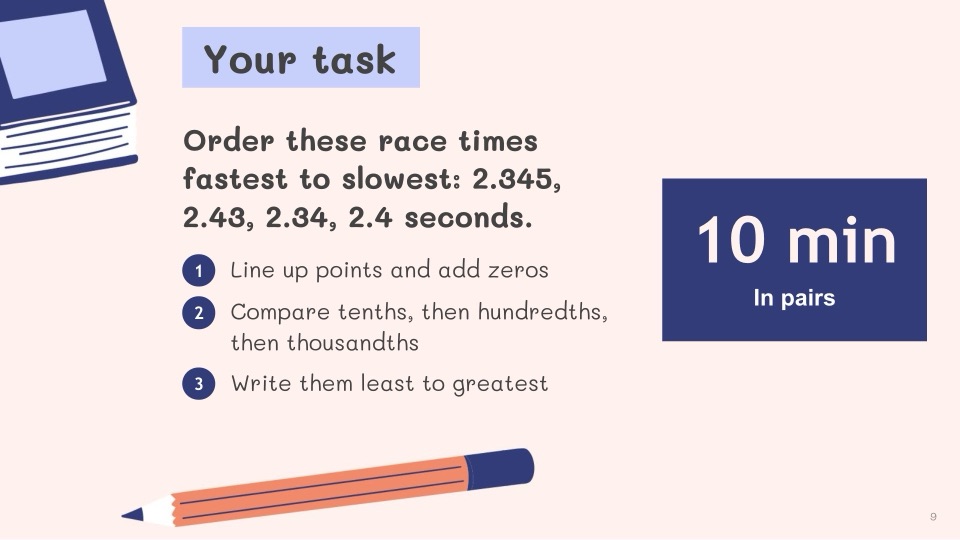
| 20 min | Main activity | Compare and order four race times to thousandths to find fastest. Hand out race-time slips and show Slide 9 task to line up points, compare, and order fastest to slowest. Remind groups smallest time wins and to write numbers in a place-value table lining up decimal points. Circulate, ask which column decided each match, and push for <, > sentences. Stop at 15 minutes for two groups to read their order aloud least to greatest. |
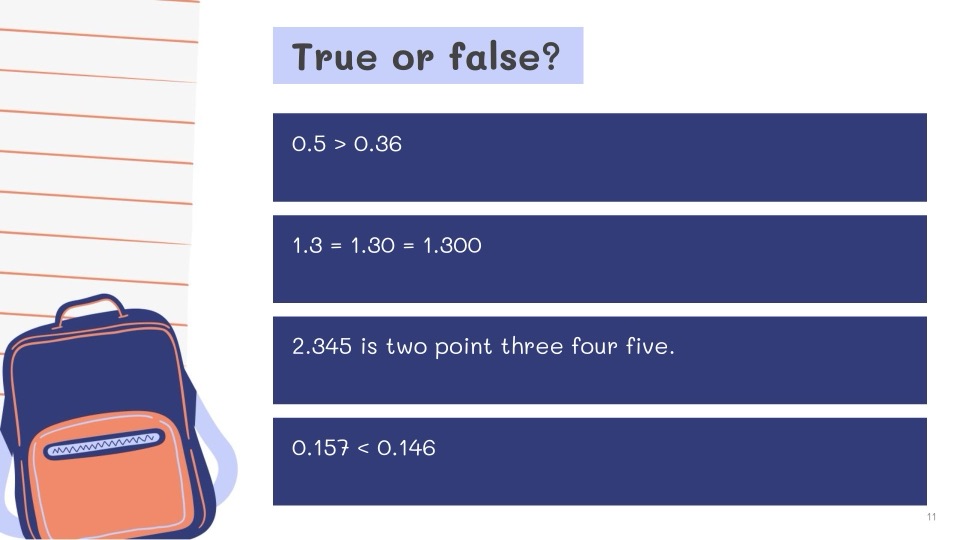
| 10 min | Plenary | Check reading and comparing against goals and fix last errors. Show Slide 10 key words and cold-call meanings without saying the word itself. Show Slide 11 true or false and vote: 0.5 > 0.36, 1.3 = 1.30 = 1.300, reading of 2.345. Model correct reading: 2.345 is two and three hundred forty-five thousandths, not two point three four five. Give 3-question exit ticket on paper. |
Common mistakes
- Longer is larger: thinking 0.36 > 0.5 because 36 > 5.
How to spot it: Student picks more digits as winner on whiteboards or bingo.
Line up as 0.50 vs 0.36 and model with tenth and hundredth grids to see sizes. - Reading as point digits, like two point three four five for 2.345.
How to spot it: Hear point talk or words missing thousandths.
Insist on place words: two and three hundred forty-five thousandths, since point talk leads to confusion about value. - Lining up left edge instead of decimal points, so 2.34 looks bigger than 2.43.
How to spot it: Digits stacked without dots aligned in Task C.
Rewrite in place-value table lining up decimal points and fill gaps with zero, then compare left to right.
Support
- Give times with same ones and tenths, like 11.451 and 11.475, so they only compare hundredths and thousandths in a lined-up chart
- Use shaded tenth and hundredth grids to model and compare decimals and pre-lined place-value charts
Stretch
- Add a fifth time that ties on thousandths and ask students to explain what tie means in thousandths
- Invent tricky pairs like 1.2 and 1.187, order four at a time, and write the place-value proof
Check questions
- Read 4.218 in words.
Answer: Four and two hundred eighteen thousandths. - Compare: 0.5 ___ 0.36 using <, > or =. Why?
Answer: 0.5 > 0.36 because 5 tenths beats 3 tenths (0.50 > 0.36). - Order least to greatest: 2.365, 2.356, 2.563, 2.536.
Answer: 2.356 < 2.365 < 2.536 < 2.563.
Curriculum
Read, write, and compare decimals to thousandths.
Video clips
Clips on YouTube, from the start and end times we chose. Check each one before you show it.
-
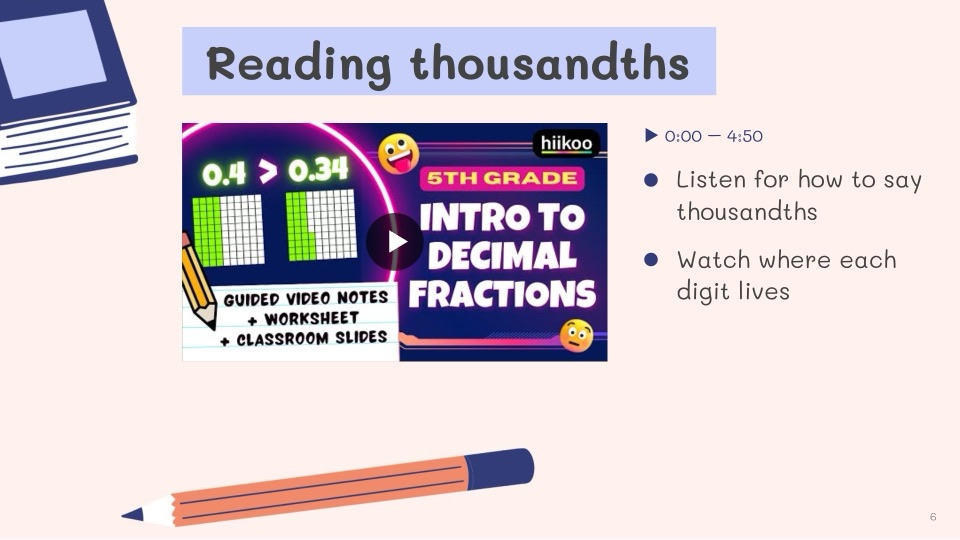
Intro to decimals to thousandths from 0:00 to 4:50
Hiikoo Learning: Intro to Decimals for Kids! (Fractions as Decimals, Comparing Decimals) 5.NBT.A.3 | 5th Grade 📊😎
Made for 5th grade and covers reading, writing, and comparing decimals to thousandths at the right pace for ages 10-11.
-
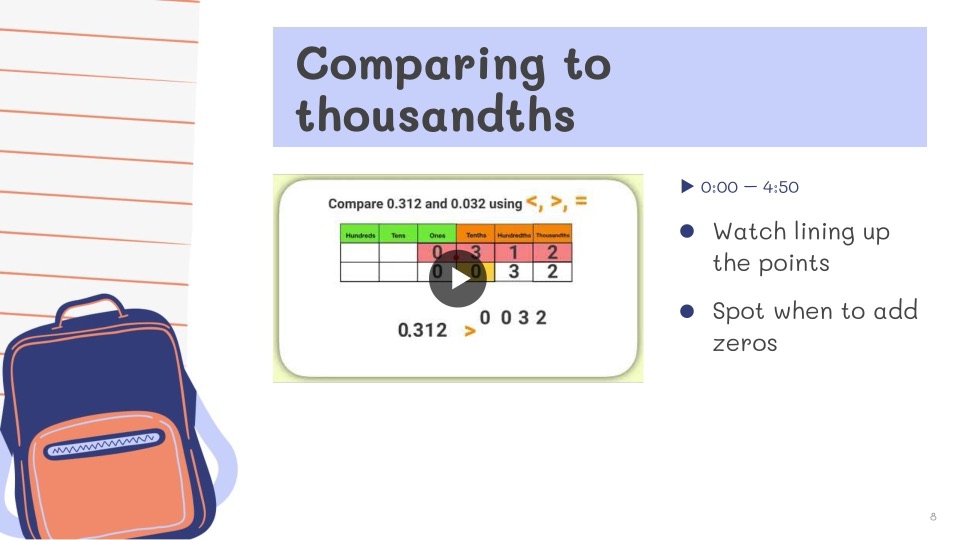
Comparing to thousandths from 0:00 to 4:50
Teach with Edpuzzle: Comparing Decimals to Thousandths
Focused on comparing decimals to thousandths with vocabulary and examples that fit ages 10-11.
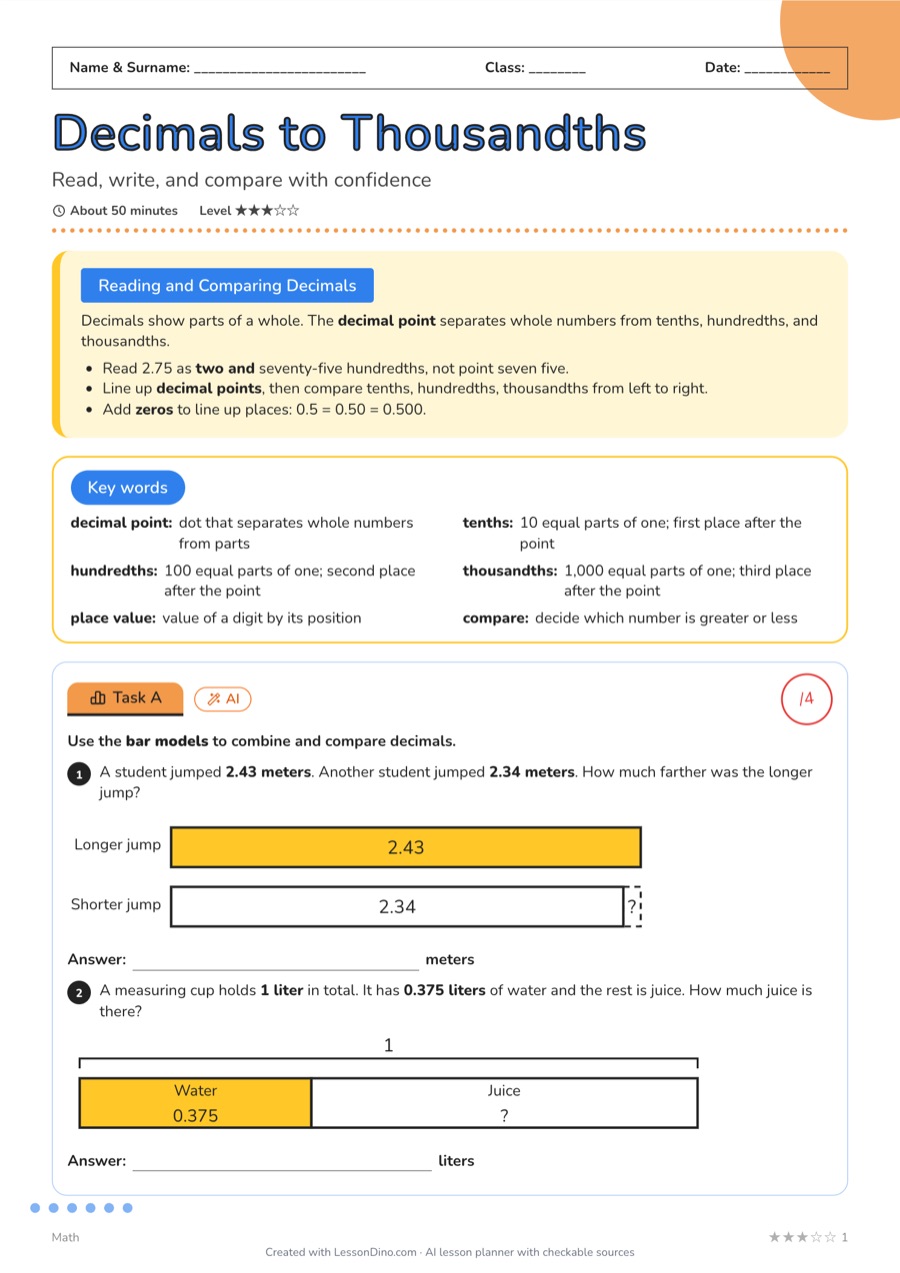
Worksheet
Sources
- Grade 5 » Introduction | Common Core State Standards Initiative thecorestandards.org
- Grade 5 Math Curriculum - Fairfax County Public Schools fcps.edu
- Comparing and ordering decimals – KS2 Maths - Year 5 - BBC bbc.co.uk
- Place value and ordering decimals - BBC Bitesize bbc.co.uk
- Recognising and comparing decimal numbers - Mathematics Hub mathematicshub.edu.au
Picture credits
Made with Lesson Dino's AI on 16 October 2026. AI can make mistakes, so check facts against the sources before you teach.