The worksheet
About this worksheet
Students learn to rename unlike fractions to equivalent like fractions. They build, add and subtract fractions and mixed numbers with models. This Grade 5 Math worksheet gives students (ages 10–11) six pages of practice on adding fractions with unlike denominators, part of the number and operations: fractions unit. It goes with our free Adding fractions with unlike denominators lesson, which has the slides and a timed lesson plan.
What it covers
By the end, students should be able to:
- Students will rename unlike fractions as equivalent fractions with a common denominator.
- Students will add and subtract fractions and mixed numbers with unlike denominators.
- Students will simplify answers and use estimation to check reasonableness.
How to use it
- Use it for practice after the teaching part of the lesson, once students have seen the worked examples on the slides.
- Support: Start with 1 1/2 + 1/4 on an area model already split into fourths to show equivalence and focus only on adding numerators.
- Stretch: Solve 2 1/4 - 1 2/3 by trading 1 whole for more small pieces and explaining the regrouping.
- The answer sheet is the last page, so you can print it on its own or let students check their own work.
Key vocabulary
- unlike denominators: different bottom numbers, so pieces are different sizes
- common denominator: same shared bottom number that both parts can use
- equivalent fractions: same amount written with different top and bottom numbers
- mixed number: a whole together with a leftover part, like 2 and 1/4
- simplify: write the answer with the smallest possible pieces
Mistakes to watch for
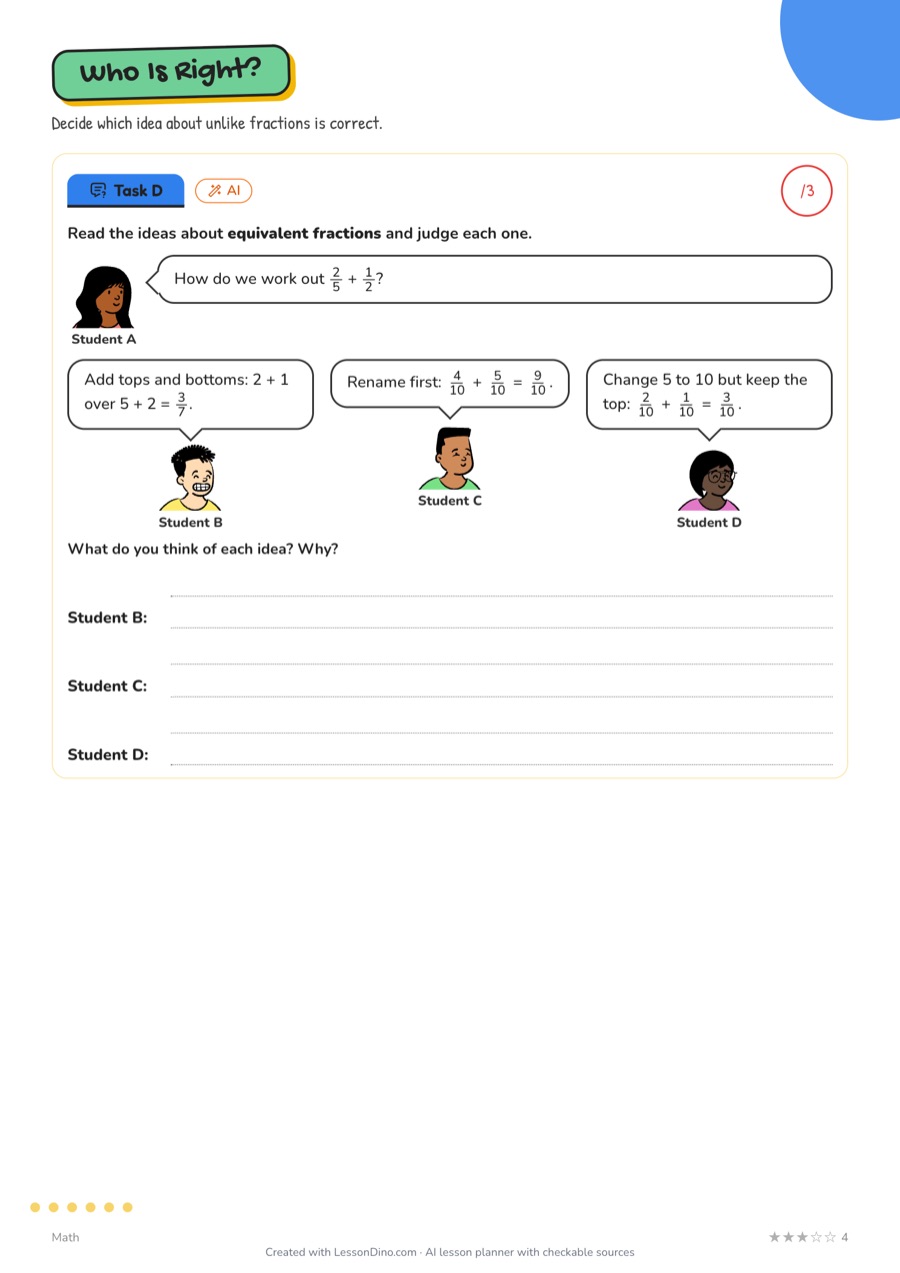
- Adding across tops and bottoms, like 2/5 + 1/2 = 3/7. Rename first to 4/10 + 5/10 = 9/10 and add only numerators, keep denominator.
- Multiplying bottom only when renaming, like 3/4 becomes 3/12. Multiply top and bottom by same number because multiplier equals 1, like 3/3.
- Adding denominators after renaming or forgetting to simplify. Keep common bottom and reduce or make mixed number, like 10/8 = 5/4 = 1 1/4.
What's on the worksheet
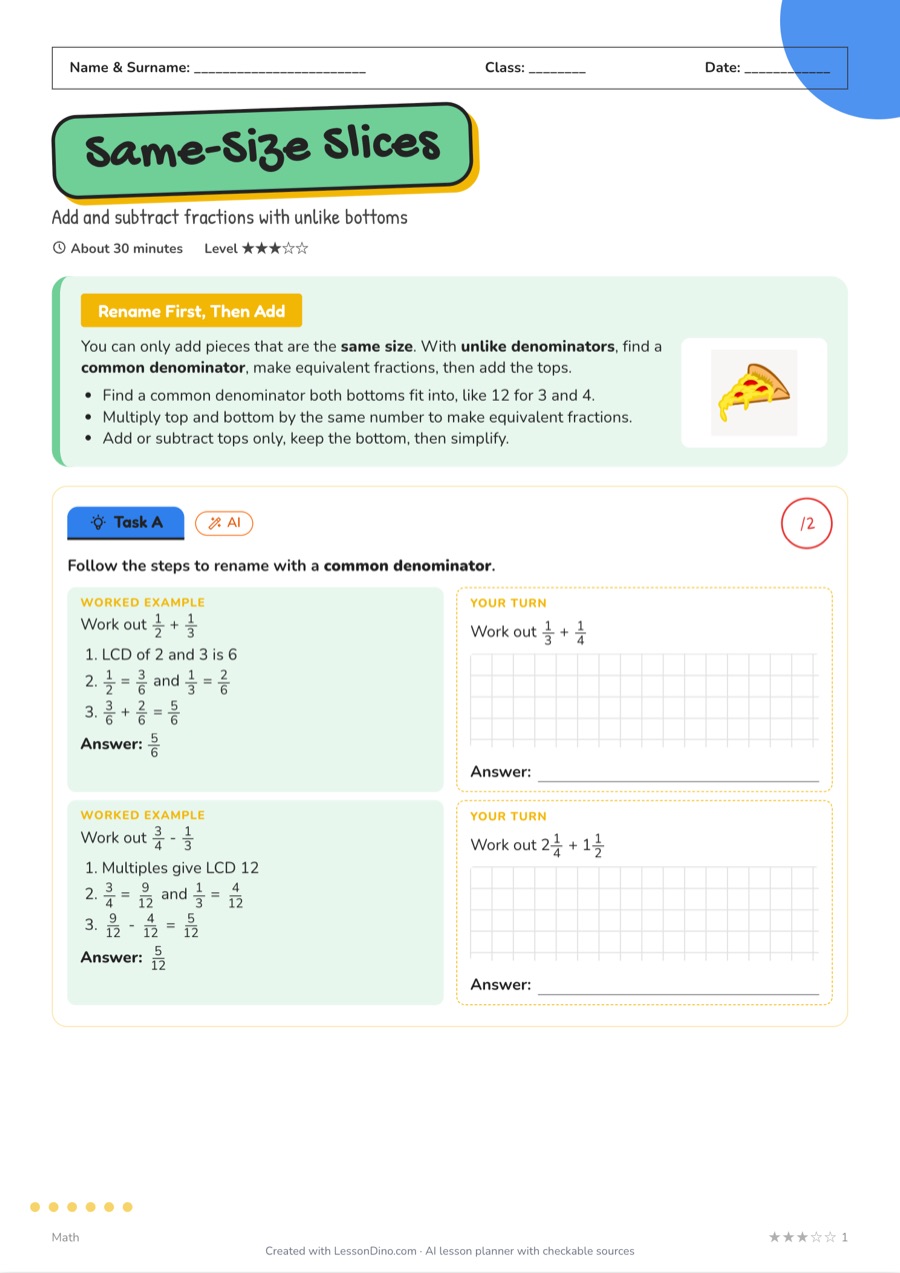
Make Pieces Match
Learn the steps for adding and subtracting unlike fractions.
Rename First, Then Add
- You can only add pieces that are the same size. With unlike denominators, find a common denominator, make equivalent fractions, then add the tops.
- Find a common denominator both bottoms fit into, like 12 for 3 and 4.
- Multiply top and bottom by the same number to make equivalent fractions.
- Add or subtract tops only, keep the bottom, then simplify.
Follow the steps to rename with a common denominator.
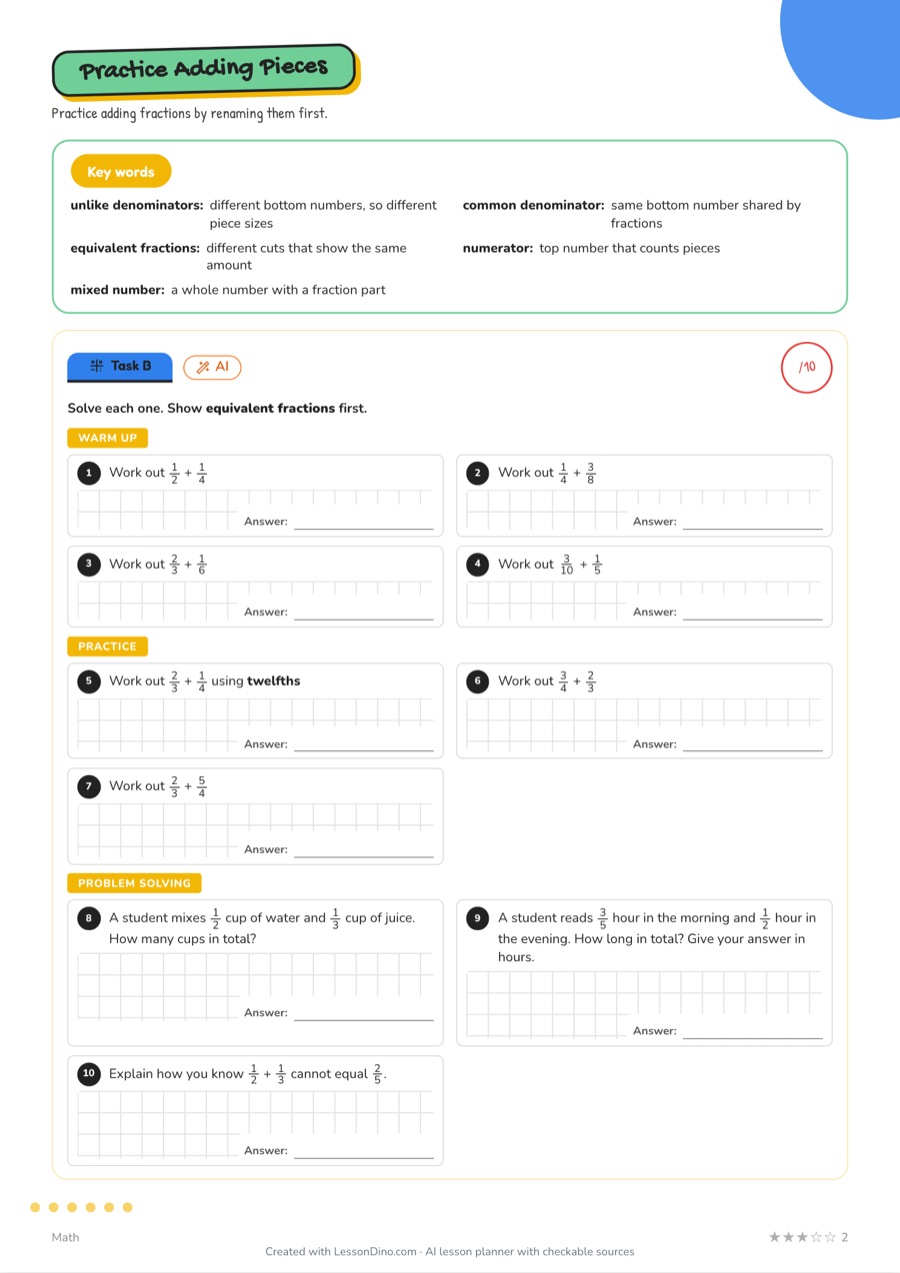
Practice Adding Pieces
Practice adding fractions by renaming them first.
| Word | Meaning |
|---|---|
| unlike denominators | different bottom numbers, so different piece sizes |
| common denominator | same bottom number shared by fractions |
| equivalent fractions | different cuts that show the same amount |
| numerator | top number that counts pieces |
| mixed number | a whole number with a fraction part |
Solve each one. Show equivalent fractions first.
Warm up
- Work out 1/2 + 1/4
- Work out 1/4 + 3/8
- Work out 2/3 + 1/6
- Work out 3/10 + 1/5
Practice
- Work out 2/3 + 1/4 using twelfths
- Work out 3/4 + 2/3
- Work out 2/3 + 5/4
Problem solving
- A student mixes 1/2 cup of water and 1/3 cup of juice. How many cups in total?
- A student reads 3/5 hour in the morning and 1/2 hour in the evening. How long in total? Give your answer in hours.
- Explain how you know 1/2 + 1/3 cannot equal 2/5.
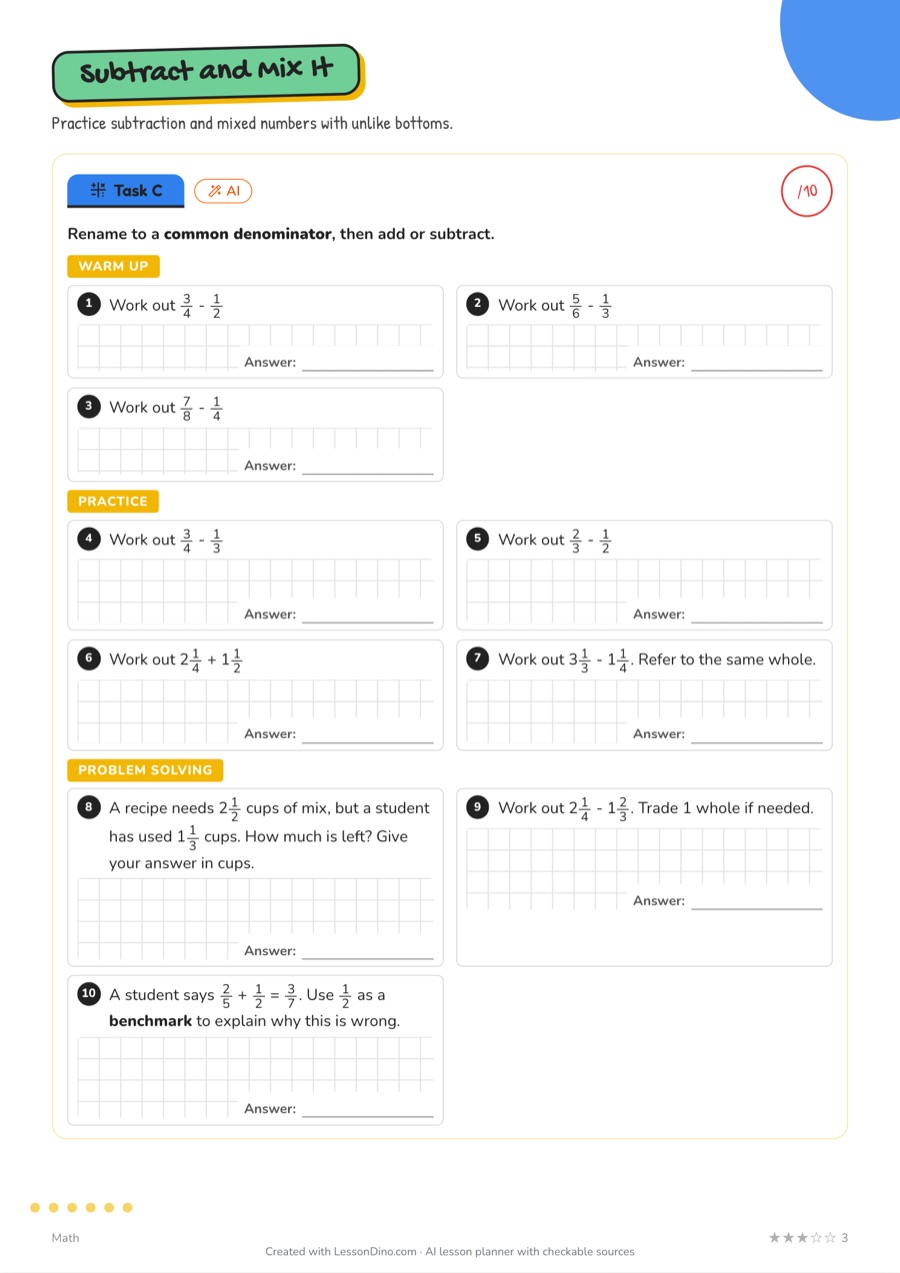
Subtract and Mix It
Practice subtraction and mixed numbers with unlike bottoms.
Rename to a common denominator, then add or subtract.
Warm up
- Work out 3/4 - 1/2
- Work out 5/6 - 1/3
- Work out 7/8 - 1/4
Practice
- Work out 3/4 - 1/3
- Work out 2/3 - 1/2
- Work out 2 1/4 + 1 1/2
- Work out 3 1/3 - 1 1/4. Refer to the same whole.
Problem solving
- A recipe needs 2 1/2 cups of mix, but a student has used 1 1/3 cups. How much is left? Give your answer in cups.
- Work out 2 1/4 - 1 2/3. Trade 1 whole if needed.
- A student says 2/5 + 1/2 = 3/7. Use 1/2 as a benchmark to explain why this is wrong.
Who Is Right?
Decide which idea about unlike fractions is correct.
Read the ideas about equivalent fractions and judge each one.
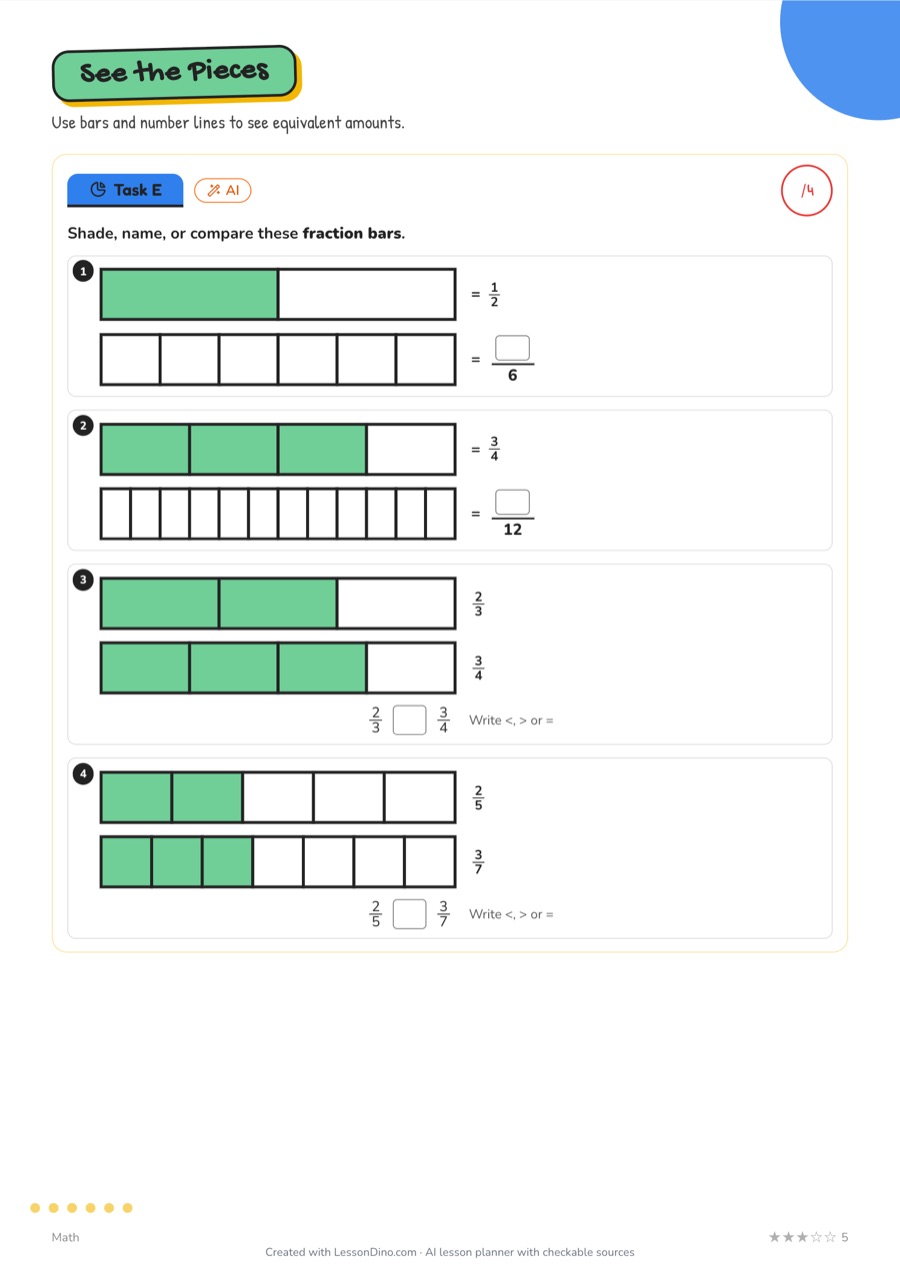
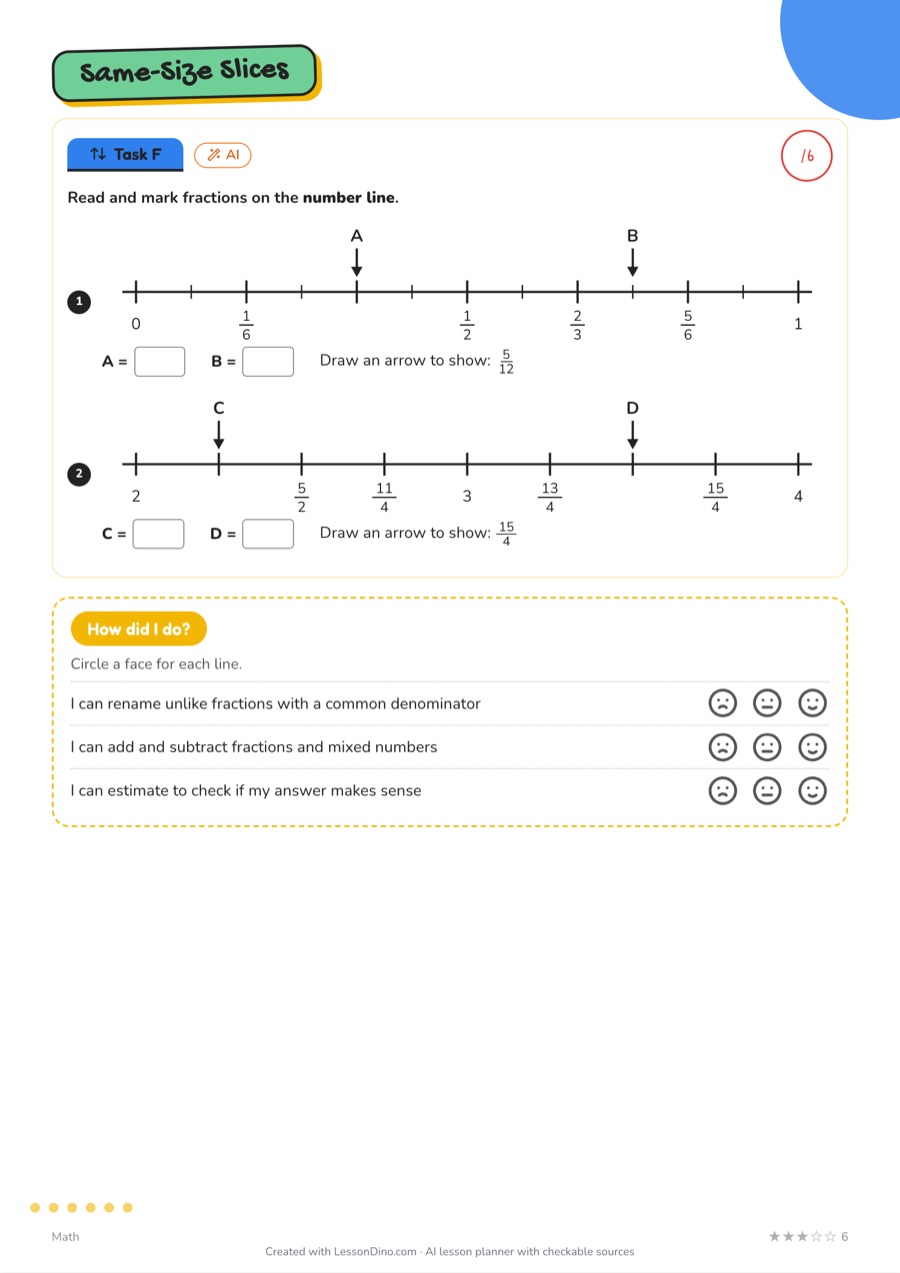
See the Pieces
Use bars and number lines to see equivalent amounts.
Shade, name, or compare these fraction bars.
Page 6
Read and mark fractions on the number line.
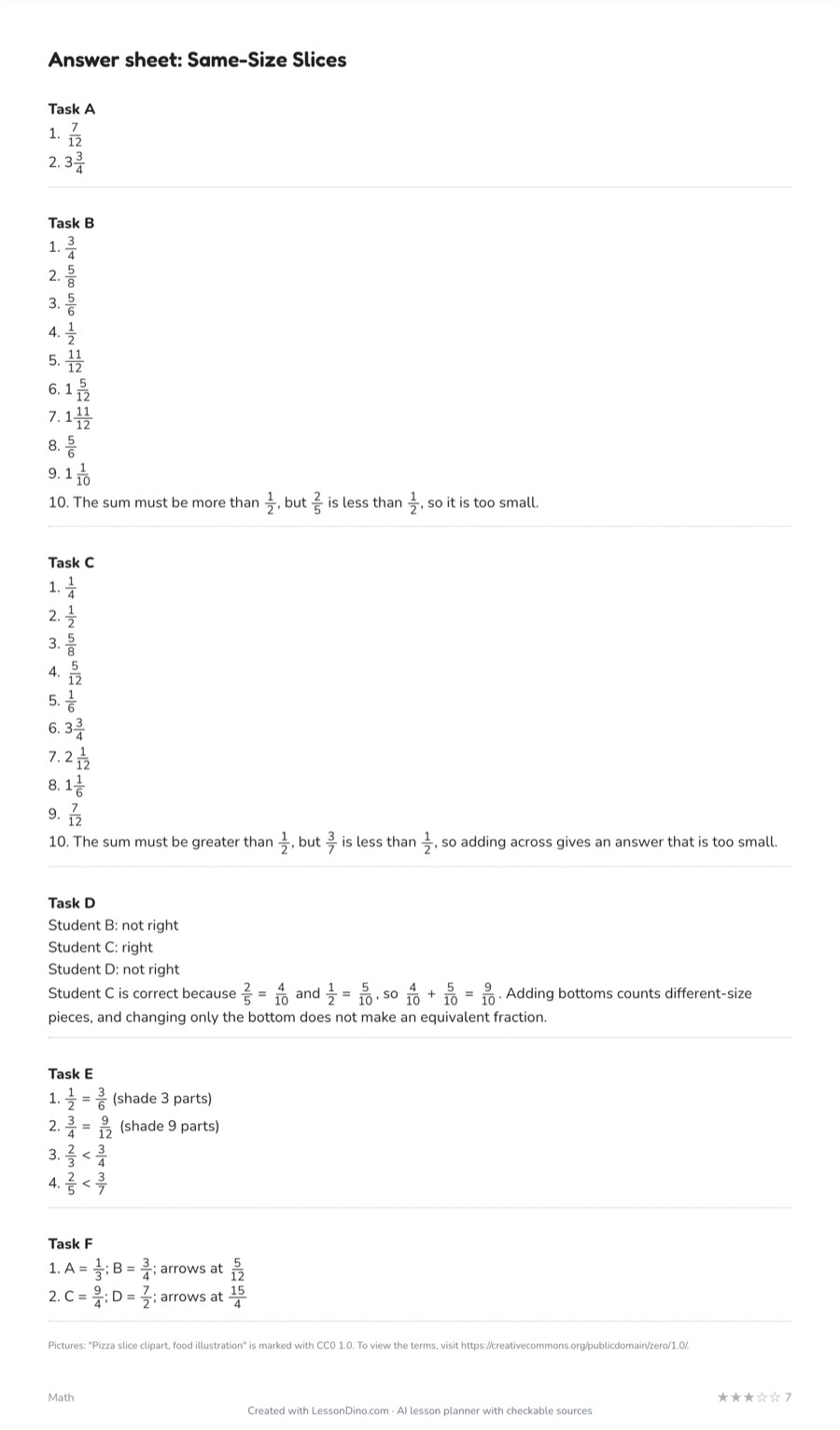
Answers
Show the answers
- Work out 1/2 + 1/4 3/4
- Work out 1/4 + 3/8 5/8
- Work out 2/3 + 1/6 5/6
- Work out 3/10 + 1/5 1/2
- Work out 2/3 + 1/4 using twelfths 11/12
- Work out 3/4 + 2/3 1 5/12
- Work out 2/3 + 5/4 1 11/12
- A student mixes 1/2 cup of water and 1/3 cup of juice. How many cups in total? 5/6
- A student reads 3/5 hour in the morning and 1/2 hour in the evening. How long in total? Give your answer in hours. 1 1/10
- Explain how you know 1/2 + 1/3 cannot equal 2/5. The sum must be more than 1/2, but 2/5 is less than 1/2, so it is too small.
- Work out 3/4 - 1/2 1/4
- Work out 5/6 - 1/3 1/2
- Work out 7/8 - 1/4 5/8
- Work out 3/4 - 1/3 5/12
- Work out 2/3 - 1/2 1/6
- Work out 2 1/4 + 1 1/2 3 3/4
- Work out 3 1/3 - 1 1/4. Refer to the same whole. 2 1/12
- A recipe needs 2 1/2 cups of mix, but a student has used 1 1/3 cups. How much is left? Give your answer in cups. 1 1/6
- Work out 2 1/4 - 1 2/3. Trade 1 whole if needed. 7/12
- A student says 2/5 + 1/2 = 3/7. Use 1/2 as a benchmark to explain why this is wrong. The sum must be greater than 1/2, but 3/7 is less than 1/2, so adding across gives an answer that is too small.
The answer sheet is the last picture above.
Curriculum
Add and subtract fractions with unlike denominators (including mixed numbers) by replacing given fractions with equivalent fractions in such a way as to produce an equivalent sum or difference of fractions with like denominators.
Made with Lesson Dino's AI on 17 October 2026. AI can make mistakes, so check the answers and facts against the sources before you teach.