Slides
Lesson plan
How Much Space Is Inside?
Students learn that volume is space inside solid figures. They pack boxes with unit cubes and compare volumes.
Objectives
- Students will recognize volume as space inside solid figures.
- Students will measure volume by counting unit cubes with no gaps.
- Students will compare two solids by volume in cubic units.
Success criteria
- I can tell what volume means for a solid.
- I can measure space by counting unit cubes.
- I can compare which solid has greater volume.
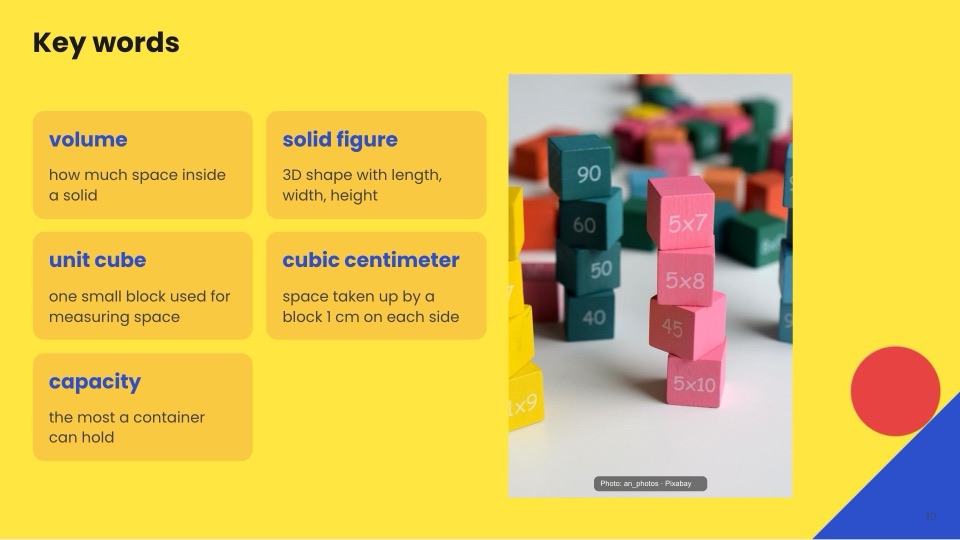
Key words
| Word | Meaning |
|---|---|
| volume | how much space is taken up inside an object |
| solid figure | an object that has length, width, and height |
| unit cube | one tiny block used to measure space inside |
| cubic centimeter | space inside a tiny block with 1-cm sides |
Timed plan (60 minutes)
| Time | Stage | What happens |
|---|---|---|
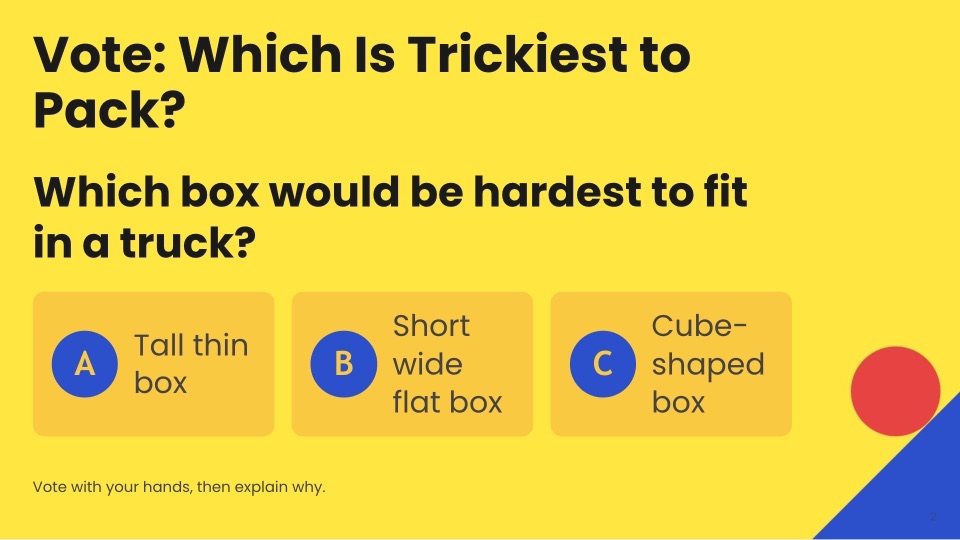
| 8 min | Starter | Spark curiosity about which container holds more and link to volume. Show two boxes that look almost the same size and hold them up side by side. Say the hook and take a quick vote using Slide 2. Ask how students could prove which holds more without guessing. Show Slide 1 title and link answers to measuring space inside. |
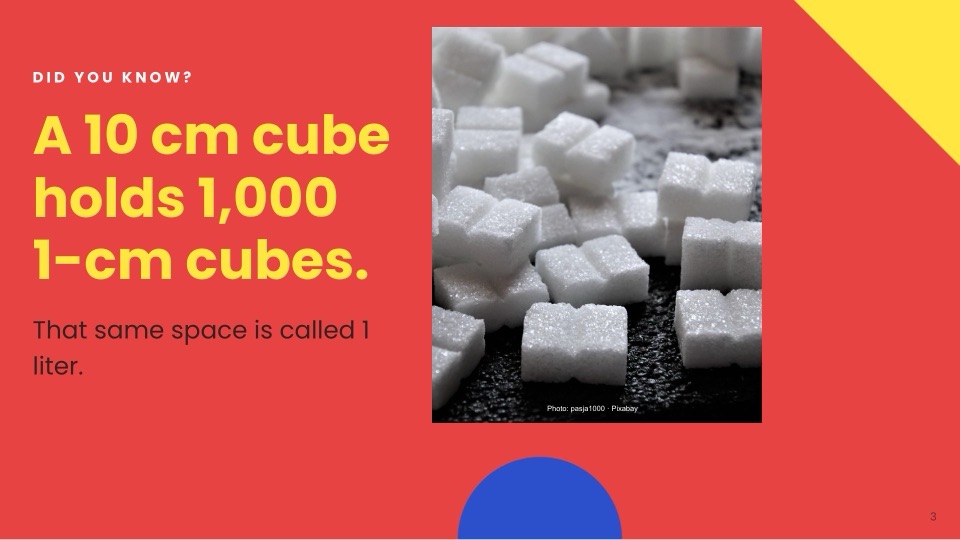
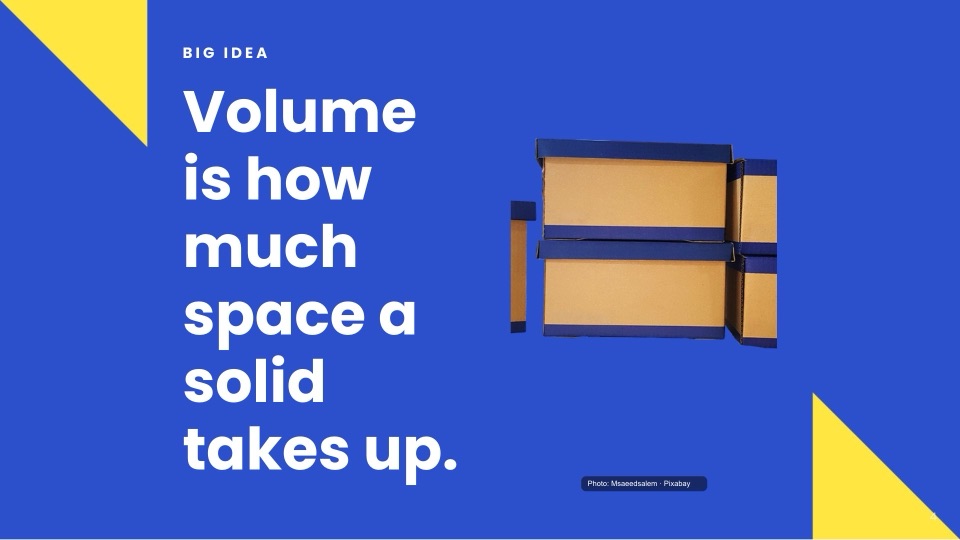
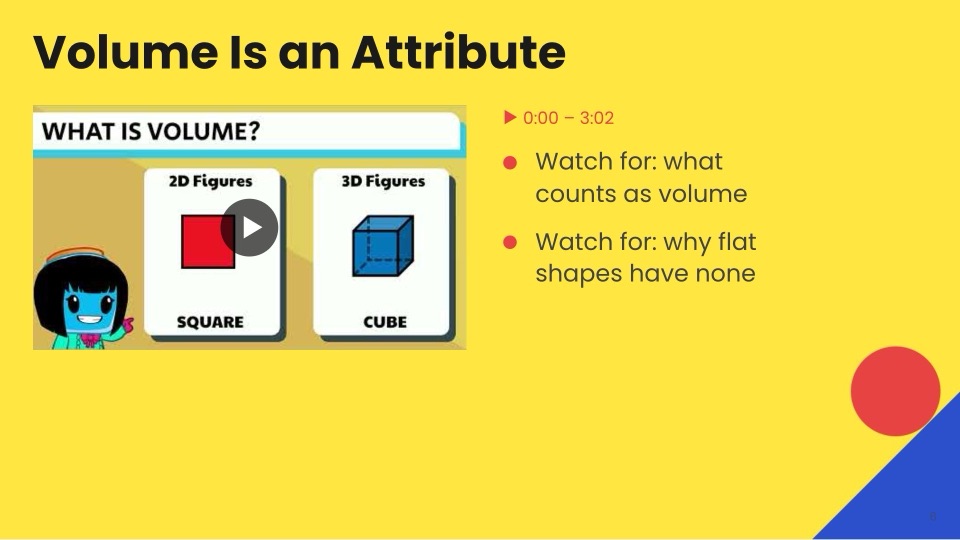
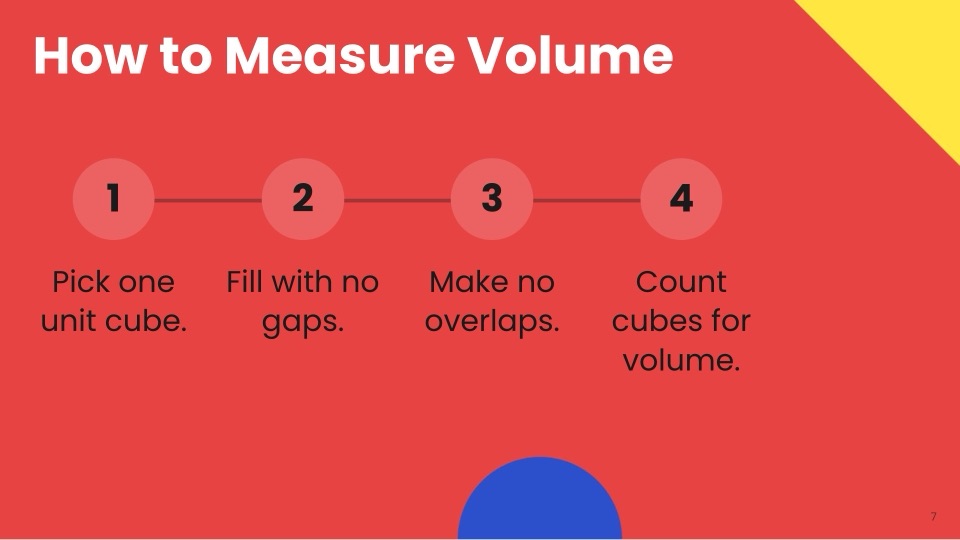
| 12 min | Teaching | Teach that volume is an attribute of solids measured in cubic units. Show Slide 4 big idea and explain volume with the 1-cm cube in hand. Play Video clip 1 (0:00-3:02) on Slide 6 and pause to stress flat shapes have none. Model Slide 7 steps: pick one unit cube, fill with no gaps or overlaps, count cubes. Show Slide 3 fact about the 10-cm cube as a benchmark. |
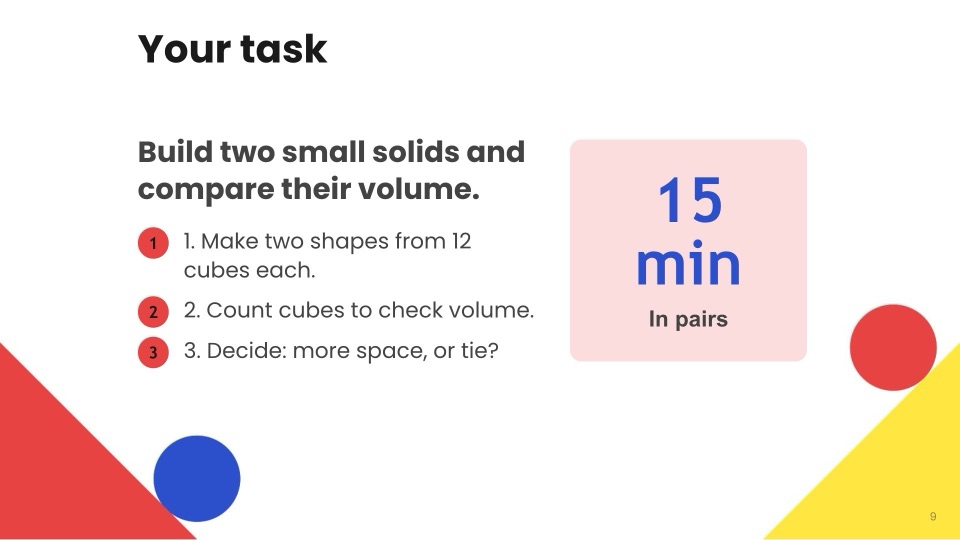
| 25 min | Main activity | Build understanding by packing boxes and counting cubes to compare volume. Demo packing Box A with 1-cm cubes in neat rows, columns, and layers. Hand out trays, cubes, and two boxes and start groups on Cube Fill-Up. Circulate, ask about rows, columns, and layers, and check counts. Move groups that finish to Worksheet Task B counting practice. |
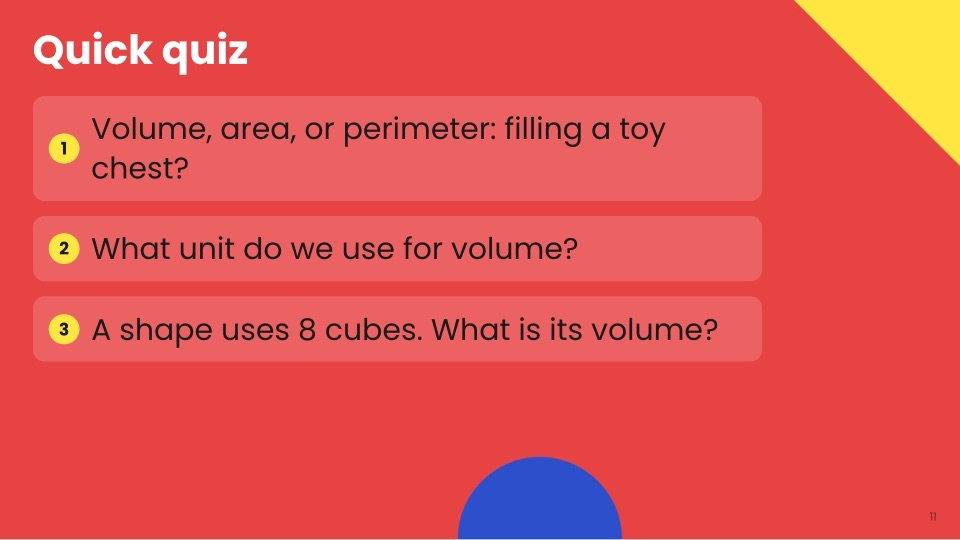
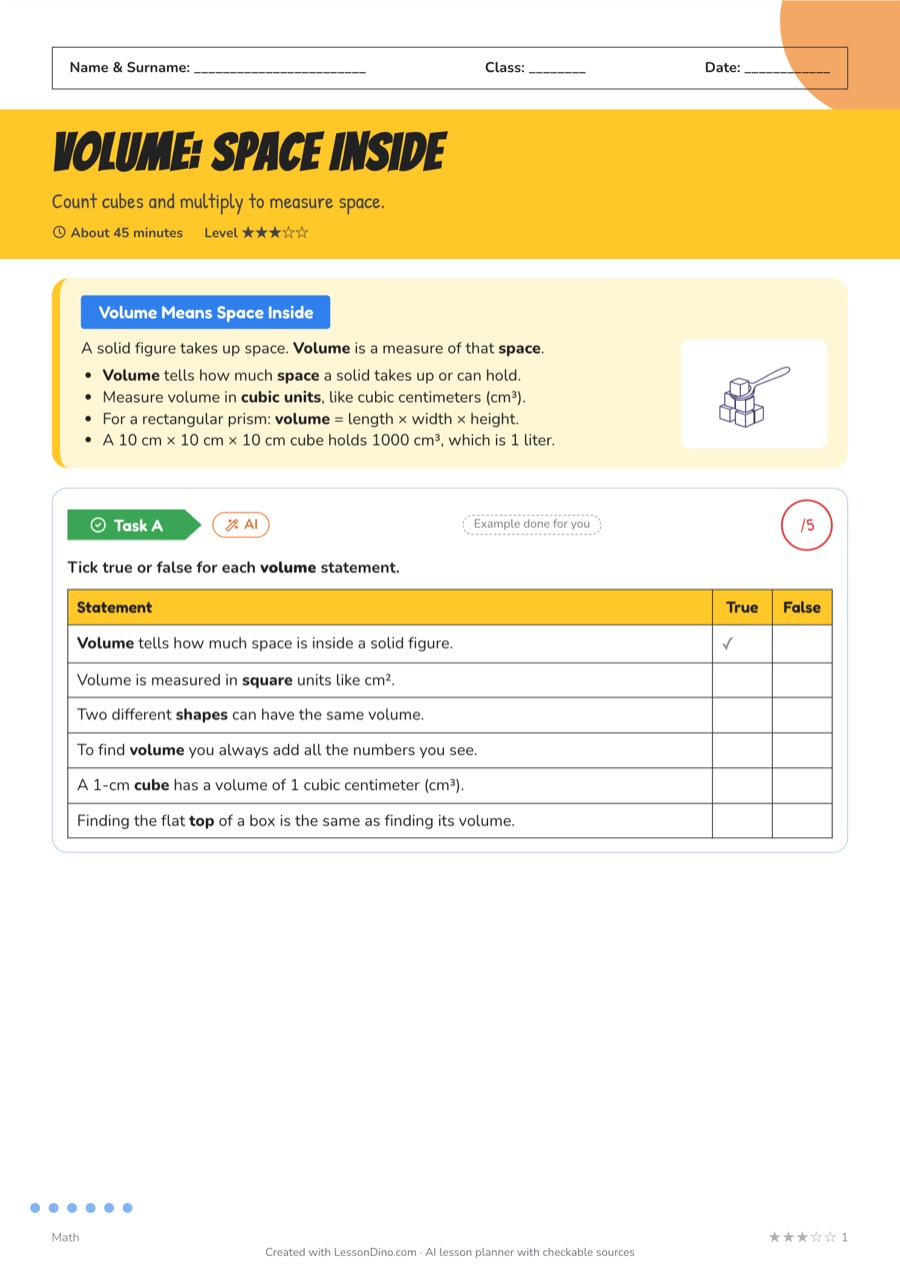
| 15 min | Plenary | Check that students can recognize volume and name correct units. Lead Think, pair, share with Slide 5: How is filling a box different from wrapping it? Review Slide 10 key words and Slide 11 quick quiz as whole class. Hand out Worksheet Task A true or false for independent check. Close by restating volume and previewing measuring larger solids. |
Common mistakes
- Finding surface area when asked for volume
How to spot it: Student adds faces or talks about wrapping and answers in square units
Ask: Are we covering the outside or measuring space inside? Repack with cubes to show volume is inside. - Leaving gaps or overlaps when packing and miscounting
How to spot it: Layers are messy or total does not match layer-by-layer count
Rebuild as rows, columns, and layers with no gaps or overlaps and count one layer at a time. - Using cm instead of cubic units, or thinking flat shapes have volume
How to spot it: Writes 12 cm for a box or says a square has volume
Hold up the 1-cm cube: a cube with 1-cm sides is 1 cm3; flat shapes cannot hold cubes so have no volume.
Support
- Pre-fill the bottom layer so the row and column structure is visible before counting up.
- Use picture cards with around, cover, fill, hold, and space inside underlined.
Stretch
- Predict a third box that would hold about twice as many cubes, then test by filling.
- Find two different objects thought to have almost the same volume and explain reasoning.
Check questions
- What is volume?
Answer: How much space a solid takes up inside. - You pack a box with 18 unit cubes with no gaps. What is its volume?
Answer: 18 cubic units. - Which needs volume: putting a fence around a yard, painting a wall, or filling a storage bin?
Answer: Filling a storage bin.
Curriculum
Recognize volume as an attribute of solid figures and understand concepts of volume measurement.
Video clips
Clips on YouTube, from the start and end times we chose. Check each one before you show it.
-
Volume as Attribute of Solids from 0:00 to 3:02
Boddle Learning: Understanding volume - 5th Grade Math 5.MD.C.3
Made for Grade 5 and directly teaches volume as an attribute of solid figures with unit cubes at the right pace for 10-11-year-olds.
-
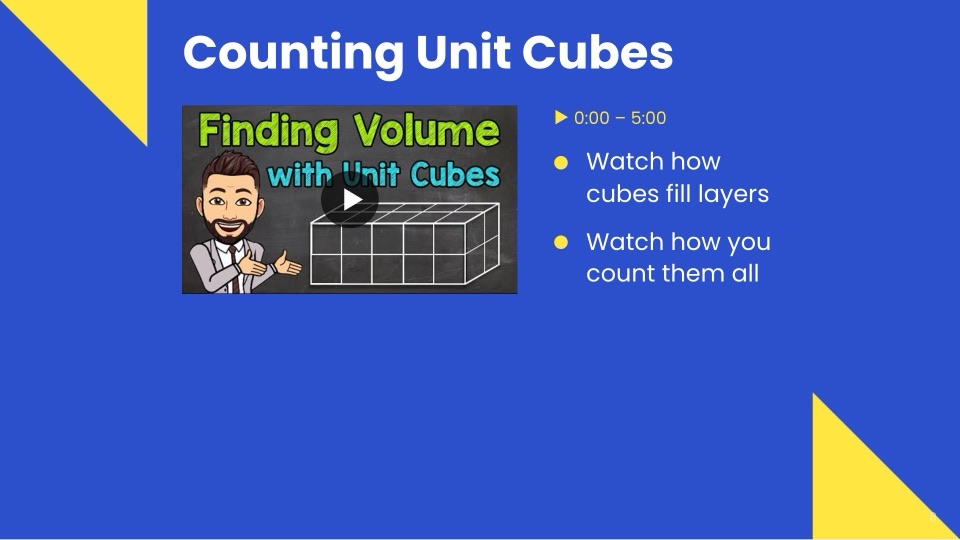
Finding Volume with Unit Cubes from 0:00 to 5:00
Math with Mr. J: Finding Volume with Unit Cubes | How to Find Volume
Models counting unit cubes to find volume at a steady Grade 5 pace perfect for 10-11-year-olds.
Worksheet
Sources
- Grade 5 Math Curriculum - Fairfax County Public Schools fcps.edu
- Mathematics Grade 5 - Chicago Public Schools cps.edu
- Winter Edition 2013 Calculus Students' Understanding of Volume files.eric.ed.gov
- SI Units - Volume | NIST nist.gov
- Calculus Students’ Understanding of Area and Volume Units files.eric.ed.gov
- Circumference, Area and Volume | NIST nist.gov
- Understanding Volume Estimation Uncertainty of Lakes and ... ntrs.nasa.gov
- Deepening Student Understanding of Area and Volume by ... journals.calstate.edu
- What is volume? - KS2 Maths - Year 6 - BBC Bitesize bbc.co.uk
- Calculating volume - KS2 Maths - Year 6 - BBC Bitesize bbc.co.uk
- Volume Facts for Kids kids.kiddle.co
Picture credits
Made with Lesson Dino's AI on 17 October 2026. AI can make mistakes, so check facts against the sources before you teach.