The worksheet
About this worksheet
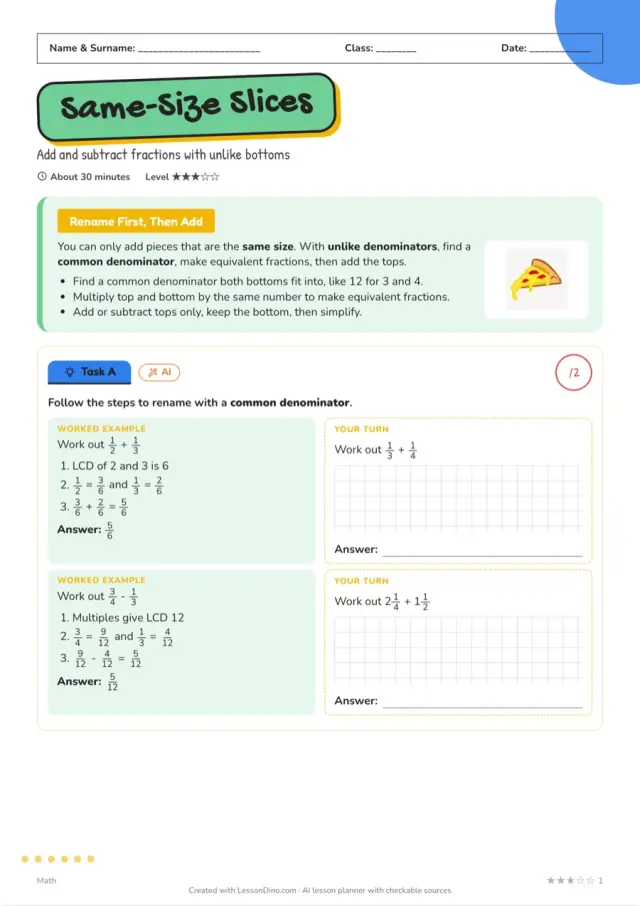
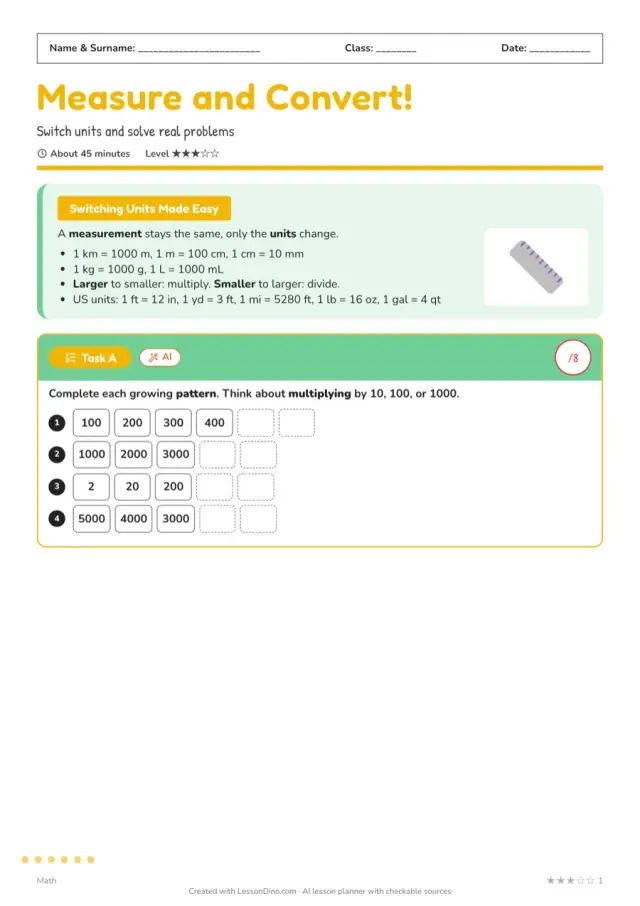
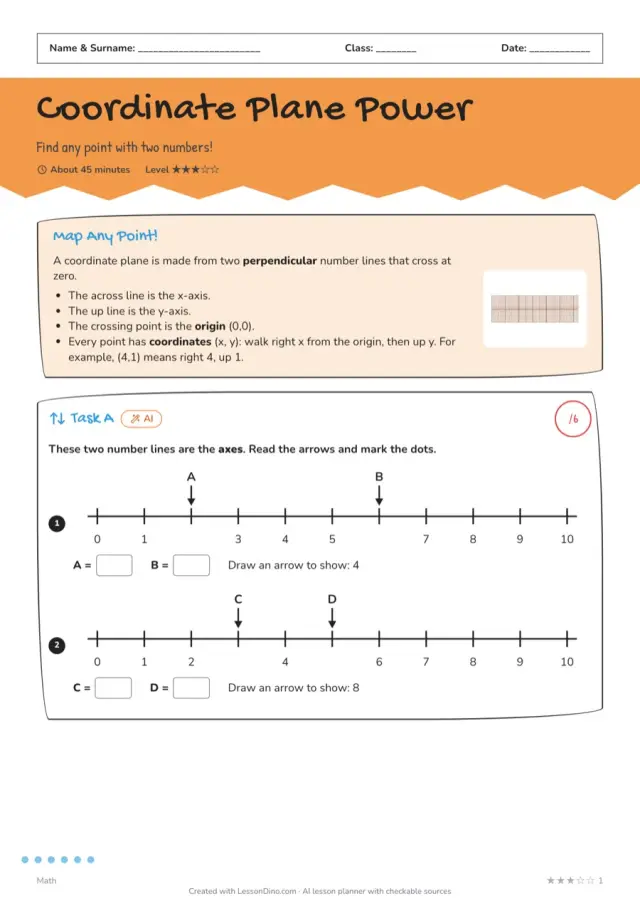
Students learn to use parentheses, brackets, and braces to show what to solve first. They evaluate expressions by working from the inside out. This Grade 5 Math worksheet gives students (ages 10–11) five pages of practice on order of operations, part of the operations and algebraic thinking unit. It goes with our free Order of operations lesson, which has the slides and a timed lesson plan.
What it covers
By the end, students should be able to:
- Students will evaluate expressions with parentheses, brackets, and braces.
- Students will solve the innermost group first and work outward stepwise.
- Students will use grouping symbols to show which part to solve first.
How to use it
- Practice in Pairs (12 minutes): Hand out Worksheet Tasks B-C for paired practice with whole number operations.
- Support: Give cards with the innermost step already highlighted in color.
- Stretch: Add a second operation inside, like [(2 + 3) x (4 - 1)].
- The answer sheet is the last page, so you can print it on its own or let students check their own work.
Key vocabulary
- parentheses: curved marks ( ) that keep numbers together to solve first
- brackets: square marks [ ] that group a bigger part outside the curved marks
- braces: curly marks { } that group the biggest part outside the square marks
- innermost: the group tucked deepest inside that you solve first
- evaluate: to work out the steps and find the answer
Mistakes to watch for
- Solving left to right and ignoring groups. Cover all but the multiplication, solve it, then uncover. Groups and then x/÷ come before +/−.
- Solving the outer brackets or braces first. Ask which pair hugs numbers with nothing inside it. Only (3 + 1) qualifies, so do it first.
- Not rewriting the expression after each step. Require write the new number back in and repeat until no groups are left.
What's on the worksheet
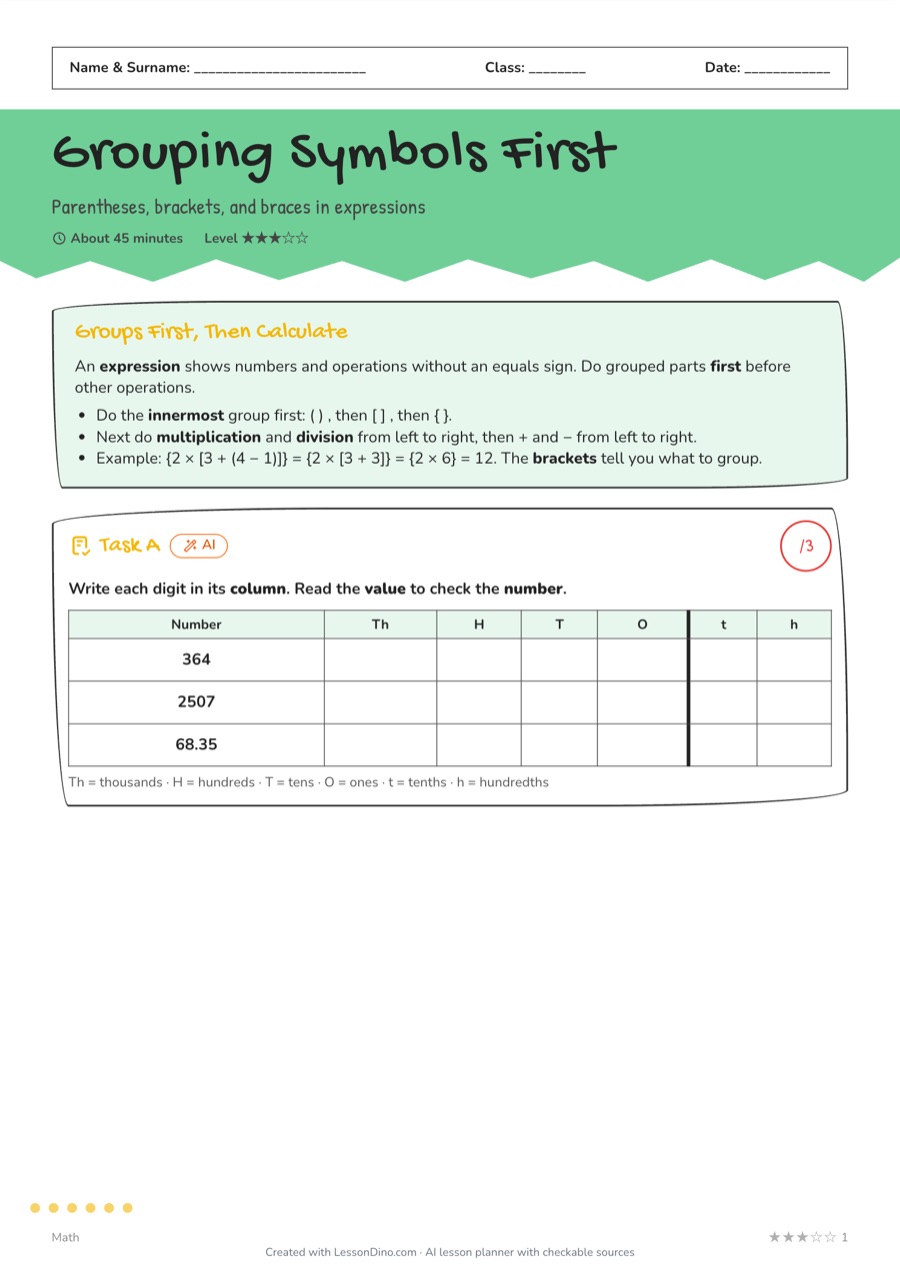
Groups Come First
How parentheses, brackets, and braces tell you what to do first.
Groups First, Then Calculate
- An expression shows numbers and operations without an equals sign. Do grouped parts first before other operations.
- Do the innermost group first: ( ) , then [ ] , then { }.
- Next do multiplication and division from left to right, then + and − from left to right.
- Example: {2 × [3 + (4 − 1)]} = {2 × [3 + 3]} = {2 × 6} = 12. The brackets tell you what to group.
Write each digit in its column. Read the value to check the number.
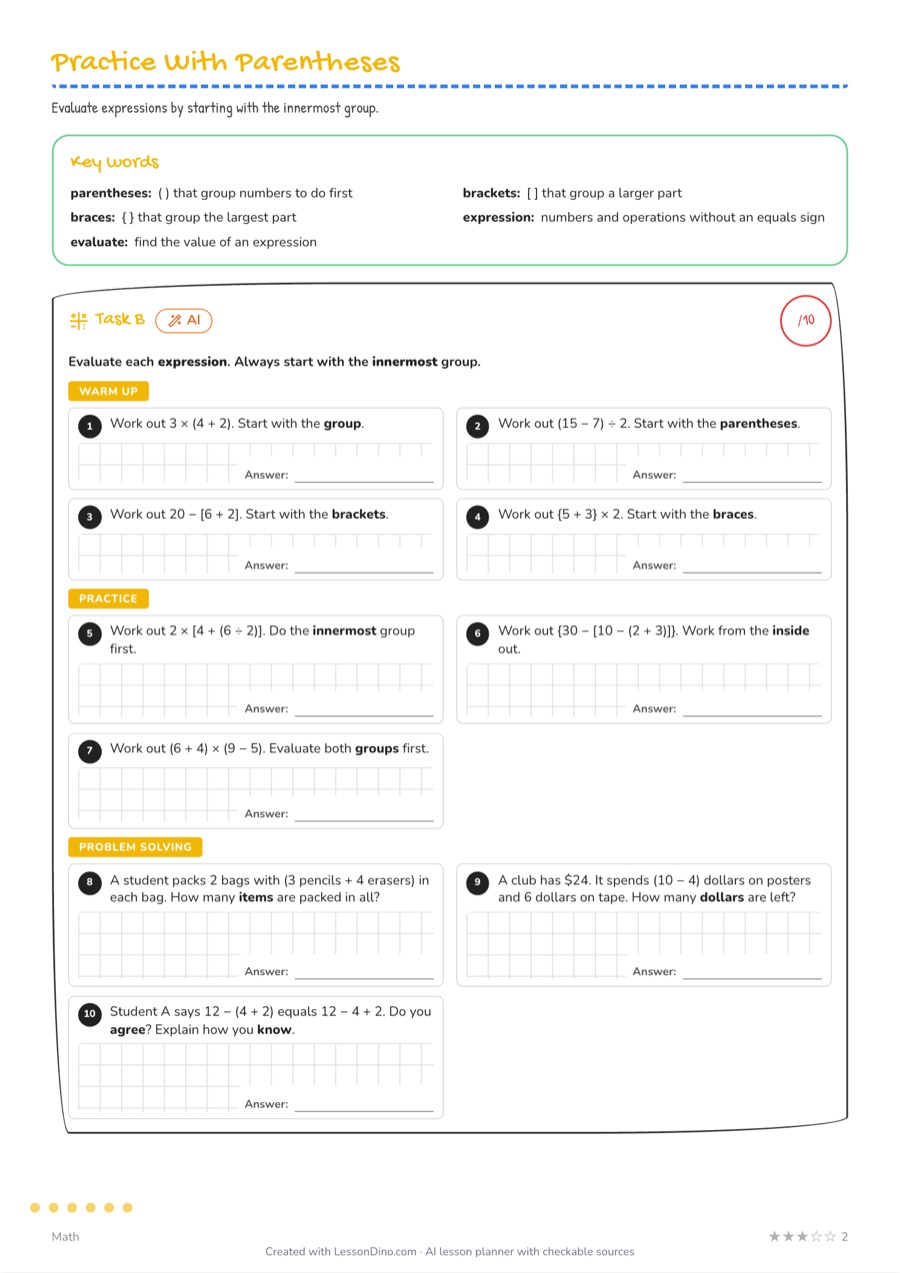
Practice With Parentheses
Evaluate expressions by starting with the innermost group.
| Word | Meaning |
|---|---|
| parentheses | ( ) that group numbers to do first |
| brackets | [ ] that group a larger part |
| braces | { } that group the largest part |
| expression | numbers and operations without an equals sign |
| evaluate | find the value of an expression |
Evaluate each expression. Always start with the innermost group.
Warm up
- Work out 3 × (4 + 2). Start with the group.
- Work out (15 − 7) ÷ 2. Start with the parentheses.
- Work out 20 − [6 + 2]. Start with the brackets.
- Work out {5 + 3} × 2. Start with the braces.
Practice
- Work out 2 × [4 + (6 ÷ 2)]. Do the innermost group first.
- Work out {30 − [10 − (2 + 3)]}. Work from the inside out.
- Work out (6 + 4) × (9 − 5). Evaluate both groups first.
Problem solving
- A student packs 2 bags with (3 pencils + 4 erasers) in each bag. How many items are packed in all?
- A club has $24. It spends (10 − 4) dollars on posters and 6 dollars on tape. How many dollars are left?
- Student A says 12 − (4 + 2) equals 12 − 4 + 2. Do you agree? Explain how you know.
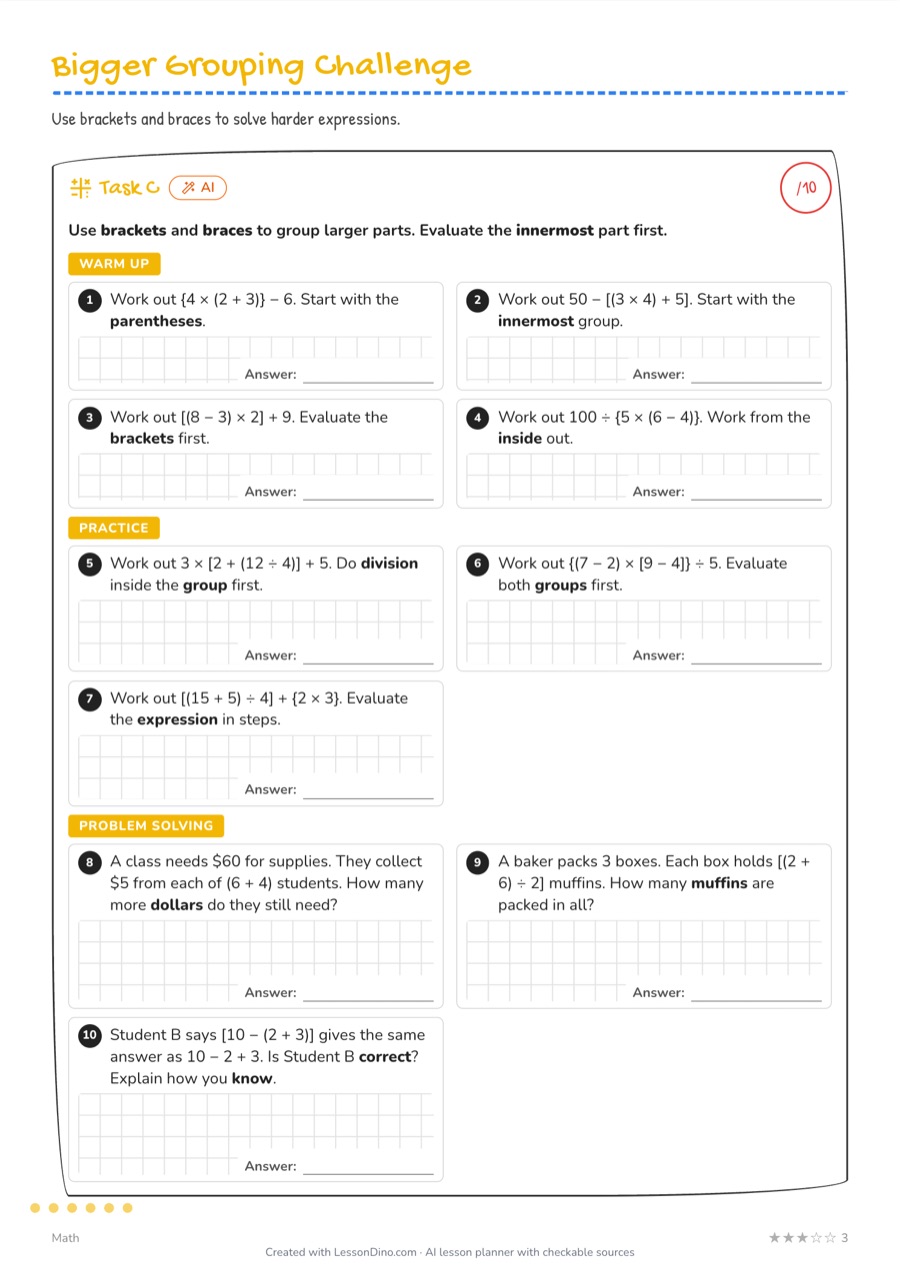
Bigger Grouping Challenge
Use brackets and braces to solve harder expressions.
Use brackets and braces to group larger parts. Evaluate the innermost part first.
Warm up
- Work out {4 × (2 + 3)} − 6. Start with the parentheses.
- Work out 50 − [(3 × 4) + 5]. Start with the innermost group.
- Work out [(8 − 3) × 2] + 9. Evaluate the brackets first.
- Work out 100 ÷ {5 × (6 − 4)}. Work from the inside out.
Practice
- Work out 3 × [2 + (12 ÷ 4)] + 5. Do division inside the group first.
- Work out {(7 − 2) × [9 − 4]} ÷ 5. Evaluate both groups first.
- Work out [(15 + 5) ÷ 4] + {2 × 3}. Evaluate the expression in steps.
Problem solving
- A class needs $60 for supplies. They collect $5 from each of (6 + 4) students. How many more dollars do they still need?
- A baker packs 3 boxes. Each box holds [(2 + 6) ÷ 2] muffins. How many muffins are packed in all?
- Student B says [10 − (2 + 3)] gives the same answer as 10 − 2 + 3. Is Student B correct? Explain how you know.
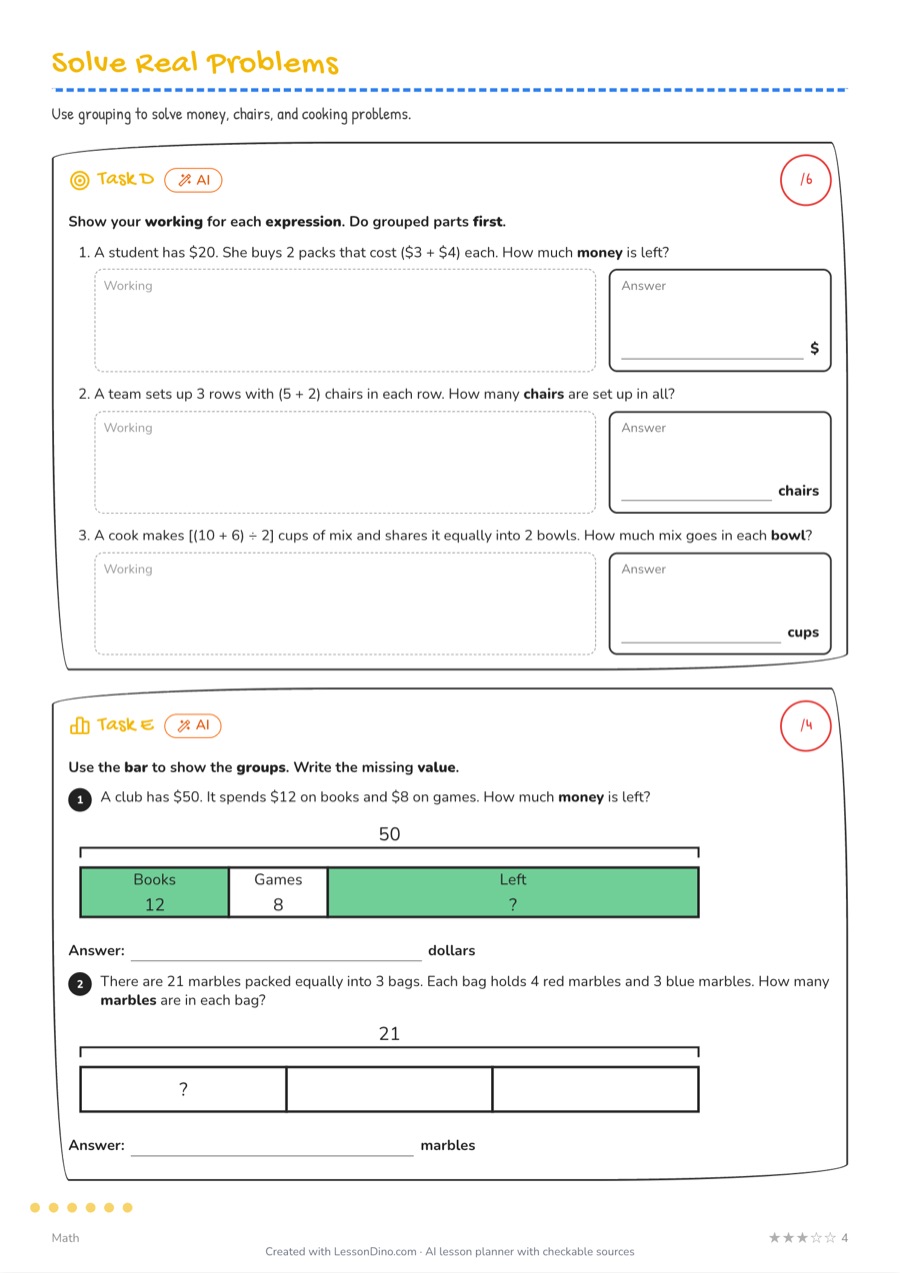
Solve Real Problems
Use grouping to solve money, chairs, and cooking problems.
Show your working for each expression. Do grouped parts first.
Use the bar to show the groups. Write the missing value.
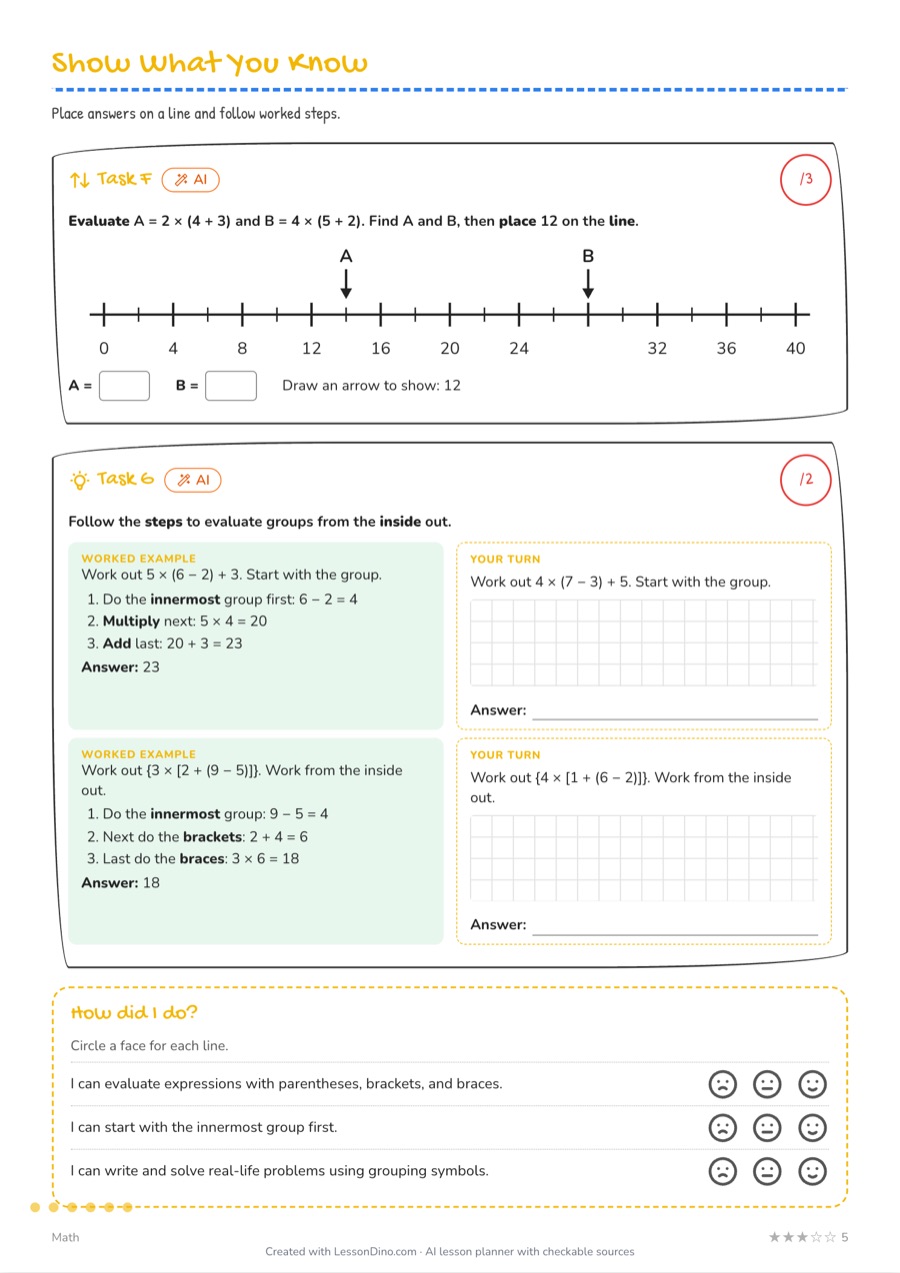
Show What You Know
Place answers on a line and follow worked steps.
Evaluate A = 2 × (4 + 3) and B = 4 × (5 + 2). Find A and B, then place 12 on the line.
Follow the steps to evaluate groups from the inside out.
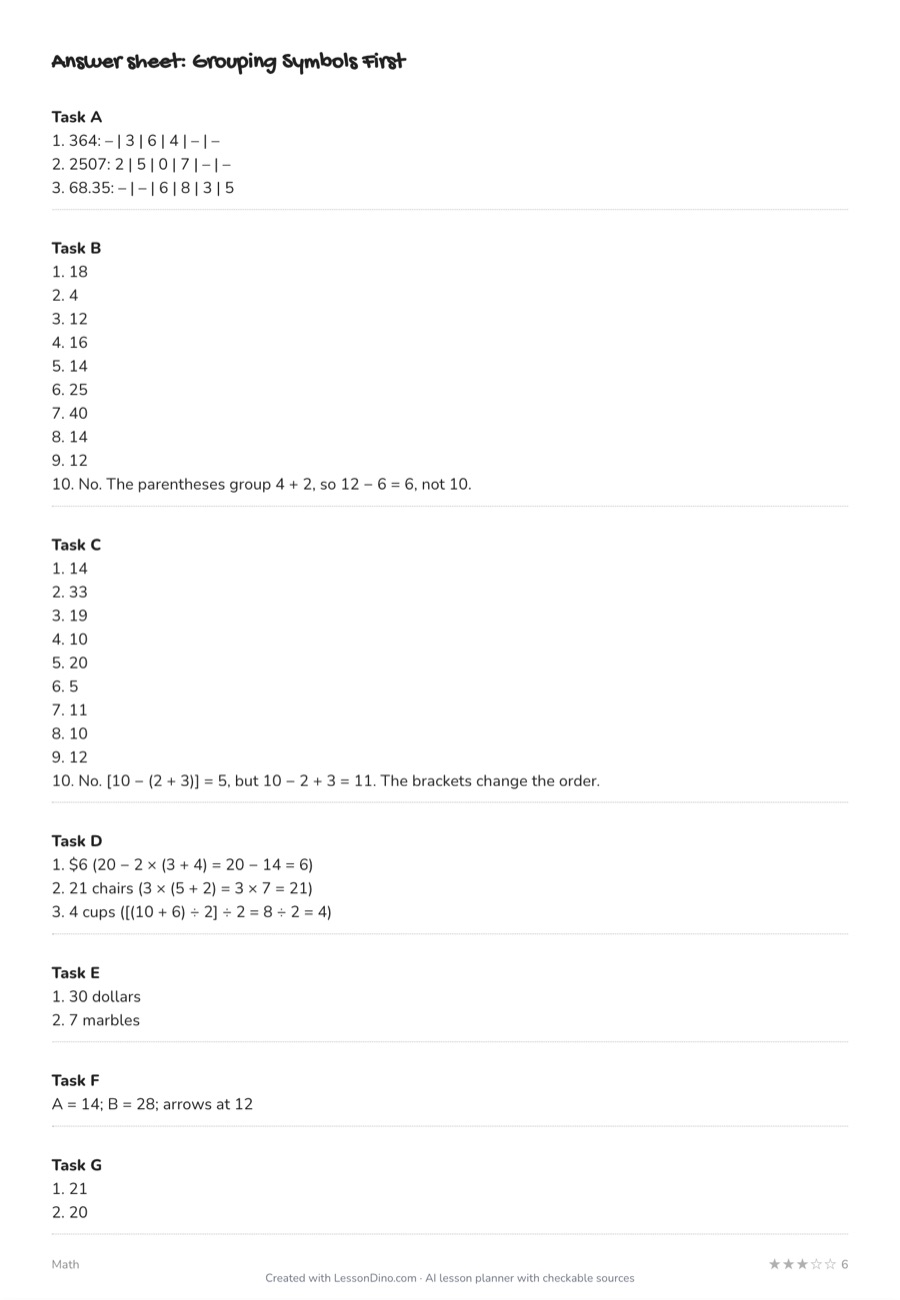
Answers
Show the answers
- Work out 3 × (4 + 2). Start with the group. 18
- Work out (15 − 7) ÷ 2. Start with the parentheses. 4
- Work out 20 − [6 + 2]. Start with the brackets. 12
- Work out {5 + 3} × 2. Start with the braces. 16
- Work out 2 × [4 + (6 ÷ 2)]. Do the innermost group first. 14
- Work out {30 − [10 − (2 + 3)]}. Work from the inside out. 25
- Work out (6 + 4) × (9 − 5). Evaluate both groups first. 40
- A student packs 2 bags with (3 pencils + 4 erasers) in each bag. How many items are packed in all? 14
- A club has $24. It spends (10 − 4) dollars on posters and 6 dollars on tape. How many dollars are left? 12
- Student A says 12 − (4 + 2) equals 12 − 4 + 2. Do you agree? Explain how you know. No. The parentheses group 4 + 2, so 12 − 6 = 6, not 10.
- Work out {4 × (2 + 3)} − 6. Start with the parentheses. 14
- Work out 50 − [(3 × 4) + 5]. Start with the innermost group. 33
- Work out [(8 − 3) × 2] + 9. Evaluate the brackets first. 19
- Work out 100 ÷ {5 × (6 − 4)}. Work from the inside out. 10
- Work out 3 × [2 + (12 ÷ 4)] + 5. Do division inside the group first. 20
- Work out {(7 − 2) × [9 − 4]} ÷ 5. Evaluate both groups first. 5
- Work out [(15 + 5) ÷ 4] + {2 × 3}. Evaluate the expression in steps. 11
- A class needs $60 for supplies. They collect $5 from each of (6 + 4) students. How many more dollars do they still need? 10
- A baker packs 3 boxes. Each box holds [(2 + 6) ÷ 2] muffins. How many muffins are packed in all? 12
- Student B says [10 − (2 + 3)] gives the same answer as 10 − 2 + 3. Is Student B correct? Explain how you know. No. [10 − (2 + 3)] = 5, but 10 − 2 + 3 = 11. The brackets change the order.
- A student has $20. She buys 2 packs that cost ($3 + $4) each. How much money is left? $6
- A team sets up 3 rows with (5 + 2) chairs in each row. How many chairs are set up in all? 21 chairs
- A cook makes [(10 + 6) ÷ 2] cups of mix and shares it equally into 2 bowls. How much mix goes in each bowl? 4 cups
The answer sheet is the last picture above.
Curriculum
Use parentheses, brackets, or braces in numerical expressions, and evaluate expressions with these symbols.
Made with Lesson Dino's AI on 17 October 2026. AI can make mistakes, so check the answers and facts against the sources before you teach.