Slides
Lesson plan
Group First, Then Solve Inside Out
Students learn to use parentheses, brackets, and braces to show what to solve first. They evaluate expressions by working from the inside out.
Objectives
- Students will evaluate expressions with parentheses, brackets, and braces.
- Students will solve the innermost group first and work outward stepwise.
- Students will use grouping symbols to show which part to solve first.
Success criteria
- I can find and solve the innermost group first.
- I can rewrite each step until no groups are left.
- I can evaluate expressions with ( ), [ ], and { } correctly.
Key words
| Word | Meaning |
|---|---|
| parentheses | curved marks ( ) that keep numbers together to solve first |
| brackets | square marks [ ] that group a bigger part outside the curved marks |
| braces | curly marks { } that group the biggest part outside the square marks |
| innermost | the group tucked deepest inside that you solve first |
| evaluate | to work out the steps and find the answer |
Timed plan (60 minutes)
| Time | Stage | What happens |
|---|---|---|
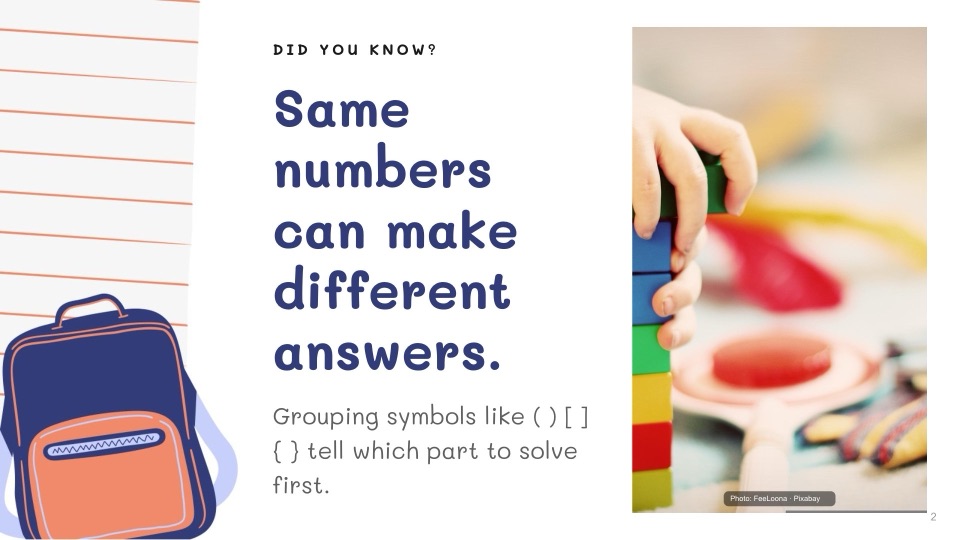
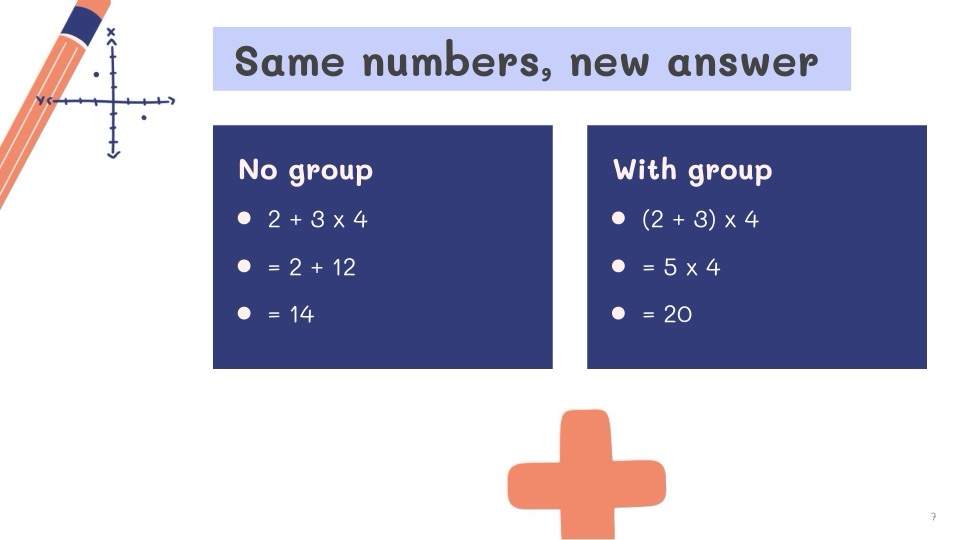
| 5 min | Starter | Hook students and recall that grouping changes the answer. Hold up three cups stuck inside each other and wiggle the smallest one. Show Slides 1-2 and read the fact about grouping symbols. Ask the class to solve 2 + 3 x 4 with no groups, then (2 + 3) x 4. Connect cups to math: we open the smallest container first. |
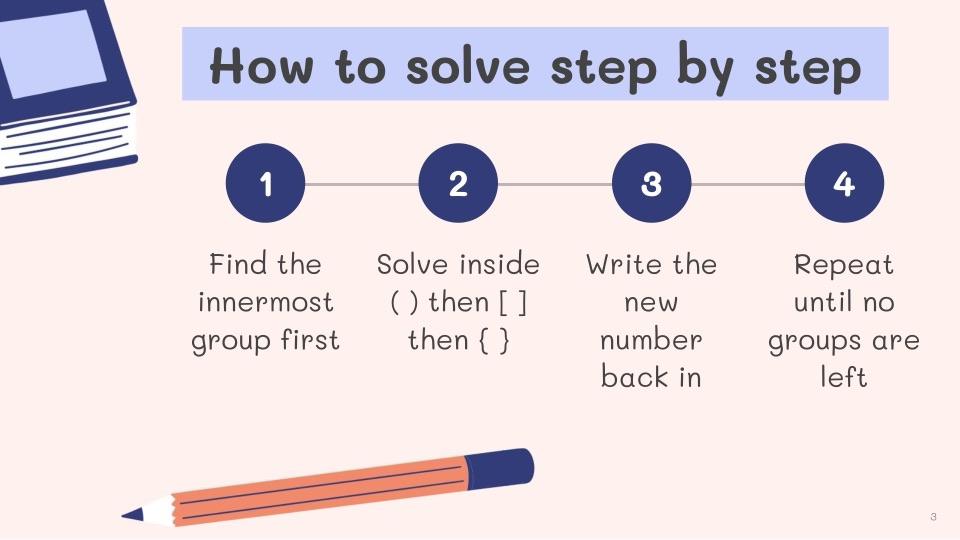
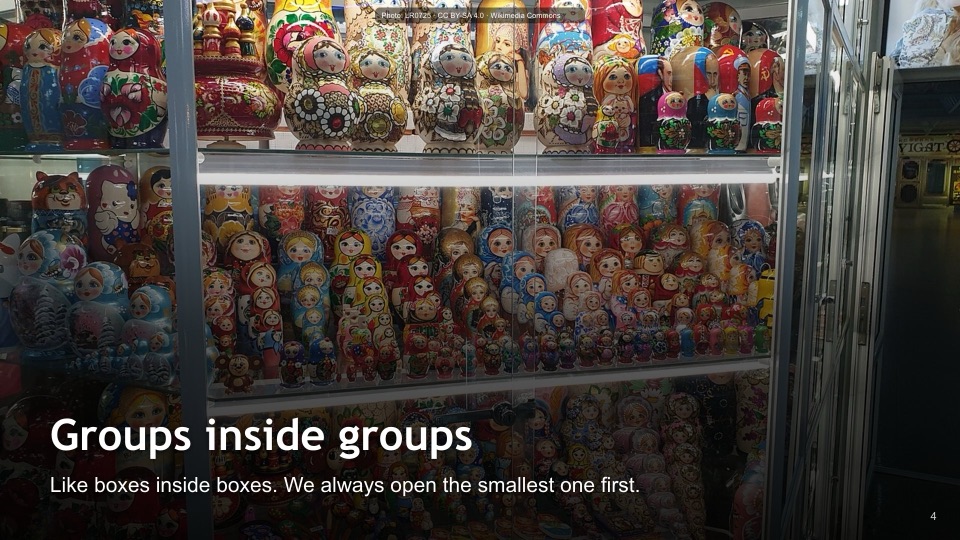
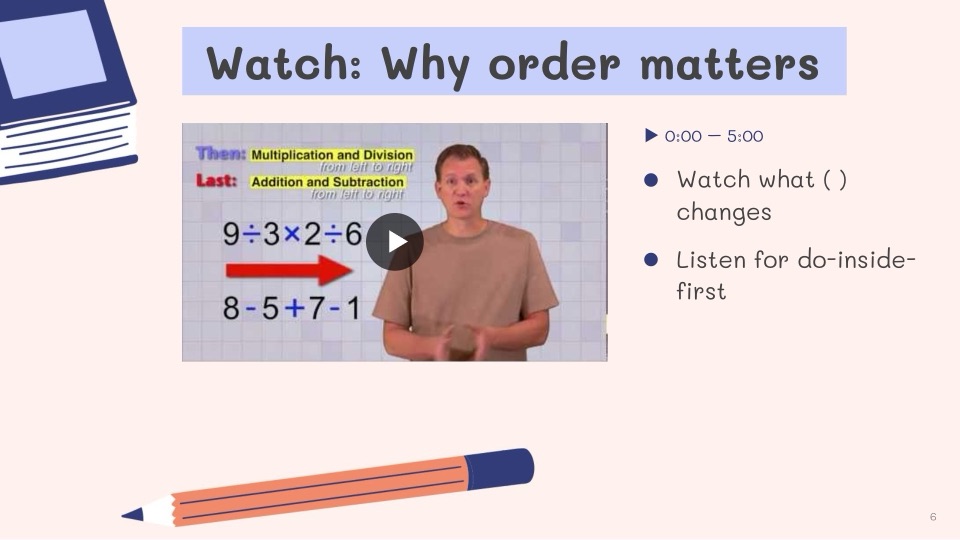
| 15 min | Teaching | Model solving innermost parentheses first, then brackets, then braces. Show Slides 3-4 and model the three steps: innermost first, write the new number back, repeat. Play Video clip 4 (0:00–5:00) on Slide 6. Tell students to listen for do-inside-first. Model 2 x [3 + (4 - 1)] on the whiteboard using cups to cover and uncover. Repeat with whole numbers to build fluency with whole number operations expected in Grade 5. |
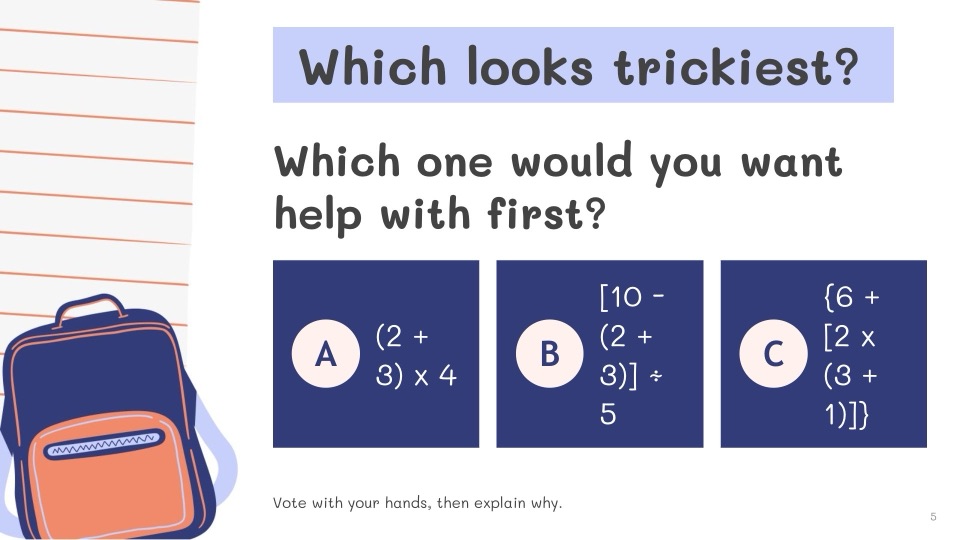
| 20 min | Main Activity - Nest Inside Out | Evaluate three-level expressions by lifting groups from inside out. Give each group 3 labeled cups, number cards, sticky notes, and scrap paper. Show 2 x [3 + (4 - 1)]. Have groups build it with cups and lift to solve inside out. Circulate as groups repeat with {6 + [2 x (3 + 1)]} and write three steps with answer circled. Stop halfway for one group to demo rewriting the expression with the new number. |
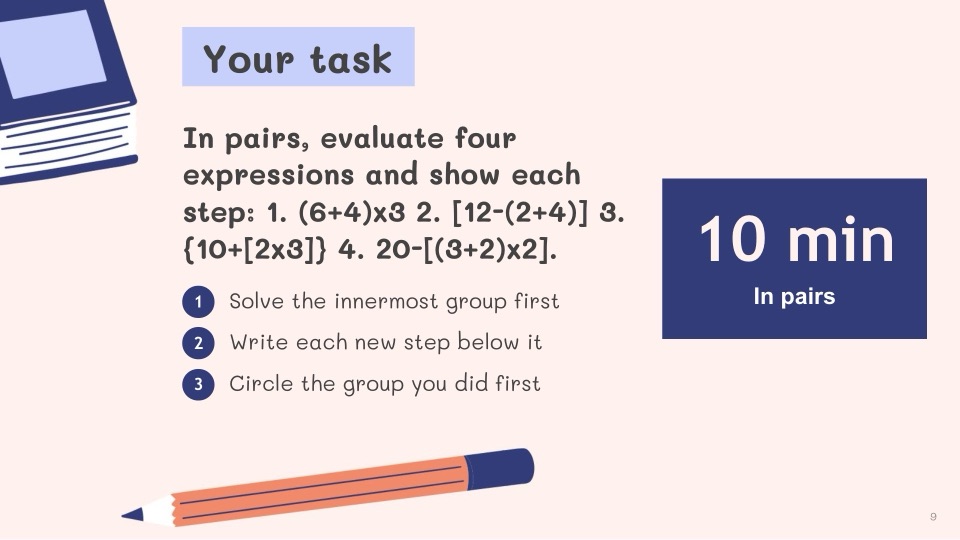
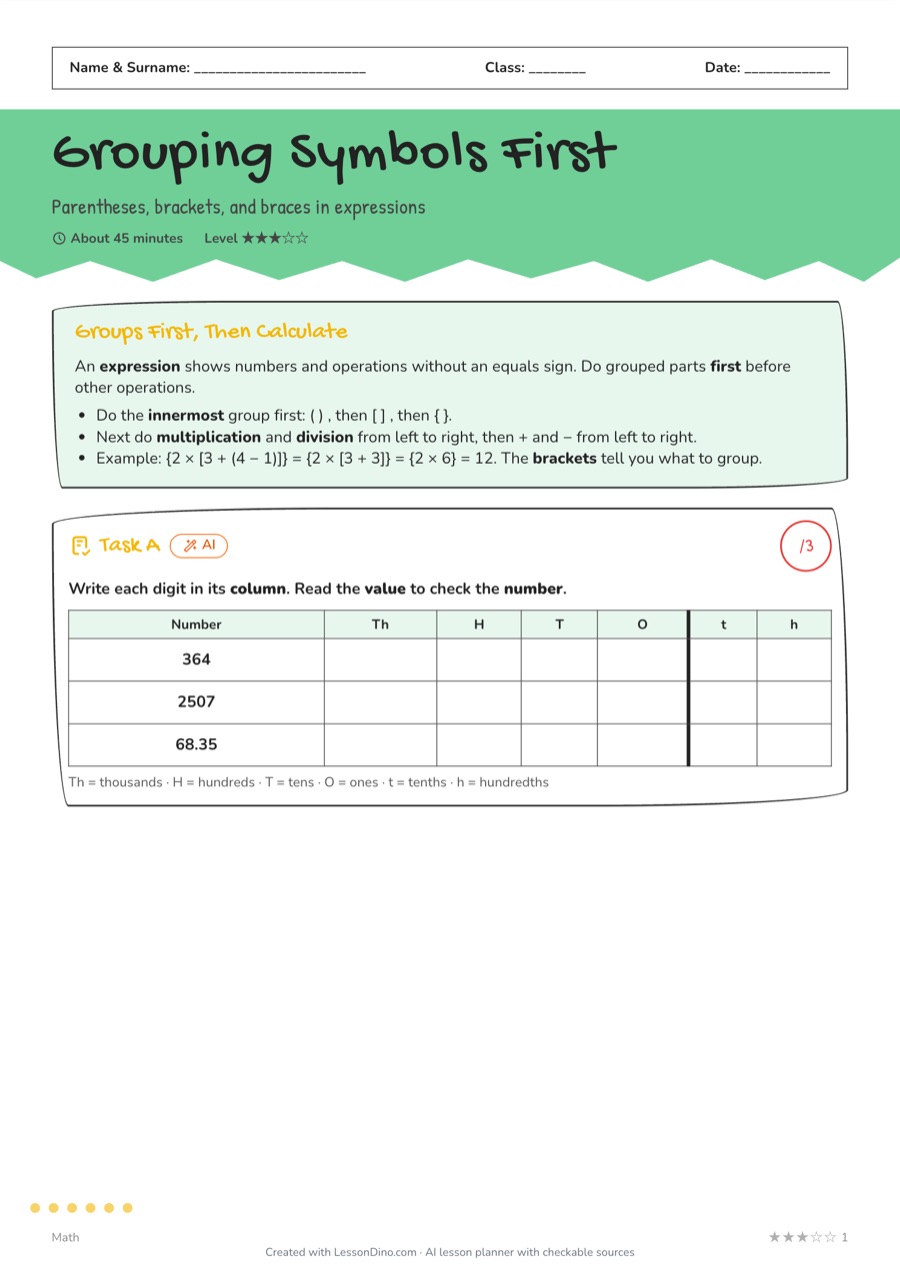
| 12 min | Practice in Pairs | Apply the inside-out method to evaluate grouped expressions. Show Slide 9 and set the task: solve innermost first, write each new step, circle first group. Hand out Worksheet Tasks B-C for paired practice with whole number operations. Circulate, asking pairs to point to the group they did first. Pick two pairs to read steps aloud for checking. |
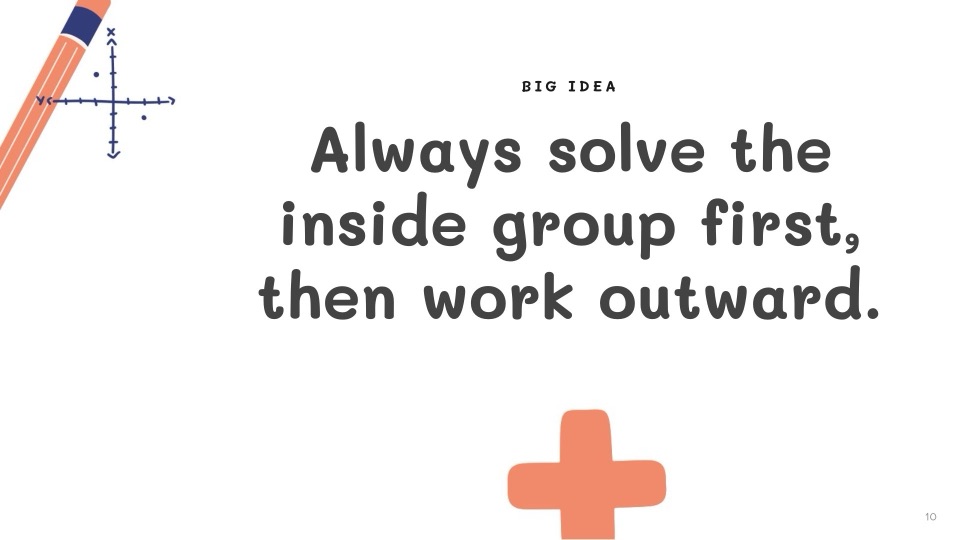
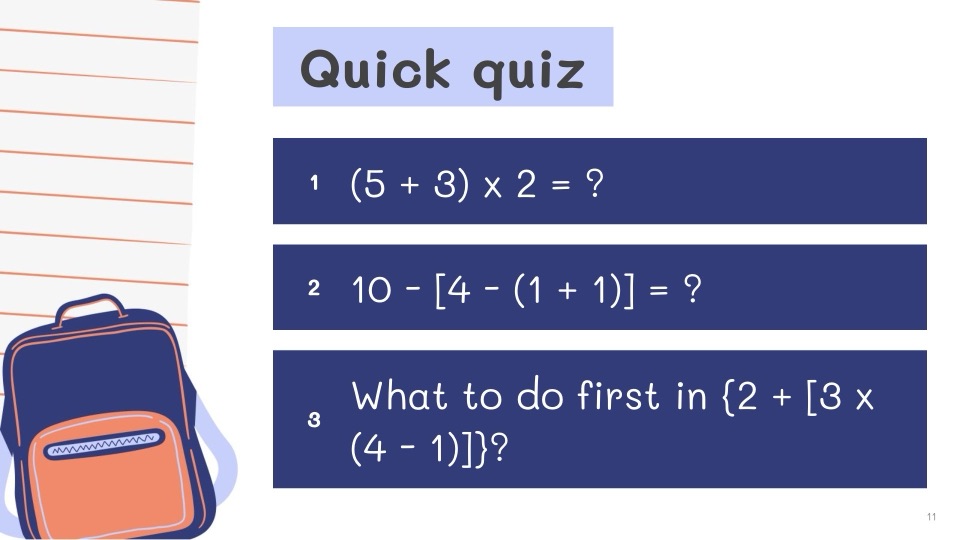
| 8 min | Plenary | Confirm students can evaluate expressions inside out. Show Slide 10 and have class read the big idea together. Show Slide 11 quiz one at a time for think-pair-share. Cold-call students to explain steps for 10 - [4 - (1 + 1)]. Link back to objectives and give exit ticket. |
Common mistakes
- Solving left to right and ignoring groups
How to spot it: Student does 2 + 3 first in 2 + 3 x 4 and gets 20
Cover all but the multiplication, solve it, then uncover. Groups and then x/÷ come before +/− - Solving the outer brackets or braces first
How to spot it: In {6 + [2 x (3 + 1)]} student tries [2 x 3] first
Ask which pair hugs numbers with nothing inside it. Only (3 + 1) qualifies, so do it first - Not rewriting the expression after each step
How to spot it: Steps jump from (4 - 1) to answer 12 with no middle [3 + 3]
Require write the new number back in and repeat until no groups are left
Support
- Give cards with the innermost step already highlighted in color.
- Provide a three-box frame labeled first, next, last for each expression.
Stretch
- Add a second operation inside, like [(2 + 3) x (4 - 1)].
- Ask students to place ( ) to make the largest possible answer and prove it.
Check questions
- (5 + 3) x 2 = ? Show first step.
Answer: 16; first step (5 + 3) = 8 - 10 - [4 - (1 + 1)] = ? Show steps.
Answer: 8; (1+1)=2, 4-2=2, 10-2=8 - What do you solve first in {2 + [3 x (4 - 1)]}?
Answer: (4 - 1)
Curriculum
Use parentheses, brackets, or braces in numerical expressions, and evaluate expressions with these symbols.
Video clips
Clips on YouTube, from the start and end times we chose. Check each one before you show it.
-
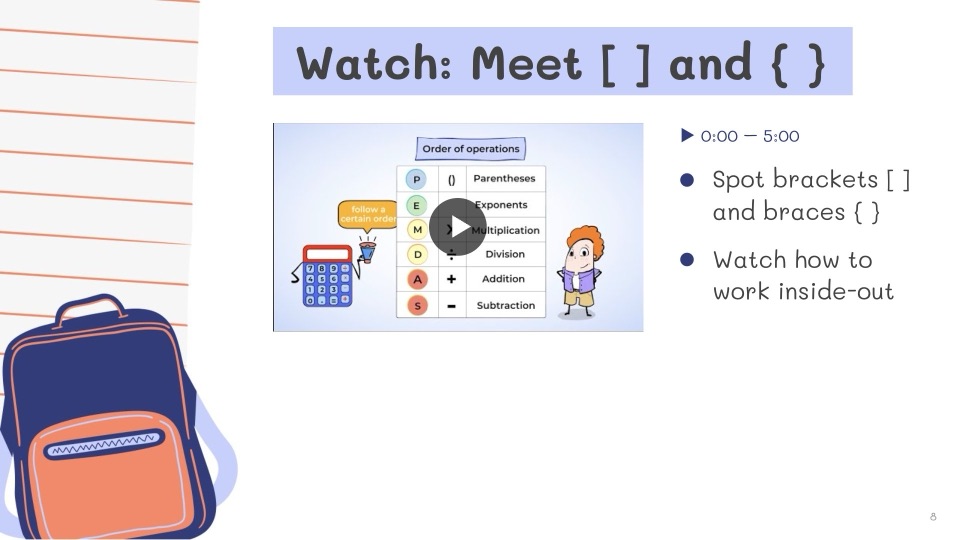
MightyOwl 5th grade PEMDAS from 0:00 to 5:00
MightyOwl: Learn Order of Operations — PEMDAS | MightyOwl Math | 5th Grade
Labeled for 5th grade and ideal pace and vocabulary for 10-11-year-olds learning grouping symbols.
-
Math Antics order of operations from 0:00 to 5:00
mathantics: Math Antics - Order Of Operations
Clear kid-friendly explainer with pace and humor that suits 10-11-year-olds in Grade 5.
Worksheet
Sources
- Grade 5 Math Curriculum - Fairfax County Public Schools fcps.edu
- Mathematics Grade 5 - Chicago Public Schools cps.edu
- General Order 2022 02 re Court Operations ctb.uscourts.gov
- Search Verified People by Job Title, Industry & Region | ZoomInfo zoominfo.com
- Order of battle of the United States Army ground forces in World War II : Pacific Theater of Operations : administrative and logistical commands, armies, corps, and divisions : United States. Departme archive.org
- Order - Wikipedia en.wikipedia.org
- order - Wiktionary, the free dictionary en.wiktionary.org
Picture credits
Made with Lesson Dino's AI on 17 October 2026. AI can make mistakes, so check facts against the sources before you teach.