The worksheet
About this worksheet
Students learn to multiply a fraction by a fraction and a whole number by a fraction. They draw overlap squares and match models to the multiply-across rule. This Grade 5 Math worksheet gives students (ages 10–11) six pages of practice on multiplying fractions, part of the number and operations—fractions unit. It goes with our free Multiplying fractions lesson, which has the slides and a timed lesson plan.
What it covers
By the end, students should be able to:
- Students will multiply a fraction by a fraction using an area model.
- Students will multiply a whole number by a fraction and explain the product.
- Students will simplify products to simplest form when possible.
How to use it
- Main Activity: Paint Overlap Squares (20 minutes): Circulate, check labels like 2/3 x 1/4 = 2/12, and prompt Worksheet Task B multiply-across items.
- Support: Start with 1/2 x 1/3 with halves and thirds to see 1 part out of 6.
- Stretch: Draw and solve 3/4 x 2/3 and explain how they know the total number of parts.
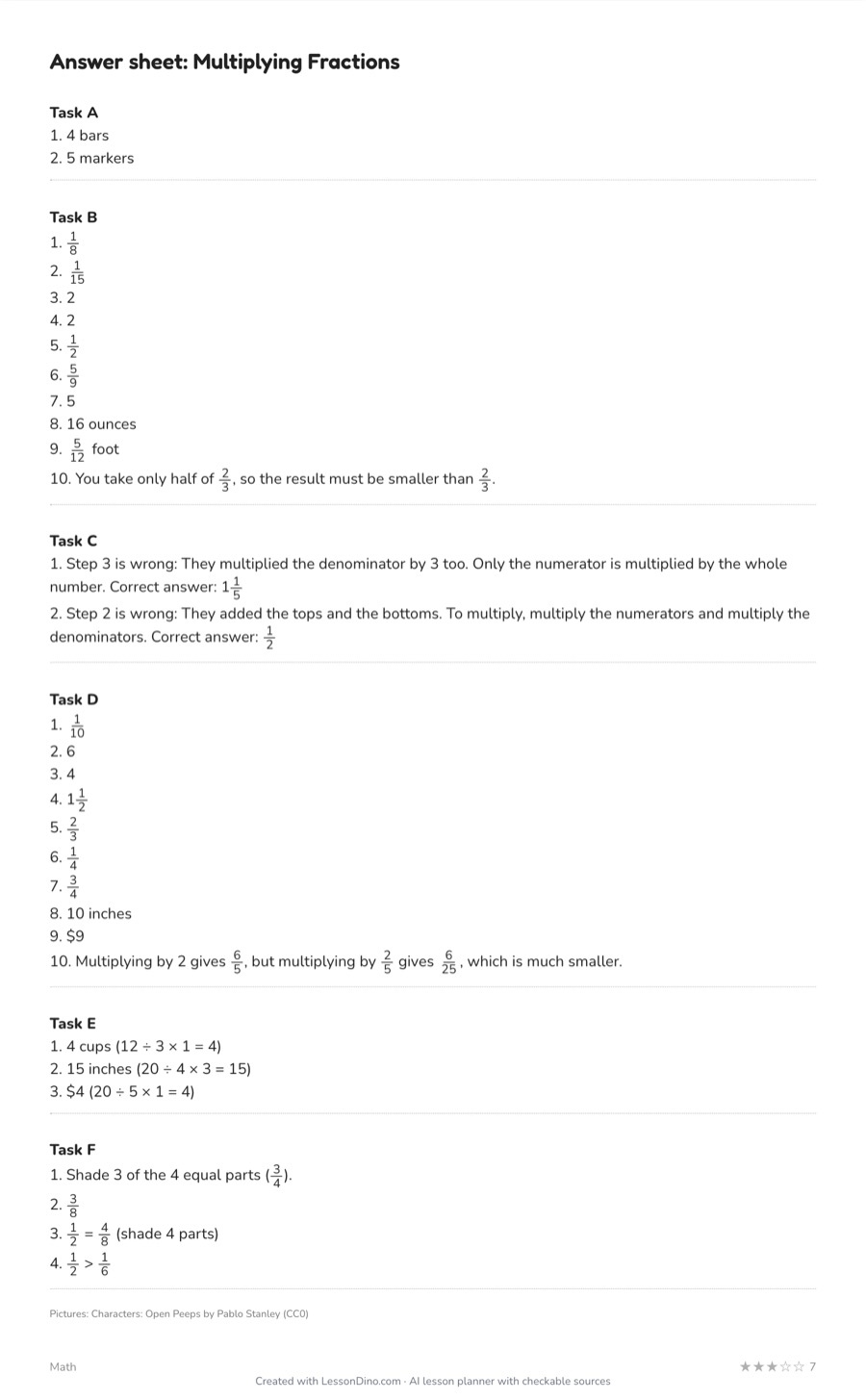
- The answer sheet is the last page, so you can print it on its own or let students check their own work.
Key vocabulary
- numerator: the top number that tells how many parts are counted
- denominator: the bottom number that tells how many equal parts make one whole
- product: the answer you get when you multiply two numbers
- area model: a rectangle drawing that shows overlap to find the answer
- simplify: make top and bottom smaller by dividing by the same number
Mistakes to watch for
- Finding a common denominator before multiplying. Remind that multiplying fractions does not need a common denominator; multiply straight across tops and bottoms.
- Multiplying both top and bottom by the whole number, for example 3/5 x 3 as 9/15. Show 3 as 3/1 and multiply only the numerator by 3, keeping the denominator the same.
- Adding tops and bottoms or simplifying incorrectly. Point to area model to count double-shaded parts over total parts, then divide top and bottom by the common factor, like 12/40 to 3/10.
What's on the worksheet
Multiply in 3 Steps
Learn the quick method, then picture it with bars.
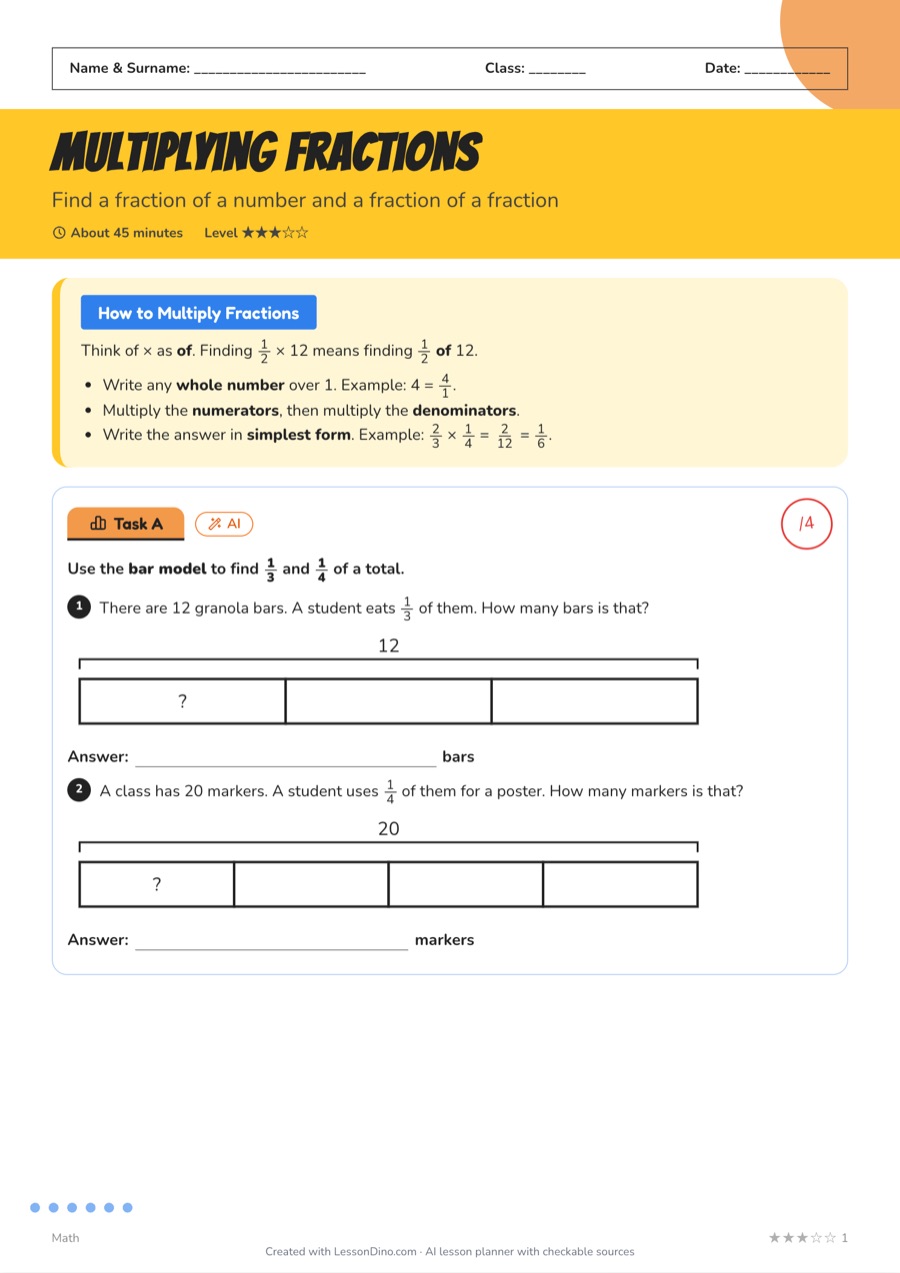
How to Multiply Fractions
- Think of × as of. Finding 1/2 × 12 means finding 1/2 of 12.
- Write any whole number over 1. Example: 4 = 4/1.
- Multiply the numerators, then multiply the denominators.
- Write the answer in simplest form. Example: 2/3 × 1/4 = 2/12 = 1/6.
Use the bar model to find 1/3 and 1/4 of a total.
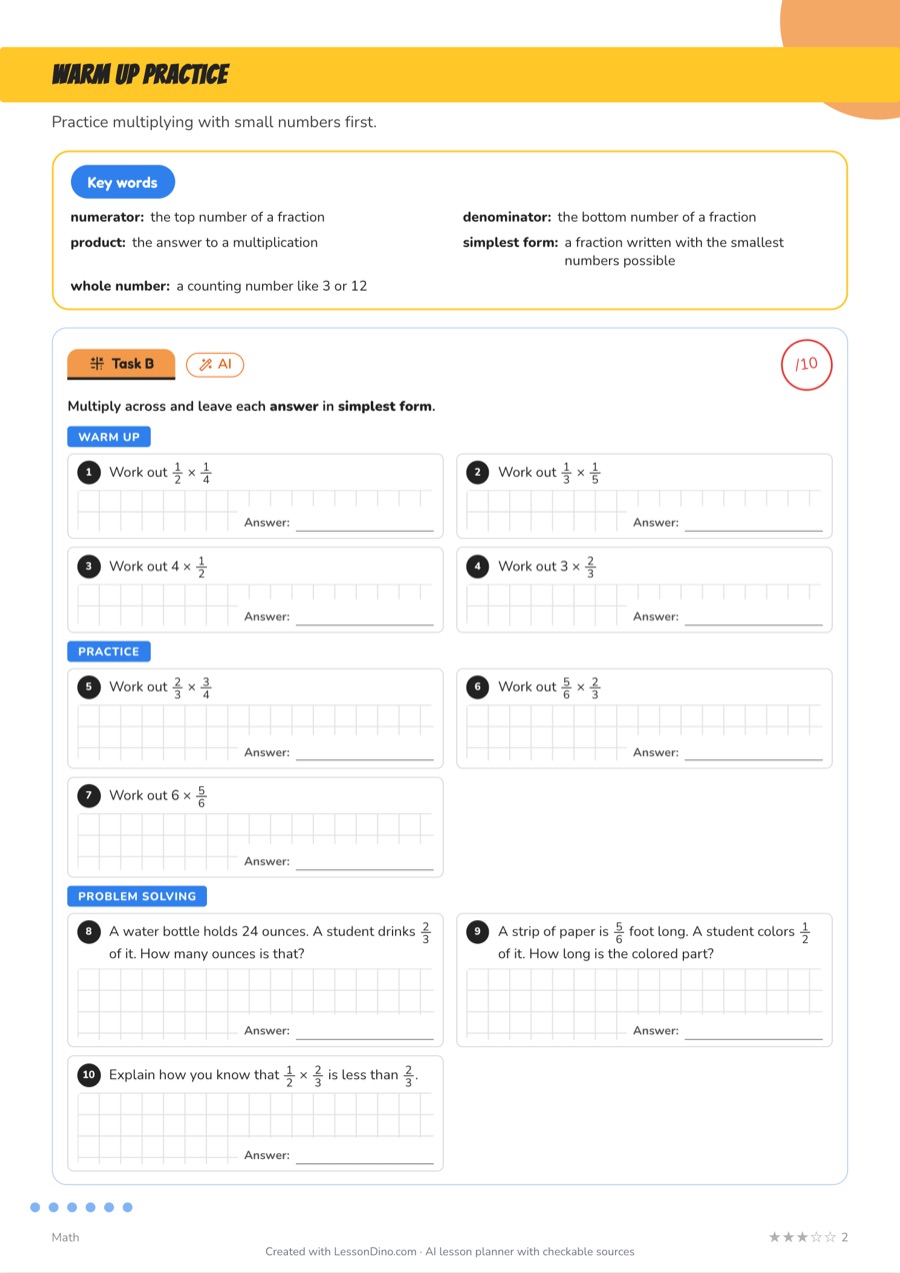
Warm Up Practice
Practice multiplying with small numbers first.
| Word | Meaning |
|---|---|
| numerator | the top number of a fraction |
| denominator | the bottom number of a fraction |
| product | the answer to a multiplication |
| simplest form | a fraction written with the smallest numbers possible |
| whole number | a counting number like 3 or 12 |
Multiply across and leave each answer in simplest form.
Warm up
- Work out 1/2 × 1/4
- Work out 1/3 × 1/5
- Work out 4 × 1/2
- Work out 3 × 2/3
Practice
- Work out 2/3 × 3/4
- Work out 5/6 × 2/3
- Work out 6 × 5/6
Problem solving
- A water bottle holds 24 ounces. A student drinks 2/3 of it. How many ounces is that?
- A strip of paper is 5/6 foot long. A student colors 1/2 of it. How long is the colored part?
- Explain how you know that 1/2 × 2/3 is less than 2/3.
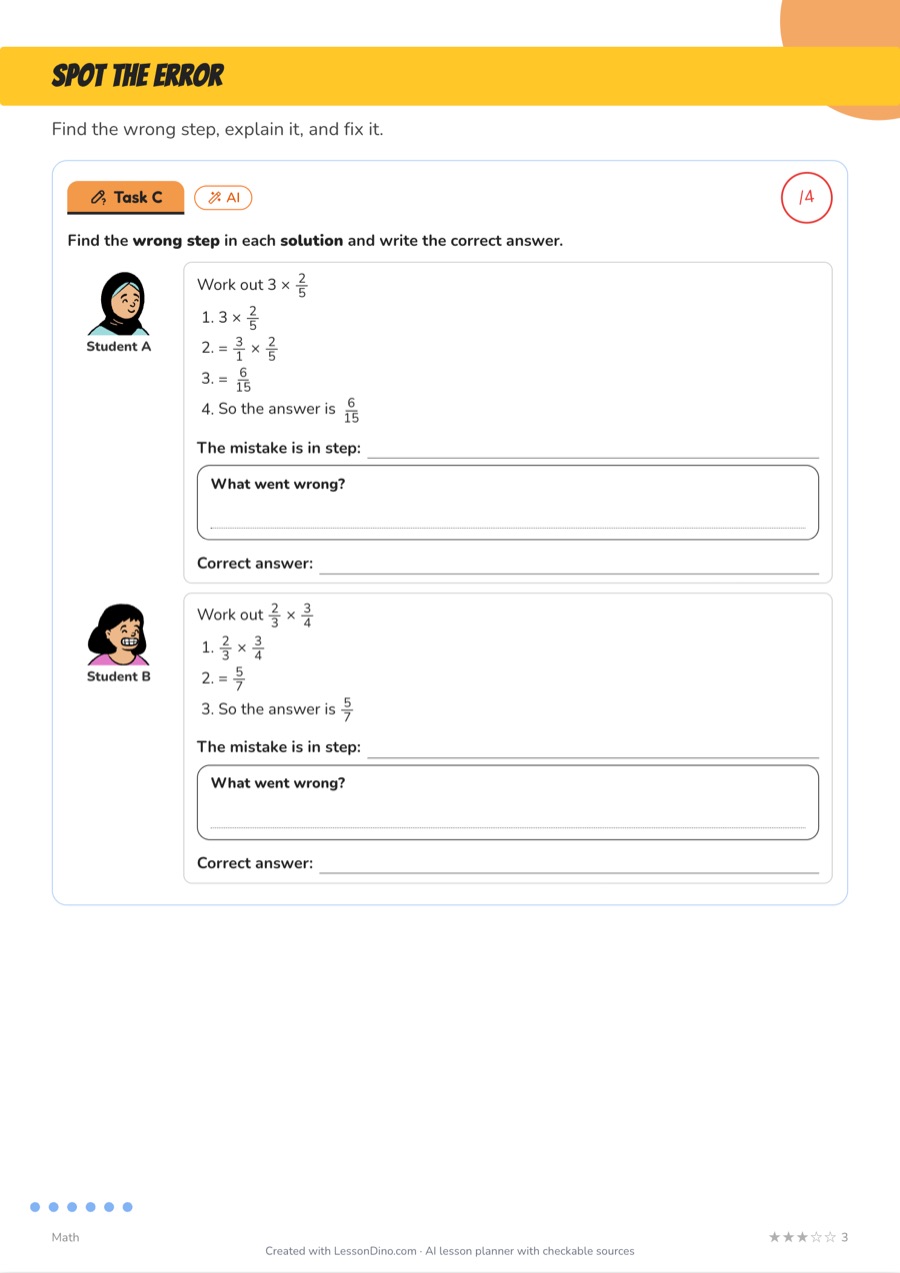
Spot the Error
Find the wrong step, explain it, and fix it.
Find the wrong step in each solution and write the correct answer.
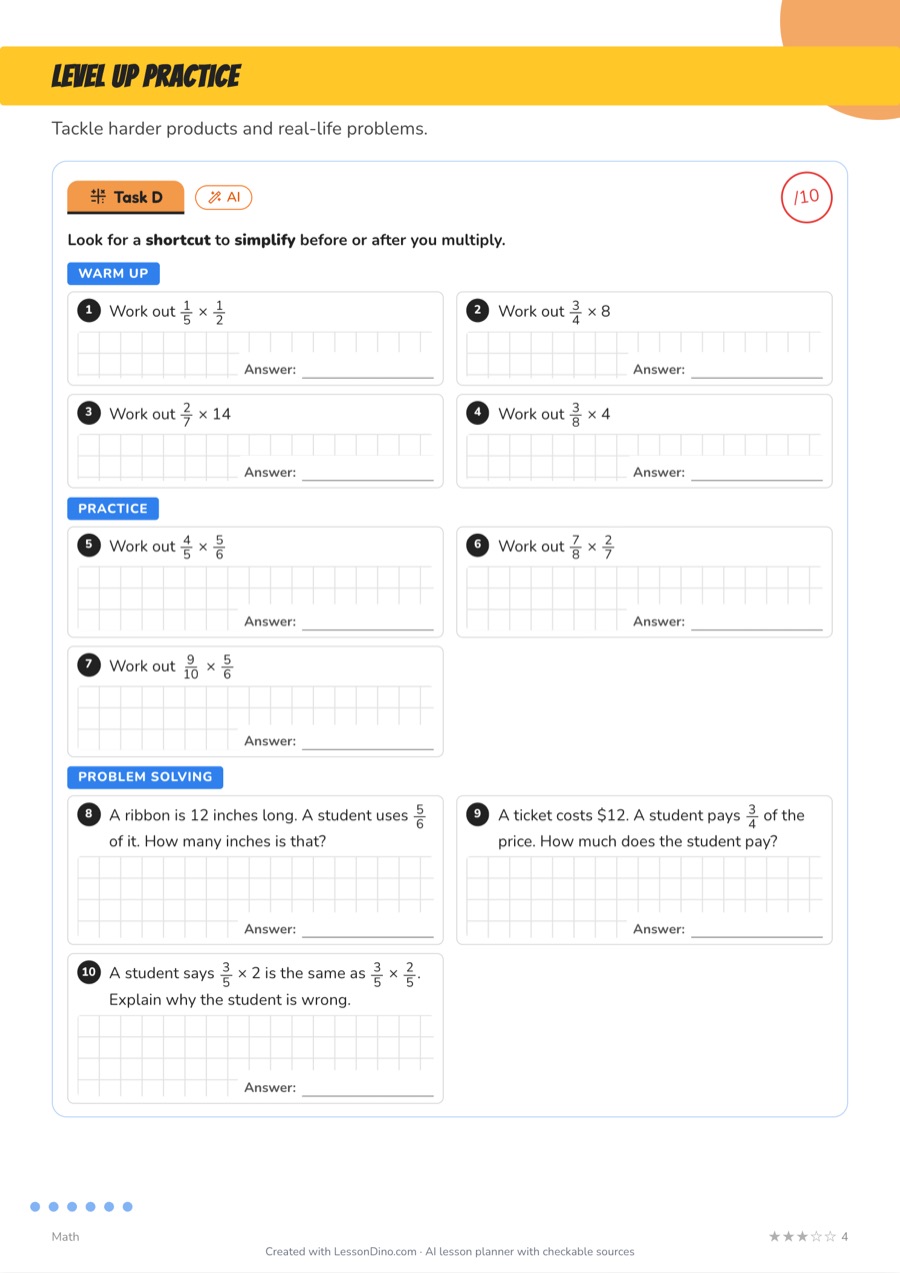
Level Up Practice
Tackle harder products and real-life problems.
Look for a shortcut to simplify before or after you multiply.
Warm up
- Work out 1/5 × 1/2
- Work out 3/4 × 8
- Work out 2/7 × 14
- Work out 3/8 × 4
Practice
- Work out 4/5 × 5/6
- Work out 7/8 × 2/7
- Work out 9/10 × 5/6
Problem solving
- A ribbon is 12 inches long. A student uses 5/6 of it. How many inches is that?
- A ticket costs $12. A student pays 3/4 of the price. How much does the student pay?
- A student says 3/5 × 2 is the same as 3/5 × 2/5. Explain why the student is wrong.
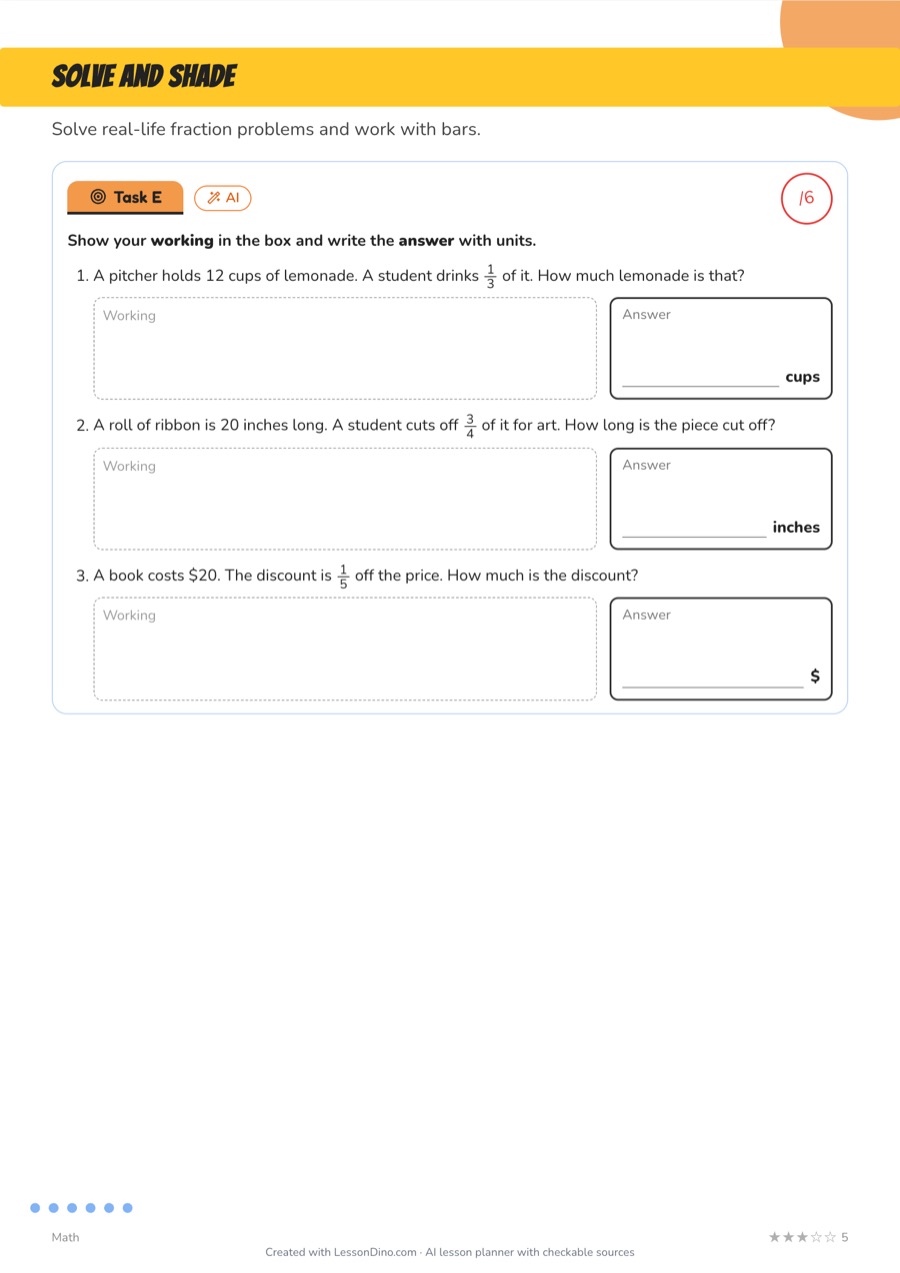
Solve and Shade
Solve real-life fraction problems and work with bars.
Show your working in the box and write the answer with units.
Page 6
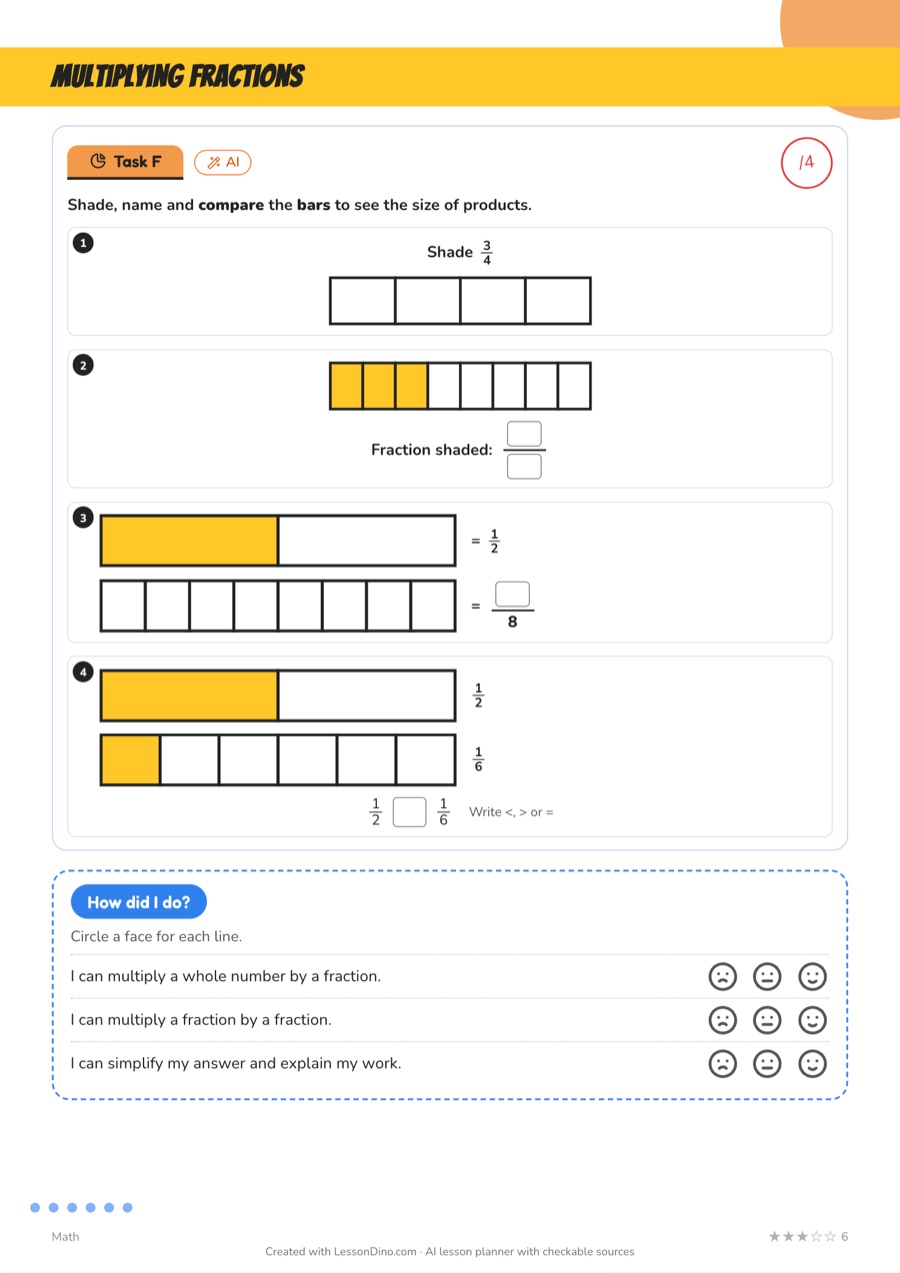
Shade, name and compare the bars to see the size of products.
Answers
Show the answers
- Work out 1/2 × 1/4 1/8
- Work out 1/3 × 1/5 1/15
- Work out 4 × 1/2 2
- Work out 3 × 2/3 2
- Work out 2/3 × 3/4 1/2
- Work out 5/6 × 2/3 5/9
- Work out 6 × 5/6 5
- A water bottle holds 24 ounces. A student drinks 2/3 of it. How many ounces is that? 16 ounces
- A strip of paper is 5/6 foot long. A student colors 1/2 of it. How long is the colored part? 5/12 foot
- Explain how you know that 1/2 × 2/3 is less than 2/3. You take only half of 2/3, so the result must be smaller than 2/3.
- Work out 1/5 × 1/2 1/10
- Work out 3/4 × 8 6
- Work out 2/7 × 14 4
- Work out 3/8 × 4 1 1/2
- Work out 4/5 × 5/6 2/3
- Work out 7/8 × 2/7 1/4
- Work out 9/10 × 5/6 3/4
- A ribbon is 12 inches long. A student uses 5/6 of it. How many inches is that? 10 inches
- A ticket costs $12. A student pays 3/4 of the price. How much does the student pay? $9
- A student says 3/5 × 2 is the same as 3/5 × 2/5. Explain why the student is wrong. Multiplying by 2 gives 6/5, but multiplying by 2/5 gives 6/25, which is much smaller.
- A pitcher holds 12 cups of lemonade. A student drinks 1/3 of it. How much lemonade is that? 4 cups
- A roll of ribbon is 20 inches long. A student cuts off 3/4 of it for art. How long is the piece cut off? 15 inches
- A book costs $20. The discount is 1/5 off the price. How much is the discount? $4
The answer sheet is the last picture above.
Curriculum
Apply and extend previous understandings of multiplication to multiply a fraction or whole number by a fraction.
Made with Lesson Dino's AI on 17 October 2026. AI can make mistakes, so check the answers and facts against the sources before you teach.