Slides


Lesson plan
Finding a Fraction of a Fraction
Students learn to multiply a fraction by a fraction and a whole number by a fraction. They draw overlap squares and match models to the multiply-across rule.
Objectives
- Students will multiply a fraction by a fraction using an area model.
- Students will multiply a whole number by a fraction and explain the product.
- Students will simplify products to simplest form when possible.
Success criteria
- I can draw and solve a fraction of a fraction.
- I can show a whole number times a fraction with a model.
- I can multiply tops and bottoms and simplify the answer.
Key words
| Word | Meaning |
|---|---|
| numerator | the top number that tells how many parts are counted |
| denominator | the bottom number that tells how many equal parts make one whole |
| product | the answer you get when you multiply two numbers |
| area model | a rectangle drawing that shows overlap to find the answer |
| simplify | make top and bottom smaller by dividing by the same number |
Timed plan (60 minutes)
| Time | Stage | What happens |
|---|---|---|
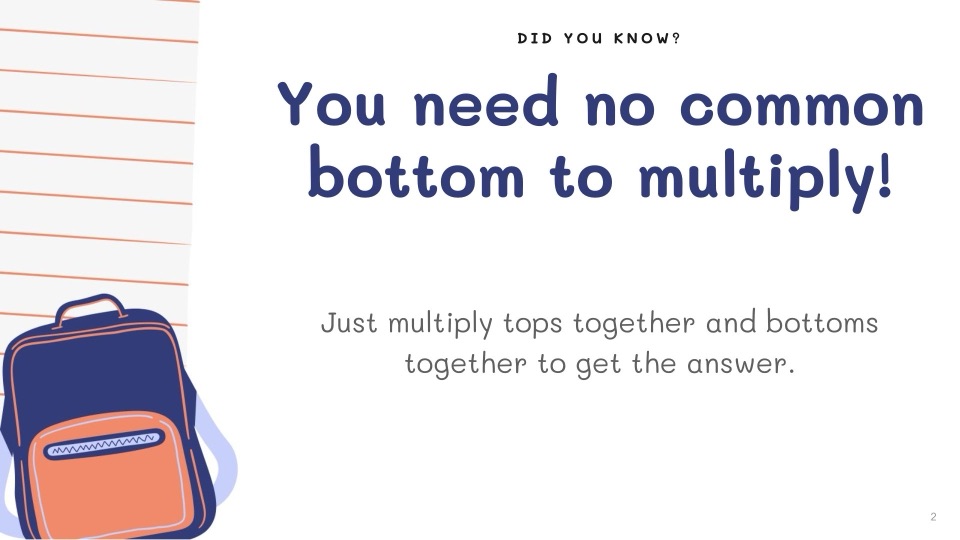
| 5 min | Starter | Connect adding to multiplying and hook students with the paint overlap question. Show Slide 1 Times a Fraction: Finding a part of a part and read the title together. Ask the hook: What happens if you paint one fraction right on top of another fraction? Show Slide 2 Did you know? You need no common bottom to multiply and stress no same bottom is needed to multiply. Show Slide 3 Big idea: Multiplying a fraction means finding a fraction of something and have students repeat it. |
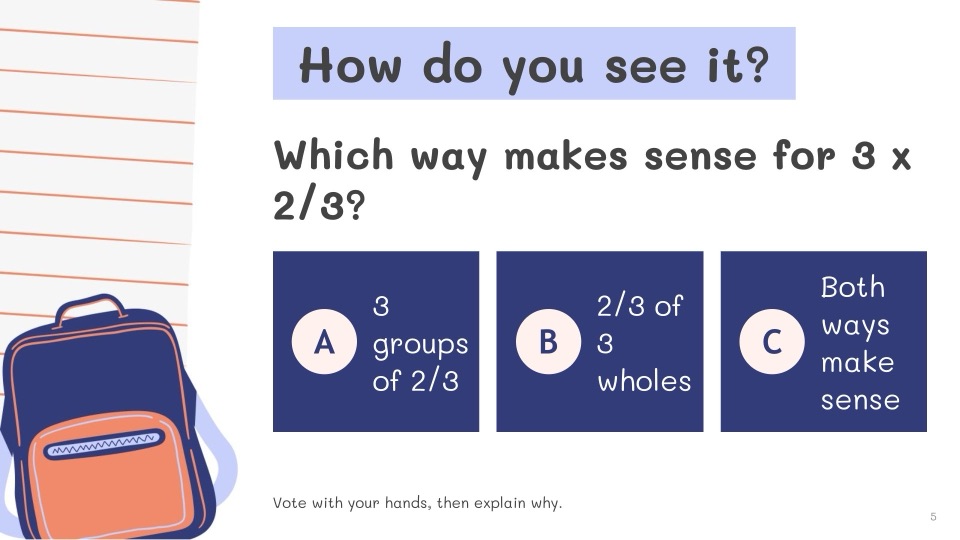
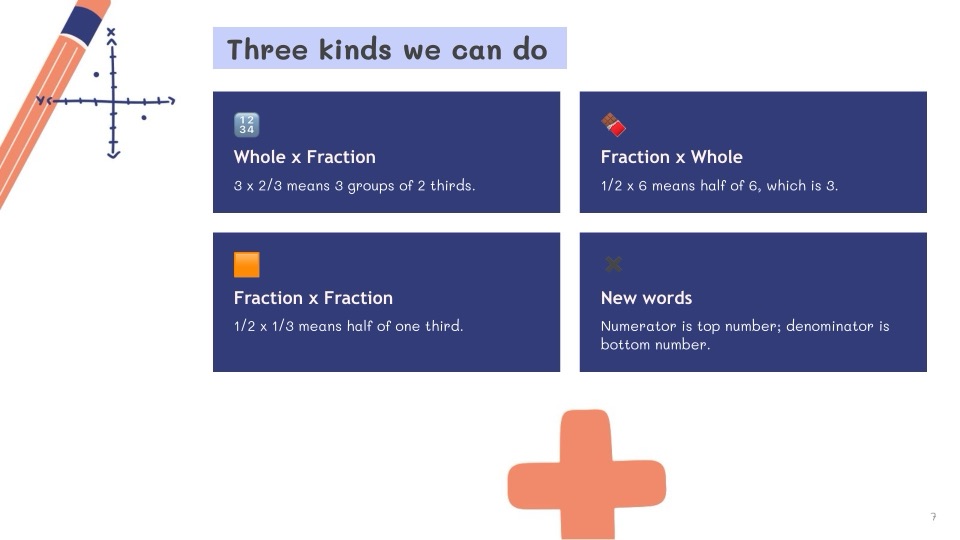
| 10 min | Teaching: Whole Number Times Fraction | Explain whole-number by fraction as groups and as a fraction of a whole. Show Slide 5 How do you see it? Which way makes sense for 3 x 2/3 and take a vote. Model 2/3 x 6 as 6 copies of two-thirds, which makes 12 thirds or 4 wholes. Show Slide 7 Three kinds we can do and point to Whole x Fraction and Fraction x Whole cards. Write 6 as 6/1 so 2/3 x 6 is the same as 2/3 x 6/1, then multiply the numerator by the whole number and keep the same denominator. |
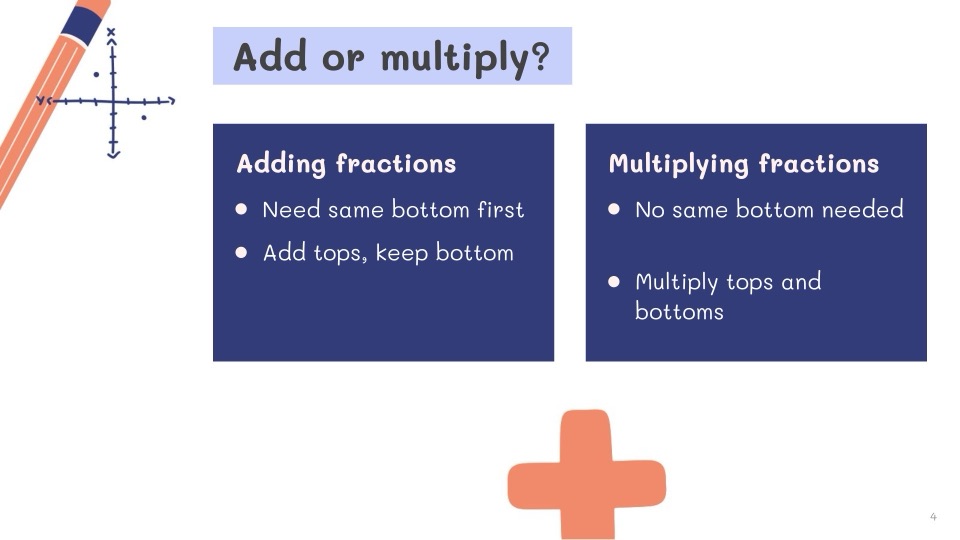
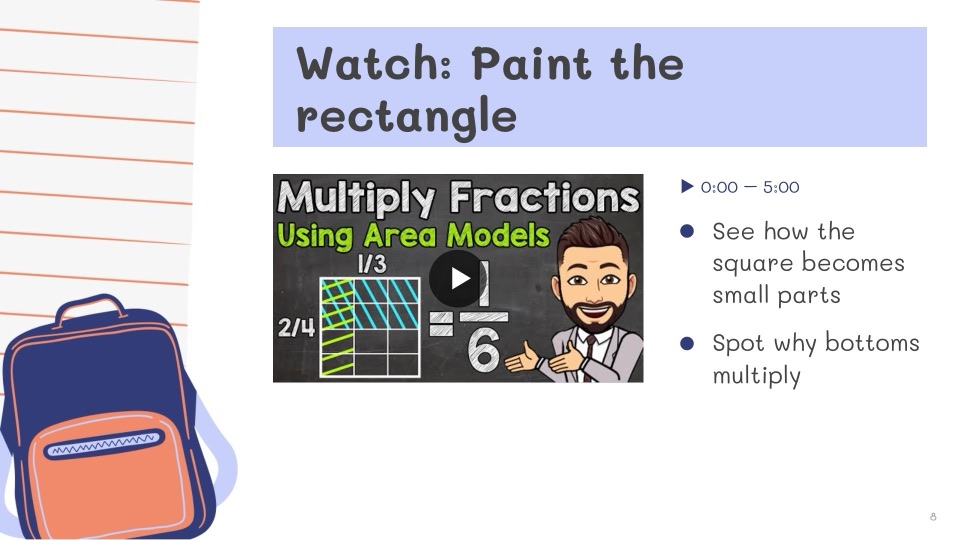
| 12 min | Teaching: Fraction Times Fraction | Show how an overlap square proves the multiply-across rule. Show Slide 4 Add or multiply? and contrast adding, which needs the same bottom first, with multiplying, which needs no same bottom. Play Video clip 5 (0:00–5:00) on Slide 8 Watch: Paint the rectangle and tell students to watch where the two shades overlap and listen for tops times tops. Model 2/3 x 1/4 on the demo square: shade two-thirds one color, one-fourth the other color, and point to the 2 overlap parts out of 12 total parts. Write the rule that to multiply fractions you multiply the top numbers for the numerator and the bottom numbers for the denominator. |
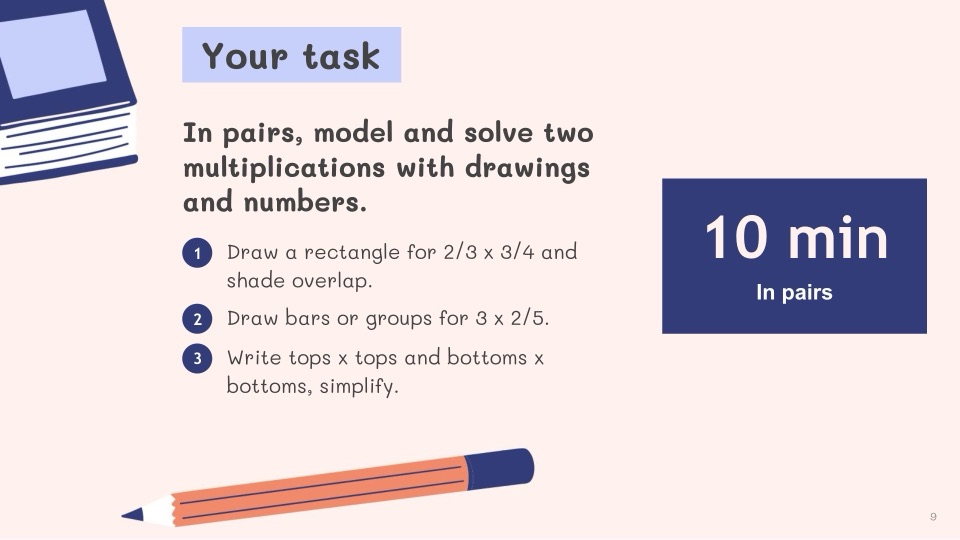
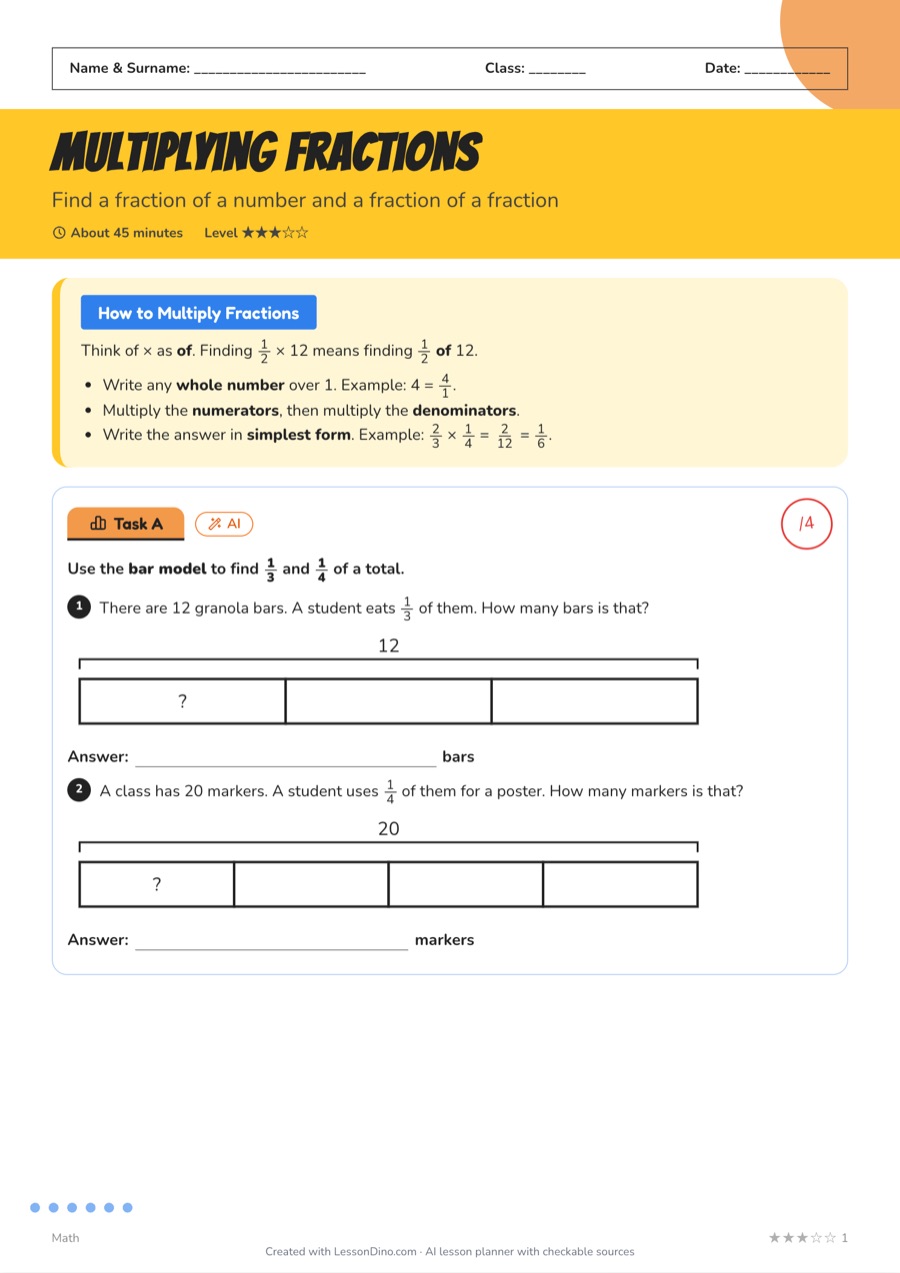
| 20 min | Main Activity: Paint Overlap Squares | Practice multiplying fraction by fraction with area models and whole number by fraction with bars. Hand out grid paper, colored pencils, and rulers and show Slide 9 Your task. Demo the steps: draw a 1-unit square, divide into thirds one way and fourths the other way, shade two-thirds, shade one-fourth, outline overlap. Direct pairs to complete the square for 2/3 x 3/4, then draw bars or groups for 3 x 2/5 and write tops x tops and bottoms x bottoms and simplify. Circulate, check labels like 2/3 x 1/4 = 2/12, and prompt Worksheet Task B multiply-across items. |
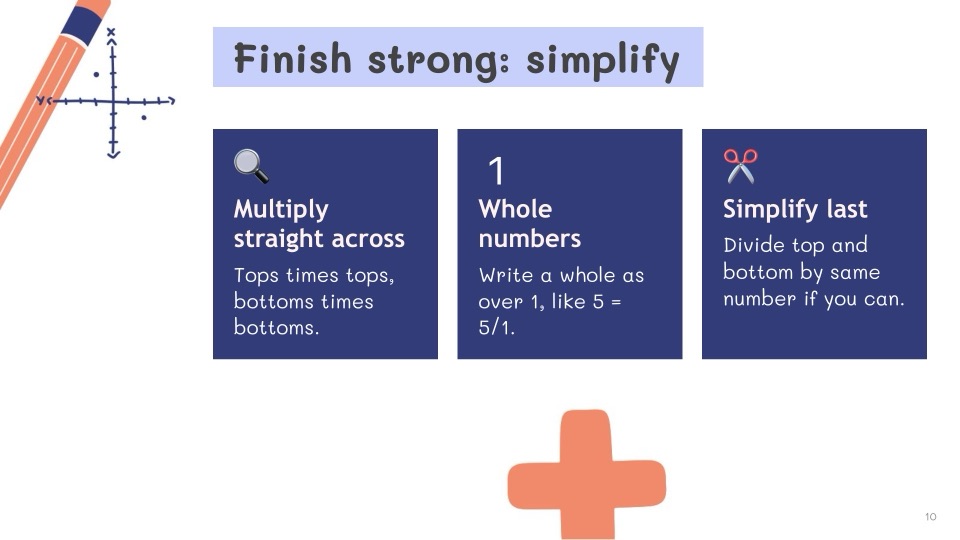
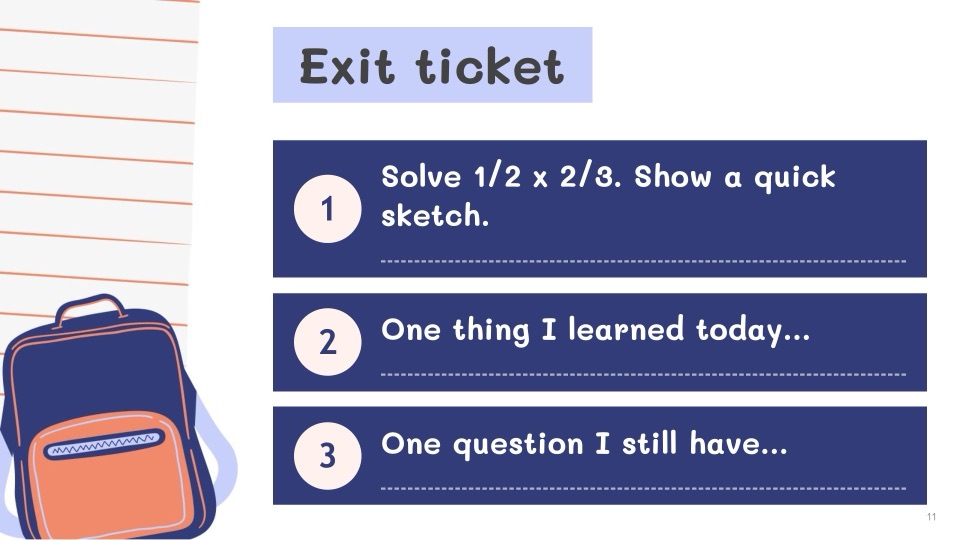
| 13 min | Plenary: Simplify and Exit | Review simplifying and check both kinds of multiplication. Show Slide 10 Finish strong: simplify and read the three cards together. Model 4/5 x 3/8: multiply numerators and denominators to get 12/40, then divide top and bottom by 4 to get 3/10. Show Slide 11 Exit ticket and give time for Solve 1/2 x 2/3 with a quick sketch. Collect exits and preview that finding a fraction of something is multiplying. |
Common mistakes
- Finding a common denominator before multiplying
How to spot it: Work shows changed fractions like 1/2 x 1/3 changed to 3/6 x 2/6
Remind that multiplying fractions does not need a common denominator; multiply straight across tops and bottoms. - Multiplying both top and bottom by the whole number, for example 3/5 x 3 as 9/15
How to spot it: Bottom changes from 5 to 15 in a whole-number problem
Show 3 as 3/1 and multiply only the numerator by 3, keeping the denominator the same. - Adding tops and bottoms or simplifying incorrectly
How to spot it: Answer like 1/2 x 2/5 = 3/7 or unsimplified 12/40 left without dividing
Point to area model to count double-shaded parts over total parts, then divide top and bottom by the common factor, like 12/40 to 3/10.
Support
- Start with 1/2 x 1/3 with halves and thirds to see 1 part out of 6.
- Use pre-split bars and counters in 3 boxes to show whole-number problems.
Stretch
- Draw and solve 3/4 x 2/3 and explain how they know the total number of parts.
- Create matches that need simplifying and show both products, like 12/40 and 3/10.
Check questions
- Solve 1/2 x 2/3. Show a quick sketch.
Answer: 2/6 = 1/3. Rectangle split into halves and thirds shows 2 overlap parts out of 6. - Solve 3 x 2/5. Show how you wrote the whole number.
Answer: 3 = 3/1, so 6/5 or 1 1/5. - Why do you multiply bottoms when you multiply fractions?
Answer: Splitting one way and the other way makes new small equal parts; bottoms multiply to give the total.
Curriculum
Apply and extend previous understandings of multiplication to multiply a fraction or whole number by a fraction.
Video clips
Clips on YouTube, from the start and end times we chose. Check each one before you show it.
-
Visualizing fraction times fraction from 0:00 to 4:57
Khan Academy: Multiplying fractions: visualizing | Fractions | 5th grade | Khan Academy
Made for 5th grade and uses bar visuals at the right pace for 10-11-year-olds learning fraction-by-fraction multiplication.
-
Area models for multiplying fractions from 0:00 to 5:00
Math with Mr. J: Multiplying Fractions Using Area Models | Math with Mr. J
Uses area models to build conceptual understanding at exactly the right level for 10-11-year-olds in Grade 5.
Worksheet
Sources
- Grade 5 | Common Core State Standards Initiative thecorestandards.org
- Grade 5 Math Curriculum - Fairfax County Public Schools fcps.edu
- Multiplying Fractions | Learning Blocks | University of Arkansas learningblocks.uark.edu
- Multiplying Fractions - ResourceCenter resourcecenter.byupathway.edu
- Multiplying Fractions – Mathematics for Elementary Teachers open.maricopa.edu
- Math Foundations: Fractions - Multiplication and Division ... studentsuccess.temple.edu
- Multiplying Fractions - University of North Georgia ung.edu
- Multiplying Fractions - Brigham Young University–Idaho content.byui.edu
- How to multiply fractions - BBC Bitesize bbc.co.uk
- Learn how to multiply fractions – KS3 Maths – BBC Bitesize bbc.co.uk
- Kids Math: Multiplying and Dividing Fractions - Ducksters ducksters.com
- Multiplying Fractions – Mathematics for Elementary Teachers pressbooks-dev.oer.hawaii.edu
- Multiplying and dividing fractions - Fractions - Edexcel - GCSE … bbc.com
- Flexi answers - How do you multiple fractions? | CK-12 Foundation ck12.org
- Multiplying Fractions Calculator, Mixed Fractions with Examples … edume.org
- Multiplying Fractions Calculator omnicalculator.com
- The Magic of Multiplying Fractions: A Kid's Guide / Learning ... learningcorner.co
- Multiplying Fractions - Math is Fun mathsisfun.com
- How to Teach Multiplying Fractions so Students Actually ... educatewithease.com
- Multiplying Fractions – Definition, Steps, Properties, Example brighterly.com
- Multiplying Fractions by Fractions Math Videos for Kids ... generationgenius.com
- How to Multiply Fractions is Explained and Exampled digitmath.com
- 5.1: Multiplying fractions – Mathematics For Elementary Education I openwa.pressbooks.pub
- Multiplying Fractions | Mathematics for the Liberal Arts Corequisite courses.lumenlearning.com
- Multiplying Fractions – Math for Trades pressbooks.bccampus.ca
Made with Lesson Dino's AI on 17 October 2026. AI can make mistakes, so check facts against the sources before you teach.