The worksheet
About this worksheet
Students learn to fluently multiply multi-digit whole numbers with the standard algorithm. They practice place value steps, then race in teams to solve and check products. This Grade 5 Math worksheet gives students (ages 10–11) five pages of practice on multi-digit multiplication, part of the number and operations in base ten unit. It goes with our free Multi-digit multiplication lesson, which has the slides and a timed lesson plan.
What it covers
By the end, students should be able to:
- Students will fluently multiply 2-digit by 2-digit numbers using the standard algorithm.
- Students will multiply 3-digit by 2-digit numbers using regrouping and place value.
- Students will use estimation with round numbers to check if products are reasonable.
How to use it
- Guided practice (10 minutes): Hand out Worksheet Task A and show the 4 steps again.
- Support: Allow a basic facts chart so students can focus on the steps and place value, not fact recall.
- Stretch: Add a challenge station with 245 x 32 and ask teams to estimate first, then solve exactly.
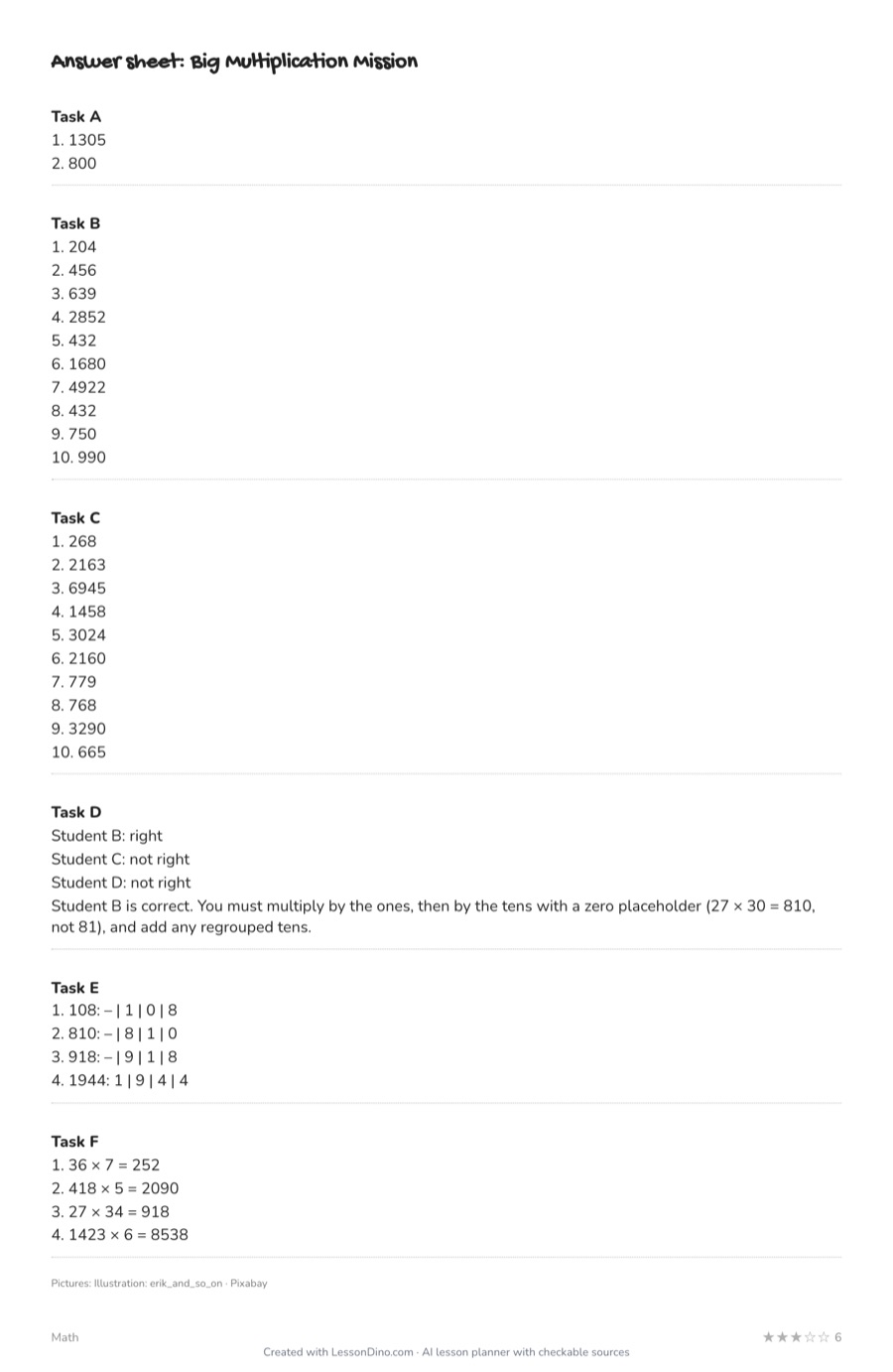
- The answer sheet is the last page, so you can print it on its own or let students check their own work.
Key vocabulary
- factor: a number that is multiplied by another number
- product: the answer you get after multiplying numbers together
- regroup: to trade 10 ones for 1 ten in the next spot
- placeholder zero: a 0 in the second row that keeps every digit in the correct spot
- estimate: a close guess using round numbers to check if an answer makes sense
- standard algorithm: a short stacked way to multiply using place value
Mistakes to watch for
- Missing placeholder zero in the second row. Write 0 first in row two, then multiply by tens, because it is 20 x 36 not 2 x 36.
- Forgotten regroup to the next place. Write the carry above the next digit and add it after multiplying.
- Misaligned digits and wrong final addition. Line up digits neatly by place on grid paper and add column by column.
What's on the worksheet
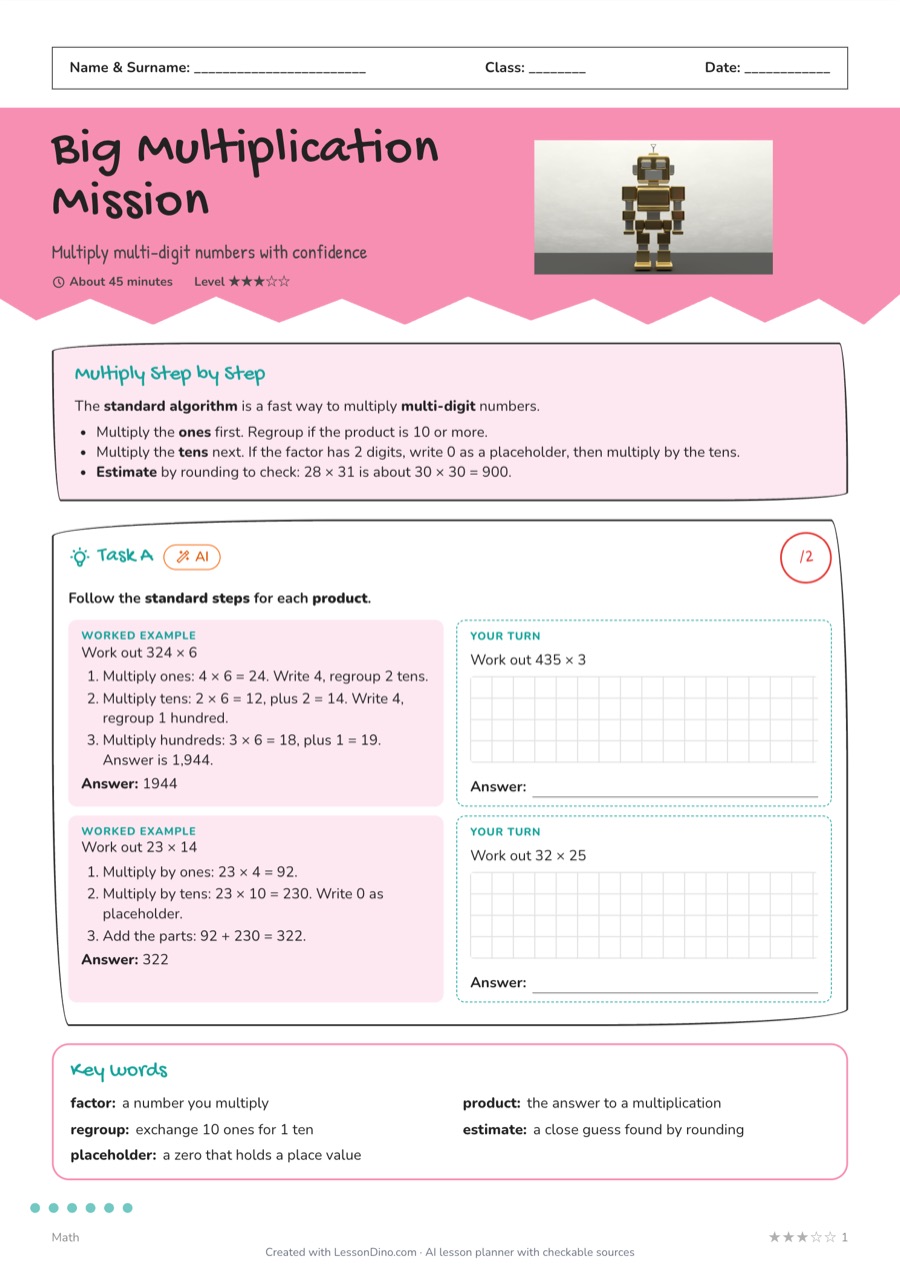
Multiply Big Numbers!
Learn the steps for the standard algorithm.
Multiply Step by Step
- The standard algorithm is a fast way to multiply multi-digit numbers.
- Multiply the ones first. Regroup if the product is 10 or more.
- Multiply the tens next. If the factor has 2 digits, write 0 as a placeholder, then multiply by the tens.
- Estimate by rounding to check: 28 × 31 is about 30 × 30 = 900.
Follow the standard steps for each product.
| Word | Meaning |
|---|---|
| factor | a number you multiply |
| product | the answer to a multiplication |
| regroup | exchange 10 ones for 1 ten |
| estimate | a close guess found by rounding |
| placeholder | a zero that holds a place value |
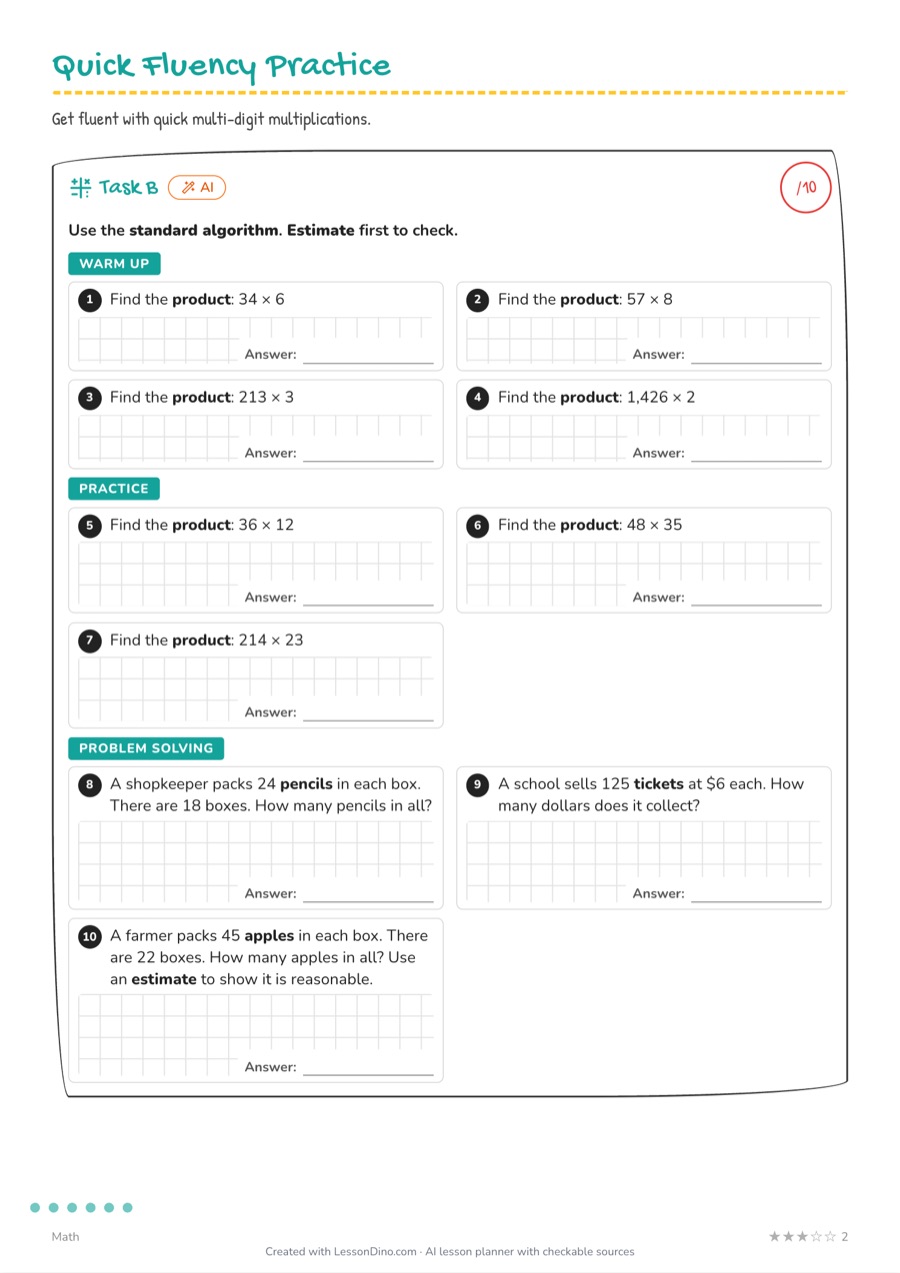
Quick Fluency Practice
Get fluent with quick multi-digit multiplications.
Use the standard algorithm. Estimate first to check.
Warm up
- Find the product: 34 × 6
- Find the product: 57 × 8
- Find the product: 213 × 3
- Find the product: 1,426 × 2
Practice
- Find the product: 36 × 12
- Find the product: 48 × 35
- Find the product: 214 × 23
Problem solving
- A shopkeeper packs 24 pencils in each box. There are 18 boxes. How many pencils in all?
- A school sells 125 tickets at $6 each. How many dollars does it collect?
- A farmer packs 45 apples in each box. There are 22 boxes. How many apples in all? Use an estimate to show it is reasonable.
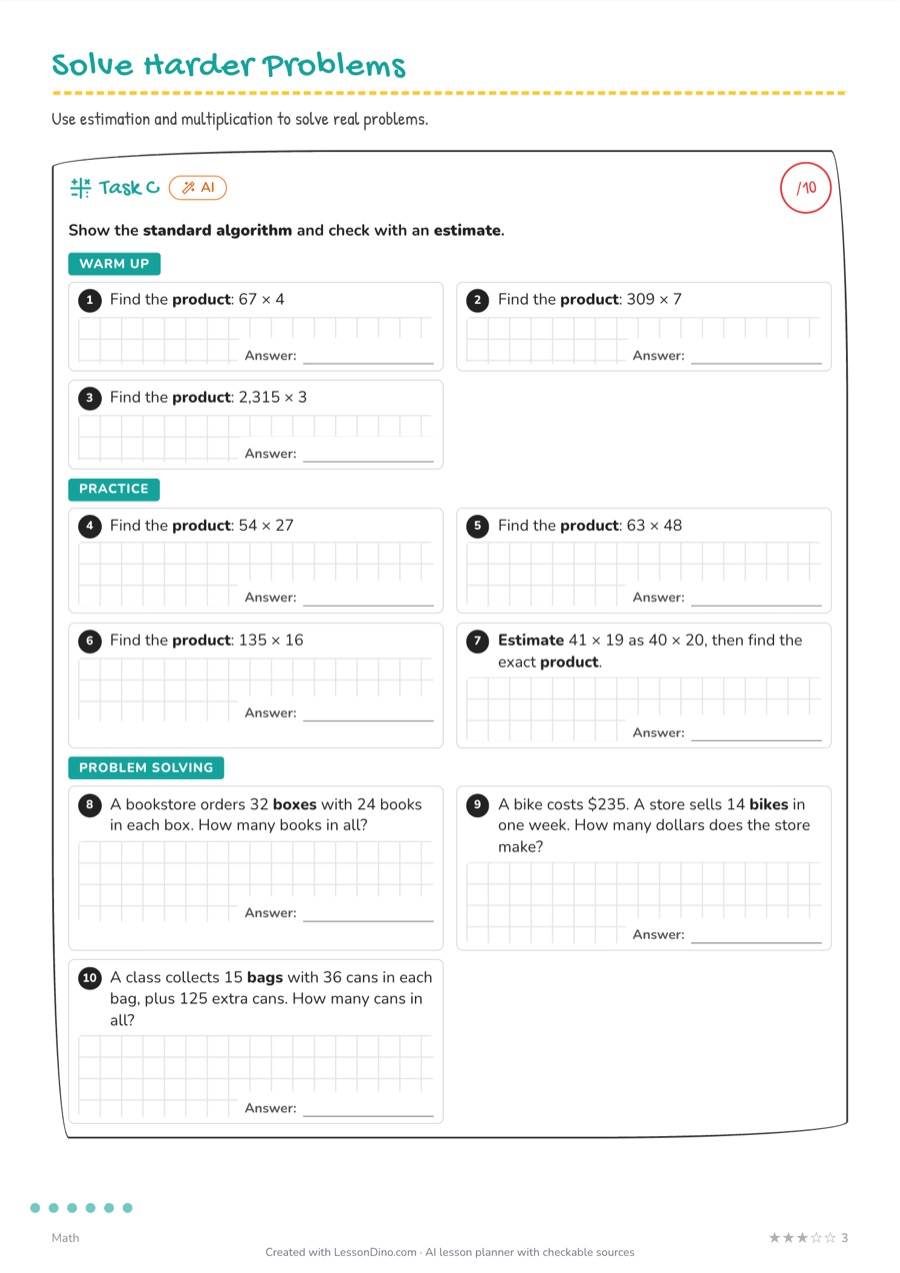
Solve Harder Problems
Use estimation and multiplication to solve real problems.
Show the standard algorithm and check with an estimate.
Warm up
- Find the product: 67 × 4
- Find the product: 309 × 7
- Find the product: 2,315 × 3
Practice
- Find the product: 54 × 27
- Find the product: 63 × 48
- Find the product: 135 × 16
- Estimate 41 × 19 as 40 × 20, then find the exact product.
Problem solving
- A bookstore orders 32 boxes with 24 books in each box. How many books in all?
- A bike costs $235. A store sells 14 bikes in one week. How many dollars does the store make?
- A class collects 15 bags with 36 cans in each bag, plus 125 extra cans. How many cans in all?
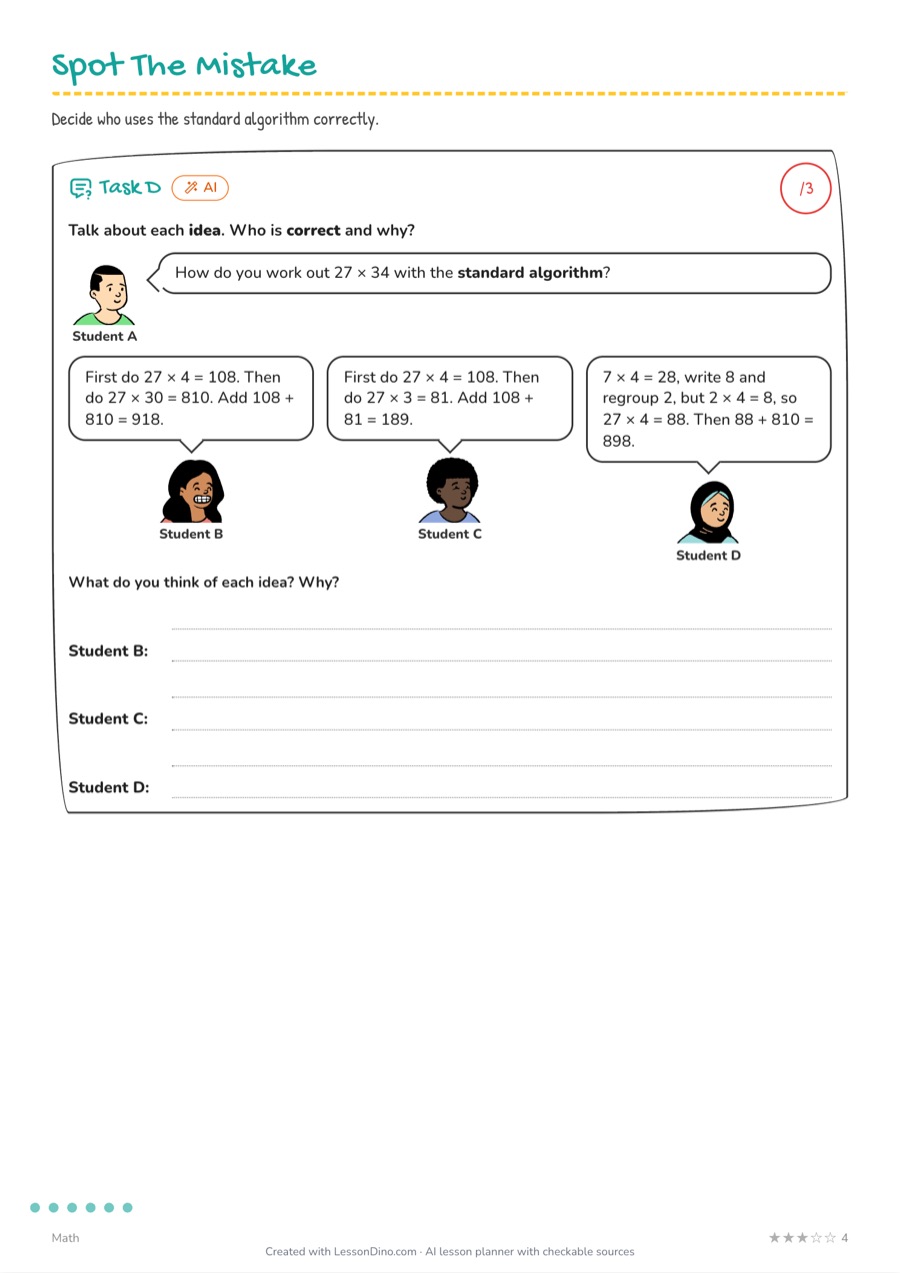
Spot The Mistake
Decide who uses the standard algorithm correctly.
Talk about each idea. Who is correct and why?
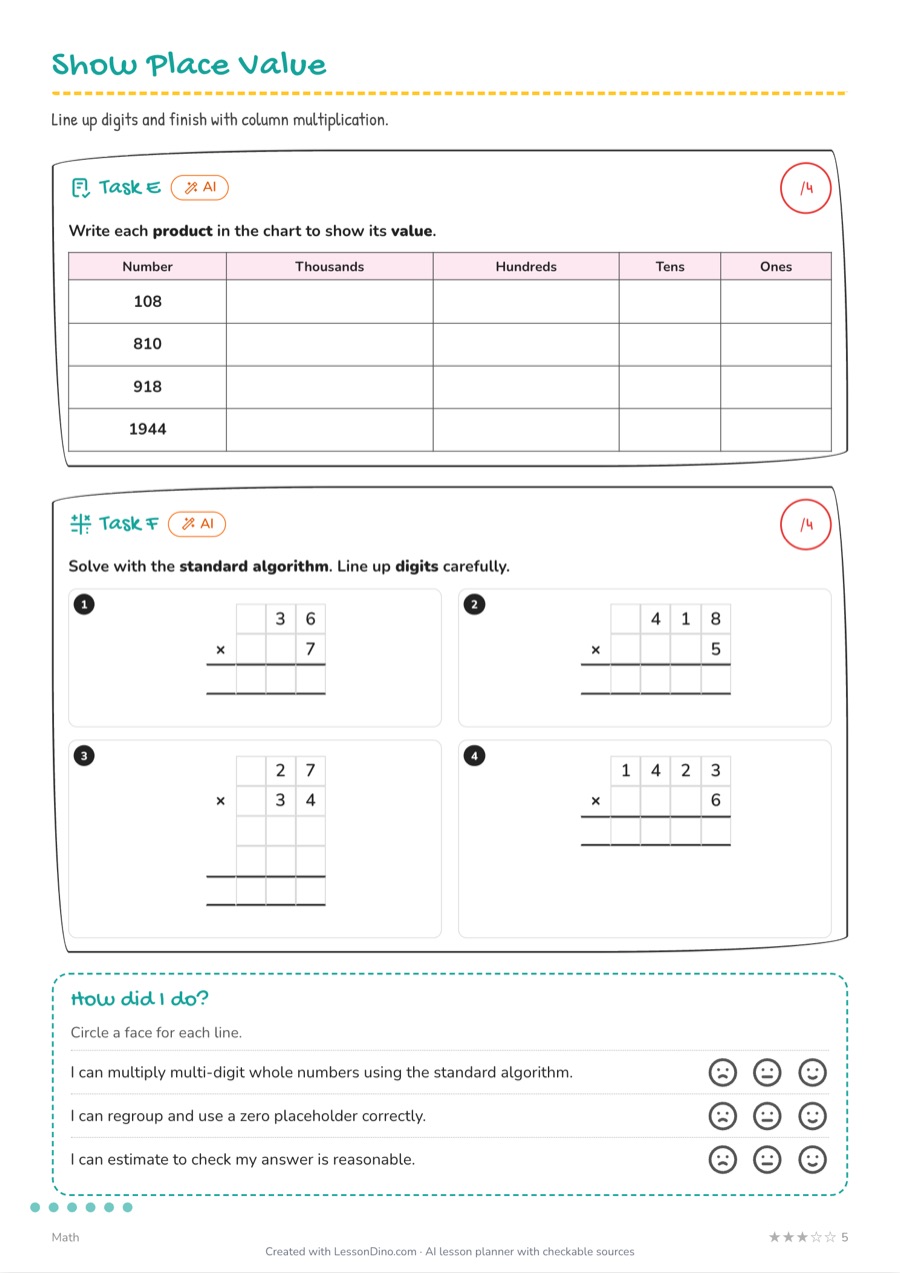
Show Place Value
Line up digits and finish with column multiplication.
Write each product in the chart to show its value.
Solve with the standard algorithm. Line up digits carefully.
Answers
Show the answers
- Find the product: 34 × 6 204
- Find the product: 57 × 8 456
- Find the product: 213 × 3 639
- Find the product: 1,426 × 2 2852
- Find the product: 36 × 12 432
- Find the product: 48 × 35 1680
- Find the product: 214 × 23 4922
- A shopkeeper packs 24 pencils in each box. There are 18 boxes. How many pencils in all? 432
- A school sells 125 tickets at $6 each. How many dollars does it collect? 750
- A farmer packs 45 apples in each box. There are 22 boxes. How many apples in all? Use an estimate to show it is reasonable. 990
- Find the product: 67 × 4 268
- Find the product: 309 × 7 2163
- Find the product: 2,315 × 3 6945
- Find the product: 54 × 27 1458
- Find the product: 63 × 48 3024
- Find the product: 135 × 16 2160
- Estimate 41 × 19 as 40 × 20, then find the exact product. 779
- A bookstore orders 32 boxes with 24 books in each box. How many books in all? 768
- A bike costs $235. A store sells 14 bikes in one week. How many dollars does the store make? 3290
- A class collects 15 bags with 36 cans in each bag, plus 125 extra cans. How many cans in all? 665
The answer sheet is the last picture above.
Curriculum
Fluently multiply multi-digit whole numbers using the standard algorithm.
Made with Lesson Dino's AI on 16 October 2026. AI can make mistakes, so check the answers and facts against the sources before you teach.