Slides
Lesson plan
Multiply Multi-Digit Numbers Fluently
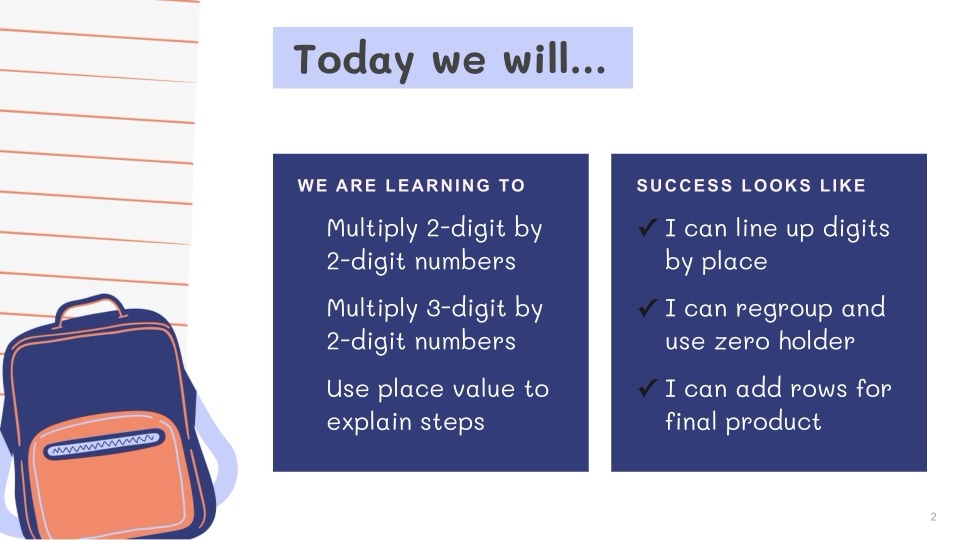
Students learn to fluently multiply multi-digit whole numbers with the standard algorithm. They practice place value steps, then race in teams to solve and check products.
Objectives
- Students will fluently multiply 2-digit by 2-digit numbers using the standard algorithm.
- Students will multiply 3-digit by 2-digit numbers using regrouping and place value.
- Students will use estimation with round numbers to check if products are reasonable.
Success criteria
- I can regroup correctly and line up digits by place value.
- I can write the placeholder zero and add both rows for the product.
- I can estimate first and check that my exact answer is reasonable.
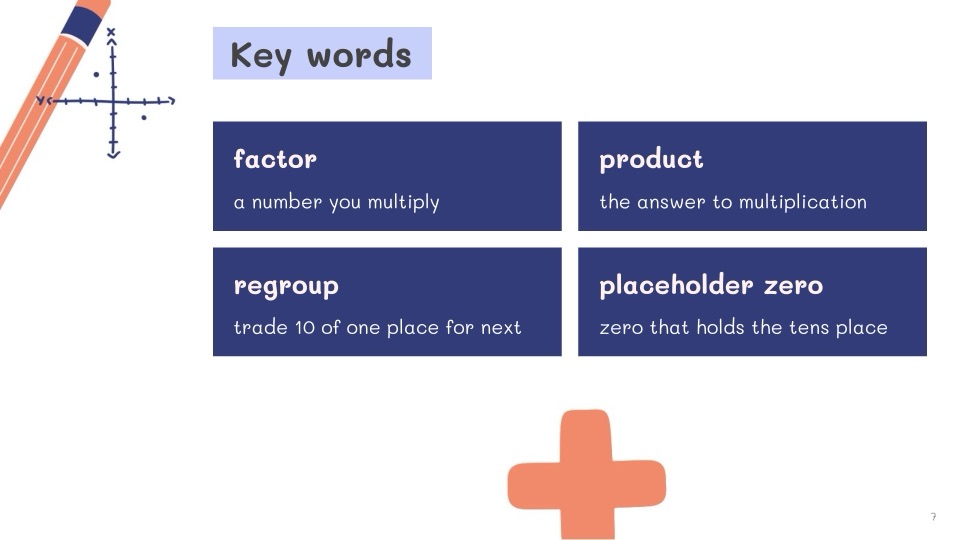
Key words
| Word | Meaning |
|---|---|
| factor | a number that is multiplied by another number |
| product | the answer you get after multiplying numbers together |
| regroup | to trade 10 ones for 1 ten in the next spot |
| placeholder zero | a 0 in the second row that keeps every digit in the correct spot |
| estimate | a close guess using round numbers to check if an answer makes sense |
| standard algorithm | a short stacked way to multiply using place value |
Timed plan (60 minutes)
| Time | Stage | What happens |
|---|---|---|
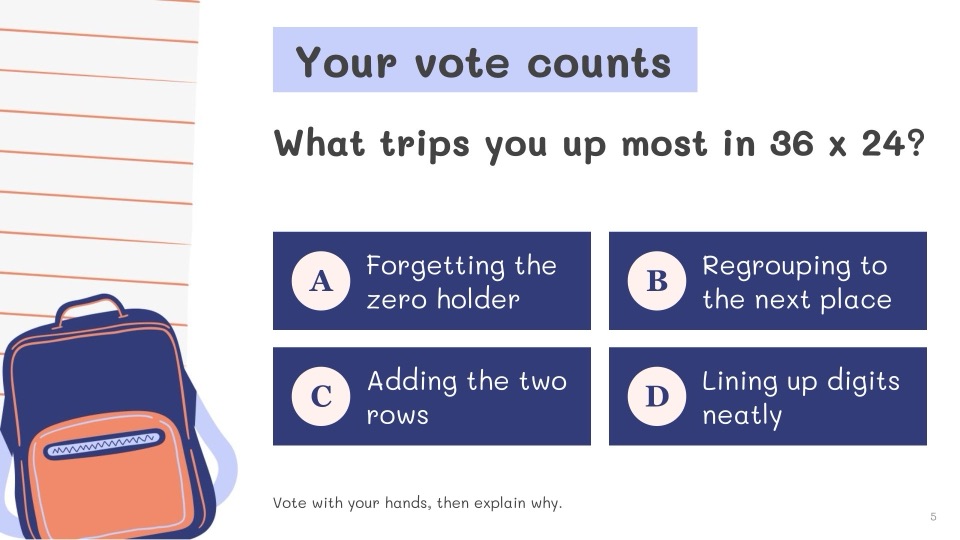
| 5 min | Starter | To recall basic facts and hook students on fluent, accurate relay solving. Show Slide 1 and say the relay hook to the class. Show Slide 5 and take a quick vote on what trips students up most. Flash oral facts: 6 x 4, 7 x 8, 20 x 3, 30 x 40 for quick recall. Explain teams of four will each do one step: multiply, regroup, shift, add. |
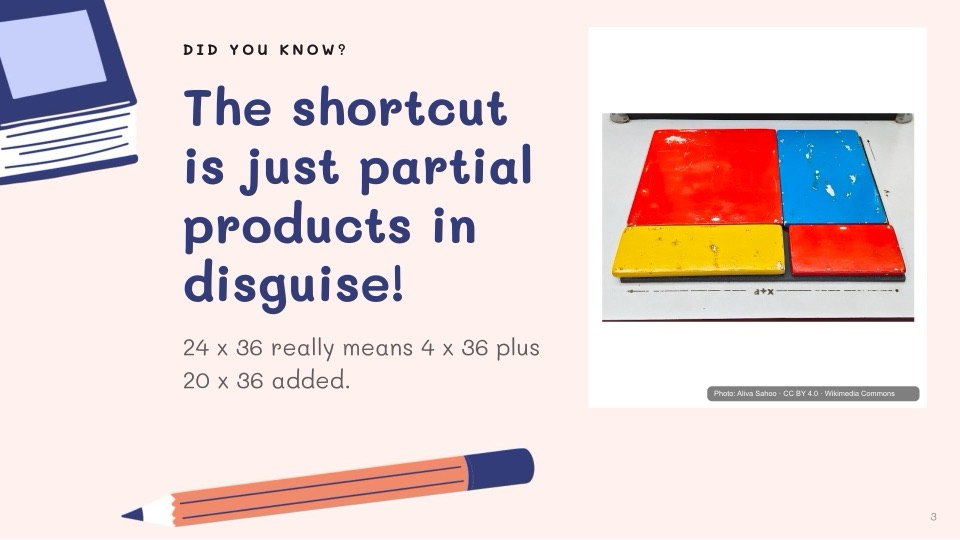
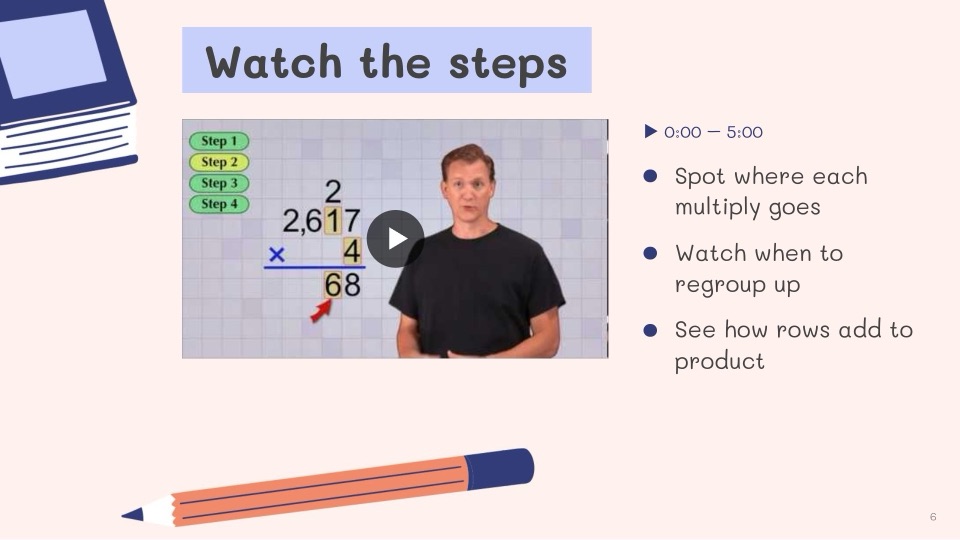
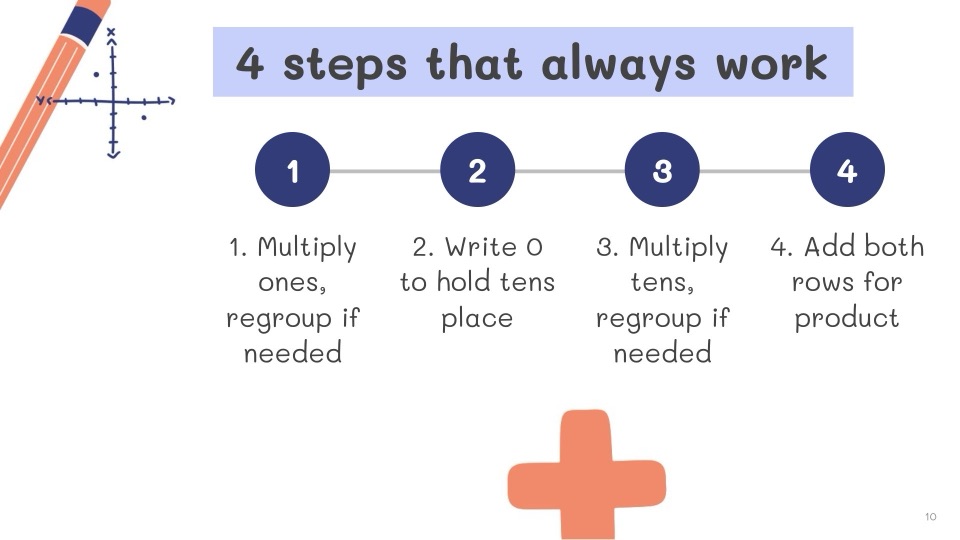
| 15 min | Teaching | To model the four steps of the standard algorithm with place value. Review key words on Slide 7: factor, product, regroup, placeholder zero. Play Video clip 3 (0:00-4:54) and ask students to spot regrouping and adding rows. Model 23 x 15 on the board using the 4 steps, circling regrouped digits. Explain the shortcut records the same partial products in shorter form based on place value. |
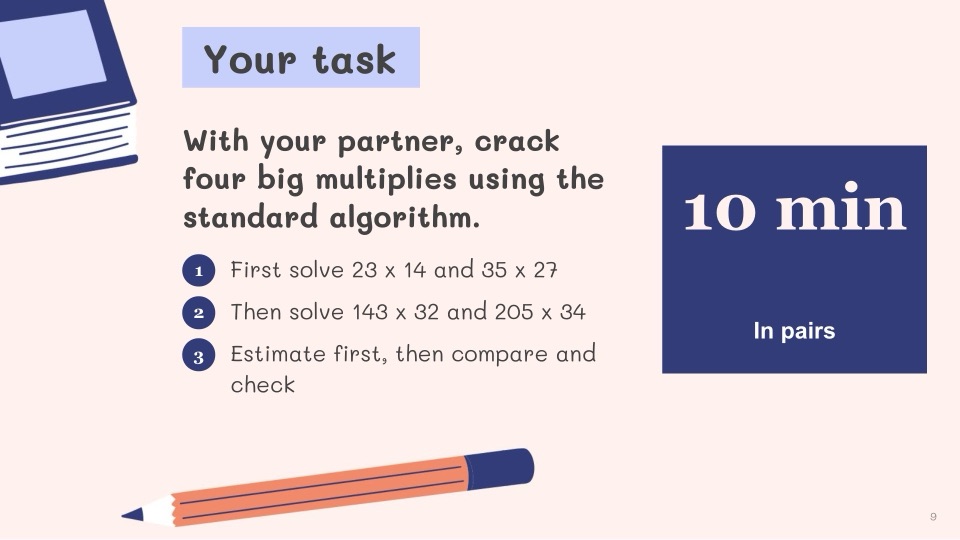
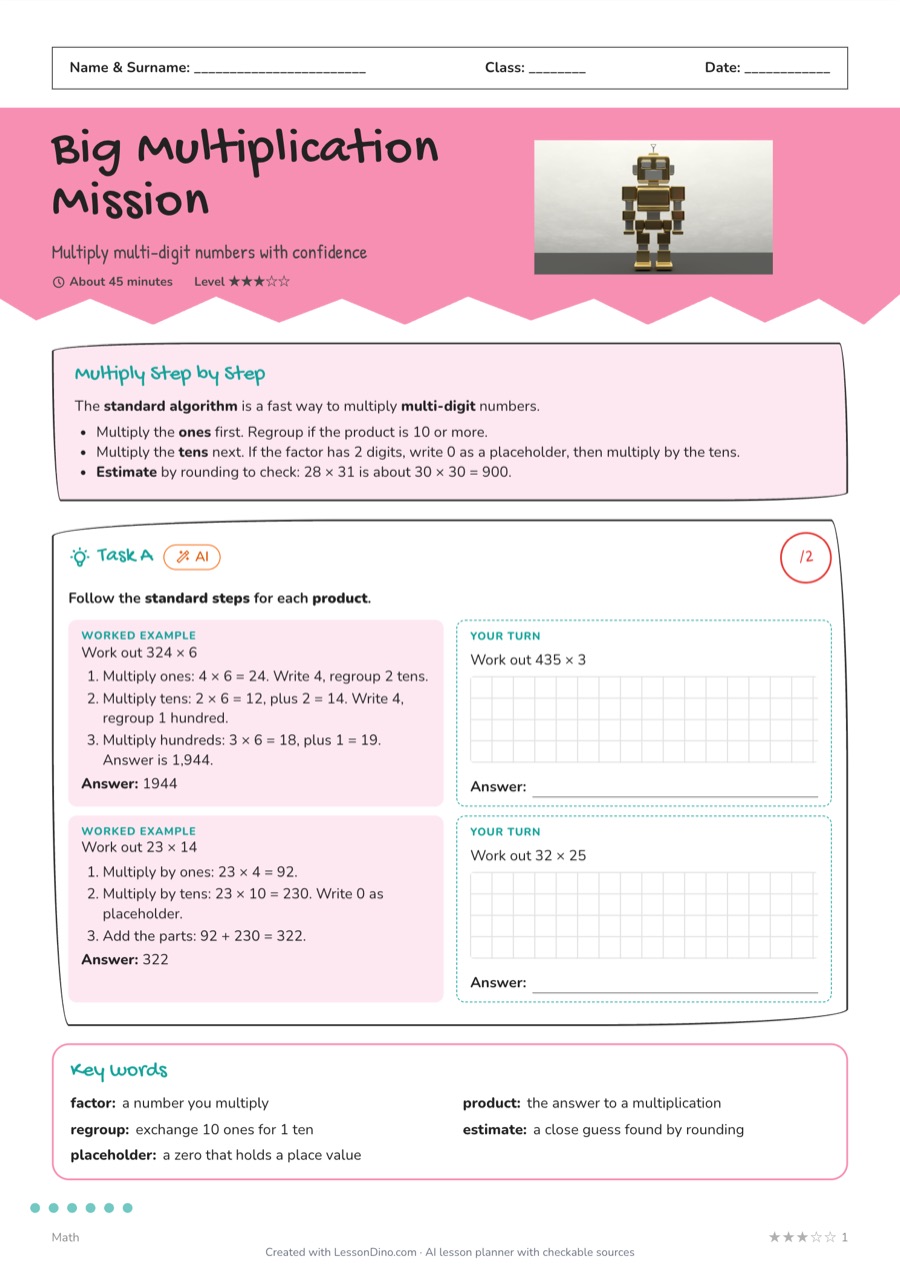
| 10 min | Guided practice | To practice 2-digit and 3-digit by 2-digit problems together with estimation. Hand out Worksheet Task A and show the 4 steps again. Solve 23 x 14 together: estimate 20 x 15 = 300, then solve exactly. Solve 143 x 32 together: estimate 140 x 30 = 4,200, then solve exactly. Ask pairs to point to regroup marks and the placeholder zero. |
| 20 min | Main activity | To build fluency solving 2-digit by 2-digit problems with the standard algorithm. Send teams to four stations: 23 x 15, 36 x 42, 56 x 38, 29 x 41 with recording sheets. Assign each student the next step: multiply, regroup, shift with zero, add. Remind teams to walk, keep aisles clear, estimate first then solve exactly. Rotate stations every 4 minutes and check that regroup marks and zeros are shown. |
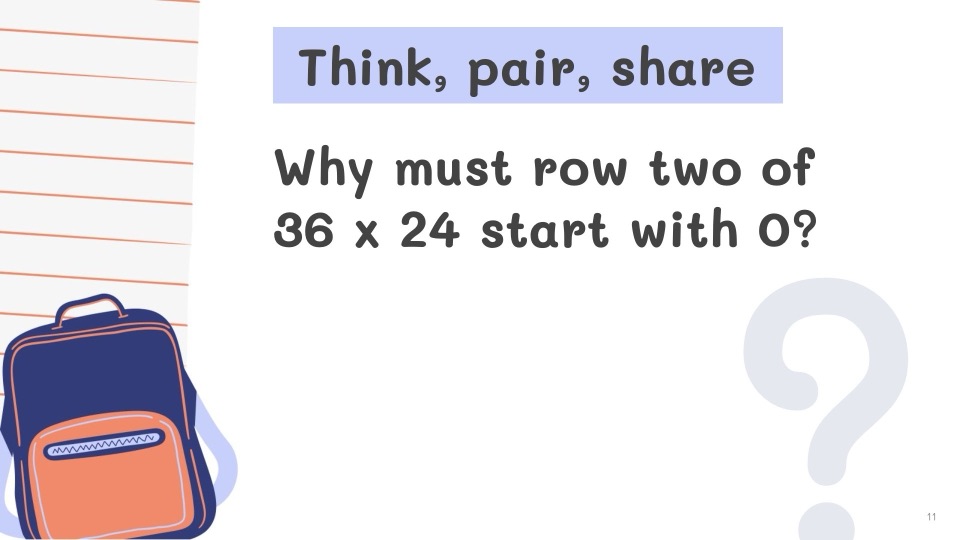
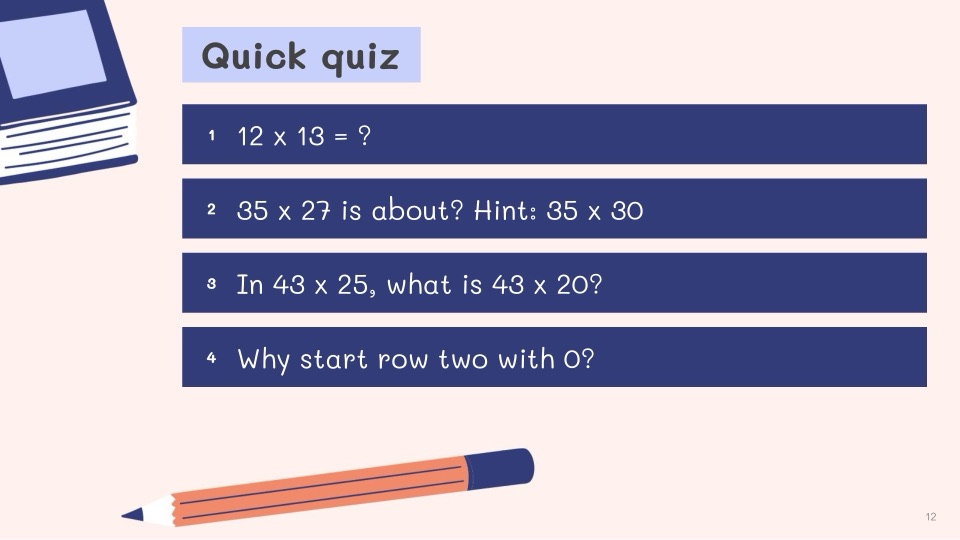
| 10 min | Plenary | To confirm fluent steps and explain the placeholder zero. Ask Slide 11 question: Why must row two of 36 x 24 start with 0? Do Slide 12 quick quiz for 12 x 13 and estimates. Review the 4 steps and link back to relay errors seen. Collect exit answers on paper. |
Common mistakes
- Missing placeholder zero in the second row
How to spot it: Second row is lined up under ones and product is too small
Write 0 first in row two, then multiply by tens, because it is 20 x 36 not 2 x 36 - Forgotten regroup to the next place
How to spot it: Row product is off by 10 or 100 and no small carry is written
Write the carry above the next digit and add it after multiplying - Misaligned digits and wrong final addition
How to spot it: Rows are crooked and ones, tens, hundreds are added in wrong columns
Line up digits neatly by place on grid paper and add column by column
Support
- Allow a basic facts chart so students can focus on the steps and place value, not fact recall
- Provide a place-value checklist: multiply ones, regroup, multiply tens with zero placeholder, add rows
- Provide pre-drawn grids for lining up digits neatly
Stretch
- Add a challenge station with 245 x 32 and ask teams to estimate first, then solve exactly
- Try 1,324 x 6 and explain where the extra thousand goes when regrouping
- Write a tricky example with a hidden zero-placeholder error for another pair to find
Check questions
- Solve 12 x 13 = ?
Answer: 156 - 35 x 27 is about? Use 35 x 30.
Answer: 1,050 is a good estimate - Why start row two with 0 in 36 x 24?
Answer: You are multiplying by tens, so 0 holds the tens place
Curriculum
Fluently multiply multi-digit whole numbers using the standard algorithm.
Video clips
Clips on YouTube, from the start and end times we chose. Check each one before you show it.
-
Multi-Digit Multiplication Pt 1 from 0:00 to 5:00
mathantics: Math Antics - Multi-Digit Multiplication Pt 1
Patient step-by-step standard algorithm introduction at perfect pace for ages 10-11.
-
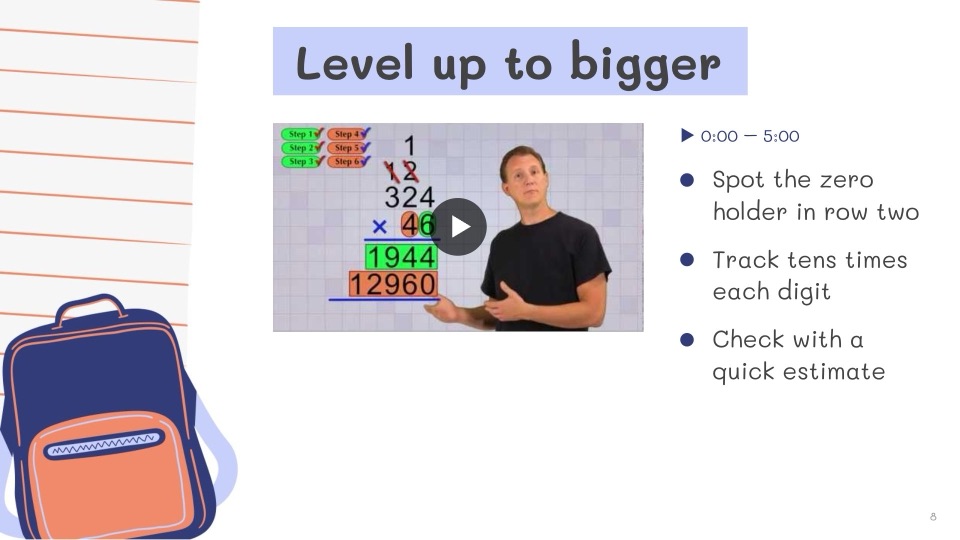
Multi-Digit Multiplication Pt 2 from 0:00 to 5:00
mathantics: Math Antics - Multi-Digit Multiplication Pt 2
Clear continuation to 2-digit by 2-digit standard algorithm ideal for ages 10-11.
Worksheet
Sources
- Grade 5 Math Curriculum - Fairfax County Public Schools fcps.edu
- Mathematics Grade 5 - Chicago Public Schools cps.edu
- Multiple Multi-digit Multiplication Strategies – SMathSmarts smathsmarts.com
- Addition Wikipedia
- Mathland Wikipedia
- Glossary of computer science Wikipedia
Picture credits
Made with Lesson Dino's AI on 16 October 2026. AI can make mistakes, so check facts against the sources before you teach.