The worksheet
About this worksheet
Students learn to quote exactly to show explicit meaning and inferences. They hunt for clues in pairs and prove ideas with exact words. This Grade 5 ELA worksheet gives students (ages 10–11) four pages of practice on reading comprehension: quoting the text, part of the reading literature unit. It goes with our free Reading comprehension: quoting the text lesson, which has the slides and a timed lesson plan.
What it covers
By the end, students should be able to:
- Students will quote exactly from a story to show what it says clearly.
- Students will quote exact clues from a story to support a smart inference.
How to use it
- Guided Practice (10 minutes): Hand out Worksheet Task B and do the first mistake together on the board.
- Support: Give a shorter paragraph with the explicit sentence already underlined.
- Stretch: Ask students to add why the second quote proves the inference in one sentence.
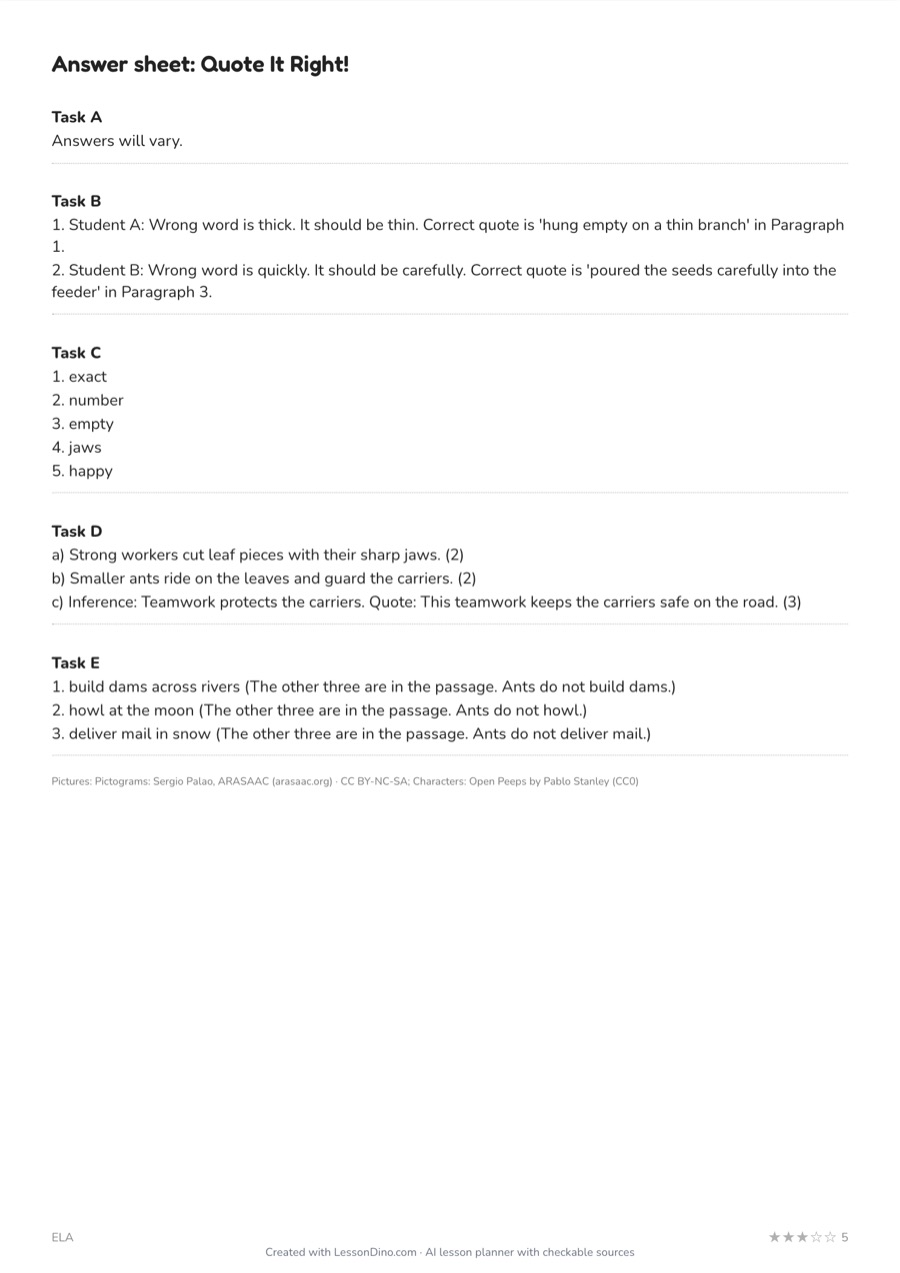
- The answer sheet is the last page, so you can print it on its own or let students check their own work.
Key vocabulary
- quote: a copy of the author's exact words used as proof
- accurately: exactly right, with no changes
- explicitly: said clearly right in the words on the page
- inference: a smart guess made by using clues plus thinking
- quotation marks: punctuation that shows where copied words begin and end
Mistakes to watch for
- Changing words when copying, like loud for loudly or adding words. Compare letter by letter and rewrite inside quotation marks with same capitals and punctuation.
- Using own summary instead of an exact quote as proof. Find the sentence that proves it, copy 5-10 exact words, and add quotation marks.
- Mixing up explicit fact and inference clue. Ask: Does it say it right there? If yes, it is explicit; if you added thinking to clues, it is inference.
What's on the worksheet
Quote Like Detectives
Learn what quoting is and how to do it.
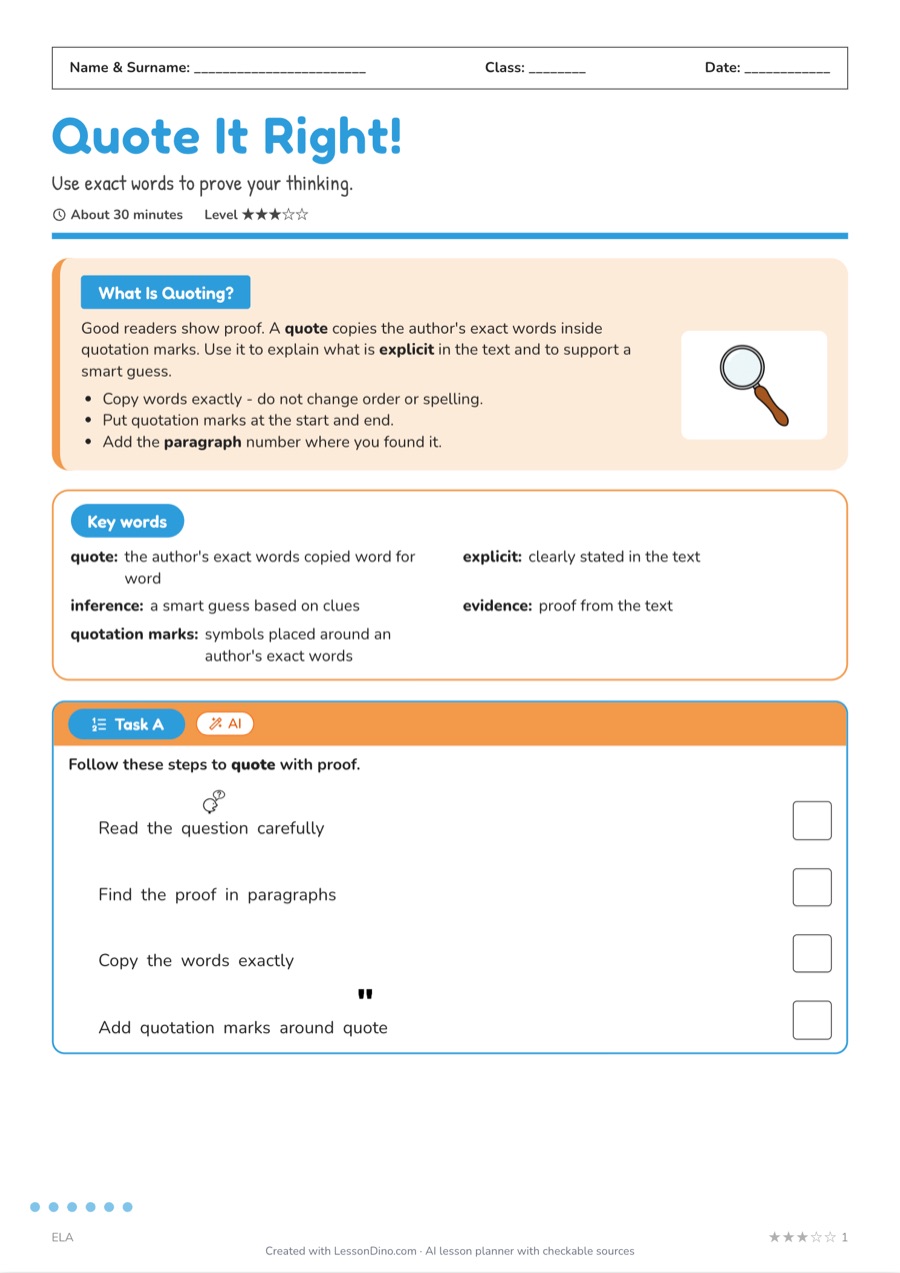
What Is Quoting?
- Good readers show proof. A quote copies the author's exact words inside quotation marks. Use it to explain what is explicit in the text and to support a smart guess.
- Copy words exactly - do not change order or spelling.
- Put quotation marks at the start and end.
- Add the paragraph number where you found it.
| Word | Meaning |
|---|---|
| quote | the author's exact words copied word for word |
| explicit | clearly stated in the text |
| inference | a smart guess based on clues |
| evidence | proof from the text |
| quotation marks | symbols placed around an author's exact words |
Follow these steps to quote with proof.
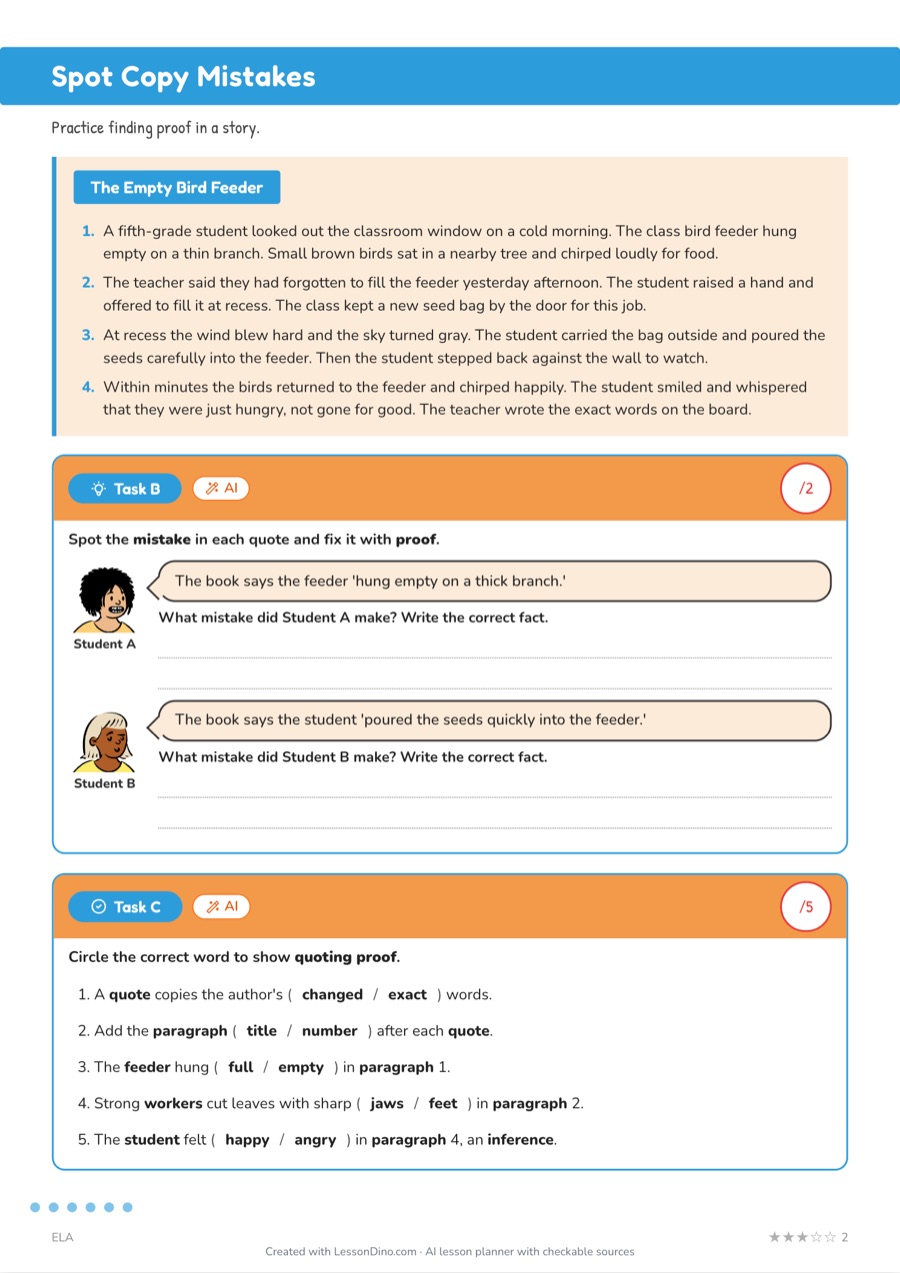
Spot Copy Mistakes
Practice finding proof in a story.
The Empty Bird Feeder
Spot the mistake in each quote and fix it with proof.
Circle the correct word to show quoting proof.
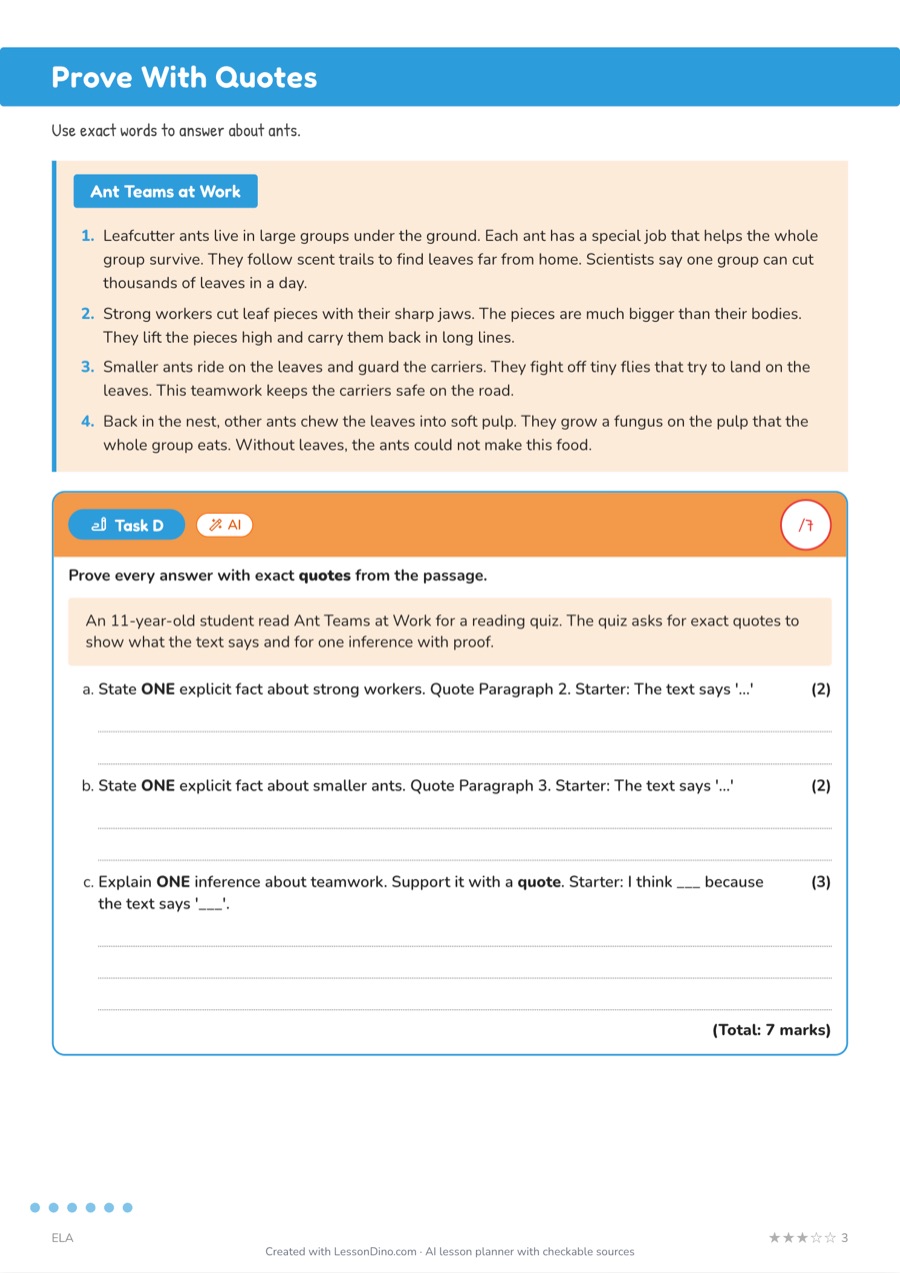
Prove With Quotes
Use exact words to answer about ants.
Ant Teams at Work
Prove every answer with exact quotes from the passage.
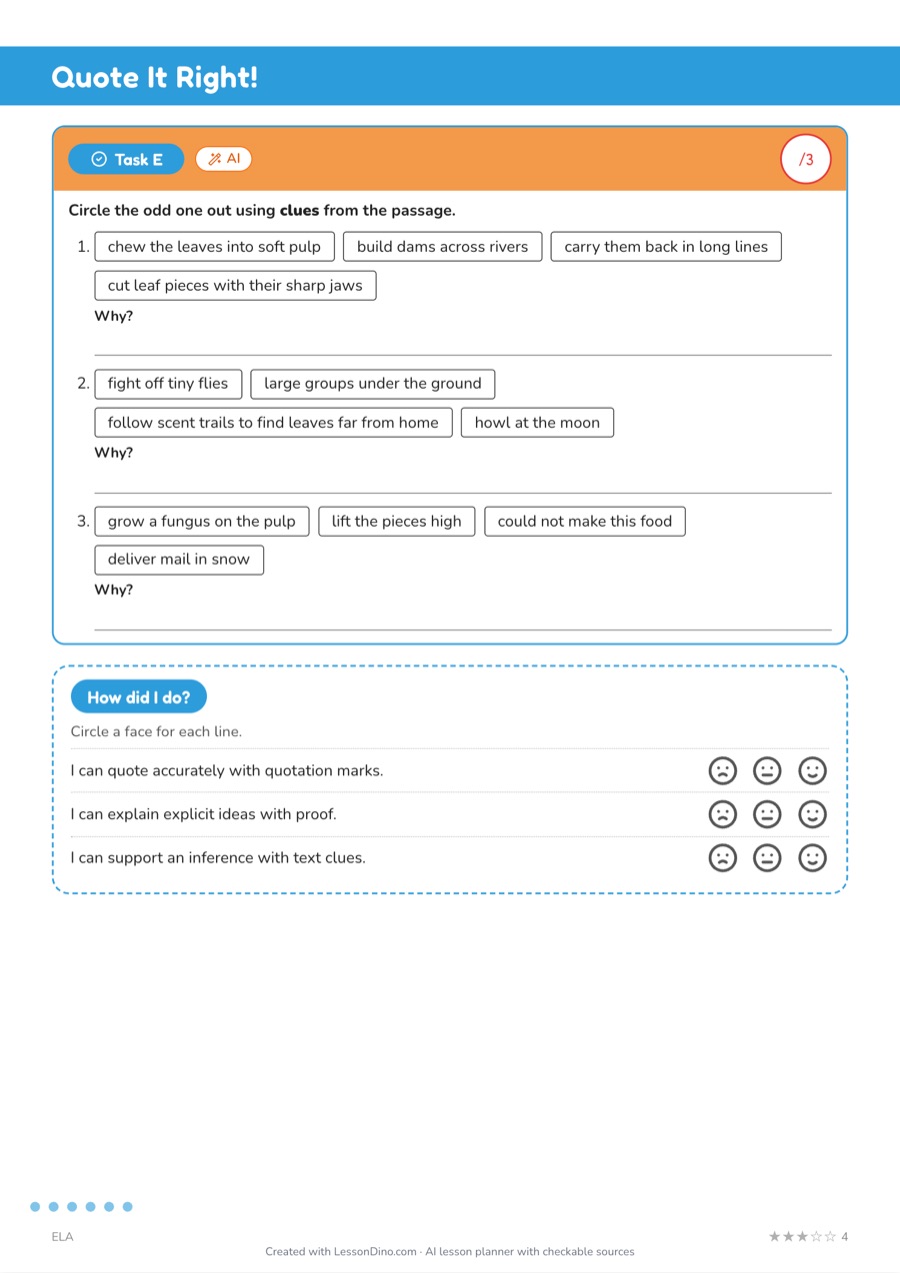
Page 4
Circle the odd one out using clues from the passage.
Answers
Show the answers
- State ONE explicit fact about strong workers. Quote Paragraph 2. Starter: The text says '...' Strong workers cut leaf pieces with their sharp jaws.
- State ONE explicit fact about smaller ants. Quote Paragraph 3. Starter: The text says '...' Smaller ants ride on the leaves and guard the carriers.
- Explain ONE inference about teamwork. Support it with a quote. Starter: I think ___ because the text says '___'. Inference: Teamwork protects the carriers. Quote: This teamwork keeps the carriers safe on the road.
The answer sheet is the last picture above.
Curriculum
Quote accurately from a text when explaining what the text says explicitly and when drawing inferences from the text.
Made with Lesson Dino's AI on 16 October 2026. AI can make mistakes, so check the answers and facts against the sources before you teach.