Slides
Lesson plan
Quote Detectives: Prove It With Exact Words
Students learn to quote exactly to show explicit meaning and inferences. They hunt for clues in pairs and prove ideas with exact words.
Objectives
- Students will quote exactly from a story to show what it says clearly.
- Students will quote exact clues from a story to support a smart inference.
Success criteria
- I can copy an exact quote that shows what the text says.
- I can use an exact quote to prove my inference.
Key words
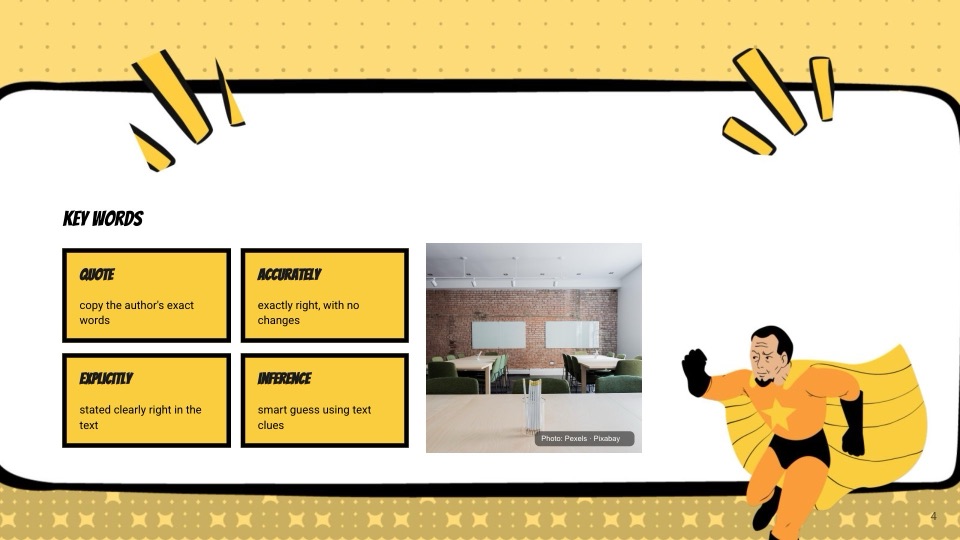
| Word | Meaning |
|---|---|
| quote | a copy of the author's exact words used as proof |
| accurately | exactly right, with no changes |
| explicitly | said clearly right in the words on the page |
| inference | a smart guess made by using clues plus thinking |
| quotation marks | punctuation that shows where copied words begin and end |
Timed plan (60 minutes)
| Time | Stage | What happens |
|---|---|---|
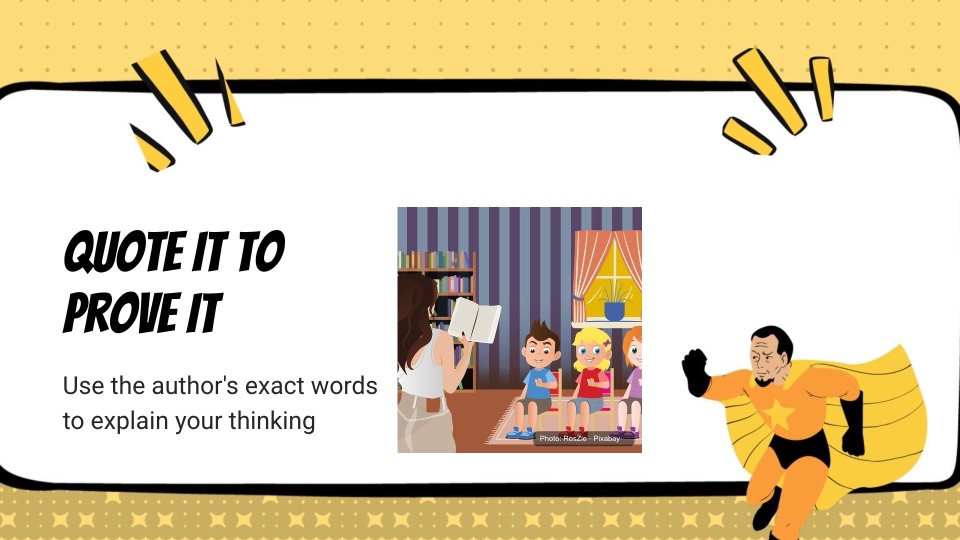
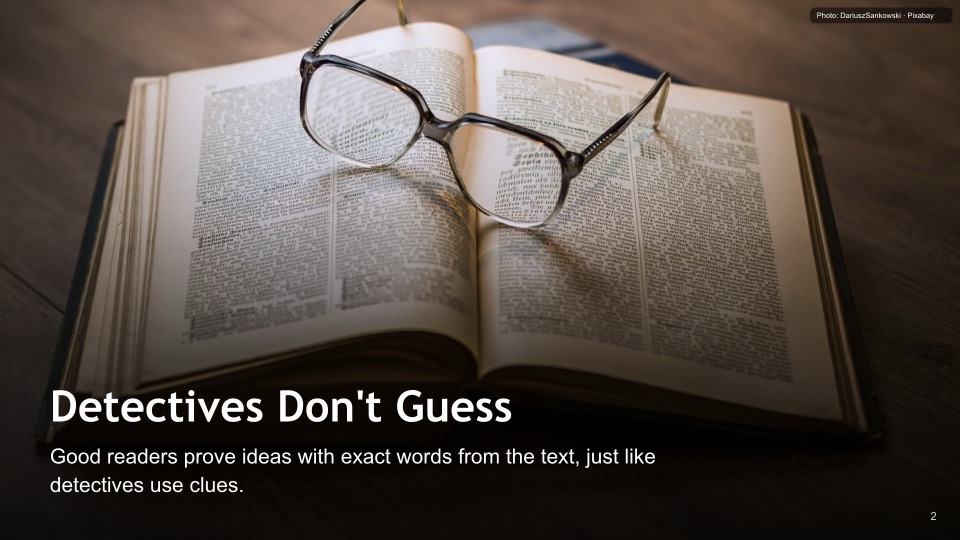
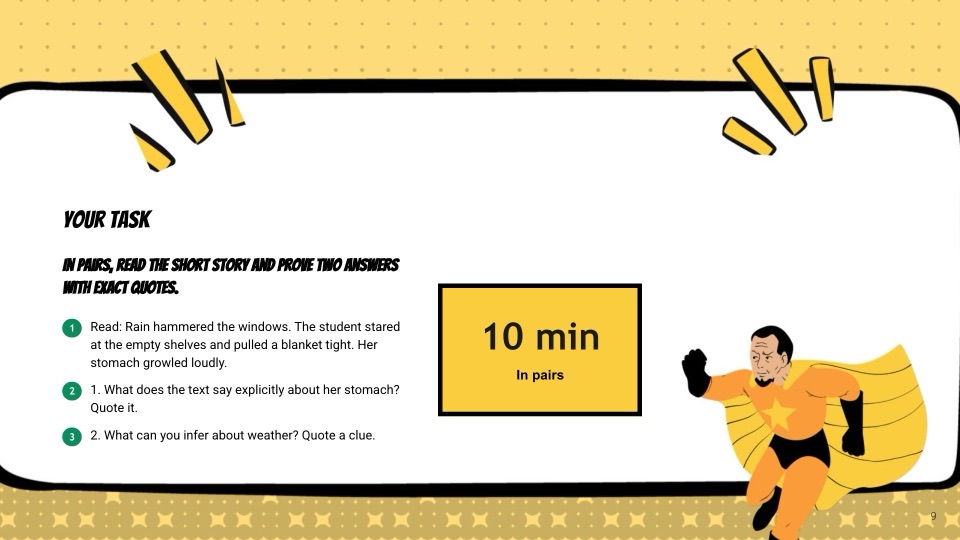
| 5 min | Starter | Hook students as detectives and recall the difference between exact words and guesses. Show Slide 1 Quote It to Prove It and Slide 2 Detectives Don't Guess. Say the hook and read Slide 9 first sentence aloud: Rain hammered the windows. Show Slide 5 Which Is Harder for You? and take a quick vote with hands. Link votes to lesson goal: copy exact words to show what a story says and what we infer. |
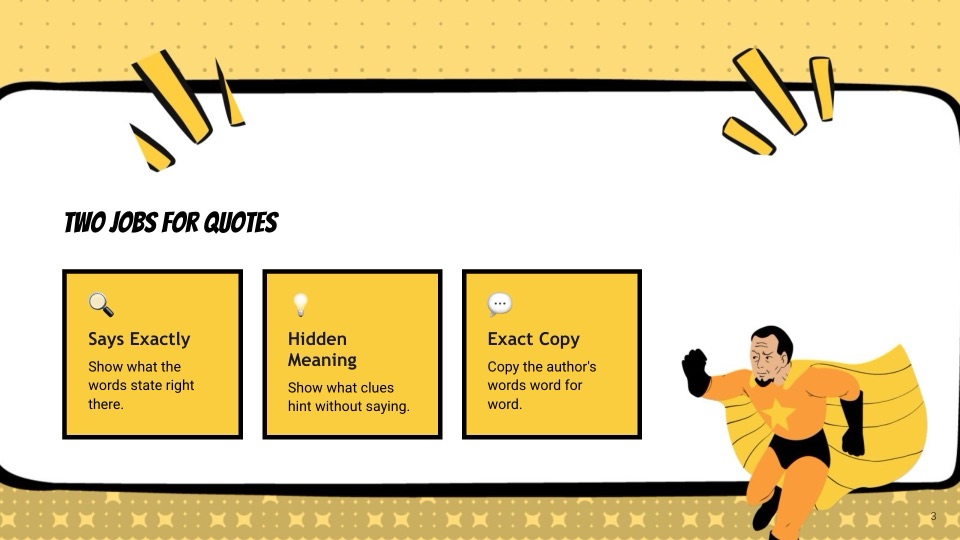
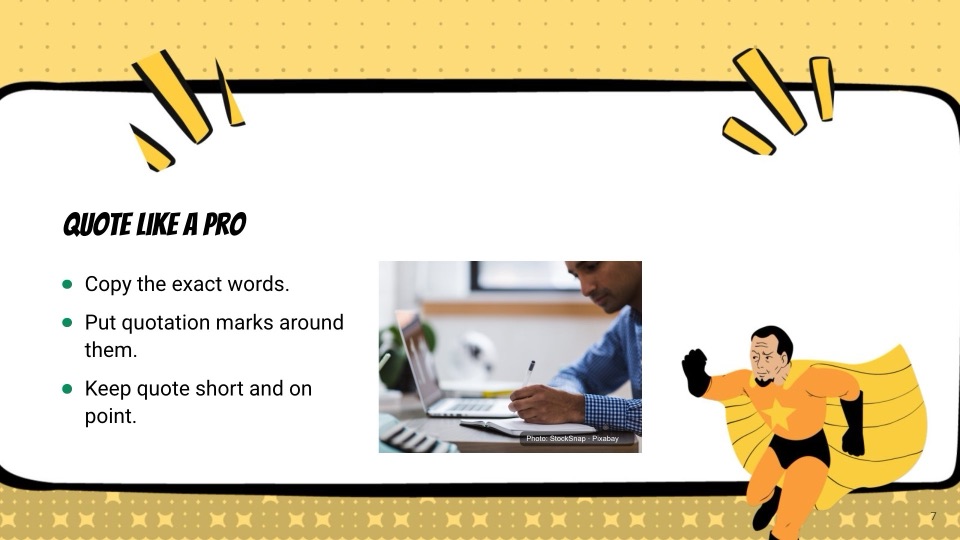
| 10 min | Teaching | Teach the two jobs for quotes and how to copy them accurately. Show Slide 3 Two Jobs for Quotes and Slide 4 Key words. Explain quote, accurately, explicitly, and inference in Grade 5 work. Show Slide 7 Quote Like a Pro and model copying a short quote with quotation marks. Think aloud the difference between an explicit quote and an inference clue. |
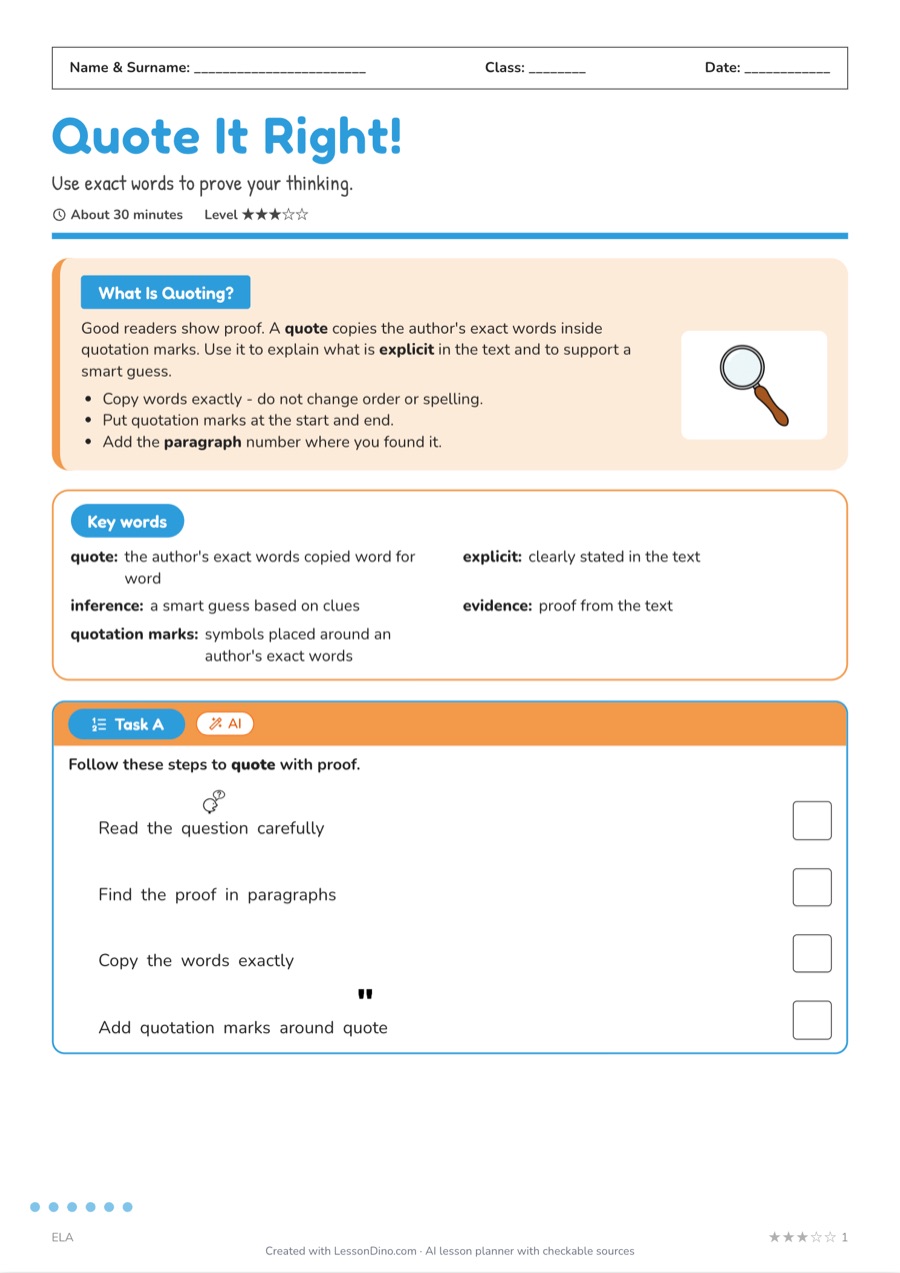
| 10 min | Guided Practice | See accurate quoting in action and practice fixing copy mistakes together. Show Slide 6 Watch: Quote Accurately and play Video clip 1 Quoting Accurately - Grade 5 (0:00-4:30). Pause twice to name the explicit fact they quote and the inference they prove with clues. Hand out Worksheet Task B and do the first mistake together on the board. Model checking every letter, capital, and mark against the text. |
| 20 min | Main Activity | Find, highlight, and copy exact quotes for explicit meaning and inference in pairs. Hand out the art paragraph, highlighters, and two sticky notes per pair. Read the paragraph aloud once, then have pairs reread and highlight yellow for explicit and blue for inference clue. Remind pairs to copy each quote word-for-word with quotation marks, checking spelling, capitals, and punctuation. Circulate, check exact matches, and send pairs to stick notes on the board. |
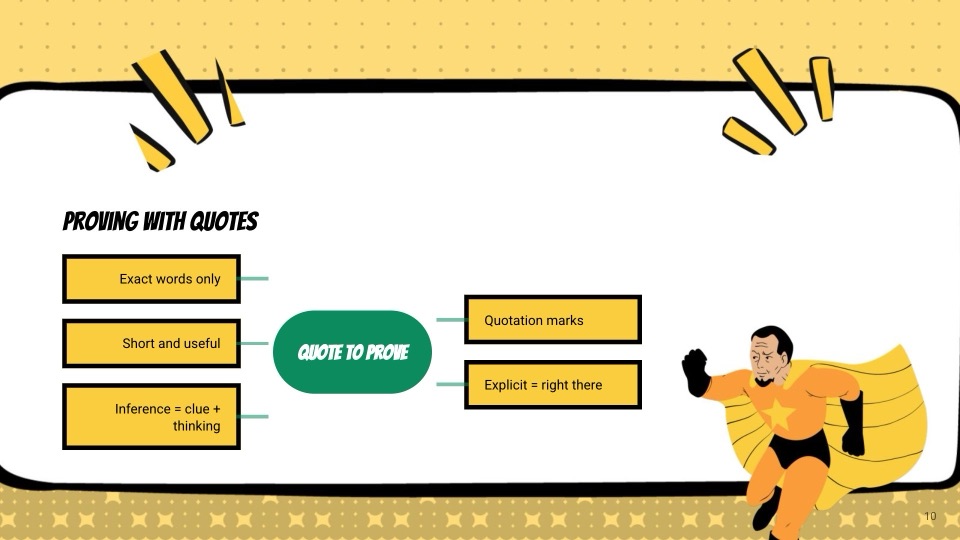
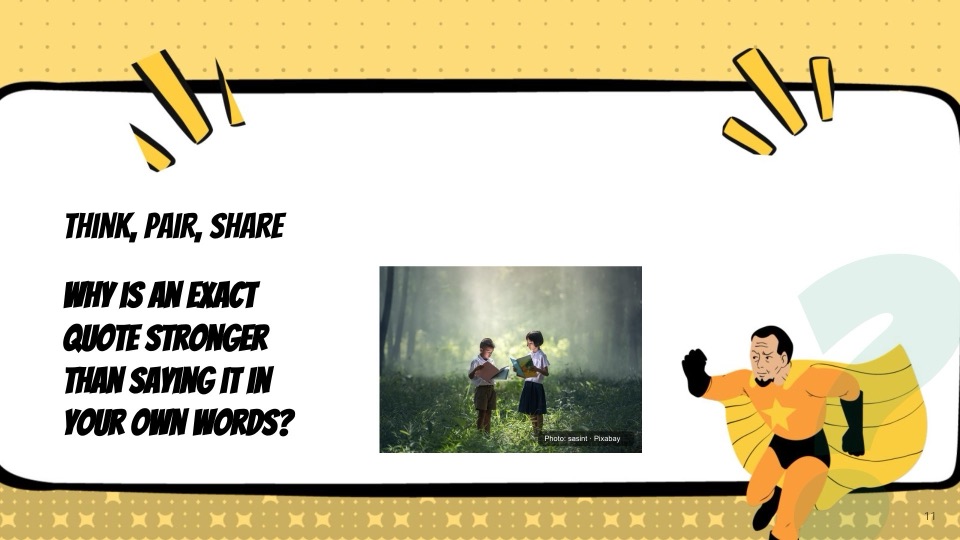
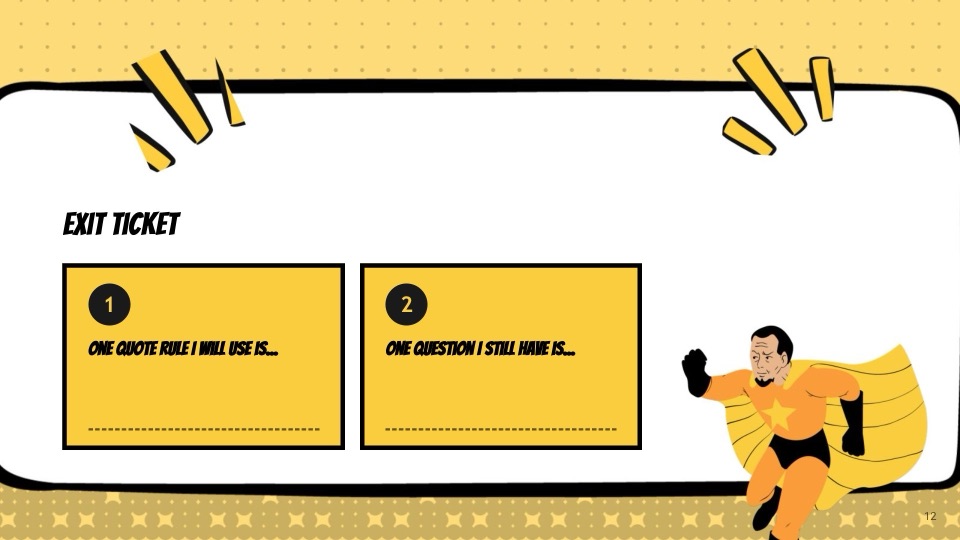
| 15 min | Plenary | Share proofs and confirm students can explain why exact quotes are stronger. Invite three pairs to read one explicit quote and one inference quote from the board. Show Slide 10 Proving With Quotes and check each quote for exact words and marks. Lead Slide 11 Think, pair, share: Why is an exact quote stronger than saying it in your own words? Show Slide 12 Exit ticket and have students write two lines to hand in. |
Common mistakes
- Changing words when copying, like loud for loudly or adding words
How to spot it: Quote does not match text word for word when checked
Compare letter by letter and rewrite inside quotation marks with same capitals and punctuation - Using own summary instead of an exact quote as proof
How to spot it: Answer has no quotation marks or cannot be found in text
Find the sentence that proves it, copy 5-10 exact words, and add quotation marks - Mixing up explicit fact and inference clue
How to spot it: Student calls a smart guess explicit or cannot point to clue words
Ask: Does it say it right there? If yes, it is explicit; if you added thinking to clues, it is inference
Support
- Give a shorter paragraph with the explicit sentence already underlined.
Stretch
- Ask students to add why the second quote proves the inference in one sentence.
Check questions
- Copy the exact quote that shows what the mural will show.
Answer: Our mural will show the school garden in spring, - Which exact clue helps you infer how the student felt, and what do you infer?
Answer: Her hands shook a little - infer nervous, excited, or worried. - What two things must an accurate quote have?
Answer: The author's exact words with no changes, inside quotation marks.
Curriculum
Quote accurately from a text when explaining what the text says explicitly and when drawing inferences from the text.
Video clips
Clips on YouTube, from the start and end times we chose. Check each one before you show it.
-
Quoting Accurately - Grade 5 from 0:00 to 4:30
ASU America Reads: 5th Grade ELA | Quoting Accurately from a Text | Arizona Academic Standard 5.RL.1
Exactly teaches quoting accurately from a text for Grade 5 and the pace and language are perfect for 10-11-year-olds.
-
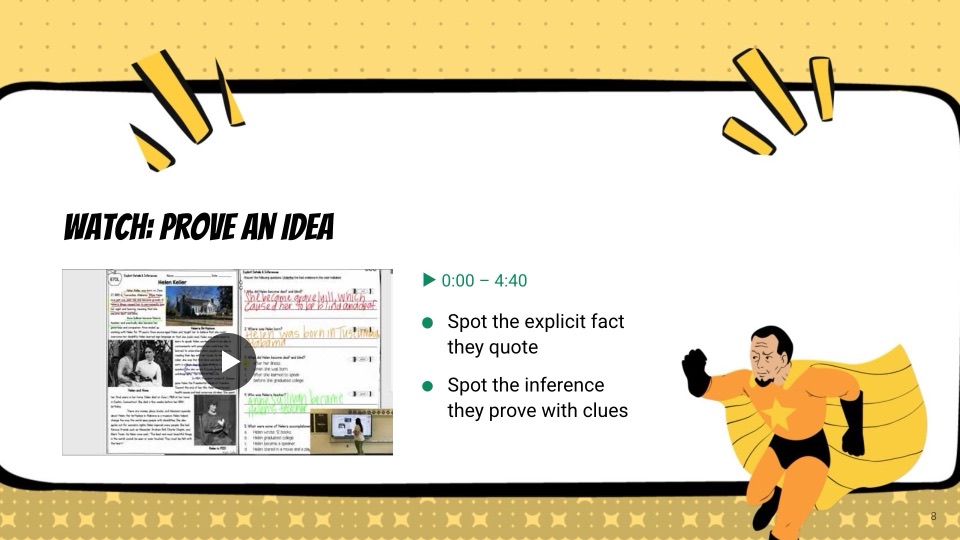
Quoting Informational Text from 0:00 to 4:40
GSD Instructional Programs: ELA Grade 5 RI.5.1 Quoting Informational Text
Exactly teaches Grade 5 quoting from informational text for explicit meaning and inferences and suits 10-11-year-olds.
Worksheet
Sources
- English Language Arts cps.edu
- 2023 NJSLS-ELA: Grade 5 nj.gov
- Reading - Wikipedia en.m.wikipedia.org
- Reading, Berkshire - Wikipedia en.m.wikipedia.org
- Science of reading Wikipedia
- Kiddush levana Wikipedia
- Francisco López Sanz Wikipedia
Picture credits
- Photo: RosZie · Pixabay
- Photo: DariuszSankowski · Pixabay
- Photo: Pexels · Pixabay
- Photo: StockSnap · Pixabay
- Photo: sasint · Pixabay
- Pictograms: Sergio Palao, ARASAAC (arasaac.org) · CC BY-NC-SA
Made with Lesson Dino's AI on 16 October 2026. AI can make mistakes, so check facts against the sources before you teach.