The worksheet
About this worksheet
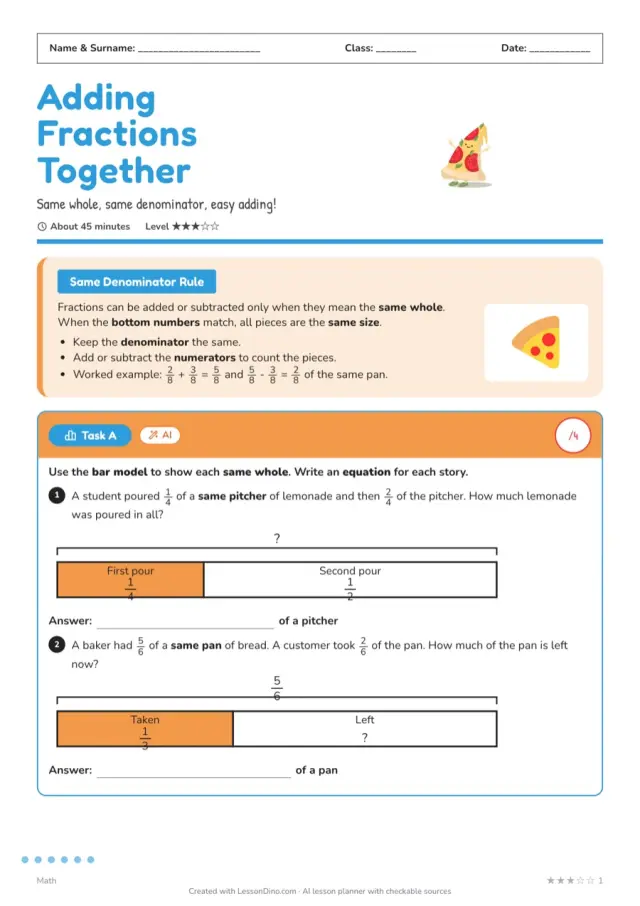
Students learn to divide up to four-digit numbers by one digit and name the remainder. They draw area models and check answers with multiplication. This Grade 4 Math worksheet gives students (ages 9–10) six pages of practice on long division with remainders, part of the number and operations in base ten unit. It goes with our free Long division with remainders lesson, which has the slides and a timed lesson plan.
What it covers
By the end, students should be able to:
- Students will find whole-number quotients and remainders for up to four-digit by one-digit division.
- Students will use place value and multiplication facts to explain each division step.
- Students will illustrate division with equations, arrays and area models.
How to use it
- Main activity (20 minutes): Hand out Worksheet Task D and rulers for pairs to draw boxes and equations.
- Support: Pre-draw the rectangle split into two parts and label the divisor outside so students only fill in the partial quotients.
- Stretch: Try 1,735 ÷ 4 and explain where the remainder 3 shows in the model.
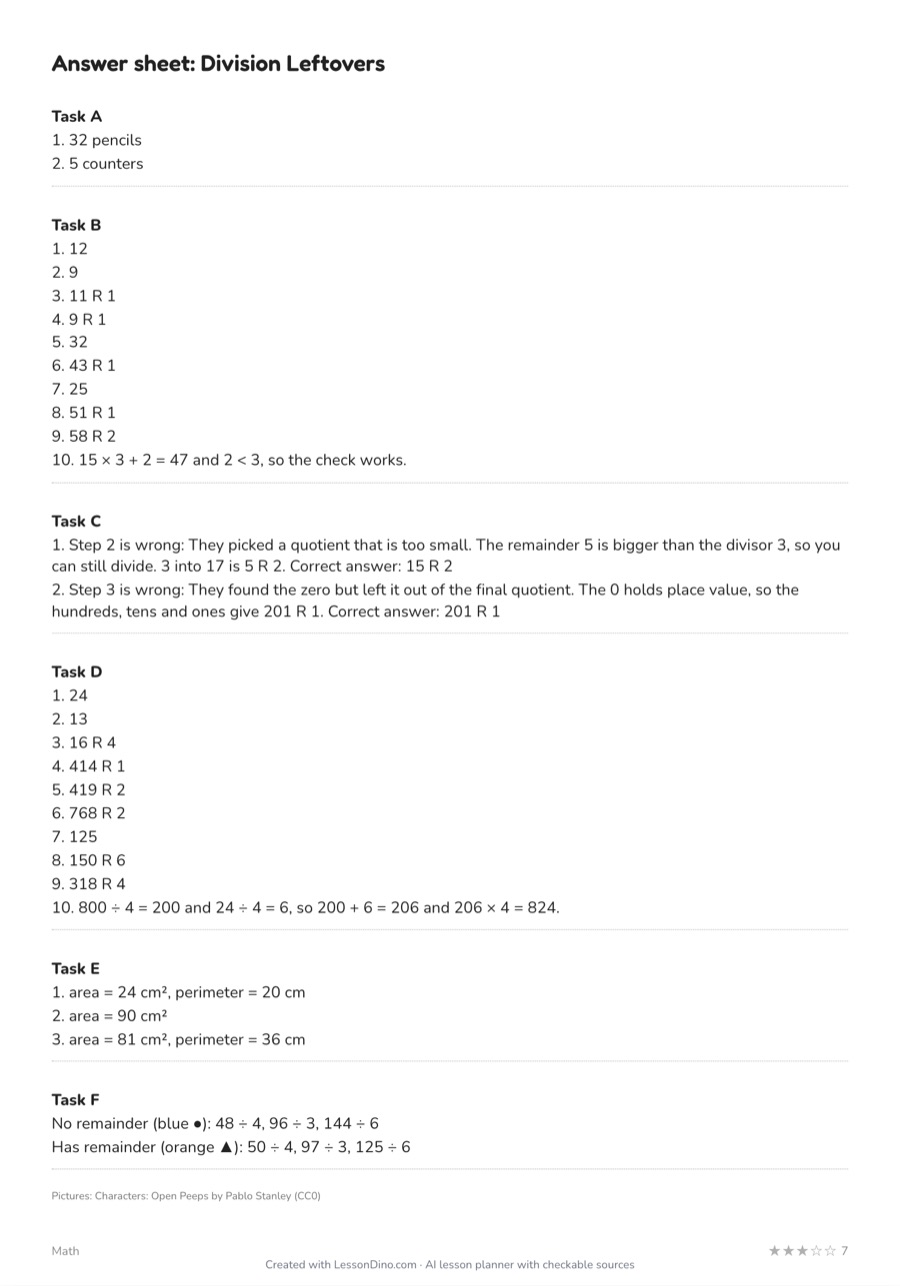
- The answer sheet is the last page, so you can print it on its own or let students check their own work.
Key vocabulary
- dividend: the total amount that is being split up
- divisor: the number telling how many equal groups to make
- quotient: how many go in each full equal group
- remainder: what is left over that cannot make another full group
- area model: a big rectangle cut into smaller boxes to show easy parts to divide
Mistakes to watch for
- Writing a remainder equal to or larger than the divisor. Add 1 to quotient and subtract divisor from remainder until remainder is smaller than divisor.
- Forgetting to bring down the next digit after subtracting. After every subtraction ask: is there another digit to bring down, then divide again following divide, multiply, subtract, bring down, repeat.
- Checking with multiplication but forgetting to add the remainder. Use dividend = quotient x divisor + remainder and add the leftover last to prove the answer.
What's on the worksheet
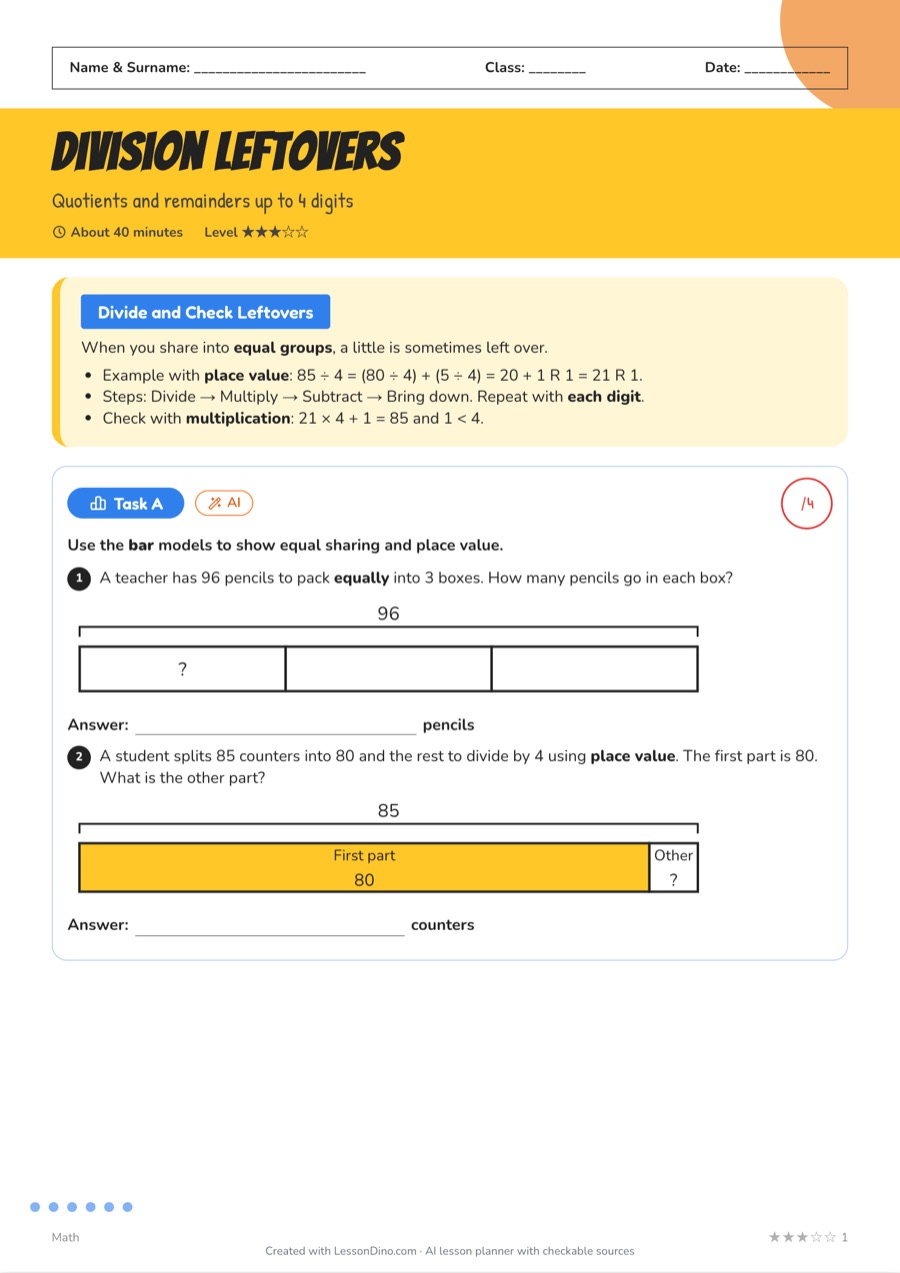
Divide With Leftovers
See what a remainder means and how to show division.
Divide and Check Leftovers
- When you share into equal groups, a little is sometimes left over.
- Example with place value: 85 ÷ 4 = (80 ÷ 4) + (5 ÷ 4) = 20 + 1 R 1 = 21 R 1.
- Steps: Divide → Multiply → Subtract → Bring down. Repeat with each digit.
- Check with multiplication: 21 × 4 + 1 = 85 and 1 < 4.
Use the bar models to show equal sharing and place value.
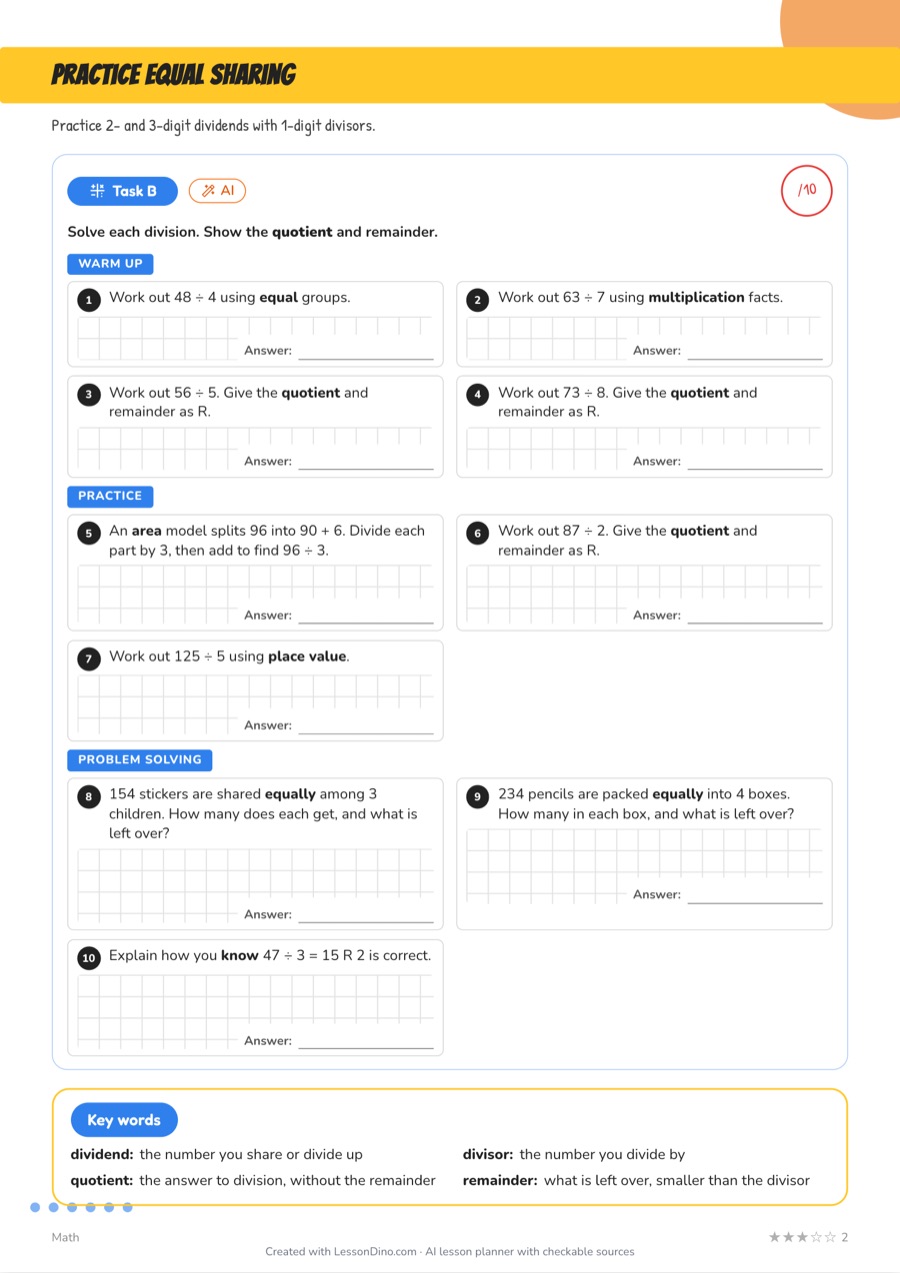
Practice Equal Sharing
Practice 2- and 3-digit dividends with 1-digit divisors.
Solve each division. Show the quotient and remainder.
Warm up
- Work out 48 ÷ 4 using equal groups.
- Work out 63 ÷ 7 using multiplication facts.
- Work out 56 ÷ 5. Give the quotient and remainder as R.
- Work out 73 ÷ 8. Give the quotient and remainder as R.
Practice
- An area model splits 96 into 90 + 6. Divide each part by 3, then add to find 96 ÷ 3.
- Work out 87 ÷ 2. Give the quotient and remainder as R.
- Work out 125 ÷ 5 using place value.
Problem solving
- 154 stickers are shared equally among 3 children. How many does each get, and what is left over?
- 234 pencils are packed equally into 4 boxes. How many in each box, and what is left over?
- Explain how you know 47 ÷ 3 = 15 R 2 is correct.
| Word | Meaning |
|---|---|
| dividend | the number you share or divide up |
| divisor | the number you divide by |
| quotient | the answer to division, without the remainder |
| remainder | what is left over, smaller than the divisor |
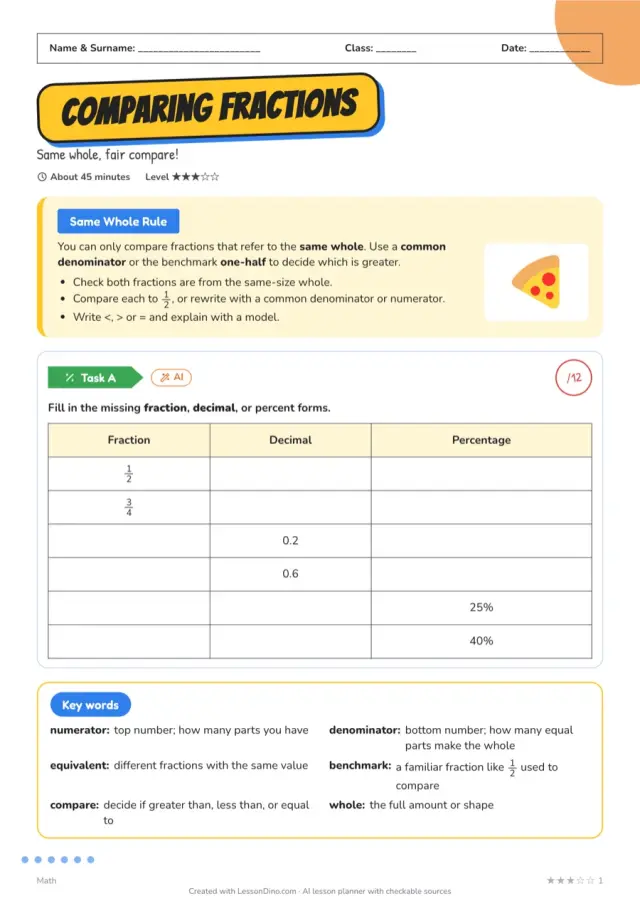
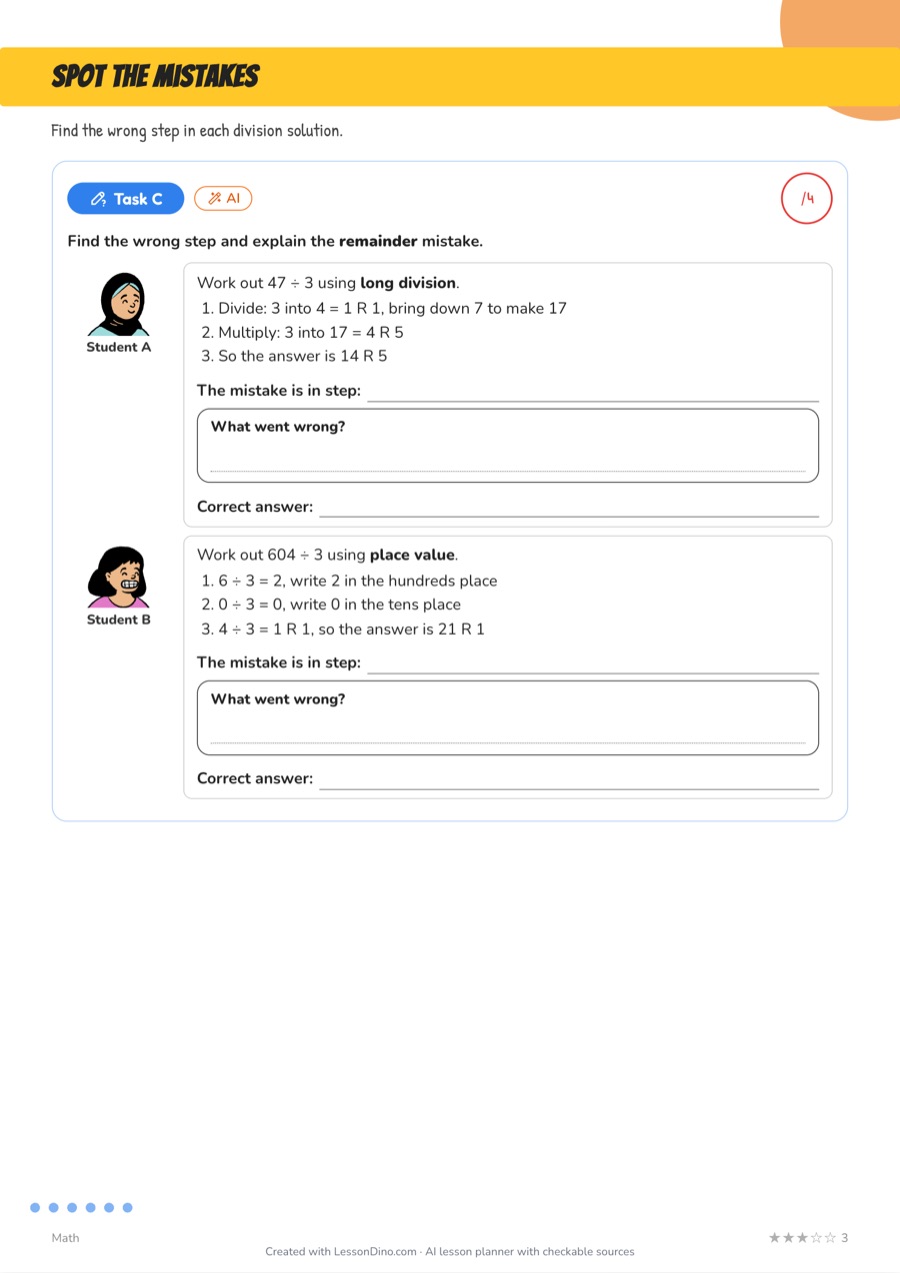
Spot the Mistakes
Find the wrong step in each division solution.
Find the wrong step and explain the remainder mistake.
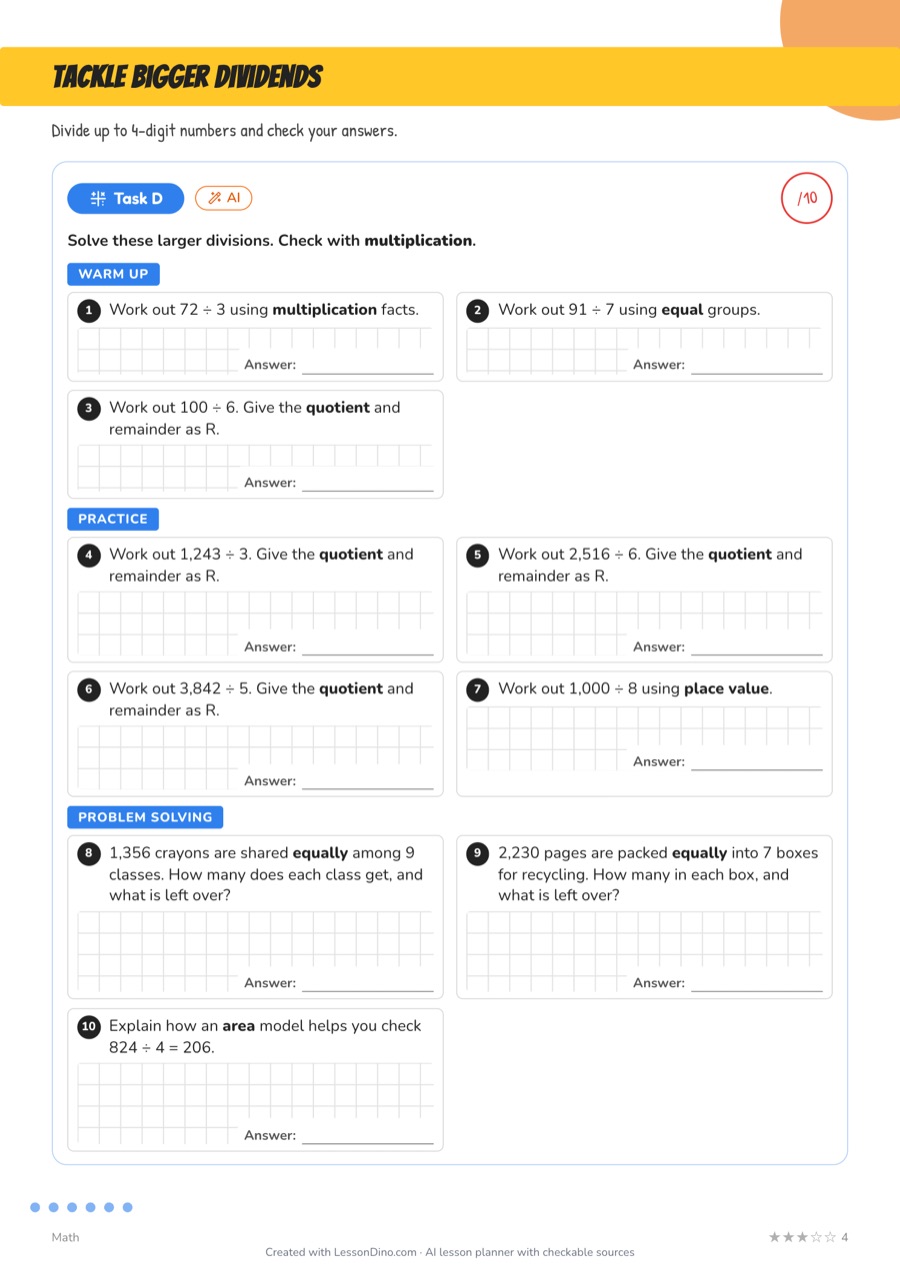
Tackle Bigger Dividends
Divide up to 4-digit numbers and check your answers.
Solve these larger divisions. Check with multiplication.
Warm up
- Work out 72 ÷ 3 using multiplication facts.
- Work out 91 ÷ 7 using equal groups.
- Work out 100 ÷ 6. Give the quotient and remainder as R.
Practice
- Work out 1,243 ÷ 3. Give the quotient and remainder as R.
- Work out 2,516 ÷ 6. Give the quotient and remainder as R.
- Work out 3,842 ÷ 5. Give the quotient and remainder as R.
- Work out 1,000 ÷ 8 using place value.
Problem solving
- 1,356 crayons are shared equally among 9 classes. How many does each class get, and what is left over?
- 2,230 pages are packed equally into 7 boxes for recycling. How many in each box, and what is left over?
- Explain how an area model helps you check 824 ÷ 4 = 206.
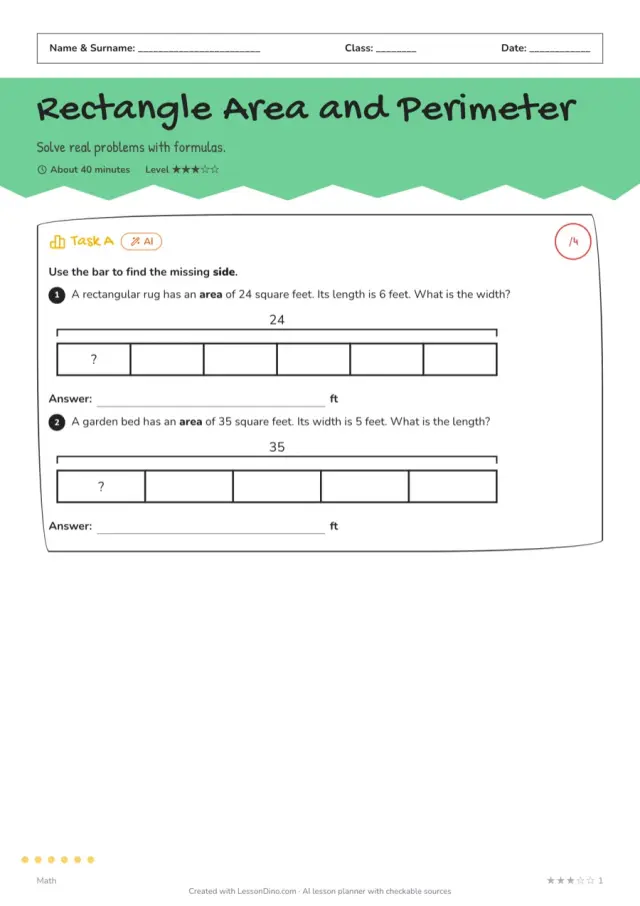
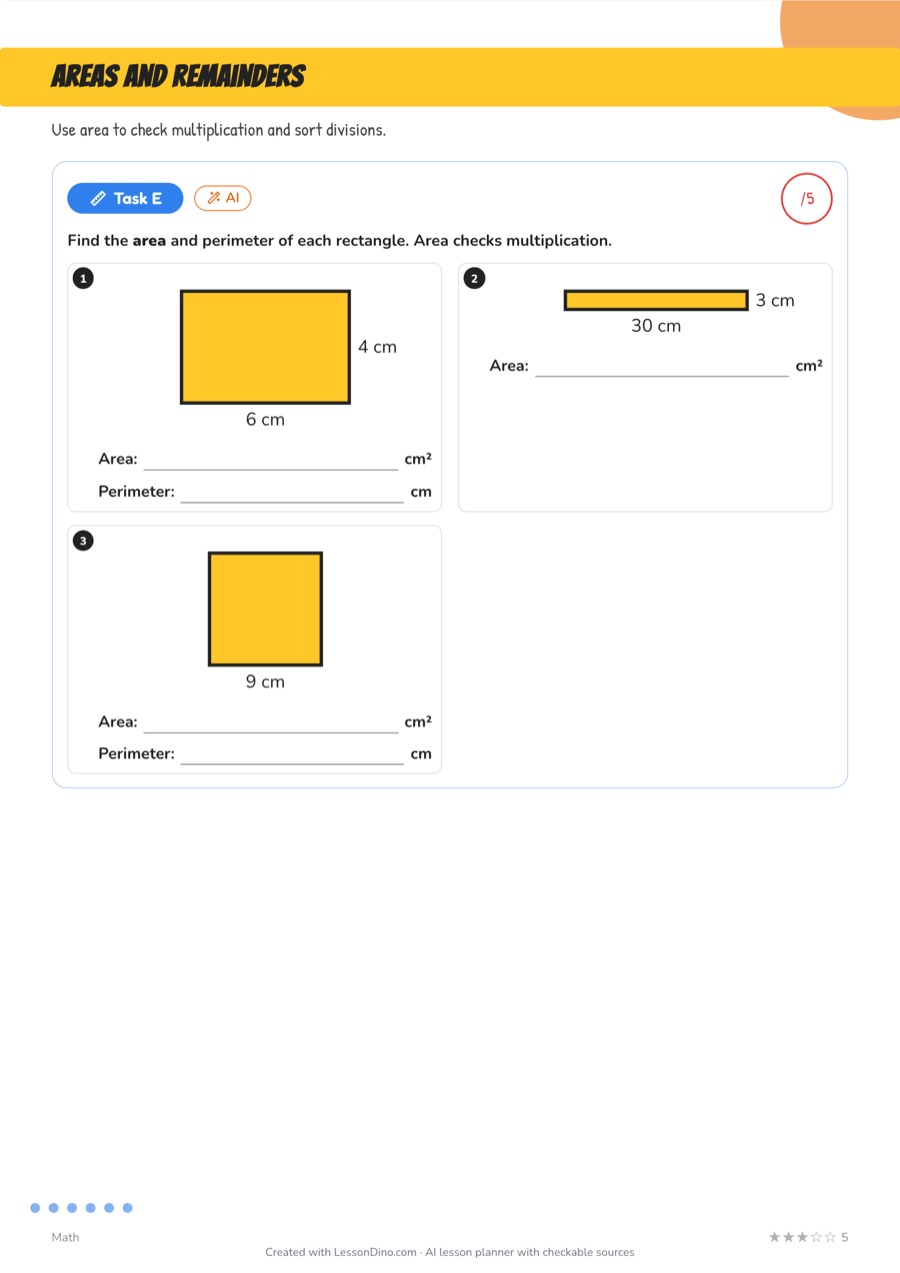
Areas and Remainders
Use area to check multiplication and sort divisions.
Find the area and perimeter of each rectangle. Area checks multiplication.
Page 6
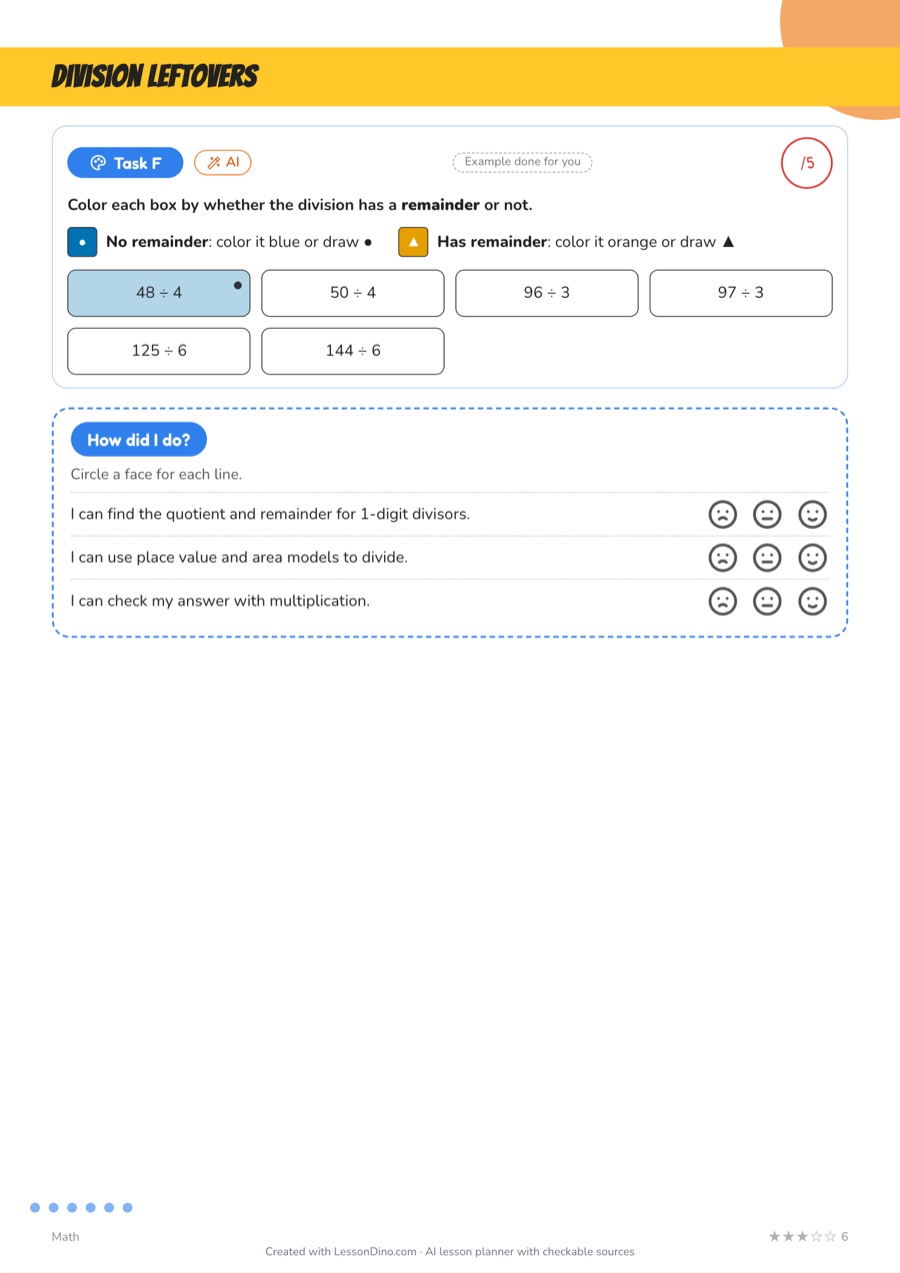
Color each box by whether the division has a remainder or not.
Answers
Show the answers
- Work out 48 ÷ 4 using equal groups. 12
- Work out 63 ÷ 7 using multiplication facts. 9
- Work out 56 ÷ 5. Give the quotient and remainder as R. 11 R 1
- Work out 73 ÷ 8. Give the quotient and remainder as R. 9 R 1
- An area model splits 96 into 90 + 6. Divide each part by 3, then add to find 96 ÷ 3. 32
- Work out 87 ÷ 2. Give the quotient and remainder as R. 43 R 1
- Work out 125 ÷ 5 using place value. 25
- 154 stickers are shared equally among 3 children. How many does each get, and what is left over? 51 R 1
- 234 pencils are packed equally into 4 boxes. How many in each box, and what is left over? 58 R 2
- Explain how you know 47 ÷ 3 = 15 R 2 is correct. 15 × 3 + 2 = 47 and 2 < 3, so the check works.
- Work out 72 ÷ 3 using multiplication facts. 24
- Work out 91 ÷ 7 using equal groups. 13
- Work out 100 ÷ 6. Give the quotient and remainder as R. 16 R 4
- Work out 1,243 ÷ 3. Give the quotient and remainder as R. 414 R 1
- Work out 2,516 ÷ 6. Give the quotient and remainder as R. 419 R 2
- Work out 3,842 ÷ 5. Give the quotient and remainder as R. 768 R 2
- Work out 1,000 ÷ 8 using place value. 125
- 1,356 crayons are shared equally among 9 classes. How many does each class get, and what is left over? 150 R 6
- 2,230 pages are packed equally into 7 boxes for recycling. How many in each box, and what is left over? 318 R 4
- Explain how an area model helps you check 824 ÷ 4 = 206. 800 ÷ 4 = 200 and 24 ÷ 4 = 6, so 200 + 6 = 206 and 206 × 4 = 824.
The answer sheet is the last picture above.
Curriculum
Find whole-number quotients and remainders with up to four-digit dividends and one-digit divisors, using strategies based on place value, the properties of operations, and/or the relationship between multiplication and division. Illustrate and explain the calculation by using equations, rectangular arrays, and/or area models.
Made with Lesson Dino's AI on 17 October 2026. AI can make mistakes, so check the answers and facts against the sources before you teach.