The worksheet
About this worksheet
Students learn to find the main idea and show how key details support it. They shrink a paragraph into a short summary in their own words. This Grade 4 ELA worksheet gives students (ages 9–10) six pages of practice on reading comprehension: summarizing, part of the reading informational text unit. It goes with our free Reading comprehension: summarizing lesson, which has the slides and a timed lesson plan.
What it covers
By the end, students should be able to:
- Students will determine the main idea of an informational text.
- Students will explain how key details support the main idea.
- Students will write a short summary in their own words.
How to use it
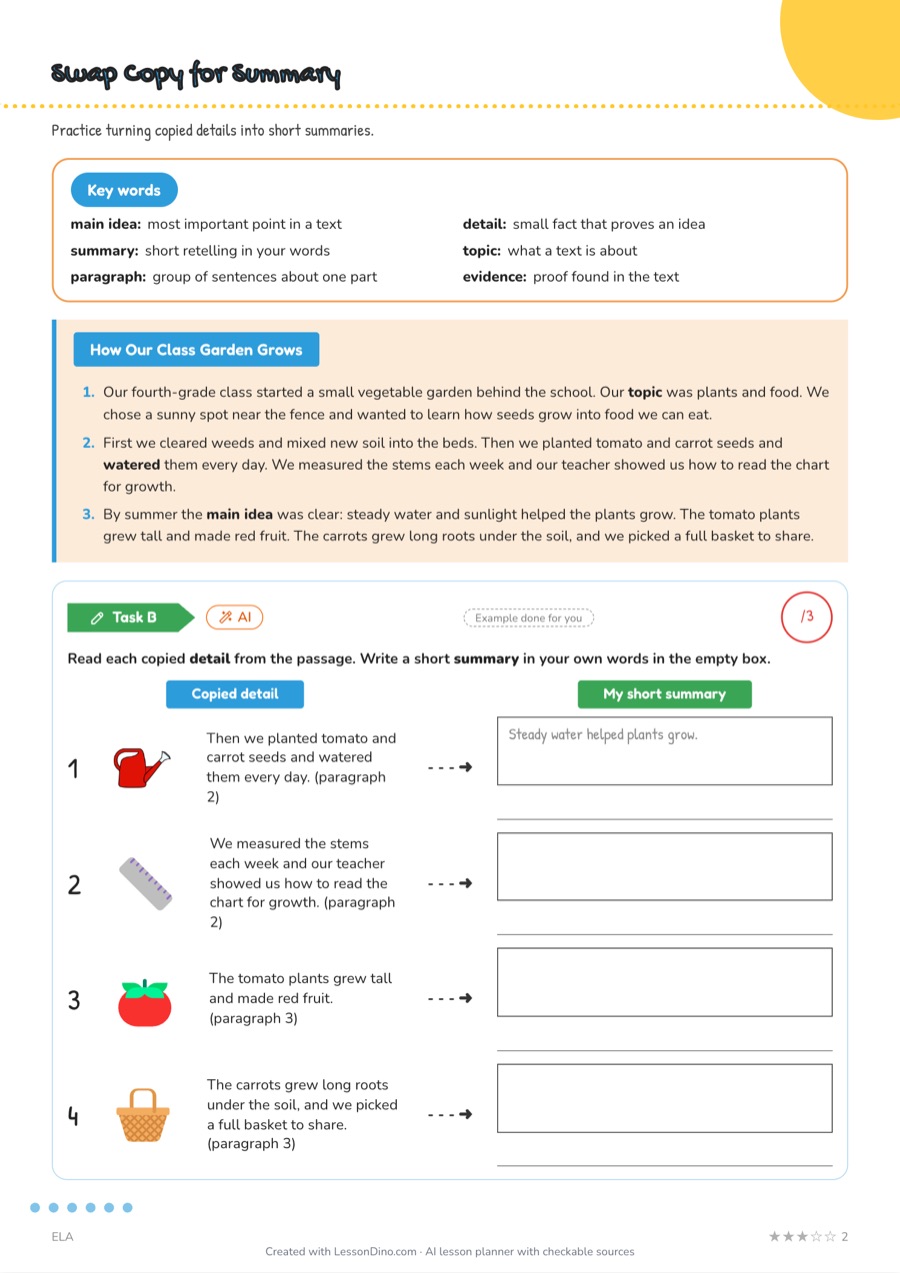
- Independent practice (10 minutes): Give out Worksheet Task B Swap it on page 2: read each copied detail from How Our Class Garden Grows and write own-words summary in empty box.
- Support: Give a paragraph with the topic sentence already underlined and only 5 sentences to shrink.
- Stretch: Have students shrink a second paragraph to exactly 20 words without losing the main idea.
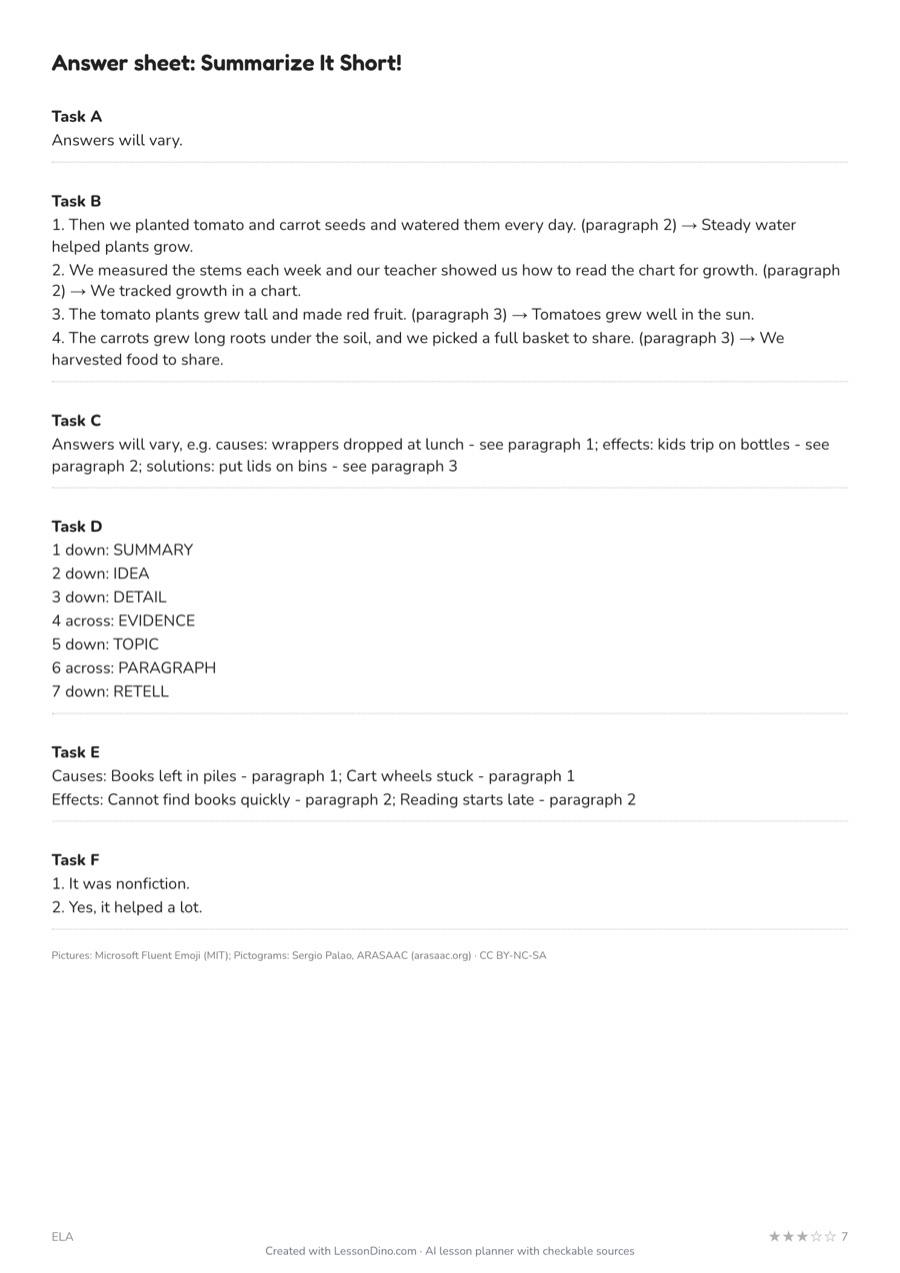
- The answer sheet is the last page, so you can print it on its own or let students check their own work.
Key vocabulary
- summary: short retelling that keeps only the most important parts in fresh phrasing
- main idea: what a text is mostly about
- detail: small piece of proof that shows the big point is true
- topic sentence: often the first line in a section that tells what that section is about
- own words: fresh phrasing thought up by you, not copied from the book
Mistakes to watch for
- Retelling every little thing instead of the big idea. Cross out extras and keep only 2-3 details that prove the main idea; a summary includes only the main ideas.
- Copying sentences word for word. Model swapping words and shortening, since summarizing is different from quoting.
- Mistaking one detail for the main idea. Ask what the whole text is mostly about and check topic sentence which is often first.
What's on the worksheet
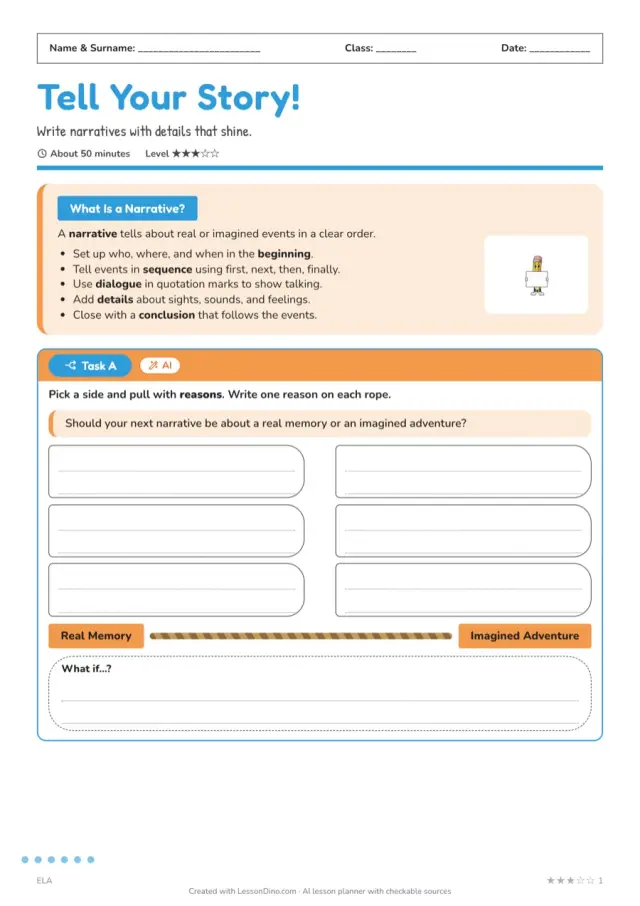
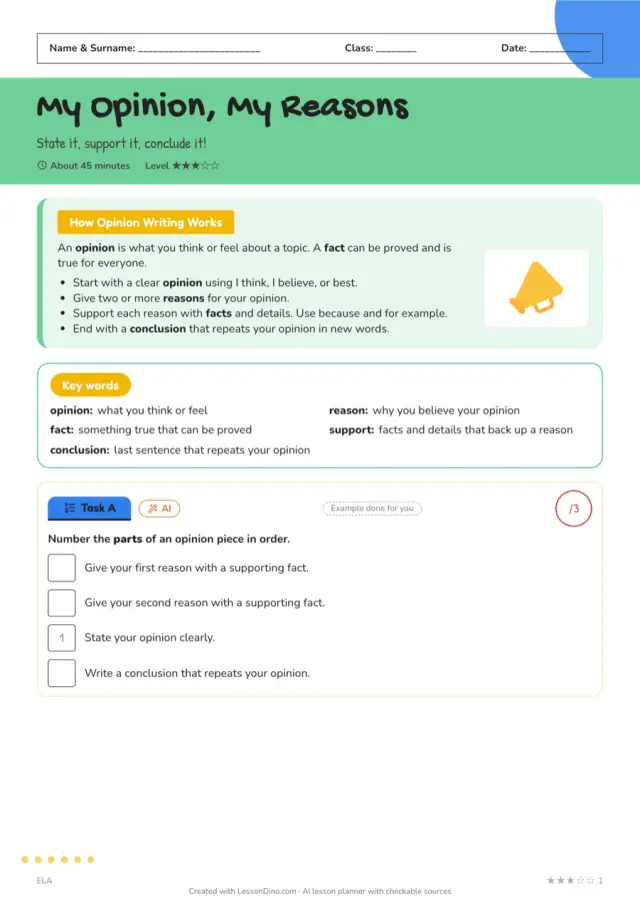
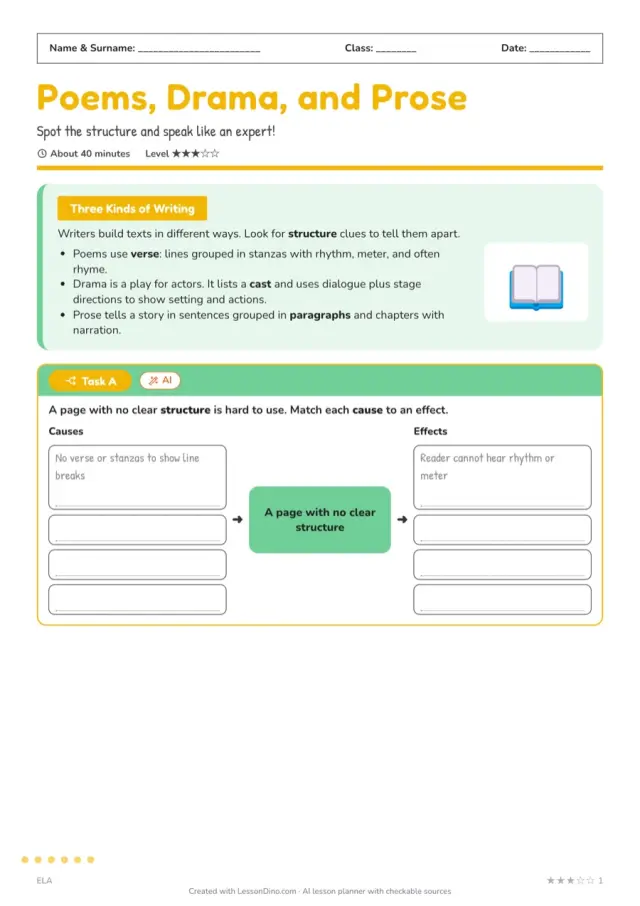
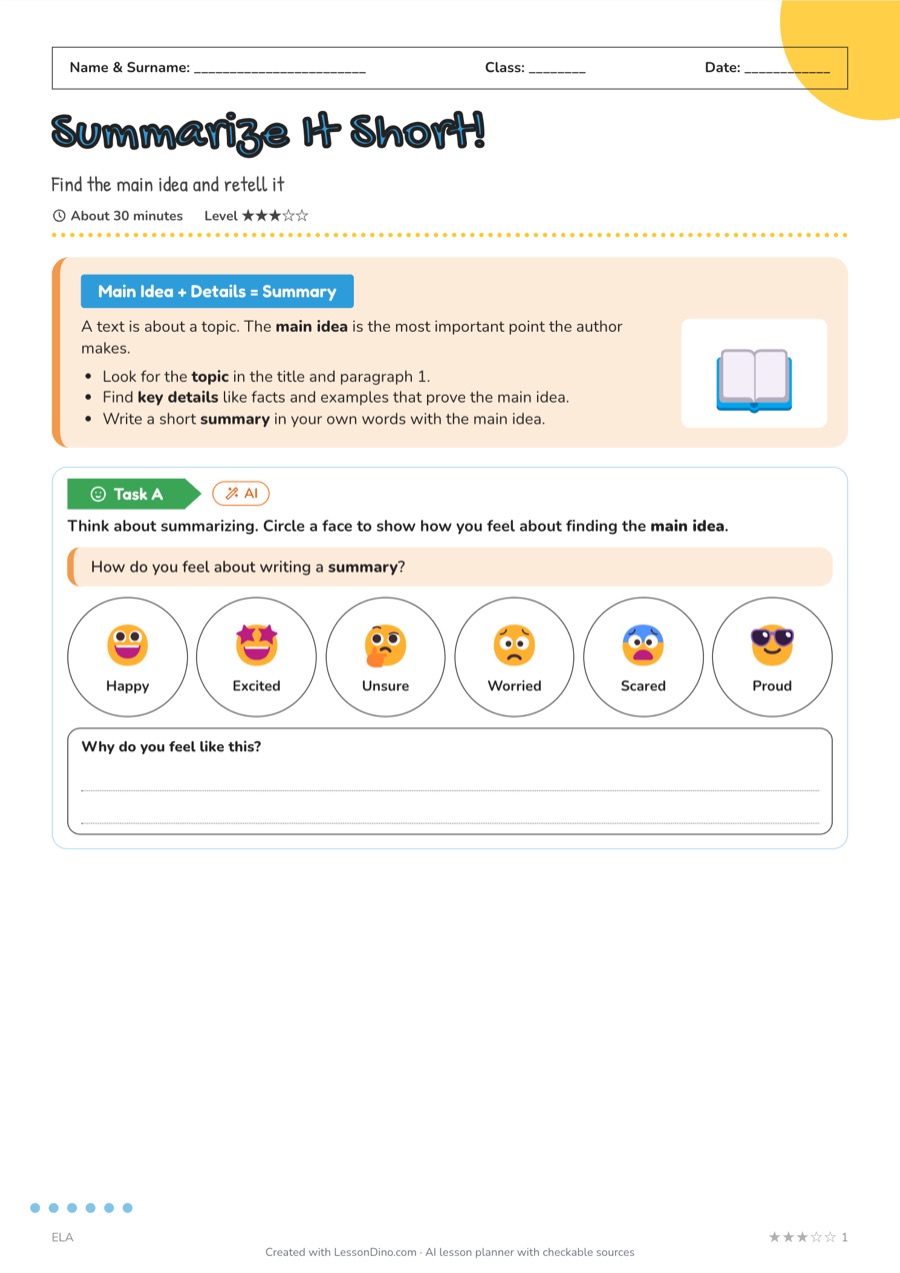
Find the Main Idea
Learn what a main idea and summary are.
Main Idea + Details = Summary
- A text is about a topic. The main idea is the most important point the author makes.
- Look for the topic in the title and paragraph 1.
- Find key details like facts and examples that prove the main idea.
- Write a short summary in your own words with the main idea.
Think about summarizing. Circle a face to show how you feel about finding the main idea.
Swap Copy for Summary
Practice turning copied details into short summaries.
| Word | Meaning |
|---|---|
| main idea | most important point in a text |
| detail | small fact that proves an idea |
| summary | short retelling in your words |
| topic | what a text is about |
| paragraph | group of sentences about one part |
| evidence | proof found in the text |
How Our Class Garden Grows
Read each copied detail from the passage. Write a short summary in your own words in the empty box.
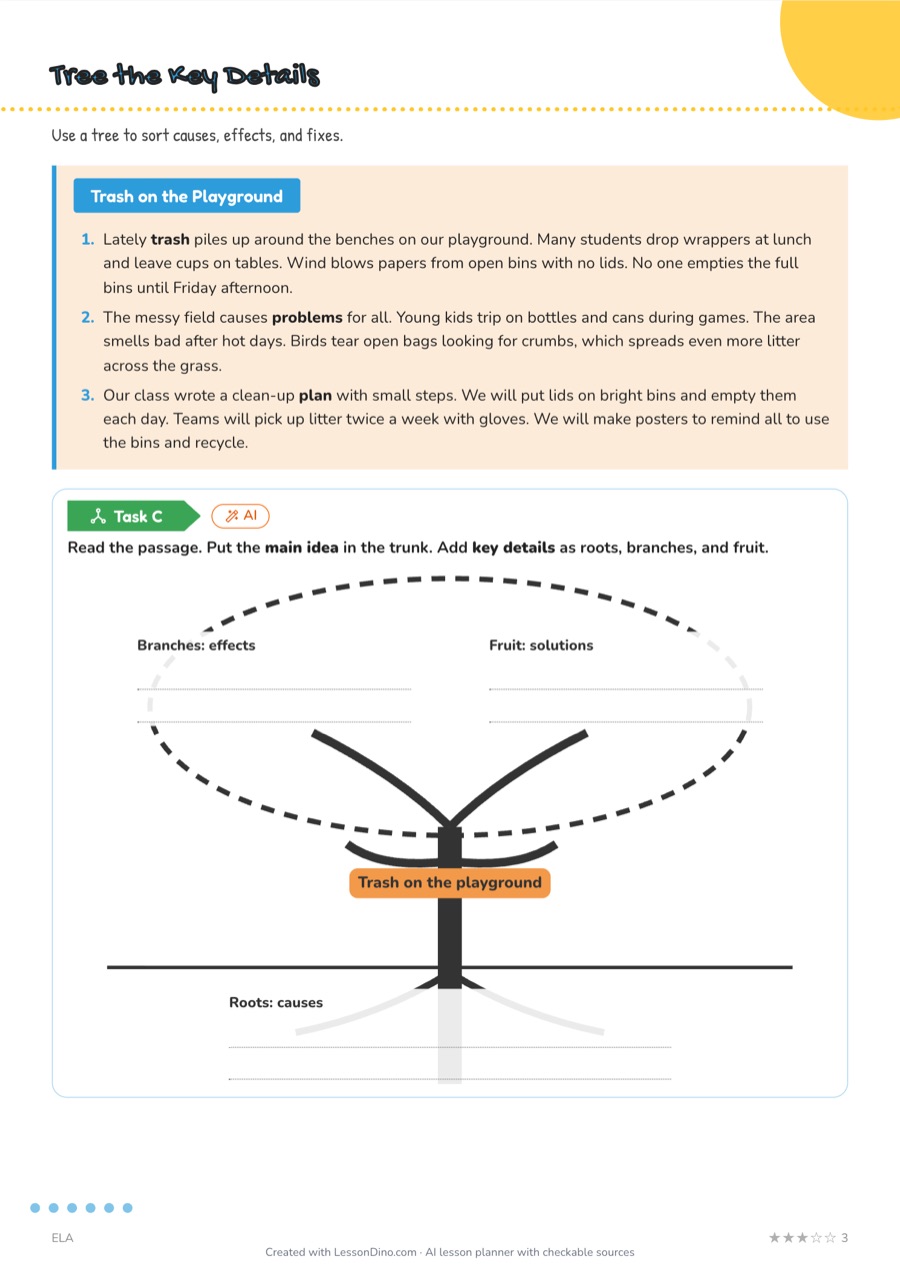
Tree the Key Details
Use a tree to sort causes, effects, and fixes.
Trash on the Playground
Read the passage. Put the main idea in the trunk. Add key details as roots, branches, and fruit.
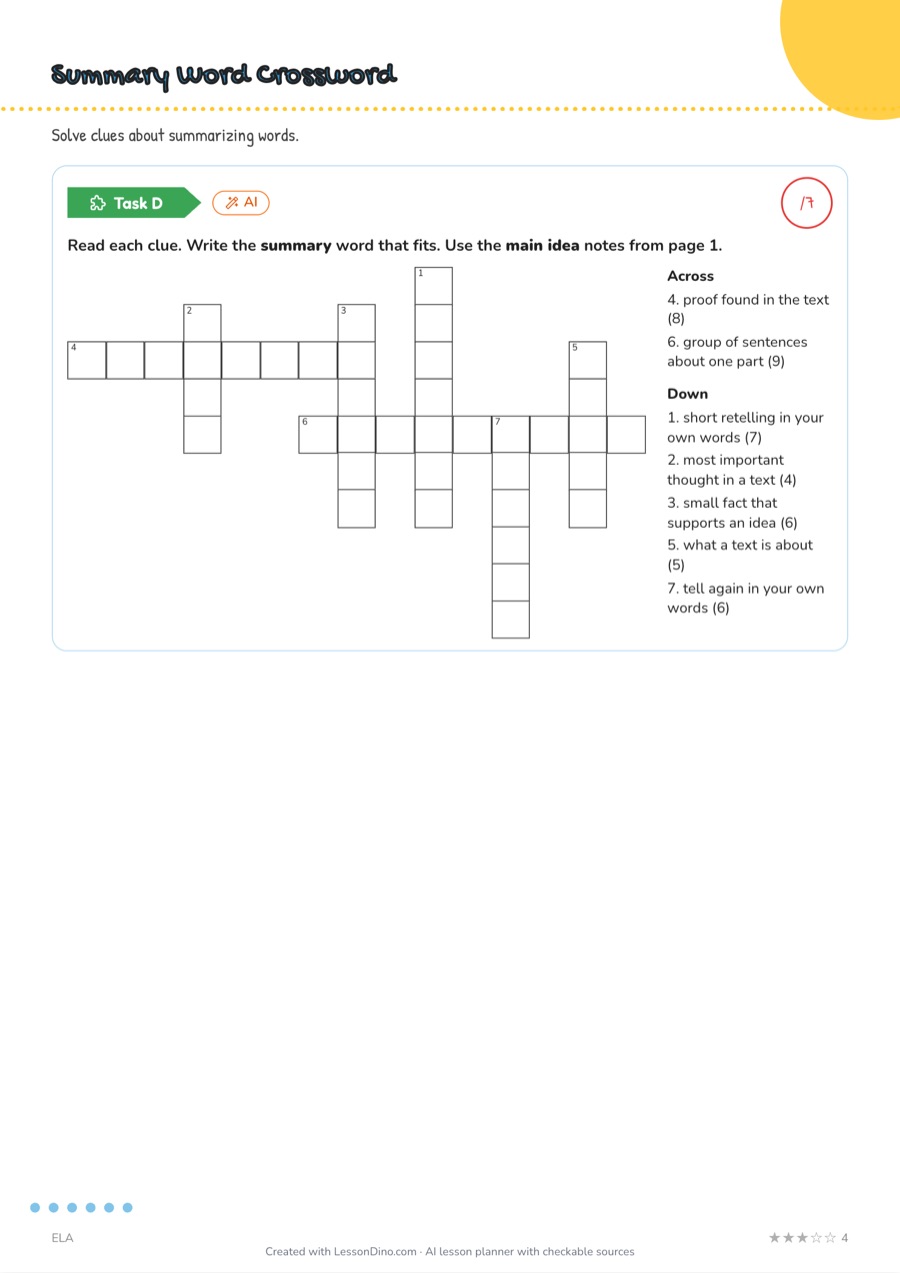
Summary Word Crossword
Solve clues about summarizing words.
Read each clue. Write the summary word that fits. Use the main idea notes from page 1.
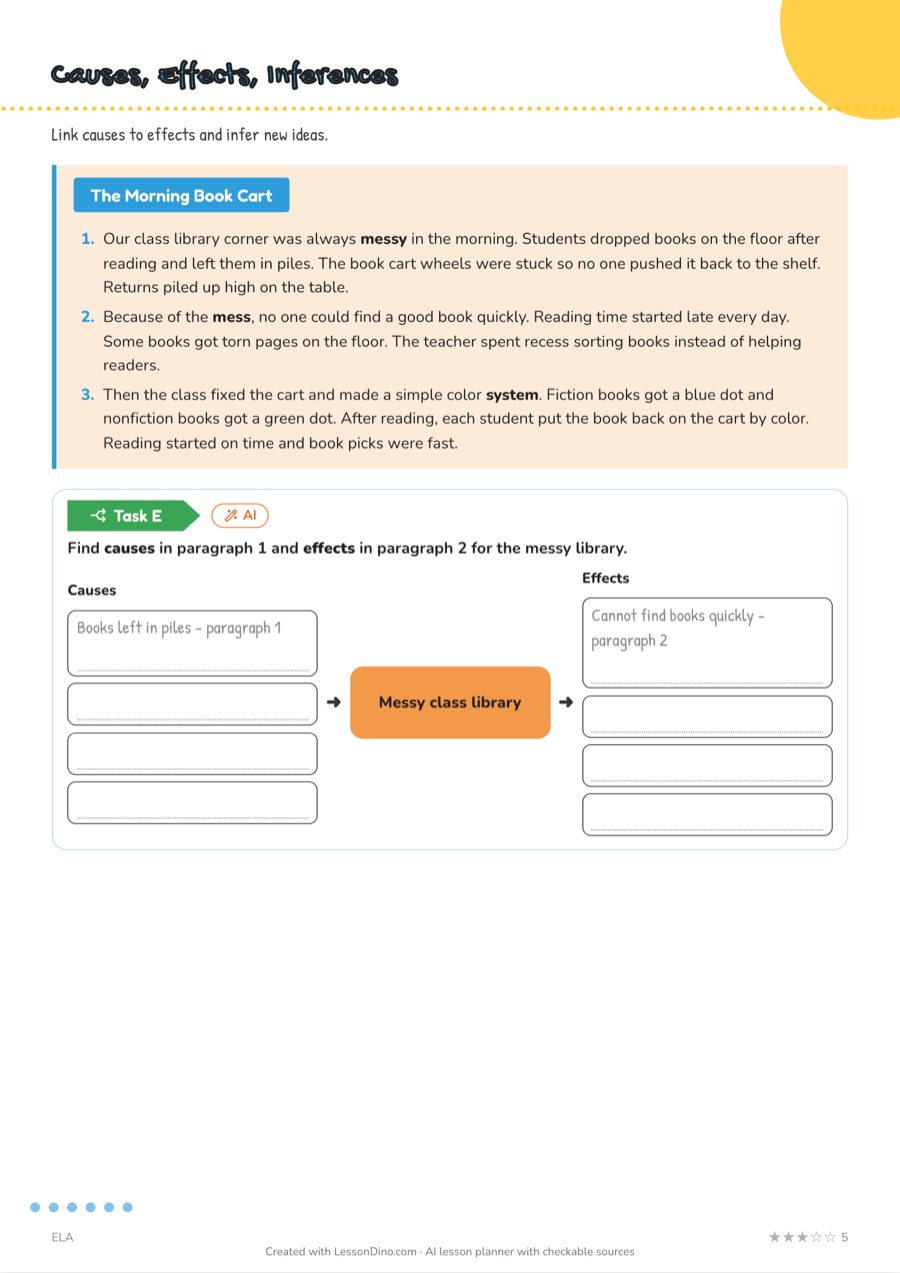
Causes, Effects, Inferences
Link causes to effects and infer new ideas.
The Morning Book Cart
Find causes in paragraph 1 and effects in paragraph 2 for the messy library.
Page 6
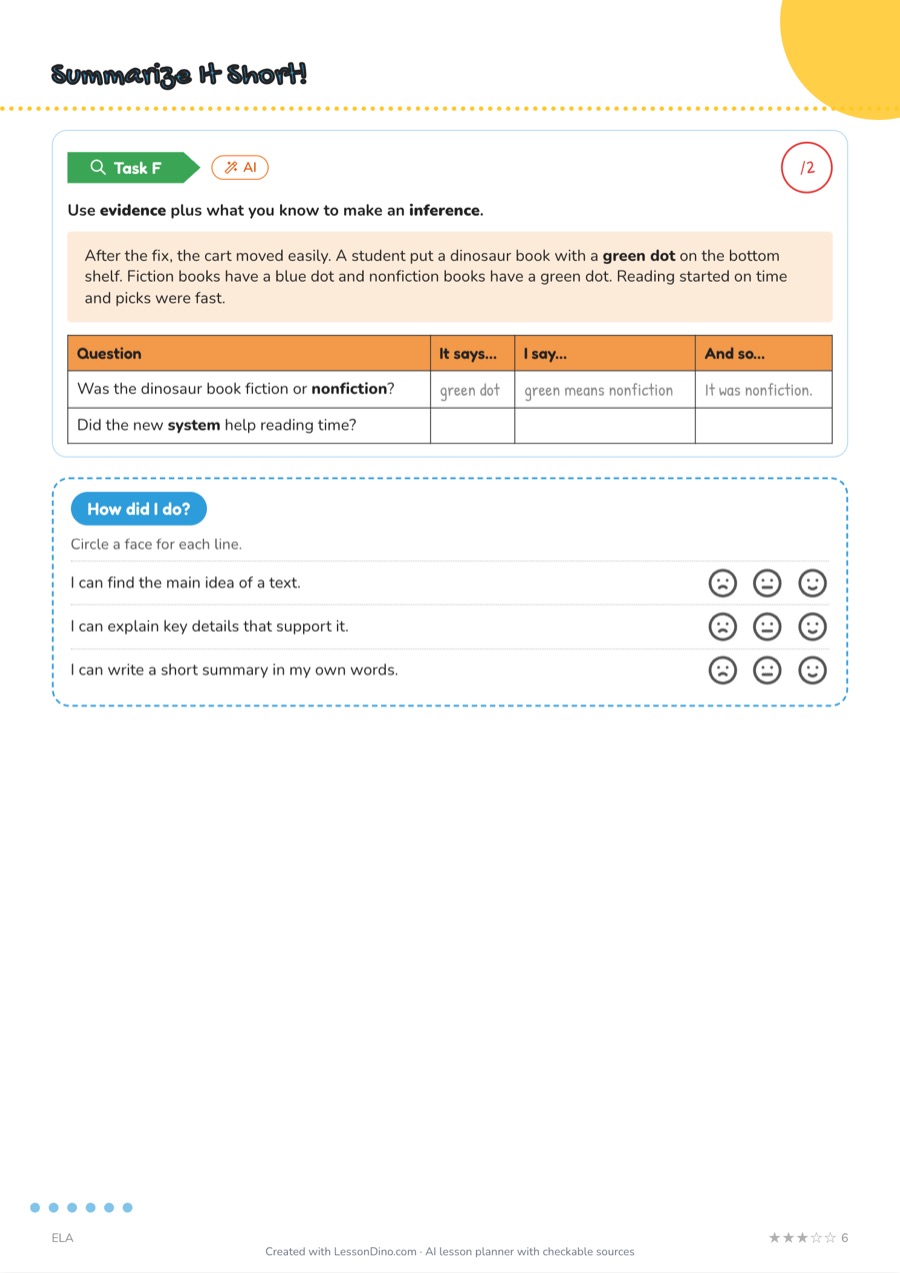
Use evidence plus what you know to make an inference.
- After the fix, the cart moved easily. A student put a dinosaur book with a green dot on the bottom shelf. Fiction books have a blue dot and nonfiction books have a green dot. Reading started on time and picks were fast.
- Was the dinosaur book fiction or nonfiction?
- Did the new system help reading time?
Answers
Show the answers
The answers are on the answer sheet, the last picture above.
Curriculum
Determine the main idea of a text and explain how it is supported by key details; summarize the text.
Made with Lesson Dino's AI on 17 October 2026. AI can make mistakes, so check the answers and facts against the sources before you teach.