Slides
Lesson plan
Sum It Up: Main Idea and Key Details
Students learn to find the main idea and show how key details support it. They shrink a paragraph into a short summary in their own words.
Objectives
- Students will determine the main idea of an informational text.
- Students will explain how key details support the main idea.
- Students will write a short summary in their own words.
Success criteria
- I can state the main idea in one sentence.
- I can point to 2 key details that prove it.
- I can write a short summary in my own words.
Key words
| Word | Meaning |
|---|---|
| summary | short retelling that keeps only the most important parts in fresh phrasing |
| main idea | what a text is mostly about |
| detail | small piece of proof that shows the big point is true |
| topic sentence | often the first line in a section that tells what that section is about |
| own words | fresh phrasing thought up by you, not copied from the book |
Timed plan (60 minutes)
| Time | Stage | What happens |
|---|---|---|
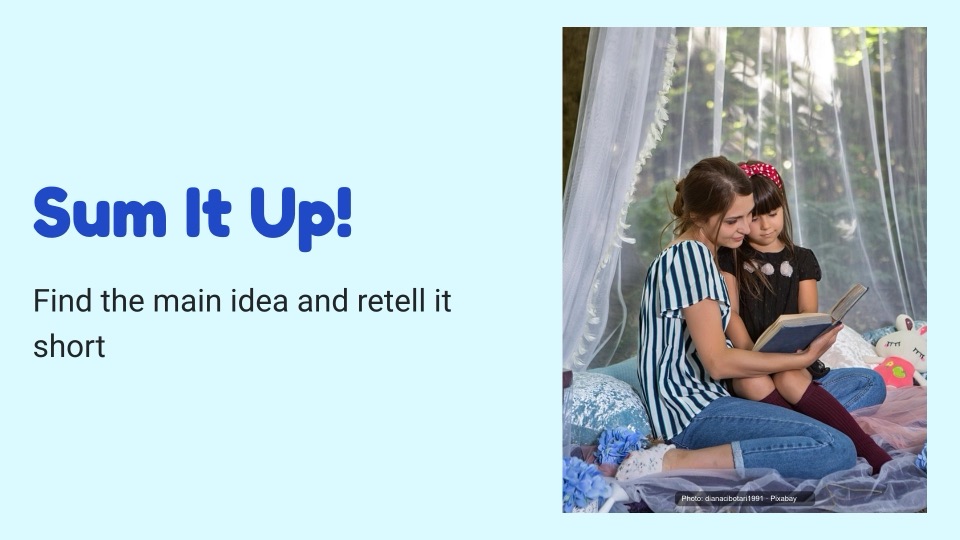
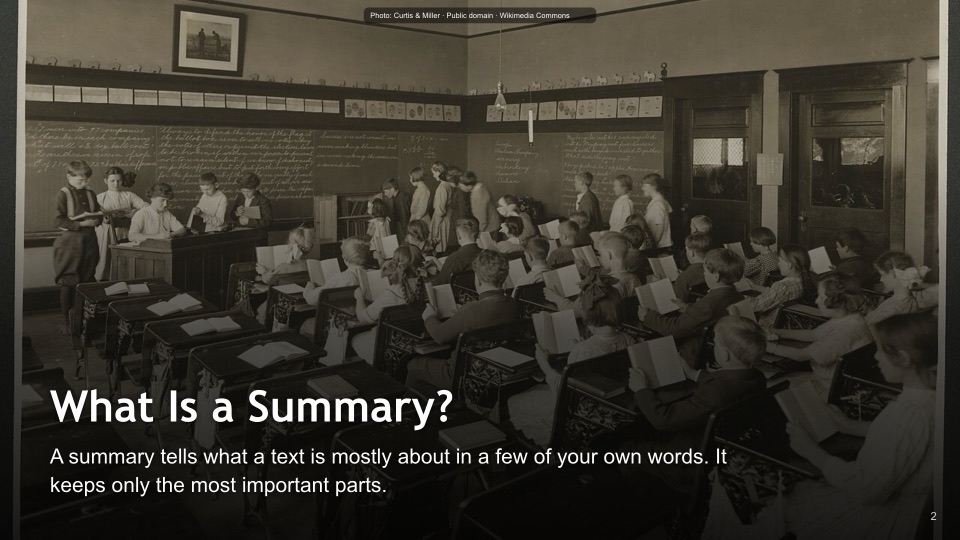
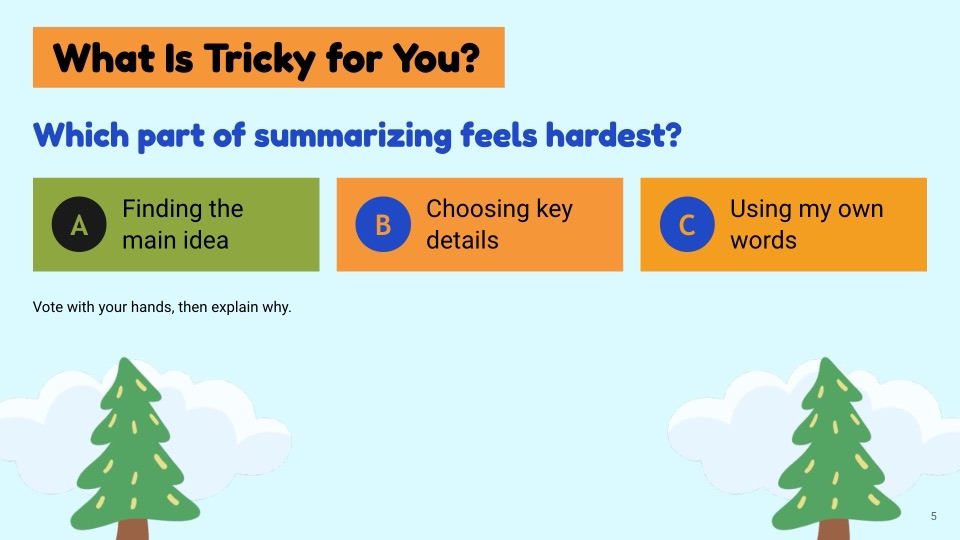
| 10 min | Starter | Activate prior knowledge of gist and hook students on shrinking text. Hold up a tiny sticky note and a full page and say the hook. Show Slide 1 Sum It Up! Find the main idea and retell it short and Slide 2: A summary tells what a text is mostly about in a few of your own words. It keeps only the most important parts. Ask what summarizing feels hard and show Slide 5 vote options. Preview goal: today we will write a short summary that states the main idea and key details in our own words. |
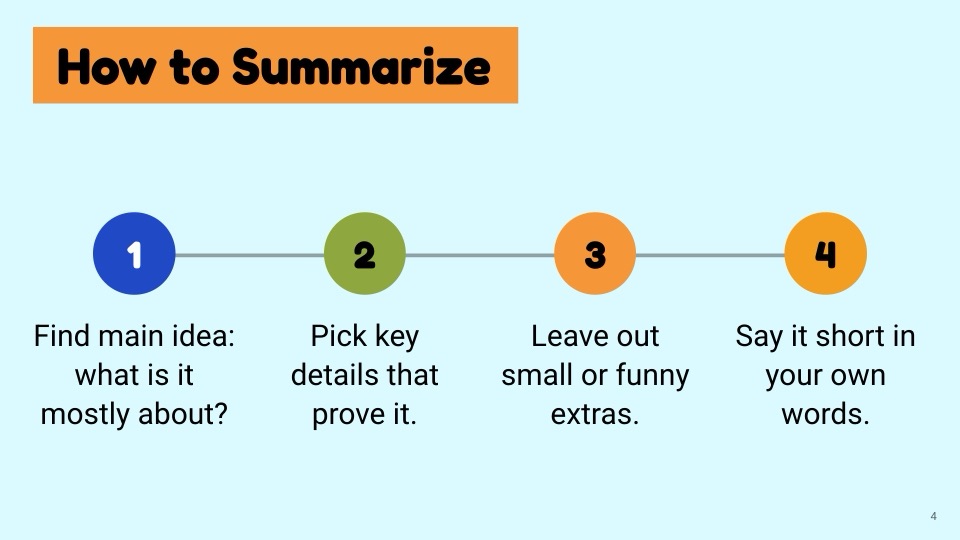
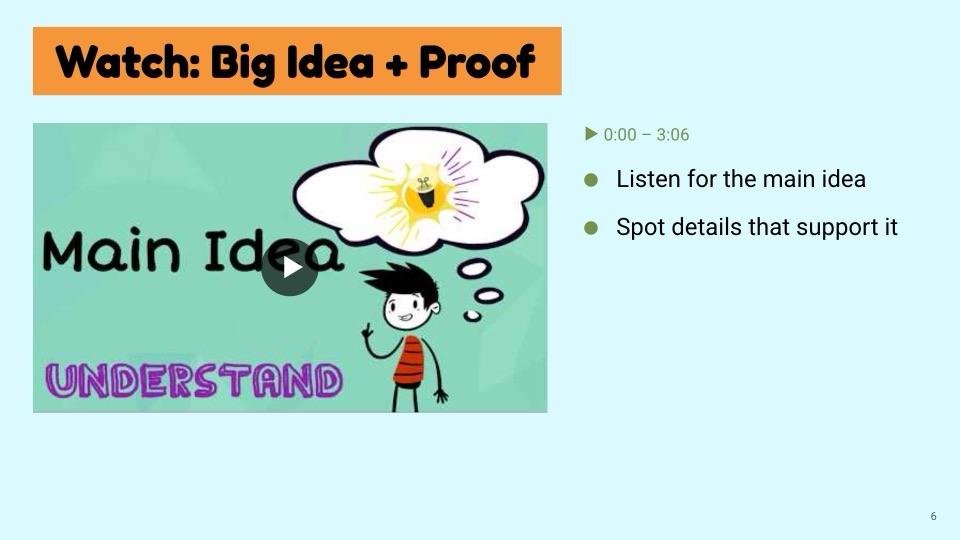
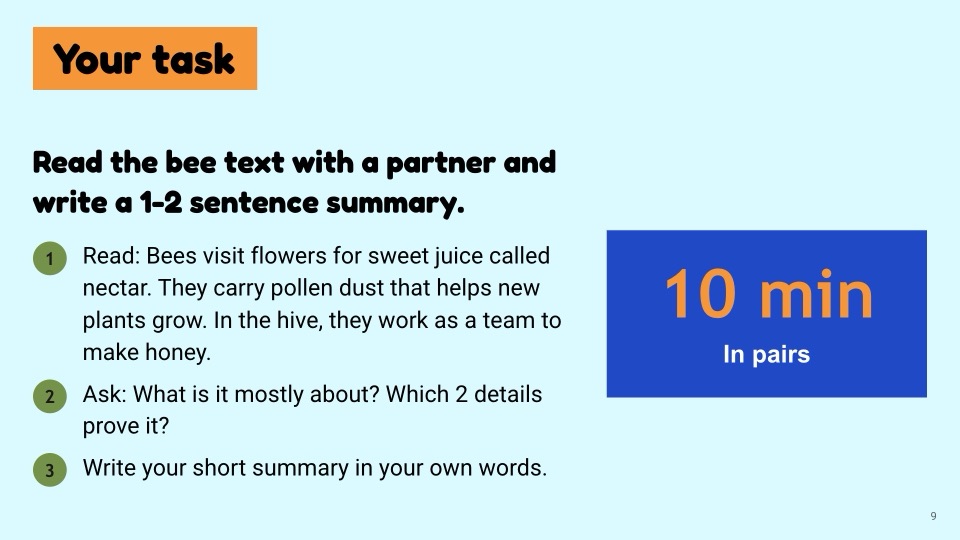
| 15 min | Teaching | Model how to find the main idea, pick key details, and summarize short. Show Slide 4 steps: Find main idea, pick key details that prove it, leave out extras, say it short in your own words. Play Video clip 3 (0:00-3:06) on Slide 6. Tell students to listen for the big idea and spot details that support it. Model with Slide 9 text, finding the topic sentence idea which is often the first one and crossing out extras. Think aloud a 2-sentence summary in own words, showing summarizing is different from quoting. |
| 20 min | Main activity | Students shrink a paragraph to a sticky-note summary with main idea and details. Give out printed recess paragraph, pencils and sticky notes. Read paragraph aloud once, then have students reread and underline the topic sentence which is often the first sentence. Model crossing out repeated words and a funny extra, keeping 2-3 key details, since summarizing checks understanding and finds main ideas. Direct each student to write a 2-3 sentence summary that includes only the main ideas on the sticky note and stick it on the board. |
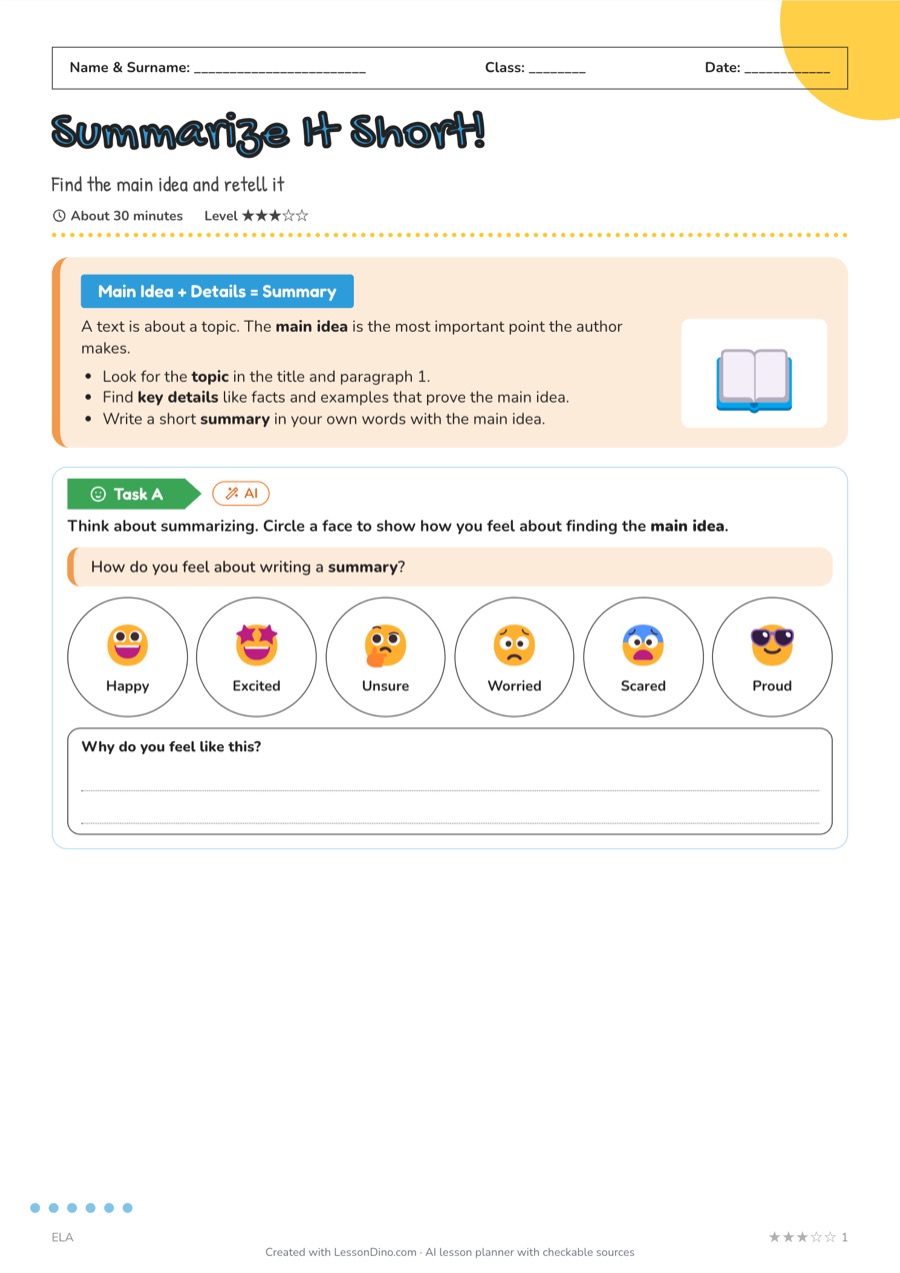
| 10 min | Independent practice | Students practice using own words for a summary of the garden passage. Give out Worksheet Task B Swap it on page 2: read each copied detail from How Our Class Garden Grows and write own-words summary in empty box. Point to paragraph 2 growth steps and paragraph 3 result where steady water and sunlight helped the plants grow. Remind students to change copied words and shorten, because paraphrasing differs from quoting and summarizing. Collect or have partners compare boxes for own-words check. |
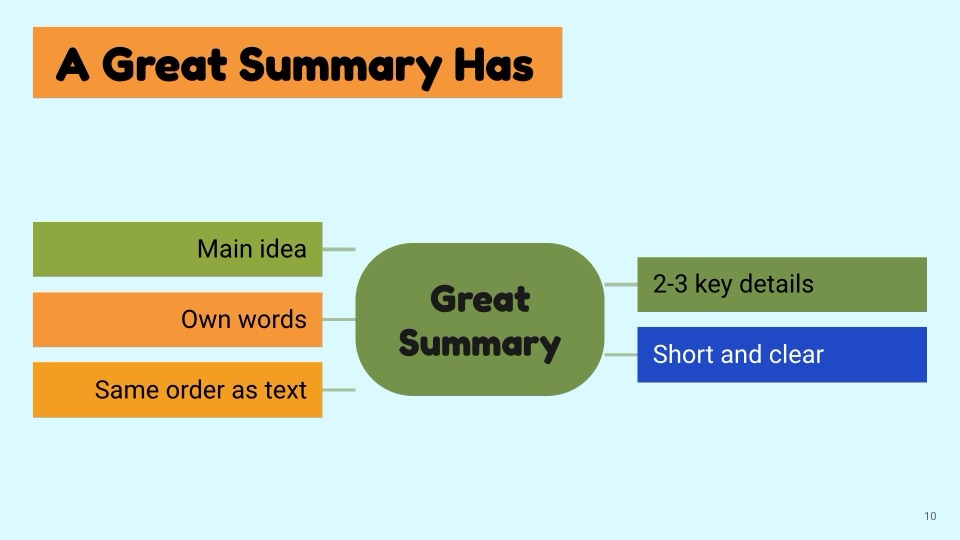
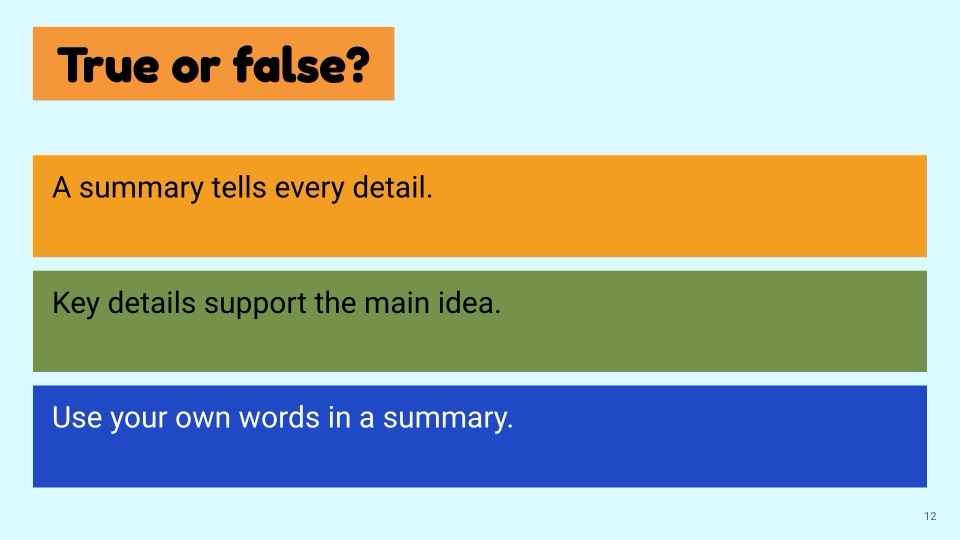
| 5 min | Plenary | Review what makes a great summary and check understanding. Show Slide 10 mindmap: Main idea, 2-3 key details, own words, short and clear, same order as text. Read 2 sticky notes aloud and have class check them against the mindmap. Run Slide 12 True or false: A summary tells every detail - false, it keeps only main idea and key details that prove what it is mostly about. |
Common mistakes
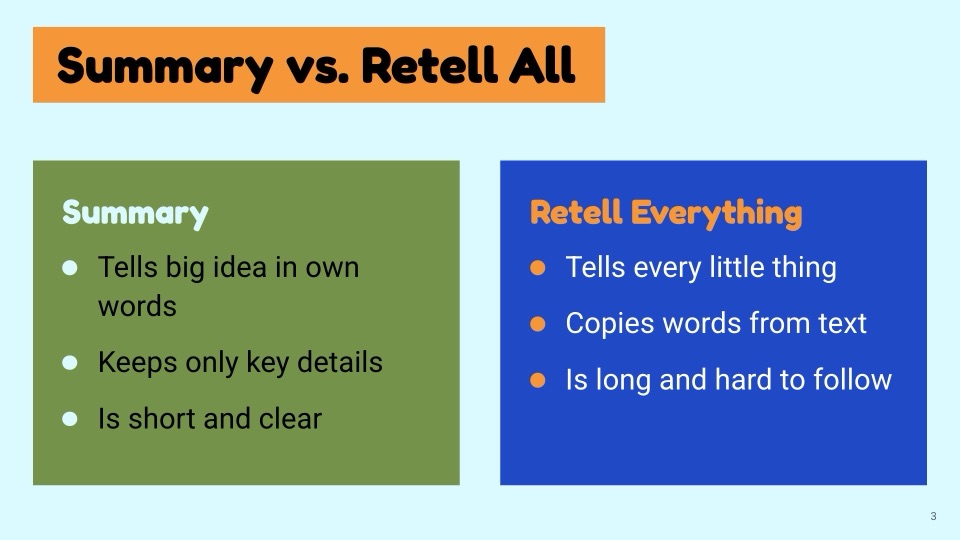
- Retelling every little thing instead of the big idea
How to spot it: Summary is long and lists extras like shoelace laugh
Cross out extras and keep only 2-3 details that prove the main idea; a summary includes only the main ideas - Copying sentences word for word
How to spot it: 3 or more words in a row match the text
Model swapping words and shortening, since summarizing is different from quoting - Mistaking one detail for the main idea
How to spot it: Main-idea sentence only names kickball or nectar
Ask what the whole text is mostly about and check topic sentence which is often first
Support
- Give a paragraph with the topic sentence already underlined and only 5 sentences to shrink.
- Provide sentence frames and word bank: This text is mostly about. One detail is. Another detail is.
Stretch
- Have students shrink a second paragraph to exactly 20 words without losing the main idea.
- Have students write two different one-sentence versions of the main idea and pick the clearer one.
Check questions
- What is the main idea of the recess paragraph?
Answer: Recess gives fourth graders a healthy break to move and play together. - Name 2 key details that support it.
Answer: Play kickball; use swings/climbing parts; walk track to stretch - any 2 that prove the break to move and play. - Write one own-words summary sentence for bees or garden text.
Answer: Accept any short sentence in new wording that keeps big idea, e.g., Bees move pollen that grows new plants and work as a team to make honey.
Curriculum
Determine the main idea of a text and explain how it is supported by key details; summarize the text.
Video clips
Clips on YouTube, from the start and end times we chose. Check each one before you show it.
-
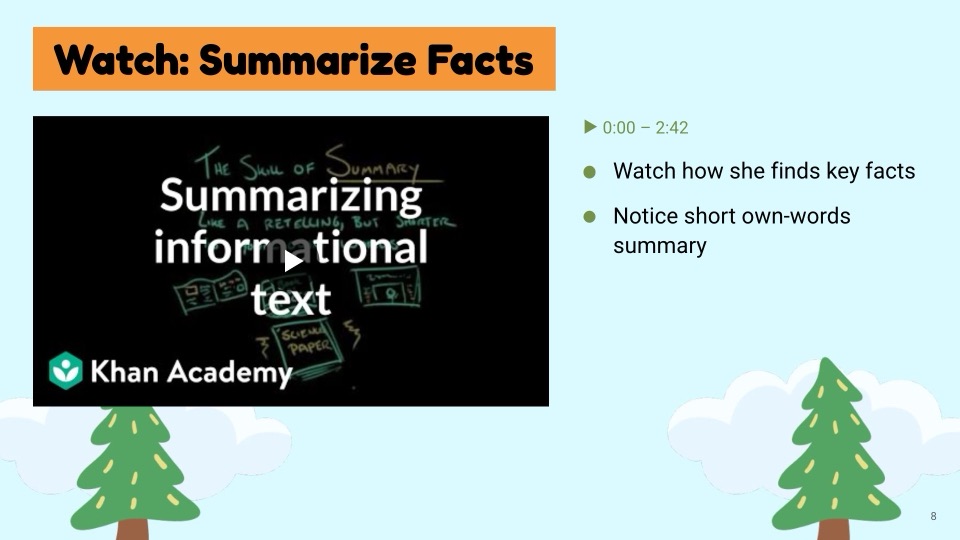
Summarizing Informational Text from 0:00 to 2:42
Khan Academy: Summarizing informational text | Reading | Khan Academy
Directly models finding the main idea with key details to write a summary at the right pace for ages 9-10.
-
Main Idea and Summarising from 0:00 to 3:06
EasyTeaching: Main Idea | Summarising | Reading Strategies
Links main idea plus supporting details to summarizing, exactly matching this Grade 4 objective for ages 9-10.
Worksheet
Sources
- How to Read the Standards thecorestandards.org
- Foundational Skills (K-5) cps.edu
- Summaries Writing to Enhance Reading Comprehension ... files.eric.ed.gov
- Online Reading Comprehension Lab | Excelsior Writing Lab owl.excelsior.edu
- How Reading Comprehension Shapes Student Learning | EWU online.ewu.edu
- Summarizing worksheets for Literacy | Worksheetzone worksheetzone.org
- Reading skills - summarising material - BBC Bitesize bbc.co.uk
- Comprehension Primary Resources | National Geographic Kids natgeokids.com
Picture credits
- Photo: dianacibotari1991 · Pixabay
- Photo: Curtis & Miller · Public domain · Wikimedia Commons
- Illustration: Tumisu · Pixabay
- Drawing: Equazcion at English Wikipedia · CC BY-SA 3.0 · Wikimedia Commons
- Microsoft Fluent Emoji (MIT)
- Pictograms: Sergio Palao, ARASAAC (arasaac.org) · CC BY-NC-SA
Made with Lesson Dino's AI on 17 October 2026. AI can make mistakes, so check facts against the sources before you teach.