The worksheet
About this worksheet
Students learn that a product shows the total in equal groups. They build 5 x 7 with cups and counters and explain the groups and total. This Grade 3 Math worksheet gives students (ages 8–9) six pages of practice on understanding multiplication, part of the operations and algebraic thinking unit. It goes with our free Understanding multiplication lesson, which has the slides and a timed lesson plan.
What it covers
By the end, students should be able to:
- Students will interpret products of whole numbers as totals in equal groups.
- Students will identify groups, size, and total for a multiplication expression.
- Students will write equal groups as repeated addition to find totals.
How to use it
- Practice (10 minutes): Hand out Worksheet Task B: Read each multiplication as equal groups and find the total.
- Support: Start with only 2 or 3 groups and use larger cubes so counting is easier.
- Stretch: Students build both 3 x 4 and 4 x 3 and explain how the groups look different but the total is the same.
- The answer sheet is the last page, so you can print it on its own or let students check their own work.
Key vocabulary
- equal groups: collections that each have the same number of things
- factor: one of the numbers we multiply
- product: the answer when you multiply
- repeated addition: adding groups of the same size one after another
Mistakes to watch for
- Adds the factors, such as 5 + 7 = 12 for 5 x 7. Rebuild 5 groups of 7 objects each and count all to show the product is 35, not 12.
- Makes unequal groups but still writes a multiplication. Check each group has the same number, since multiplication is calculating the sum of groups of the same size.
- Swaps groups and size, building 7 groups of 5 for 5 x 7. Point to first factor for number of cups and second for counters in each cup, then compare 5 groups of 7 with 7 groups of 5.
What's on the worksheet
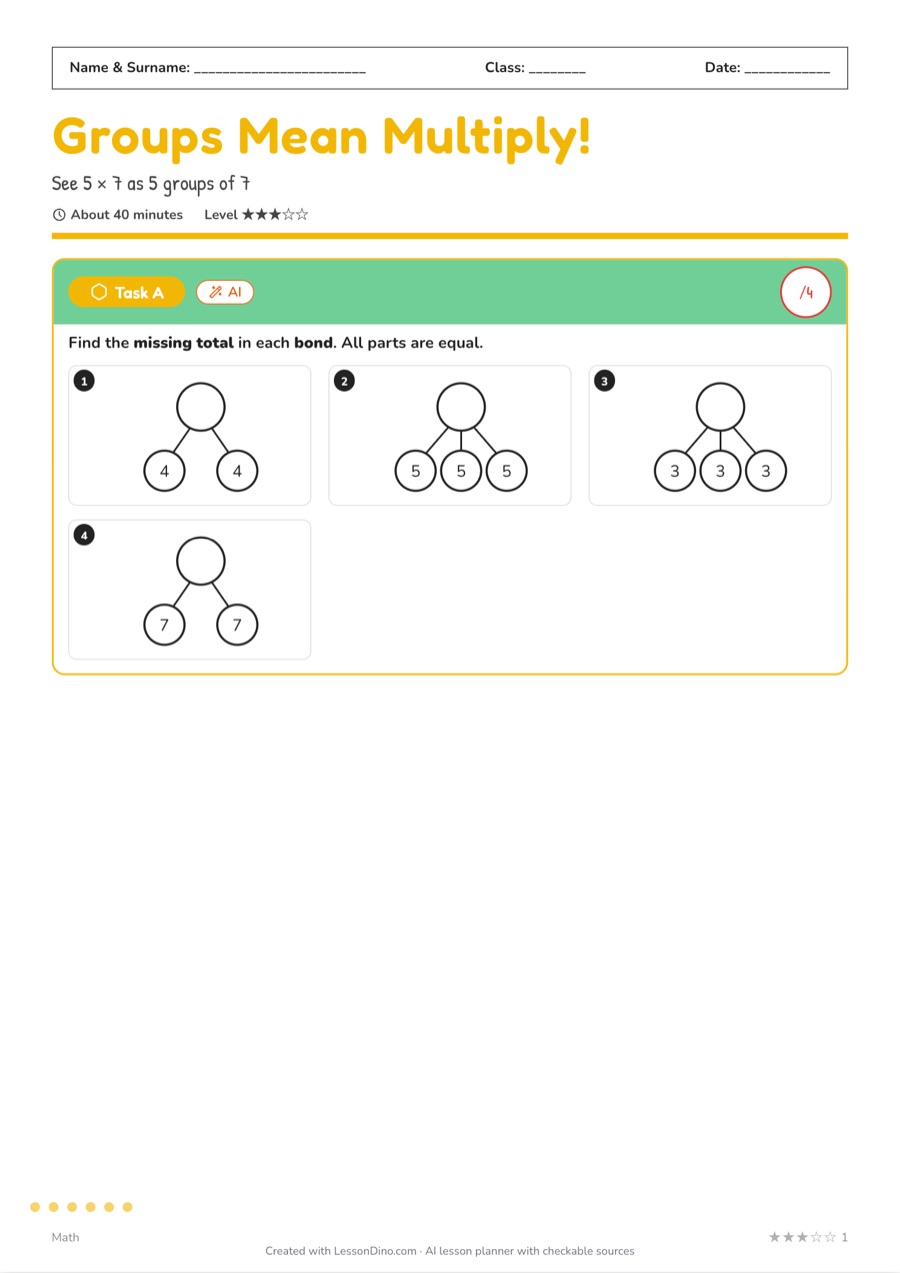
Groups Make Totals
Learn what a product means in equal groups.
Find the missing total in each bond. All parts are equal.
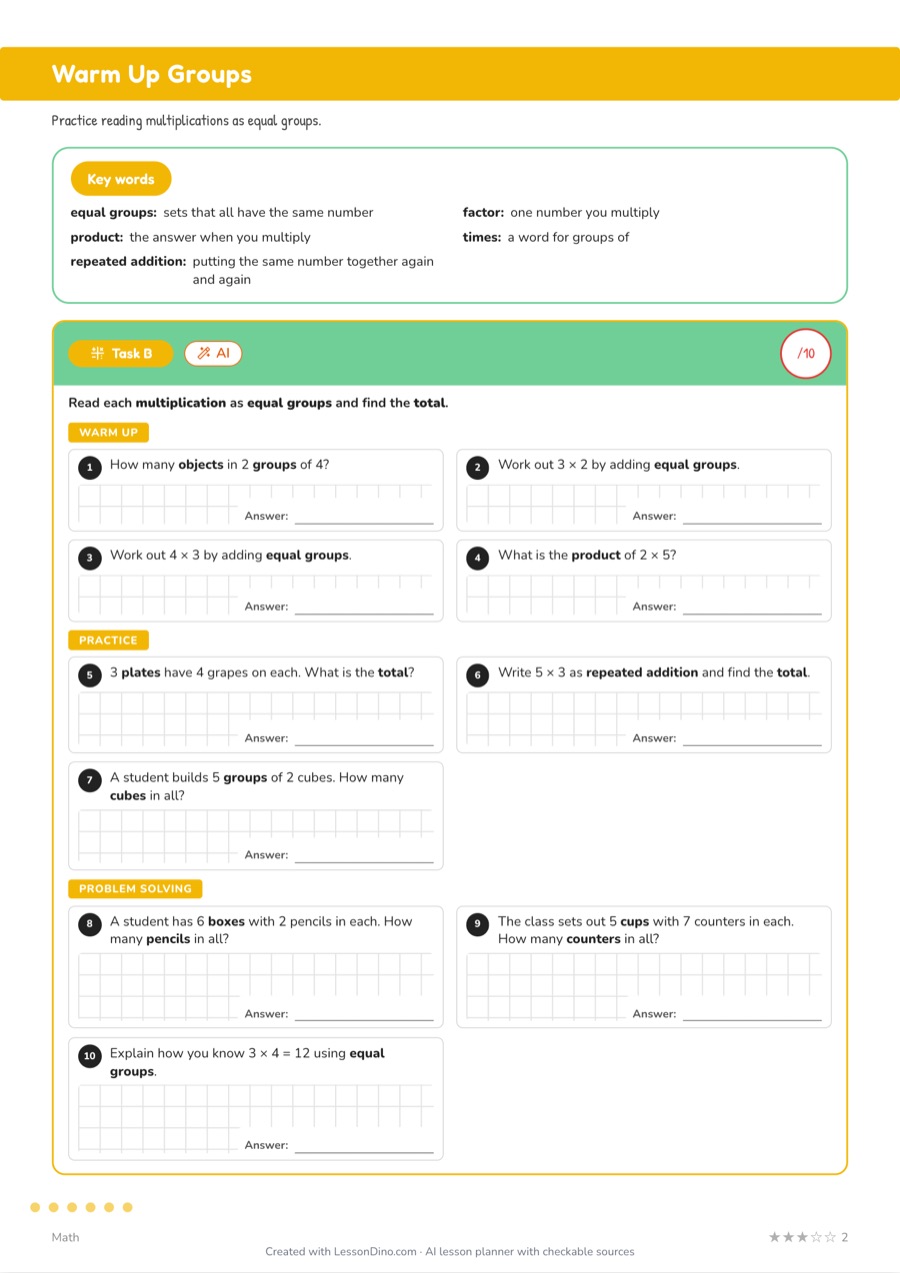
Warm Up Groups
Practice reading multiplications as equal groups.
| Word | Meaning |
|---|---|
| equal groups | sets that all have the same number |
| factor | one number you multiply |
| product | the answer when you multiply |
| times | a word for groups of |
| repeated addition | putting the same number together again and again |
Read each multiplication as equal groups and find the total.
Warm up
- How many objects in 2 groups of 4?
- Work out 3 × 2 by adding equal groups.
- Work out 4 × 3 by adding equal groups.
- What is the product of 2 × 5?
Practice
- 3 plates have 4 grapes on each. What is the total?
- Write 5 × 3 as repeated addition and find the total.
- A student builds 5 groups of 2 cubes. How many cubes in all?
Problem solving
- A student has 6 boxes with 2 pencils in each. How many pencils in all?
- The class sets out 5 cups with 7 counters in each. How many counters in all?
- Explain how you know 3 × 4 = 12 using equal groups.
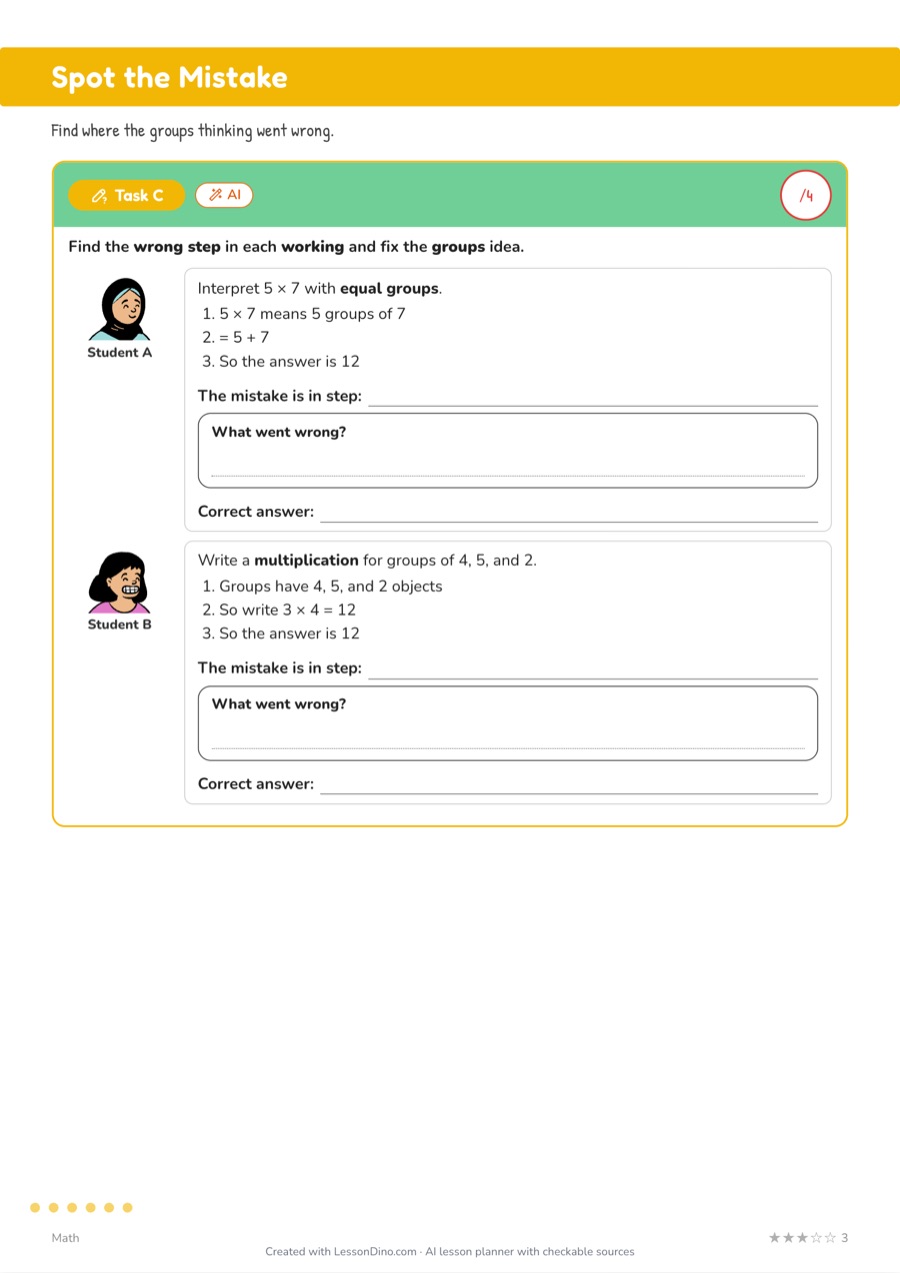
Spot the Mistake
Find where the groups thinking went wrong.
Find the wrong step in each working and fix the groups idea.
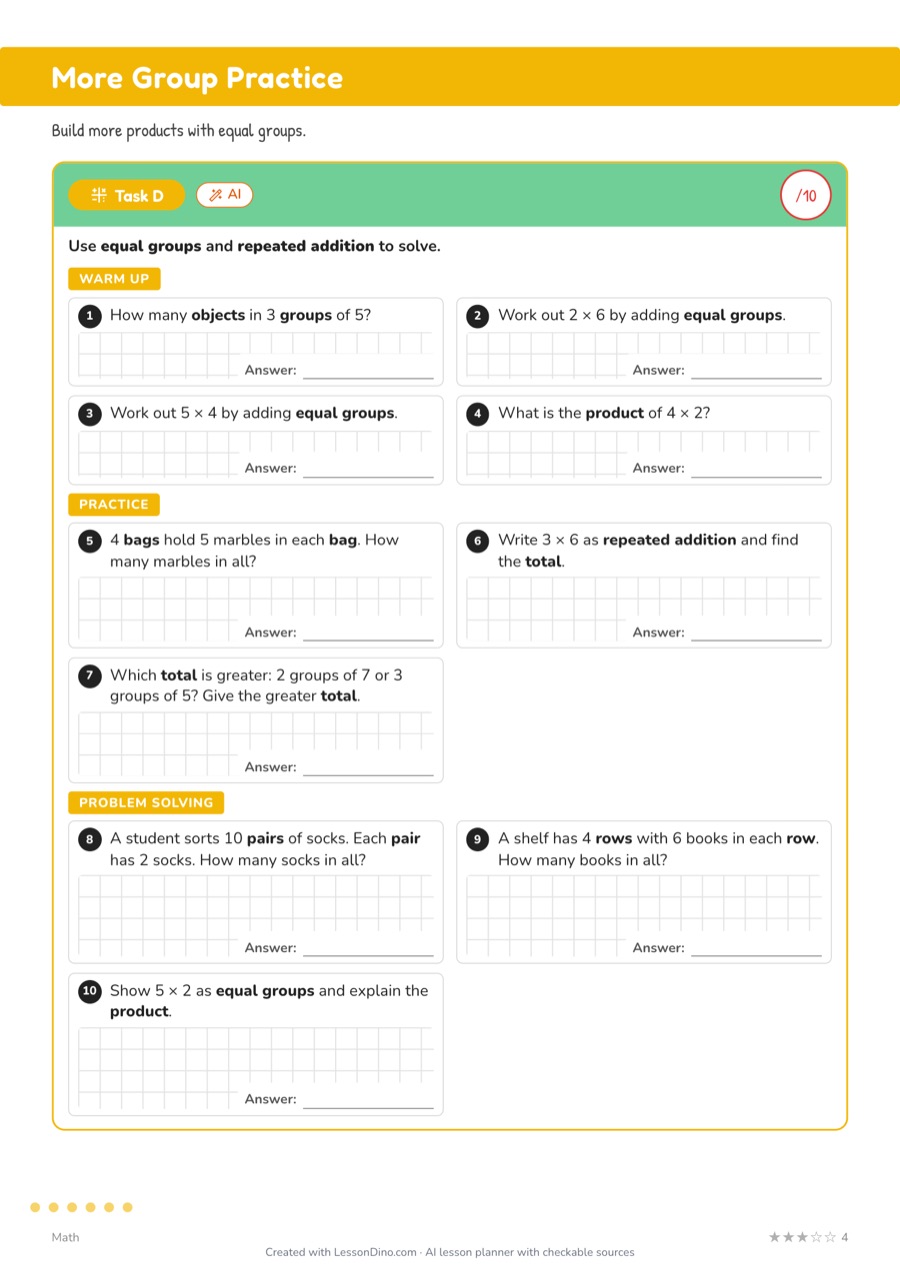
More Group Practice
Build more products with equal groups.
Use equal groups and repeated addition to solve.
Warm up
- How many objects in 3 groups of 5?
- Work out 2 × 6 by adding equal groups.
- Work out 5 × 4 by adding equal groups.
- What is the product of 4 × 2?
Practice
- 4 bags hold 5 marbles in each bag. How many marbles in all?
- Write 3 × 6 as repeated addition and find the total.
- Which total is greater: 2 groups of 7 or 3 groups of 5? Give the greater total.
Problem solving
- A student sorts 10 pairs of socks. Each pair has 2 socks. How many socks in all?
- A shelf has 4 rows with 6 books in each row. How many books in all?
- Show 5 × 2 as equal groups and explain the product.
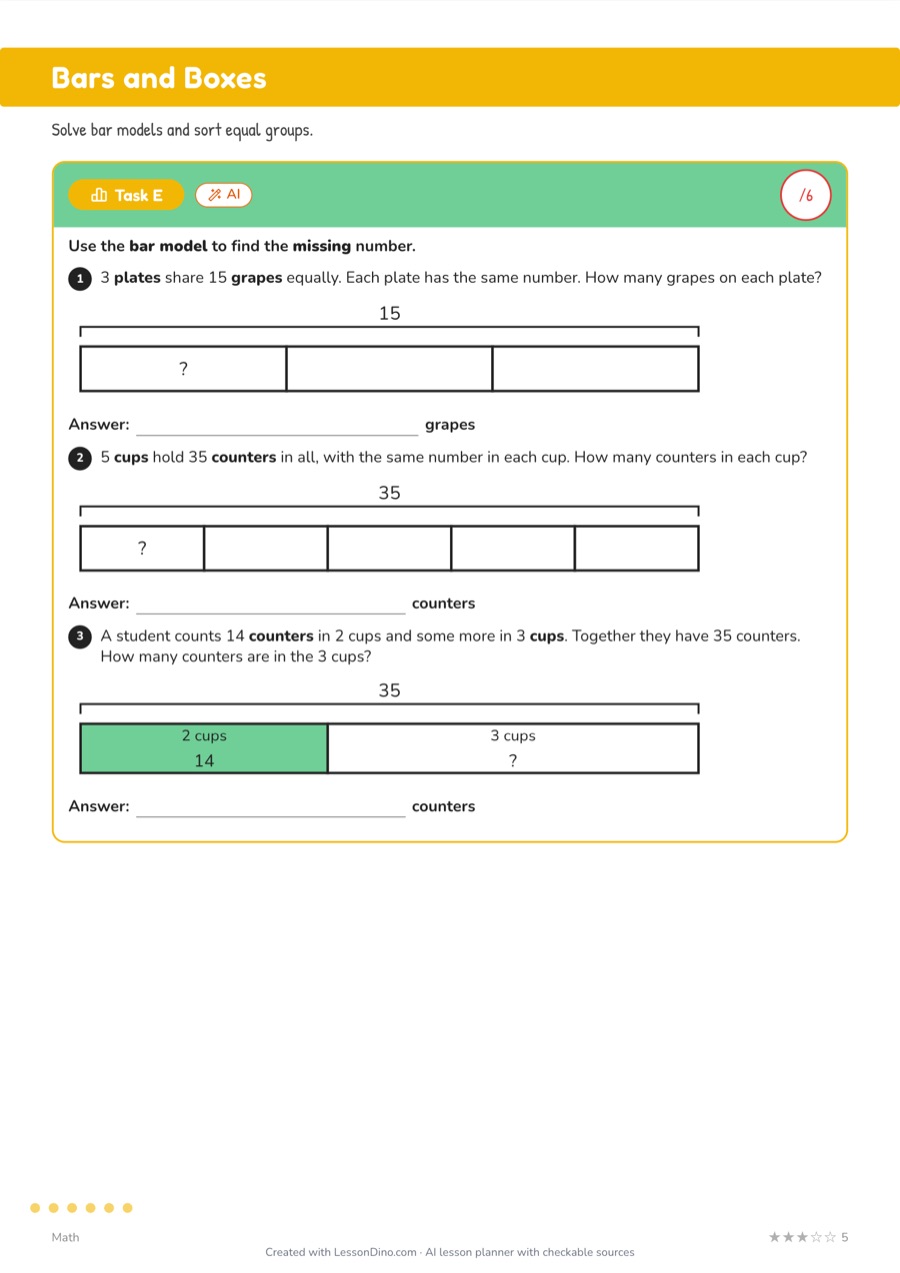
Bars and Boxes
Solve bar models and sort equal groups.
Use the bar model to find the missing number.
Page 6
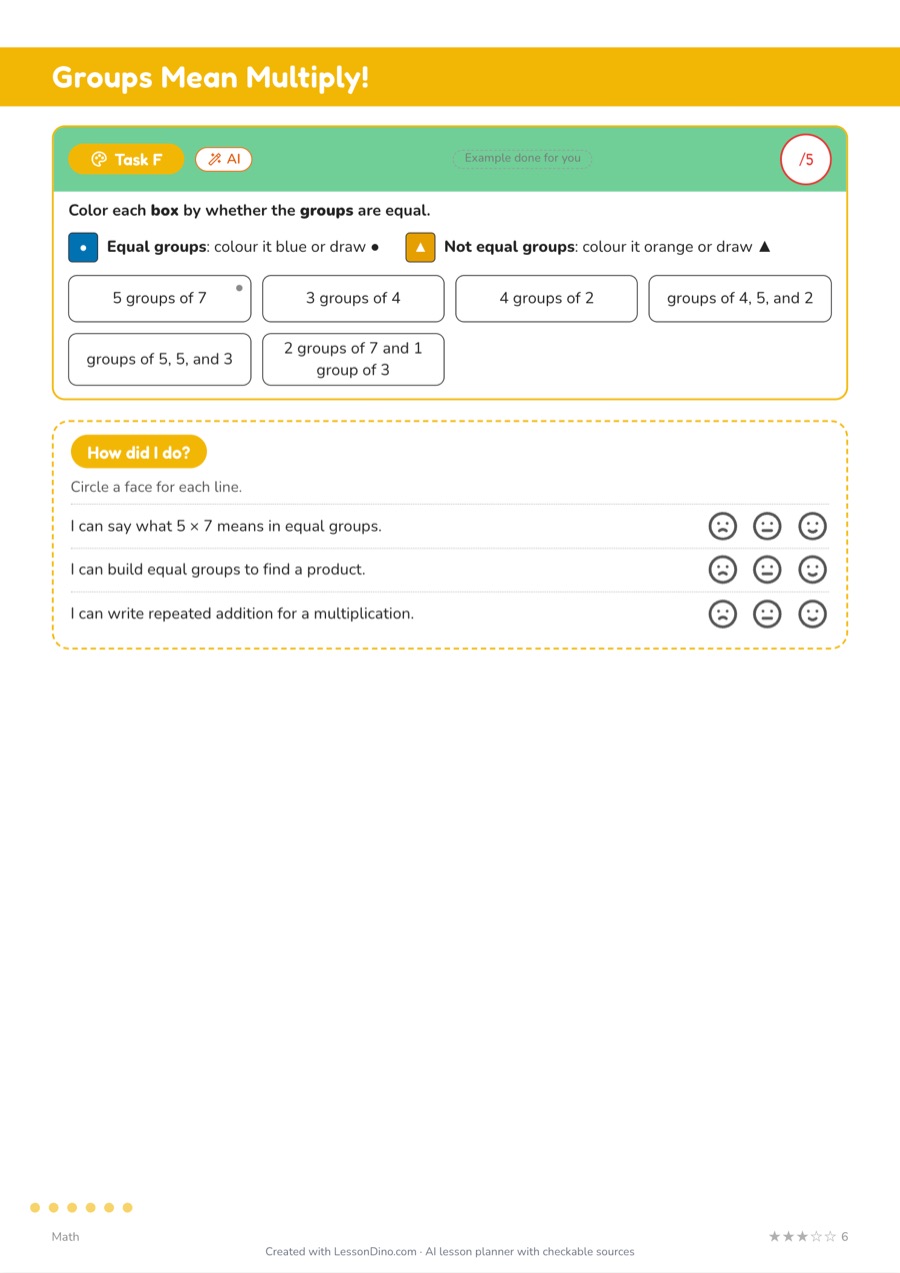
Color each box by whether the groups are equal.
Answers
Show the answers
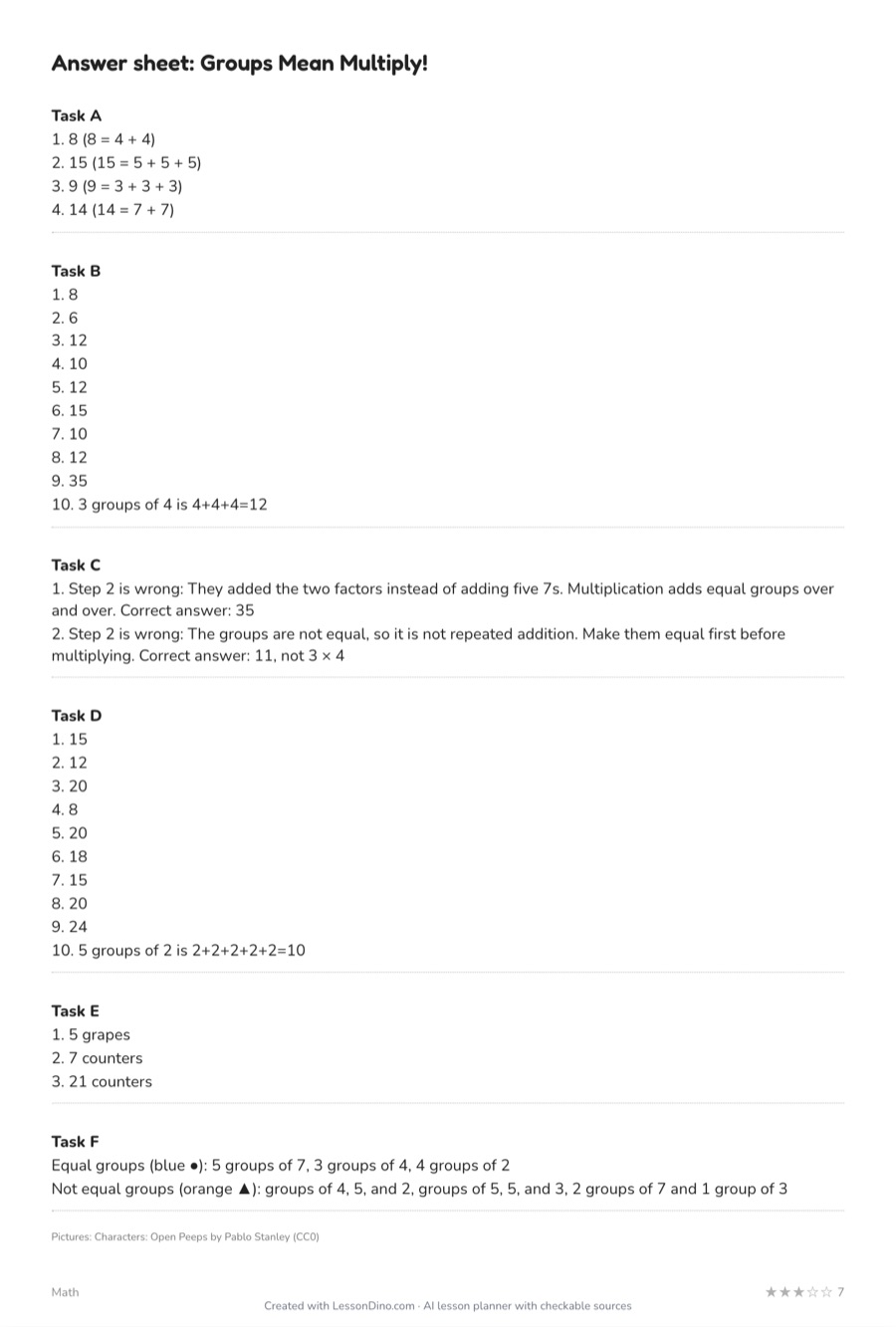
- How many objects in 2 groups of 4? 8
- Work out 3 × 2 by adding equal groups. 6
- Work out 4 × 3 by adding equal groups. 12
- What is the product of 2 × 5? 10
- 3 plates have 4 grapes on each. What is the total? 12
- Write 5 × 3 as repeated addition and find the total. 15
- A student builds 5 groups of 2 cubes. How many cubes in all? 10
- A student has 6 boxes with 2 pencils in each. How many pencils in all? 12
- The class sets out 5 cups with 7 counters in each. How many counters in all? 35
- Explain how you know 3 × 4 = 12 using equal groups. 3 groups of 4 is 4+4+4=12
- How many objects in 3 groups of 5? 15
- Work out 2 × 6 by adding equal groups. 12
- Work out 5 × 4 by adding equal groups. 20
- What is the product of 4 × 2? 8
- 4 bags hold 5 marbles in each bag. How many marbles in all? 20
- Write 3 × 6 as repeated addition and find the total. 18
- Which total is greater: 2 groups of 7 or 3 groups of 5? Give the greater total. 15
- A student sorts 10 pairs of socks. Each pair has 2 socks. How many socks in all? 20
- A shelf has 4 rows with 6 books in each row. How many books in all? 24
- Show 5 × 2 as equal groups and explain the product. 5 groups of 2 is 2+2+2+2+2=10
The answer sheet is the last picture above.
Curriculum
Interpret products of whole numbers, e.g., interpret 5 × 7 as the total number of objects in 5 groups of 7 objects each.
Made with Lesson Dino's AI on 16 October 2026. AI can make mistakes, so check the answers and facts against the sources before you teach.