Slides
Lesson plan
Seeing 5 x 7 as 5 Groups of 7
Students learn that a product shows the total in equal groups. They build 5 x 7 with cups and counters and explain the groups and total.
Objectives
- Students will interpret products of whole numbers as totals in equal groups.
- Students will identify groups, size, and total for a multiplication expression.
- Students will write equal groups as repeated addition to find totals.
Success criteria
- I can show what 5 x 7 means with equal groups.
- I can name groups, size, and total for a product.
- I can write equal groups as repeated addition.
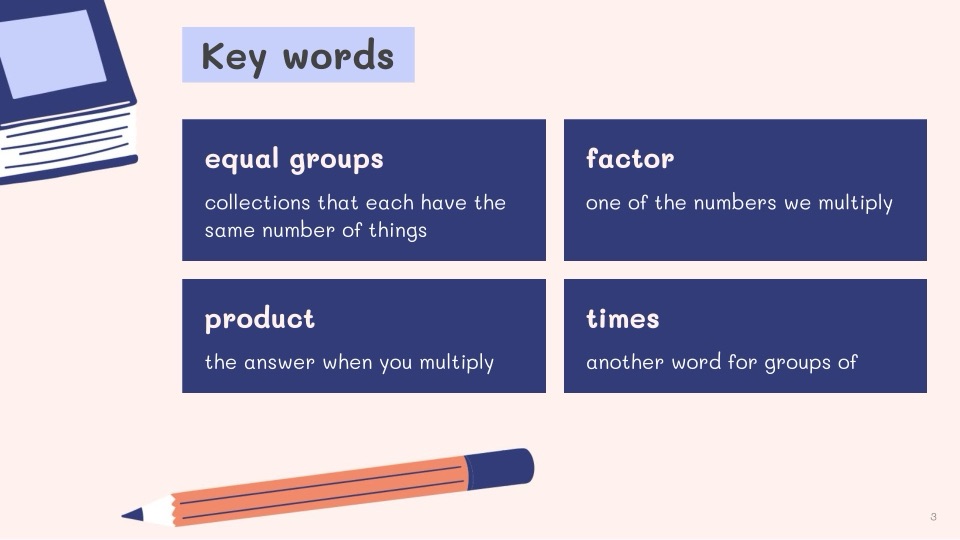
Key words
| Word | Meaning |
|---|---|
| equal groups | collections that each have the same number of things |
| factor | one of the numbers we multiply |
| product | the answer when you multiply |
| repeated addition | adding groups of the same size one after another |
Timed plan (60 minutes)
| Time | Stage | What happens |
|---|---|---|
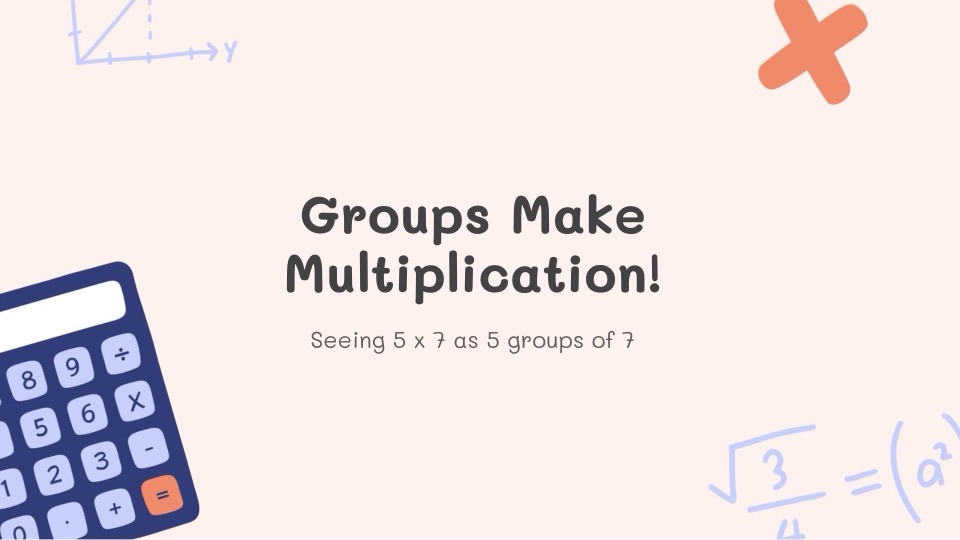
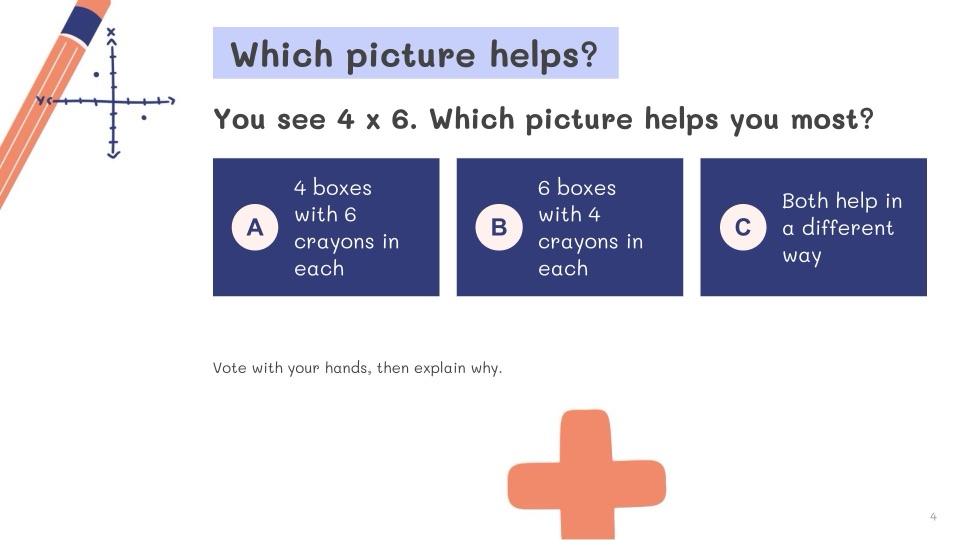
| 10 min | Starter | Hook interest and recall what makes groups equal. Welcome the class and show a tray of counters mixed in cups with unequal numbers. Say the hook and show Slide 1: Groups Make Multiplication! Show Slide 4 vote with 4 boxes with 6 crayons in each and 6 boxes with 4 crayons in each. Take a quick vote: You see 4 x 6. Which picture helps you most? |
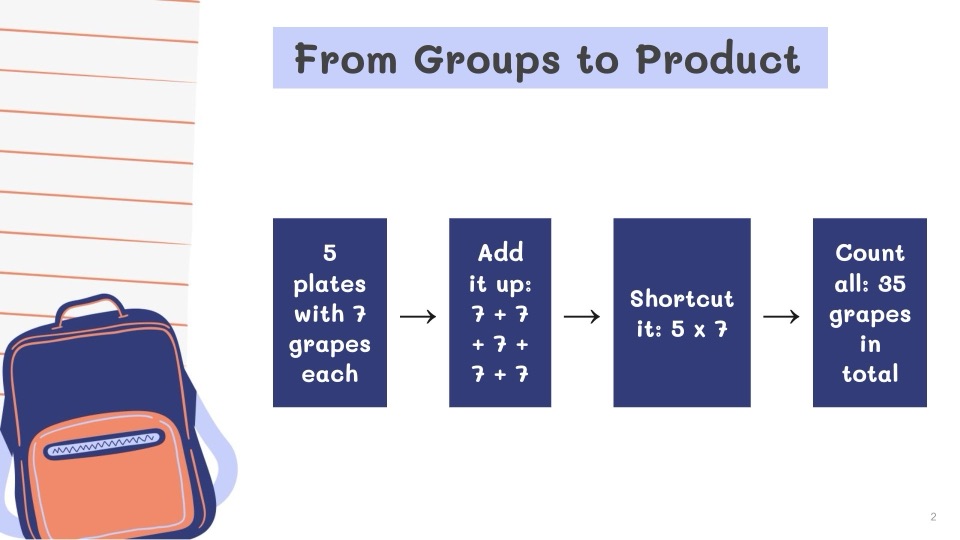
| 12 min | Teaching | Model that 5 x 7 means 5 groups of 7 and 35 in all. Display Slide 2: From Groups to Product with 5 plates with 7 grapes each. Point to plates and count: Add it up: 7 + 7 + 7 + 7 + 7, Shortcut it: 5 x 7, Count all: 35 grapes in total. Display Slide 3 key words: equal groups, factor, product, and model each with the plates. Think aloud the meaning of 5, 7, and 35 while drawing circles and dots. |
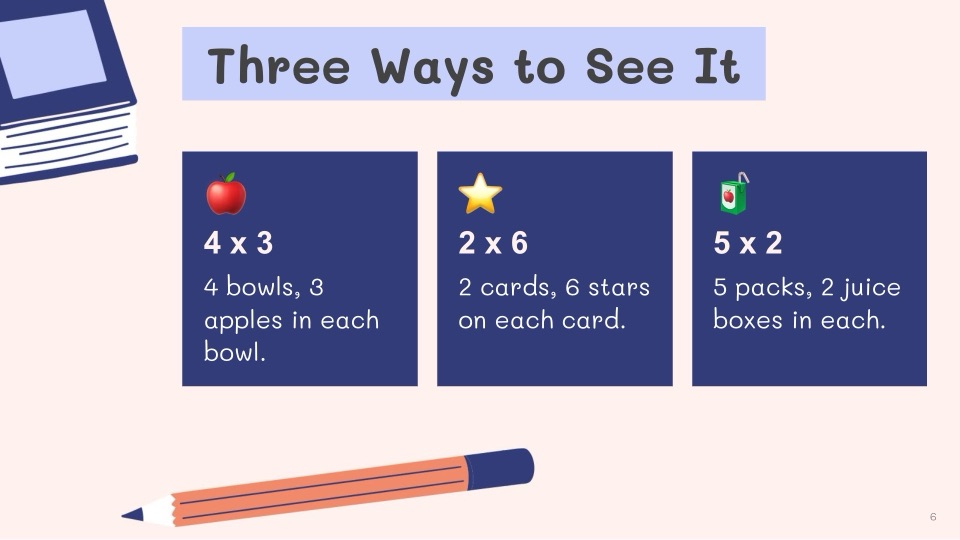
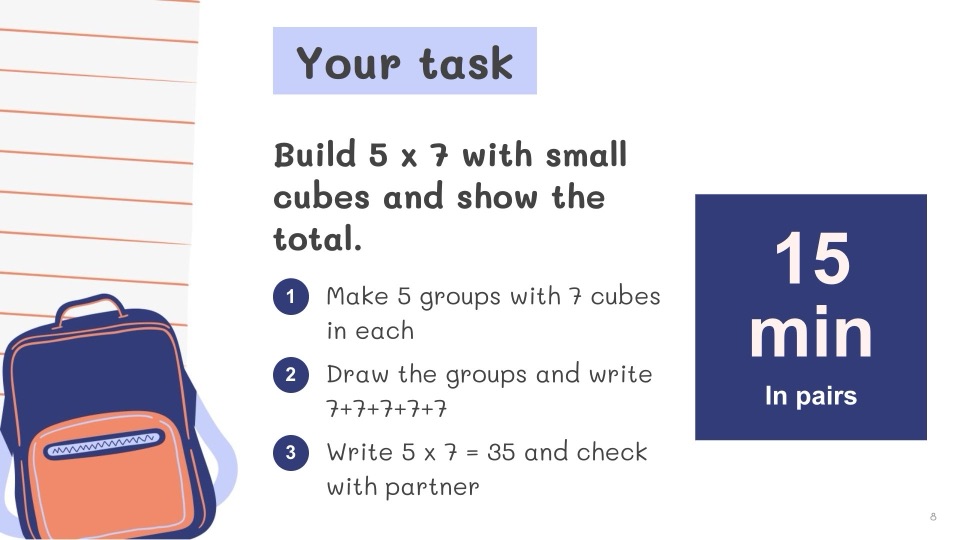
| 20 min | Main activity | Build products with cups to show groups, size, and total. Model Tray Groups: pick a card like 4 x 3, make 4 cups with 3 counters in each, and count the total. Model saying: 4 x 3 means 4 groups of 3, 12 in all, because multiplication represents the total number of objects in equal groups. Hand out cups, counters, and number cards and show Slide 8 task: Make 5 groups with 7 cubes in each. Circulate, check each group is equal, and ask pairs to draw groups and write 7+7+7+7+7 and 5 x 7 = 35. |
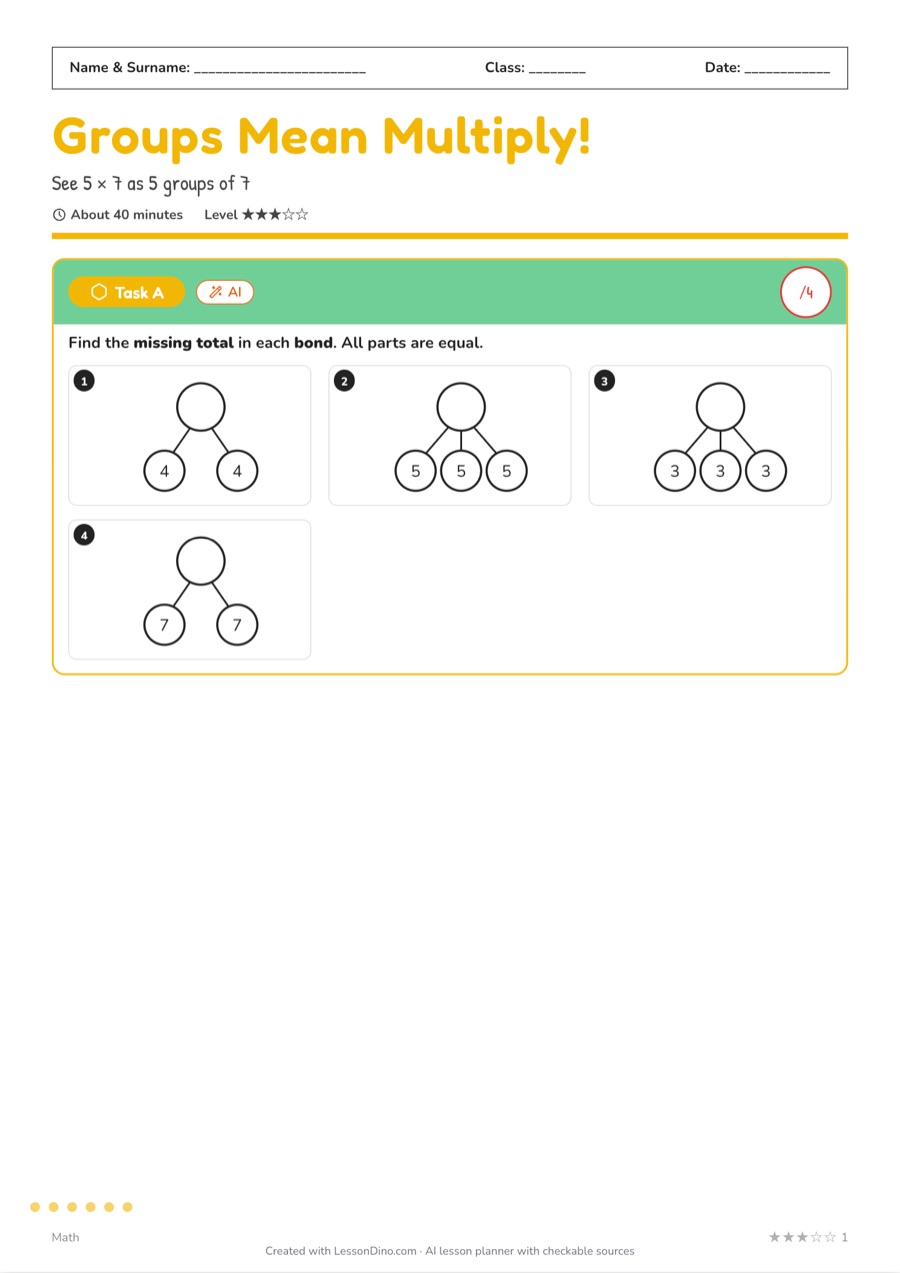
| 10 min | Practice | Read multiplications as equal groups and find totals on paper. Hand out Worksheet Task B: Read each multiplication as equal groups and find the total. Model one item: 3 groups of 5 can be written as 3 x 5 = 15 with 3 circles and 5 dots in each. Give quiet work time and remind students to check that each group is equal. Collect and spot-check for groups, size, and total labels. |
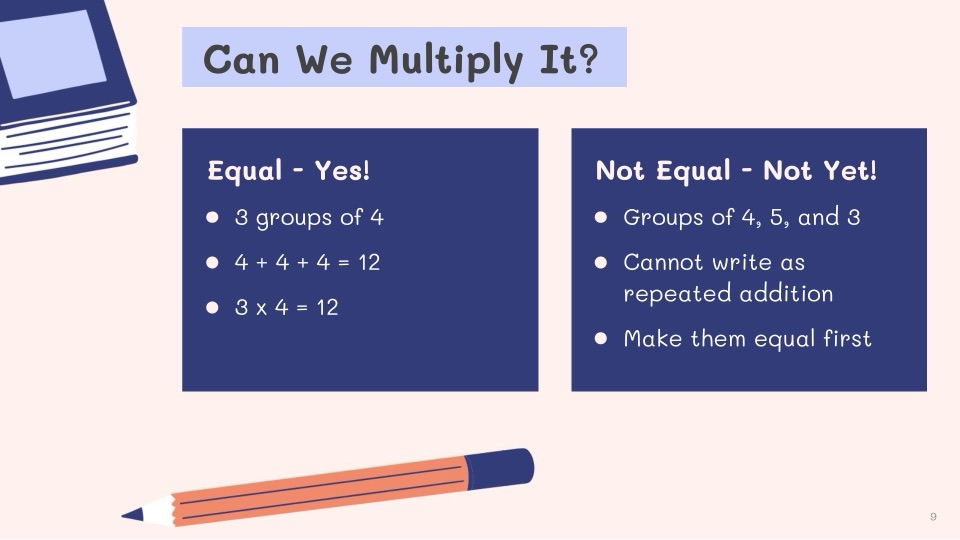
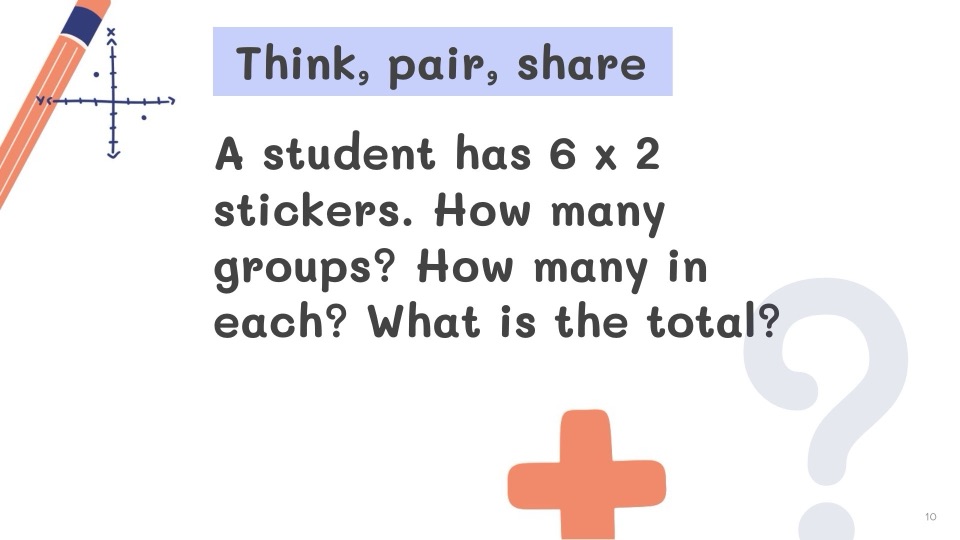
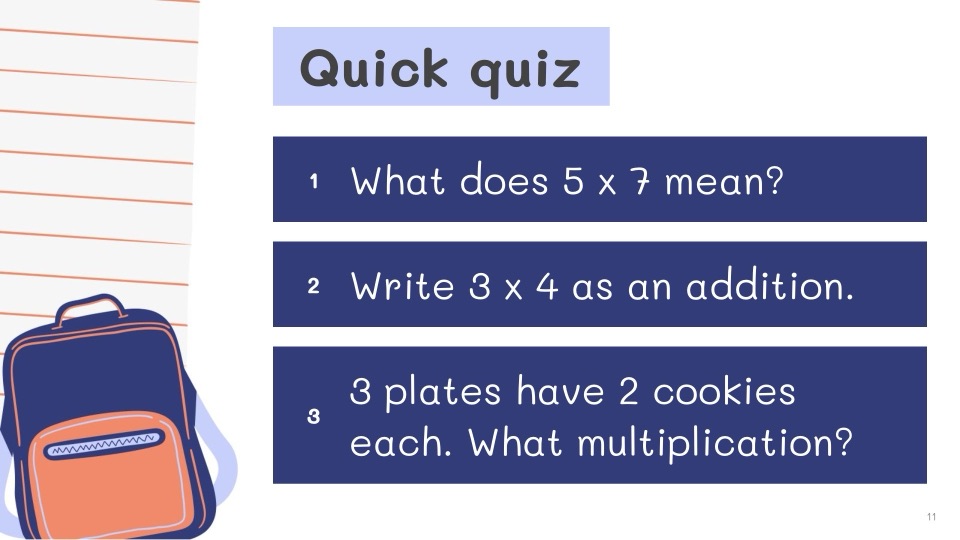
| 8 min | Plenary | Check that students can tell equal from unequal and explain a product. Show Slide 9: 3 groups of 4 with 4 + 4 + 4 = 12 and 3 x 4 = 12 as Equal - Yes, and Groups of 4, 5, and 3 as Not Equal. Ask Slide 10: A student has 6 x 2 stickers. How many groups? How many in each? What is the total? Use Slide 11 Quick quiz to review 5 groups with 7 in each, 35 in all and 3 plates have 2 cookies with 3 x 2 = 6 cookies in all. Close by having class state what 5 x 7 means. |
Common mistakes
- Adds the factors, such as 5 + 7 = 12 for 5 x 7
How to spot it: Total is far too small and drawing shows only two numbers, not groups
Rebuild 5 groups of 7 objects each and count all to show the product is 35, not 12 - Makes unequal groups but still writes a multiplication
How to spot it: Cups or drawing have different numbers in each group
Check each group has the same number, since multiplication is calculating the sum of groups of the same size - Swaps groups and size, building 7 groups of 5 for 5 x 7
How to spot it: Student says 7 groups but card says 5 x 7
Point to first factor for number of cups and second for counters in each cup, then compare 5 groups of 7 with 7 groups of 5
Support
- Start with only 2 or 3 groups and use larger cubes so counting is easier.
- Provide pre-drawn circles so students only add the same number of dots to each.
Stretch
- Students build both 3 x 4 and 4 x 3 and explain how the groups look different but the total is the same.
- Students write their own story card for a new product within 100 with matching drawing.
Check questions
- What does 5 x 7 mean? How many groups, how many in each, and what total?
Answer: 5 groups of 7 objects each, 35 in all. - Write 3 x 4 as an addition. What is the total?
Answer: 4 + 4 + 4 = 12 - 3 plates have 2 cookies on each. Write the multiplication and total.
Answer: 3 x 2 = 6 cookies in all.
Curriculum
Interpret products of whole numbers, e.g., interpret 5 × 7 as the total number of objects in 5 groups of 7 objects each.
Video clips
Clips on YouTube, from the start and end times we chose. Check each one before you show it.
-
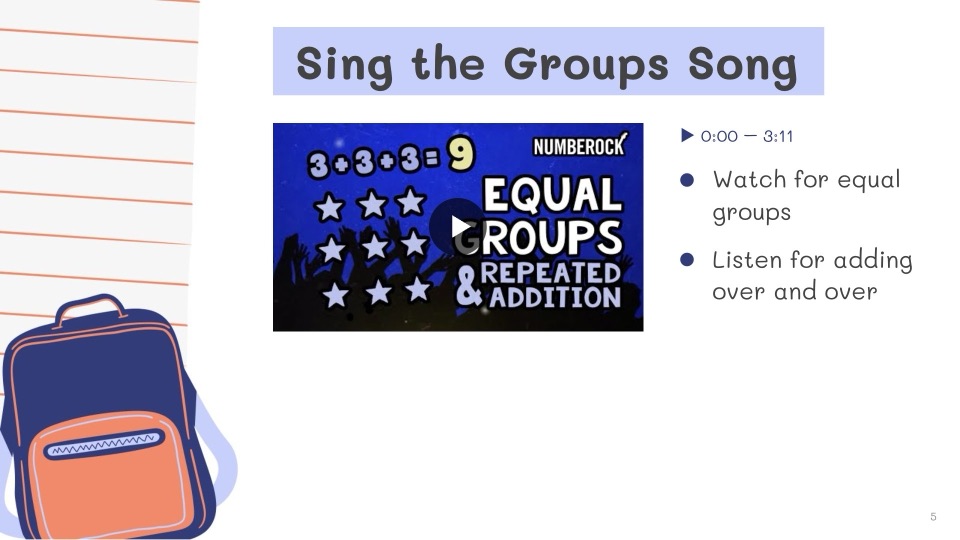
Equal groups song from 0:00 to 3:11
Numberock: Equal Groups Multiplication Song | Repeated Addition Using Arrays
Directly models products as equal groups, repeated addition, and arrays with music and pace perfect for ages 8-9.
-
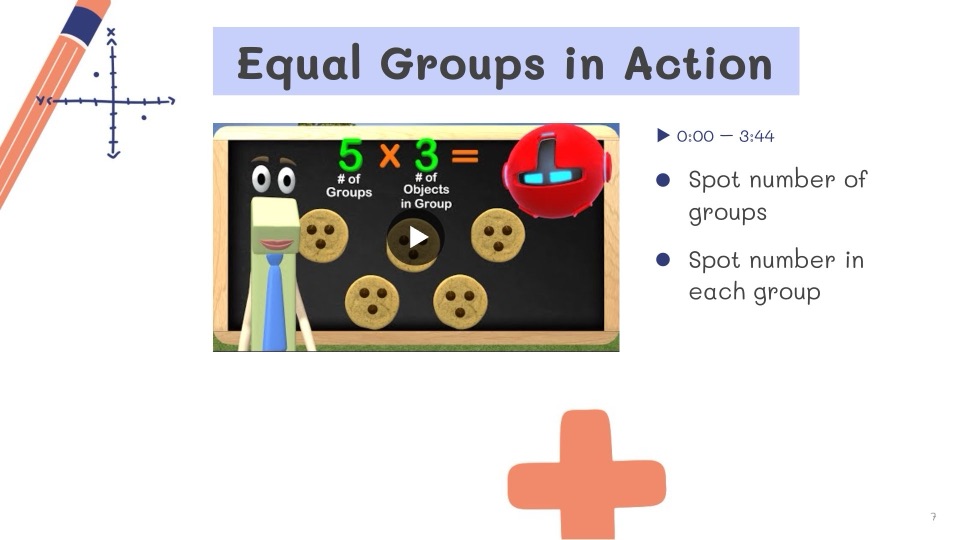
3rd grade multiplication intro from 0:00 to 3:44
Math & Learning Videos 4 Kids: Multiplication 3rd Grade - Learn Multiplication Educational Math Videos
Made specifically for Grade 3 to build the meaning of multiplication as equal groups for ages 8-9.
Worksheet
Sources
- Grade 3 » Introduction | Common Core State Standards Initiative thecorestandards.org
- 2025-2026 3rd grade Math Curriculum boepublic.parkhill.k12.mo.us
- Introduction to Multiplication - ResourceCenter resourcecenter.byupathway.edu
- Getting to the Heart of Multiplication: Understanding its ... www1.udel.edu
- Multiplication Fact Strategies - St. Johns County School District teachers.stjohns.k12.fl.us
- Math Content by Strand Multiplication and Division investigations.terc.edu
- Multiplication Exploration 3: Understanding the ... pressbooks-dev.oer.hawaii.edu
- What are ‘multiplication facts’? Why are they essential to ... world.edu
- Kids Math: Multiplication Tips and Tricks - Ducksters ducksters.com
- Multiplication sentences - KS2 Maths - Learning with ... - BBC bbc.co.uk
- Multiplication table Facts for Kids kids.kiddle.co
- Preservice teachers' understanding of fraction multiplication through problem posing and solving in Korea and the United States jksmea.org
- Teaching Multiplication Concepts - Understanding Of ... mathskills4kids.com
- Kids Math: Multiplication Basics - Ducksters ducksters.com
- Multiplication Facts for Kids kids.kiddle.co
- KS1 / KS2 Maths: What is multiplication? - BBC Teach bbc.co.uk
Made with Lesson Dino's AI on 16 October 2026. AI can make mistakes, so check facts against the sources before you teach.