The worksheet
About this worksheet
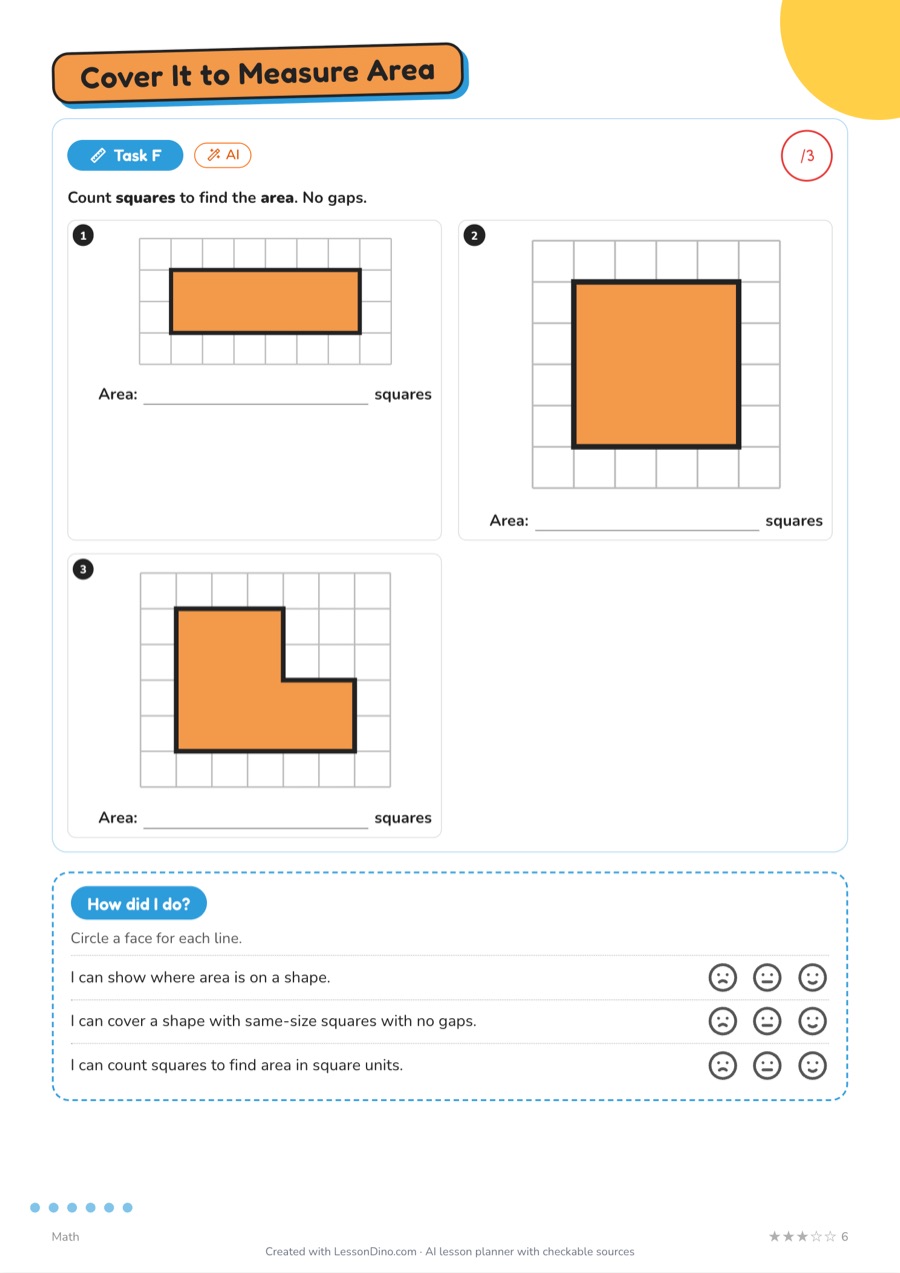
Students learn that area is the flat space a shape covers. They cover shapes with squares and count to find area. This Grade 3 Math worksheet gives students (ages 8–9) six pages of practice on understanding area, part of the measurement and data unit. It goes with our free Understanding area lesson, which has the slides and a timed lesson plan.
What it covers
By the end, students should be able to:
- Students will recognize area as the flat space inside plane figures.
- Students will measure area by counting same-size squares without gaps or overlaps.
How to use it
- Practice (15 minutes): Give out Worksheet Task B: Count square units to find area. No gaps, no overlaps.
- Support: Give a small rectangle that fits squares exactly and let students line the edge first, then fill the middle.
- Stretch: Give an L-shape made of squares and ask students to count and compare its area to the rectangle.
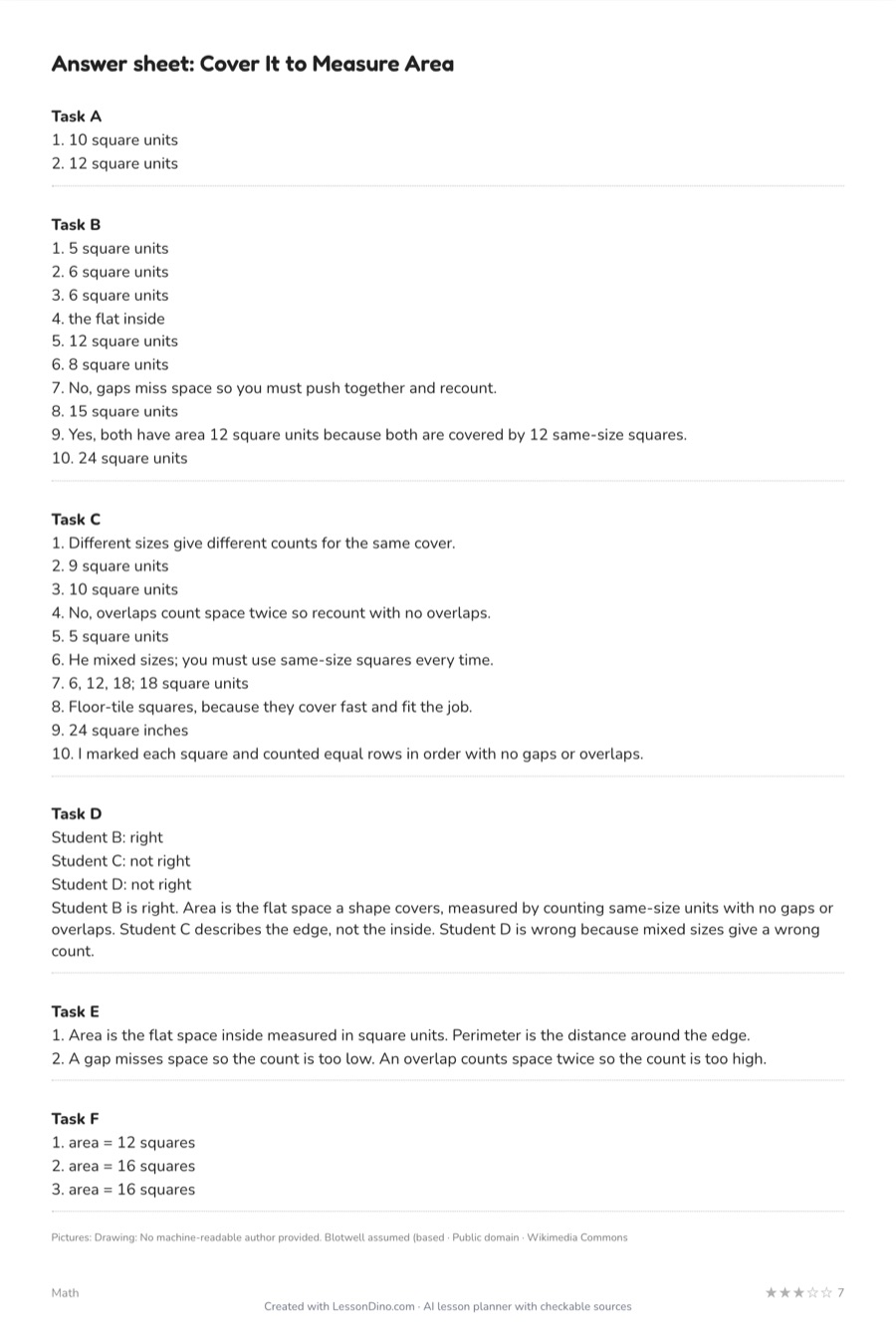
- The answer sheet is the last page, so you can print it on its own or let students check their own work.
Key vocabulary
- area: how much flat space inside a shape
- plane figure: a flat shape, like a rectangle
- square unit: a tiny tile with four equal sides we count with
- cover: to put squares across a shape with no gaps or overlaps
Mistakes to watch for
- Leaving gaps or stacking squares when covering. Push squares together with no spaces and recount row by row, since area needs total same-size units without gaps or overlaps.
- Confusing area with the edge around the shape. Point to the flat inside for area and lay yarn on edge versus tiles inside to show linear versus area measures.
- Using mixed-size squares in one measurement. Replace with one same-size square unit and recount, because the square with sides of unit length is the standard unit.
What's on the worksheet
Cover It Up
Learn what area means and how to count it.
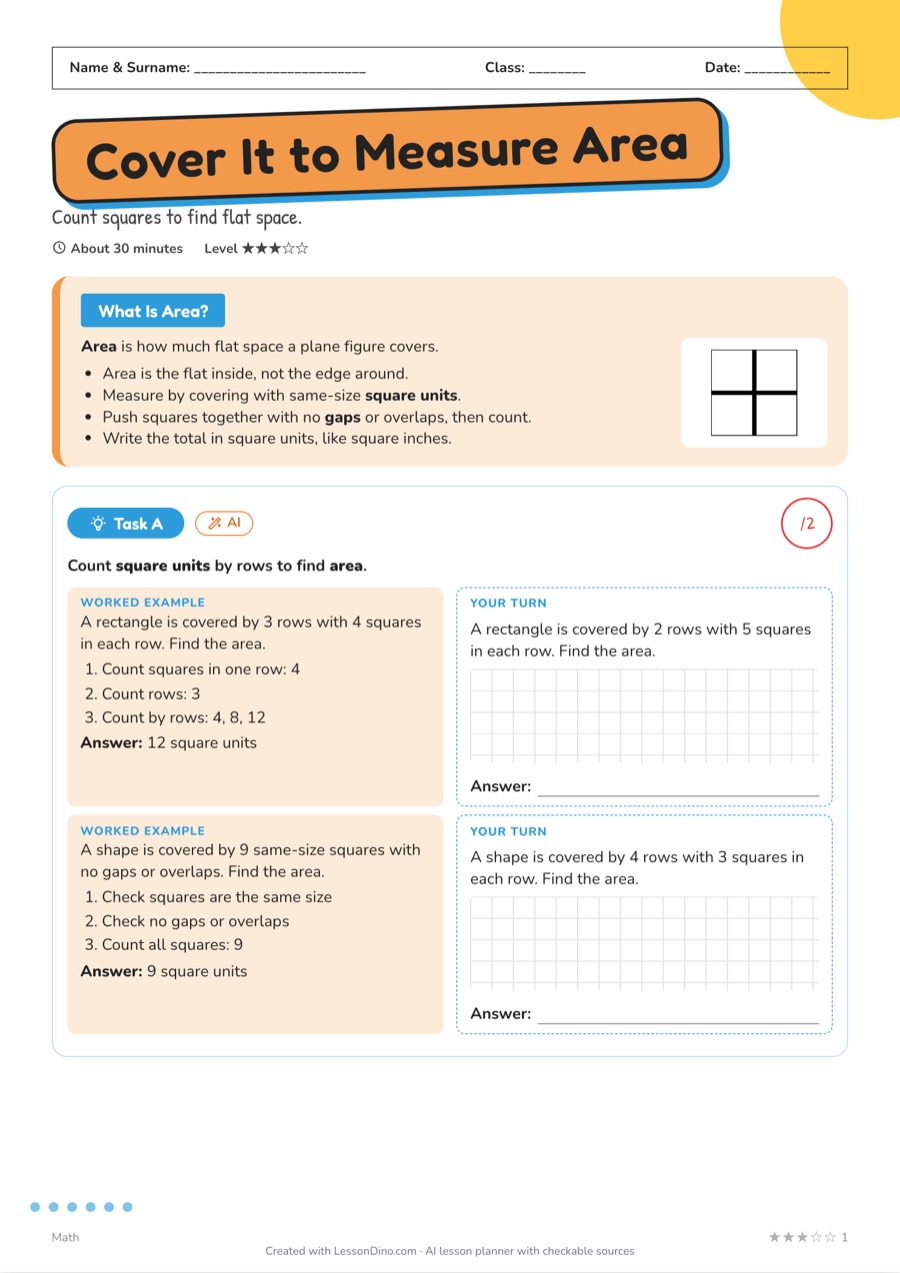
What Is Area?
- Area is how much flat space a plane figure covers.
- Area is the flat inside, not the edge around.
- Measure by covering with same-size square units.
- Push squares together with no gaps or overlaps, then count.
- Write the total in square units, like square inches.
Count square units by rows to find area.
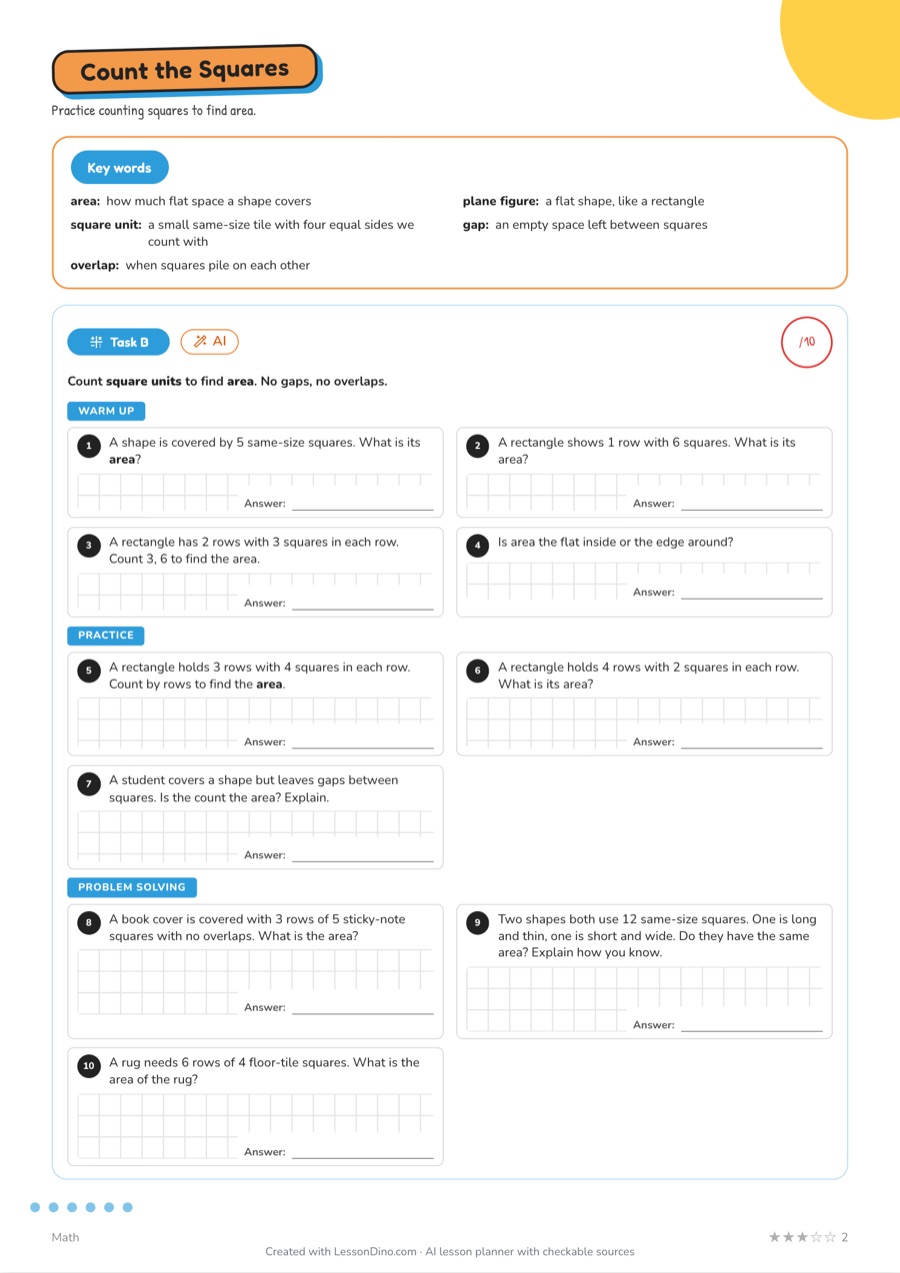
Count the Squares
Practice counting squares to find area.
| Word | Meaning |
|---|---|
| area | how much flat space a shape covers |
| plane figure | a flat shape, like a rectangle |
| square unit | a small same-size tile with four equal sides we count with |
| gap | an empty space left between squares |
| overlap | when squares pile on each other |
Count square units to find area. No gaps, no overlaps.
Warm up
- A shape is covered by 5 same-size squares. What is its area?
- A rectangle shows 1 row with 6 squares. What is its area?
- A rectangle has 2 rows with 3 squares in each row. Count 3, 6 to find the area.
- Is area the flat inside or the edge around?
Practice
- A rectangle holds 3 rows with 4 squares in each row. Count by rows to find the area.
- A rectangle holds 4 rows with 2 squares in each row. What is its area?
- A student covers a shape but leaves gaps between squares. Is the count the area? Explain.
Problem solving
- A book cover is covered with 3 rows of 5 sticky-note squares with no overlaps. What is the area?
- Two shapes both use 12 same-size squares. One is long and thin, one is short and wide. Do they have the same area? Explain how you know.
- A rug needs 6 rows of 4 floor-tile squares. What is the area of the rug?
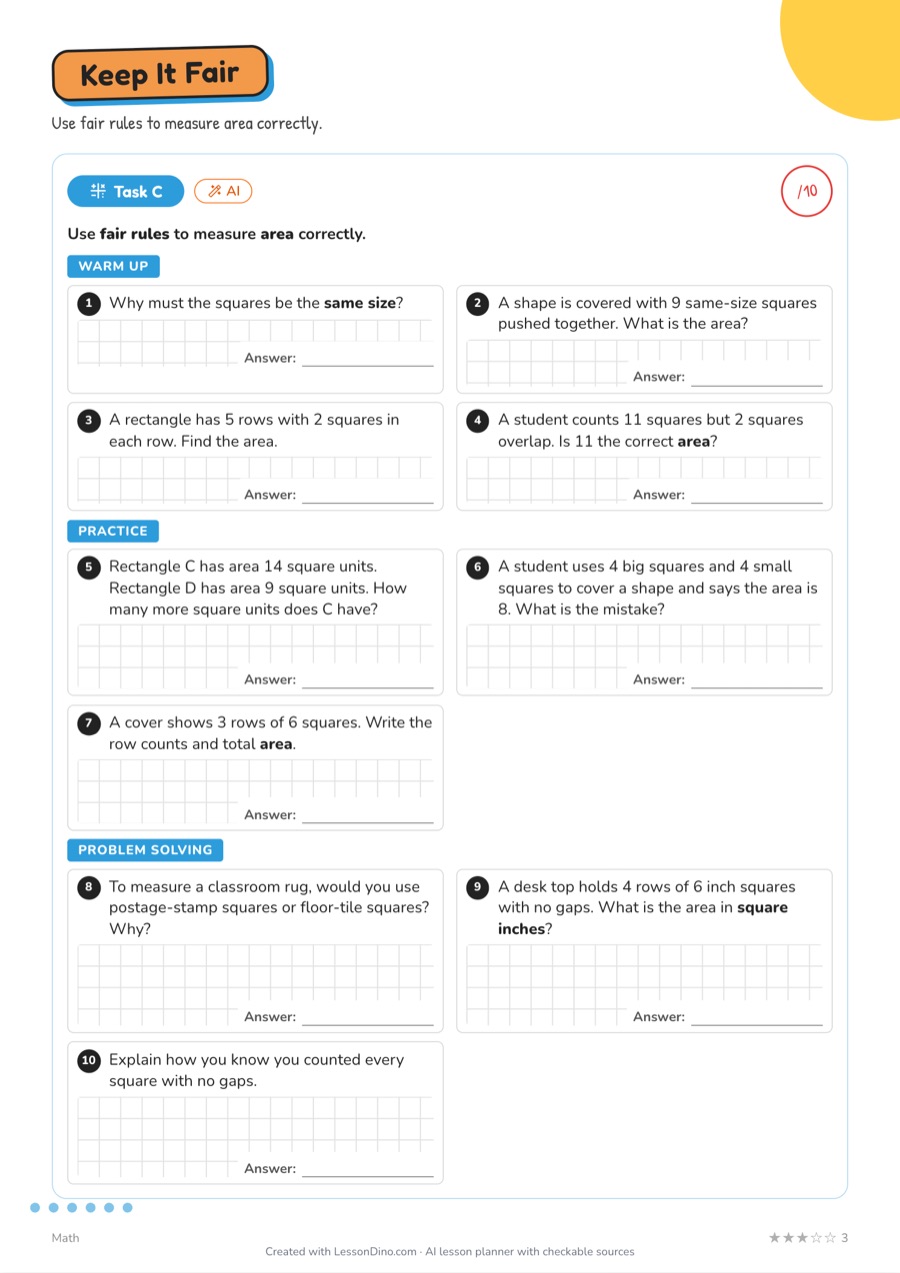
Keep It Fair
Use fair rules to measure area correctly.
Use fair rules to measure area correctly.
Warm up
- Why must the squares be the same size?
- A shape is covered with 9 same-size squares pushed together. What is the area?
- A rectangle has 5 rows with 2 squares in each row. Find the area.
- A student counts 11 squares but 2 squares overlap. Is 11 the correct area?
Practice
- Rectangle C has area 14 square units. Rectangle D has area 9 square units. How many more square units does C have?
- A student uses 4 big squares and 4 small squares to cover a shape and says the area is 8. What is the mistake?
- A cover shows 3 rows of 6 squares. Write the row counts and total area.
Problem solving
- To measure a classroom rug, would you use postage-stamp squares or floor-tile squares? Why?
- A desk top holds 4 rows of 6 inch squares with no gaps. What is the area in square inches?
- Explain how you know you counted every square with no gaps.
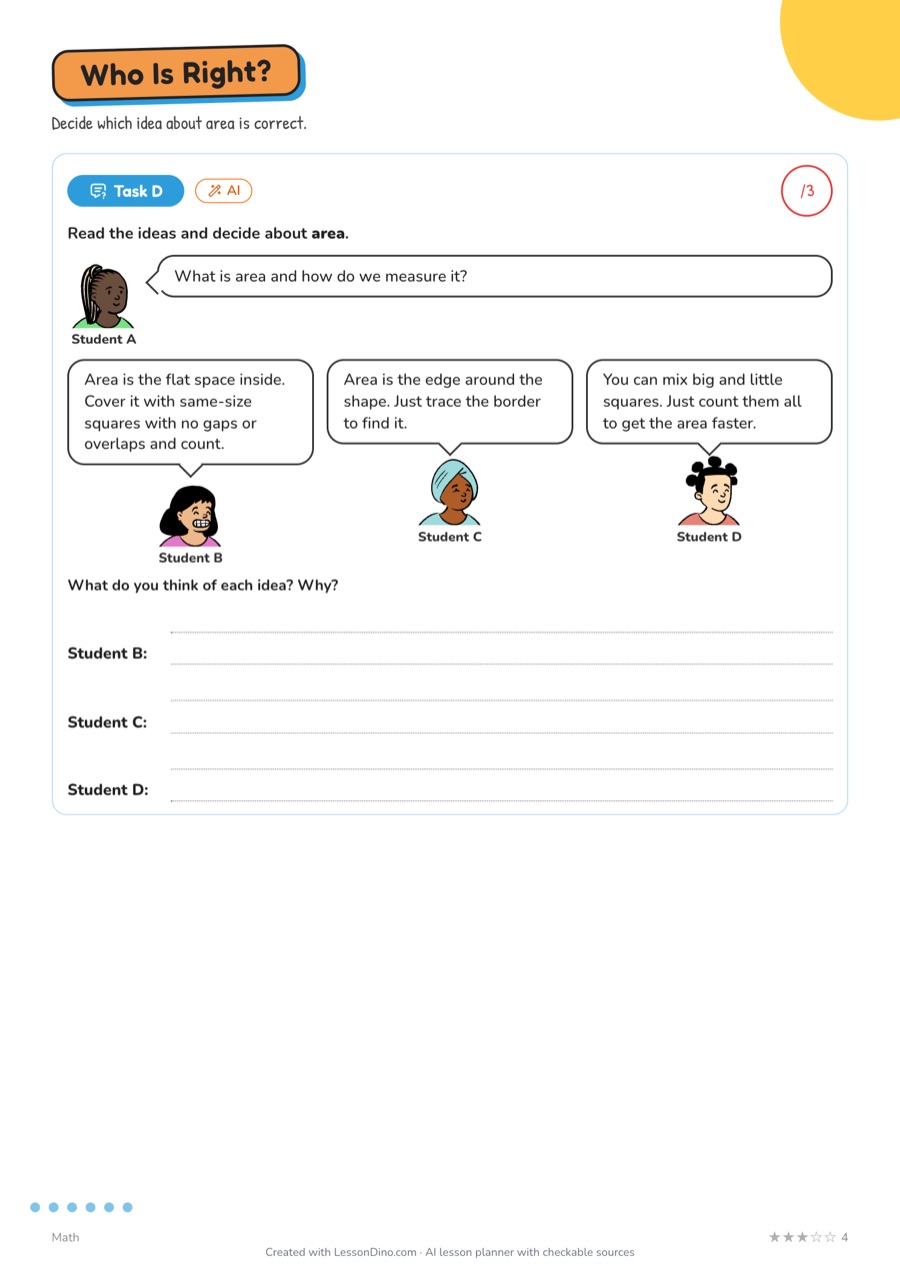
Who Is Right?
Decide which idea about area is correct.
Read the ideas and decide about area.
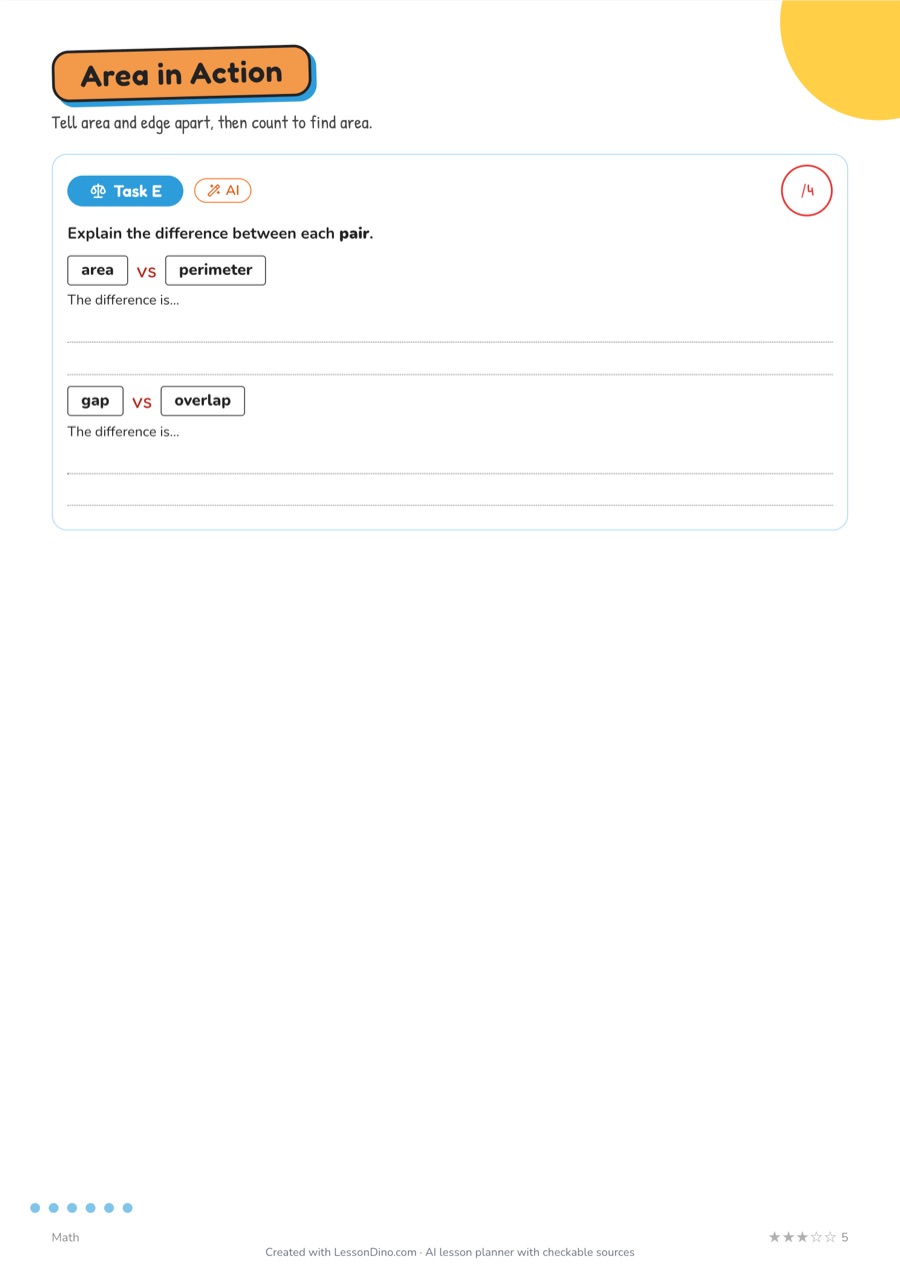
Area in Action
Tell area and edge apart, then count to find area.
Explain the difference between each pair.
Page 6
Count squares to find the area. No gaps.
Answers
Show the answers
- A shape is covered by 5 same-size squares. What is its area? 5 square units
- A rectangle shows 1 row with 6 squares. What is its area? 6 square units
- A rectangle has 2 rows with 3 squares in each row. Count 3, 6 to find the area. 6 square units
- Is area the flat inside or the edge around? the flat inside
- A rectangle holds 3 rows with 4 squares in each row. Count by rows to find the area. 12 square units
- A rectangle holds 4 rows with 2 squares in each row. What is its area? 8 square units
- A student covers a shape but leaves gaps between squares. Is the count the area? Explain. No, gaps miss space so you must push together and recount.
- A book cover is covered with 3 rows of 5 sticky-note squares with no overlaps. What is the area? 15 square units
- Two shapes both use 12 same-size squares. One is long and thin, one is short and wide. Do they have the same area? Explain how you know. Yes, both have area 12 square units because both are covered by 12 same-size squares.
- A rug needs 6 rows of 4 floor-tile squares. What is the area of the rug? 24 square units
- Why must the squares be the same size? Different sizes give different counts for the same cover.
- A shape is covered with 9 same-size squares pushed together. What is the area? 9 square units
- A rectangle has 5 rows with 2 squares in each row. Find the area. 10 square units
- A student counts 11 squares but 2 squares overlap. Is 11 the correct area? No, overlaps count space twice so recount with no overlaps.
- Rectangle C has area 14 square units. Rectangle D has area 9 square units. How many more square units does C have? 5 square units
- A student uses 4 big squares and 4 small squares to cover a shape and says the area is 8. What is the mistake? He mixed sizes; you must use same-size squares every time.
- A cover shows 3 rows of 6 squares. Write the row counts and total area. 6, 12, 18; 18 square units
- To measure a classroom rug, would you use postage-stamp squares or floor-tile squares? Why? Floor-tile squares, because they cover fast and fit the job.
- A desk top holds 4 rows of 6 inch squares with no gaps. What is the area in square inches? 24 square inches
- Explain how you know you counted every square with no gaps. I marked each square and counted equal rows in order with no gaps or overlaps.
The answer sheet is the last picture above.
Curriculum
Recognize area as an attribute of plane figures and understand concepts of area measurement.
Made with Lesson Dino's AI on 17 October 2026. AI can make mistakes, so check the answers and facts against the sources before you teach.