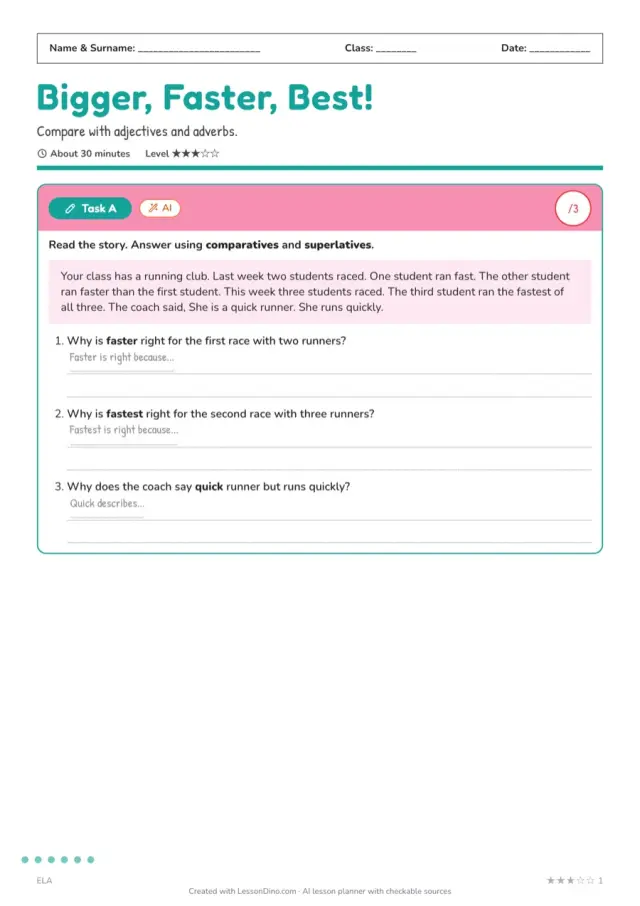
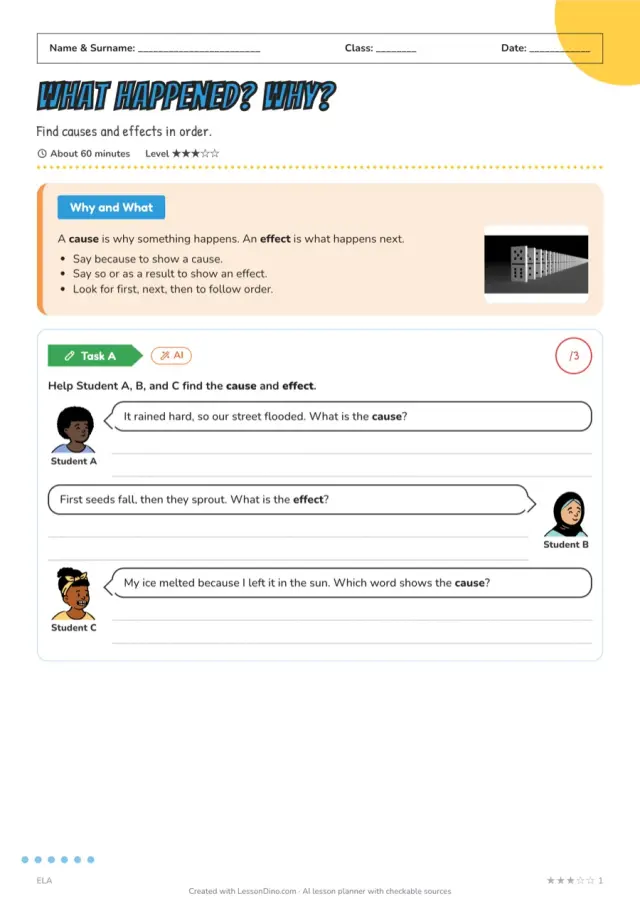
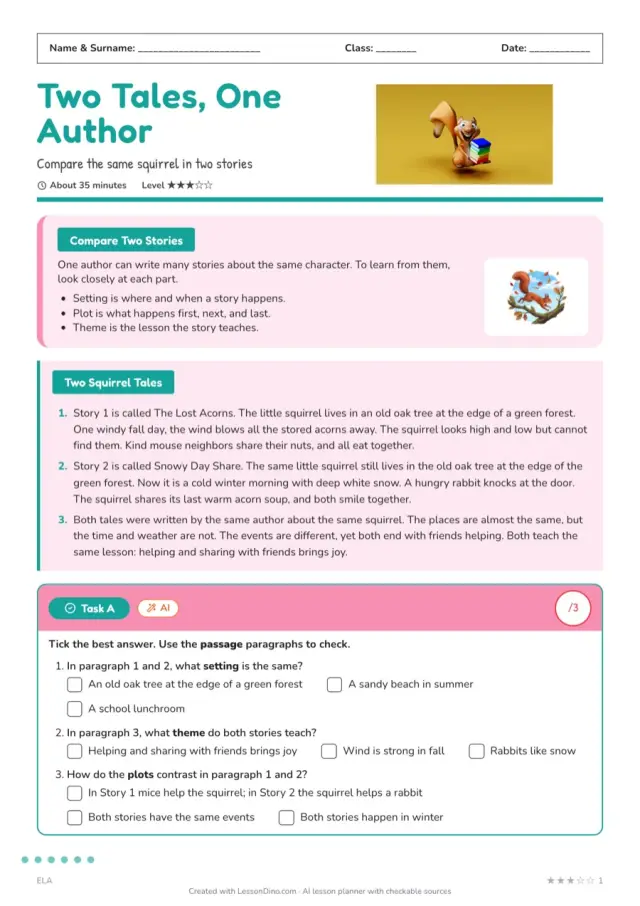
The worksheet
About this worksheet
Students learn to build simple, compound, and complex sentences. They draw a three-panel comic and write one matching sentence per panel. This Grade 3 ELA worksheet gives students (ages 8–9) five pages of practice on simple, compound, and complex sentences, part of the language unit. It goes with our free Simple, compound, and complex sentences lesson, which has the slides and a timed lesson plan.
What it covers
By the end, students should be able to:
- Students will write one simple, one compound, and one complex sentence.
- Students will use commas correctly with and, but, so and helper words.
- Students will speak and check if ideas sound complete and finished.
How to use it
- Use it for practice after the teaching part of the lesson, once students have seen the worked examples on the slides.
- Support: Provide sentence frames: The dog ___. I wanted to ___, but ___. I stayed inside because ___.
- Stretch: Have students add a second complex sentence where the helper part comes first, with a comma after it.
- The answer sheet is the last page, so you can print it on its own or let students check their own work.
Key vocabulary
- simple sentence: one full idea that can stand alone as a complete thought. It has one independent clause and no dependent clauses.
- compound sentence: two full ideas joined with and, but, or, so. It has two independent clauses but no dependent clauses.
- complex sentence: one full idea plus a helper part that needs the other part to make sense. It has one independent clause and at least one dependent clause.
- comma: small mark , that shows a short pause and comes before and, but, or so in a compound sentence.
- helper word: small starting word like because, when, if, after that makes a part need a partner.
Mistakes to watch for
- Writing a helper part alone, like Because it started to rain. Add the main idea: We stayed inside because it started to rain. A dependent clause needs another clause to make a complete sentence.
- Missing the comma before and, but, or so in a compound sentence. Insert comma before the joiner: I wanted to play, but it rained. Use a comma before the coordinating conjunction.
- Calling any long sentence with and a complex sentence. Ask Can both sides stand alone? Teach underline main clause and circle helper part; if no because, when, if, after part, it is not complex.
What's on the worksheet
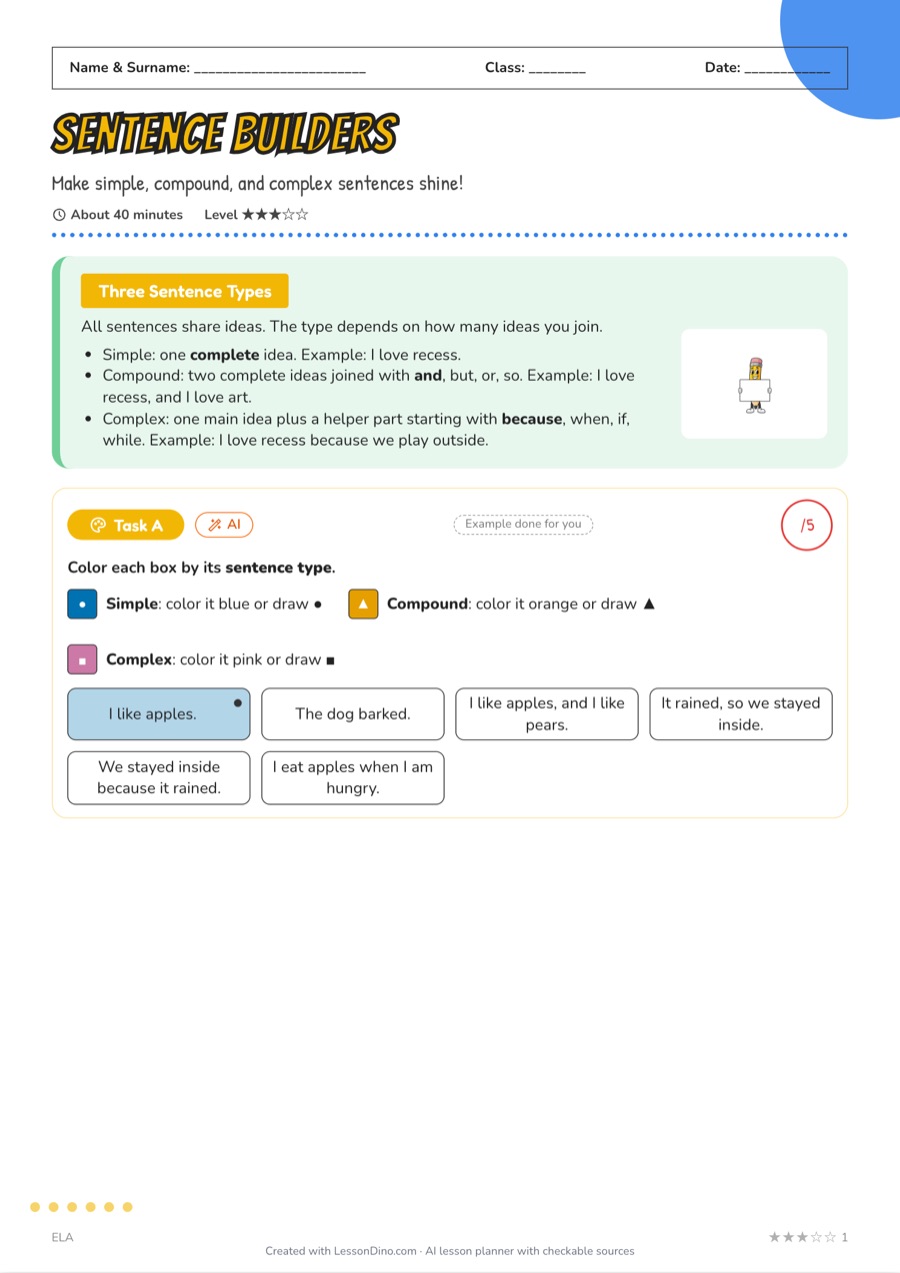
Build Great Sentences
Learn the three sentence types and sort them.
Three Sentence Types
- All sentences share ideas. The type depends on how many ideas you join.
- Simple: one complete idea. Example: I love recess.
- Compound: two complete ideas joined with and, but, or, so. Example: I love recess, and I love art.
- Complex: one main idea plus a helper part starting with because, when, if, while. Example: I love recess because we play outside.
Color each box by its sentence type.
Ask Your Friends
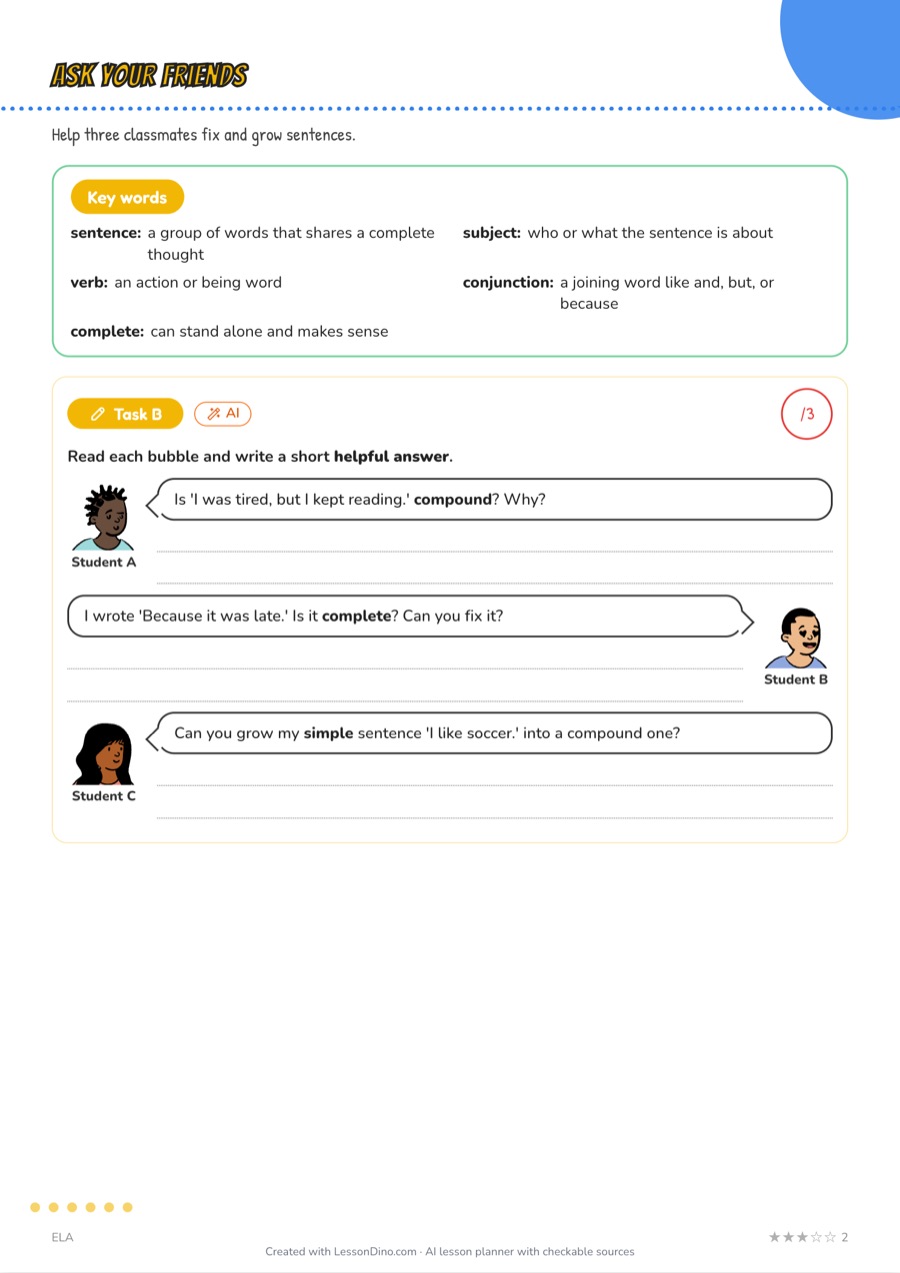
Help three classmates fix and grow sentences.
| Word | Meaning |
|---|---|
| sentence | a group of words that shares a complete thought |
| subject | who or what the sentence is about |
| verb | an action or being word |
| conjunction | a joining word like and, but, or because |
| complete | can stand alone and makes sense |
Read each bubble and write a short helpful answer.
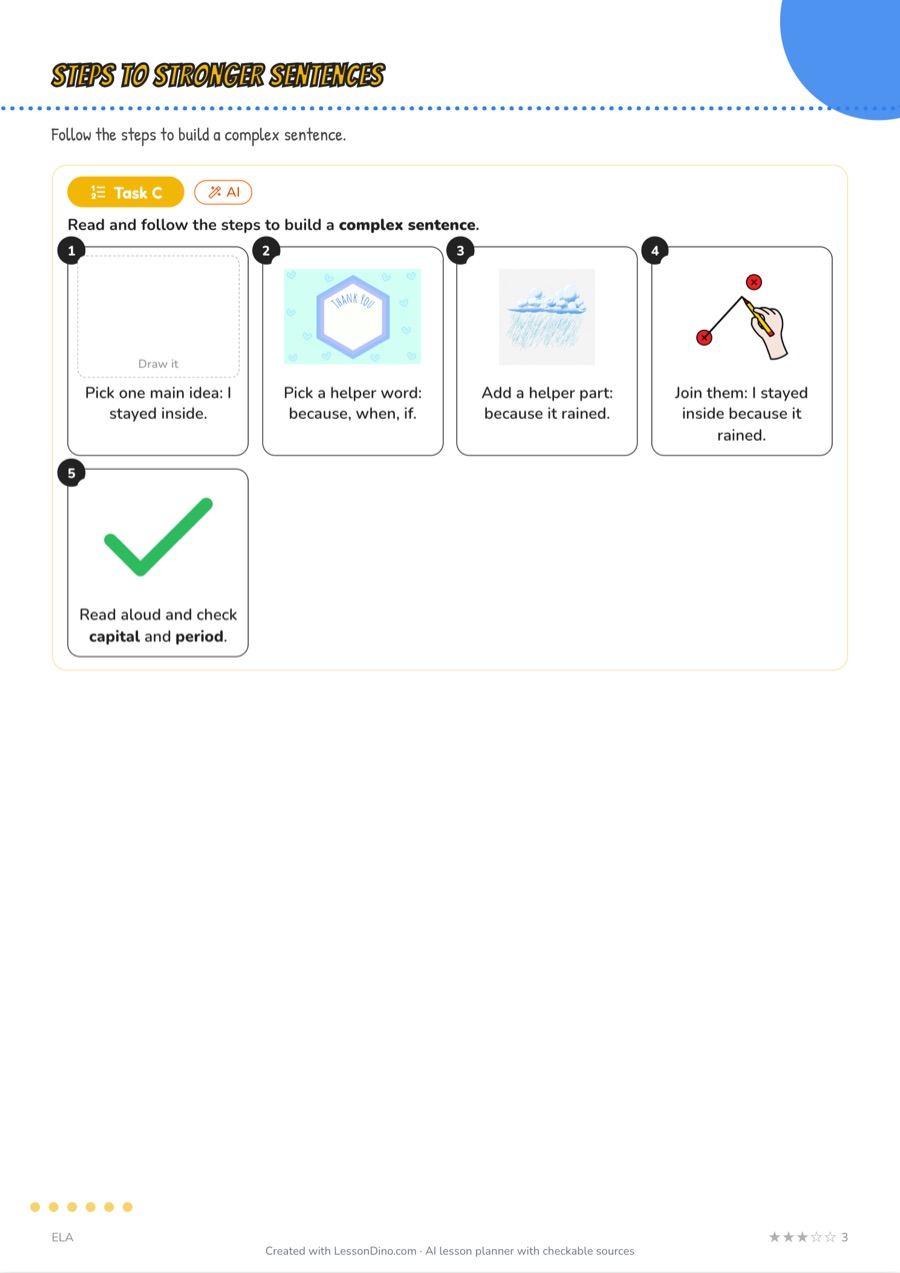
Steps to Stronger Sentences
Follow the steps to build a complex sentence.
Read and follow the steps to build a complex sentence.
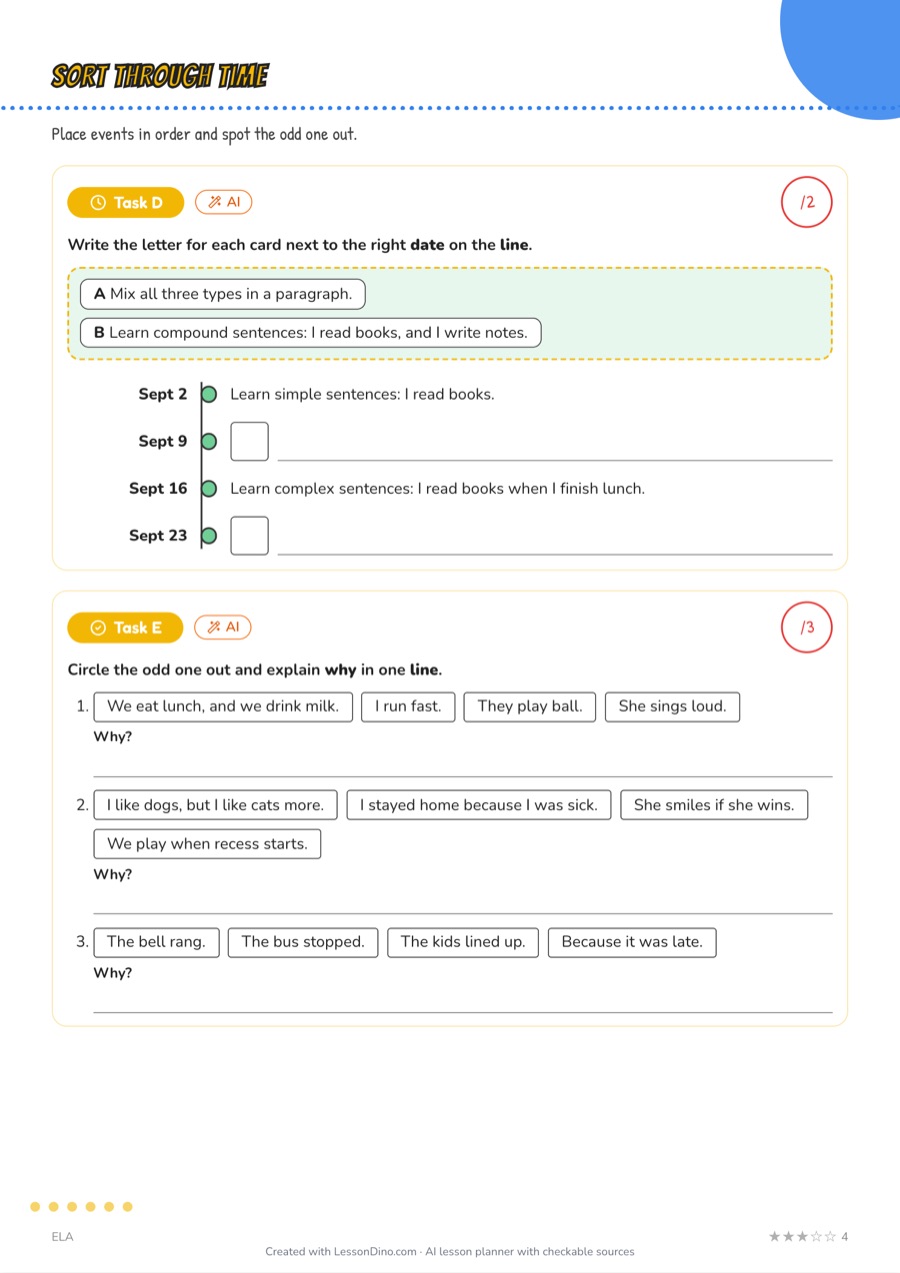
Sort Through Time
Place events in order and spot the odd one out.
Write the letter for each card next to the right date on the line.
Circle the odd one out and explain why in one line.
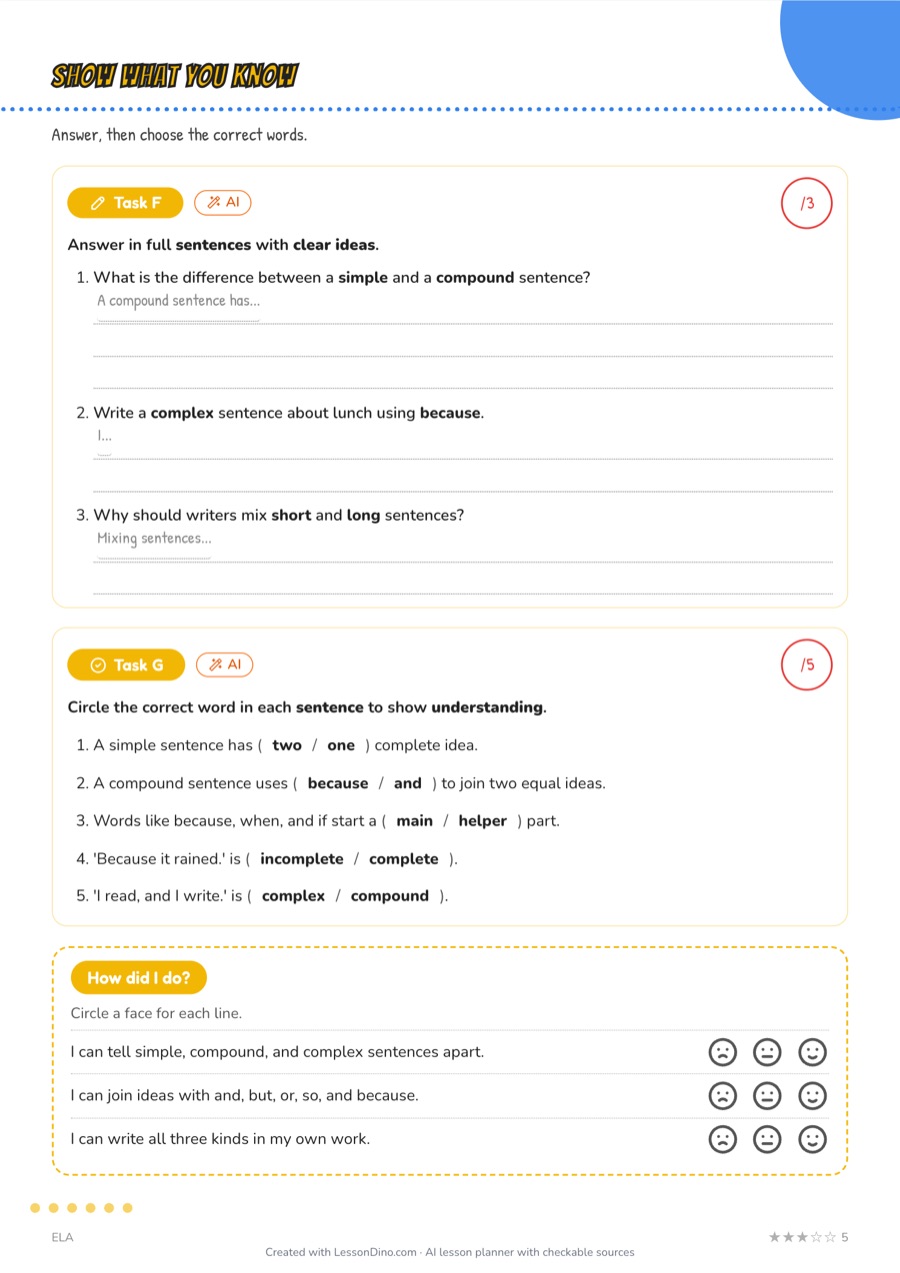
Show What You Know
Answer, then choose the correct words.
Answer in full sentences with clear ideas.
- What is the difference between a simple and a compound sentence?
- Write a complex sentence about lunch using because.
- Why should writers mix short and long sentences?
Circle the correct word in each sentence to show understanding.
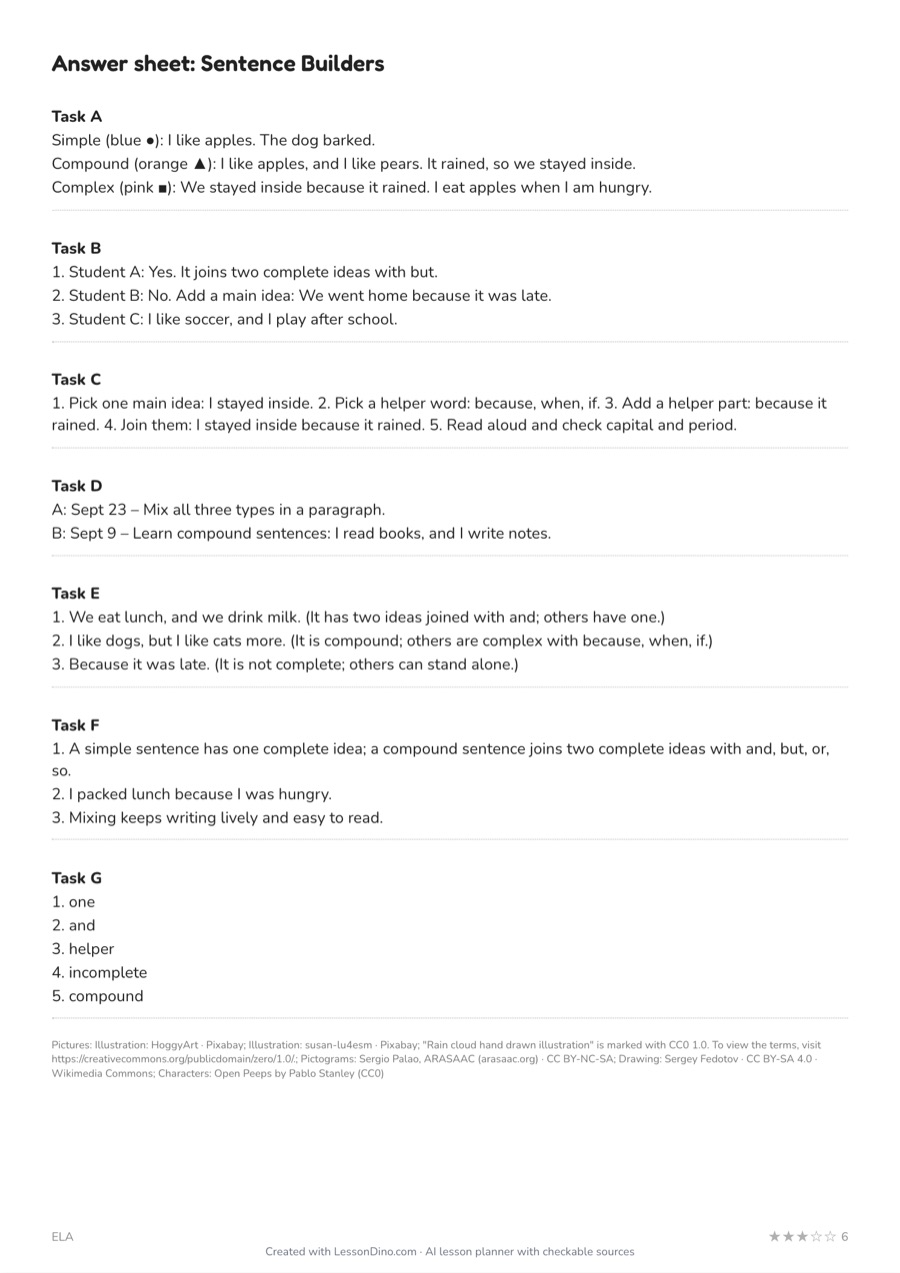
Answers
Show the answers
- What is the difference between a simple and a compound sentence? A simple sentence has one complete idea; a compound sentence joins two complete ideas with and, but, or, so.
- Write a complex sentence about lunch using because. I packed lunch because I was hungry.
- Why should writers mix short and long sentences? Mixing keeps writing lively and easy to read.
The answer sheet is the last picture above.
Curriculum
Demonstrate command of the conventions of standard English grammar and usage when writing or speaking.
Made with Lesson Dino's AI on 17 October 2026. AI can make mistakes, so check the answers and facts against the sources before you teach.