Slides
Lesson plan
Super Sentences: Simple, Compound, and Complex
Students learn to build simple, compound, and complex sentences. They draw a three-panel comic and write one matching sentence per panel.
Objectives
- Students will write one simple, one compound, and one complex sentence.
- Students will use commas correctly with and, but, so and helper words.
- Students will speak and check if ideas sound complete and finished.
Success criteria
- I can write a simple sentence with one full idea.
- I can join two ideas with a comma and and, but, or so.
- I can add a helper part with because, when, if, or after.
Key words
| Word | Meaning |
|---|---|
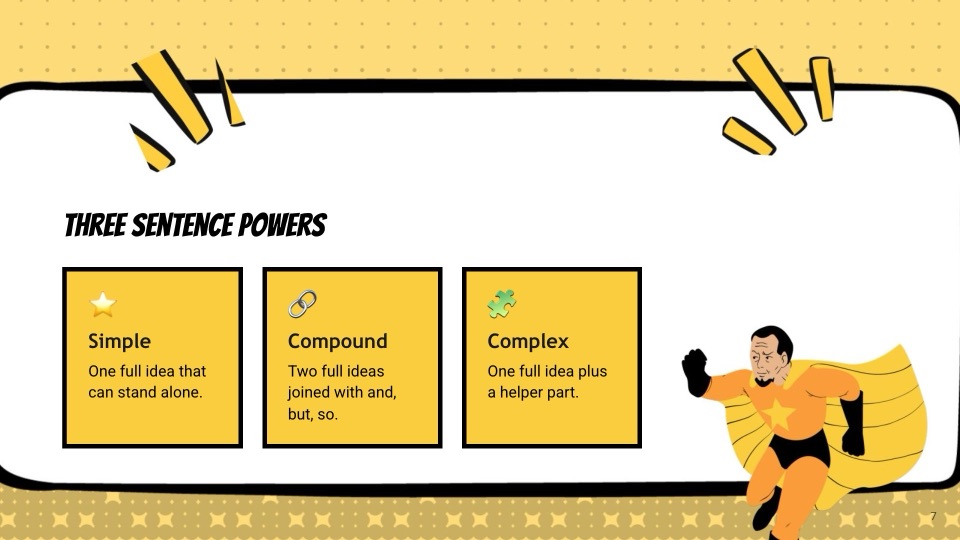
| simple sentence | one full idea that can stand alone as a complete thought. It has one independent clause and no dependent clauses. |
| compound sentence | two full ideas joined with and, but, or, so. It has two independent clauses but no dependent clauses. |
| complex sentence | one full idea plus a helper part that needs the other part to make sense. It has one independent clause and at least one dependent clause. |
| comma | small mark , that shows a short pause and comes before and, but, or so in a compound sentence. |
| helper word | small starting word like because, when, if, after that makes a part need a partner. |
Timed plan (60 minutes)
| Time | Stage | What happens |
|---|---|---|
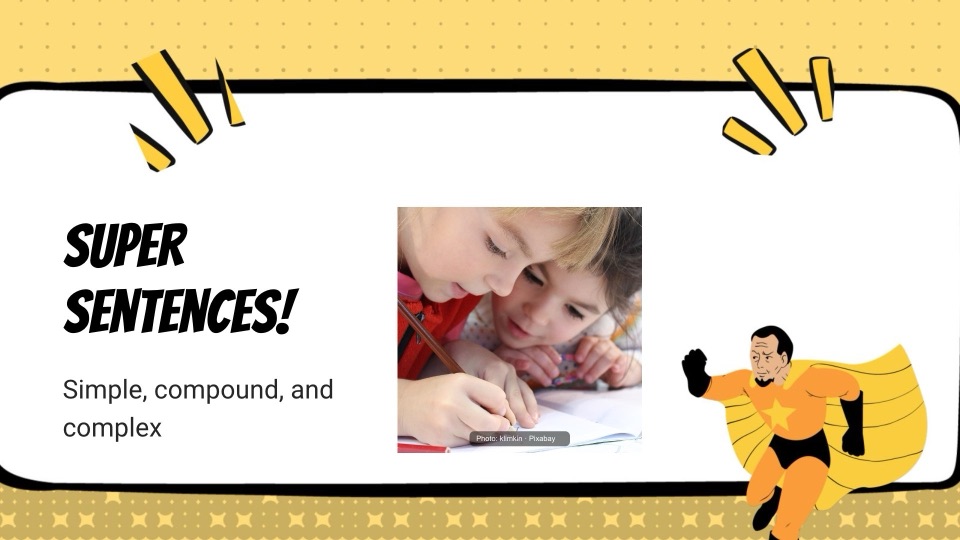
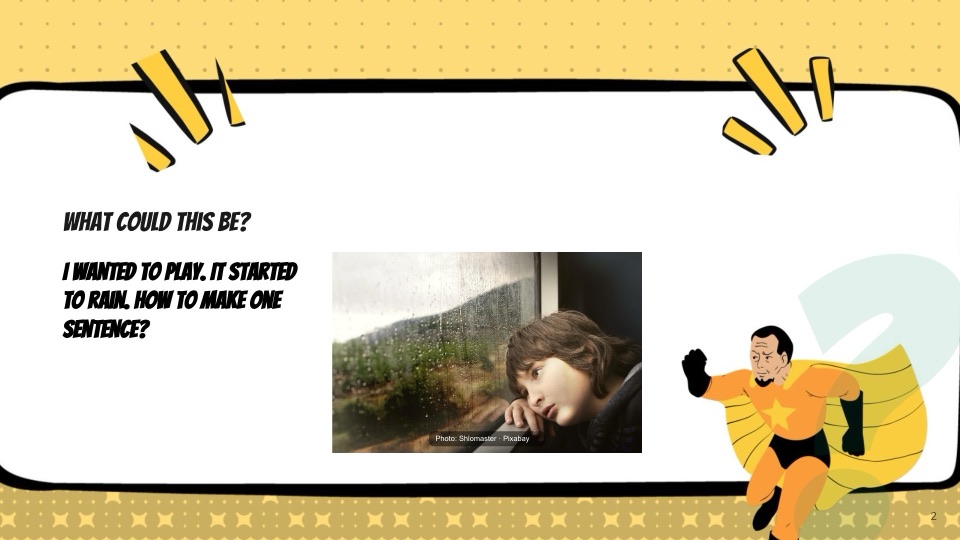
| 10 min | Starter | Hook students and surface the problem of joining two short ideas into one sentence. Show Slide 1 Super Sentences! Simple, compound, and complex and read the title together. Say the hook: Cartoon writers mix short and long sentences to keep stories exciting. Today you are the writer. Show Slide 2 mystery: I wanted to play. It started to rain. How to make one sentence? Model joining them: I wanted to play, but it started to rain! Point to the comma before but. |
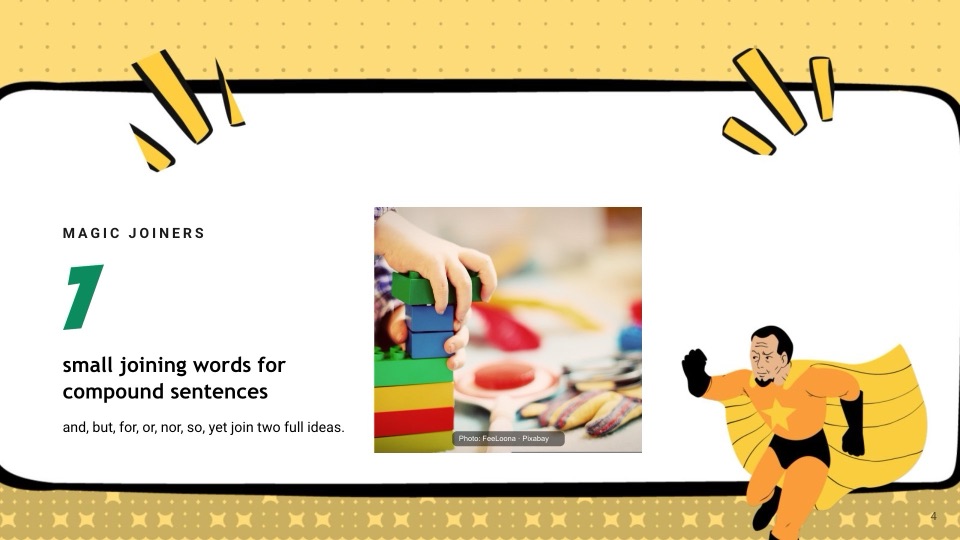
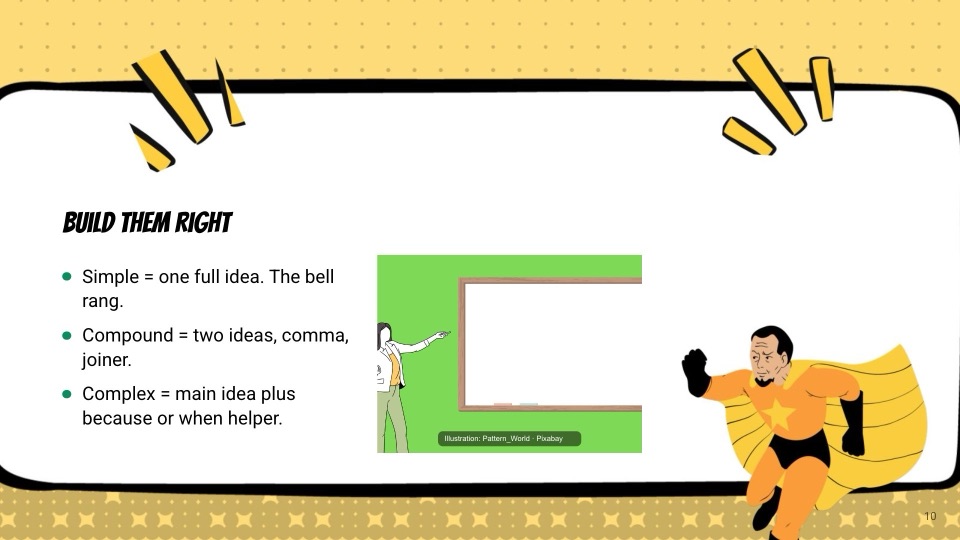
| 15 min | Teaching | Teach the three sentence powers and how commas and helper words work. Show Slide 3 One Idea or Two and Slide 7 Three Sentence Powers cards for Simple, Compound, Complex. Show Slide 4 Magic Joiners: and, but, for, or, nor, so, yet join two full ideas. Explain there are 7 small joining words for compound sentences. Show Slide 10 Build Them Right and model each type: The bell rang. The bell rang, so we lined up. We lined up because the bell rang. Think aloud about complete and helper parts: an independent clause forms a complete sentence on its own, while a dependent clause needs another clause. |
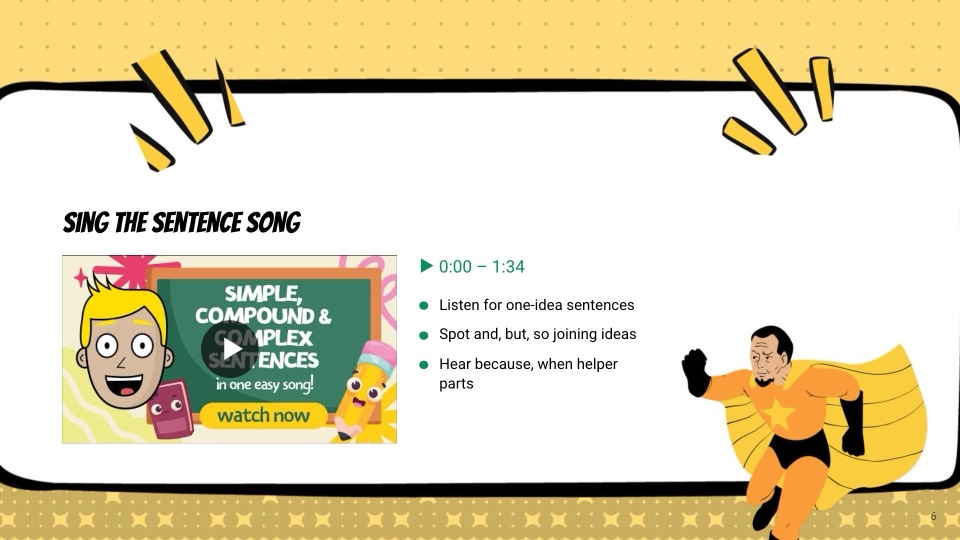
| 10 min | Sing and Share | Hear the three types in a song and decide together when short or long sentences work best. Show Slide 5 question: When is a short sentence best? When is a long one best? Let pairs share quickly. Play Video clip 1 Sentence Song - three types (0:00-1:34) on Slide 6 once. Replay key lines and pause to name: one-idea sentence, and, but, so joining ideas, because, when helper parts. Chart answers: short for fast action, long for joining or explaining why. |
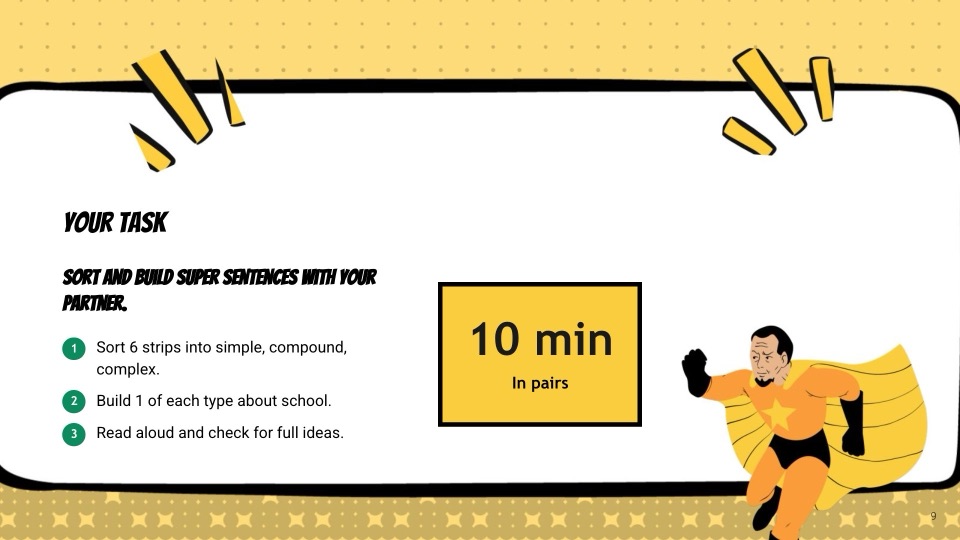
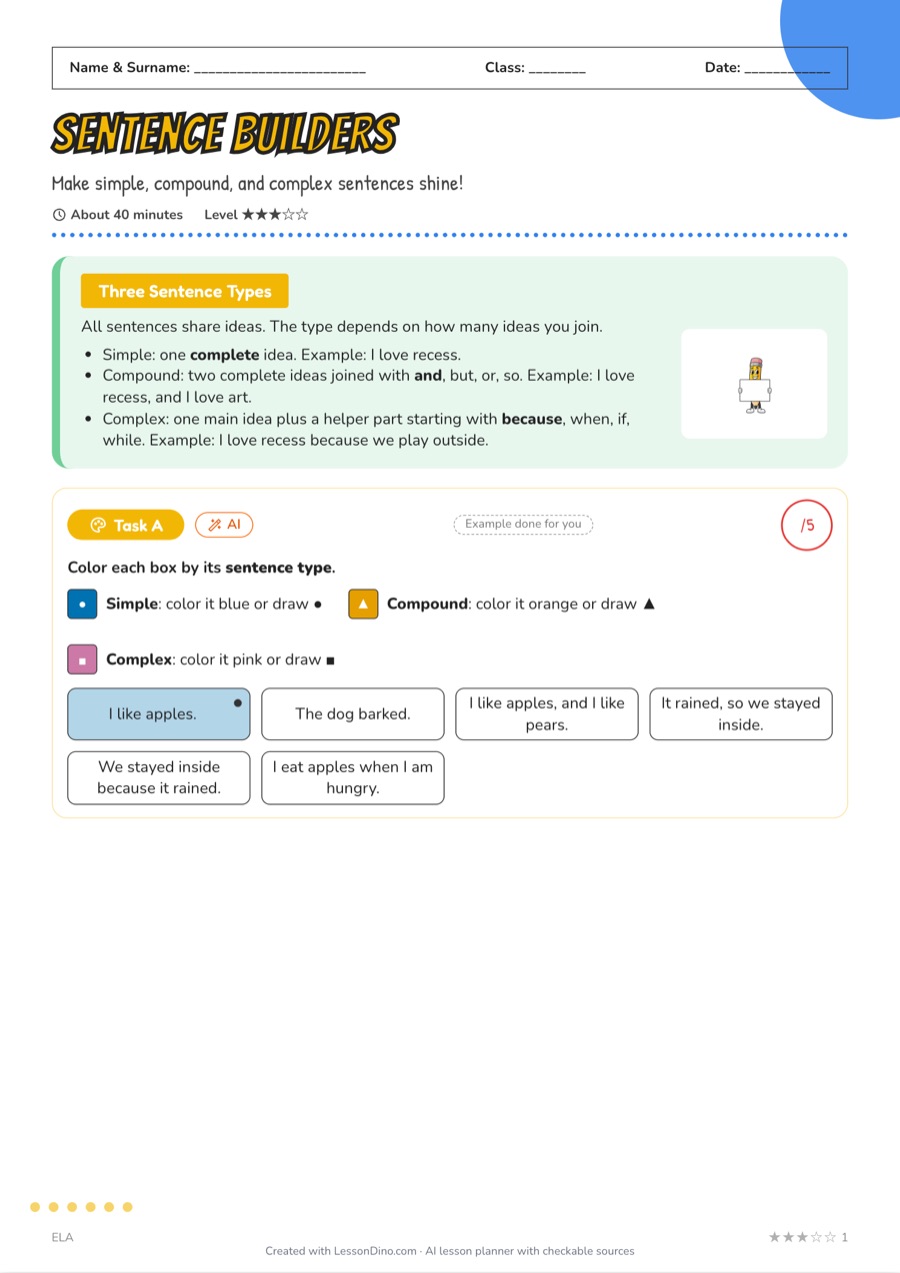
| 18 min | Main Activity | Write one simple, one compound, and one complex sentence in a three-panel comic. Show Slide 9 task: Sort 6 strips into simple, compound, complex. Build 1 of each type about school. Read aloud and check for full ideas. Model a 3-panel comic about rain: panel 1 simple The dog barked. panel 2 compound with two equal ideas joined by and, but, or, so. panel 3 complex with one main idea plus helper starting with because or when. Hand out 3-panel paper and frames: The dog ___. I wanted to ___, but ___. I stayed inside because ___. Circulate as pairs draw quick pictures and label each panel simple, compound, or complex. |
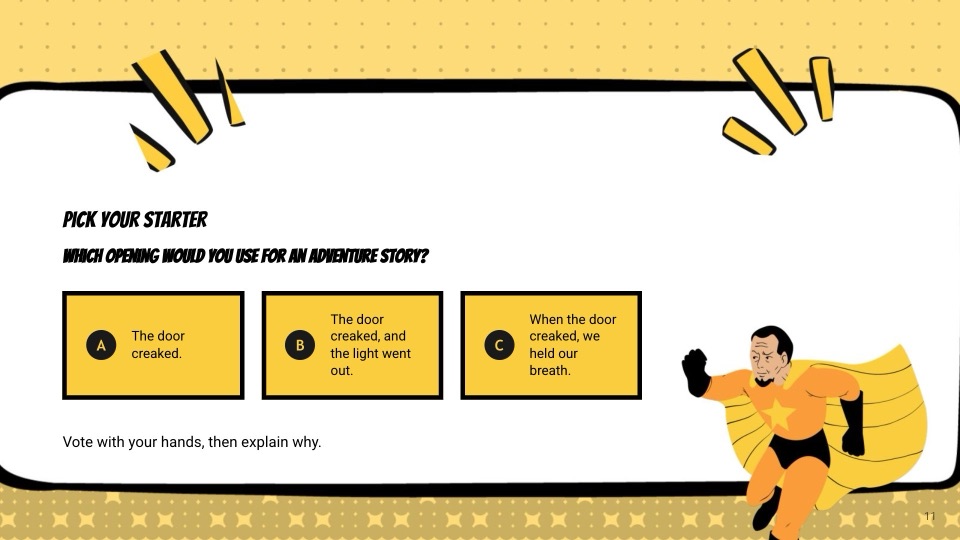
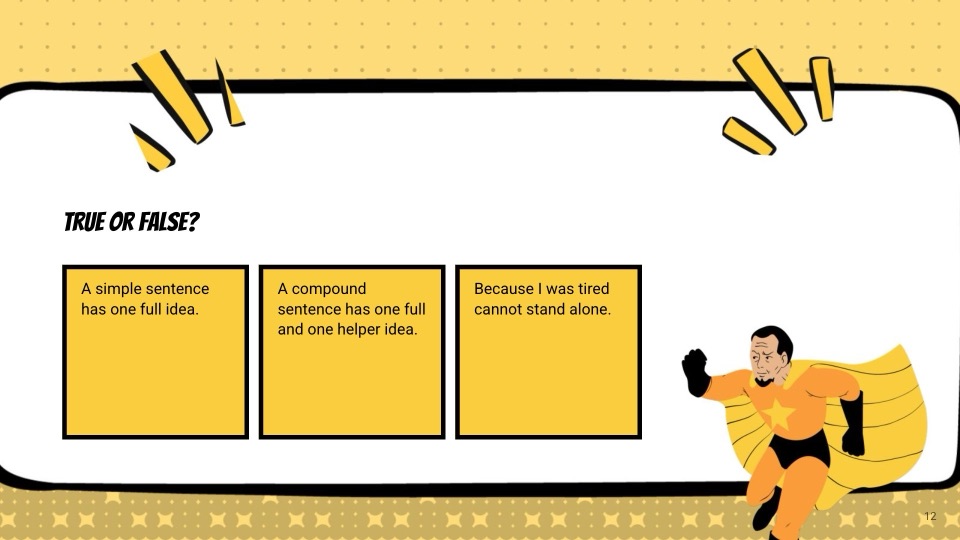
| 7 min | Plenary | Return to success criteria and check who can name and fix each sentence type. Show Slide 11 vote: Which opening would you use for an adventure story? Read the three choices aloud. Show Slide 12 True or false and read each line: A simple sentence has one full idea. One independent clause makes a simple sentence. A compound sentence has one full and one helper idea. Fix the false one together: a compound sentence has two full ideas, a complex sentence has one full and one helper idea. Link back to I can statements and preview next writing. |
Common mistakes
- Writing a helper part alone, like Because it started to rain.
How to spot it: Student reads it aloud and it sounds unfinished or teacher asks Can this stand alone and they hesitate.
Add the main idea: We stayed inside because it started to rain. A dependent clause needs another clause to make a complete sentence. - Missing the comma before and, but, or so in a compound sentence.
How to spot it: Two full ideas run together with only the joiner word, like I wanted to play but it rained.
Insert comma before the joiner: I wanted to play, but it rained. Use a comma before the coordinating conjunction. - Calling any long sentence with and a complex sentence.
How to spot it: Student labels The dog ran and barked as complex because it is long.
Ask Can both sides stand alone? Teach underline main clause and circle helper part; if no because, when, if, after part, it is not complex.
Support
- Provide sentence frames: The dog ___. I wanted to ___, but ___. I stayed inside because ___.
- Color underline each full idea in a different color and use a checklist with examples for commas.
Stretch
- Have students add a second complex sentence where the helper part comes first, with a comma after it.
- Have students change the joiner word in a compound sentence and explain how meaning changed.
Check questions
- Which is simple: The bell rang or The bell rang, so we lined up?
Answer: The bell rang. - Fix it: I wanted to play but it started to rain.
Answer: I wanted to play, but it started to rain. - Which is complex: We stayed inside or We stayed inside because it rained?
Answer: We stayed inside because it rained.
Curriculum
Demonstrate command of the conventions of standard English grammar and usage when writing or speaking.
Video clips
Clips on YouTube, from the start and end times we chose. Check each one before you show it.
-
Sentence Song - three types from 0:00 to 1:34
Good Morning Mr.D: The Sentence Song! | Simple, Compound & Complex Sentences Song
Covers simple, compound, and complex with music and simple examples perfect for 8-9-year-olds in Grade 3.
-
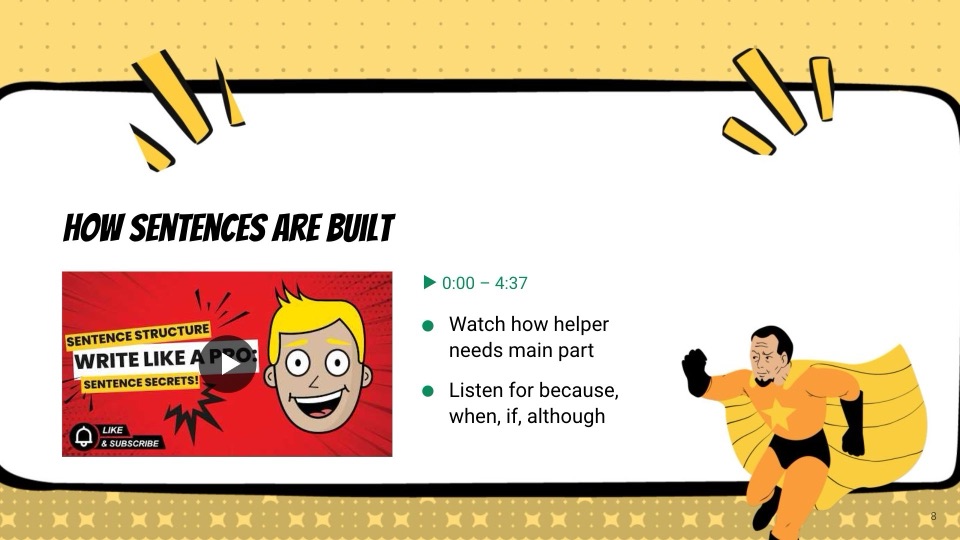
Sentence structure explained from 0:00 to 4:37
Good Morning Mr.D: Sentence Structure Explained – Simple, Compound, & Complex Sentences!
Clear teacher explanation of all three types with kid-friendly examples at the right pace for 8-9-year-olds.
Worksheet
Sources
- English Language Arts Standards | Common Core State Standards ... thecorestandards.org
- LearnZillion EL Education Language Arts Correlation Guide Grade 3 ortn.edu
- Simple, Compound, and Complex Sentences ... csuchico.edu
- Sentence Types - Purdue OWL® - Purdue University owl.purdue.edu
- Sentence Types and Functions - San José State University sjsu.edu
- ENG 1001: Sentences: Simple, Compound, and Complex facultyweb.ivcc.edu
- Sentence Punctuation Patterns - Purdue OWL® owl.purdue.edu
- University Writing Center - North Carolina Agricultural and ... ncat.edu
- Simple, compound and complex sentences - KS2 English - BBC bbc.co.uk
- How to write a complex sentence - KS3 English - BBC Bitesize bbc.co.uk
- Sentence Types | Writing Center gustavus.edu
- Simple, Compound and Complex Sentences: How to Teach them theteachingcouple.com
- Simple, Compound & Complex Sentences — Writing Guide for Kids ... english1to5.com
- Simple, Compound and Complex Sentences [Explained with ... englishgrammarsoft.com
- Finally Understand Simple, Compound, and Complex Sentences elavibes.co
- Simple, Compound, Complex Printable Sentences Simple Compound ... superteacherworksheets.com
- Sentence Structures: Simple, Compound, Complex, & Compound ... englishcurrent.com
- Simple, Compound and Complex Sentences Worksheets for 7th Graders | Lumos Learning lumoslearning.com
- What Are Simple, Compound, and Complex Sentences? prowritingaid.com
- ESL001: Simple, Compound, and Complex Sentences | Saylor Academy learn.saylor.org
- Sentence Structure (Simple, Compound, Complex, & Compound ... english-grammar-revolution.com
- How to Teach Simple Compound and Complex Sentences - Hello ... hellotennesseeteacher.com
- Sentences: Use a variety of SENTENCE TYPES in your writing skagit.edu
- Types of Sentences - Excelsior OWL owl.excelsior.edu
Picture credits
- Photo: klimkin · Pixabay
- Photo: Shlomaster · Pixabay
- Photo: FeeLoona · Pixabay
- Illustration: Pattern_World · Pixabay
- Illustration: HoggyArt · Pixabay
- Illustration: susan-lu4esm · Pixabay
- Picture: unknown · CC0 · rawpixel via Openverse
- Pictograms: Sergio Palao, ARASAAC (arasaac.org) · CC BY-NC-SA
- Drawing: Sergey Fedotov · CC BY-SA 4.0 · Wikimedia Commons
Made with Lesson Dino's AI on 17 October 2026. AI can make mistakes, so check facts against the sources before you teach.