Slides
Lesson plan
Why World War, and Did Peace Fix It?
Students learn how alliances turned the 1914 crisis into world war and what the 1919 settlement changed. They debate the peace and write a verdict on whether it would last.
Objectives
- Students will explain how alliances turned the 1914 crisis into world war.
- Students will describe the global scale of the war and its human cost.
- Students will weigh views on whether the 1919 settlement would keep peace.
Success criteria
- I can explain how one shooting led to declarations of war in 1914.
- I can describe where the war was fought and what changed after it.
- I can give a verdict on the peace with reasons from both sides.
Key words
| Word | Meaning |
|---|---|
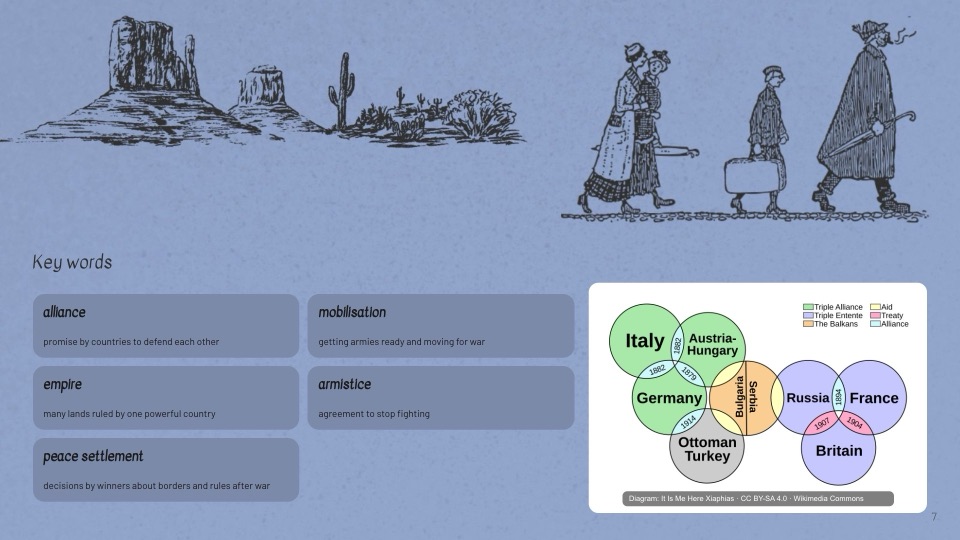
| alliance | a promise between countries to help defend each other if attacked |
| mobilisation | getting armies ready and moving for fighting |
| empire | many lands ruled by one powerful country |
| reparations | money a defeated country is made to pay to cover war costs |
| consequence | something that happens later because of an earlier event |
Timed plan (60 minutes)
| Time | Stage | What happens |
|---|---|---|
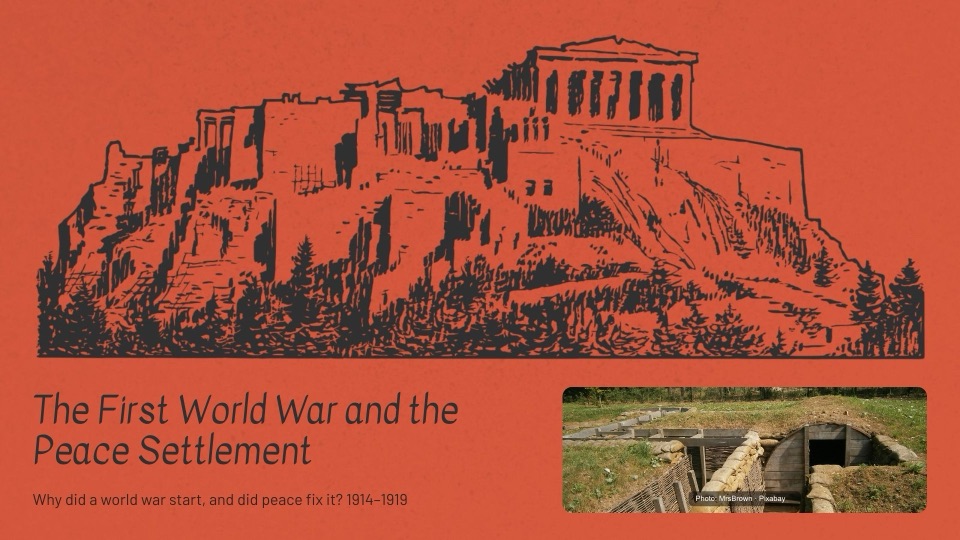
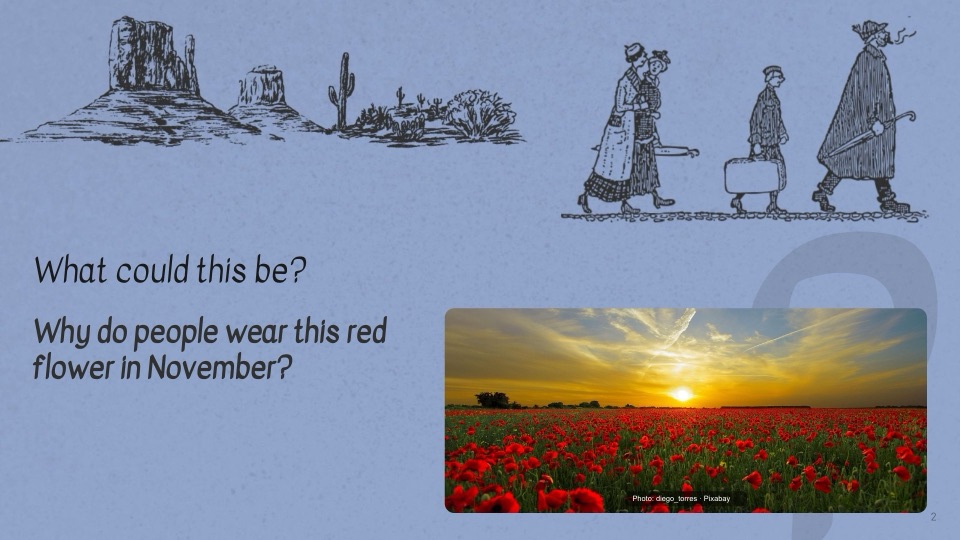
| 8 min | Starter | Hook interest with the fairness question and recall remembrance and dates. Show Slide 1 The First World War and the Peace Settlement and read the question Why did a world war start, and did peace fix it? Show Slide 2 and say the hook: If you win after losing millions of people, what do you ask for? Stand where you stand. Ask pairs to answer why people wear the red flower in November, then confirm it is a poppy for remembrance of the First World War and Armistice Day, 11 November. Preview the verdict vote on Slide 11 and point to the opinion line. |
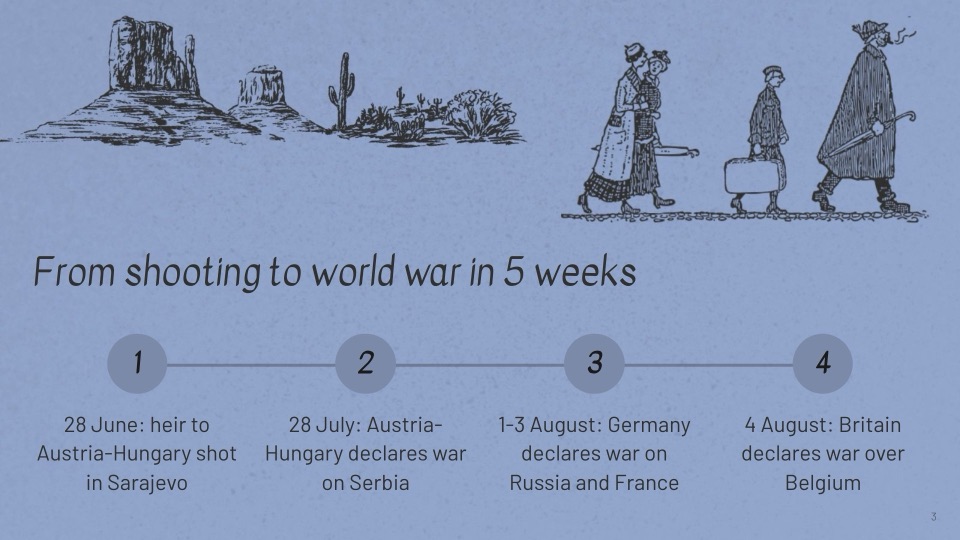
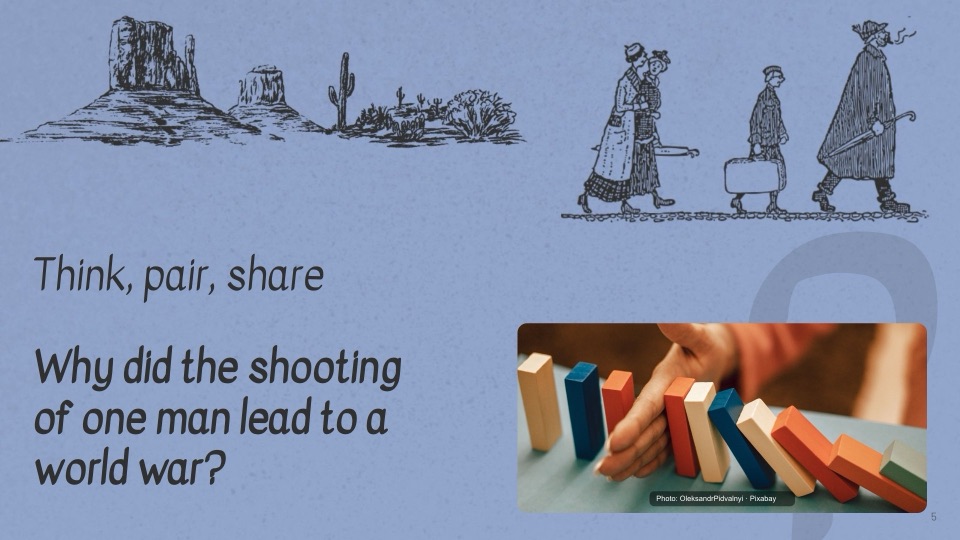
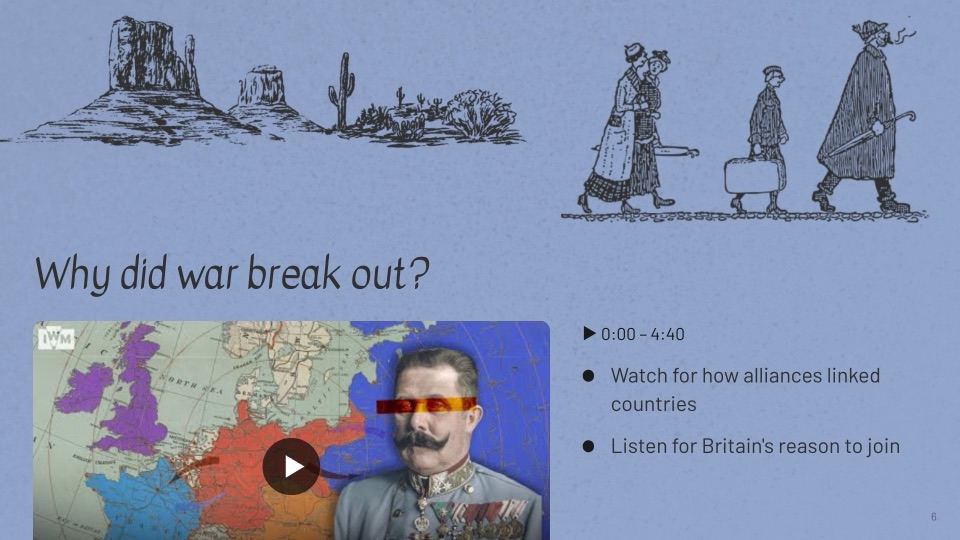
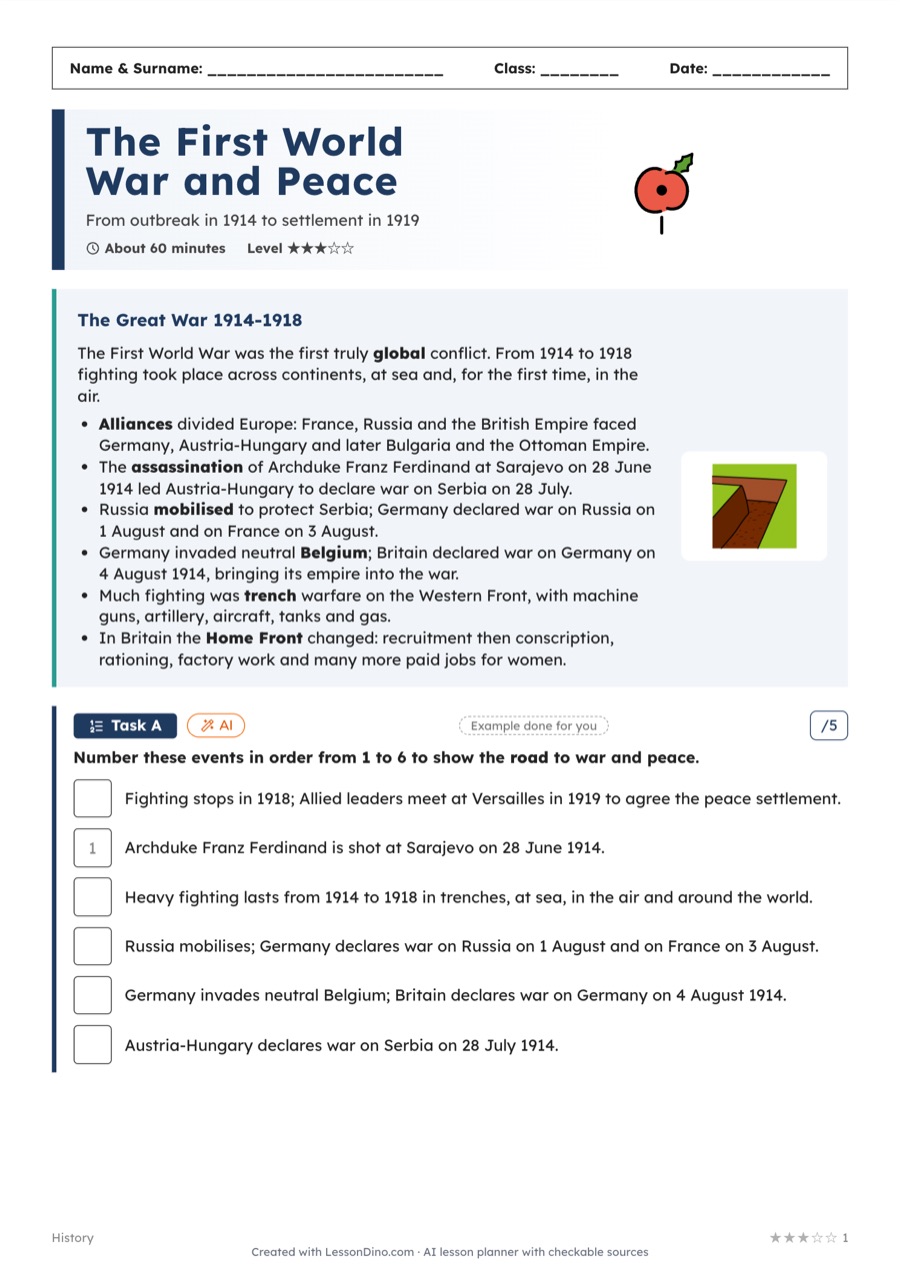
| 12 min | Road to war | Explain how alliances linked the July–August 1914 declarations of war. Show Slide 3 From shooting to world war in 5 weeks and talk through the chain in date order. Explain that countries agreed to protect each other and would defend them if one was attacked. Play Video clip 1 (0:00–4:40) on Slide 6. Ask students to listen for how alliances linked countries and for Britain's reason to join. Use Slide 5 Think, pair, share to check why the shooting of one man led to world war. |
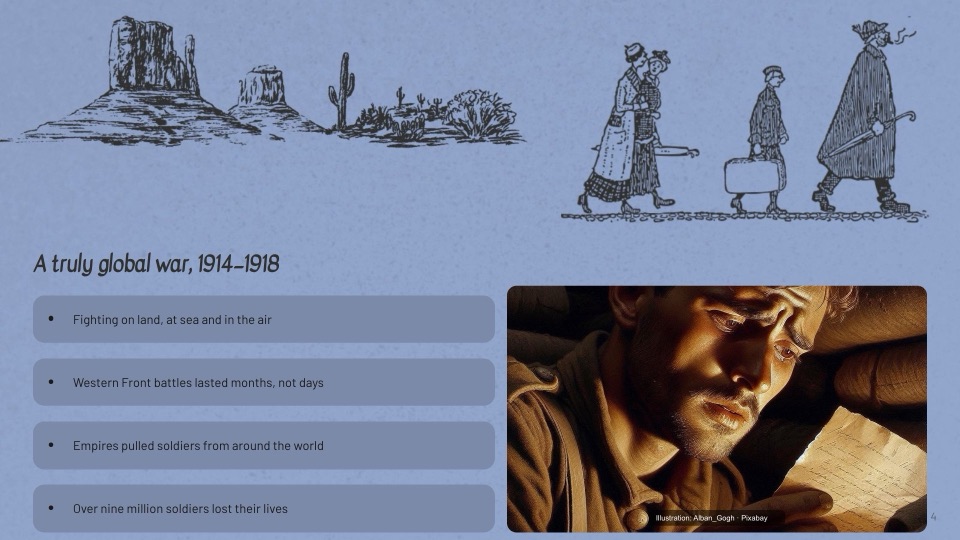
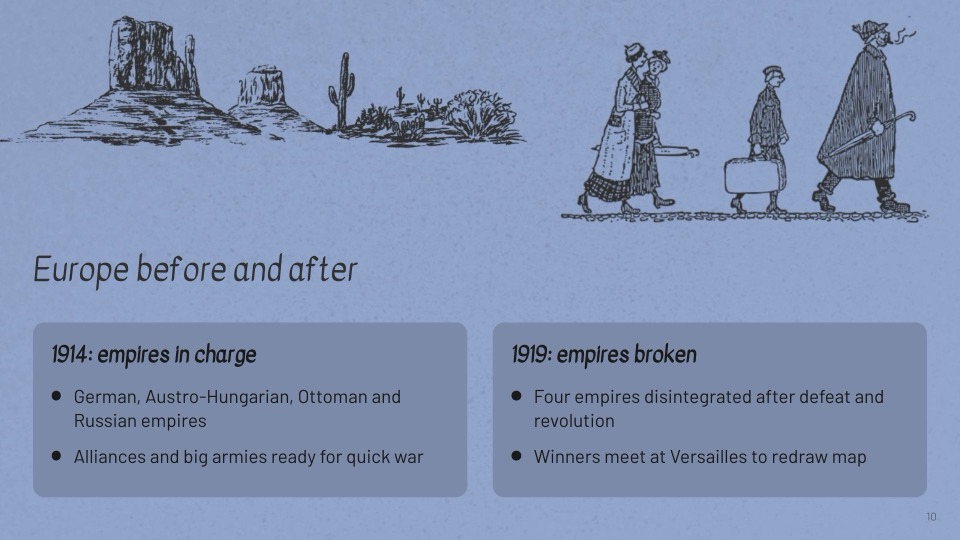
| 12 min | Global war to peace deal | Teach the scale of war and the key changes decided in 1919. Show Slide 4 A truly global war and confirm fighting was from 1914 to 1918 across Europe, Africa, Asia, the Pacific and the Middle East. Teach Slide 7 words alliance, mobilisation and empire, and explain battles often lasted months instead of days and fighting took place for the first time in the air as well as on land and at sea. Show Slide 10 Europe before and after and explain the conflict caused the disintegration of four empires – the Austro-Hungarian, German, Ottoman and Russian. Introduce the Allied delegates at the Versailles peace conference in 1919 and that the victorious Allies looked to defeated Germany in 1919 to pay reparations. |
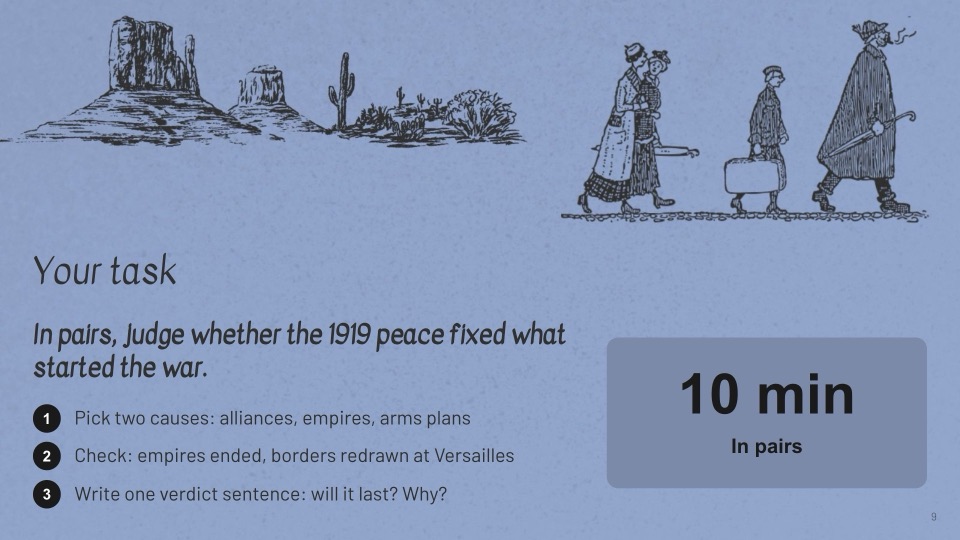
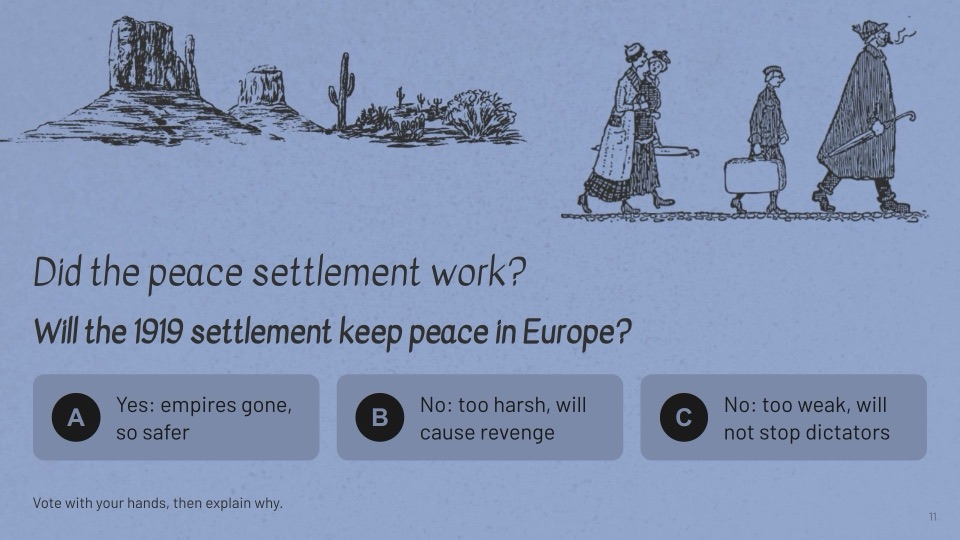
| 20 min | Was the Peace Fair? | Weigh different views on the consequences and judge if peace would last. Set out consequence cards and the opinion line from Strongly agree to Strongly disagree for the vote Will the 1919 settlement keep peace in Europe? Read three statements: it is fair because empires are gone so safer; it is too harsh and will cause revenge; it is too weak and will not stop dictators. Run the line debate: students stand, one from each part gives a reason in ten seconds, others may move one step after hearing the other side. Hand out Worksheet Task D and ask students to Judge the peace settlement fairly from three angles and use Slide 9 to write one verdict sentence using reparations, empires and consequence. |
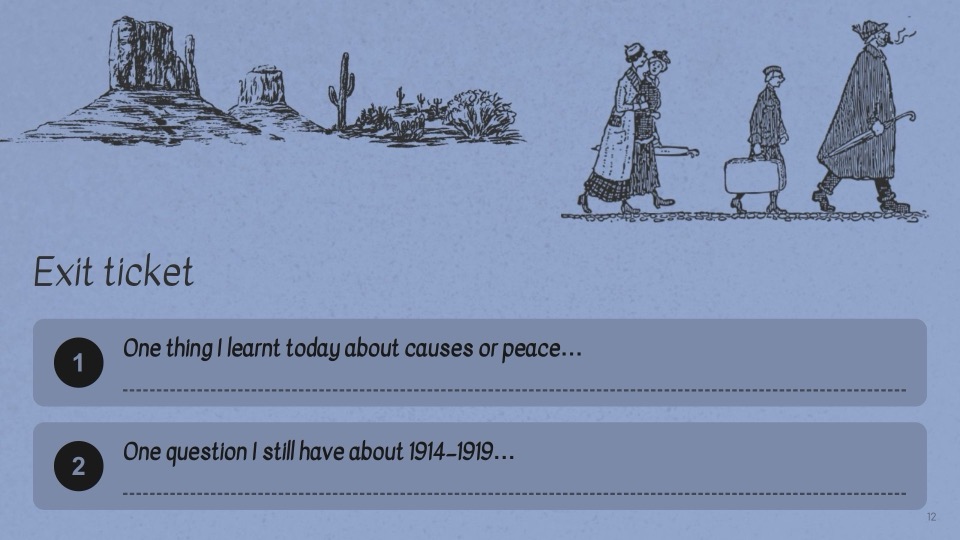
| 8 min | Plenary | Return to objectives and check verdicts on causes and peace. Revisit Slide 1 question and ask two students from different parts of the line to restate their verdict. Show Slide 12 Exit ticket and ask students to write one thing learnt about causes or peace and one question still held. Connect back to Year 9 focus on analysing causes and consequences of modern conflicts like the First World War. Collect Worksheet Task D Thinking hats: Judge the peace settlement fairly from three angles and Slide 9 verdicts and preview next lesson on inter-war years. |
Common mistakes
- Thinking the assassination alone caused the war
How to spot it: Says 28 June shooting equals world war with no links
Rebuild chain: alliances promised defence, so 28 July, 1-3 August and 4 August declarations followed. - Thinking the war was only fought in France
How to spot it: Map or answer names only the Western Front
Recall war 1914 to 1918 across Europe, Africa, Asia, Pacific and Middle East and at sea and in the air. - Thinking Versailles ended all danger of war
How to spot it: Says peace must last because fighting stopped
Weigh reparations burden in 1919 and break-up of four empires which was a key factor in later war.
Support
- Hold For, Against or Unsure cards and pass to speak, rather than speaking unprompted.
- Use pre-ordered timelines, word banks and sentence frames for verdict writing.
Stretch
- Connect one consequence back to one long-term cause of tension before 1914 and explain the link.
- Draft two fairer alternatives delegates could have chosen and note one risk of each.
Check questions
- Name the 1914 chain in order from assassination to Britain entering.
Answer: 28 June assassination, 28 July Austria-Hungary v Serbia, 1-3 August Germany v Russia and France, 4 August Britain and empire enter. - Name two changes made by the 1919 settlement.
Answer: Germany made to pay reparations and give up land decided at Versailles. - Was the peace fair and will it last? Give one reason.
Answer: Accept Yes with empires gone so safer, or No with too harsh causing revenge or too weak to stop dictators.
Curriculum
the First World War and the Peace Settlement
Video clips
Clips on YouTube, from the start and end times we chose. Check each one before you show it.
-
Causes of the First World War from 0:00 to 4:40
Imperial War Museums: How did WW1 Start? | Causes of the First World War
Museum explainer with clear vocabulary and steady pace that is ideal for 13-14-year-olds learning causes.
-
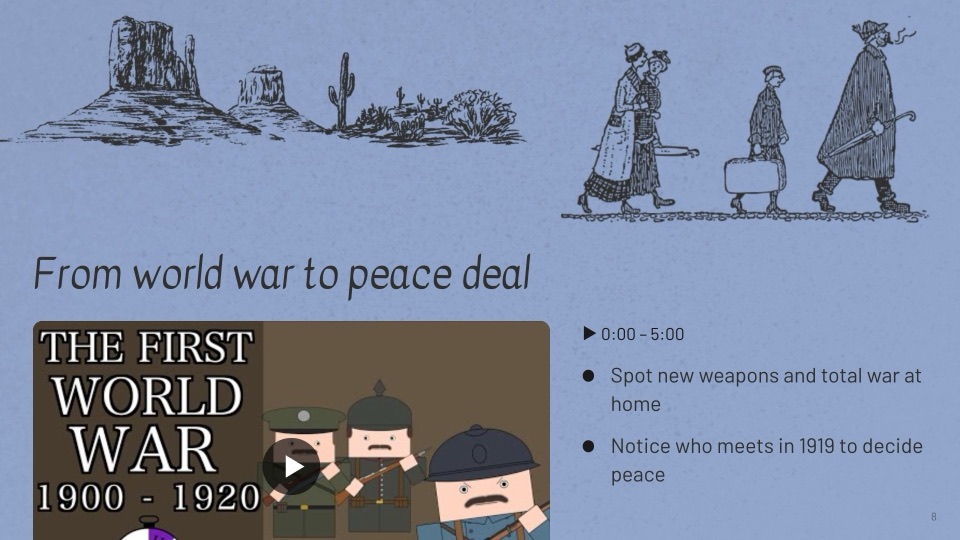
War and international relations from 0:00 to 5:00
History Matters: Ten Minute History - World War One and International Relations (Short Documentary)
Animated short documentary on the war and settlement that is accessible for 13-14-year-olds, though a little fast.
Worksheet
Sources
- Oriel High School: History & Ancient History Year 9 Curriculum Overview oriel.w-sussex.sch.uk
- National curriculum in England: history programmes of study gov.uk
- First World War - National Army Museum nam.ac.uk
- First World War | Causes, Battles and Home Front | Schoolshistory schoolshistory.org.uk
- World War One: The global conflict that defined a century - BBC bbc.co.uk
- Home Front | First World War | Schoolshistory schoolshistory.org.uk
- Outbreak of the First World War | Imperial War Museums iwm.org.uk
- How and why did World War One start? - BBC Bitesize bbc.co.uk
- What Caused the First World War? (article) | Khan Academy khanacademy.org
- World War One: how 'total' was it for people in the British Empire? thenational.academy
- The First World War in Global Context | History Teaching Institute hti.osu.edu
- BBC One - The First World War from Above bbc.co.uk
- Origins of war: First World War workbook - Anzac Portal anzacportal.dva.gov.au
- World War 1 facts for kids | National Geographic Kids natgeokids.com
- How did the first world war actually end? - Paul Mason | libcom.… libcom.org
- Home front during World War I en.wikipedia.org
- World War One: The global conflict that defined a century - BBC … bbc.com
- [0903.4425] The trace of First World War on mathematics in Brno arxiv.org
- READ: The First World War as a Global War - Khan Academy khanacademy.org
- First world war | The Guardian theguardian.com
- First World War: News, analysis and opinion - Page 3 | The Week theweek.com
- The First World War nytimes.com
- First World War Literature | History Today historytoday.com
- First World War | The New Yorker newyorker.com
- World War One - KS2 History - BBC Bitesize bbc.co.uk
Picture credits
- Photo: MrsBrown · Pixabay
- Photo: diego_torres · Pixabay
- Illustration: Alban_Gogh · Pixabay
- Photo: OleksandrPidvalnyi · Pixabay
- Diagram: It Is Me Here Xiaphias · CC BY-SA 4.0 · Wikimedia Commons
- Pictograms: Sergio Palao, ARASAAC (arasaac.org) · CC BY-NC-SA
- Illustration: Elf-Moondance · Pixabay
- Illustration: Mohamed_hassan · Pixabay
- OpenMoji – the open-source emoji and icon project (CC BY-SA 4.0)
Made with Lesson Dino's AI on 17 October 2026. AI can make mistakes, so check facts against the sources before you teach.