Slides
Lesson plan
Clever Farming Built Maya Cities
Pupils learn how skilful Maya farming fed cities near AD 900. They trade crop cards and explain how extra food built temples.
Objectives
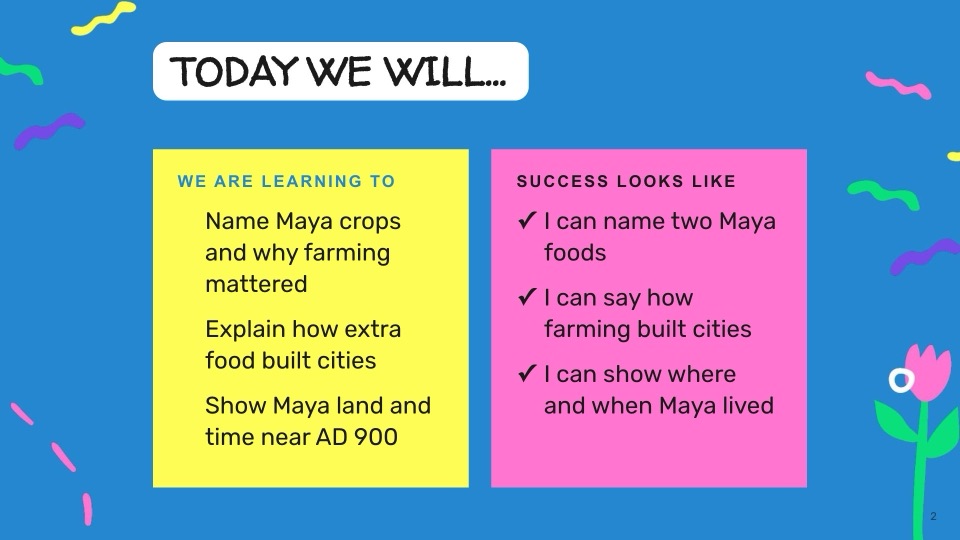
- Students will name Maya crops such as maize, beans and squash.
- Students will explain how extra food helped build Maya cities.
- Students will describe Maya land and time around AD 900.
Success criteria
- I can name two foods Maya farmers grew.
- I can say how extra food helped build cities.
- I can show where and when the Maya lived.
Key words
| Word | Meaning |
|---|---|
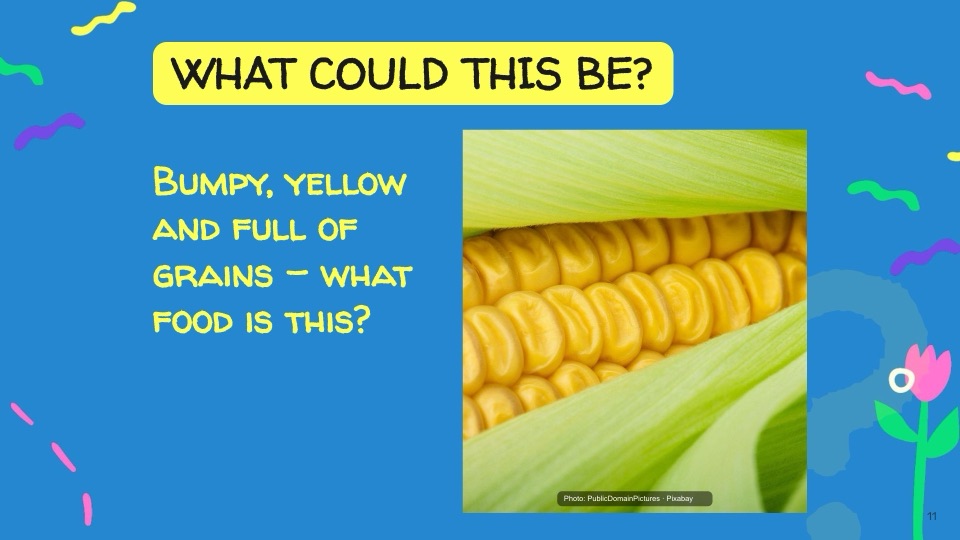
| maize | yellow grain crop grown for food that stores well |
| civilisation | large organised human society with shared rules and culture |
| temple | large stepped building made to honour gods |
| calendar | system for tracking days and seasons for farming and ceremonies |
| trade | swapping food and goods between families and groups |
Timed plan (60 minutes)
| Time | Stage | What happens |
|---|---|---|
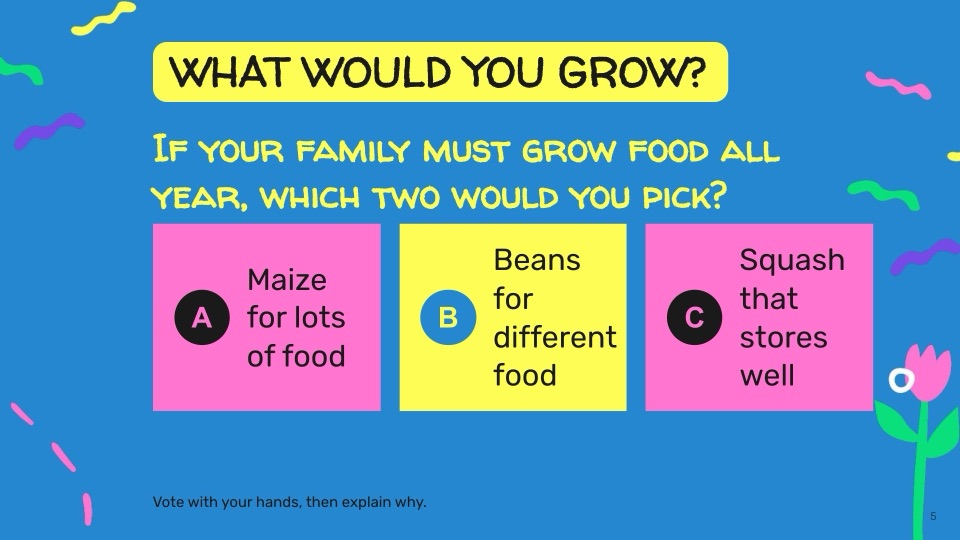
| 8 min | Starter | To hook pupils with feeding a family and recall what farming provides. Show Slide 1 The Marvellous Maya and welcome the class to the Maya world. Say the hook question and show Slide 5 vote choices. Take a quick hands-up vote for maize, beans or squash and ask two pupils why. Link answers to today’s job: choosing foods that feed a family all year. |
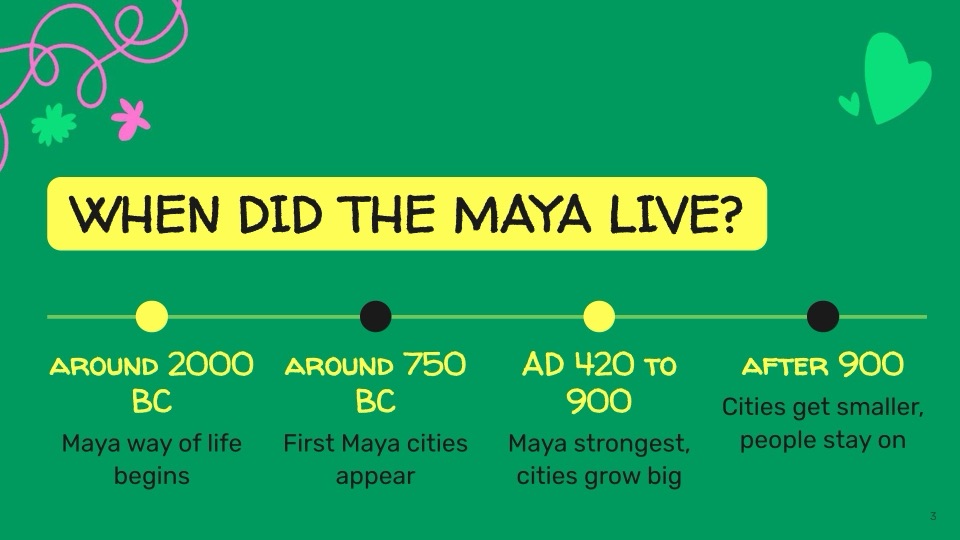
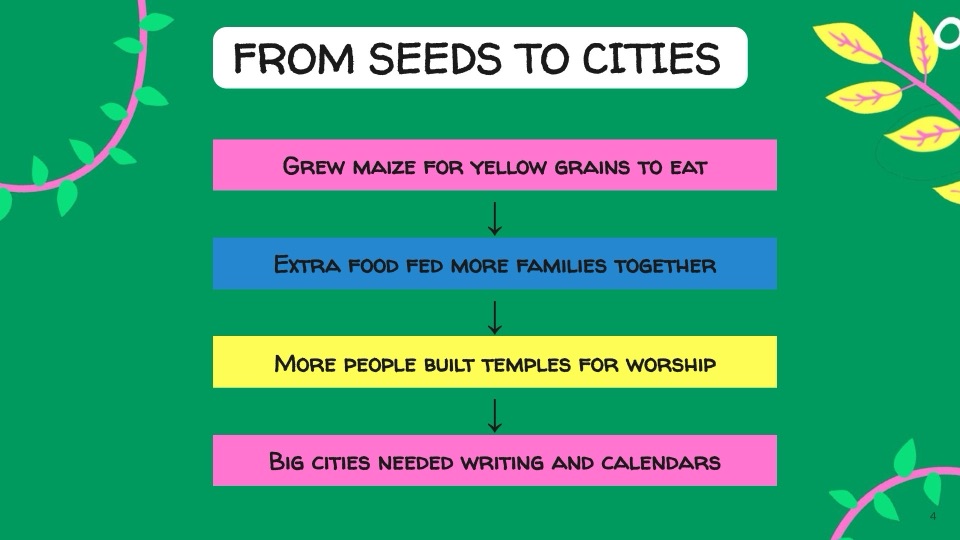
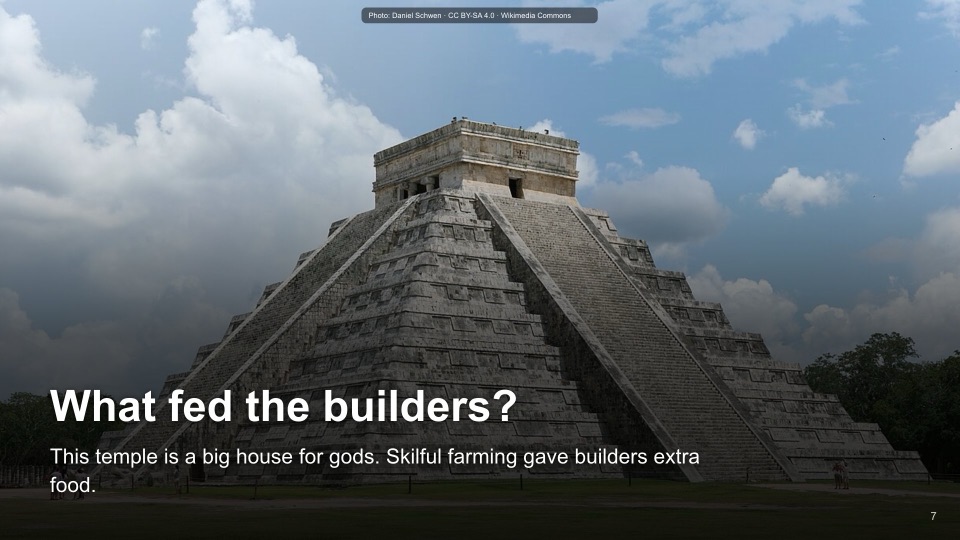
| 12 min | Teaching | To explain when the Maya lived and how extra food built cities. Show Slide 2 objectives and read the two I can statements with the class. Show Slide 3 timeline and talk through 2000 BC, 750 BC, AD 420 to 900 and after 900. Show Slide 4 chain and model the steps from seeds to cities. Show Slide 7 photo and explain the temple link to skilful farming. |
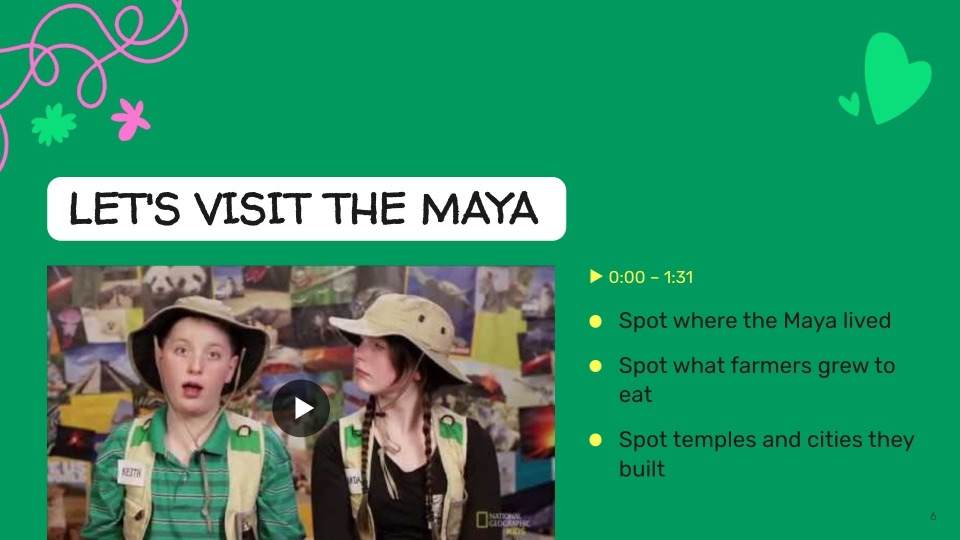
| 10 min | Video visit | To see Maya land, crops and city buildings together near AD 900. Show Slide 6 and set three spots: where the Maya lived, what farmers grew, temples they built. Play Video clip 4 from 0:00 to 1:31 without pausing. Pause on key images and name the Maya area across five present-day countries. Record class spots on the board under Land, Food and Cities. |
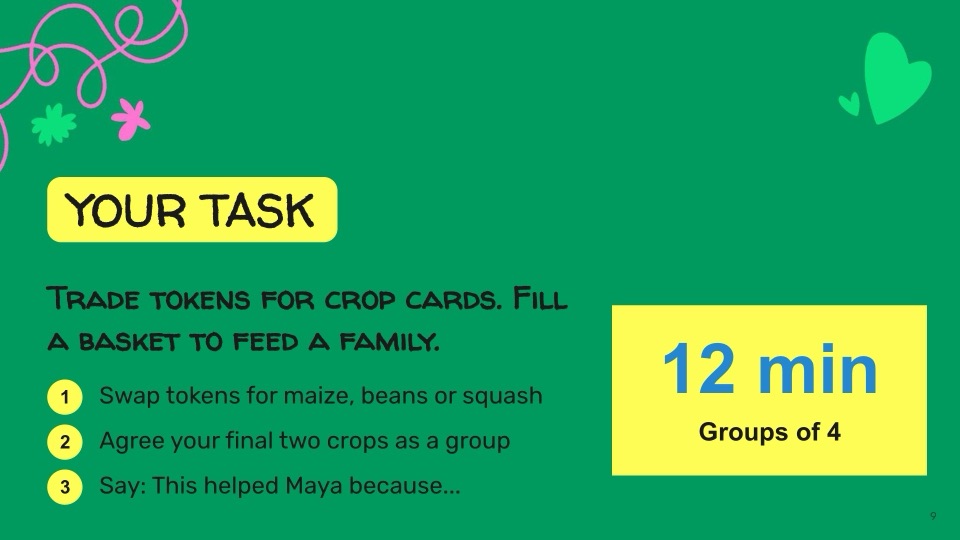
| 20 min | Main activity | To trade crops and explain what fed Maya builders. Show Slide 9 task and set groups of four around a basket and tokens. Model one swap: give 2 tokens, take 1 maize card, place it in the basket. Start timed trading for maize, beans or squash, then stop to agree final two crops. Hear group sentences using: This helped Maya because... |
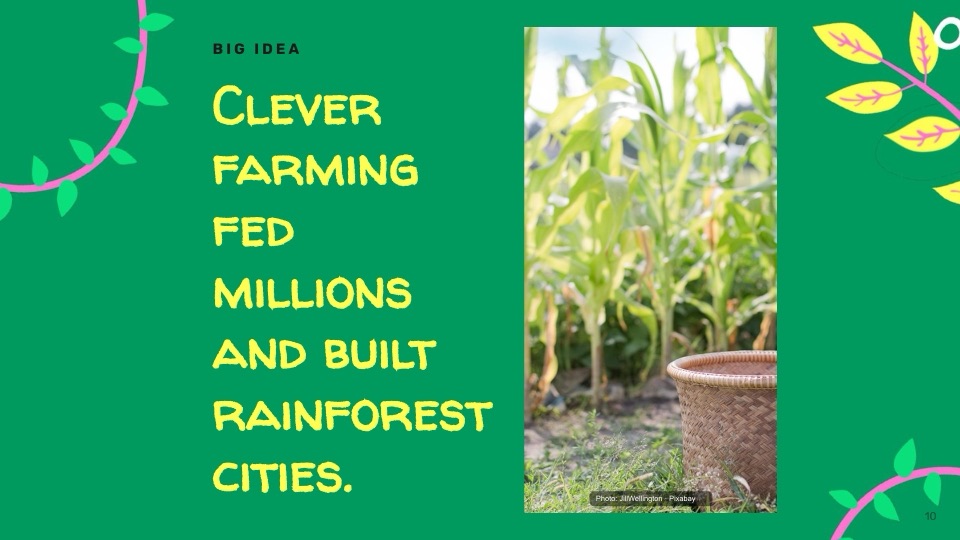
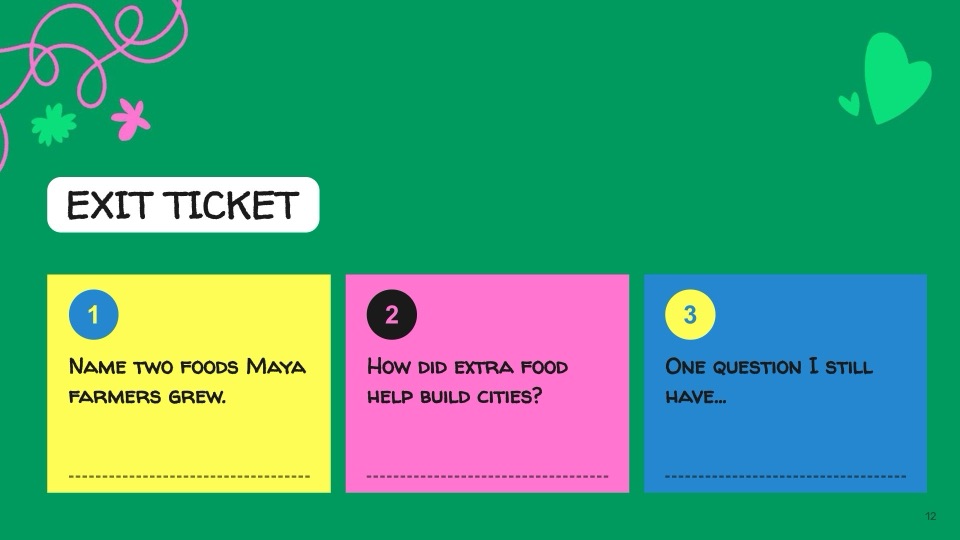
| 10 min | Plenary | To secure the big idea and check what pupils can name and explain. Show Slide 10 and read the big idea together as a class chant. Show Slide 11 mystery and reveal maize as the main crop Maya farmers grew. Show Slide 12 exit ticket and give out slips for two answers plus a question. Collect slips and pick two strong because sentences to read aloud. |
Common mistakes
- Thinking the Maya lived in one present-day country
How to spot it: Map or talk names only Mexico
Show the five parts again: the area spreads over Mexico, Belize, Guatemala, west Honduras and north El Salvador. - Thinking the Maya vanished right after AD 900
How to spot it: Pupils say everyone disappeared at once
Explain cities started to become smaller after AD 900, but cities were still thriving in AD 1000 and the civilisation was still in existence in AD 1500, and Maya people still live there today. - Thinking extra food only meant more eating
How to spot it: Because sentence stops at full baskets
Rebuild the chain: extra food fed more families together so more people could build temples, palaces and cities.
Support
- Limit choices to two cards, maize and beans, with picture prompts and simple word labels.
- Provide chain strips, word bank and sentence starters for baskets and exit slips.
Stretch
- Pupils must plan for a poor harvest and explain which crop they would still grow first and why.
- Ask pupils to link farming, temples and timekeeping by explaining why big cities needed calendars.
Check questions
- Name two foods Maya farmers grew.
Answer: Maize and beans, or squash. - How did extra food help build cities?
Answer: It fed more families living together, so there were builders for temples and cities. - Where and when were Maya cities big?
Answer: In Central American rainforest land, strongest between AD 420 and 900.
Curriculum
a non-European society that provides contrasts with British history – one study chosen from: early Islamic civilization, including a study of Baghdad c. AD 900; Mayan civilization c. AD 900; Benin (West Africa) c. AD 900-1300
Video clips
Clips on YouTube, from the start and end times we chose. Check each one before you show it.
-
Learn about the Maya from 0:00 to 1:31
Nat Geo Kids: Learn About the Maya | Nat Geo Kids Archaeology Playlist
Made by Nat Geo Kids for age 9-10 with very clear visuals and simple language ideal for Year 5.
-
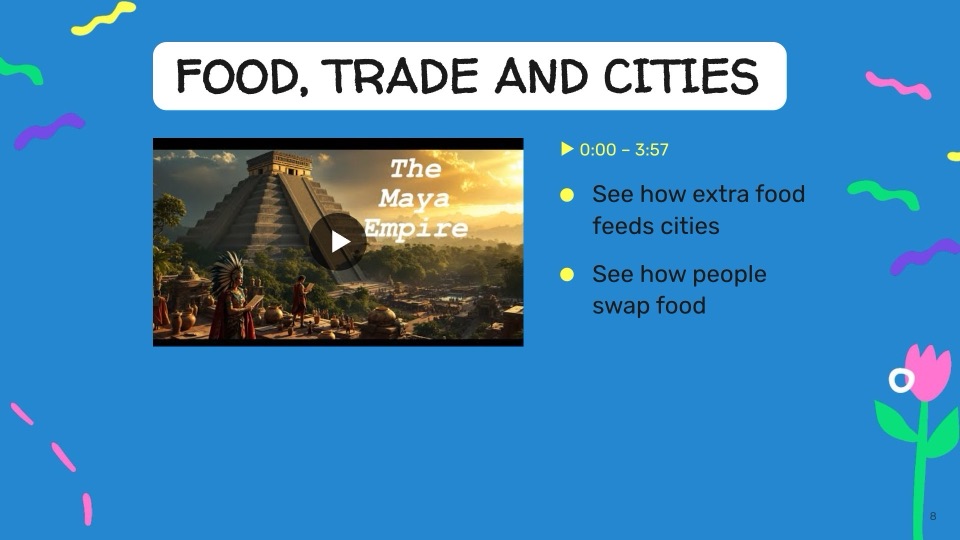
Maya Empire at its peak from 0:00 to 3:57
History Kiddos: The Maya Empire at Its Peak | How an Ancient Civilization Thrived for Kids
Made for kids age 9-10 with clear explanations of trade and cities suitable for Year 5.
Worksheet
Sources
- E759905053311CC7D0A86969C4BD08C6 pyrford.surrey.sch.uk
- 25B26F989F10243DEA01CAC486F267D0 lodgefarm.herts.sch.uk
- Maya Civilisation - KS2 History - BBC Bitesize bbc.co.uk
- Mayan Civilisation by Izzi Howell (9781526300195/Paperback) | LoveReading4Kids lovereading4kids.co.uk
- Mayan civilisation primary resource - National Geographic Kids natgeokids.com
- Did ancient Mayan civilisation collapse because of a sudden drou… newscientist.com
- Mayan civilization Facts for Kids kids.kiddle.co
Picture credits
- Illustration: DGSstudios · Pixabay
- Photo: Daniel Schwen · CC BY-SA 4.0 · Wikimedia Commons
- Photo: JillWellington · Pixabay
- Photo: PublicDomainPictures · Pixabay
- Illustration: gdizerega · Pixabay
- Drawing: GitHub user @ooosssay · CC0 · Wikimedia Commons
- Pictograms: Sergio Palao, ARASAAC (arasaac.org) · CC BY-NC-SA
- Drawing: gnokii at openclipart.org · CC0 · Wikimedia Commons
- Picture: unknown · CC0 · rawpixel via Openverse
Made with Lesson Dino's AI on 17 October 2026. AI can make mistakes, so check facts against the sources before you teach.