Slides
Lesson plan
Athens or Sparta? Greek Life and Lasting Ideas
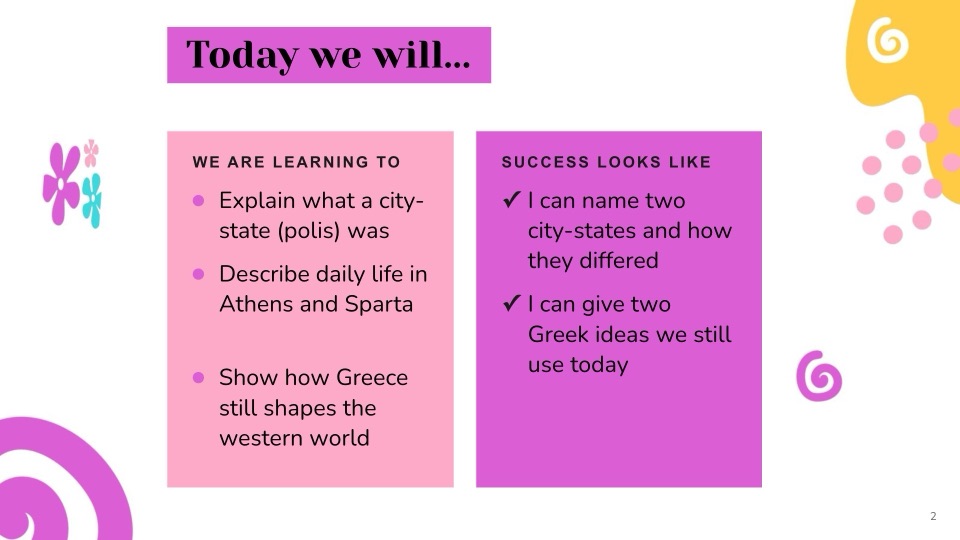
Pupils compare life in Athens and Sparta and explain city-states. They link democracy, Olympics and theatre to life today.
Objectives
- Students will explain what a city-state was and name two examples.
- Students will compare daily life for children in Athens and Sparta.
- Students will explain three Greek achievements that still shape life today.
Success criteria
- I can name two city-states and say what a polis was.
- I can give one difference between Athens and Sparta childhood.
- I can give one Greek idea we still use and why it matters.
Key words
| Word | Meaning |
|---|---|
| polis | a tiny Greek town area with its own laws and leaders |
| city-state | a small place that rules itself with its own laws and leaders |
| democracy | a way of running a place where people vote to decide |
| Olympics | a big sports contest held every four years to honour Zeus |
| theatre | plays acted outside for crowds, sad or funny stories |
| philosophy | thinking and talking about big ideas of life and right and wrong |
Timed plan (60 minutes)
| Time | Stage | What happens |
|---|---|---|
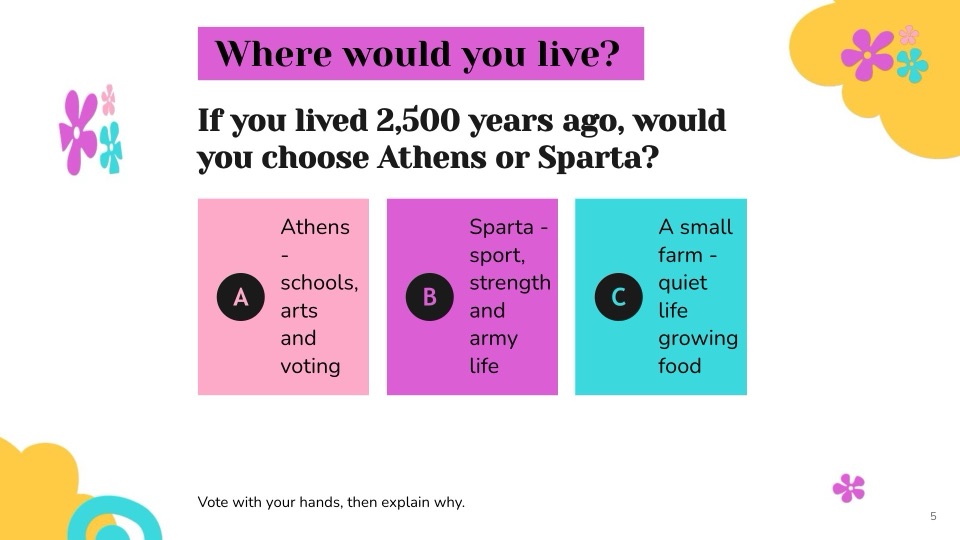
| 8 min | Starter | To hook pupils with a choice and recall what Ancient Greece was. Show Slides 1-2, share objectives and success in pupil words. Use the hook choice: learning and debating or training and getting strong. Show Slide 5 vote: Athens - schools, arts and voting, Sparta - sport, strength and army life. Take a quick show of hands vote and ask two pupils to give a reason. |
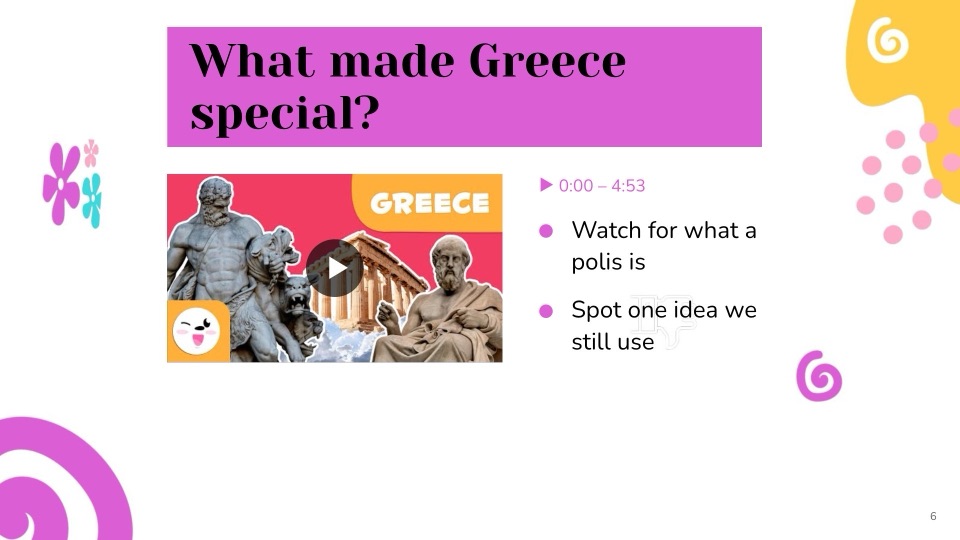
| 12 min | Teaching | To explain what a polis was and why Greece was not one country. Explain there was never one country called Ancient Greece, it was divided into small city-states like Athens, Sparta, Corinth and Olympia. Show Slide 6 and play Video clip 1, asking pupils to spot what a polis is. Teach they were small, independent communities each with its own laws and leaders and lived near the sea because mountains made land travel hard. Sum up they spoke versions of the same language and worshipped the same gods, but daily life could be very different. |
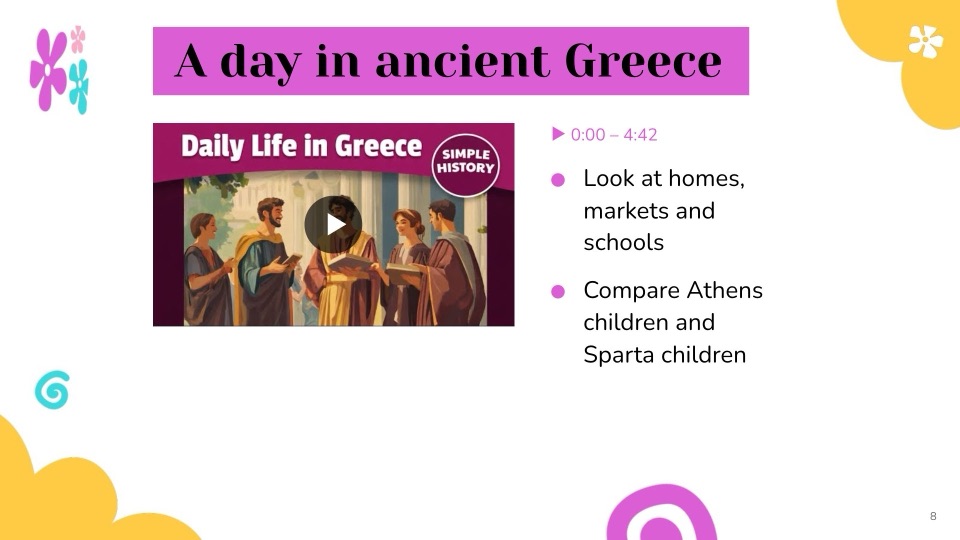
| 20 min | Main activity | To compare daily life in Athens and Sparta through structured debate. Show Slide 8 and play Video clip 2, asking pupils to watch homes, markets, schools and children. Seat class in two facing lines: side A Athens, side B Sparta, as Student A and Student B pairs. Read fact cards: Athens known for democracy, philosophy and the arts, Sparta well-known for military training and discipline; in Athens boys went to school and girls learned household skills at home. Lead turn-taking: Student A gives one good point about Athens, Student B replies with one good point about Sparta, using Sparta ruled by two kings and Spartan boys training young and girls staying strong and competing in sport. |
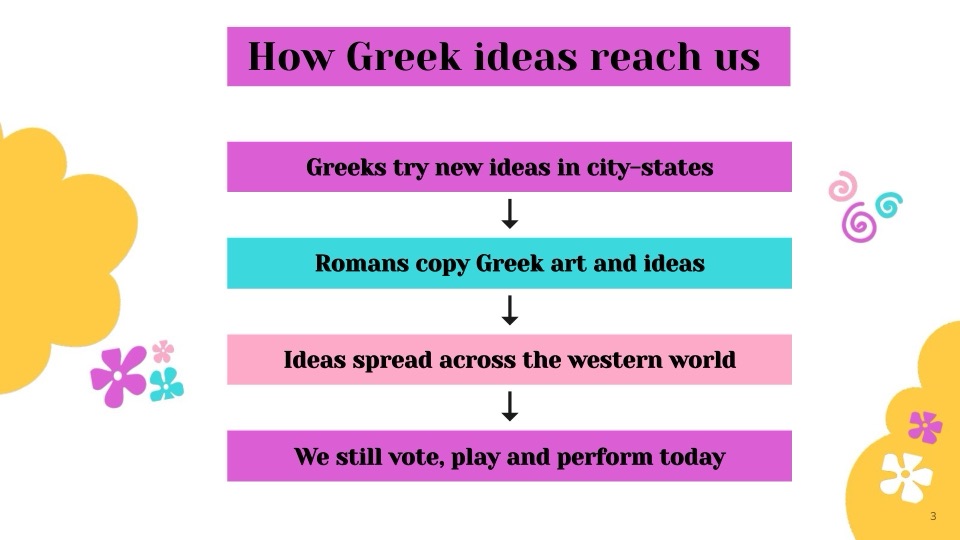
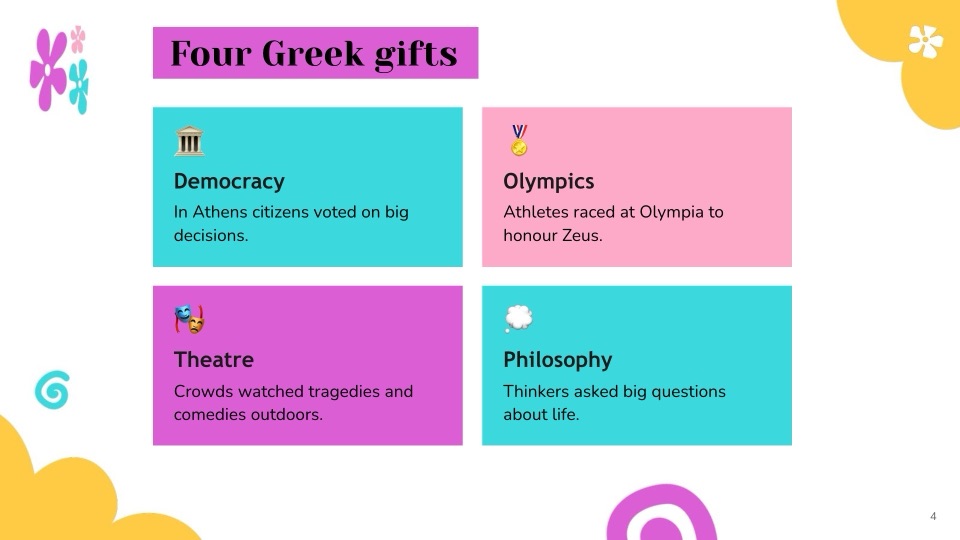
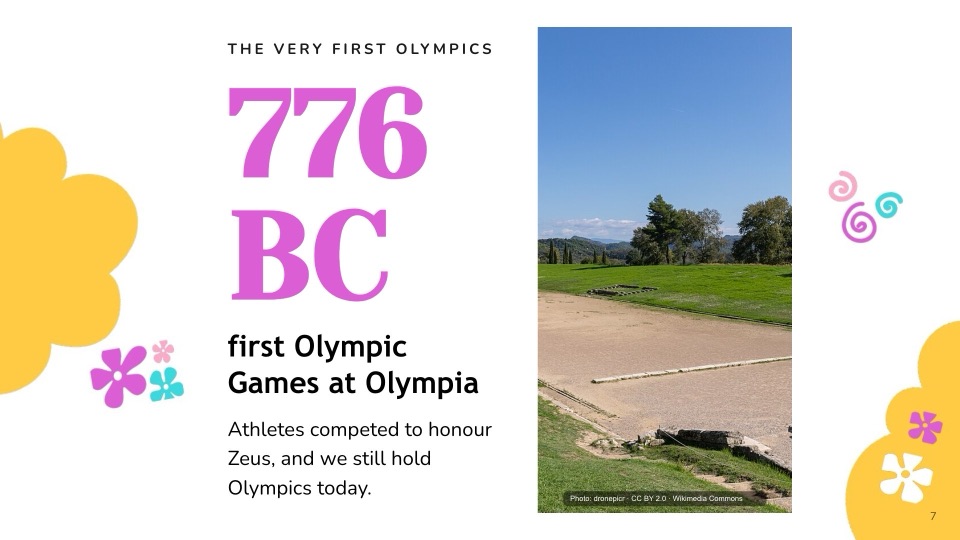
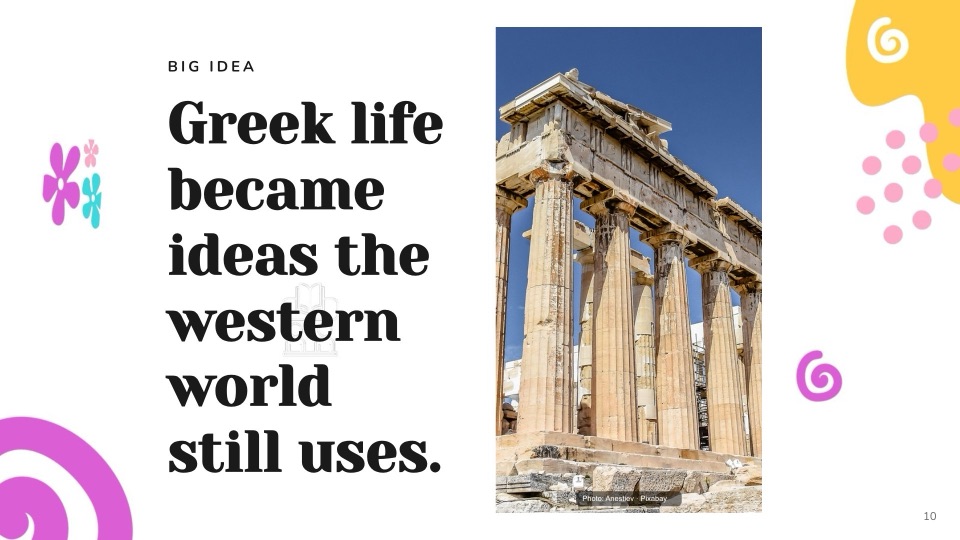
| 12 min | Teaching | To show how Greek democracy, Olympics and theatre still shape the western world. Show Slides 3-4 chain: Greeks try ideas in city-states, Romans copy art and ideas, ideas spread, we still vote, play and perform today. Teach democracy: Athens developed rule by the people, they voted by placing objects like pebbles in jars, but only adult men born in Athens could vote. Teach Olympics and theatre: first recorded Games at Olympia to honour Zeus, began in 776 BC every four years; they built outdoor amphitheatres for tragedies and comedies, and our words tragedy and comedy come from Ancient Greek. Model a then-and-now link for philosophy, where Socrates, Plato and Aristotle asked big questions to help people understand the world. |
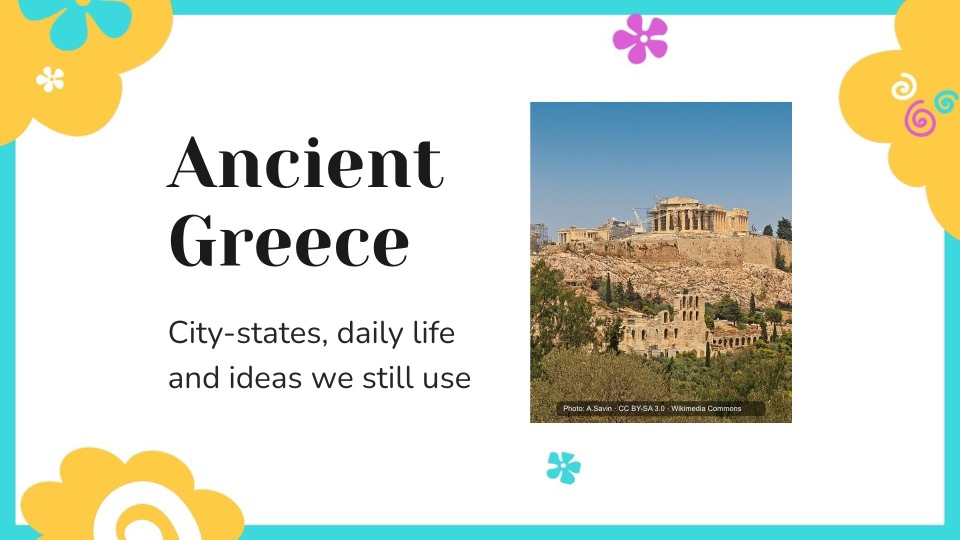
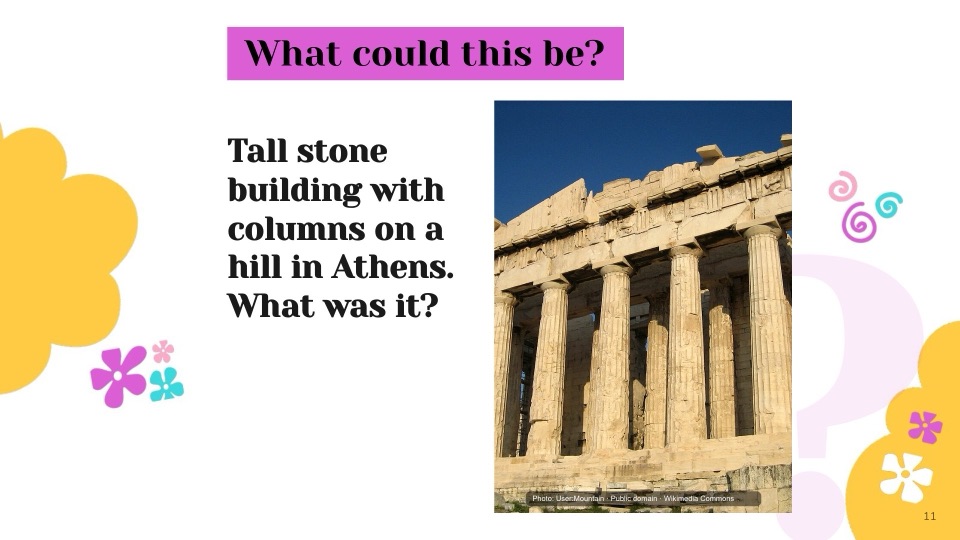
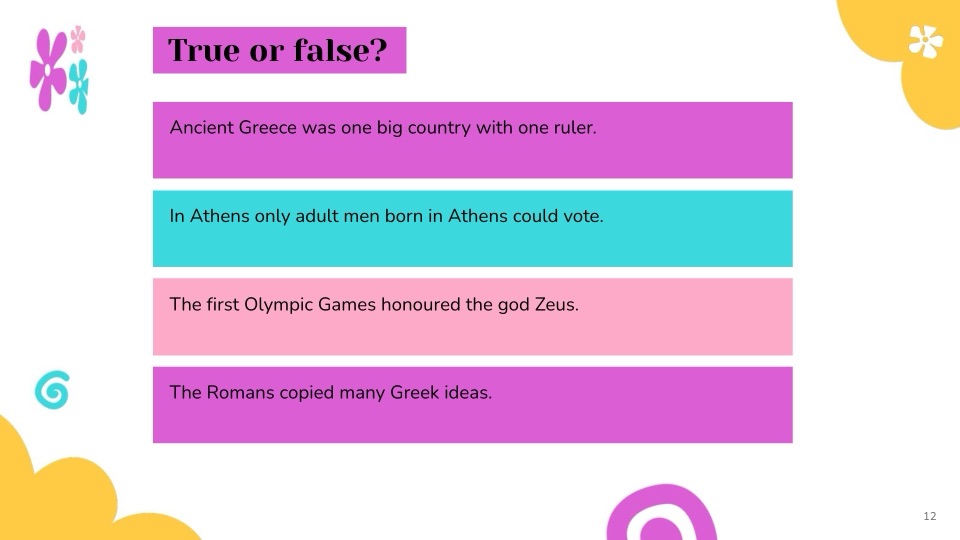
| 8 min | Plenary | To check objectives and secure one lasting Greek idea each. Show Slide 11 mystery: tall stone building with columns on a hill; reveal the Parthenon, a temple for Athena finished in 432 BC. Show Slide 12 true or false: Ancient Greece was one big country; correct to many city-states each with own laws. Check second statement: in Athens only adult men born there could vote; discuss if fair. Take exit answers and restate big idea: Greek life became ideas the western world still uses. |
Common mistakes
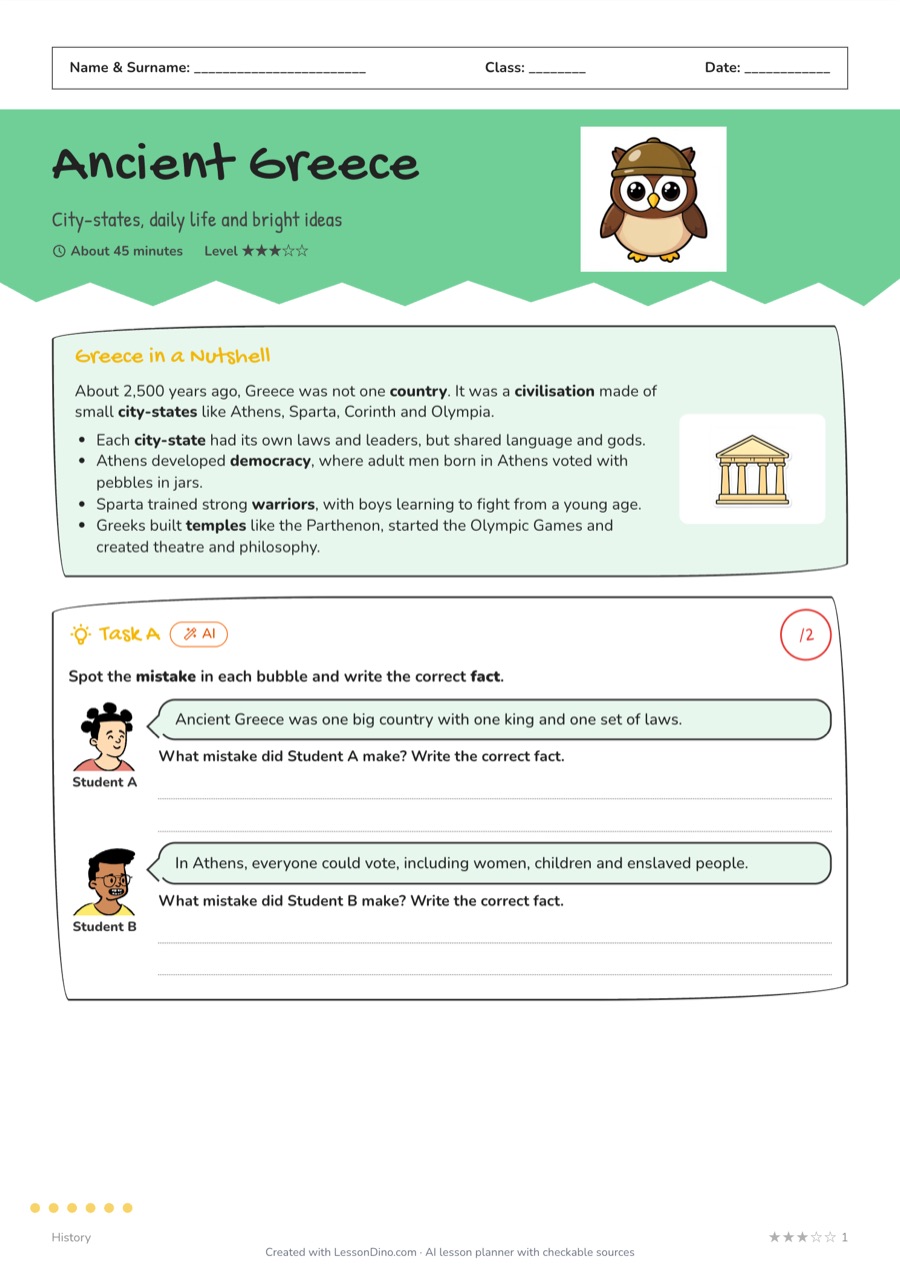
- Thinking Ancient Greece was one country with one king.
How to spot it: Pupils draw one border or say the king of Greece ruled all.
Restate there was never one country, but small city-states like Athens and Sparta each with own laws and leaders. - Thinking everyone in Athens could vote.
How to spot it: Pupils say women, children or enslaved people voted too.
Remind only adult men born in Athens could vote, not women, children or enslaved people, shown by pebbles in jars. - Thinking Olympics were only modern sport with no Greek meaning.
How to spot it: Pupils describe medals only, with no god or coming together.
Rebuild link: first Games at Olympia to honour Zeus in 776 BC, and city-states even paused wars to compete.
Support
- Provide sentence starters on the board for Athens and Sparta reasons.
- Offer pre-drawn coastline and pre-matched then-and-now cards with picture word bank.
- Let pupils rehearse in pairs for 30 seconds before speaking and allow pass.
Stretch
- Challenge pupils to justify one benefit and problem of no single ruler.
- Ask pupils to swap one good idea between Athens and Sparta and explain why.
- Ask pupils to argue if a decision is fair when many affected cannot vote.
Check questions
- What was a polis? Name two city-states.
Answer: A small community with its own laws and leaders; e.g. Athens and Sparta. - Give one difference between growing up in Athens and Sparta.
Answer: Athens boys went to school; Sparta boys trained young as soldiers and girls trained strong. - Name one Greek gift we still use and why it matters.
Answer: Democracy / Olympics / theatre; e.g. voting gives people a say; Games bring rivals together to honour Zeus.
Curriculum
Ancient Greece – a study of Greek life and achievements and their influence on the western world
Video clips
Clips on YouTube, from the start and end times we chose. Check each one before you show it.
-
5 things about Ancient Greece from 0:00 to 4:53
Smile and Learn - English: Ancient Greece - 5 Things you Should Know - History for Kids
Perfect overview of poleis, society and philosophy with vocabulary and pace ideal for 9-10-year-olds.
-
Daily life in Ancient Greece from 0:00 to 4:42
Bedtime History: Daily Life in Ancient Greece | Simple History
Directly covers Greek life for 9-10-year-olds with clear language about homes, schools, markets and festivals.
Worksheet
Sources
- National Curriculum - History key stages 1 to 2 - GOV.UK assets.publishing.service.gov.uk
- 5134399E273119F20617690AF072A2CC warden-house.kent.sch.uk
- Ancient Greece - KS2 History - BBC Bitesize bbc.co.uk
- Who were the ancient Greeks? - BBC Bitesize bbc.co.uk
- Ancient Greece: A Timeline | History Timelines history-timelines.org.uk
- Ancient Greece - Homework Help For Kids homeworkhelpforkids.co.uk
- Ancient Greece Facts for Kids kids.kiddle.co
- History: Ancient Greece for Kids - Ducksters ducksters.com
- Ancient Greece Archives - Library For Kids libraryforkids.com
- Introduction to Ancient Greece - BBC Bitesize bbc.co.uk
- Musical system of ancient Greece - Wikipedia en.wikipedia.org
- Ancient Greece - Simple English Wikipedia, the free encyclopedia simple.wikipedia.org
- The Gods and Goddesses of Ancient Greece! - National ... natgeokids.com
- Guide to Ancient Greece - History for kids historyforkids.net
- Ancient Greece: Democracy, Myths, and the Birth of Western ... academickids.com
- Ancient Greece on British Television (Screening Antiquity): 9781474454650 - AbeBooks abebooks.com
- Parthenon sculptures of Ancient Greece, fragments which are... News Photo - Getty Images gettyimages.ca
- Ancient Greece on British Television | Barnes & Noble® barnesandnoble.com
- Ancient Greece on British Television (Paperback) theportobellobookshop.com
Picture credits
Made with Lesson Dino's AI on 19 October 2026. AI can make mistakes, so check facts against the sources before you teach.