Slides

Lesson plan
Verbs in Disguise: Gerunds, Participles, Infinitives
Students learn the jobs of gerunds, participles, and infinitives. They sort verbals and explain each one's job in sentences.
Objectives
- Students will define verbal and describe general jobs of gerunds, participles, infinitives.
- Students will identify verbals in sentences and explain their noun, adjective, or adverb job.
Success criteria
- I can name the three verbals and tell the job each one does.
- I can label a verbal in a sentence and explain its job.
- I can use a gerund, participle, and infinitive correctly in writing.
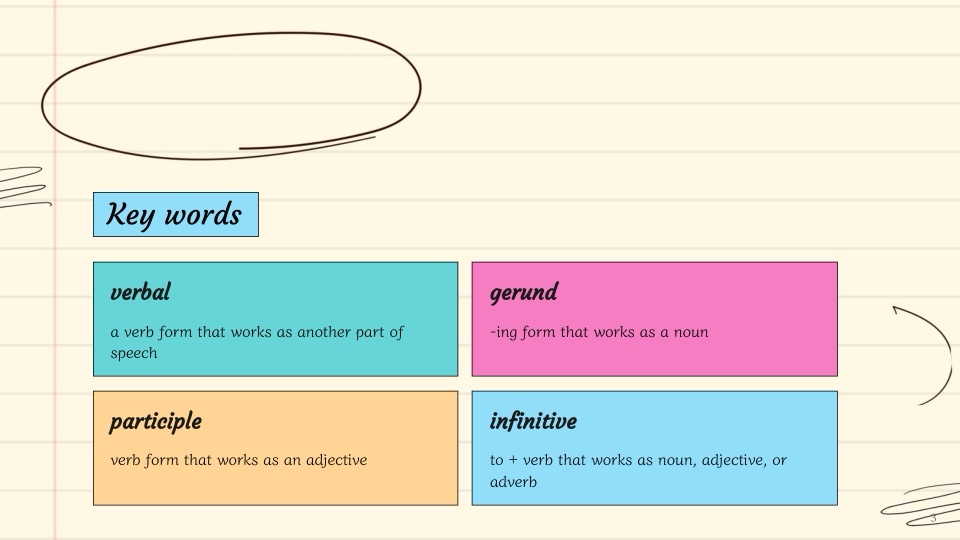
Key words
| Word | Meaning |
|---|---|
| verbal | a word made from an action word that does a different job |
| gerund | an -ing form that works like a thing-word in a sentence |
| participle | a verb form that works like a describing word |
| infinitive | to plus the plain form of an action word |
Timed plan (60 minutes)
| Time | Stage | What happens |
|---|---|---|
| 5 min | Starter | Hook interest and recall that verbs can look like verbs but do other jobs. Welcome class with hook and show Slide 1 title. Show Slide 2 big idea and read it aloud. Ask what a verb usually does and take two quick answers. Preview that they will catch verbs in disguise and name the job. |
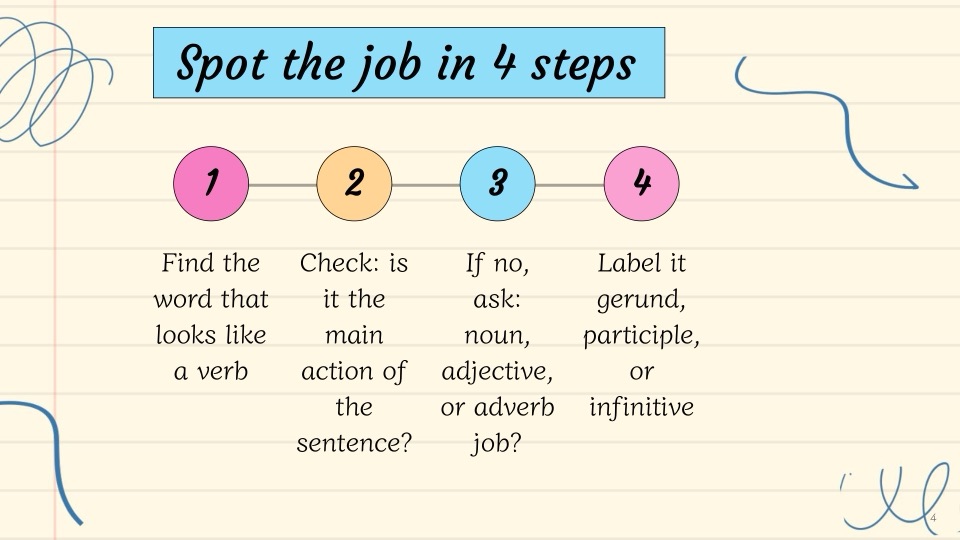
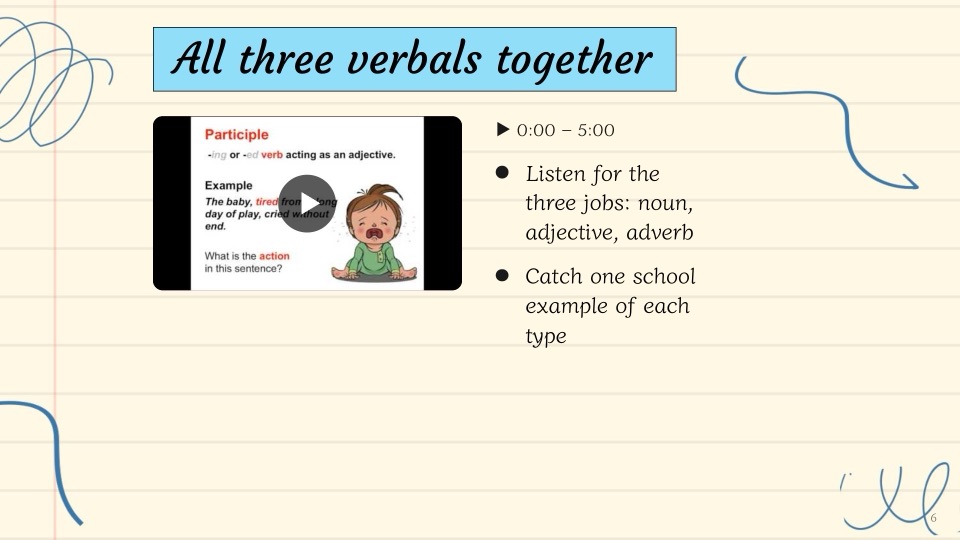
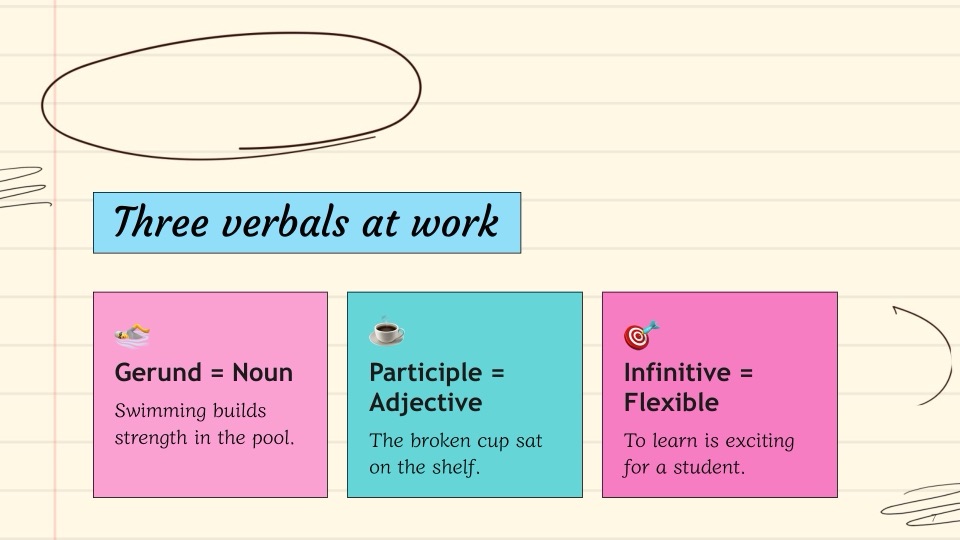
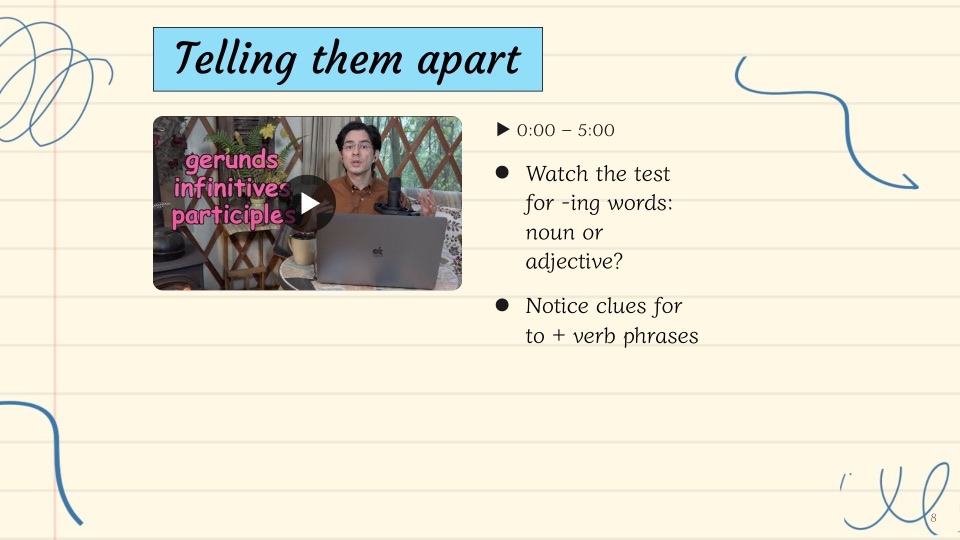
| 15 min | Teaching | Explain the general function of each verbal type with clear models. Show Slide 3 key words and define verbal as formed from a verb that acts as noun, adjective, or adverb. Teach three kinds: gerunds, participles, and infinitives with Slide 4 steps. Play Video clip 1 and tell students to listen for noun, adjective, adverb jobs. Model Slide 7 examples and label each job on the whiteboard. |
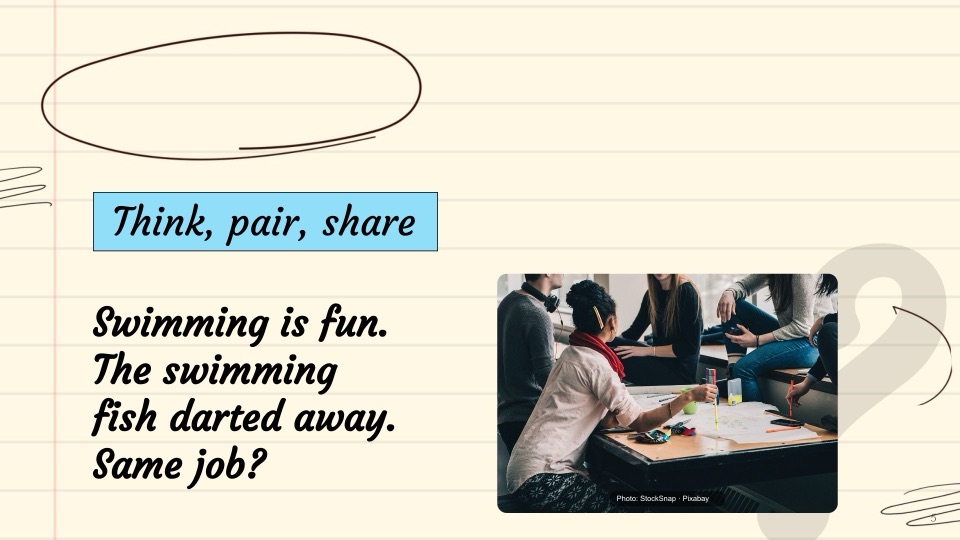
| 10 min | Guided Practice | Practice telling gerunds apart from present participles in pairs. Project Slide 5 question pair and read both sentences aloud. Think aloud with Slide 4 steps: find -ing, check main verb, ask noun or adjective. Have pairs hold up Noun or Adjective cards and justify choice. Confirm gerunds act as nouns while participles act as adjectives though both can end in -ing. |
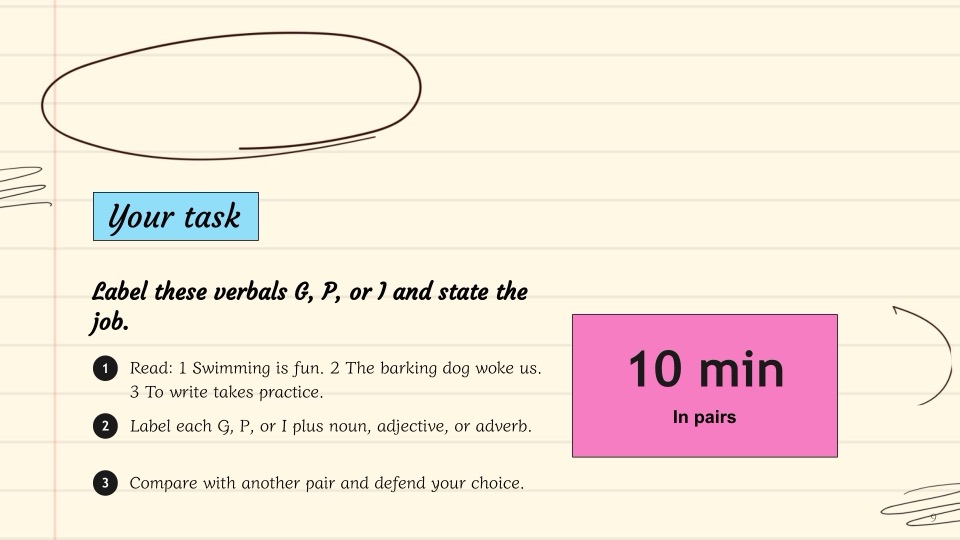
| 20 min | Main Activity | Sort verbals and explain their function in particular sentences. Hand each team word cards and point to three labeled bins. Time 8 minutes for sorting swimming, broken window, to study type cards, then flip to check function note. Direct teams to Slide 9 task: write one sentence per bin and label G, P, or I plus job. Circulate, ask why for each label, and pick two teams to share. |
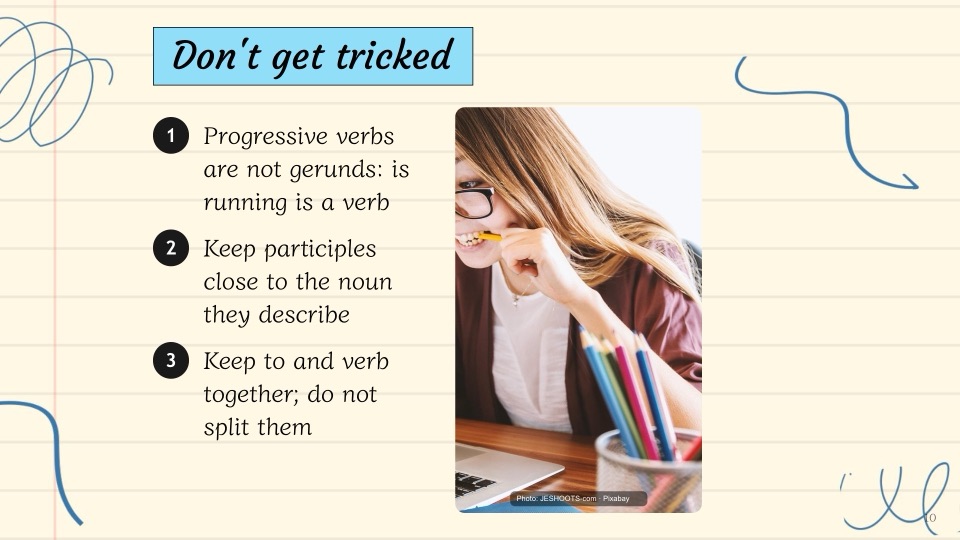
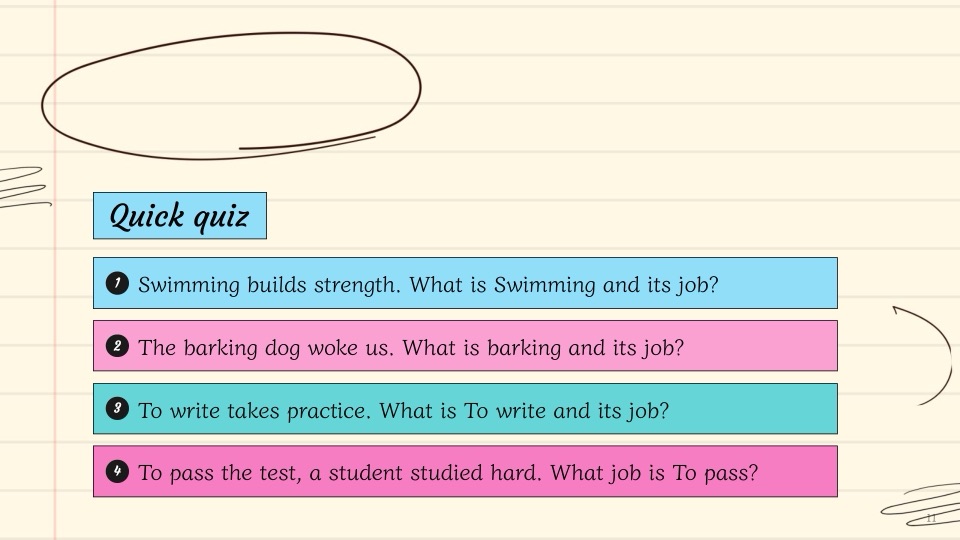
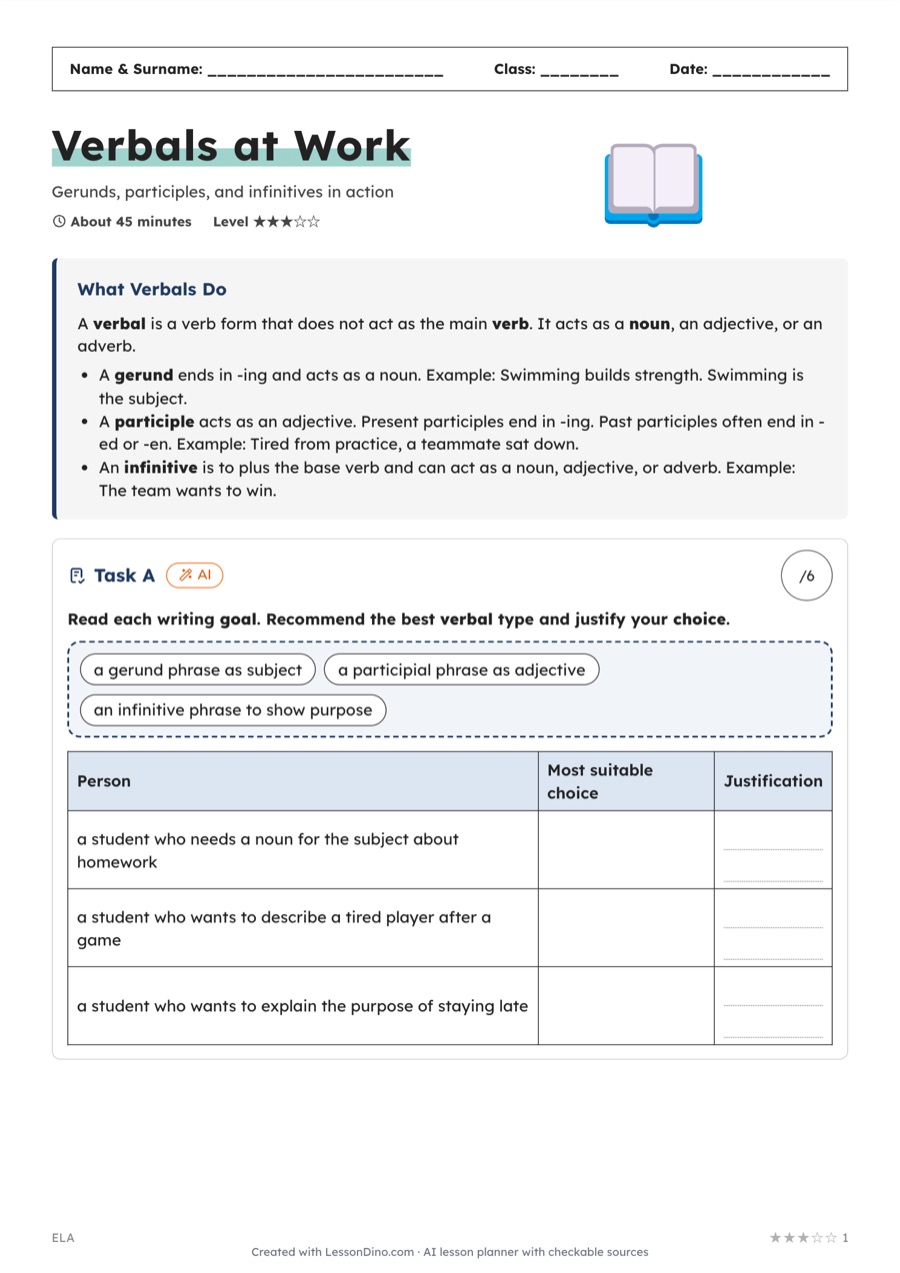
| 10 min | Plenary | Review tricks and check each student can explain verbal functions. Show Slide 10 bullets: progressive verbs are not gerunds, keep participles close, keep to and verb together. Run Slide 11 quick quiz orally with whiteboards. Hand Worksheet Task G table and have students fill missing type or job in pairs. Close by restating objectives and previewing homework. |
Common mistakes
- Calling is running or are swimming a gerund
How to spot it: See helper verb am, is, are, was, were with -ing as the action
Remove helper test: without helper it would be participle or gerund; with helper it is progressive verb, not a verbal - Labeling every -ing word the same
How to spot it: Student labels both Swimming is fun and swimming fish as gerunds
Ask naming or describing and replace with something to prove noun job; if it describes a noun it is a participle - Splitting infinitives or placing participles far from nouns
How to spot it: To carefully mark or a participle describing the wrong noun
Keep to and verb together and keep participles close to the noun they modify
Support
- Give a one-page chart with examples: -ing as noun for gerund, -ing or -ed as describing word for participle, to plus verb for infinitive.
- Start with clear subject gerunds at the front, like Swimming is fun, before objects.
Stretch
- Have students expand the single word into a phrase, like swimming in the pool after school, and explain how the whole phrase keeps the same job.
- Have students write a sentence where the same -ing form is a verb with a helper and explain why it is not a gerund.
Check questions
- In Swimming builds strength, what is Swimming and its job?
Answer: Gerund acting as noun subject. - In The barking dog woke us, what is barking and its job?
Answer: Present participle acting as adjective describing dog. - In To write takes practice, what is To write and its job?
Answer: Infinitive acting as noun subject.
Curriculum
Explain the function of verbals (gerunds, participles, infinitives) in general and their function in particular sentences.
Video clips
Clips on YouTube, from the start and end times we chose. Check each one before you show it.
-
Gerunds, infinitives, participles overview from 0:00 to 5:00
ereading worksheets: Verbals: Gerunds, Infinitives, and Participles | Parts of Speech App
Covers all three verbals with clear school examples at the right vocabulary and pace for 13-14-year-olds.
-
How to tell verbals apart from 0:00 to 5:00
Cozy Grammar: How to Recognize Verbals: Gerunds, Infinitives, and Participles | 3 Ways to Remember the Difference
Focuses on remembering the difference between the three types, which helps 13-14-year-olds analyze function in particular sentences.
Worksheet
Sources
- English Language Arts Standards » Language » Grade 8 thecorestandards.org
- English Language Arts Standards » Language » Grade 8 » 1 » a thecorestandards.org
- Verbals - Towson University webapps.towson.edu
- English as a Second Language (ESL): Verbals - Germanna germanna.edu
- Verbals What Are Verbals II.7.2 Verbal And Non Verbal ... articulate.strayer.edu
- Verbal Adjectives | Dickinson College Commentaries dcc.dickinson.edu
- Verbals (article) | Grammar: Verbs | Khan Academy khanacademy.org
- Verbals (article) | Verbs | Khan Academy khanacademy.org
- Verbals (article) | Verbs - Khan Academy en.khanacademy.org
- Formes verbals no finites - Viquipèdia, l'enciclopèdia lliure ca.m.wikipedia.org
- Verbals Worksheets - worksheetlibrary.com worksheetlibrary.com
- Verbals worksheets | Worksheetzone worksheetzone.org
- Verbals Worksheets - 15 Worksheets.com 15worksheets.com
- Verbals Worksheets - Reading Duck.com readingduck.com
- Verbals: Explanation and Examples - Grammar Monster grammar-monster.com
- Verbals in English Grammar – Definition, Types, and Examples englishlesson.com
- PPT - Chapter 7: Verbals PowerPoint Presentation, free download - ID:2047192 slideserve.com
- Warrior Swimming's Brynlee Yoder Verbals to Army for 2027 - Swimming World swimmingworldmagazine.com
- Charbonneau Verbals to United States Air Force Academy - OurSports Central oursportscentral.com
- Verbals – HyperGrammar 2 – Writing Tools – Resources of the Lang… noslangues-ourlanguages.gc.ca
- Verbals Worksheets easyteacherworksheets.com
- Pennsylvania High School State Finalist Julia Tengowski Verbals To Miami University (Ohio) For Fall 2027 swimswam.com
Picture credits
- Photo: Pexels · Pixabay
- Photo: 192635 · Pixabay
- Photo: StockSnap · Pixabay
- Photo: JESHOOTS-com · Pixabay
- Pictograms: Sergio Palao, ARASAAC (arasaac.org) · CC BY-NC-SA
- Microsoft Fluent Emoji (MIT)
Made with Lesson Dino's AI on 16 October 2026. AI can make mistakes, so check facts against the sources before you teach.