Slides
Lesson plan
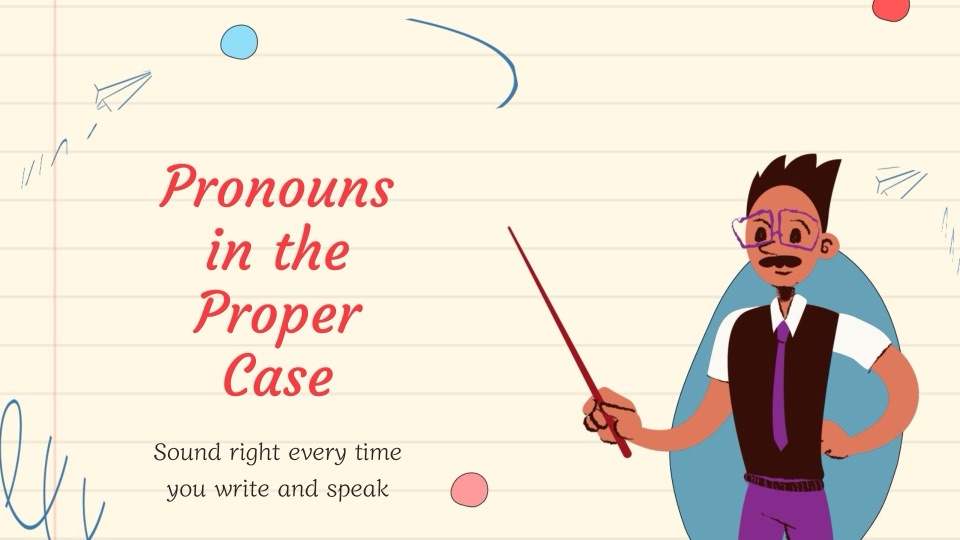
Pronouns in the Proper Case
Students learn subjective, objective, and possessive pronoun case. They sort pronouns and fix sentences in pairs.
Objectives
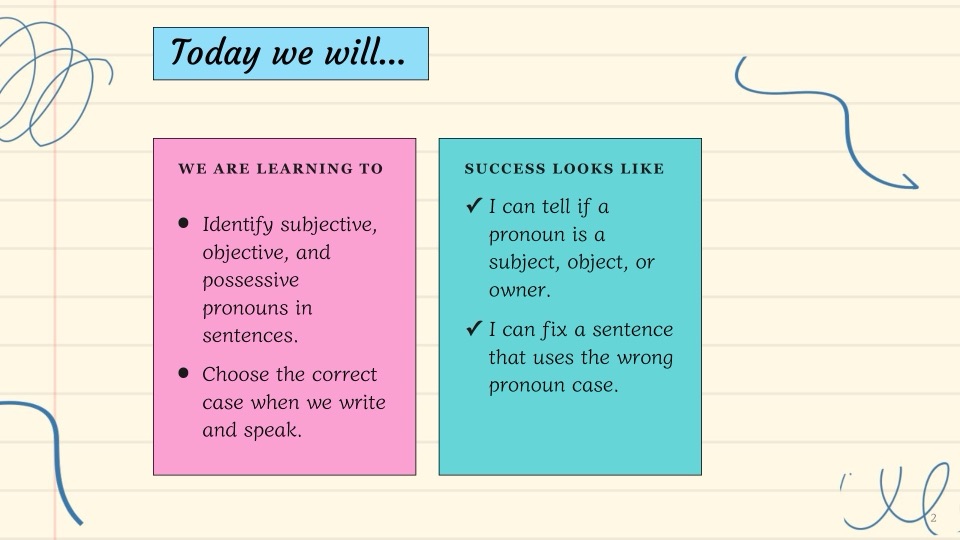
- Students will sort pronouns into subjective, objective, and possessive case.
- Students will fix sentences that use pronouns in the wrong case.
Success criteria
- I can tell if a pronoun is a subject, object, or owner.
- I can fix a sentence that uses the wrong pronoun case.
Key words
| Word | Meaning |
|---|---|
| pronoun | a short word that stands in for a person, place, or thing |
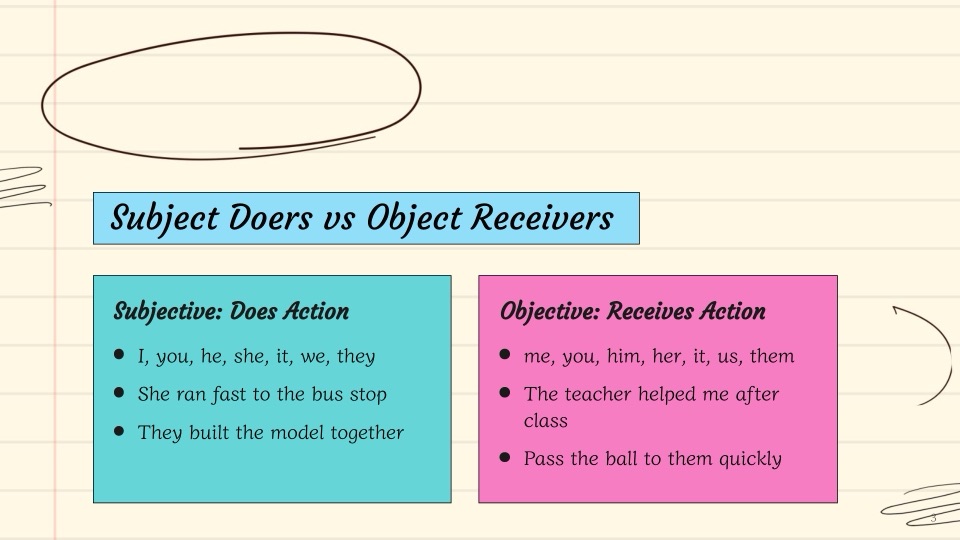
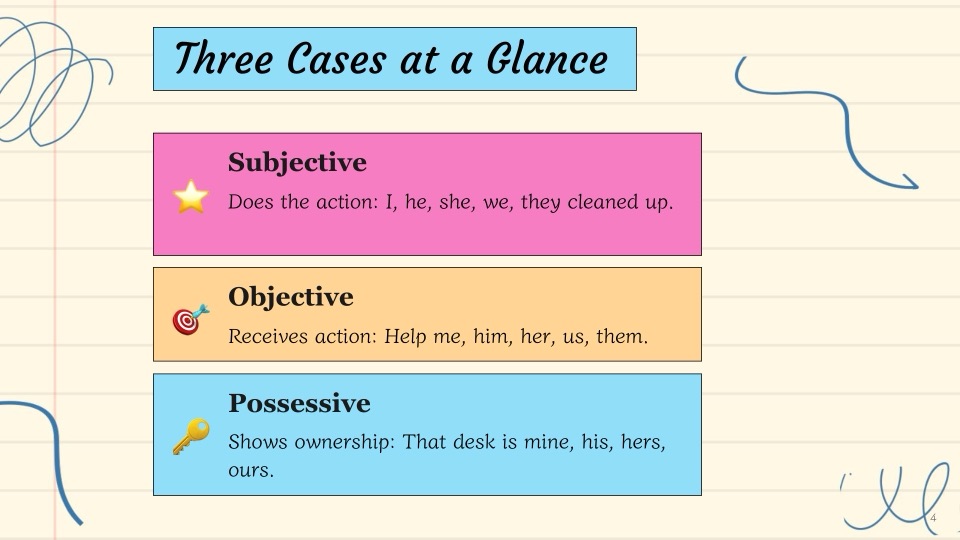
| subjective case | the form used when the word does the action |
| objective case | the form used when the word gets the action |
| possessive case | the form that shows something belongs to someone |
Timed plan (60 minutes)
| Time | Stage | What happens |
|---|---|---|
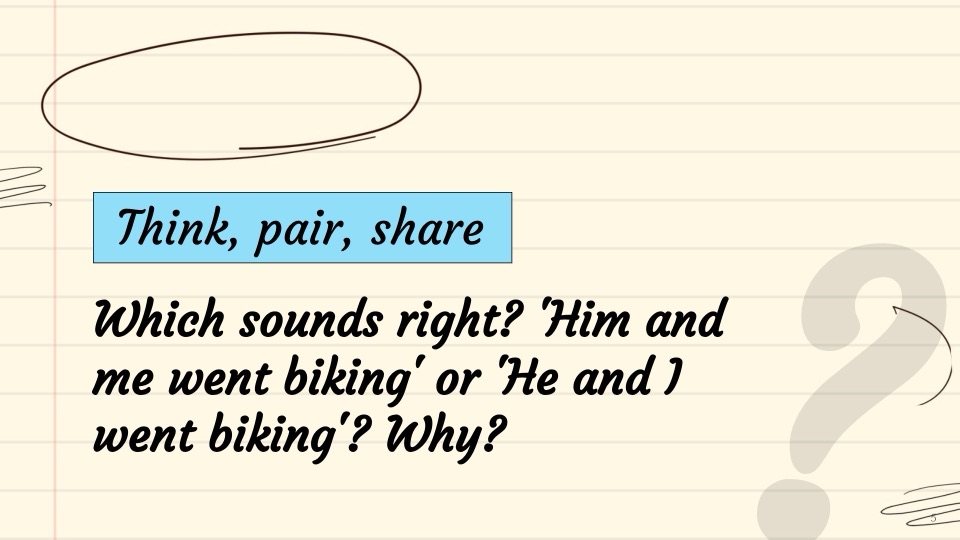
| 5 min | Starter | Hook students with a funny error and surface what they already hear about case. Point to the board sentence Her threw the ball to I and say the hook line. Show Slide 5 and read: Which sounds right? 'Him and me went biking' or 'He and I went biking'? Why? Give pairs 1 minute to talk and choose. Collect 3 ideas without correcting yet, noting doer language to revisit. |
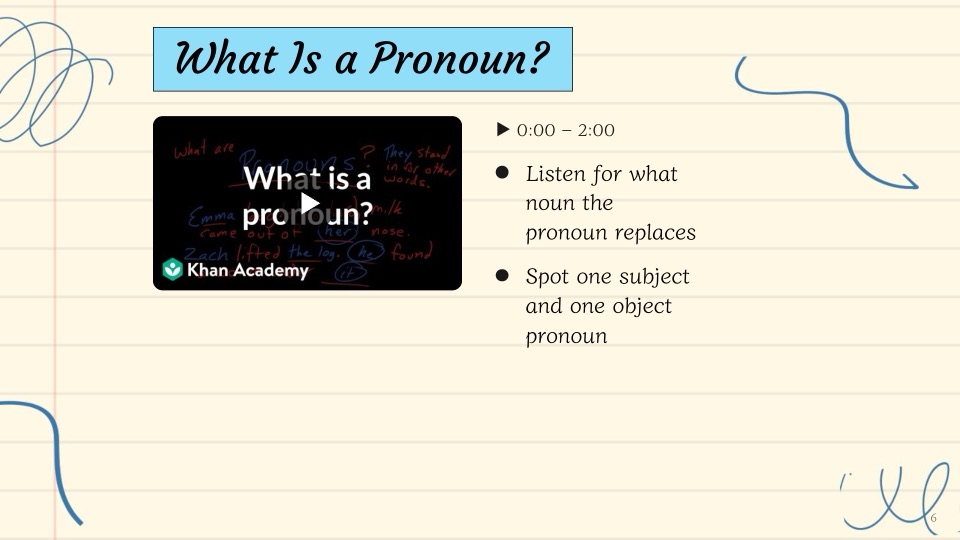
| 10 min | Teaching | Teach the three cases and how the pronoun's job picks its form. Show Slides 1-2 and read the two goals: tell subject, object, or owner and fix wrong case. Show Slides 3-4 and explain doers, receivers, and owners with the example lines. Play Video clip 1 (0:00-2:00) on Slide 6: listen for what noun the pronoun replaces and spot one subject and one object pronoun. Summarize the rule and personal pronoun lists for all to repeat. |
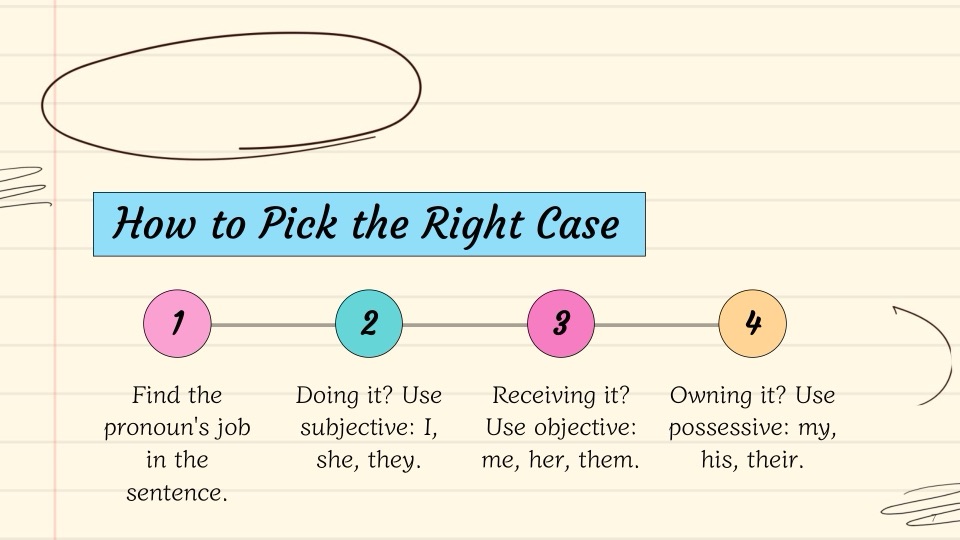
| 15 min | Guided practice | Practice picking case together using job testers and the cover-up trick. Show Slide 7 and model: Find the pronoun's job. Doing it? Use I, she, they. Receiving it? Use me, her, them. Model the three frames: ___ threw the ball, The ball hit ___, That ball is ___. Teach the cover-up trick for compounds with I and me: cover the other person, then choose. Do three compound sentences together with whiteboards, correcting aloud. |
| 15 min | Main activity | Sort pronouns by case and prove each choice in a full sentence. Hand out pronoun cards, three mats, and start the timer for 8 minutes of sorting. Remind pairs to test each card in ___ threw the ball, The ball hit ___, That ball is ___. Circulate, ask for job reasons, and prompt cover-up for I/me compounds. Stop and have each pair read one card in a full sentence and point to its mat. |
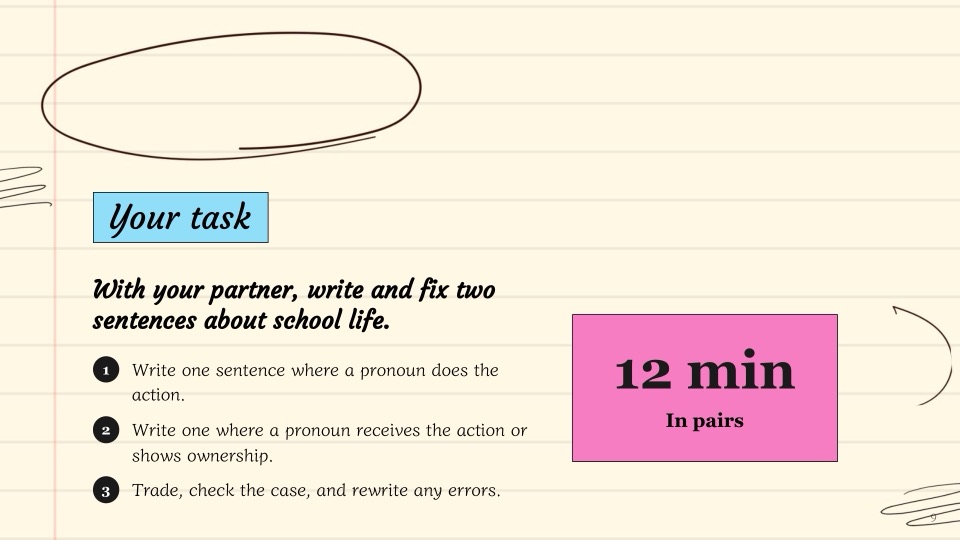
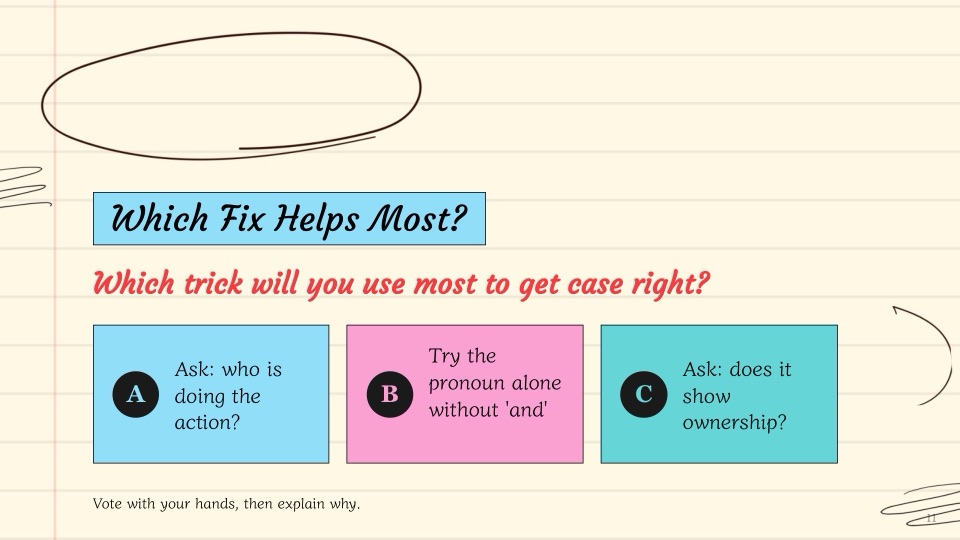
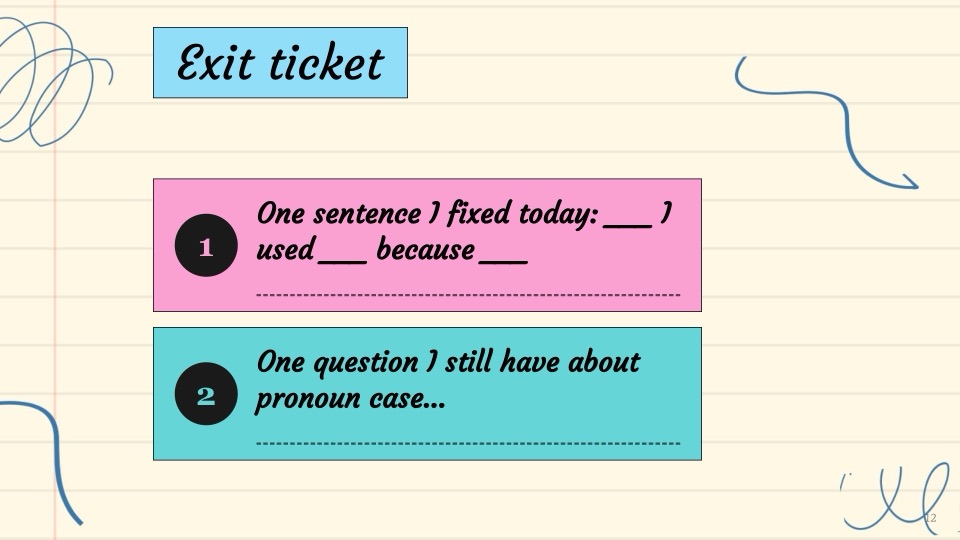
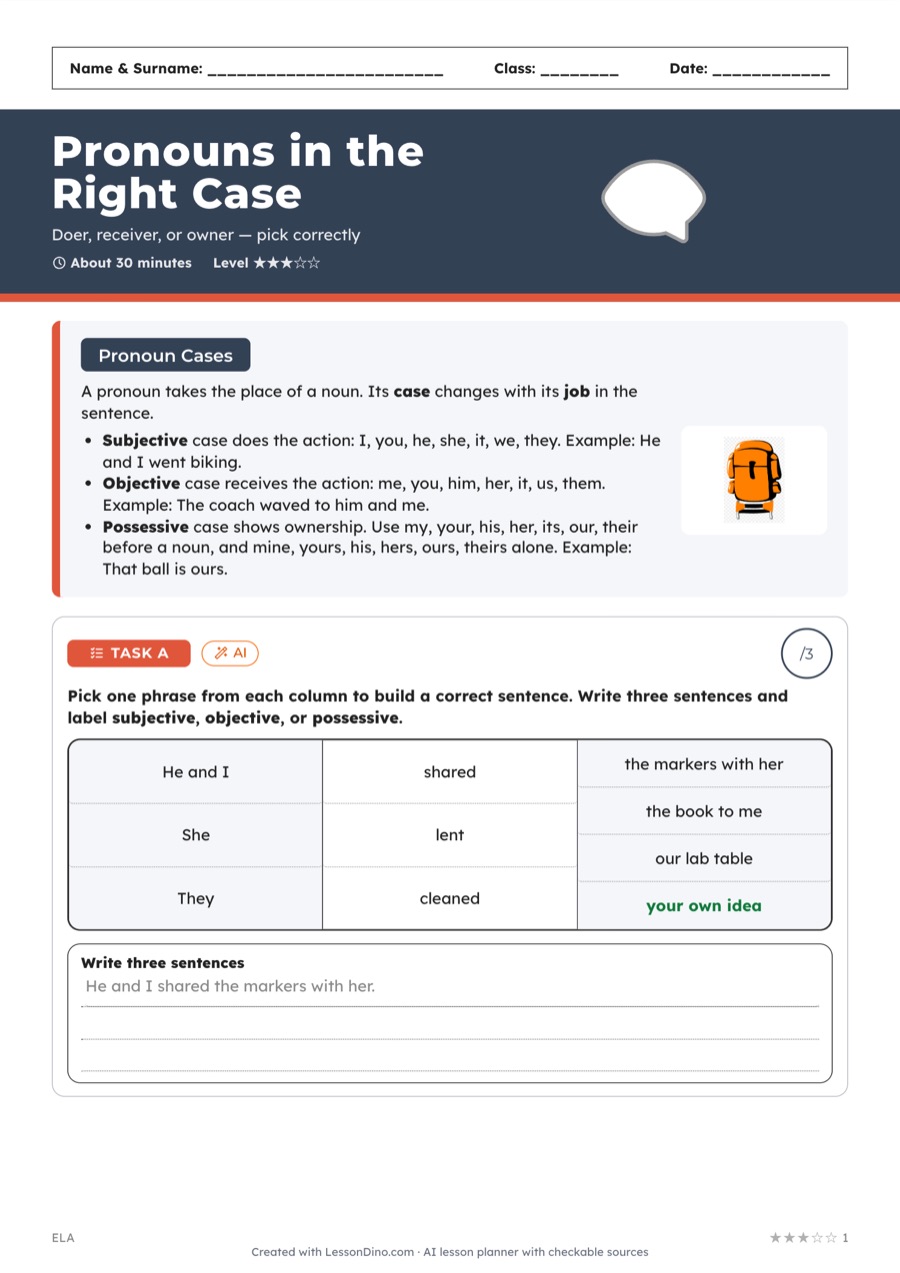
| 15 min | Plenary | Apply case knowledge to build correct sentences and pick the best fix-up trick. Hand out Worksheet Task A and direct: pick one phrase from each column to build a correct sentence, write three and label subjective, objective, or possessive. Give 7 minutes to write, then have partners read before and after to hear smoother flow. Show Slide 11 and take a vote on which trick helps most: who does it, try alone without and, or does it show ownership. Show Slide 12 and collect the exit line: One sentence I fixed today. |
Common mistakes
- Using Her, Him, or Them to start a sentence, like Her threw the ball.
How to spot it: Listen for him, her, and them placed as doers.
Swap to he, she, and they, because subject forms do the action. - Using I, He, or She as a receiver, like The teacher gave she more paper.
How to spot it: Listen for I, he, she, and they after verbs like gave, hit, or to.
Swap to me, him, her, and them, because object forms receive the action. - Adding a noun after a stand-alone owner, like The paints are theirs paints.
How to spot it: Look for mine, yours, hers, ours, or theirs followed by another noun.
Use theirs alone or their plus noun, because mine, yours, his, hers, ours, theirs can stand alone to show ownership.
Support
- Give six high-frequency cards with printed frames ___ threw the ball, The ball hit ___, That ball is ___ for sorting
- Provide a three-column pronoun bank and allow oral rehearsal before writing Task A
- Partner struggling readers with a confident reader to read frames aloud and point to doer and receiver
Stretch
- Sort and fix compound subjects and objects with I and me, like a classmate and I / a classmate and me
- Write two new sentences using a stand-alone possessive like The win was ours and prove the case
- Explain what changes if a pronoun moves jobs in the sentence, such as She helped them versus They helped her
Check questions
- In She tossed it to them, what case is them and why?
Answer: Objective, because them receives the action. - Fix this sentence: Him and me went biking.
Answer: He and I went biking, because doers need subjective case. - That notebook is hers. What case is hers and why?
Answer: Possessive, because it shows ownership.
Curriculum
Ensure that pronouns are in the proper case (subjective, objective, possessive).
Video clips
Clips on YouTube, from the start and end times we chose. Check each one before you show it.
-
Pronoun basics from 0:00 to 2:00
Khan Academy: What is a pronoun? | The parts of speech | Grammar | Khan Academy
Clear Khan Academy explainer ideal for ages 11-12 that introduces pronouns with Grade 6-friendly examples.
-
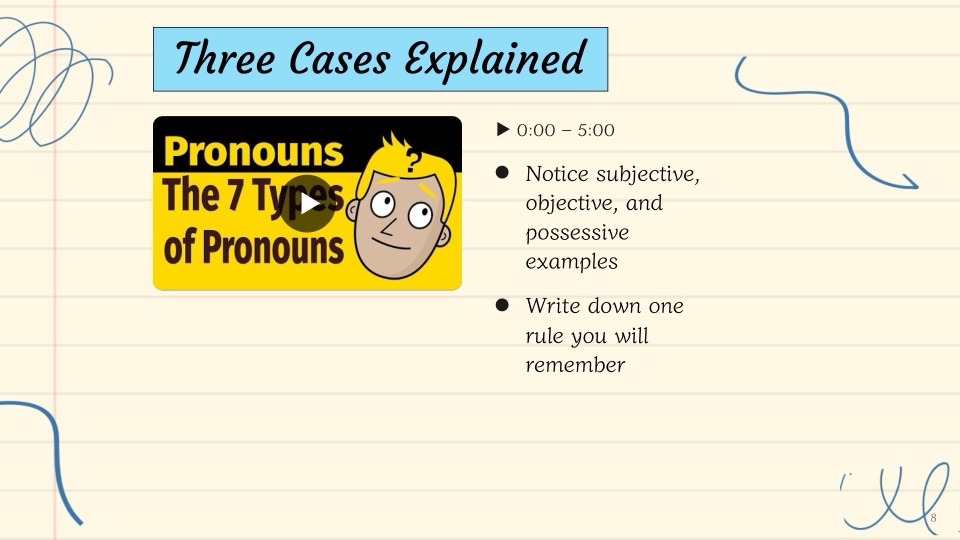
7 types of pronouns from 0:00 to 5:00
Good Morning Mr.D: THE 7 TYPES OF PRONOUNS | PARTS OF SPEECH | Good Morning Mr. D
Made by a middle-school teacher perfect for ages 11-12 and directly covers subjective, objective, and possessive types.
Worksheet
Sources
- English Language Arts Standards » Language » Grade 6 thecorestandards.org
- ELA Grade 6 - Chicago Public Schools cps.edu
- Pronouns thecenter.wsu.edu
- Gender Pronouns – LGBTQ+ Resource Center uwm.edu
- PRONOUN GUIDE - Columbia University ombuds.columbia.edu
- Pronouns - Excelsior OWL owl.excelsior.edu
- What is a pronoun? - KS2 English - BBC Bitesize bbc.co.uk
- Pronoun case, person, and number (article) | Khan Academy khanacademy.org
- Grammar: Pronouns | 7th grade reading, grammar, and vocab ... khanacademy.org
- Pronouns and antecedents: Case, person, and number en.khanacademy.org
- Using consistent pronouns (article) | Khan Academy en.khanacademy.org
- Pronoun | Meaning, Examples, Types, & Gender | Britannica britannica.com
- Pronoun Practices for Teaching and Learning lgbtq.georgetown.edu
- Gender Pronouns and Teaching - Inclusive Teaching - COD ... library.cod.edu
- Language Log » Choosing their pronouns for oneself languagelog.ldc.upenn.edu
- pronouns - Schema.org Property schema.org
- [ZIL] - Pronouns for NPCs - ZIL - The Interactive Fiction Commun… intfiction.org
- Resolving Pronouns for a Resource-Poor Language, Malayalam Using… aclanthology.org
- Pronoun Worksheets (Free Printables) - Superstar Worksheets superstarworksheets.com
- Pronouns for Kids grammar-monster.com
- Pronouns Worksheets (With Answers and Free PDF) atozworksheet.com
- Pronouns | Exercism's Docs exercism.io
- Pronouns | Google developer documentation style guide | Goog… developers.google.com
- Pronouns for preverbal children jefftk.com
- IXL | Learn pronouns ixl.com
Picture credits
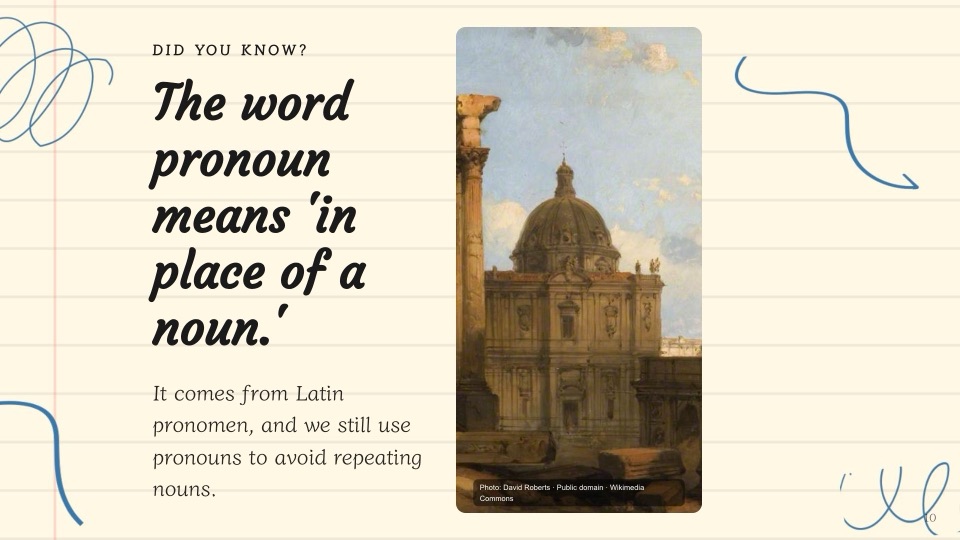
- Photo: David Roberts · Public domain · Wikimedia Commons
- Picture: unknown · CC0 · rawpixel via Openverse
- Microsoft Fluent Emoji (MIT)
Made with Lesson Dino's AI on 17 October 2026. AI can make mistakes, so check facts against the sources before you teach.