Slides
Lesson plan
Picture Words: Four Figures and Word Shades
Students learn four kinds of picture words and how word strength changes meaning. They sort, act, and write wild lines about a school day.
Objectives
- Students will identify simile, metaphor, personification, and hyperbole in sentences.
- Students will explain the real meaning of figurative phrases in plain words.
- Students will order close words by strength to show small differences in meaning.
Success criteria
- I can name the figure type and point to the clue words.
- I can say what a picture line really means in plain words.
- I can line up related words from weakest to strongest and explain the change.
Key words
| Word | Meaning |
|---|---|
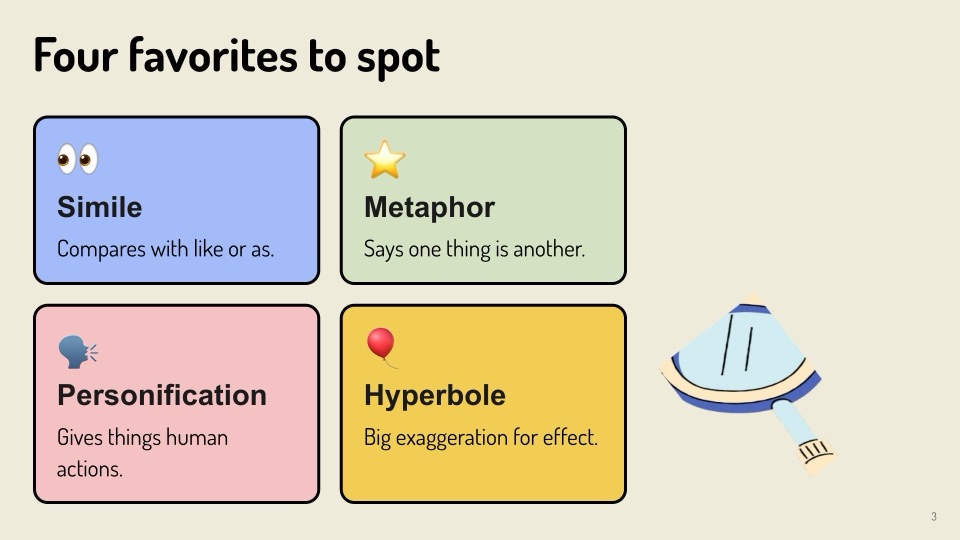
| simile | a comparison that uses like or as to link two different things |
| metaphor | saying one thing is another thing to show they are alike |
| personification | giving human actions or feelings to a thing or animal |
| hyperbole | a very big exaggeration that is not true and adds feeling |
| literal | words that mean exactly what they say with no hidden picture |
| nuance | a small change in strength or feeling between close words |
Timed plan (60 minutes)
| Time | Stage | What happens |
|---|---|---|
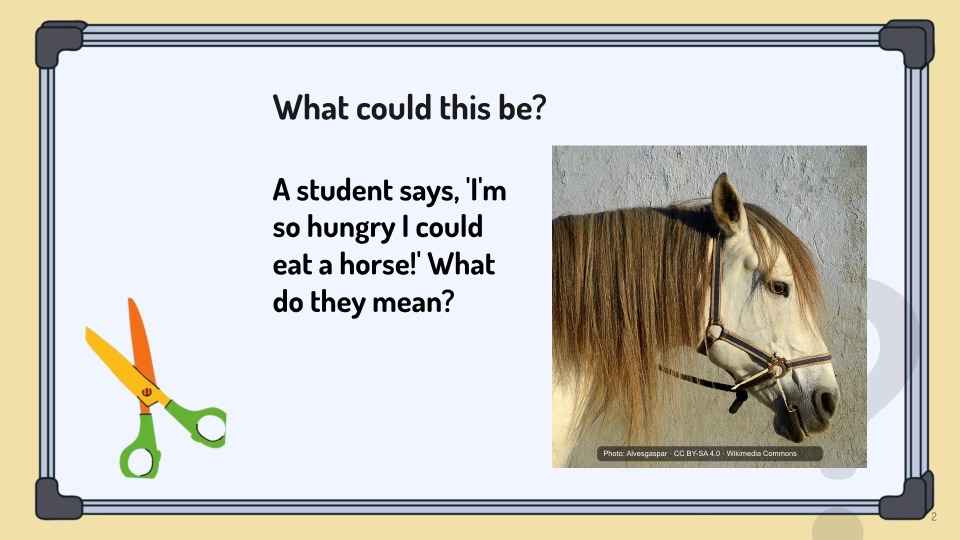
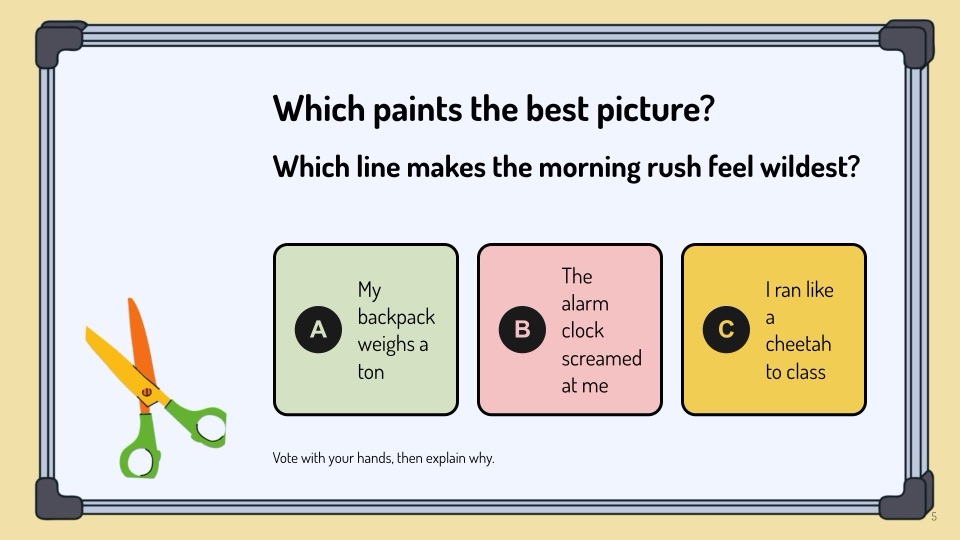
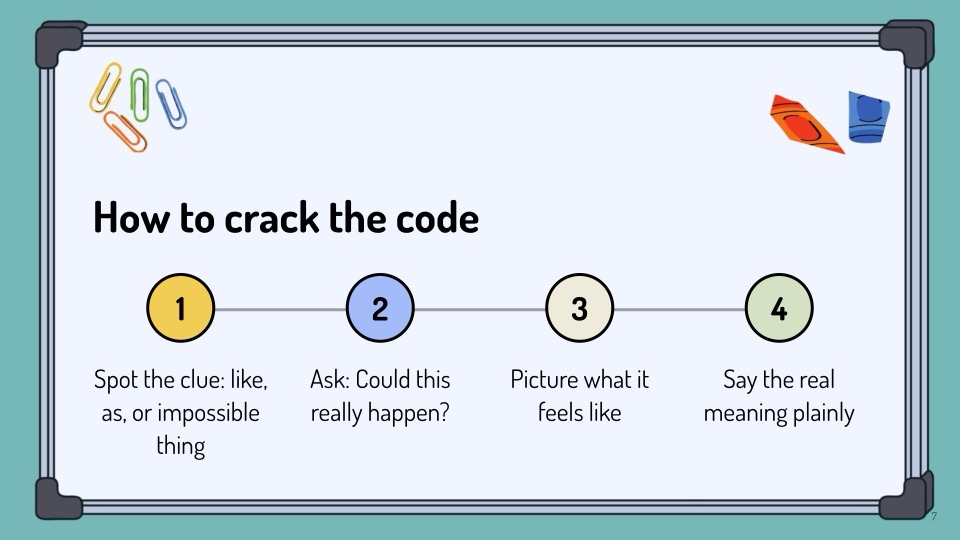
| 8 min | Starter | Hook interest and recall the difference between plain words and picture words. Welcome the class and say the game hook to preview the main activity. Show Slide 2 mystery: A student says, 'I'm so hungry I could eat a horse!' What do they mean? Think aloud with Slide 7 step: Ask: Could this really happen? Show Slide 5 vote with My backpack weighs a ton, The alarm clock screamed at me, I ran like a cheetah to class and take a quick vote. |
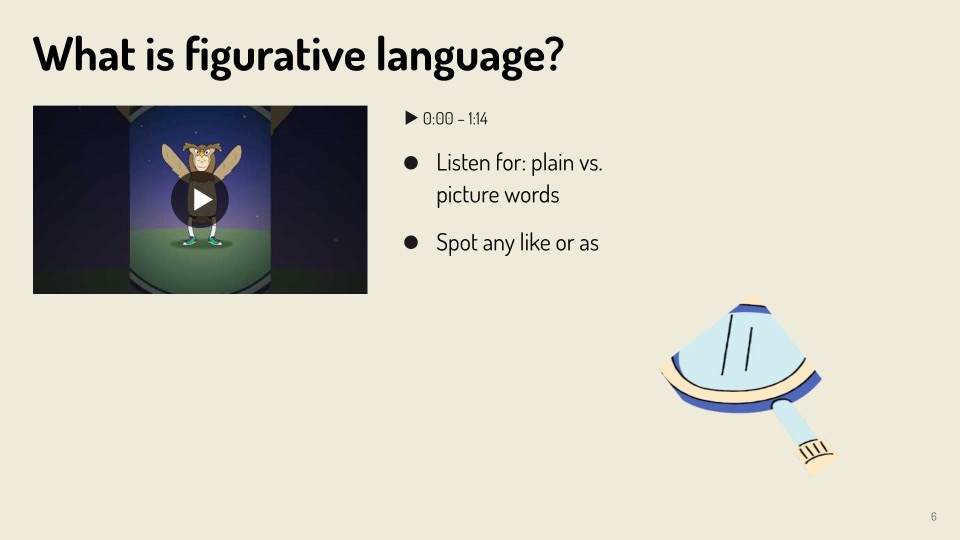
| 12 min | Teaching | Teach the four figures and how to crack their real meaning. Show Slide 3 cards and name each type with its test. Play Video clip 1 on Slide 6 and tell students to listen for plain vs picture words and spot any like or as. Show Slide 7 steps and model them on one simile. Share Slide 4 fact to build confidence. |
| 15 min | Main activity | Identify simile, metaphor, personification, and hyperbole and explain the clues. Post four corner signs and read aloud the sentence list from Slides 5 and 12. Read one sentence at a time: My backpack weighs a ton, The alarm clock screamed at me, I ran like a cheetah to class, Her smile was as bright as the sun., The classroom was a zoo., I'm so hungry I could eat a horse! Students walk to the corner they think fits, then one student from each corner defends the choice. Confirm the type, underline the two things compared or the impossible part, and state the real meaning. |
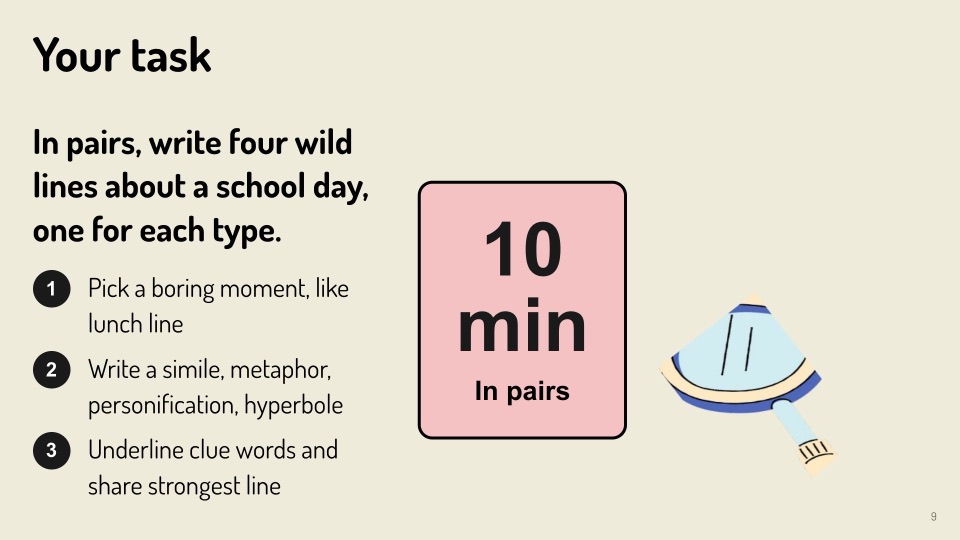
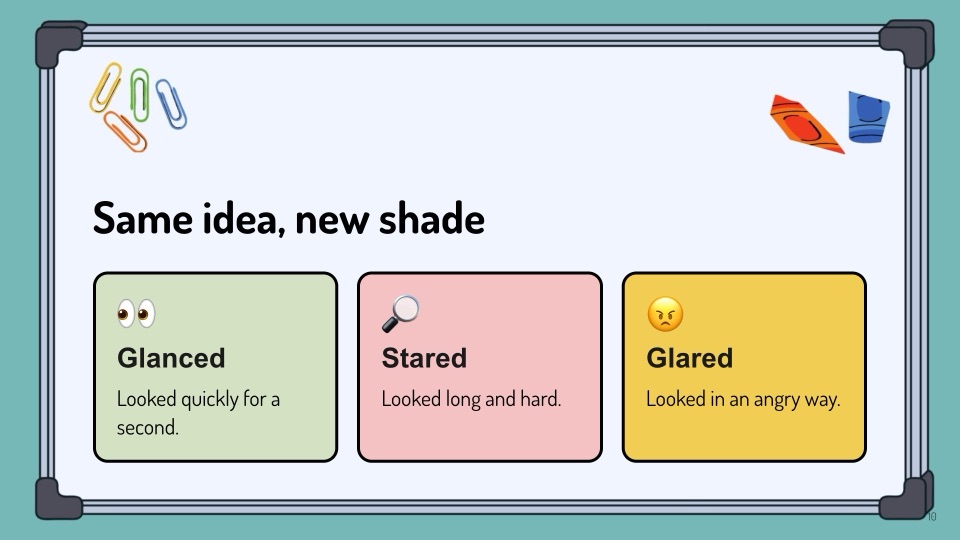
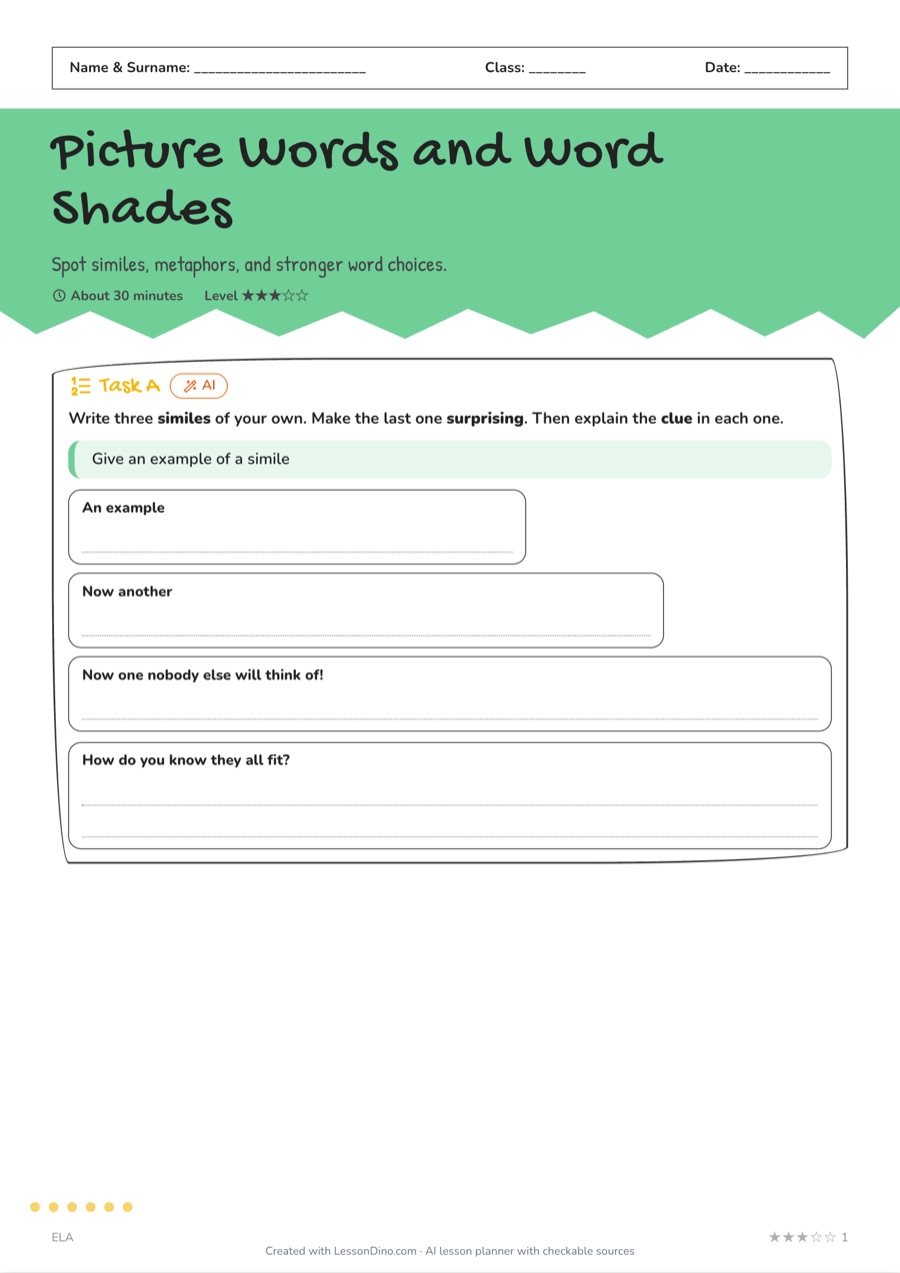
| 15 min | Word shades and writing | Show how word strength changes feeling and write own figures. Show Slide 10 cards: Glanced - Looked quickly for a second., Stared - Looked long and hard., Glared - Looked in an angry way. Model lining them weakest to strongest and swapping them into The alarm clock screamed at me to feel the change. Set Slide 9 task: Pick a boring moment, like lunch line, and write a simile, metaphor, personification, and hyperbole line. Hand out Worksheet Task A and remind pairs to explain the clue in each simile. |
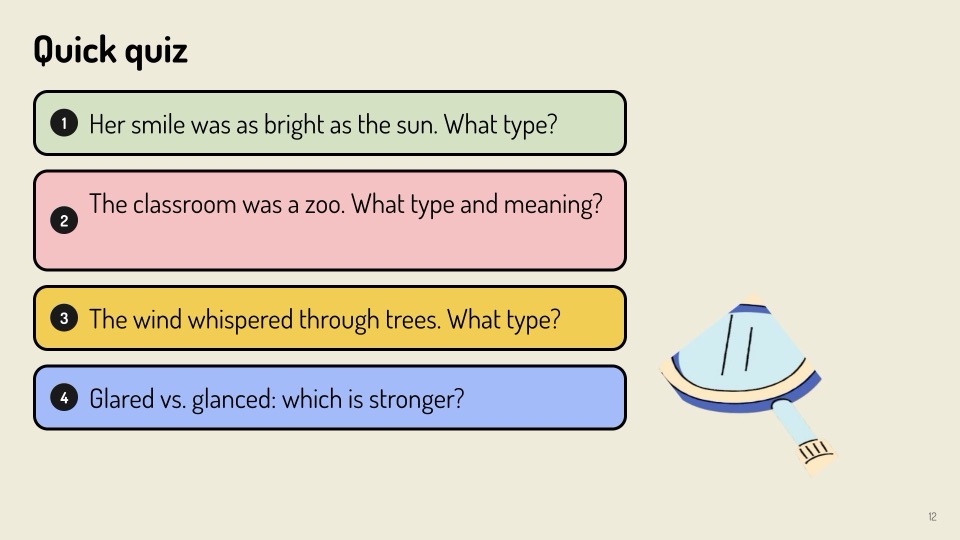
| 10 min | Plenary | Check understanding of figures and when exaggeration helps. Lead Slide 11 think, pair, share: When does exaggeration help a story? When does it confuse? Run Slide 12 quick quiz on Her smile was as bright as the sun. and The classroom was a zoo. Link back to success lines and collect exit tickets. |
Common mistakes
- Calling any comparison a simile, even without like or as.
How to spot it: Student labels The classroom was a zoo. as simile.
Use the like-or-as test: a simile compares with like or as, a metaphor says one thing is another. - Taking hyperbole as true fact.
How to spot it: Student thinks My backpack weighs a ton means 2,000 pounds.
Ask Could this really happen? Hyperbole is not meant to be taken literally, it means very heavy. - Thinking personification means the thing really became a person.
How to spot it: Student says the alarm clock really screamed with a mouth.
Explain personification treats a thing as if it were a person to connect feelings, the clock sounded loud and harsh.
Support
- Clue cards with tests for like, as, is, human action, and big exaggeration.
- Sentence frames: This compares ___ to ___. It really means ___.
- Word bank with picture clues for glanced, stared, glared and sound words.
Stretch
- Rewrite each simile as a metaphor and each metaphor as a simile.
- Rank three hyperboles strongest to weakest and explain the nuance.
- Add a second sentence that shows the feeling created, not just the action.
Check questions
- Her smile was as bright as the sun. What type and what is compared?
Answer: Simile; compares smile to sun to show bright and warm. - The classroom was a zoo. What type and what does it really mean?
Answer: Metaphor; means noisy and chaotic room, not real animals. - Put Glanced, Stared, Glared weakest to strongest and tell the difference.
Answer: Glanced, Stared, Glared; from quick look to long hard look to angry look.
Curriculum
Demonstrate understanding of figurative language, word relationships, and nuances in word meanings.
Video clips
Clips on YouTube, from the start and end times we chose. Check each one before you show it.
-
Generation Genius intro from 0:00 to 1:14
Newsela and GenerationGenius: CLIP: Figurative Language with Generation Genius ELA | NEWSELA
Short animated explainer made for Grade 5 that defines figurative language clearly for ages 10-11.
-
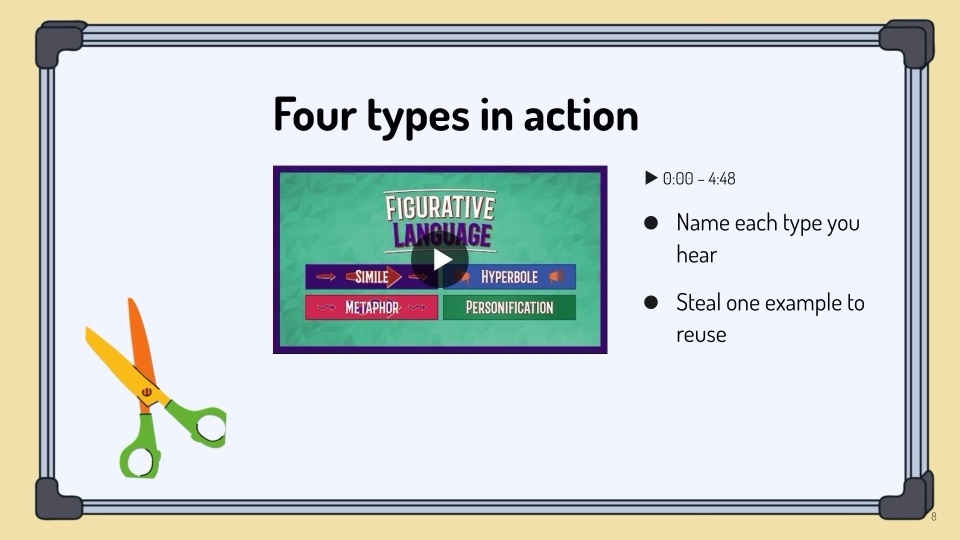
Metaphor, simile, personification, hyperbole from 0:00 to 4:48
Mineola Creative Content: Metaphor, Simile, Personification, Hyperbole | Figurative Language Lesson
Clear school lesson covering four main types at the right level and pace for Grade 5 ages 10-11.
Worksheet
Sources
- How to Read the Standards thecorestandards.org
- ELA Grade 5 - Chicago Public Schools cps.edu
- What is Figurative Language? | A Guide to Literary Terms liberalarts.oregonstate.edu
- Research Guides: Creative Writing: Figurative Language research.ewu.edu
- Figurative Language - Del Mar College delmar.edu
- Figurative language: hyperbole, similes and metaphors - BBC bbc.co.uk
- Figurative language Facts for Kids kids.kiddle.co
- Literal and figurative language Facts for Kids kids.kiddle.co
- Figurative Language | OER Commons oercommons.org
- How to Teach Kids Figurative Language - KidsKonnect kidskonnect.com
- Figurative Language for Kids: A Super Simple Guide to Tricky ... vappingo.com
- Figurative Language Explained for Kids: Story, Facts ... mystorypie.com
- What Are Figurative Language Devices? – Explained for Kids smartonlinegames.com
- Figurative Language and Emotive Language: A Simple Guide for Kids theprintablenest.com
- What figurative language is used in o Captain my Captain? – Swirlzcupcakes.com swirlzcupcakes.com
- A Survey on Automatic Generation of Figurative Language: From Ru… oadoi.org
Picture credits
Made with Lesson Dino's AI on 17 October 2026. AI can make mistakes, so check facts against the sources before you teach.