Slides
Lesson plan
Three Pictures, One Story
Students learn to order real or imagined events and add vivid details. They plan and write a three-part narrative in clear sequence.
Objectives
- Students will write a real or imagined narrative in clear beginning-middle-end order.
- Students will use sensory details and action to show feelings and events.
Success criteria
- I can order my story events from start to big moment to end.
- I can add one sense detail and show a feeling by action.
Key words
| Word | Meaning |
|---|---|
| narrative | a story that tells connected events in order to share meaning |
| sequence | the order in which events happen, one after another |
| climax | the most exciting or important part of the story |
| resolution | the end part where the problem is solved and change is shown |
| sensory detail | words that tell what can be seen, heard, smelled, or felt |
| technique | a smart trick a writer uses to make the story clear and lively |
Timed plan (60 minutes)
| Time | Stage | What happens |
|---|---|---|
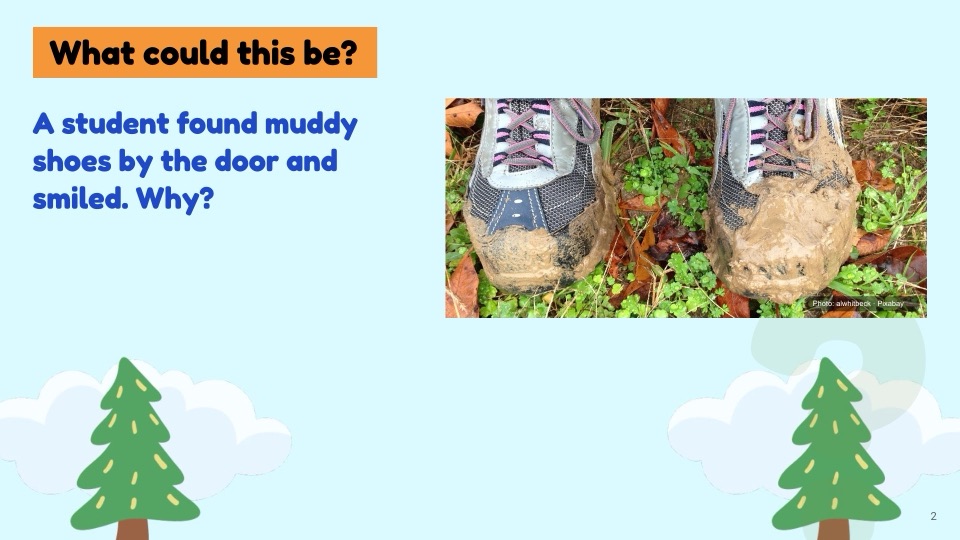
| 5 min | Starter | Hook interest and recall that stories need a beginning, a middle and an end. Show Slide 2 and read aloud: A student found muddy shoes by the door and smiled. Why? Say the hook and point to three blank boxes on the board. Ask partners to whisper one guess about what happened before and after the shoes. Link guesses to lesson goal: today we plan and write a short real or imagined story in clear order. |
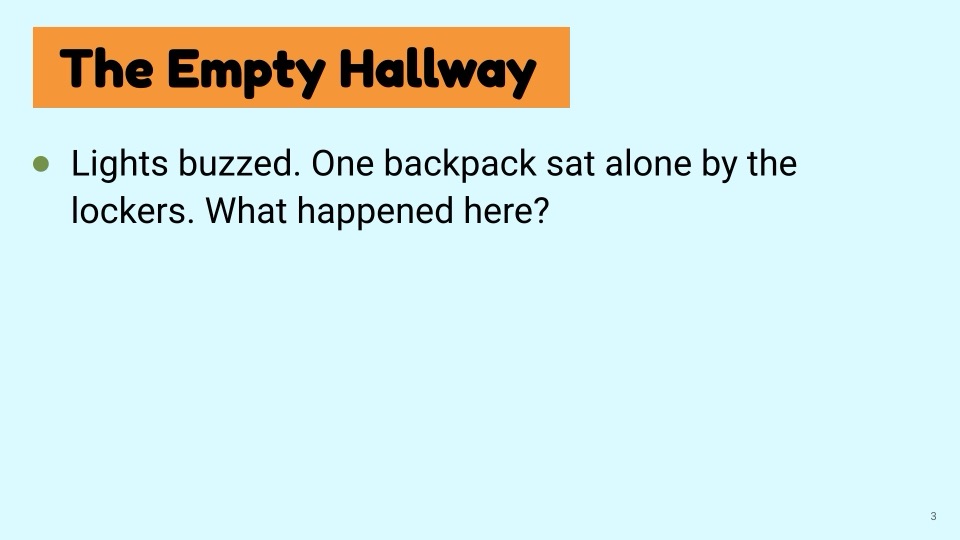
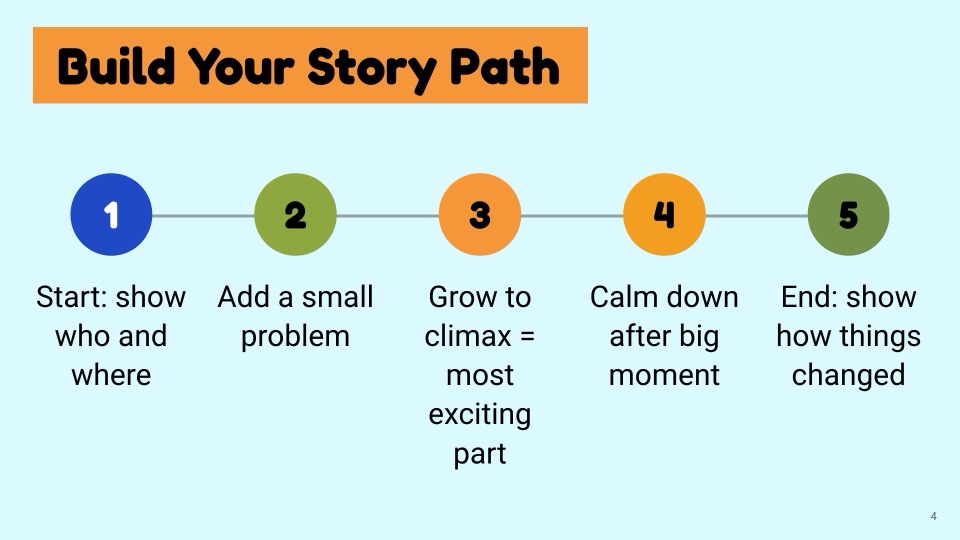
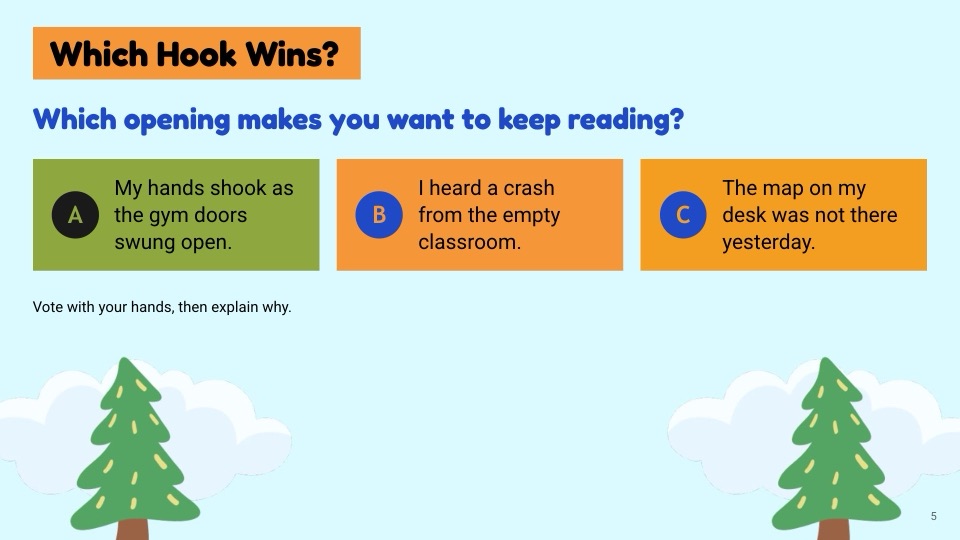
| 12 min | Teaching: Build the Story Path | Teach how to order events from introduction to climax to resolution. Show Slide 3: Lights buzzed. One backpack sat alone by the lockers. What happened here? Ask who and where. Show Slide 4 and walk through the five steps: show who and where, add a small problem, grow to climax, calm down, show change. Model putting three events in order on the three-box path, thinking aloud about time words. Show Slide 5 and vote quickly on which opening makes you want to keep reading. |
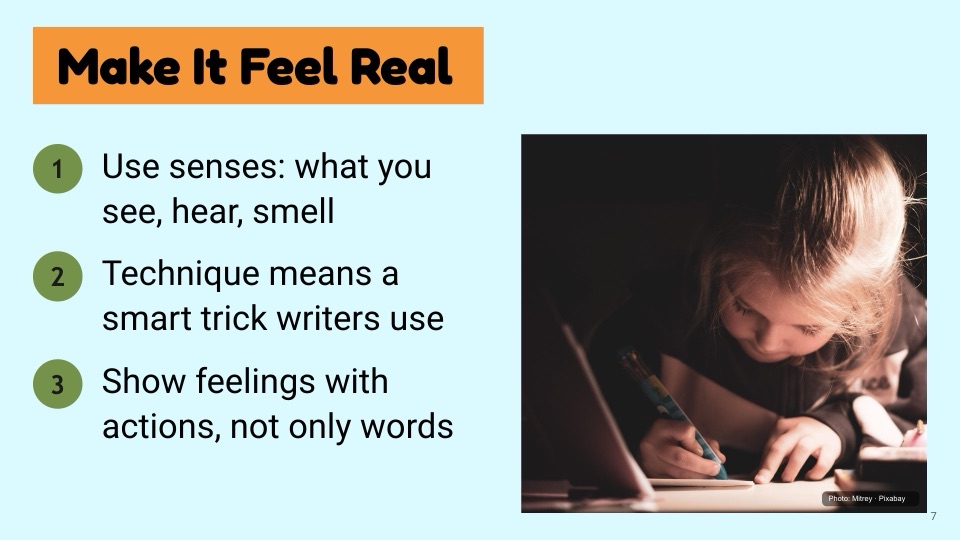
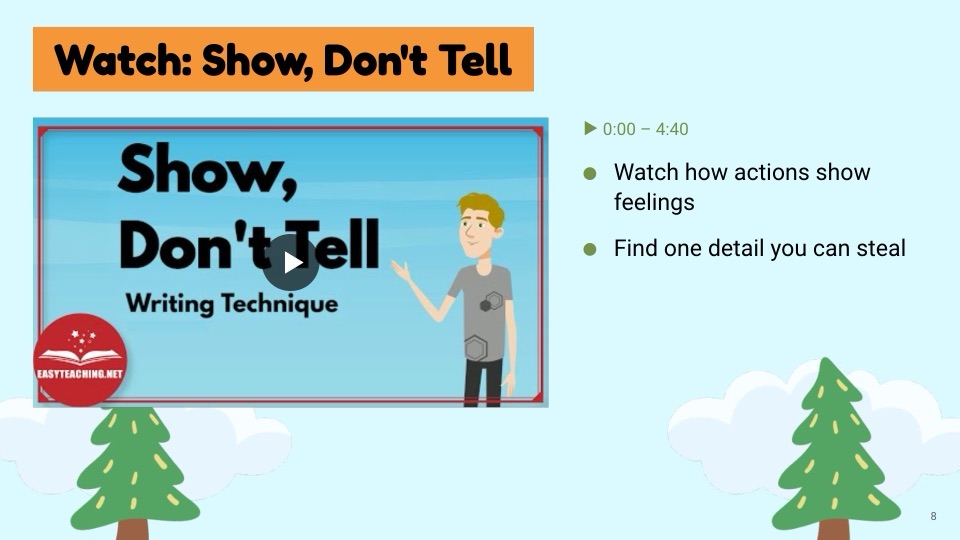
| 13 min | Teaching: Make It Feel Real | Model adding sensory details and showing feelings by action. Show Slide 7 and explain technique as a smart trick writers use. Play Video clip 4 (0:00-4:40) and tell students to steal one detail that shows feeling. Model upgrading a flat sentence with a sense and an action that shows feeling. Show Slide 8 and ask students to name the action that shows the feeling. |
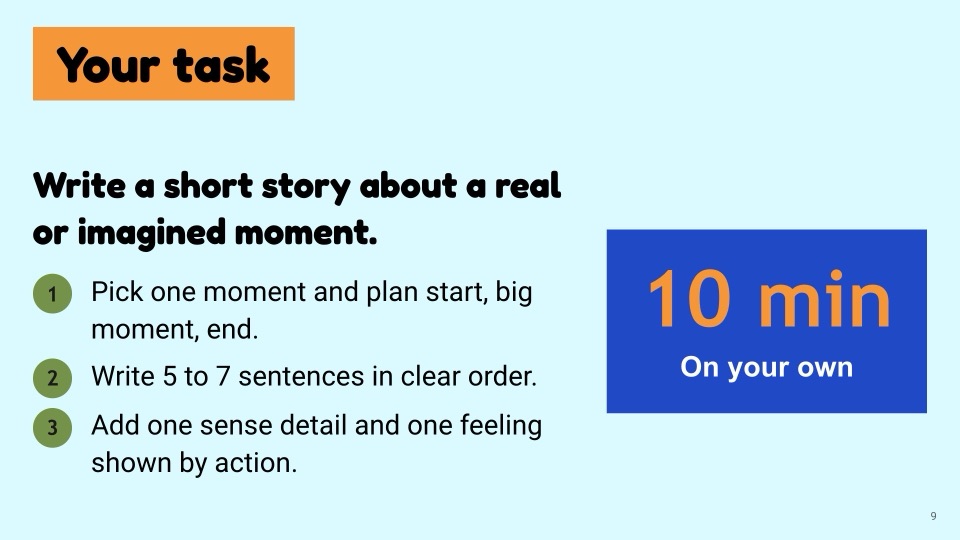
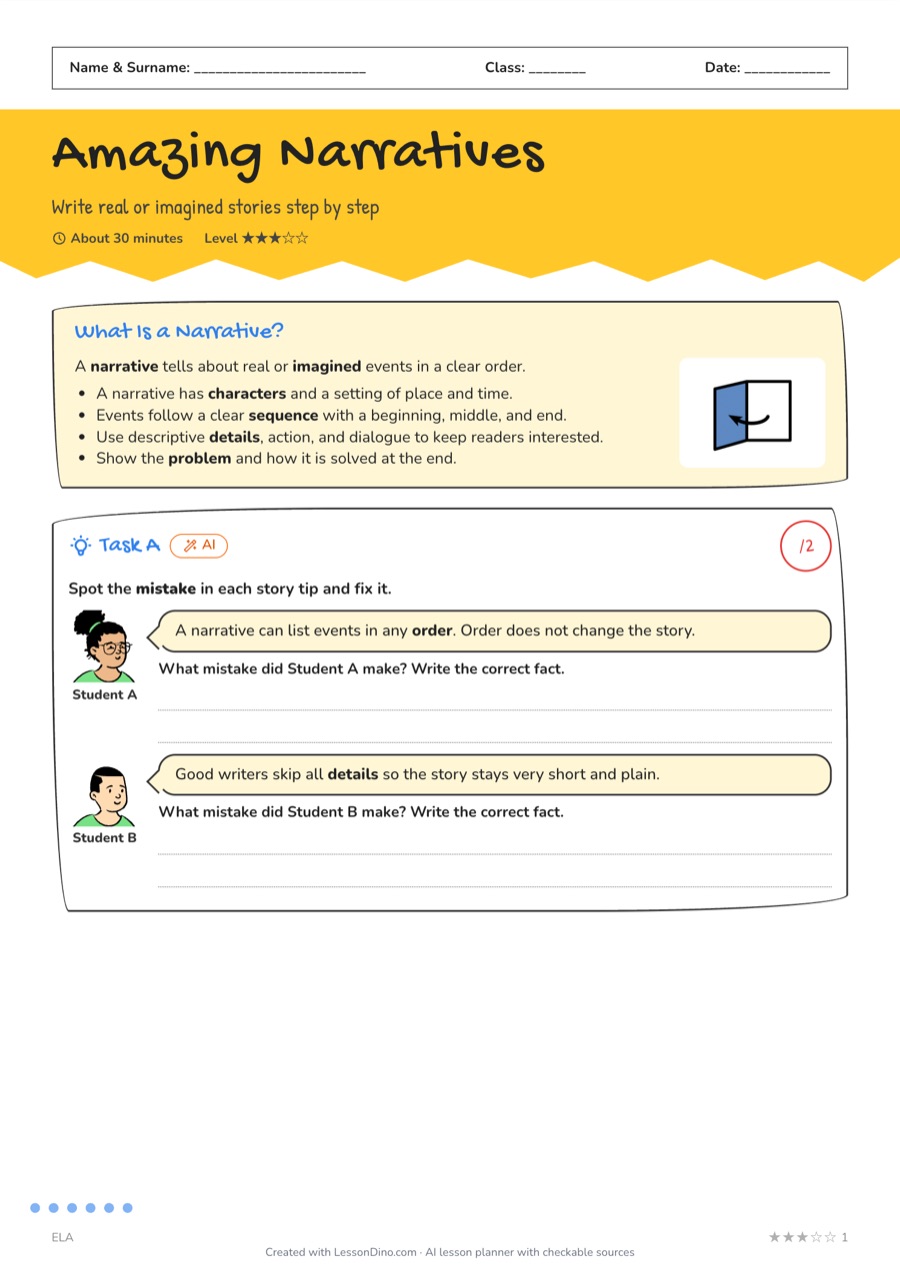
| 20 min | Main activity: Three-Panel Story Sprint | Draft a short real or imagined narrative with clear order and details. Give out folded three-box paper, pencils, and crayons and show Slide 9 task. Direct quick planning talk using Worksheet Task C: tell your start, big moment, end with no writing for 2 minutes. Set writing time: 5 to 7 sentences in clear order, with one sense detail and one feeling shown by action. Stop at 15 minutes for partner check that events connect in order from start to finish. |
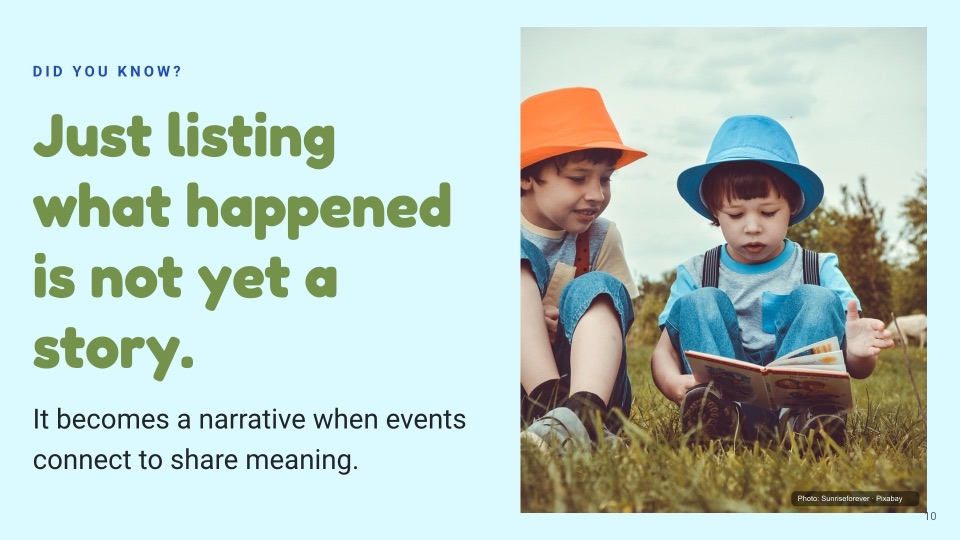
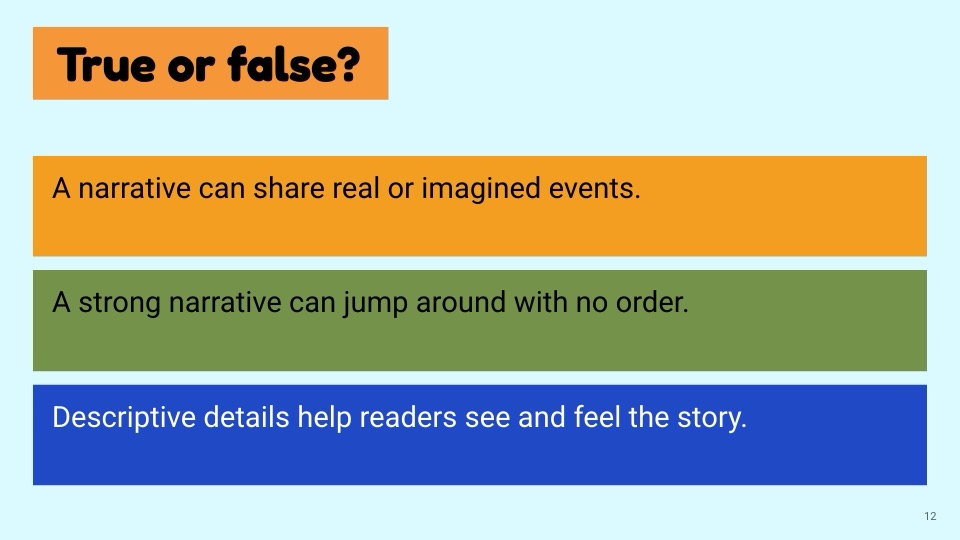
| 10 min | Plenary | Share work and check understanding of narrative order and details. Invite two students to read start to end while class listens for order and one vivid detail. Show Slide 10: just listing what happened is not yet a story; it becomes a narrative when events connect to share meaning. Use Slide 11 for think, pair, share: what smart trick made your partner's story easy to picture? Close with Slide 12 true-or-false check on real or imagined and clear sequence. |
Common mistakes
- Listing events without connection
How to spot it: Story reads like and then, and then with no problem or change
Link events so they share meaning; it becomes a narrative when events connect to share meaning. Ask: what changed? - Putting the climax first or last with flat ending
How to spot it: Most exciting part at start, then boring rest, or ends with and then they went home
Move most exciting or important part to the middle and add action and detail to resolution where conflict is solved. - Telling feelings instead of showing
How to spot it: Only writes I was happy, sad, scared with no senses
Add elaboration, explanation and detail with senses and action, using metaphors, similes, and imagery.
Support
- Provide sentence starters for Start, Big Moment, and End to help plan, revise, and keep ideas in order
- Offer a word bank of color, size, sound, and texture words and connecting words like next, then, suddenly
Stretch
- Add one descriptive detail about setting and one about character feelings in each panel
- Explain how changing one detail changes character choices and next events
Check questions
- What three parts must your narrative plan show?
Answer: Start, big moment (climax), and end (resolution). - Give one sense detail you used or heard today.
Answer: Any see, hear, smell, or feel detail, such as buzzing lights or rain smell. - How did you show a feeling without just naming it?
Answer: By an action, such as hands shook to show fear.
Curriculum
Write narratives to develop real or imagined experiences or events using effective technique, descriptive details, and clear event sequences.
Video clips
Clips on YouTube, from the start and end times we chose. Check each one before you show it.
-
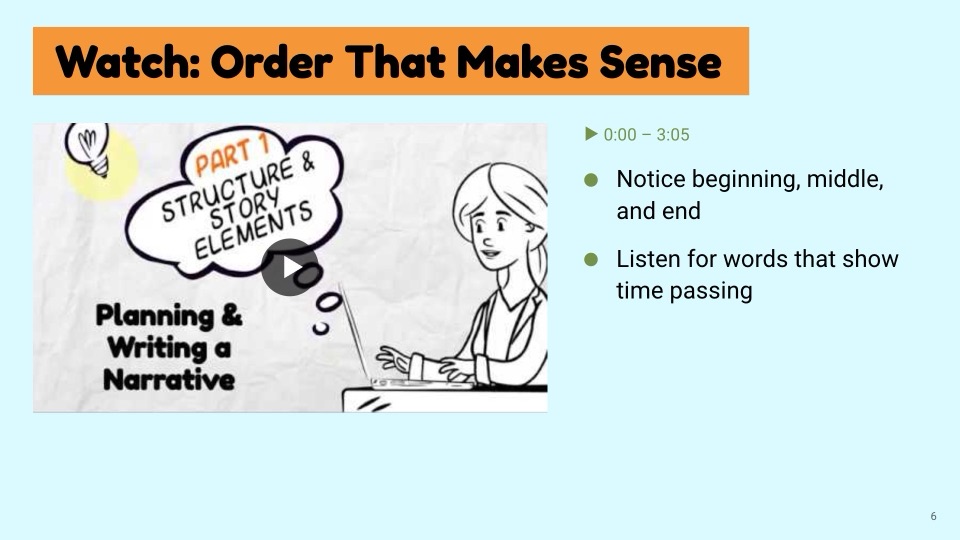
narrative structure and elements from 0:00 to 3:05
EasyTeaching: Writing a Narrative: Part 1 Structure & Elements | EasyTeaching
Covers narrative structure and clear event sequences with simple visuals perfect for 10-11-year-olds.
-
show, don't tell technique from 0:00 to 4:40
EasyTeaching: Show, Don't Tell Writing Technique | EasyTeaching
Teaches show-don't-tell as effective technique for descriptive details at a level ideal for ages 10-11.
Worksheet
Sources
- How to Read the Standards thecorestandards.org
- English Language Arts cps.edu
- Beginning Creative Writing - Harvard Division of Continuing Education ... coursebrowser.dce.harvard.edu
- Fundamentals in Creative Writing: The Grammar of Narrative creativewriting.uchicago.edu
- Creative Writing Examples - Online Lesson articulate.strayer.edu
- The Effects of Creative Writing Activities on Narrative Text Writing ... files.eric.ed.gov
- Research Guides: Creative Writing: Resources by Genre guides.nyu.edu
- Finding your creative writing voice: Practical exercises to help you ... lpsonline.sas.upenn.edu
- Writing Skills - Creative and narrative writing - BBC Bitesize bbc.co.uk
- Creative writing - KS2 English - BBC Bitesize bbc.co.uk
- Narrative Facts for Kids kids.kiddle.co
- Creative Writing - eCornell ecornell.cornell.edu
Picture credits
- Photo: klimkin · Pixabay
- Photo: alwhitbeck · Pixabay
- Photo: Mitrey · Pixabay
- Photo: Sunriseforever · Pixabay
- Pictograms: Sergio Palao, ARASAAC (arasaac.org) · CC BY-NC-SA
Made with Lesson Dino's AI on 16 October 2026. AI can make mistakes, so check facts against the sources before you teach.