Slides
Lesson plan
Finding Every Line of Symmetry
Students learn that a fold makes symmetry only when both sides match exactly. They test shapes by folding and draw every line of symmetry.
Objectives
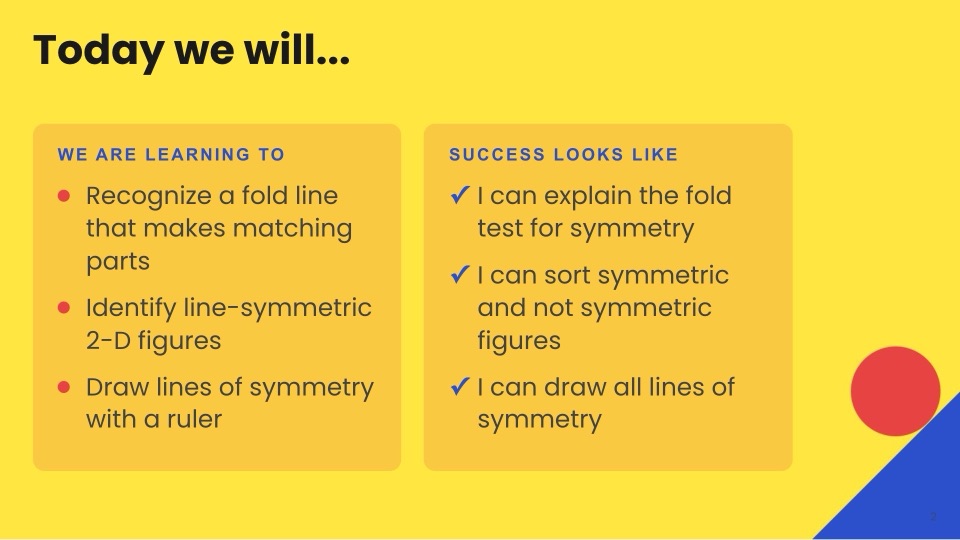
- Students will recognize a line of symmetry as a fold into matching parts.
- Students will identify line-symmetric and not symmetric figures using fold test.
- Students will draw all lines of symmetry for squares, rectangles and triangles.
Success criteria
- I can explain the fold test for matching parts.
- I can sort figures into symmetric and not symmetric.
- I can draw all symmetry lines for a shape with a ruler.
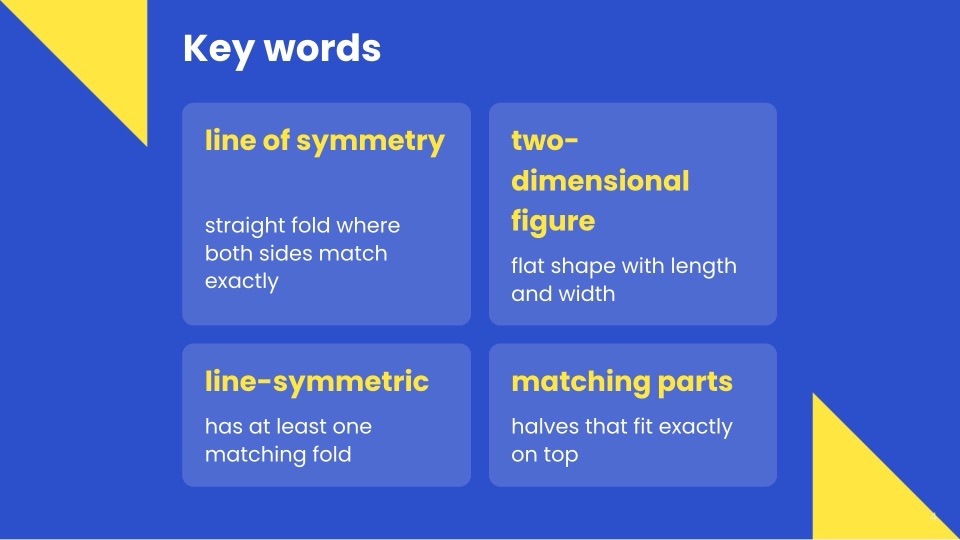
Key words
| Word | Meaning |
|---|---|
| line of symmetry | straight fold where both sides match exactly |
| two-dimensional figure | flat shape with length and width |
| line-symmetric | having at least one fold with two parts that match |
| mirror image | exact flipped copy that lines up when folded |
Timed plan (60 minutes)
| Time | Stage | What happens |
|---|---|---|
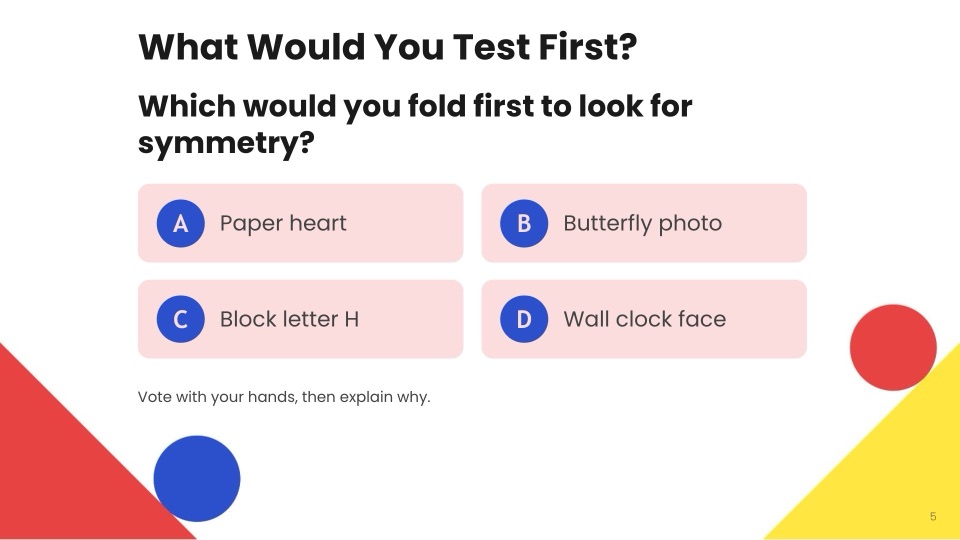
| 8 min | Starter | Hook interest and surface ideas about folding to find matching halves. Show Slide 1 title and Slide 2 objectives and read them in student words. Show Slide 5 vote: Which would you fold first to look for symmetry? Paper heart, butterfly photo, block letter H, wall clock face. Use the hook: Who can find every single hiding line? Some shapes have more than one — let's see who finds them all. Take a quick vote and ask students to justify which object looks easiest to fold into matching parts. |
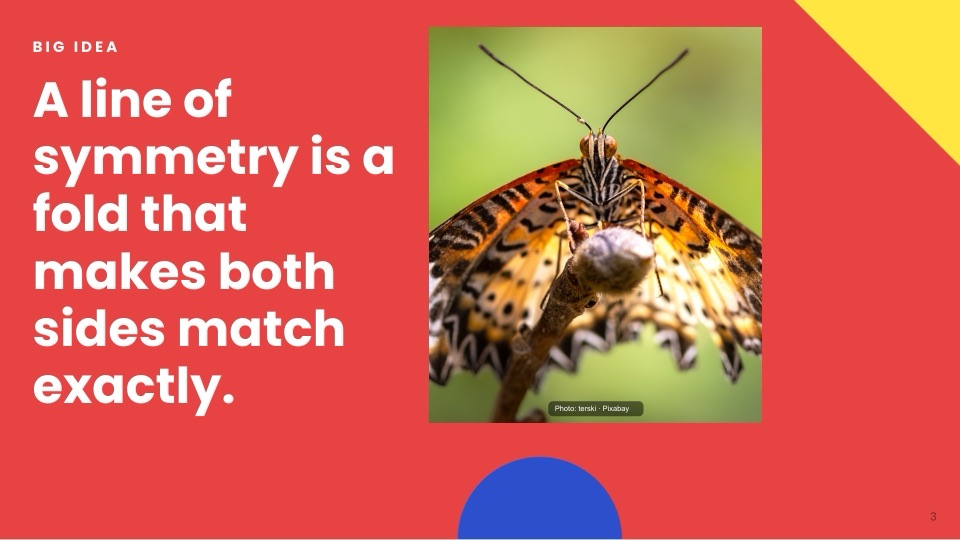
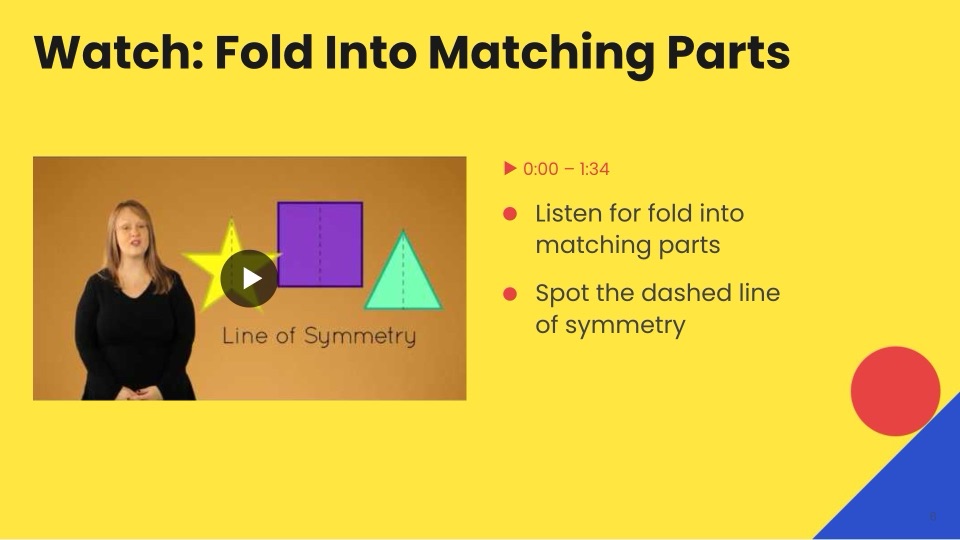
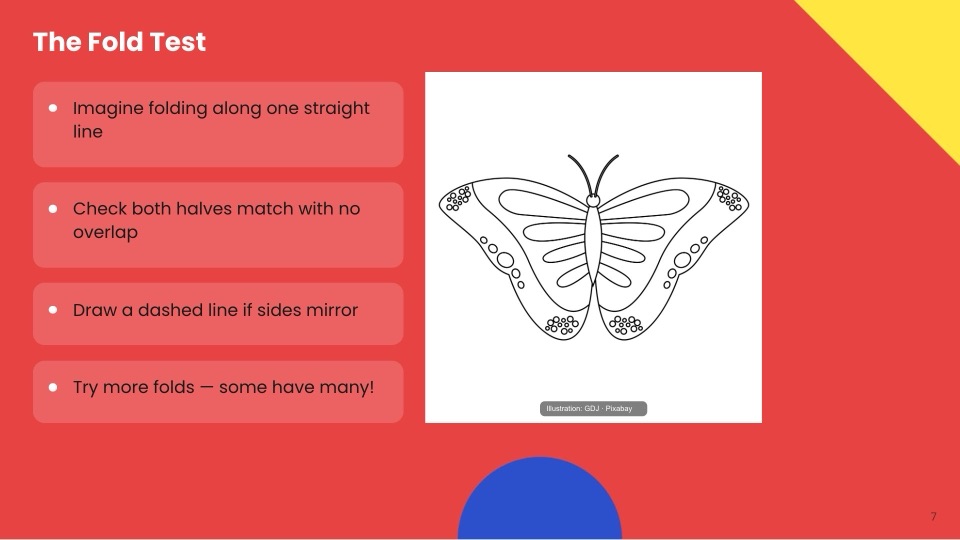
| 12 min | Teaching | Teach the fold test definition and how to mark a true line of symmetry. Show Slide 3 big idea and Slide 4 key words, emphasizing a line of symmetry is a fold that makes both sides match exactly. Play Video clip 1 on Slide 6 and tell students to listen for fold into matching parts and spot the dashed line of symmetry. Model with a large paper heart using Slide 7 steps: imagine folding along one straight line, check both halves match with no overlap, draw a dashed line if sides mirror. Show a near-miss fold that cuts in half but does not make mirror halves. |
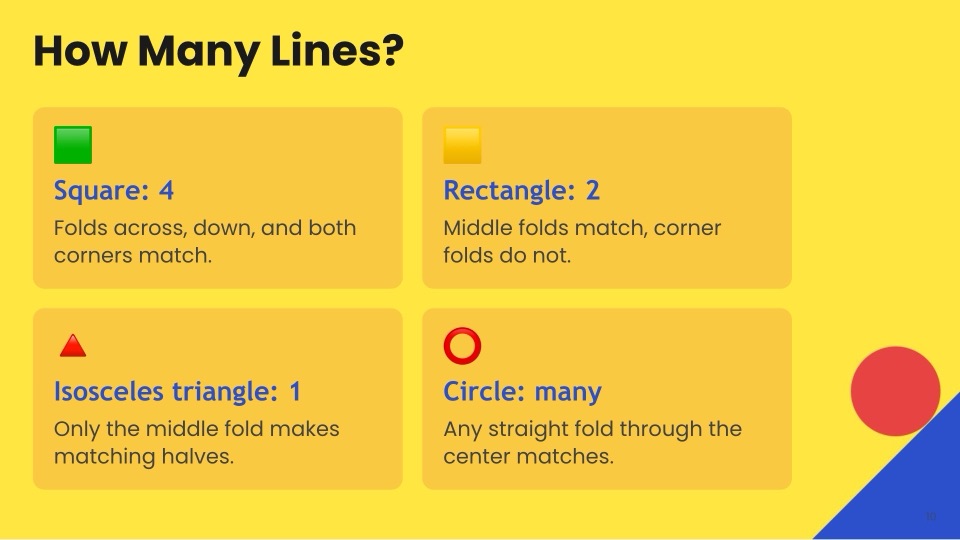
| 10 min | Guided practice | Prove why equal halves are not always symmetric halves using rectangle and square. Hold up a large paper rectangle marked with vertical, horizontal, and diagonal lines. Fold and test each line with the class, narrating whether corners and edges line up exactly. Compare with a square diagonal fold that does match to show shapes behave differently. Record results on the board as yes or no lines of symmetry. |
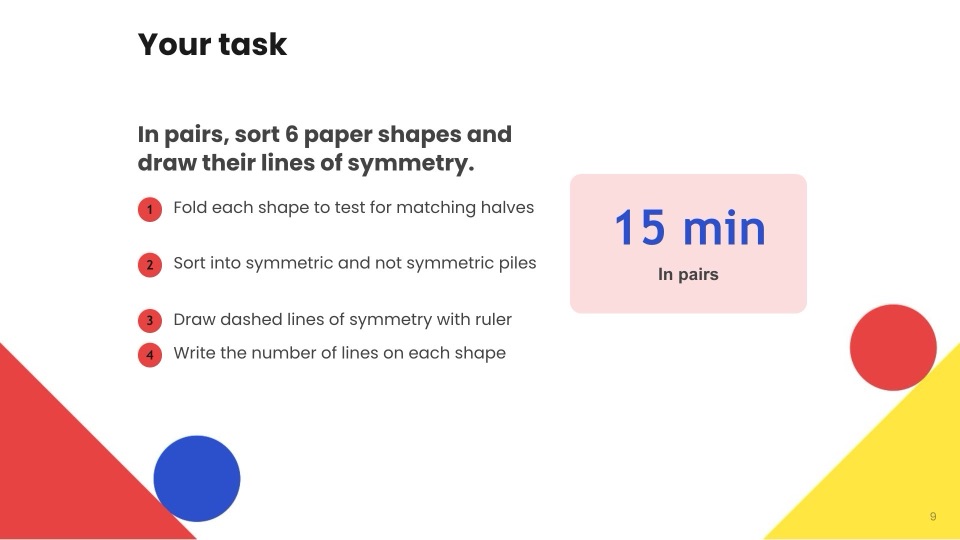
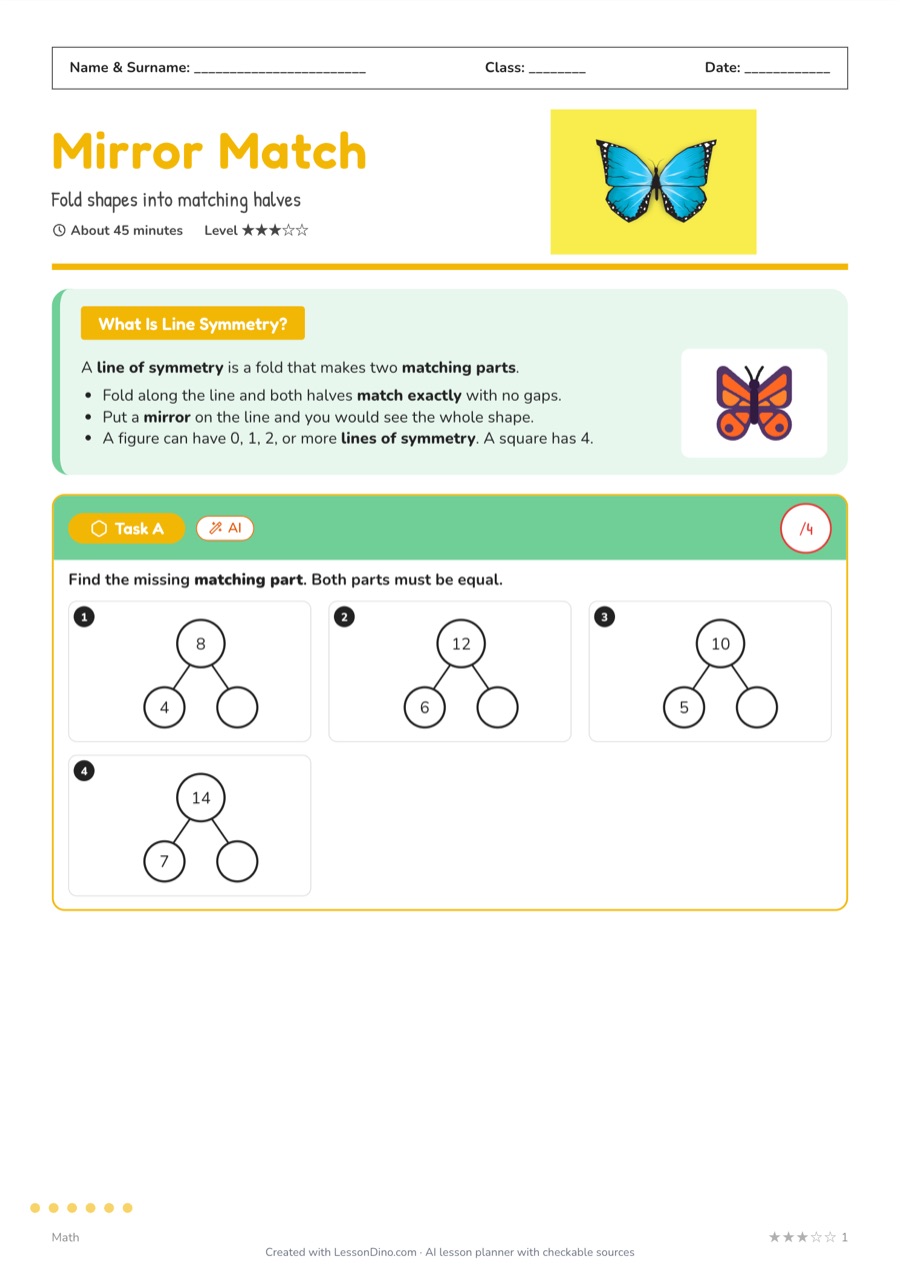
| 20 min | Main activity | Draw all lines of symmetry for familiar shapes and prove each by folding. Show Slide 9 task: fold each shape to test for matching halves, sort into symmetric and not symmetric piles, draw dashed lines with ruler, write the number of lines. Distribute shape sheets with squares, rectangles, triangles, plus rulers and stickers, and model drawing one straight dashed line with a ruler. Circulate as pairs fold, sort, draw, and place a sticker on each line they drew and count aloud, then fold to prove each line makes matching parts. Direct pairs to complete Worksheet Task B to record lines counted. |
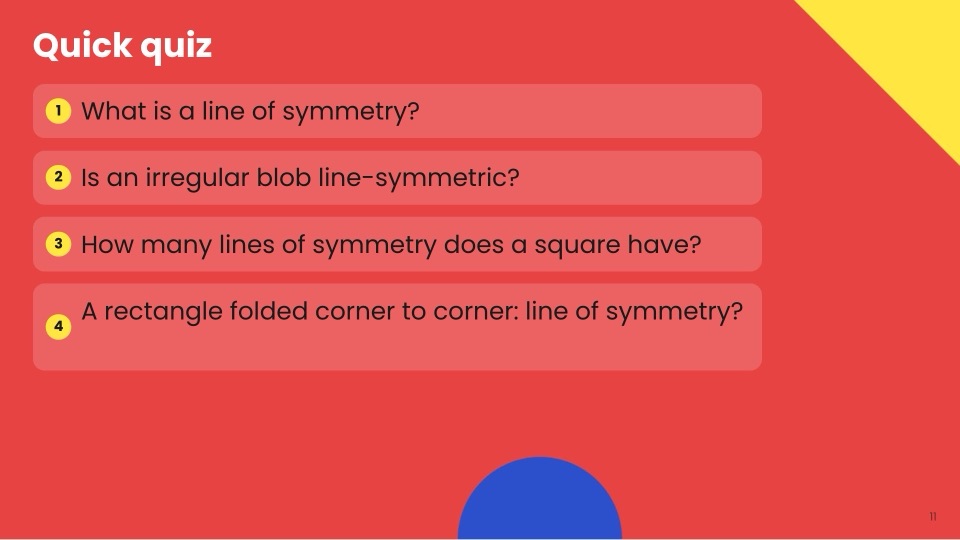
| 10 min | Plenary | Confirm the definition and that students can identify and count lines of symmetry. Return to objectives on Slide 2 and restate success in student words. Use Slide 11 quick quiz: define line of symmetry and decide if an irregular blob is line-symmetric. Collect exit answers on whiteboards and correct the diagonal-rectangle error once more. |
Common mistakes
- Thinking any line that makes two equal-size pieces is a line of symmetry, like the rectangle diagonal.
How to spot it: Student draws diagonal on rectangle or says half means symmetric.
Refold and check edges land exactly; stress it must divide into two mirror-image halves, not just two pieces the same size. - Drawing only one line on a square or rectangle that has more than one.
How to spot it: Stops after vertical line and writes 1 for square or rectangle.
Prompt to test across, down, and both corners; recall square has 4 lines and rectangle has 2 lines. - Drawing a wobbly or off-center line and calling it symmetry.
How to spot it: Line is not straight or halves do not line up when folded.
Use a ruler for a straight dashed line and fold to prove both halves overlap exactly with no gaps.
Support
- Use thin paper with a light pre-crease and start with vertical lines only, checking overlap exactly when folded.
- Give pre-cut shapes to fold first, mark the crease, then draw over it with a ruler.
- Provide sentence frames and a picture checklist with the line started as a dot to finish.
Stretch
- Have students predict yes or no before folding, then fold to check and explain what matched.
- Have students hunt for a second line on the same shape and try new quadrilaterals, describing where they looked next.
- Have students design a new block letter with exactly one line and prove it by folding.
Check questions
- What is a line of symmetry and how do you test it?
Answer: A fold line where both sides match exactly; fold and check no overlap. - Is a rectangle diagonal a line of symmetry? Why?
Answer: No, it cuts in half but halves are not mirror images. - How many lines of symmetry do a square and an isosceles triangle have?
Answer: Square 4, isosceles triangle 1.
Curriculum
Recognize a line of symmetry for a two-dimensional figure as a line across the figure such that the figure can be folded along the line into matching parts. Identify line-symmetric figures and draw lines of symmetry.
Video clips
Clips on YouTube, from the start and end times we chose. Check each one before you show it.
-
Grade 4 Lines of Symmetry from 0:00 to 1:34
Roble Education: Lines of Symmetry: Grade 4 Module 4 Lesson 12
Made explicitly for Grade 4 on folding figures into matching parts, with pace and vocabulary perfect for ages 9-10.
-
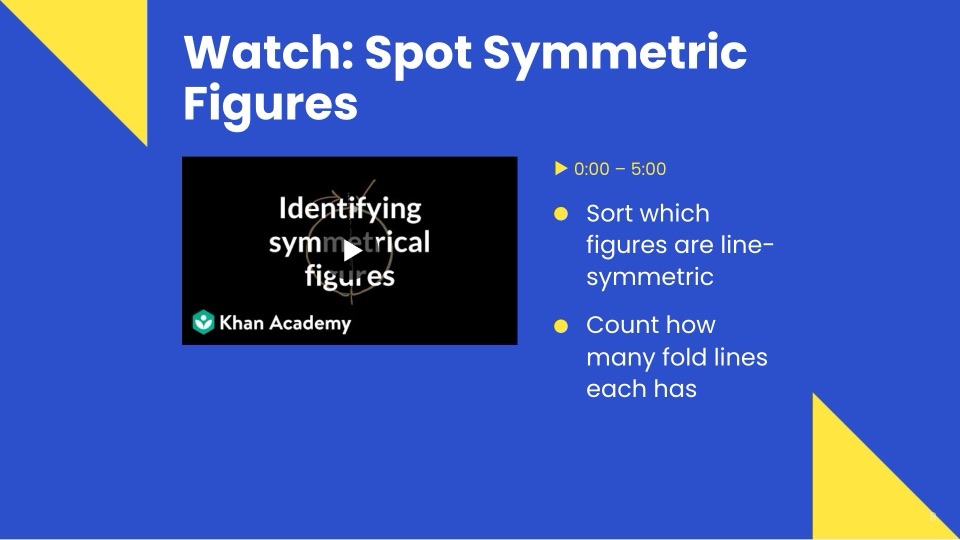
Identifying Symmetrical Figures from 0:00 to 5:00
Khan Academy: Identifying symmetrical figures | Math | 4th grade | Khan Academy
Khan Academy 4th-grade lesson on identifying symmetric figures, ideal for ages 9-10 in the US.
Worksheet
Sources
- Grade 4 Math Curriculum - Fairfax County Public Schools fcps.edu
- Grade 4 Math | SFUSD sfusd.edu
- Symmetry – Mathematics for Elementary Teachers open.maricopa.edu
- Line Reflection and Line Symmetry - University of Washington sites.math.washington.edu
- Symmetry for Kids | Lines of Symmetry | Symmetry in Real-life ... classx.org
- Symmetry - KS1 Maths - BBC Bitesize bbc.co.uk
- Flexi answers - What figure shows an example of symmetry? | CK-12 Foundation ck12.org
- Lines of Symmetry Math Video for Kids | 3rd, 4th, & 5th Grade generationgenius.com
- Lines of Symmetry for Kids - Learn Geometry Basics kidsacademy.mobi
- What is a Line of Symmetry? KS1 & KS2 Primary School Maths ... blog.thinkacademy.uk
- What Is Symmetry for Kids? Types and Examples scienceinsights.org
- Symmetry Facts for Kids kids.kiddle.co
Picture credits
- Photo: terski · Pixabay
- Illustration: GDJ · Pixabay
- Illustration: thisisprabha · Pixabay
- Microsoft Fluent Emoji (MIT)
Made with Lesson Dino's AI on 17 October 2026. AI can make mistakes, so check facts against the sources before you teach.