Slides
Lesson plan
Dolphin Detectives Research Sprint
Students learn how to run a short research project that builds knowledge. They investigate dolphins in pairs and make illustrated fact cards.
Objectives
- Students will choose a focused research question that is just right.
- Students will gather facts about different aspects from two sources.
- Students will share findings in a clear fact card in own words.
Success criteria
- I can pick a just-right question I can answer in days.
- I can find and check facts from two different sources.
- I can share what I learned in my own words.
Key words
| Word | Meaning |
|---|---|
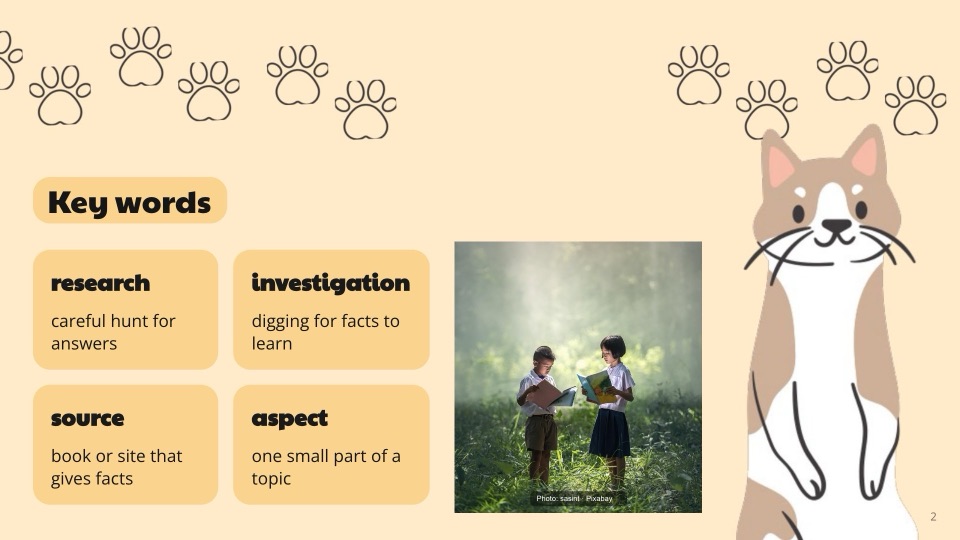
| research | careful hunt for answers to a question |
| investigation | digging for facts to learn more |
| source | book or site that gives facts |
| aspect | one small part of a bigger topic |
Timed plan (60 minutes)
| Time | Stage | What happens |
|---|---|---|
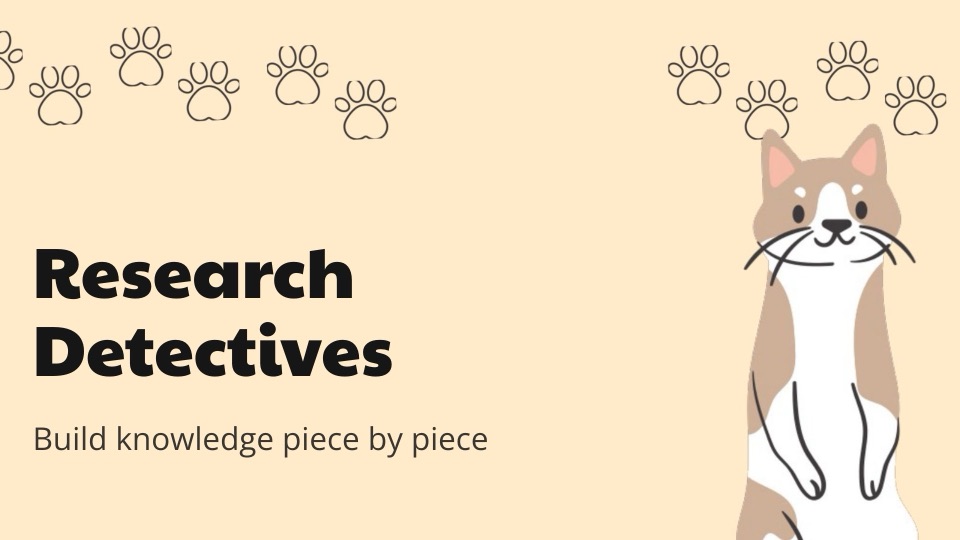
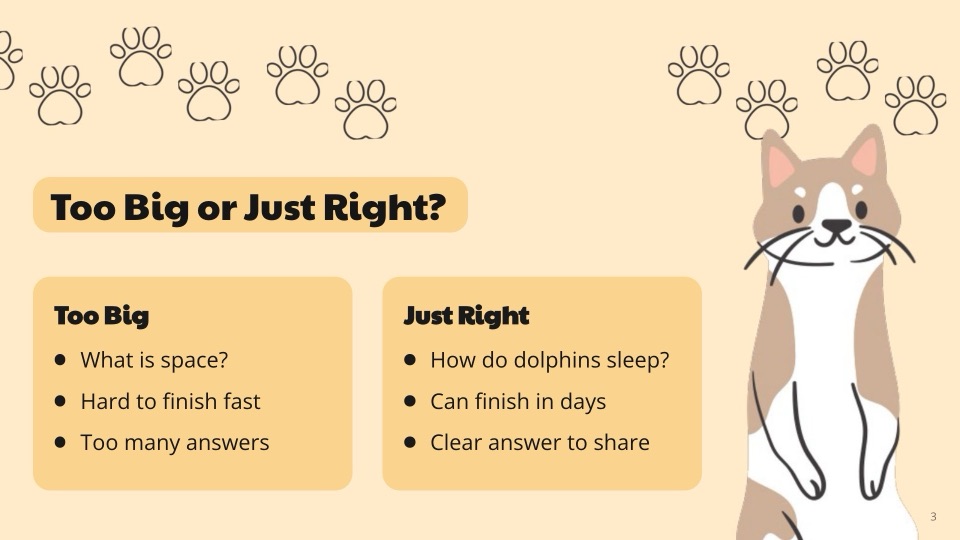
| 8 min | Starter | Hook curiosity and review what makes a research question too big or just right. Show Slide 1 Research Detectives: Build knowledge piece by piece and say the detective hook. Show Slide 2 Key words and chant research, investigation, source, aspect with meanings. Show Slide 3 Too Big or Just Right? and model thinking aloud for What is space? versus How do dolphins sleep? Cold-call students to vote thumbs up for just-right and thumbs down for too big. |
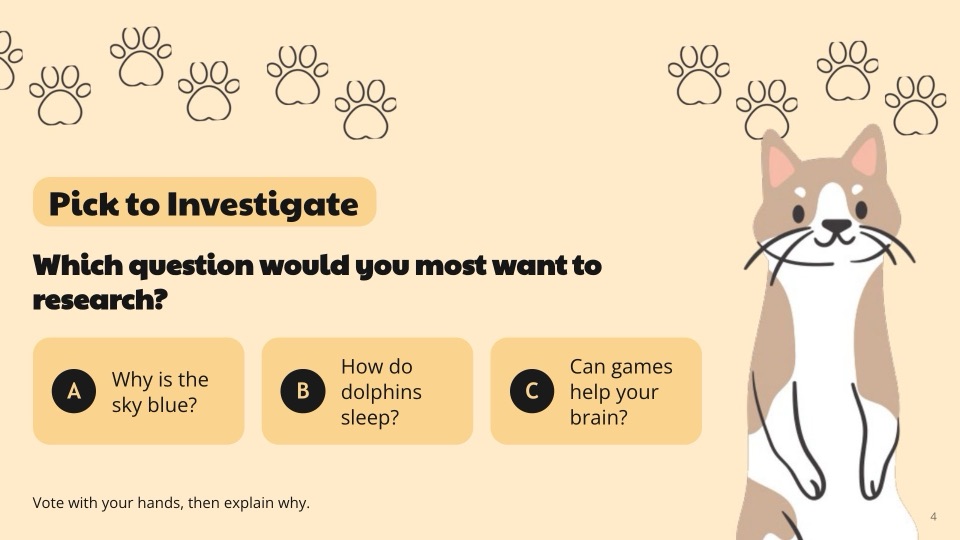
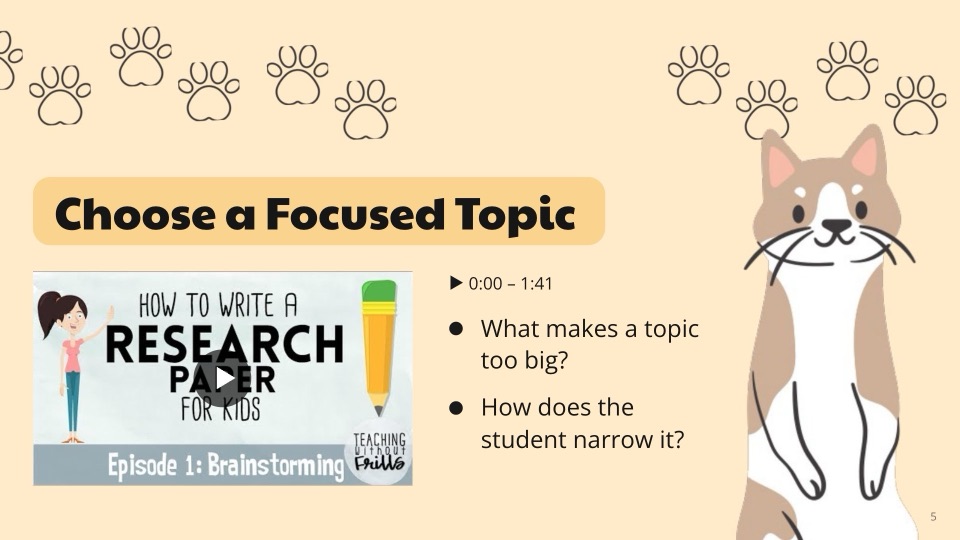
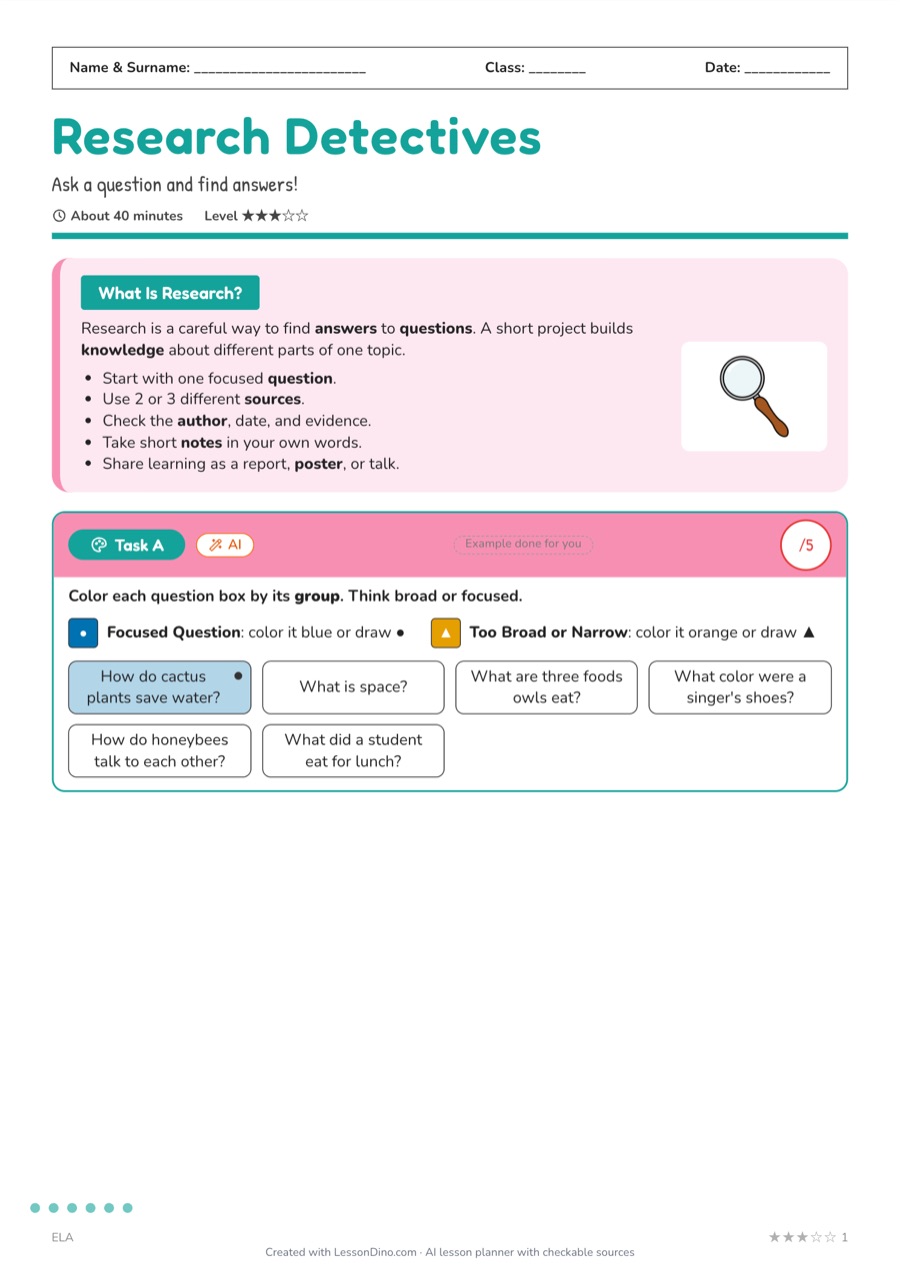
| 12 min | Teaching | Model how to pick a focused question and list aspects to investigate. Show Slide 4 Pick to Investigate and take a class vote on Why is the sky blue? How do dolphins sleep? Can games help your brain? Play Video clip 2 Brainstorming topics (0:00-1:41) on Slide 5 and pause to name what makes a topic too big. Do Worksheet Task A together: Color each question box by its group and think broad or focused. Model narrowing to dolphins and listing three aspects sleep, food, home to check. |
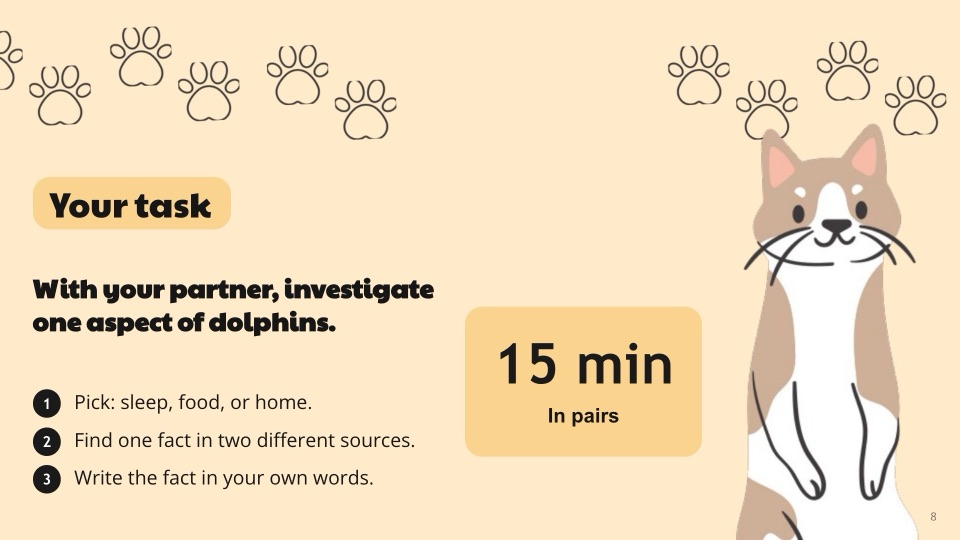
| 22 min | Main activity | Investigate one dolphin aspect using two sources and make an illustrated fact card. Show Slide 8 Your task and assign sleep, food, or home so the class covers three aspects. Model reading Source 1 book page and Source 2 printout, thinking aloud Who wrote this and Is it backed by evidence?. Hand out blank fact cards and Task E Picture-supported steps tracker and set a 15-minute timer. Circulate, prompt writing the fact in own words and ticking two sources used. |
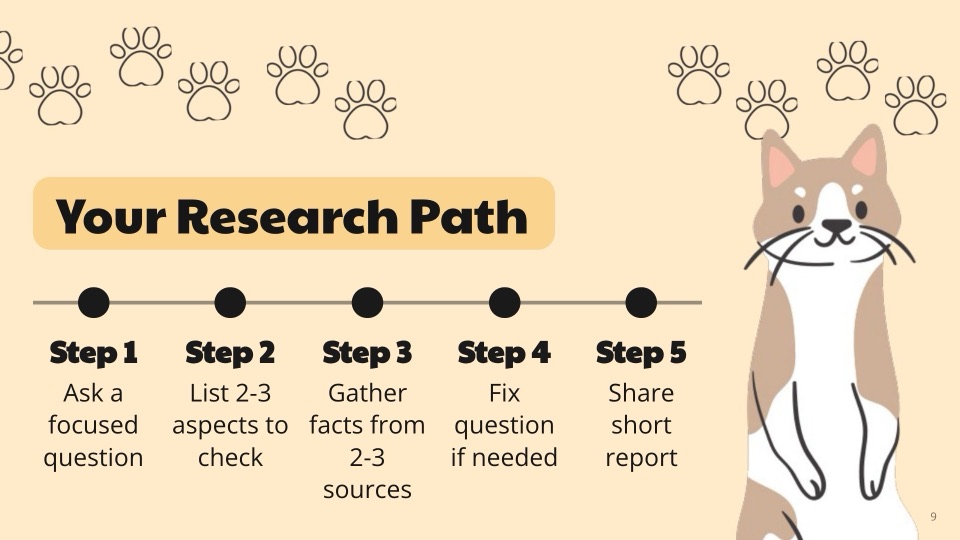
| 8 min | Share | Combine different aspects to build class knowledge of the topic. Show Slide 9 Your Research Path Step 1 to Step 5 and point to Gather facts from 2-3 sources and Share. Invite one sleep pair, one food pair, and one home pair to read their fact card in 60 seconds. Chart three boxes for sleep, food, home so students see investigation of different aspects. Ask what new question we could fix or ask next if facts did not match. |
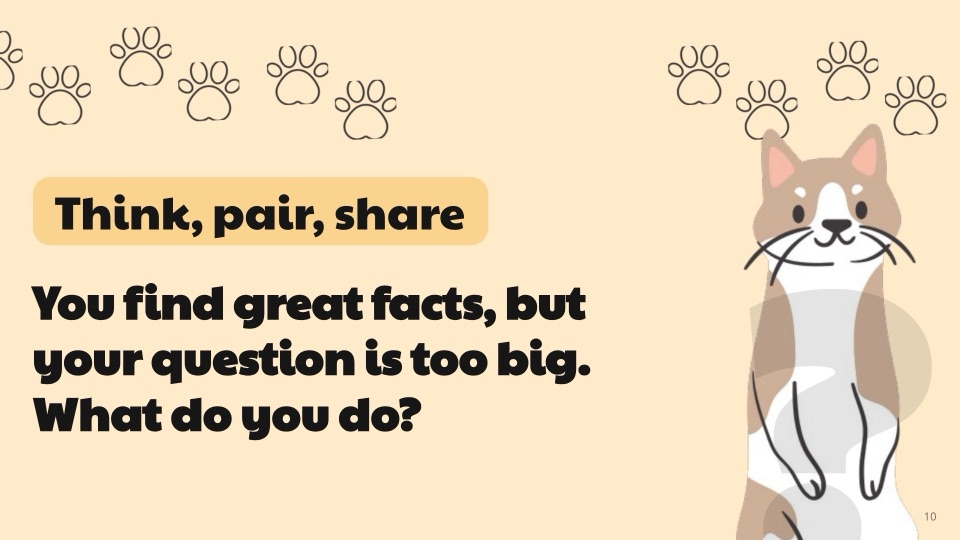
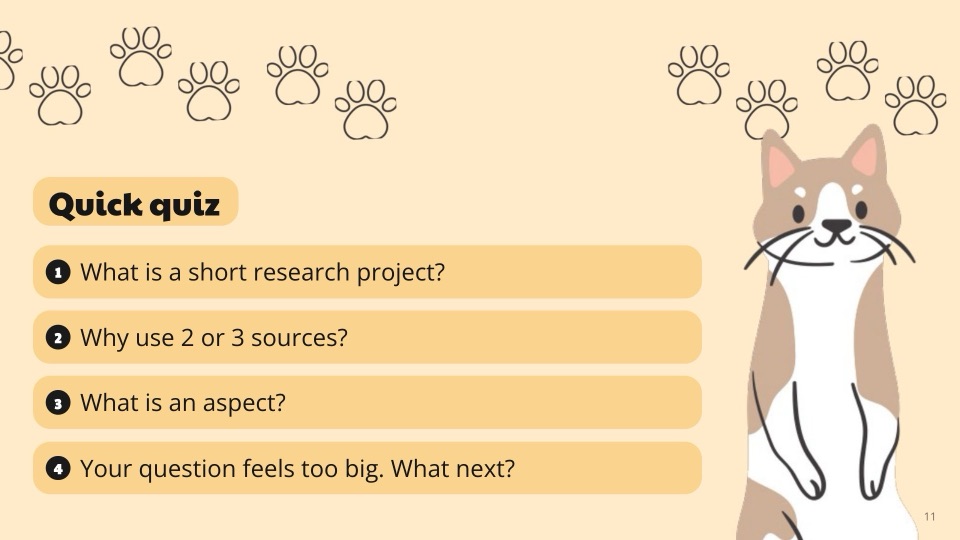
| 10 min | Plenary | Check understanding of short research steps and trustworthy sources. Show Slide 10 Think, pair, share: You find great facts, but your question is too big. What do you do? Show Slide 11 Quick quiz and ask What is a short research project and Why use 2 or 3 sources? Model fair conclusion: based on facts, not feelings, fair and unbiased. Give exit ticket on paper to collect. |
Common mistakes
- Using only one source for the answer
How to spot it: Fact card ticks only one source box
Require two ticks and ask how two sources help check facts and see angles. - Copying sentences word for word
How to spot it: Card words match Source 1 exactly
Cover source and retell in own words, then write; good work is organized and fair. - Picking a too-broad question like What is space?
How to spot it: Task A colors broad as focused
Narrow to one aspect like sleep, food, or home and retest can finish in days.
Support
- Sentence-starter cards and pre-marked facts to find and underline in sources
- Picture cues for Plan, Gather, Conclude and three-box fact template with one line per box
- Partner reading and walking through steps together with LSE checking ticks
Stretch
- Add a fourth fact that compares two sources and notes where they agreed
- Write a follow-up question for a gap and list what source would answer it next
- Add Sources Used strip with one sentence about what each source added
Check questions
- What is a short research project?
Answer: Short hunt that builds knowledge about a topic. - Why use 2 or 3 sources?
Answer: To check facts and see different sides. - Your question is too big. What do you do?
Answer: Fix or narrow it to one aspect like sleep, food, or home.
Curriculum
Conduct short research projects that build knowledge through investigation of different aspects of a topic.
Video clips
Clips on YouTube, from the start and end times we chose. Check each one before you show it.
-
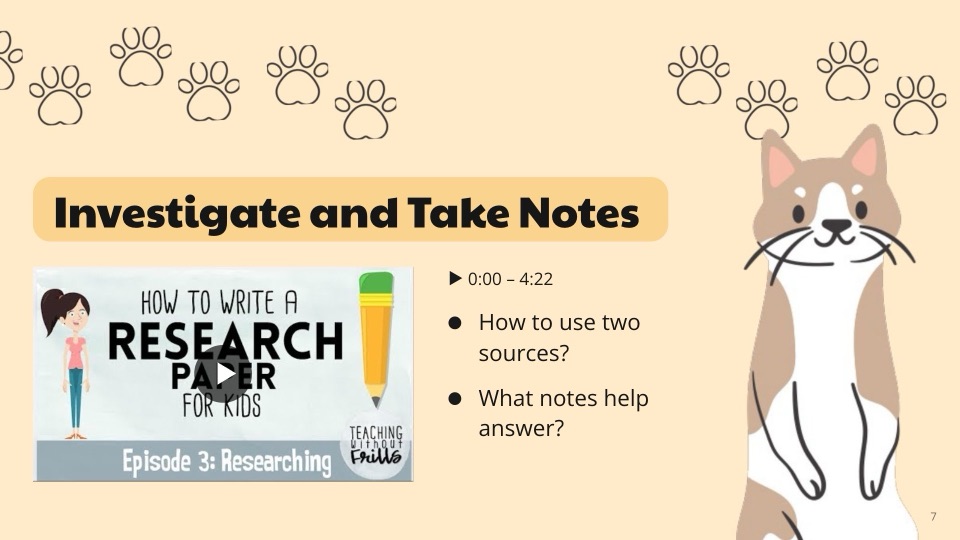
Researching your topic from 0:00 to 4:22
Teaching Without Frills: How to Write a Research Paper for Kids - Episode 3: Researching
Shows the investigating and note-taking step of a short research project with vocabulary and pace ideal for ages 9-10.
-
Brainstorming topics from 0:00 to 1:41
Teaching Without Frills: How to Write a Research Paper for Kids Episode 1: Brainstorming Topics
Models how to choose a focused topic for a short research project in a style perfect for Grade 4 ages 9-10.
Worksheet
Sources
- Standards::Conduct short research projects that build ... learninglab.si.edu
- ELA Grade 4 - Chicago Public Schools cps.edu
- Short-Term Research Project Ideas - University of Pennsylvania cis.upenn.edu
- Short-Term Opportunities | Office of Medical Student Research med.unc.edu
- Research Projects | NYU School of Global Public Health publichealth.nyu.edu
- Short Research Projects: Definition, Significance and ... edu.com
- CCSS.ELA-Literacy.W.4.7 Conduct Short Research Projects That ... internet4classrooms.com
- Conducting Short Research Projects | Varsity Tutors varsitytutors.com
- Analysing, interpreting and research reports - Planning and ... bbc.co.uk
- Primary research - Planning and organisation - WBQ National ... bbc.co.uk
- Research Facts for Kids kids.kiddle.co
- Kids science: Projects and Experiments - Ducksters ducksters.com
- W.3.7 — Conduct short research projects that build knowledge ... afterschool.network
Picture credits
- Photo: sasint · Pixabay
- Pictograms: Sergio Palao, ARASAAC (arasaac.org) · CC BY-NC-SA
- Drawing: JasonCarswell · CC BY-SA 4.0 · Wikimedia Commons
Made with Lesson Dino's AI on 17 October 2026. AI can make mistakes, so check facts against the sources before you teach.