Slides
Lesson plan
Finding the Theme in Four Boxes
Students learn to find a story theme from details. They draw a four-box summary and state its big message.
Objectives
- Students will determine a story theme using key details from the text.
- Students will summarize a story briefly in order from beginning to end.
Success criteria
- I can retell the main parts of a story in short order.
- I can state the theme and show details that prove it.
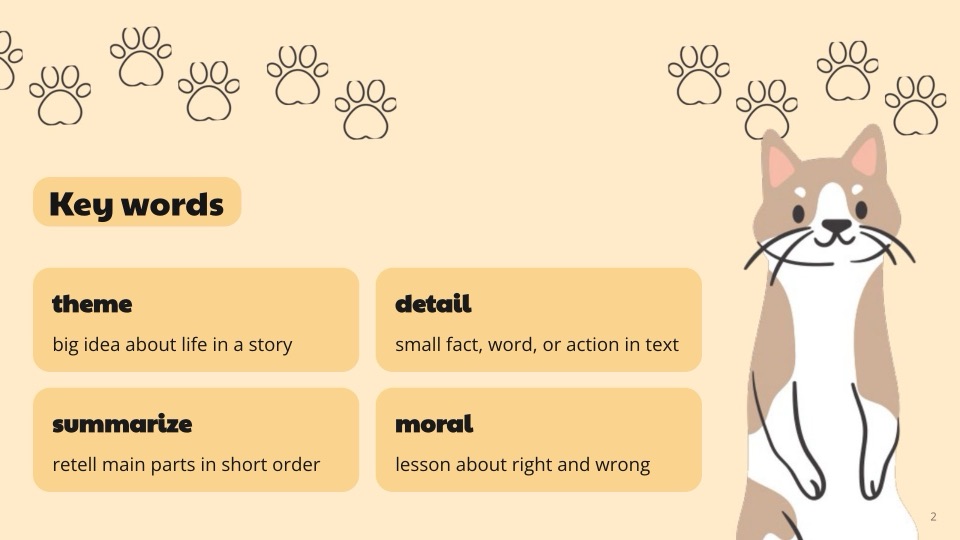
Key words
| Word | Meaning |
|---|---|
| theme | big idea about life that a story shows |
| detail | small fact, word, or action in the writing |
| summarize | retell only the main parts in short order |
| moral | lesson about right and wrong choice |
Timed plan (60 minutes)
| Time | Stage | What happens |
|---|---|---|
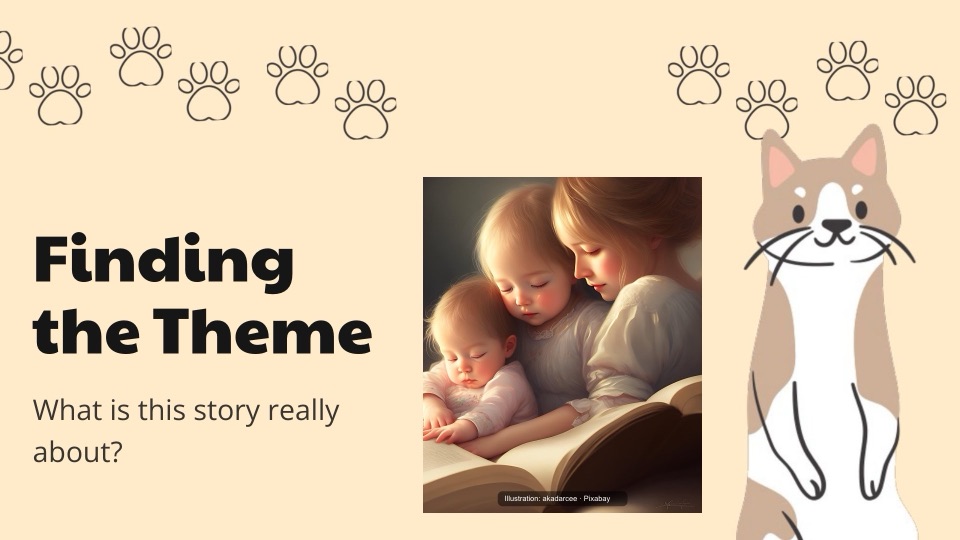
| 7 min | Starter | To hook interest and recall what theme and summarize mean. Show Slide 1: Finding the Theme: What is this story really about? Say the hook and hold up a blank 4-box comic. Show Slide 2 key words and ask students to explain theme, detail, and summarize. Preview that pairs will shrink a story into 4 boxes and find its message. |
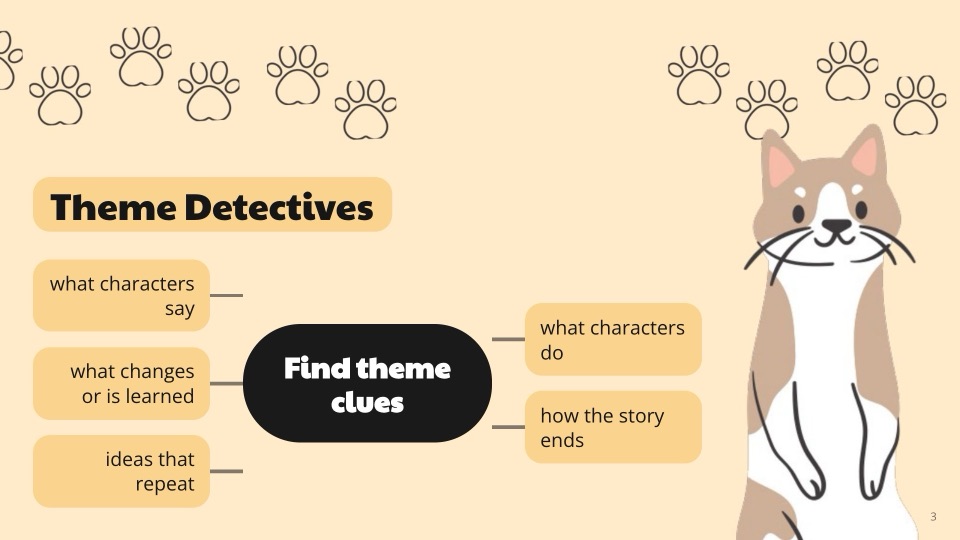
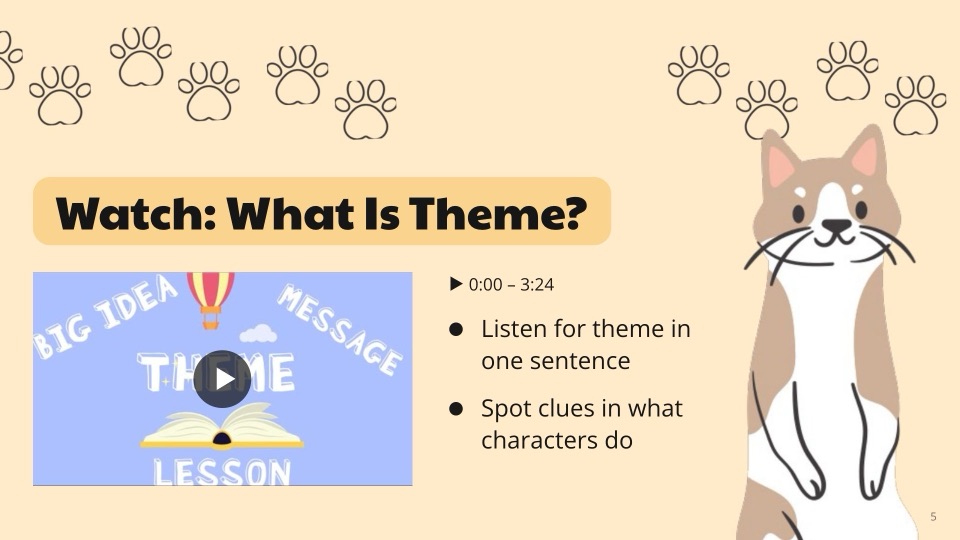
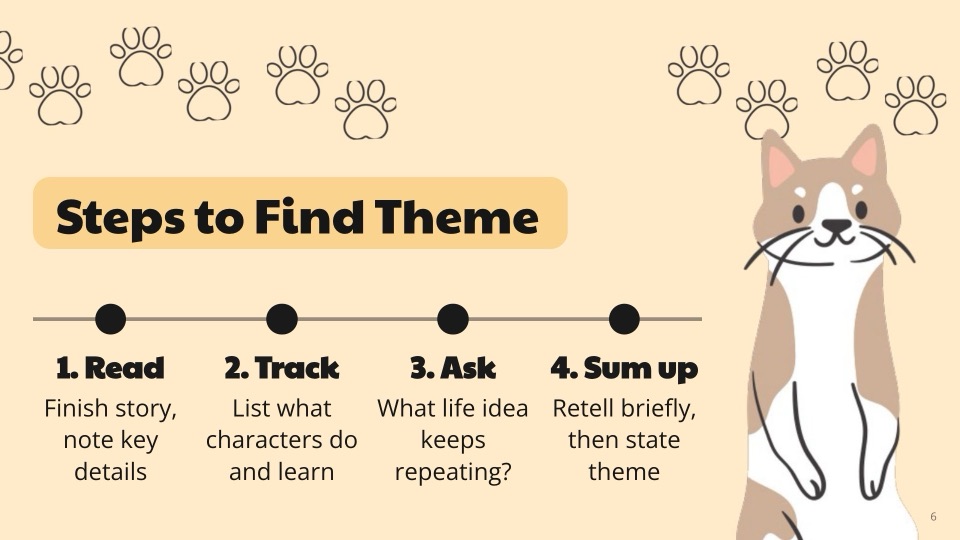
| 12 min | Teaching | To teach what theme is and where to look for clues. Show Slide 3 mindmap and explain 5 clue places: what characters say and do, what changes, how it ends, ideas that repeat. Play Slide 5 video to model theme in one sentence and clues in what characters do. Show Slide 6 Steps to Find Theme: Read, Track, Ask. Think aloud how characters pursuing goals reveals the bigger issue. |
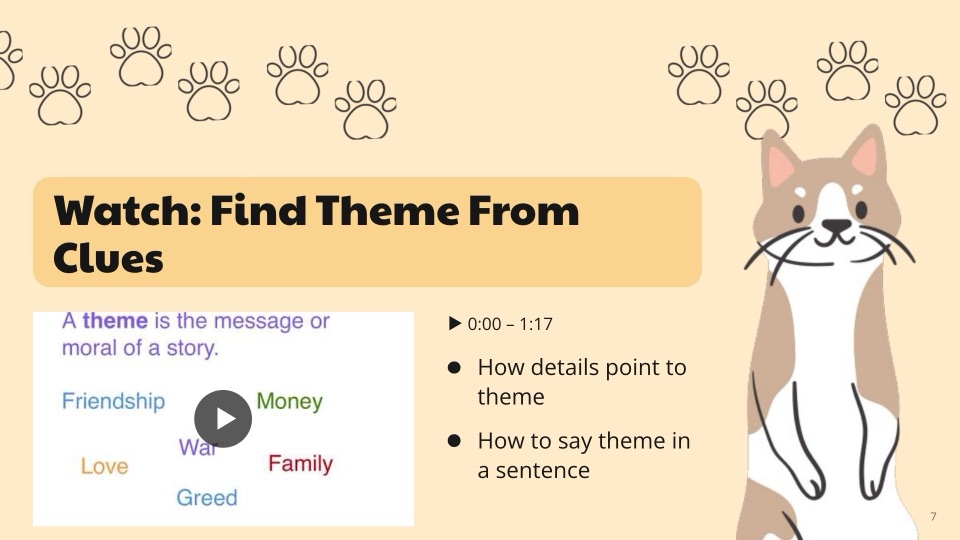
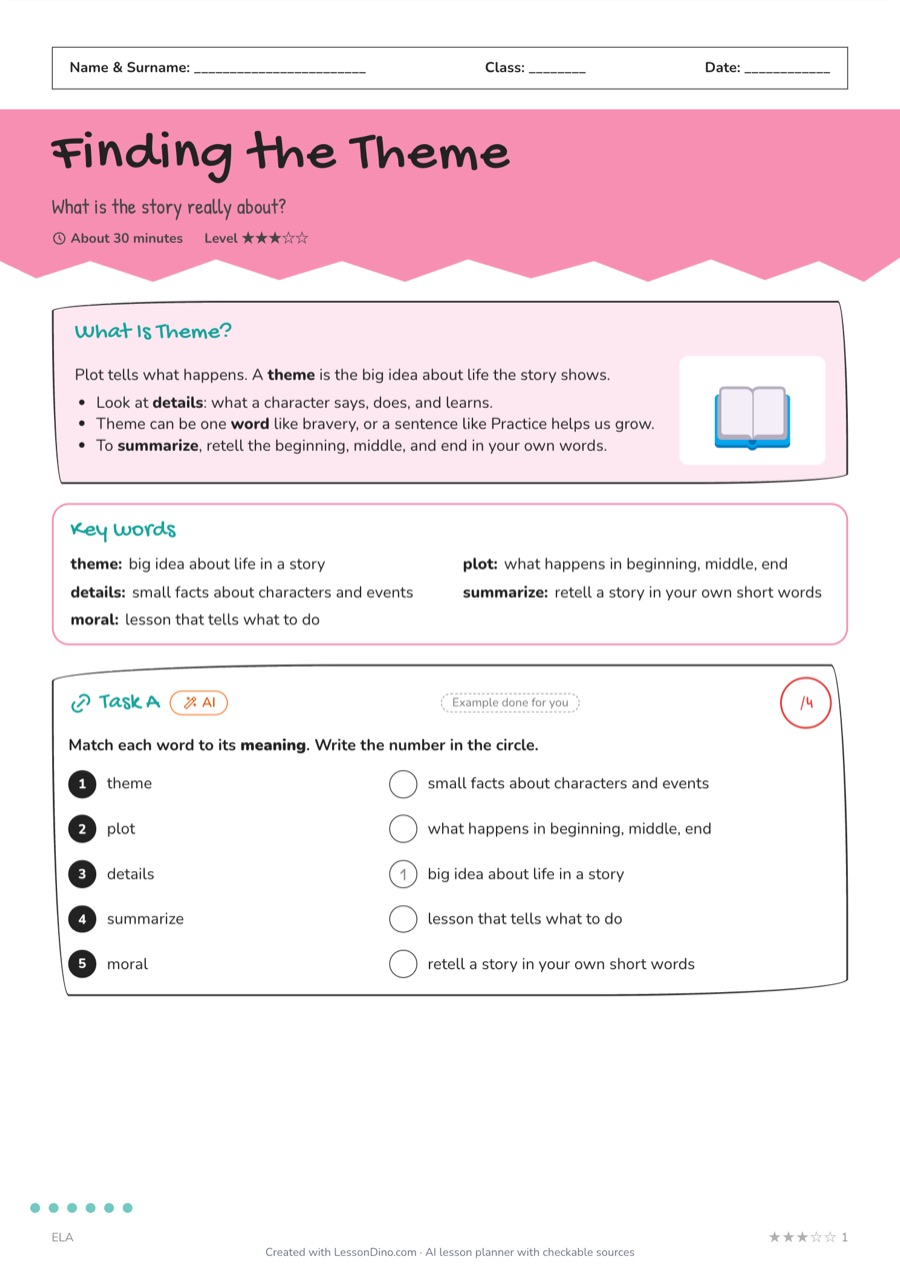
| 11 min | Guided practice | To model summarizing then stating theme together. Read aloud Passage The Long Practice paragraphs 1-4 with class following. Play Slide 7 video to model how details point to theme and how to say theme in a sentence. Model a short summary in order, then ask what life idea keeps repeating. Do Worksheet Task F together to order the 4 steps for finding theme. |
| 20 min | Main activity | To summarize a story in comics and prove its theme with details. Give each pair comic strip paper, pencils, crayons and Passage The Broken Wagon. Direct pairs to read paragraphs 1-4 and draw Worksheet Task B: 4-box summary in order with one short sentence under each. Direct pairs to do Worksheet Task C: finish frame, then add a speech bubble for theme in one full sentence. Circulate, ask which box gave best clue, and prompt proof with two details. |
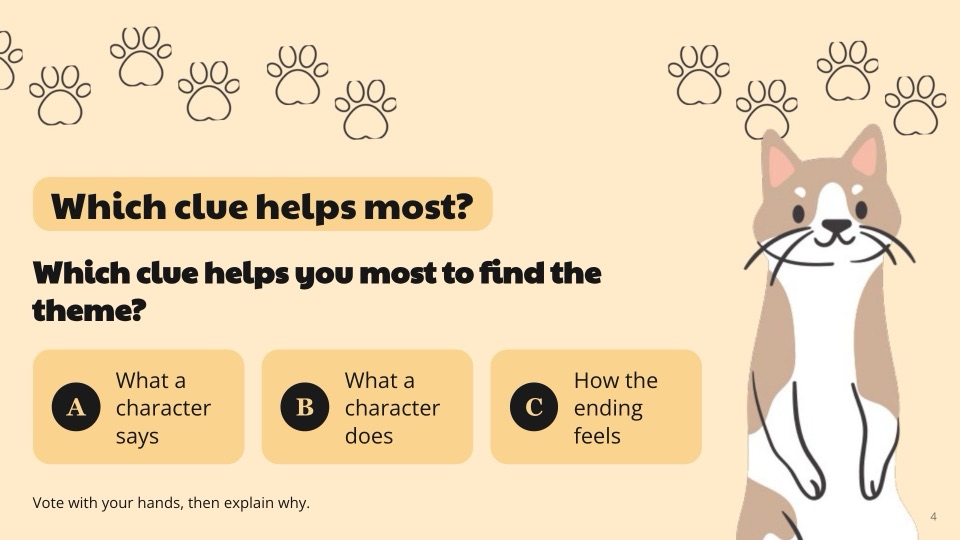
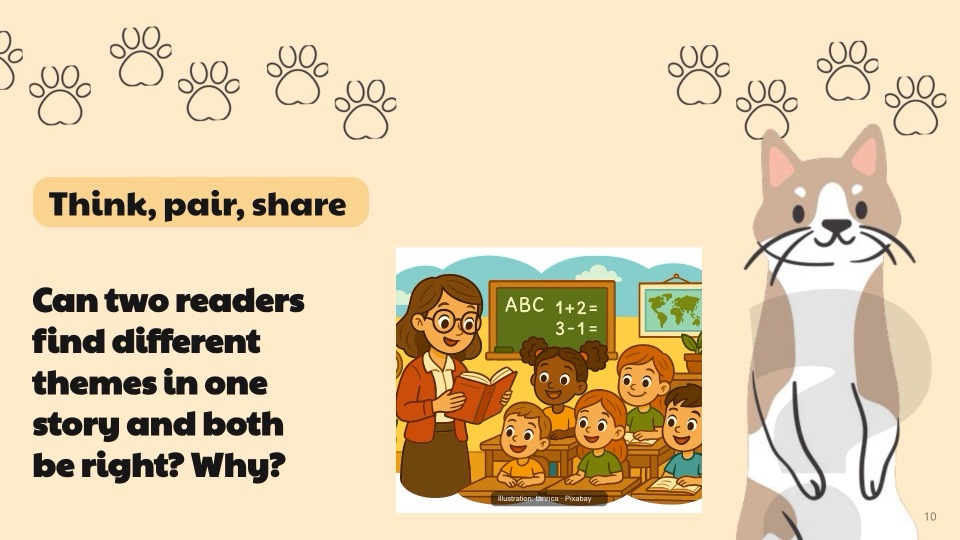
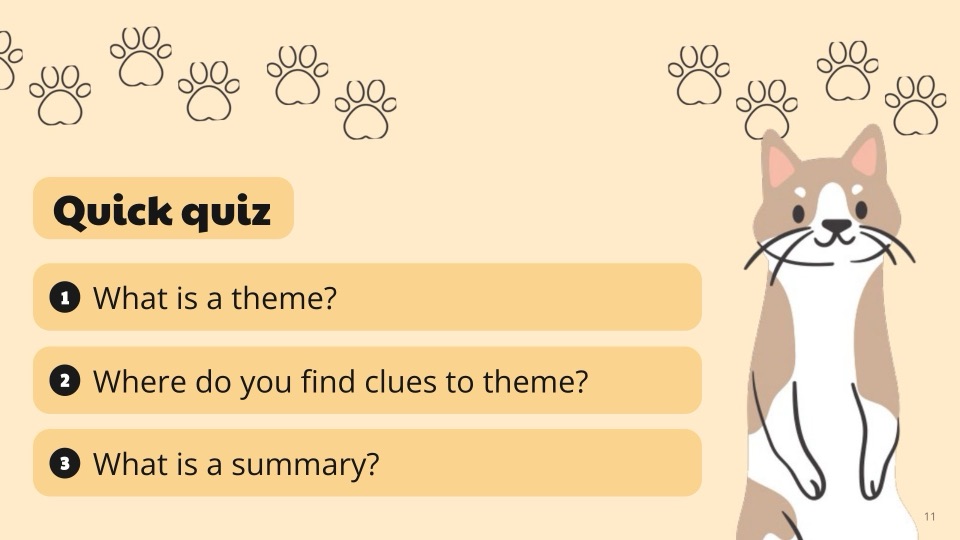
| 10 min | Plenary | To compare themes and check summary and theme understanding. Display 2-3 comics and ask class to link setting and actions to theme; an isolated place can highlight loneliness and hard work can highlight perseverance. Show Slide 10 question and lead think, pair, share on different themes being right. Show Slide 11 quick quiz on what theme is and where clues are found. Restate objectives and collect comics with Task B-C. |
Common mistakes
- Writing a topic word like friendship instead of a theme message
How to spot it: Bookmark or bubble has one word with no message
Stretch concept into statement: a concept is a word, a statement is a full sentence; add what story says about friendship. - Writing a summary retell instead of theme
How to spot it: Answer only tells what happened in order with no life idea
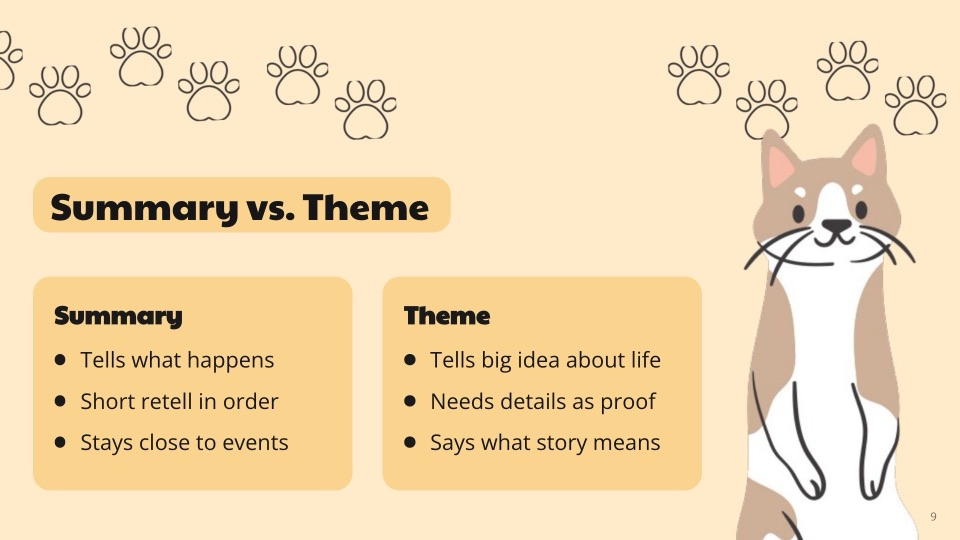
Use Slide 9 compare: summary tells what happens, theme tells big idea; ask What did characters learn about life? - Using one detail or no proof for theme
How to spot it: Theme sentence has no underlined repeat or action linked
Hunt for repeated ideas and character actions that infer theme; add two short details as proof.
Support
- Use 3-sentence summary frame: Someone wanted ___, then ___, in the end ___.
- Pre-highlight one repeated feeling or action to model hunting repeats.
- Provide word bank: friendship, honesty, teamwork, perseverance and theme frame: This story shows that ___ because ___.
Stretch
- Add a title that hints at the theme without giving away the ending.
- Add best proving detail and explain why it fits strongest.
- Compare two theme ideas and choose which has stronger text details.
Check questions
- What is a theme in one sentence?
Answer: The big idea about life in a story. - Summarize The Broken Wagon in one short sentence in order.
Answer: A sister and brother fixed their broken wagon together and it rolled again. - State one theme of The Broken Wagon with one detail as proof.
Answer: Working together makes hard jobs easier because they held, tightened, and shared work.
Curriculum
Determine a theme of a story, drama, or poem from details in the text; summarize the text.
Video clips
Clips on YouTube, from the start and end times we chose. Check each one before you show it.
-
What Is Theme? Grades 3-5 from 0:00 to 3:24
Ms. Andy: What Is Theme? | Understanding Theme in Stories for Kids (Grades 3-5
Made specifically for grades 3-5 so vocabulary, examples, and pace are perfect for 9-10-year-olds learning theme.
-
Determine the theme from 0:00 to 1:17
Freckle by Renaissance: Determine the theme of the story
From a trusted school practice channel and at Grade 4 level, so it directly models finding theme from details for 9-10-year-olds.
Worksheet
Sources
- Grade 4: Using Literary Elements to Determine Theme - CT.gov portal.ct.gov
- English Language Arts cps.edu
- What is a Theme in Literature? || Oregon State Guide to Literary Terms ... liberalarts.oregonstate.edu
- How To Find The Theme Of A Story - southernwv.edu staging.southernwv.edu
- A Writer's Handbook: Theme Analysis Idea Development library.jeffersonstate.edu
- Theme (narrative) Facts for Kids kids.kiddle.co
- Identifying themes in texts - English - Learning with BBC Bitesize bbc.co.uk
- Investigating themes in fiction guide for KS3 English students - BBC bbc.co.uk
- Finding the theme of a story | Guided practice - Khan Academy khanacademy.org
- What Is the Theme of a Story? Definition + How to Find It spines.com
Picture credits
- Illustration: akadarcee · Pixabay
- Illustration: tanrıca · Pixabay
- Microsoft Fluent Emoji (MIT)
Made with Lesson Dino's AI on 16 October 2026. AI can make mistakes, so check facts against the sources before you teach.