Slides
Lesson plan
Whose Shoes Are You In?
Students learn to separate my view from the narrator's view and characters' views. They move, sort clues, and explain whose thought each line shows.
Objectives
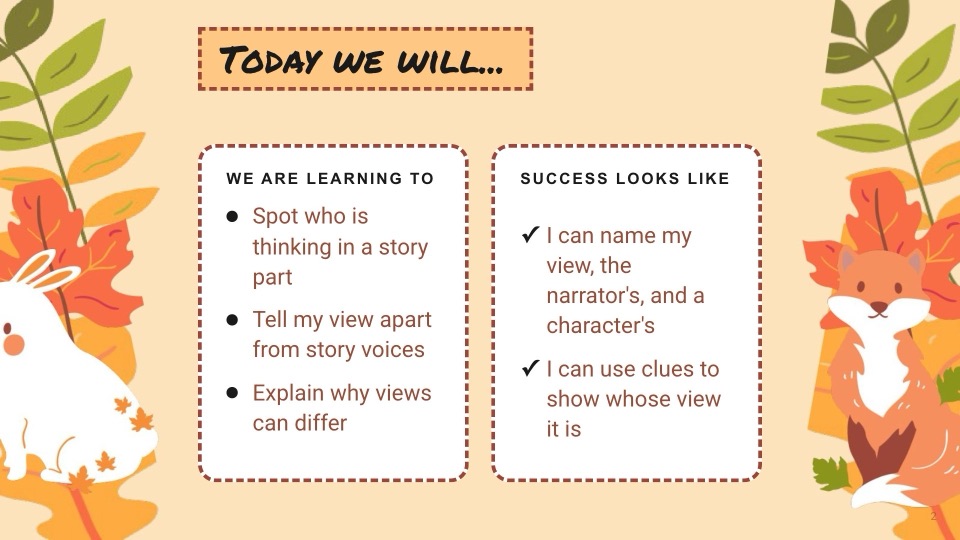
- Students will tell apart my view, the narrator view, and character views.
- Students will use I, you, he, she, they clues to find who thinks.
- Students will state my own view apart from story views with reasons.
Success criteria
- I can name my view, the narrator view, and a character view.
- I can use word clues to show whose thought it is.
- I can tell my view apart from story views and why.
Key words
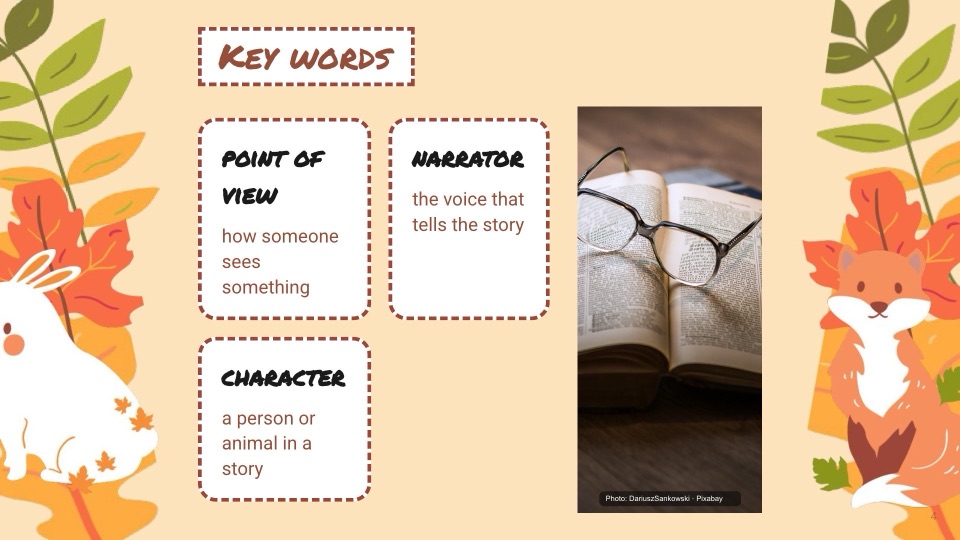
| Word | Meaning |
|---|---|
| point of view | how someone sees or thinks about something |
| narrator | the voice that tells the story |
| character | a person or animal in a story |
| clue | a small word or sign that helps you decide |
Timed plan (60 minutes)
| Time | Stage | What happens |
|---|---|---|
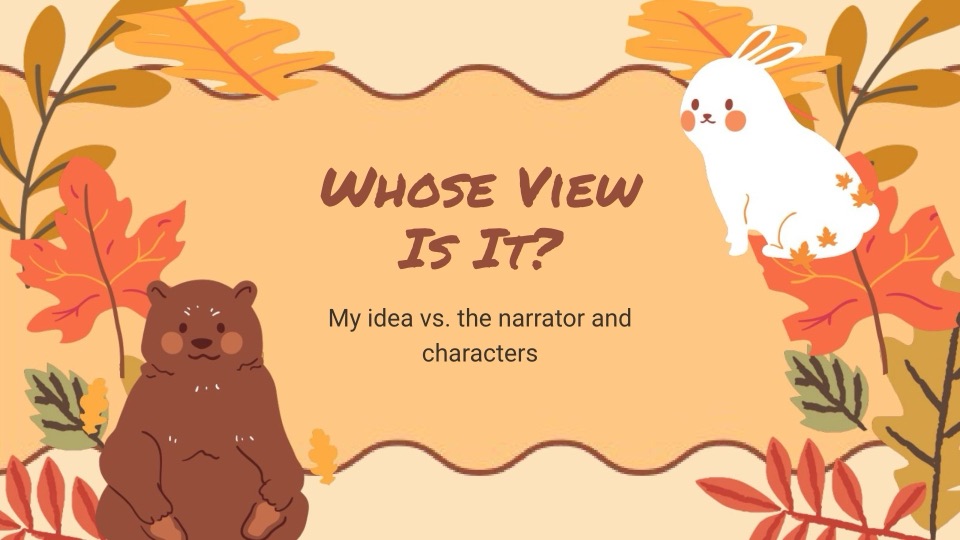
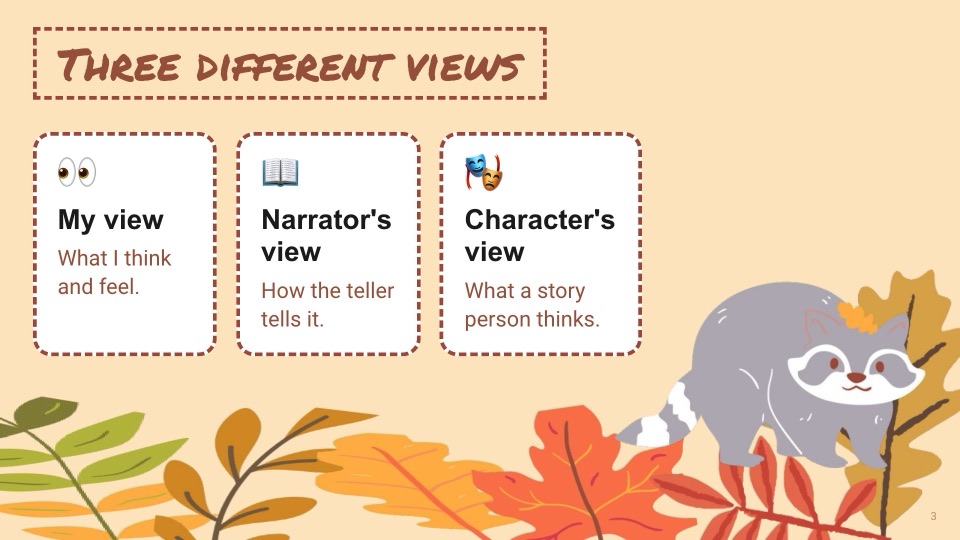
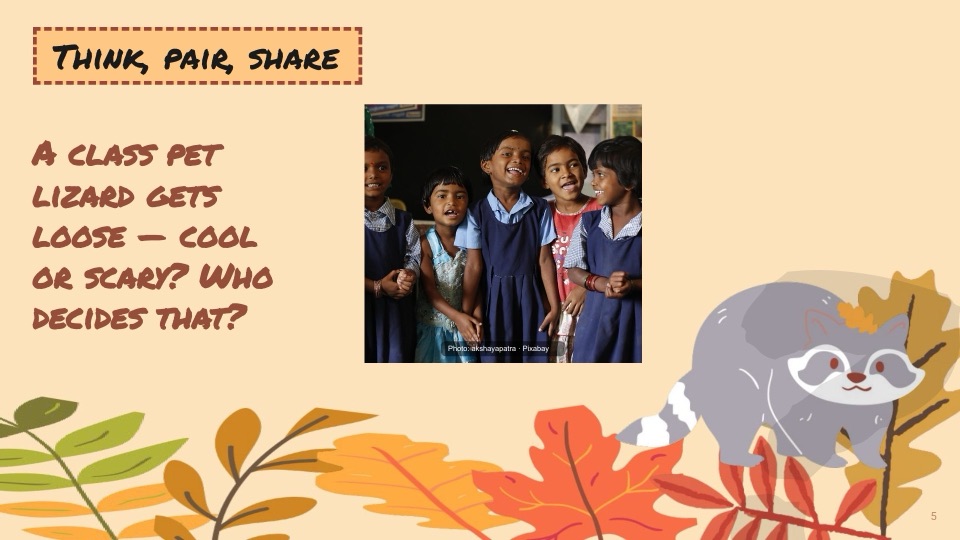
| 5 min | Starter | To hook interest and show that my view, narrator view, and character view can differ. Show Slide 1 Whose View Is It? and Slide 3 cards for My view, Narrator's view, Character's view. Say the hook and point to the three corner signs. Read two quick lines: I think a loose lizard is cool. The kids stared at the tank. Ask students to point to Me, Narrator, or Character for each line. |
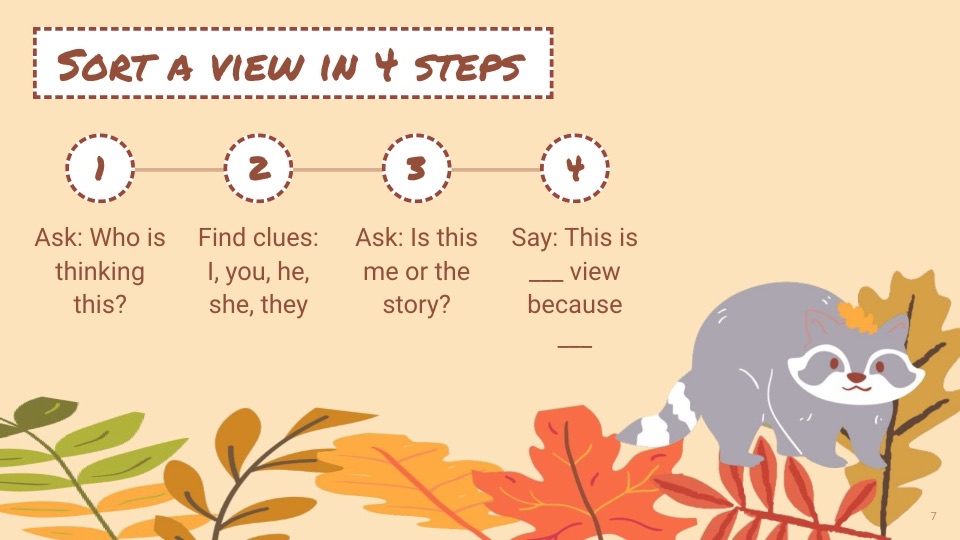
| 10 min | Teaching | To teach the three views and the 4-step clue routine with a model. Show Slide 4 Key words and read meanings together. Show Slide 7 Sort a view in 4 steps and teach pronoun clues. Model with paragraph 1 of The Stuck Kite using think-aloud. Chart the model answer as This is narrator view because. |
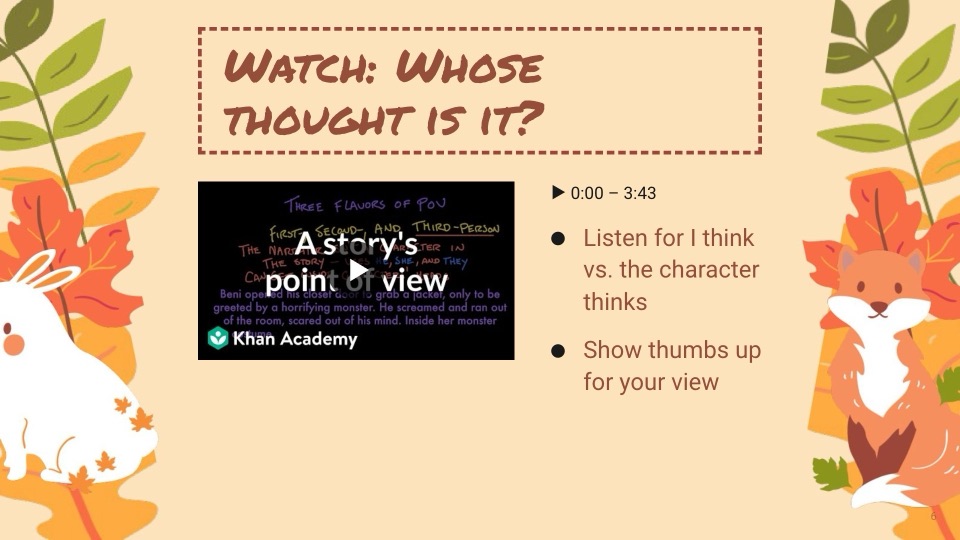
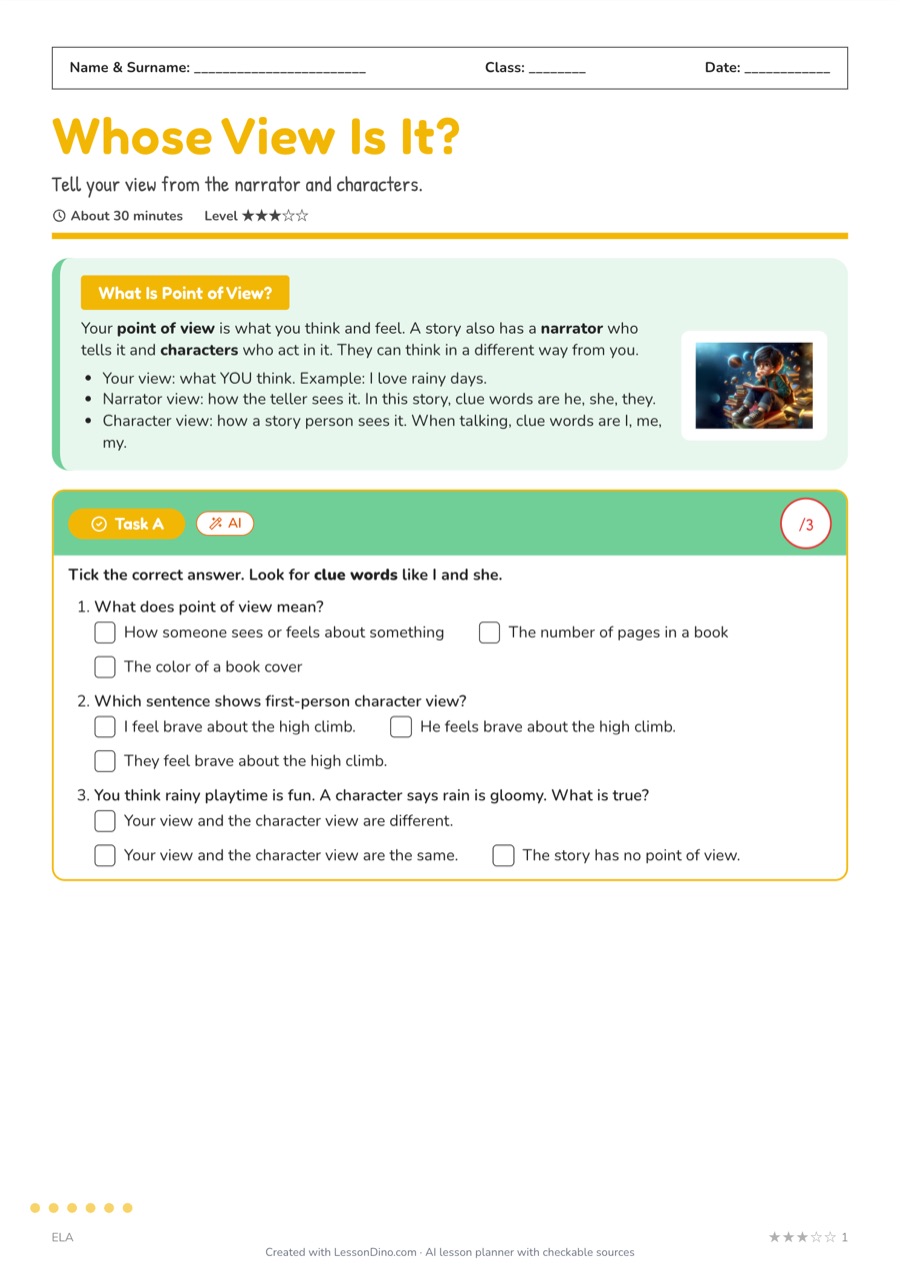
| 15 min | Guided practice | To practice spotting whose thought it is with video and clue sorting. Show Slide 6 and play Video clip 1 (0:00-3:43) a story's point of view. Pause twice to ask Listen for I think vs. the character thinks with thumbs up for your view. Hand out Worksheet Task A multiple choice and read directions together. Review answers by asking for clue words like I and she. |
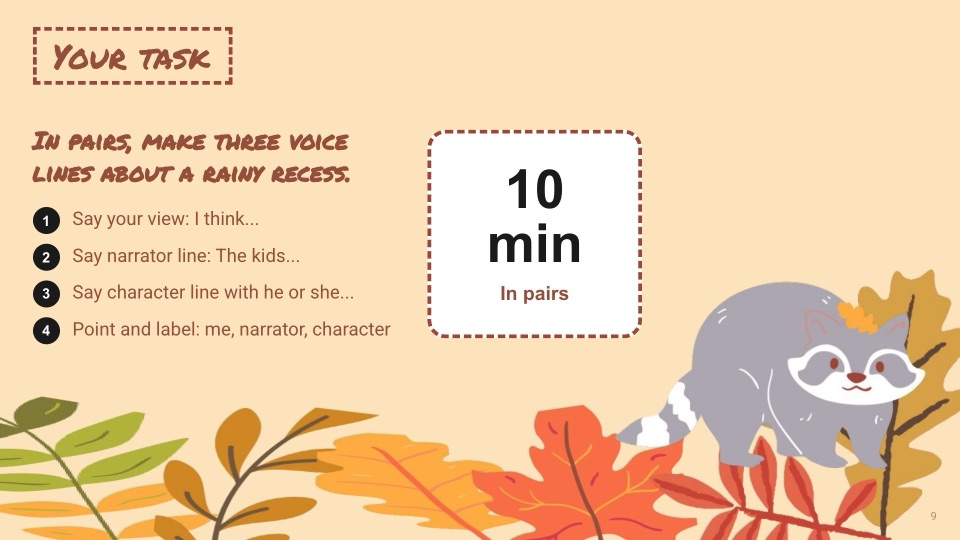
| 20 min | Main activity | To show if an idea belongs to me, the narrator, or a character using movement and pairs. Clear walkways and remind class to walk do not run between corners. Read six lines from The Stuck Kite paragraphs 2 and 3 for Me, Narrator, Character corners. Ask two students at each corner to explain why they chose Me, Narrator, or Character. Move pairs to seats for Worksheet Task D causes and effects using paragraphs 2 and 3. |
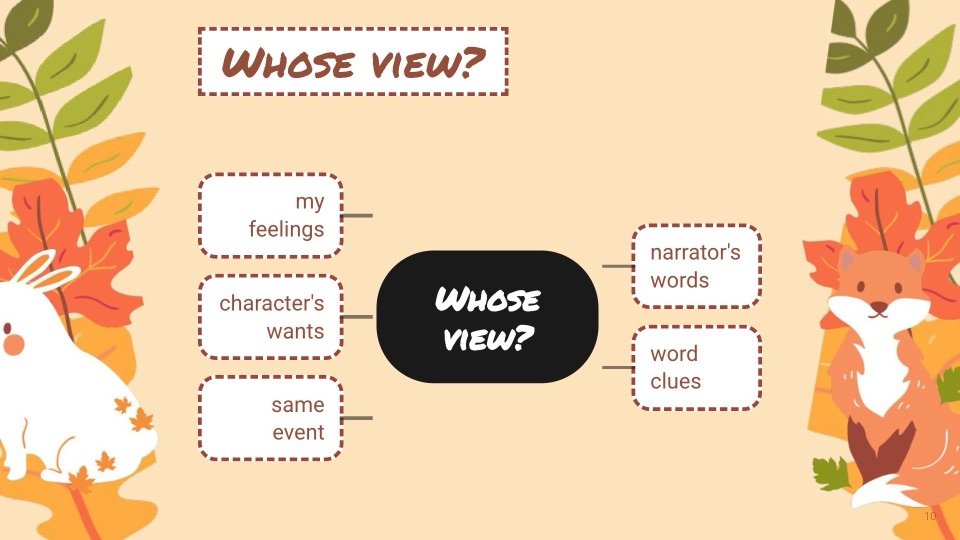
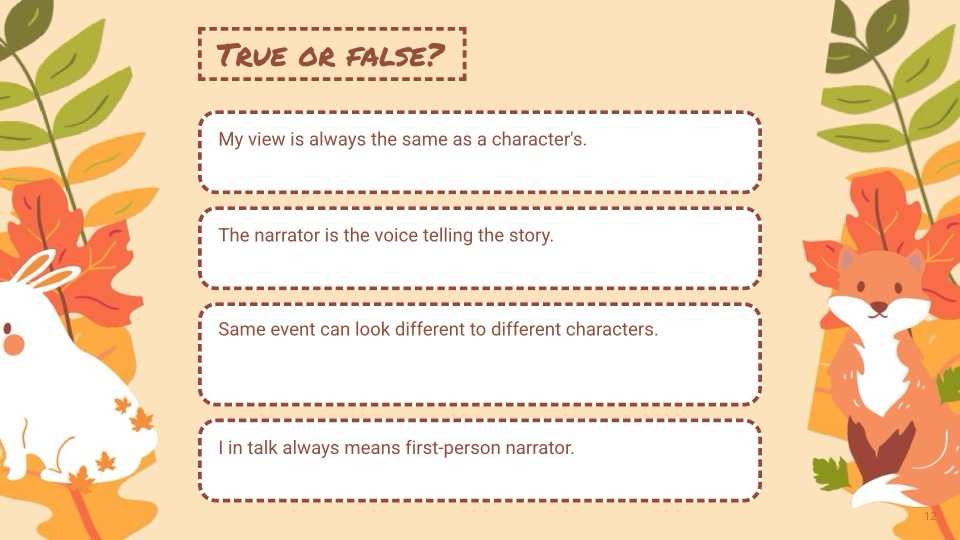
| 10 min | Plenary | To check that students can tell my view apart from narrator and character views. Show Slide 12 True or false and read each line together. Ask students to show true with thumbs up and false with thumbs down. Return to Slide 2 objectives and have students say I can lines. Give exit ticket on paper with three quick questions. |
Common mistakes
- Thinking if a character says I in talking, the whole story is first-person.
How to spot it: Student picks first-person when narration uses she but talking has I.
Color narration yellow and talking blue, then ask who is narrating versus who is speaking. - Thinking my view must match the brave or scared character's view.
How to spot it: Student copies character feeling instead of stating own different view.
Use two lines: My point of view is ___ because ___. The character view is ___. Views differ because experiences shape views. - Mixing up he-she-they clues and calling narrator lines mine.
How to spot it: Student goes to Me corner for The narrator feels calm lines.
Ask Is this me or the story? Find I, you, he, she, they, then say This is _ view because _.
Support
- Pair students to move and decide together with I-equals-me card
- Pre-underline pronouns and pre-draw charts with feeling choices
- Sentence frames for My view, Narrator view, and Character view
Stretch
- Explain what the narrator knows that one character does not know
- Add a second reason with because, since, or for example
- Rewrite one narration sentence as if the character told it with I
Check questions
- Line: I feel scared up high! Whose view is this and how do you know?
Answer: Character view, uses I about self and worried feeling. - Line: The narrator feels calm and thinks the problem can be fixed. Whose view?
Answer: Narrator view, outside teller uses calm thought about both. - What is your view of climbing for the kite, different from one character?
Answer: My view is ___ because ___; it can differ from story people.
Curriculum
Distinguish their own point of view from that of the narrator or those of the characters.
Video clips
Clips on YouTube, from the start and end times we chose. Check each one before you show it.
-
a story's point of view from 0:00 to 3:43
Khan Academy: A story's point of view | Reading | Khan Academy
Perfect for ages 8-9 with clear, kid-friendly examples of what the reader thinks versus what the narrator and characters think.
-
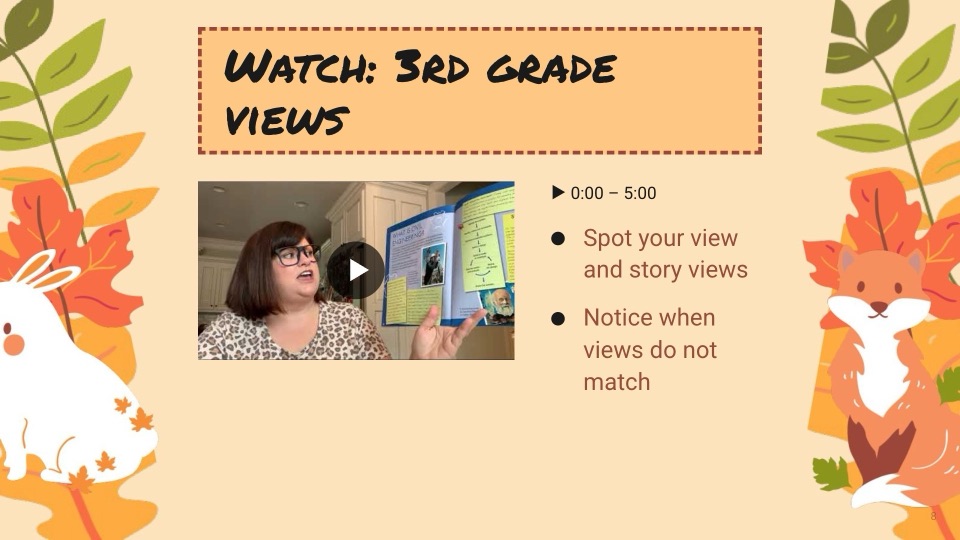
3rd grade point of view lesson from 0:00 to 5:00
Tonya Painter: Point Of View | ELA 3rd Grade
Made specifically for 3rd grade ages 8-9 and models how to tell your own view apart from the narrator's and characters' views.
Worksheet
Sources
- College and Career Readiness Anchor Standards for Reading thecorestandards.org
- English Language Arts Standards » Writing » Grade 3 thecorestandards.org
- What is Point of View? || Definition and Examples | College ... liberalarts.oregonstate.edu
- LibGuides: Grammar and Punctuation Rules: Point of View library.csp.edu
- Point of View - Del Mar College delmar.edu
- Point of View in Academic Writing | Tutoring Resources stlcc.edu
- Developing a Point of View - Stanford University web.stanford.edu
- Point of view - Creative writing - National 4 English ... - BBC bbc.co.uk
- Point of view Facts for Kids kids.kiddle.co
- Point of view (philosophy) Facts for Kids kids.kiddle.co
- A Point of View: Why Donald Trump and Bernie Sanders aren't as r… bbc.com
- A Point of View - It's all right for you - BBC Sounds bbc.co.uk
- Fourth Person Point Of View Explained With Examples justpublishingadvice.com
- Helpful Point of View Examples in Children’s Books imaginationsoup.net
- How to Teach Point of View - kristinenannini.com kristinenannini.com
- Who’s Talking? How to Teach Point of View in Reading - ELA Vibes elavibes.co
- The Complete Guide to Teaching Point of View and Perspective teachingwithamountainview.com
- Point of View: Patience, please — waiting for cancer surgery dur… cbc.ca
Picture credits
- Photo: DariuszSankowski · Pixabay
- Photo: DariuszSankowski · Pixabay
- Photo: akshayapatra · Pixabay
- Photo: Manne1409 · Pixabay
- Illustration: hobim · Pixabay
- Picture: unknown · CC0 · rawpixel via Openverse
- Picture: unknown · CC0 · rawpixel via Openverse
- Illustration: TyliJura · Pixabay
- Drawing: Google · Apache License 2.0 · Wikimedia Commons
Made with Lesson Dino's AI on 17 October 2026. AI can make mistakes, so check facts against the sources before you teach.