Slides
Lesson plan
My Amazing Beginning, Middle, and End Story
Students learn to order real or imagined events and add talking and senses details. They plan on a story mountain and write a short mini-narrative.
Objectives
- Students will order real or imagined events in a clear beginning, middle, and end.
- Students will use talking and senses words to develop experiences and events.
Success criteria
- I can put my story events in order with first, next, and last.
- I can tell if my narrative is real or imagined.
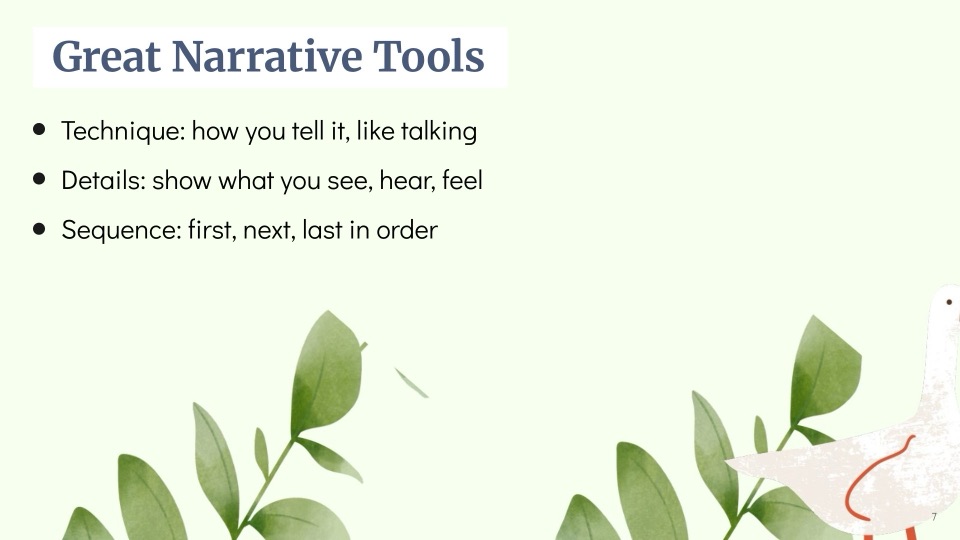
- I can add talking and what I see, hear, and feel.
Key words
| Word | Meaning |
|---|---|
| narrative | a story about things that happened, real or made up |
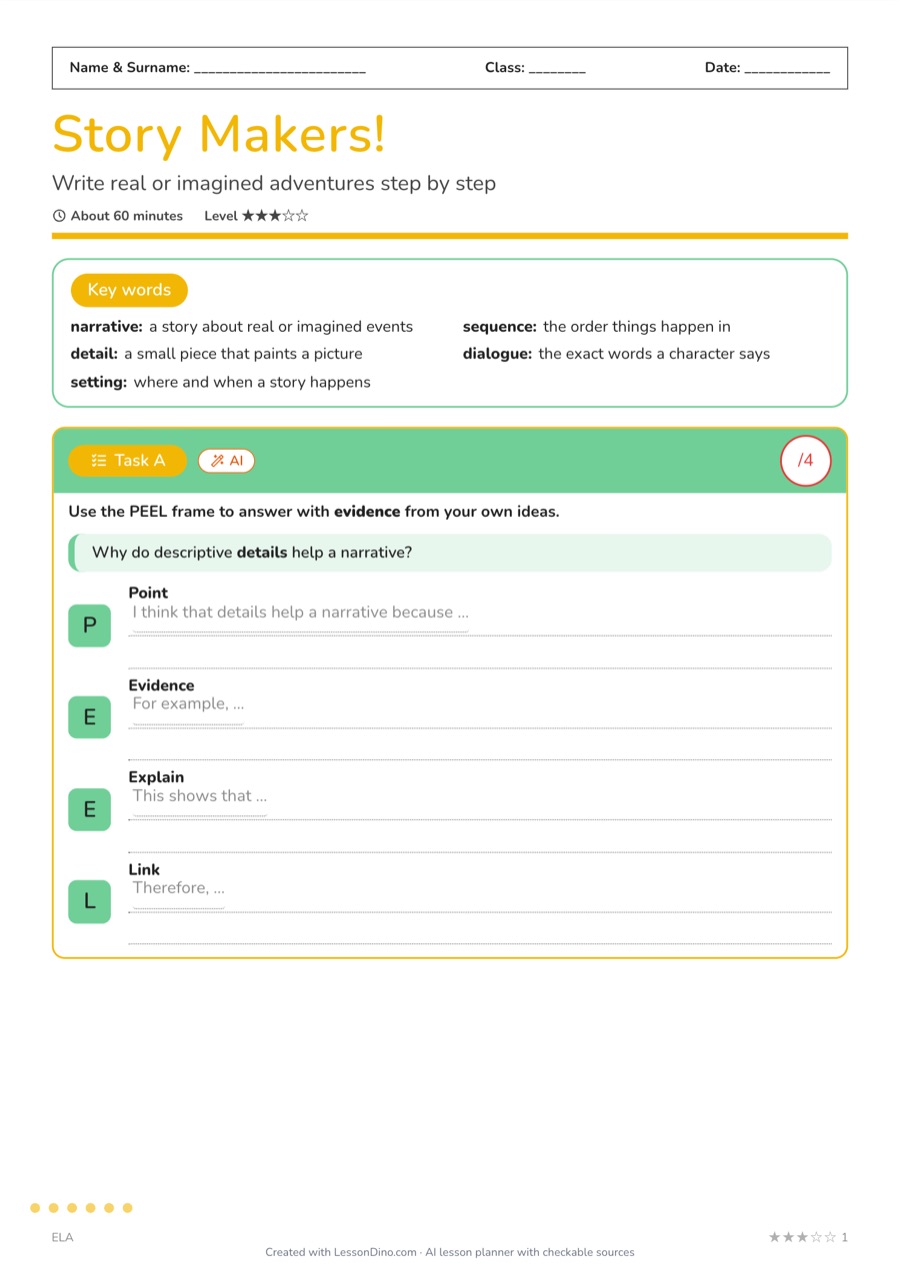
| sequence | the order things happen in, from first to last |
| detail | a small word that shows what you see, hear, or feel |
| technique | a smart way to tell a story, like using talking |
| dialogue | the exact words a person in a story says |
Timed plan (60 minutes)
| Time | Stage | What happens |
|---|---|---|
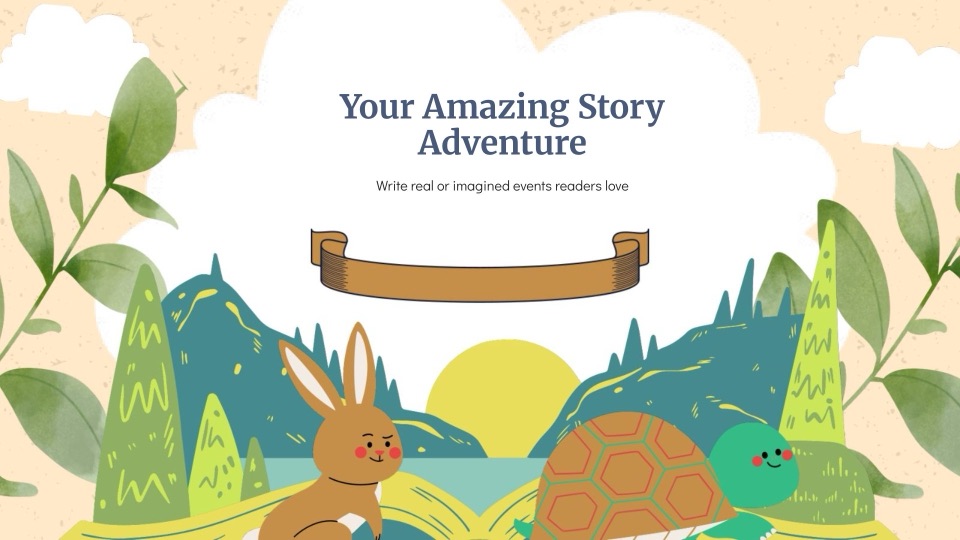
| 10 min | Starter | Activates past storytelling and hooks interest in putting events in order. Display the title Write real or imagined events readers love and read it together. Say the hook question about the wobbly lunch tray and ask for a vote. Ask the think, pair, share question Have you told a story about something real or make-believe? and time 60 seconds. Connect votes to goal: today we put real or imagined events in clear beginning, middle, and end order. |
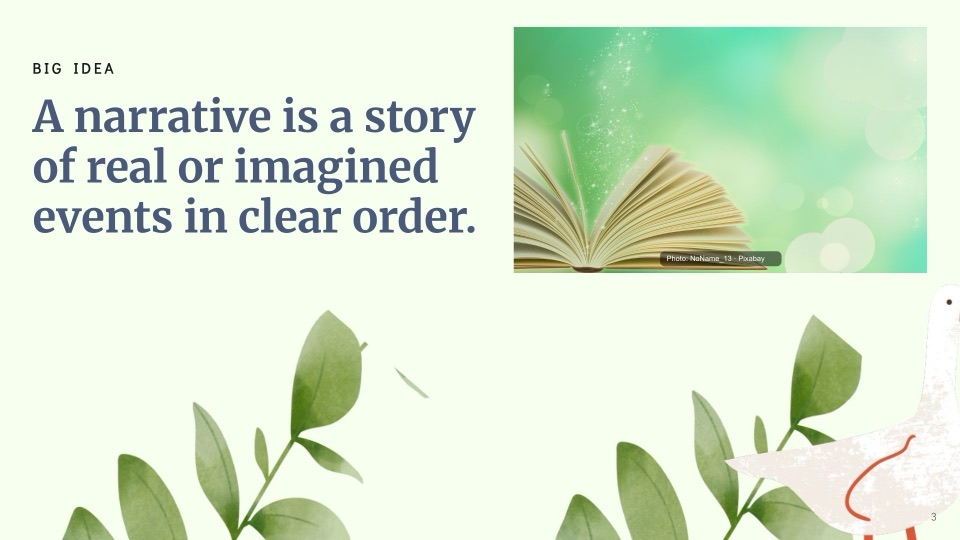
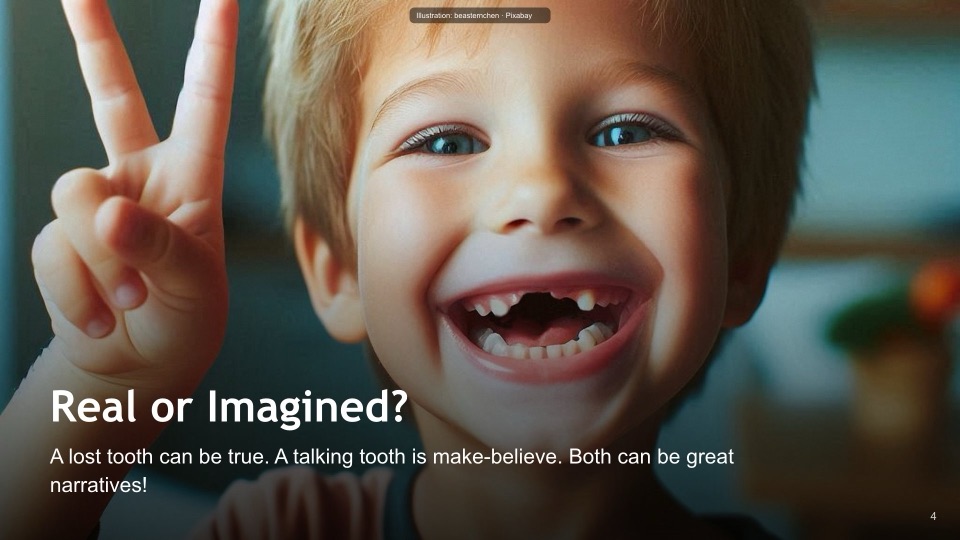
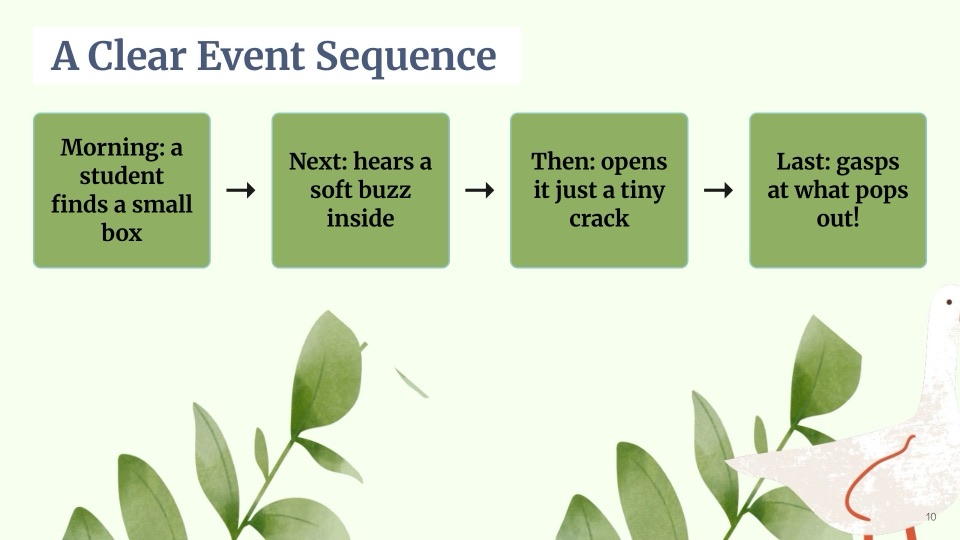
| 15 min | Teaching | Teaches narrative tools and models a clear event sequence. Share the big idea: A narrative is a story of real or imagined events in clear order. Show the photo example: A lost tooth can be true. A talking tooth is make-believe. Both can be great narratives! Play Video clip 3 and pause to name first, next, last words that connect events. Model the paper mountain with the box story while thinking aloud about talking and senses. |
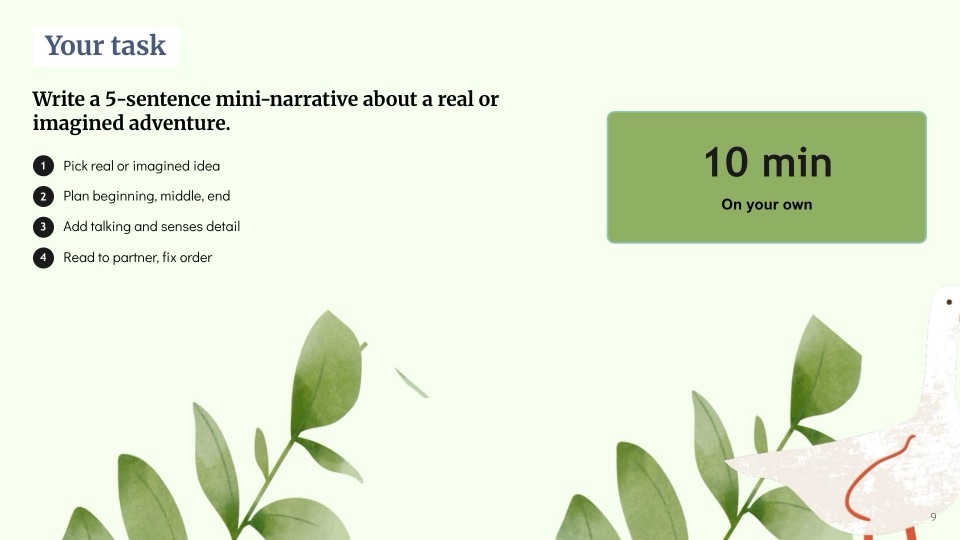
| 25 min | Main activity | Students plan and draft ordered narratives with technique and details. Give each student a long paper strip, crayons, and tape and model folding into three hills. Direct students to choose a real or imagined lunch-tray or box idea and draw or write one event per hill. Prompt adding one talking line in the middle and one see, hear, or feel word. Have partners point to each hill, retell in order, fix order, then write a 5-sentence mini-narrative. |
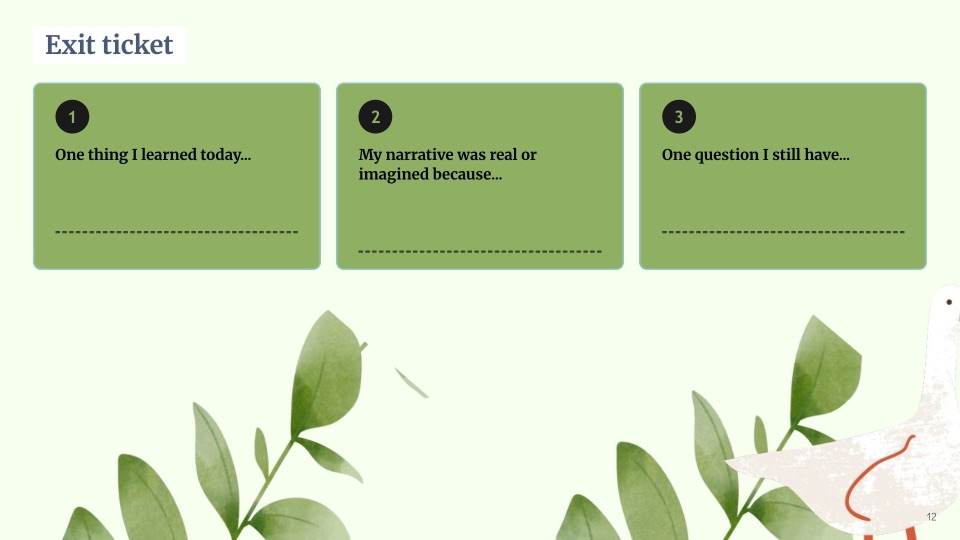
| 10 min | Plenary | Reviews order, technique, and details and checks exit understanding. Invite two pairs to read mini-narratives and have class name the beginning, middle, end. Lead a quick fix-up: move one mixed-up sentence back into order together. Guide exit ticket writing: One thing I learned today and My narrative was real or imagined because. Preview next writing: we will keep using talking and senses to entertain readers. |
Common mistakes
- Telling events out of order, like starting with the ending
How to spot it: Story uses last first, or reader cannot follow first, next, last
Point to each mountain hill and retell; move sentences to match the hills so progression is clear - Thinking a narrative must be true
How to spot it: Student says imagined ideas like a talking tooth cannot be a story
Remind that a narrative can be non-fictional or fictional events; sort real and imagined ideas both work - Telling instead of showing with no senses or talking
How to spot it: Writing says It was fun with no see, hear, feel words
Add one sense and one talking line; descriptive writing appeals to the senses and paints a picture
Support
- Give pre-drawn three-box strips with starters: First, Next, Last.
- Provide senses chart with eyes, ears, hands and word bank for see, hear, feel.
- Let partners tell it first, then write, using talk frames At first, Then, At the end.
Stretch
- Add one line of what a character said in the middle box to show action.
- Combine two senses in one sentence about the same object.
- Change one detail to turn a Real idea into an Imagined story idea.
Check questions
- Is your story real or imagined, and how do you know?
Answer: Real if it truly happened; imagined if I made it up. - Put these in order: opens box a crack, finds box, hears buzz.
Answer: Finds box first, hears buzz next, opens a crack last. - Make this showing: He was scared. Add talking or senses.
Answer: Example: His hands felt cold and he whispered, What was that buzz?
Curriculum
Write narratives to develop real or imagined experiences or events using effective technique, descriptive details, and clear event sequences.
Video clips
Clips on YouTube, from the start and end times we chose. Check each one before you show it.
-
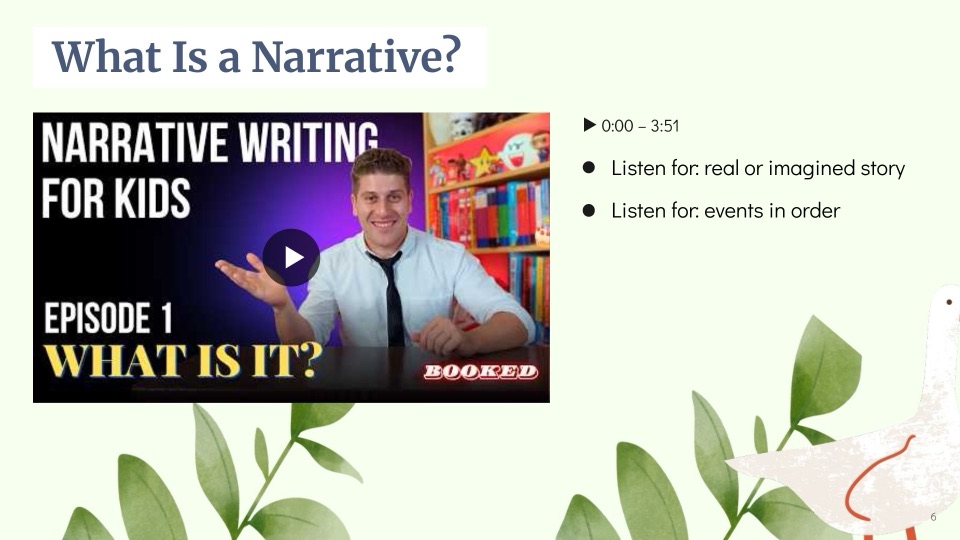
What is a narrative? from 0:00 to 3:51
BOOKED: What Is a Narrative? | Narrative Writing for Kids (Ep 1)
Clear kid-friendly intro to narratives as real or imagined stories, perfect vocabulary and pace for ages 8-9.
-
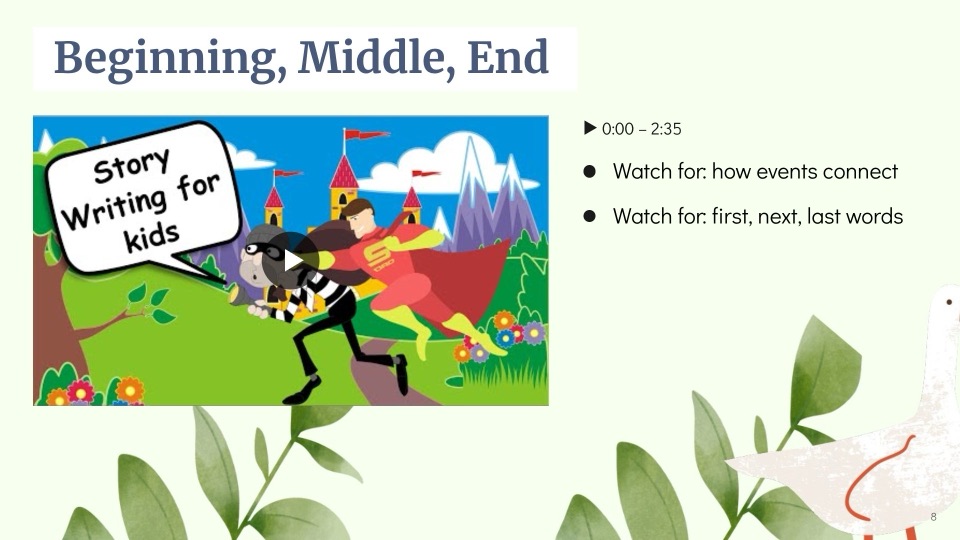
Beginning, middle, end from 0:00 to 2:35
The Evelyn Winters Adventure: Writing a story with beginning, middle, end - tutorial for kids
Teaches clear event sequence in simple language ideal for Grade 3 ages 8-9.
Worksheet
Sources
- How to Read the Standards thecorestandards.org
- LearnZillion EL Education Language Arts Correlation Guide Grade 3 ortn.edu
- Beginning Creative Writing - Harvard Division of Continuing ... coursebrowser.dce.harvard.edu
- Fundamentals in Creative Writing: The Grammar of Narrative creativewriting.uchicago.edu
- THE EFFECTS OF CREATIVE WRITING ACTIVITIES ON NARRATIVE TEXT ... files.eric.ed.gov
- Introduction - Creative Writing - LibGuides at Malone University libraryguides.malone.edu
- What is Creative Writing? | SNHU snhu.edu
- Narrative and Creative Writing for Nonfiction - eCornell ecornell.cornell.edu
- Writing Skills - Creative and narrative writing - BBC Bitesize bbc.co.uk
- Narrative - Wikipedia en.wikipedia.org
- Narrative - NSW Department of Education education.nsw.gov.au
- UNIVERSITY WRITING CENTER calbaptist.edu
- Modes of Writing - Eastern easternct.edu
Picture credits
- Photo: NoName_13 · Pixabay
- Illustration: beasternchen · Pixabay
- Photo: 12019 · Pixabay
- Pictograms: Sergio Palao, ARASAAC (arasaac.org) · CC BY-NC-SA
- Microsoft Fluent Emoji (MIT)
Made with Lesson Dino's AI on 16 October 2026. AI can make mistakes, so check facts against the sources before you teach.