Slides
Lesson plan
Trait Detectives: How Actions Move the Story
Students learn to name traits, feelings and wants with story proof. They hunt for clues in pairs and chain actions to events.
Objectives
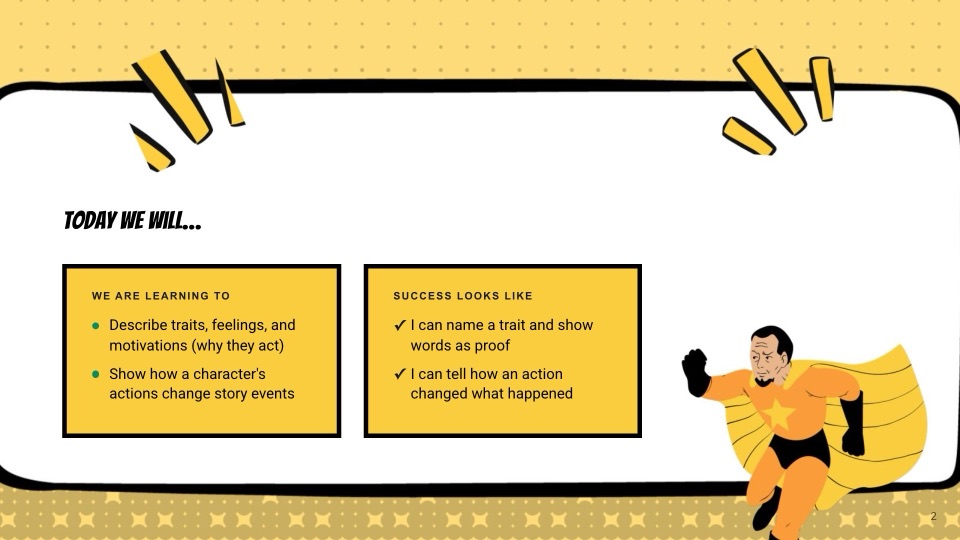
- Students will describe a trait with proof from thoughts, words, or actions.
- Students will explain a character's feelings and motivation for acting.
- Students will explain how character actions change the story events in order.
Success criteria
- I can name a trait and show words as proof.
- I can say why a character acts and what happens next.
- I can order actions to show how the story changes.
Key words
| Word | Meaning |
|---|---|
| character | a person or being in a made-up story |
| trait | how someone often behaves, like kind, brave, or patient |
| motivation | the reason why someone wants to do something |
| feeling | what is happening inside, like happy, scared, or proud |
| event | one thing that happens in a story |
Timed plan (60 minutes)
| Time | Stage | What happens |
|---|---|---|
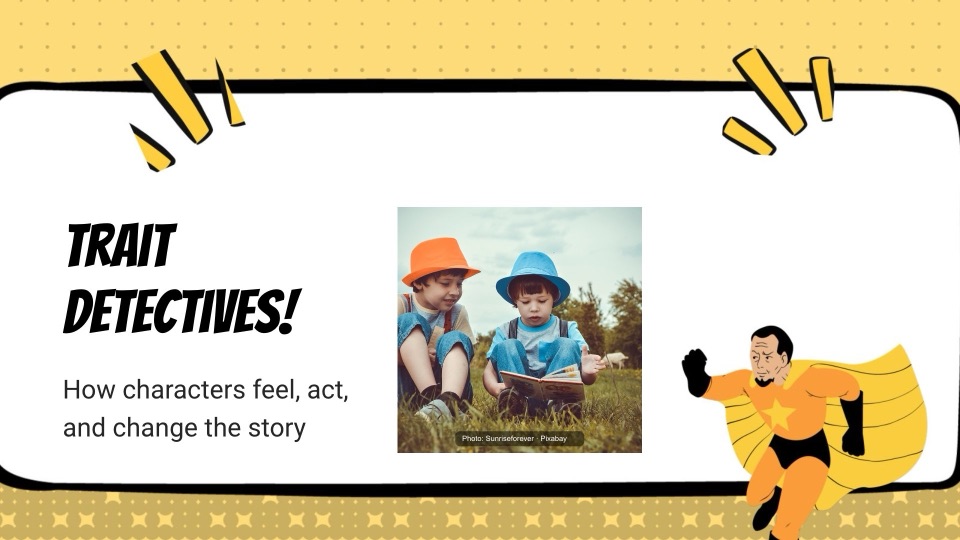
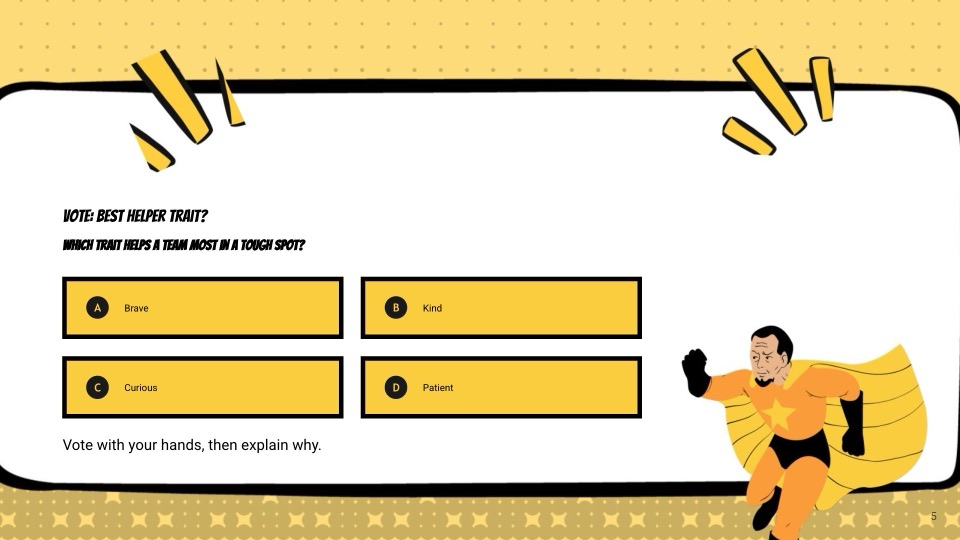
| 8 min | Starter | Hook students as detectives and recall what a character is like. Show Slide 1 and greet class as reading detectives with the hook line. Show Slide 5 vote and read the question and four choices aloud. Take a quick vote by show of hands for Brave, Kind, Curious, Patient. Link votes to lesson: today we prove traits with clues, not guesses. |
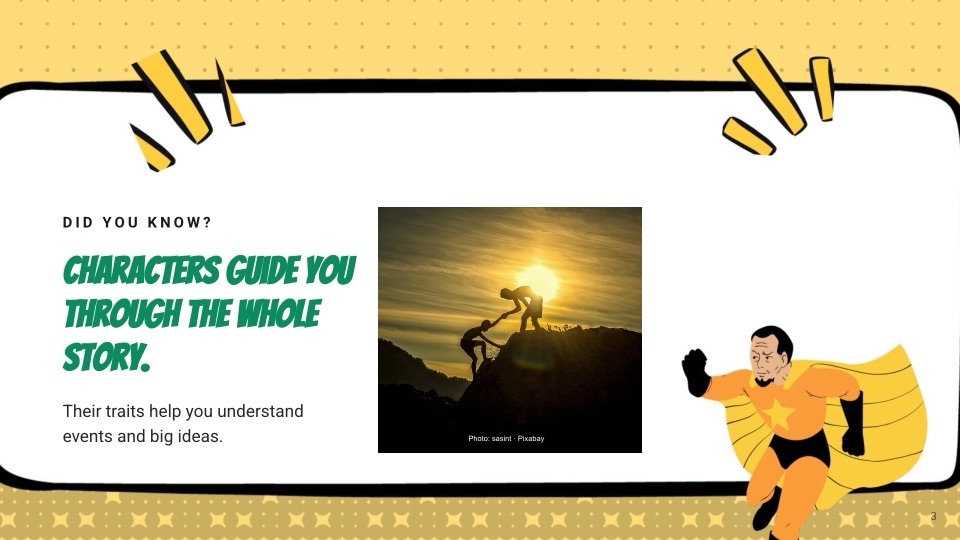
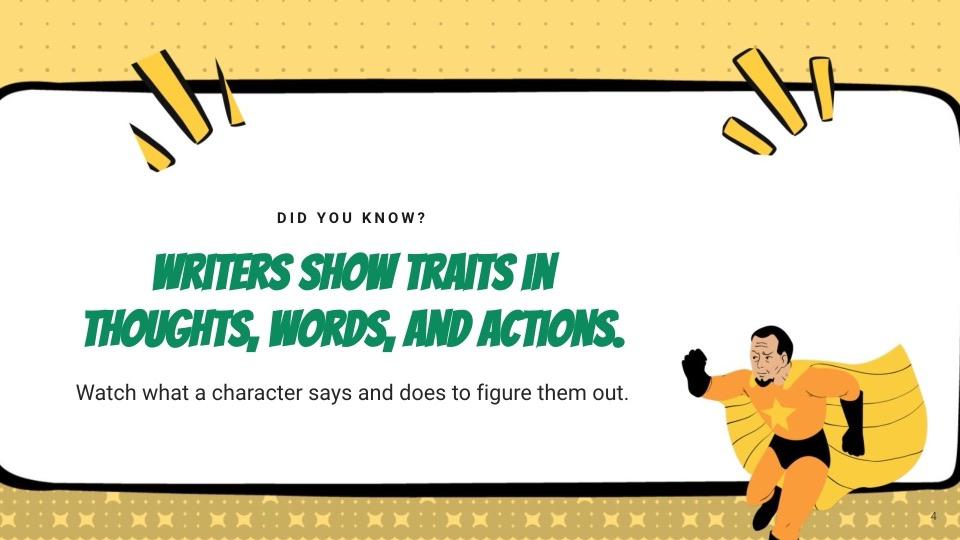
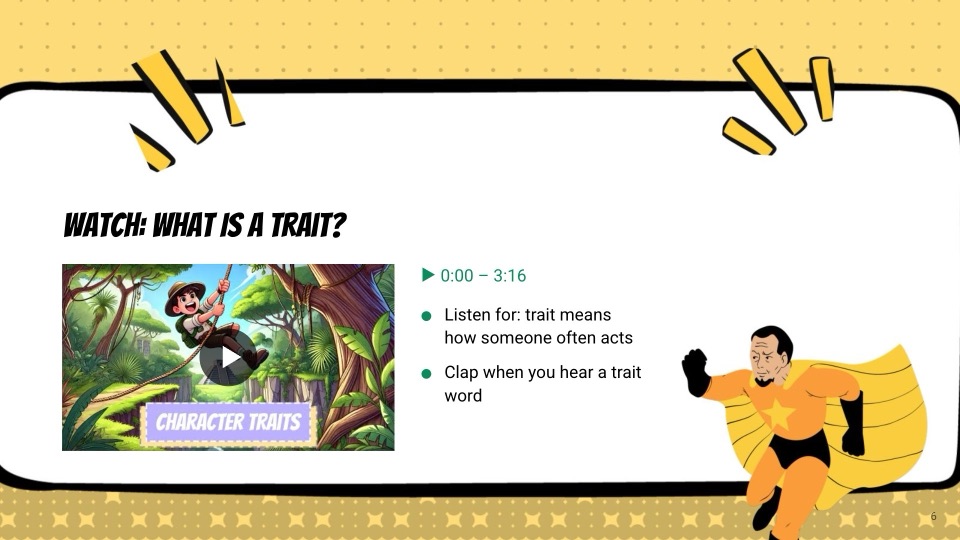
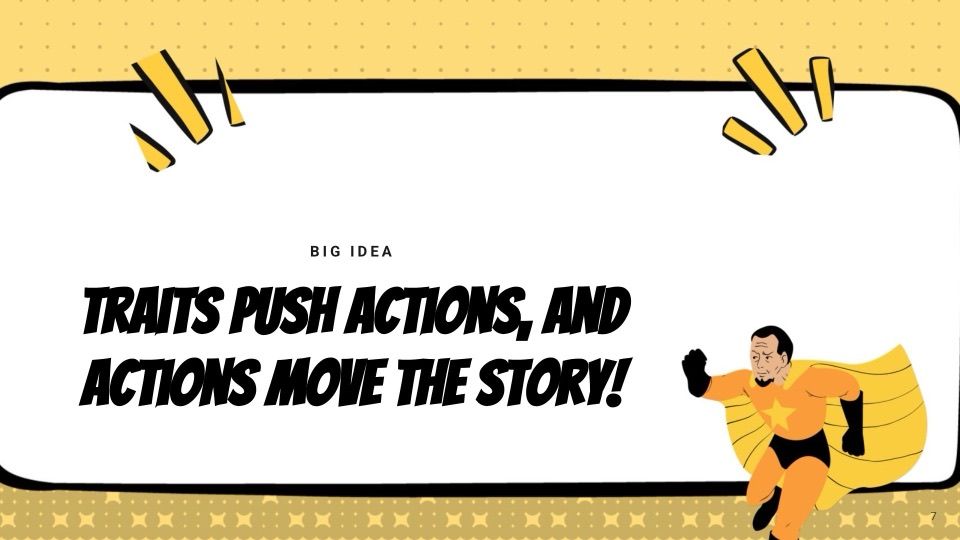
| 12 min | Teaching | Teach that traits show in thoughts, words, and actions and push story events. Show Slide 2 objectives, then Slide 3 and read both fact lines aloud. Show Slide 4 and explain readers describe personality traits from thoughts, words, and actions. Play Video clip 1 on Slide 6 and ask students to clap when they hear a trait word. Model one clue from paragraph 1 on chart paper and state Slide 7 big idea. |
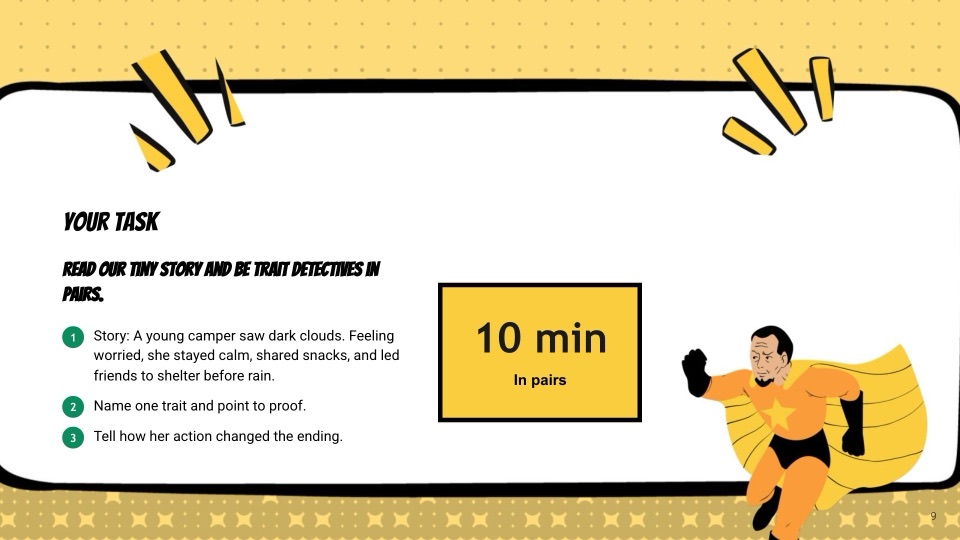
| 25 min | Main activity | Find traits with proof and link wants and actions to story events in order. Read The Lost Kite paragraphs 2 and 3 twice aloud while pairs follow on printed copies. Hand out sticky notes and trait word bank cards and remind pairs to hunt for 2 clues. Guide pairs to write trait plus proof on notes and place them first, next, then, last. Circulate to help pairs fill the chain frame: The character wants ___, so they ___, then ___. |
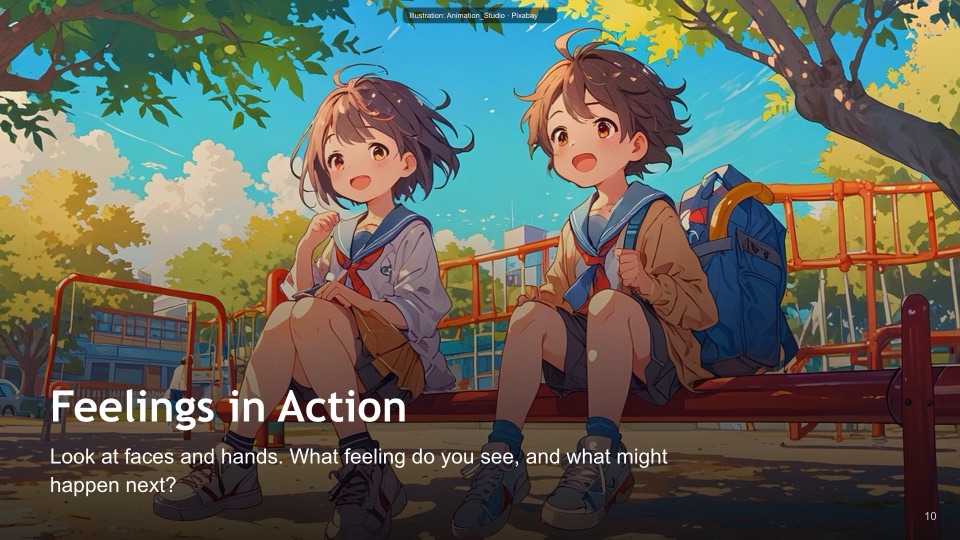
| 10 min | Share | Retell the ordered chain to show how actions cause story events. Invite 3 pairs to post their sticky notes in order on class chart paper. Model retell with first, next, then, last using their notes. Show Slide 10 photo and ask what feeling they see and what might happen next. Restate that describing this link shows how actions contribute to events. |
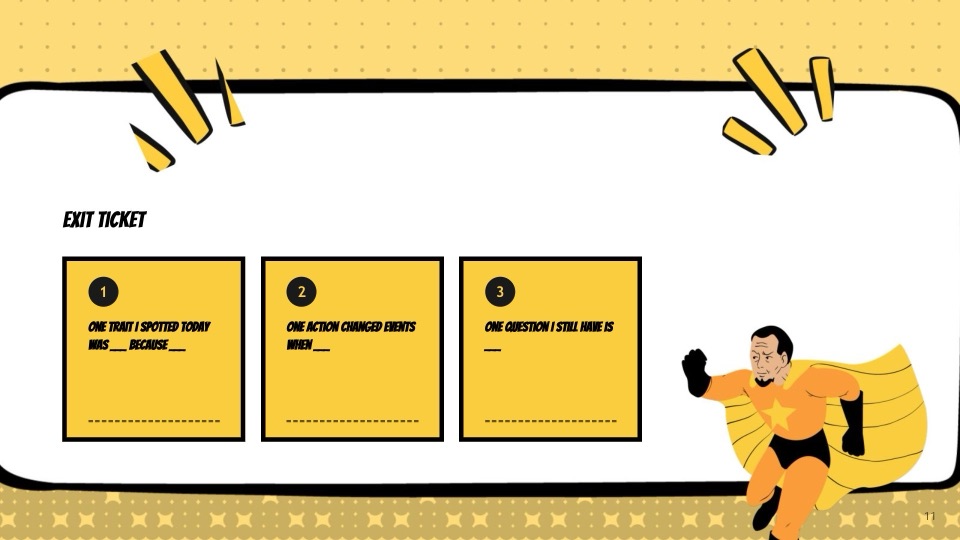
| 5 min | Plenary | Check each objective with a short exit ticket. Show Slide 11 exit ticket and read the three stems aloud. Give 3 minutes for students to write two short lines on paper. Collect papers while restating the big idea in one sentence. Preview next lesson: we will compare two characters. |
Common mistakes
- Calling a feeling in the moment a lasting trait, like sad means sad person
How to spot it: Sticky note says trait is sad with no often-behavior
Ask: Is sad how she often acts, or how she feels right now? Trait is brave or patient; sad is the feeling - Naming a trait with no story proof
How to spot it: Says she is kind but cannot point to words or action
Ask: What did she say, think, or do that shows it? Point to the exact words - Retelling events out of order or missing cause
How to spot it: Says she smiled, then built kite, with no link
Reorder with first, next, then, last and add so / then to show action changed events
Support
- Give a bank of 8 traits with pictures and the frame, The character is ___ because ___.
Stretch
- Find a second action by the same character that shows a different trait and explain which matters more.
Check questions
- One trait I spotted today was ___ because ___?
Answer: Patient because she spent all week making a big blue kite; brave because she took a deep breath and reached with help - One action changed story events when ___?
Answer: She stayed brave and reached with help, so the race kept going and she finished smiling - Why did the student keep trying instead of quitting?
Answer: Her friend said, "Try again." She wanted to finish the race, and she stayed brave and patient.
Curriculum
Describe characters in a story (e.g., their traits, motivations, or feelings) and explain how their actions contribute to the sequence of events
Video clips
Clips on YouTube, from the start and end times we chose. Check each one before you show it.
-
traits shape a story song from 0:00 to 3:16
Learning Through Lyrics: Character Traits in Stories Song for Kids | Learn How Traits Shape a Story
Directly about character traits in stories and how they shape events, with song pace and vocabulary perfect for 8-9-year-olds.
-
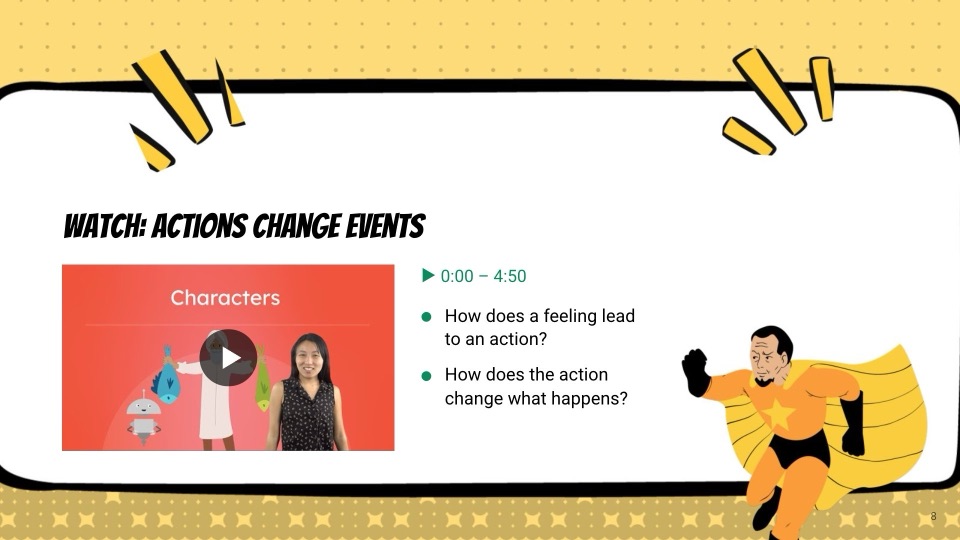
how traits shape a story from 0:00 to 4:50
Miacademy & MiaPrep Learning Channel: Characters - How Their Traits Shape a Story
Shows how traits, motivations and feelings lead to actions and events, at the right level for 8-9-year-olds.
Worksheet
Sources
- LearnZillion EL Education Language Arts Correlation Guide Grade 3 ortn.edu
- 3rd Grade ELA – Reading Curriculum boepublic.parkhill.k12.mo.us
- Character (arts) - Wikipedia en.m.wikipedia.org
- Character Traits boost.org
- CORE CHARACTER TRAITS FOR FAMILY MEDICINE | Annals of Family Med… annfammed.org
- Character Traits and Similes | OER Commons oercommons.org
- Code of West teaches students character traits | Cowboys & Kids reachkids.com
- CHARACTER Definition & Meaning - Merriam-Webster merriam-webster.com
- List of Unicode characters - Wikipedia en.m.wikipedia.org
- character - Wiktionary, the free dictionary en.m.wiktionary.org
- Scooby-Doo (character) en.wikipedia.org
Picture credits
- Photo: Sunriseforever · Pixabay
- Photo: sasint · Pixabay
- Illustration: Animation_Studio · Pixabay
- Pictograms: Sergio Palao, ARASAAC (arasaac.org) · CC BY-NC-SA
- Illustration: Mohamed_hassan · Pixabay
Made with Lesson Dino's AI on 16 October 2026. AI can make mistakes, so check facts against the sources before you teach.