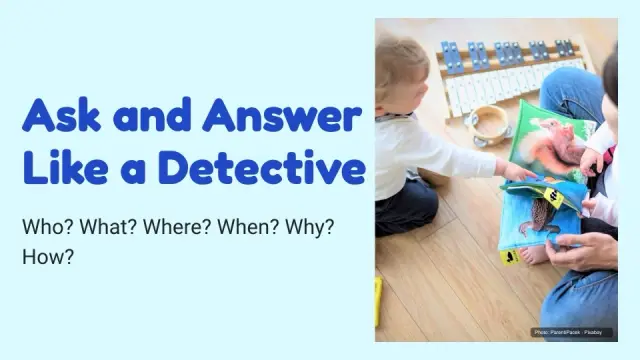
Slides

Lesson plan
Prefix Power: un- Means Not, re- Means Again
Students learn that un- means not and re- means again. They build unhappy, retell, reread and redo with cards and tell the new meanings.
Objectives
- Students will tell the meaning of unhappy when un- is added to happy.
- Students will build and explain retell, reread, and redo with re- meaning again.
Success criteria
- I can say unhappy means not happy.
- I can say retell, reread, and redo mean doing it again.
Key words
| Word | Meaning |
|---|---|
| prefix | tiny part put at the start of a word that makes a new meaning |
| un- | starting part that means not |
| re- | starting part that means one more time |
| unhappy | not glad, not happy |
| retell | say a story one more time |
Timed plan (60 minutes)
| Time | Stage | What happens |
|---|---|---|
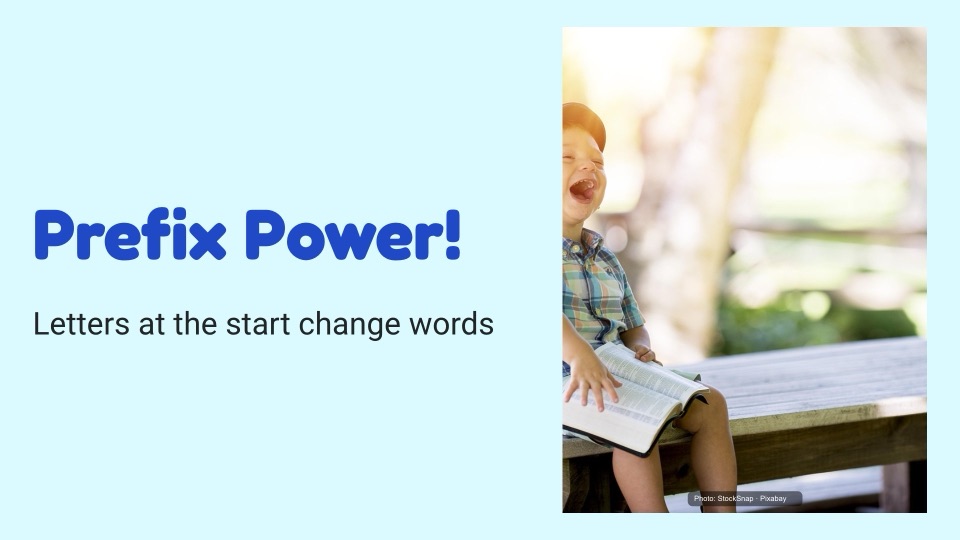
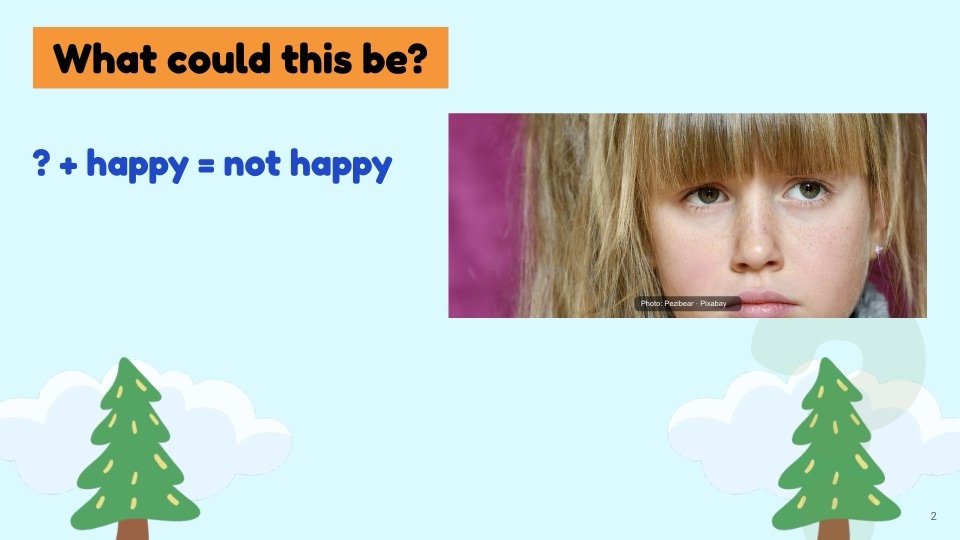
| 8 min | Starter | Hook interest and show that letters at the start can make a new word meaning. Show Slide 1: Prefix Power! Letters at the start change words and read the title together. Hold up the re card and the do card apart and say the hook, then push them together to make redo. Show Slide 2 mystery: ? + happy = not happy, unhappy, and point out un- at the start means not. Ask partners to say what changed from happy to unhappy and from do to redo. |
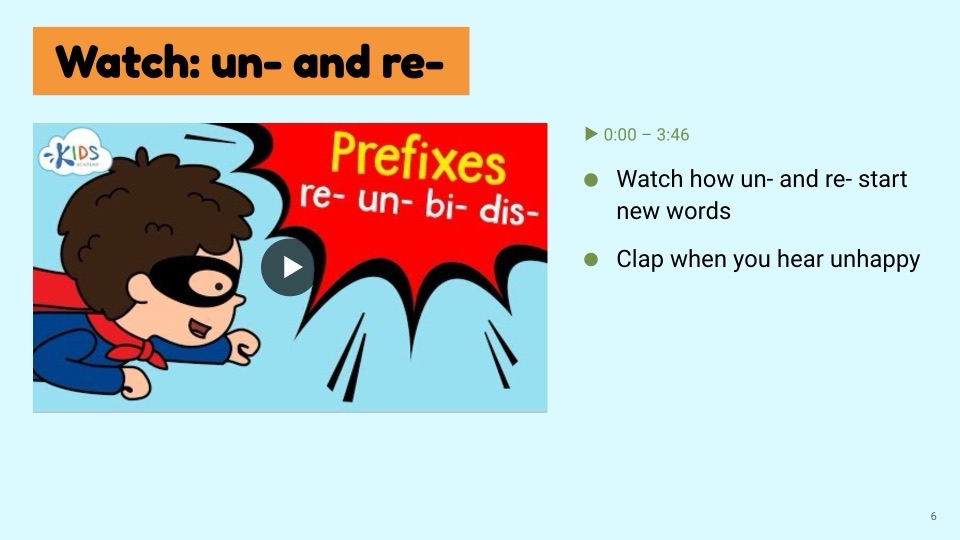
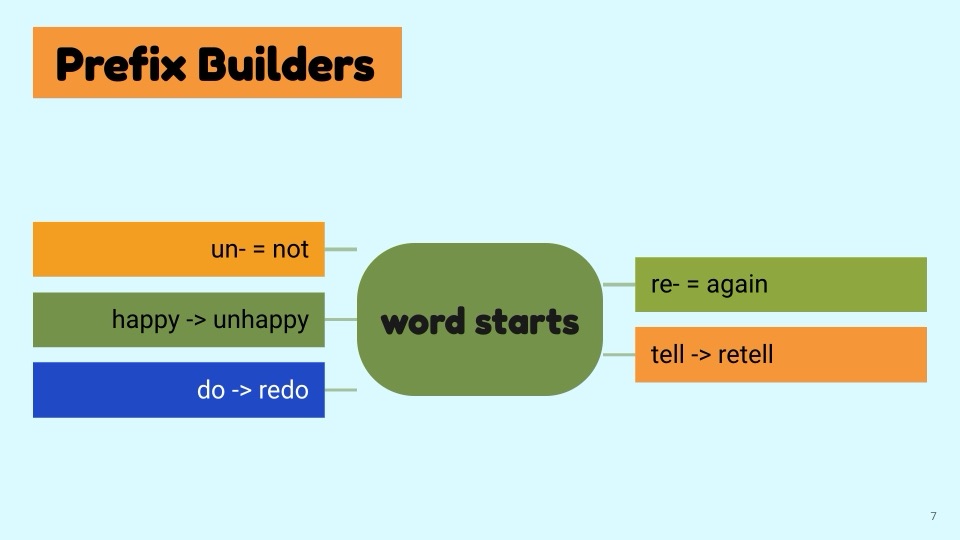
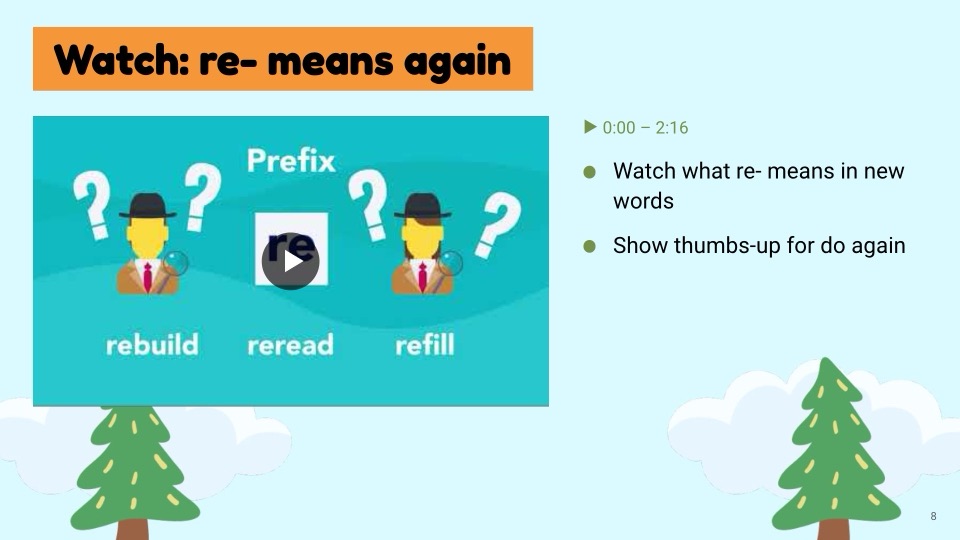
| 12 min | Teaching | Model how un- means not and re- means again with known words. Show Slide 3 fact: re- means again, Retell means to tell a story again, and model tell to retell. Show Slide 4 photo and tell a 2-sentence tale, then have the class retell it together. Play Video clip 1 on Slide 6 about un- and re- and have students clap when they hear unhappy. Build Slide 7 mindmap together: un- = not with happy to unhappy, re- = again with tell to retell and do to redo. |
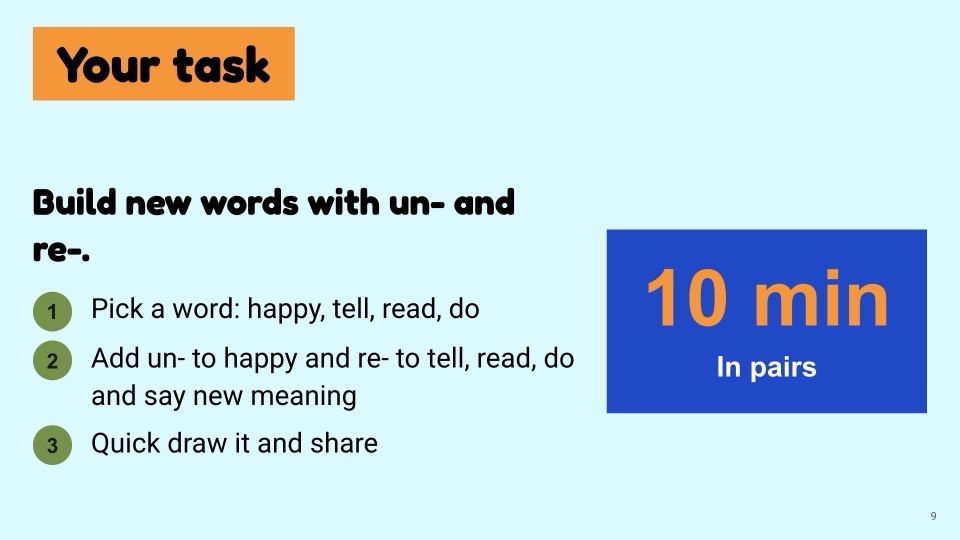
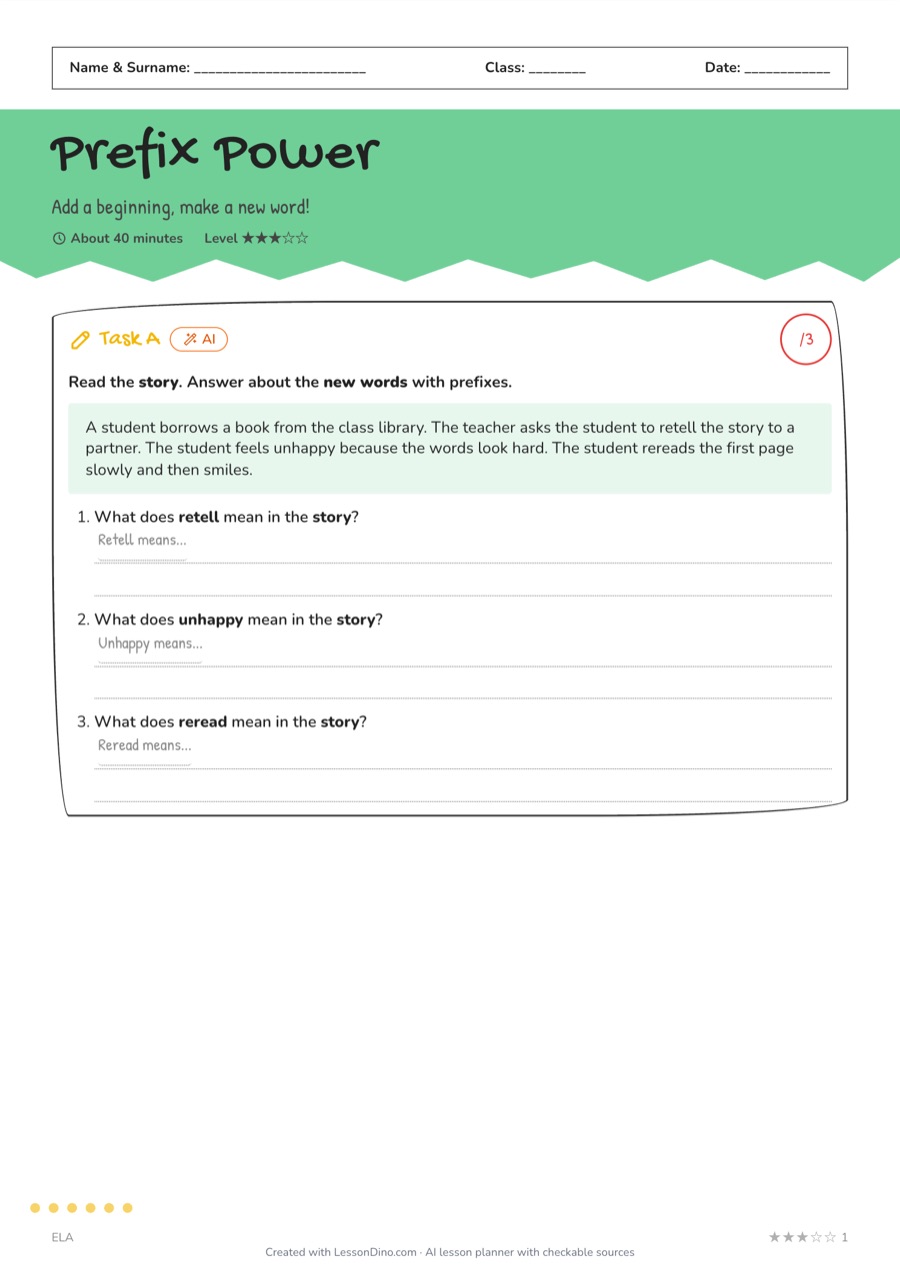
| 20 min | Main activity | Build new words with prefixes and tell the new meanings. Show Slide 9 task: pick happy, tell, read, do, add un- to happy and re- to tell, read, do, say the new meaning and quick draw it. Hand out re- and un- prefix cards and base cards for do, read, tell, write and happy and model matching re- + read = reread. Have groups build redo, reread, retell, rewrite and unhappy, then say the again or not meaning for each match. Hand out Worksheet Task D and guide students to follow the steps to make a new word and tick the box when done. |
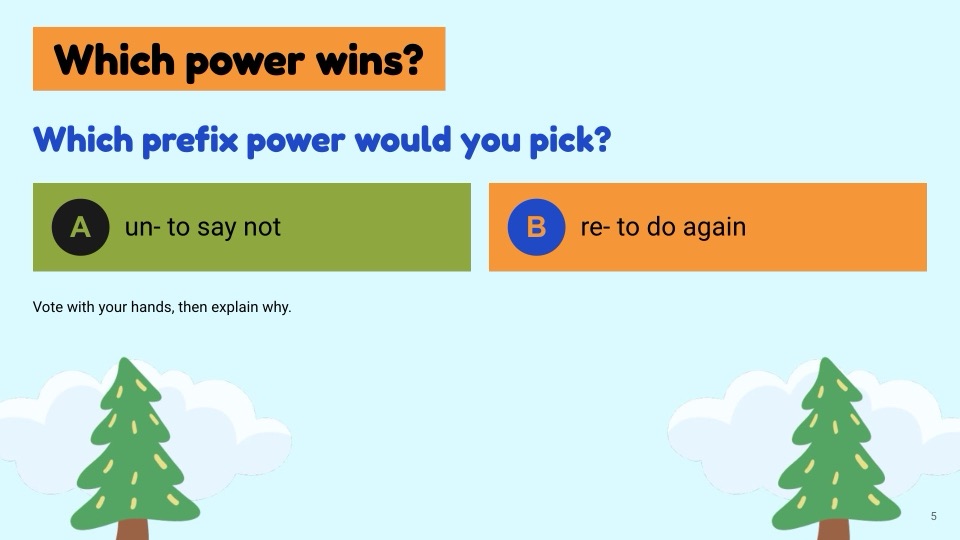
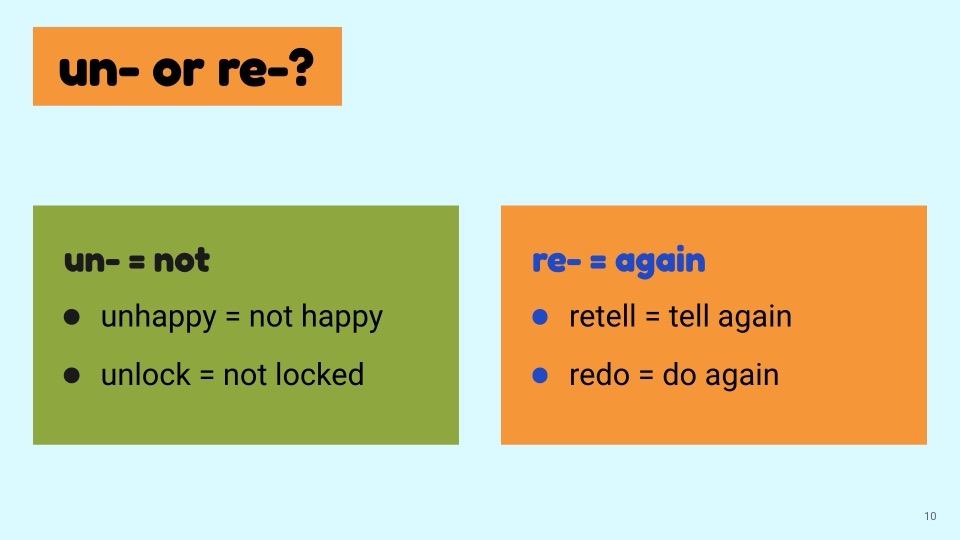
| 12 min | Practice | Sort and read prefix words by what the prefix does to the meaning. Show Slide 10 compare: un- = not with unhappy = not happy and unlock = not locked, re- = again with retell = tell again and redo = do again. Hand out Worksheet Task E and read each word first together: unhappy, unlock, retell, redo, reread. Have students sort the words into un- and re- columns on their own. Ask students to whisper each new meaning as they sort, like unlock means not locked. |
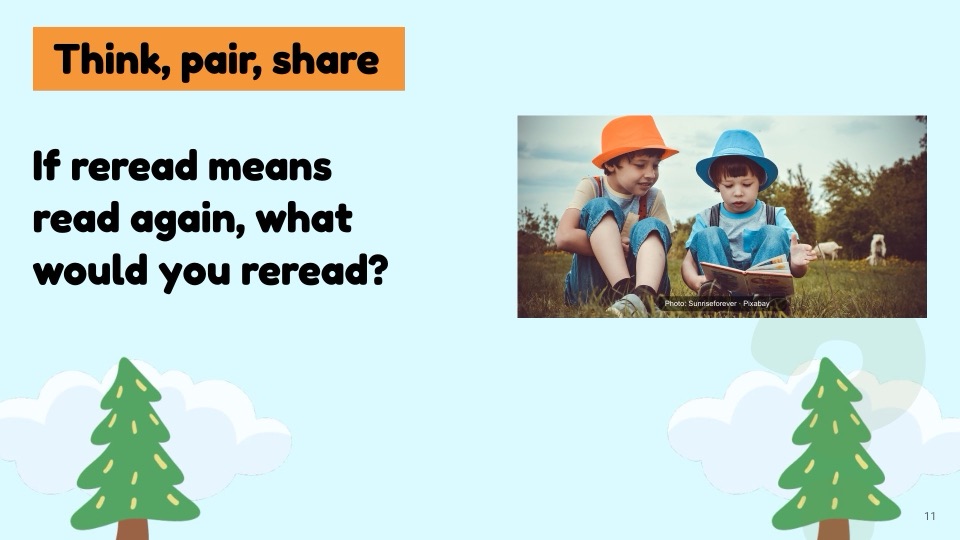
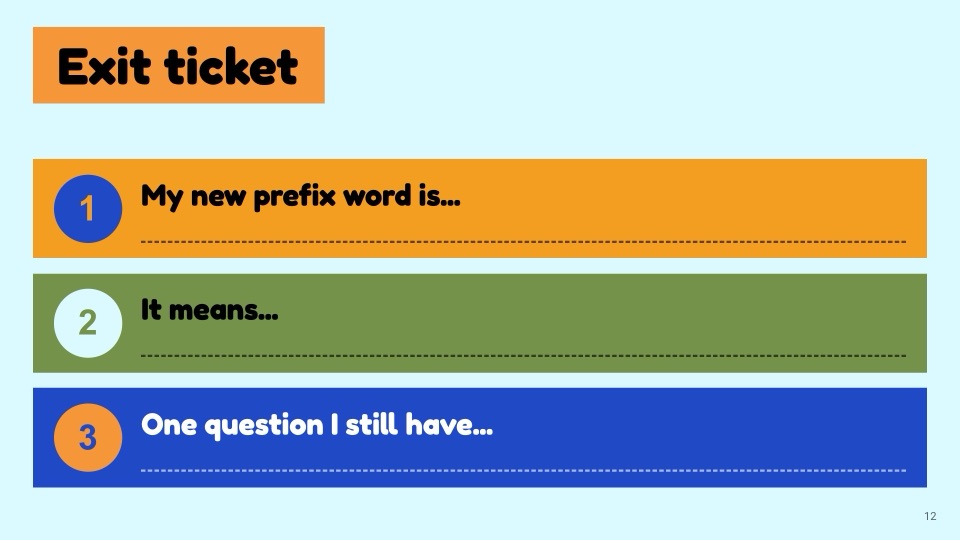
| 8 min | Plenary | Check that students can tell the meaning of prefix words with un- and re-. Show Slide 11 question: If reread means read again, what would you reread, and take two partner shares. Review Slide 10 meanings once more with choral responses for unhappy, retell, redo. Show Slide 12 exit ticket: My new prefix word is, It means, One question I still have, and have students write or say it. |
Common mistakes
- Thinking the base word spelling changes when the prefix is added
How to spot it: Student writes unhapy or retel with missing letters
Show side by side and remind that the spelling of the base word typically stays the same when a prefix is added; just push parts together - Mixing up un- means not and re- means again
How to spot it: Student says unhappy means happy again or redo means not do
Point to signs and sort again: un- usually means not and re- means again, then rebuild unhappy and redo - Reading only the base word and ignoring the prefix
How to spot it: Student reads retell as tell and answers about first telling
Cover and uncover: read base, then add prefix, because a prefix is added to the start and changes the meaning
Support
- Limit choices to two base cards at a time so students can focus on joining and reading the words
- Give a word bank with pictures for happy, tell, read, and do so students only work on the prefix part
- Keep re- = again and un- = not charts visible with picture examples for quick checks
Stretch
- Students mix re- words back into base words and explain both meanings to a partner
- Students use the new un- or re- word in a spoken sentence and check the meaning still fits
- Students call out a new pre-taught word like unlock or rewrite for the class to break apart and define
Check questions
- What does unhappy mean, and what does un- mean?
Answer: Unhappy means not happy; un- means not. - What does retell mean, and what does re- mean?
Answer: Retell means tell again; re- means again. - Build redo from parts and tell its meaning.
Answer: re- + do = redo, which means do again.
Curriculum
Determine the meaning of the new word formed when a known prefix is added to a known word (e.g., happy/unhappy, tell/retell).
Video clips
Clips on YouTube, from the start and end times we chose. Check each one before you show it.
-
re-, un-, bi-, dis- for 2nd grade from 0:00 to 3:46
Kids Academy: Prefixes "re", "un", "bi", "dis" | English Grammar for 2nd Grade | ELA lessons | Kids Academy
Made explicitly for 2nd grade ages 7-8 and models how adding re- and un- changes known words.
-
re- prefix grades 2-3 from 0:00 to 2:16
Distance Learning - FCPS: Prefixes "Re" - Language Arts, Word Study, Grades 2 - 3
Made for grades 2-3 ages 7-8 and focuses on re- meaning again like tell/retell.
Worksheet
Sources
- English Language Arts Standards | Common Core State Standards ... thecorestandards.org
- ELA Grade 2 - Chicago Public Schools cps.edu
- 2.5 Prefixes and Suffixes – Say It Well: Writing for Real ... pressbooks.lib.vt.edu
- 3.4 Prefixes and Suffixes – Supplemental Handbook Material ... open.lib.umn.edu
- PREFIXES - Idaho State University isu.edu
- 4.4 Prefixes and Suffixes – Writing for Success opened.tesu.edu
- Roots, Prefixes and Suffixes – Biosciences for Health ... pressbooks.cuny.edu
- English | English Grammar for Second Language Learners courses.dcs.wisc.edu
- What are prefixes? - BBC Bitesize bbc.co.uk
- Prefixes for Kids - ClassX classx.org
- Prefixes for Kids – ClassX dev.classx.org
- Prefixes in English | What are Prefixes? | ESL Kids World eslkidsworld.com
- What Are Prefixes and Suffixes? – Explained for Kids smartonlinegames.com
- Prefixes for Kids with Activities & Printable Lists | ABCmouse abcmouse.com
- Prefixes Facts & Worksheets | Examples & Definition For Kids kidskonnect.com
- Prefixes and Suffixes: A Complete Grammar Guide for Kids planetspark.in
- Prefixes and Suffixes List: Meanings and Examples (K-5) whatihavelearnedteaching.com
- Prefixes and Suffixes Teaching Resources - Teach Starter teachstarter.com
- The Complete Guide to Teaching Prefixes and Suffixes teachingwithamountainview.com
- Prefixes | Lesson Plan | Education.com education.com
- Prefixes And Suffixes Worksheets With Answers (Free Printable ... atozworksheet.com
- United States country code, United States telephone prefixes phonesunknown.com
- Common Prefixes: Lesson for Kids - Study.com study.com
- 80 Examples of Prefixes and Suffixes - Online Lesson articulate.strayer.edu
- Prefixes: A Huge List of Prefix with Meaning and Examples ... articulate.strayer.edu
Picture credits
- Photo: StockSnap · Pixabay
- Photo: Pezibear · Pixabay
- Illustration: Vilkasss · Pixabay
- Photo: Sunriseforever · Pixabay
- Illustration: Elf-Moondance · Pixabay
- Microsoft Fluent Emoji (MIT)
- Pictograms: Sergio Palao, ARASAAC (arasaac.org) · CC BY-NC-SA
Made with Lesson Dino's AI on 17 October 2026. AI can make mistakes, so check facts against the sources before you teach.